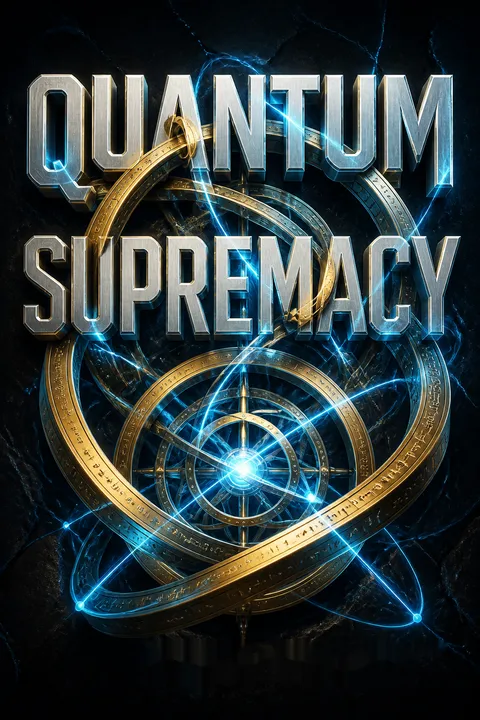


Key Takeaways
Treat quantum supremacy as a benchmark, not a new everyday computer.
A narrow victory. Quantum supremacy means that a quantum computer outperforms the best classical computer on a particular task. In 2019, Google reported that its Sycamore processor completed a benchmark calculation in about 200 seconds, compared with an estimated 10,000 years for a classical supercomputer. The result showed a striking capability, but it did not mean the machine could run ordinary software faster or solve useful business problems on demand.
Potential is not deployment. The book presents that milestone as a signal of a technological shift, while noting that practical, dependable machines remain difficult to build. Claims of supremacy depend on the chosen task and on estimates of what classical computers can accomplish. The meaningful question is not simply which machine wins a benchmark, but whether quantum methods help with a problem people actually need solved.
The distinction between a laboratory benchmark and an economically valuable capability is essential in any emerging technology. A record-setting aircraft flight does not establish a reliable airline, and a quantum benchmark does not establish a useful general-purpose computer. The comparison with earlier technology revolutions captures the scale of possibility, but also invites caution: first demonstrations often precede decades of engineering. The strongest reading is neither dismissive nor breathless. The benchmark establishes that the physical idea works in a defined setting, while practical value remains a separate proposition requiring evidence.
Use quantum computers where the problem itself is quantum.
A better match. A classical bit represents either zero or one. A qubit, or quantum bit, is a quantum system that can be prepared in a combination of those states. Multiple qubits can also become entangled, meaning their states are linked in ways with no classical equivalent. Together, these properties let a quantum computer represent some complex quantum systems more naturally than a conventional machine.
Not parallel brute force. Richard Feynman argued that simulating nature may require a computer built from quantum principles, because molecules themselves obey quantum mechanics. The book points to chemistry as the clearest target: predicting how electrons interact in a molecule can overwhelm classical computation. Quantum computers do not simply inspect every possible answer and reveal the right one. Algorithms must make the possibilities interfere so useful results become more likely when measured.
The important idea is representation, not magic speed. A map is most useful when its geometry fits the terrain, and a quantum device may represent quantum molecular behavior with less computational overhead than a classical simulation. That advantage is specific to certain tasks, not a general license to expect acceleration everywhere. The common image of a quantum machine trying every route simultaneously can obscure the hard part: designing an algorithm that steers interference toward a useful answer. The conceptual match is powerful, but it does not remove the need for mathematical and experimental validation.
Count reliable logical qubits, not impressive raw qubit totals.
Fragile information. Quantum states are easily disturbed by heat, vibration, and other interactions with the environment. This loss of a controlled quantum state is called decoherence, and it can corrupt a calculation before it finishes. Superconducting machines therefore operate at temperatures close to absolute zero. Ion traps can preserve coherence longer, while photonic systems can avoid some environmental noise but face different challenges in scaling and programming.
Errors cost qubits. A machine's advertised qubit count does not reveal how many dependable calculations it can perform. Error correction uses extra qubits to detect and repair faults, adding substantial overhead. The book cites estimates that hundreds or even about a thousand physical qubits might be needed to protect one useful logical qubit. The competing designs are not just a race to add qubits. They are different attempts to control errors, maintain coherence, and build a system large enough to do useful work.
This is a useful corrective to the instinct to rank technology by one headline number. The same principle appears in data science, where volume is not the same as quality, and in engineering, where a component's performance matters only inside a reliable system. Quantum hardware must coordinate preparation, operations, error correction, and measurement. A larger processor can still be less useful if its errors overwhelm its calculations. Comparing platforms therefore requires attention to the quality and duration of operations, not just the number of physical qubits on a chip.
Treat silicon's ceiling as pressure to diversify, not proof it is finished.
Shrinking has limits. For decades, chipmakers increased computing power by fitting more transistors onto silicon. The book explains that as components approach atomic dimensions, electrons can leak between circuits and generate heat, undermining the old pattern of steady miniaturization. This is the physical pressure behind predictions that Moore's law, the historical trend of rapidly increasing chip density, will slow.
A different tool, not a total replacement. Quantum computers use quantum states rather than ordinary on-off bits, but they do not make silicon irrelevant. Several designs still rely on semiconductor manufacturing, and quantum machines need conventional computers to control hardware and process results. The likely shift described by the book is toward specialized machines that complement classical computing, especially for simulation and optimization, rather than a sudden swap of every laptop and server for a quantum device.
The history of computing in the book is a story of transitions, from gears and relays to vacuum tubes, transistors, and chips. Each transition changes what is feasible without erasing every older tool. That pattern makes the end-of-silicon claim more compelling as a warning about physical limits than as a timetable for silicon's disappearance. Computing ecosystems are usually layered: new hardware takes on particular workloads while established systems remain useful elsewhere. The practical question is which tasks justify the cost and complexity of a quantum processor.
Target chemical bottlenecks where trial-and-error burns time and energy.
A planetary-scale reaction. The Haber-Bosch process turns nitrogen from the air into ammonia for fertilizer, helping sustain modern food production. The book estimates that it consumes about 2 percent of the world's energy. Bacteria perform nitrogen fixation at ordinary temperatures, using the enzyme nitrogenase, but scientists still do not fully understand how this intricate molecular process works. Quantum simulation might help identify more efficient catalysts or alternative ways to make ammonia.
Storage is chemistry, too. Batteries are another bottleneck. Solar and wind power are intermittent, so a cleaner energy system needs affordable ways to store electricity. Finding better battery materials has traditionally involved testing many chemical combinations in laboratories. Quantum computers could model some reactions before those experiments are attempted. The larger lesson is to aim quantum tools at chemistry that is costly to explore through physical trial and error, not at every problem with a large dataset.
The fertilizer and battery examples show how a difficult molecular calculation can connect to public concerns that seem far removed from physics: food security, energy prices, and emissions. They also reveal a useful chain of reasoning. Better simulation could narrow the field of candidate materials, but it would not automatically create a factory-ready catalyst or battery. Laboratory testing, supply chains, cost, safety, and adoption remain decisive. The machine's contribution is most credible as an accelerator of discovery, not as a substitute for the institutions and infrastructure that turn discovery into widespread benefit.
See quantum medicine as molecular prediction, not an instant cure.
A genome is only a start. Sequencing the human genome produced a catalogue of genetic material, but identifying a gene does not fully explain how it affects cells or causes disease. Proteins carry out much of the body's work, and their shape affects how they behave. The book presents quantum computers as possible tools for modeling molecular interactions that classical computers must simplify or approximate.
Maps are not treatments. Artificial intelligence has already helped predict protein structures. The book cites AlphaFold's predictions for hundreds of thousands of proteins, including those in the human genome. But a predicted structure does not by itself explain every function, interaction, or disease mechanism. Quantum simulation could add detail to molecular research, potentially aiding drug discovery and studies of cancer or misfolded proteins. Each candidate therapy would still need to pass biological experiments and clinical testing.
The distinction between describing a biological object and understanding its role is a recurring challenge in science. A protein structure is like a map of a tool: useful, but not a complete account of how it works under changing conditions or alongside other tools. This makes the partnership between machine learning and molecular simulation plausible, while discouraging claims that a better model immediately yields a cure. Medicine has a long translation pathway from explanation to safe treatment. Computational insight can make that pathway more focused, but cannot erase its biological uncertainty.
Prepare encryption for quantum attacks before the machines mature.
Some locks are vulnerable. Much online security relies on mathematical problems that are easy to solve in one direction and difficult to reverse. RSA encryption, for example, relies on the difficulty of factoring very large numbers. Peter Shor showed that a sufficiently capable quantum computer could factor such numbers far more efficiently, threatening systems that depend on this kind of public-key cryptography.
The risk has a long lead time. The book argues that governments and companies should prepare before a powerful machine exists, because replacing security infrastructure takes time. It discusses more resistant mathematical schemes and quantum key distribution, a method that uses quantum states to help detect interception of encryption keys. This does not mean every password, message, or encrypted file becomes instantly readable. The threat depends on the cryptographic method, the machine's capabilities, and whether organizations migrate their systems in time.
Cybersecurity has a distinctive time problem: information stolen today can remain sensitive long after the theft, and infrastructure changes slowly. That makes preparation rational even when the exact arrival date of a threat is uncertain. The book's alarm is most useful when focused on cryptographic systems that rely on problems quantum algorithms can attack, rather than a blanket claim that quantum machines break all security. Security also depends on implementation, software updates, and human behavior. A stronger algorithm cannot protect an organization that never deploys it correctly.
Pair AI's pattern learning with quantum simulation's physical detail.
Different strengths. Artificial intelligence can learn patterns from examples, while quantum computers may be suited to representing certain molecular processes. Kaku argues that combining them could make scientific searches more capable: AI could help decide what to investigate, and quantum calculations could test questions about molecular behavior. The book's protein discussion illustrates the opportunity. AlphaFold used AI to predict protein structures, creating a valuable starting point for research into how proteins function and how they might be targeted by medicines.
No automatic upgrade. A quantum processor does not make every AI system faster simply by being attached to it. A useful partnership requires a task where quantum computation offers an advantage, along with data and algorithms that suit the hardware. AI predictions can also be wrong or incomplete. The combination is best understood as a research strategy to test, not as a guaranteed shortcut to human-level intelligence or instant drug discovery.
The pairing is compelling because it combines two kinds of inference: learning statistical regularities and modeling physical interactions. Many scientific problems need both, since data can identify patterns without explaining mechanisms, while a mechanistic model can be too expensive to explore across every possibility. Still, combining technologies does not guarantee that their advantages add together. The integration must be judged by measurable improvement over strong alternatives. This is a broader lesson for technological partnerships: complementarity is a hypothesis that requires testing, not a benefit that follows from putting two impressive tools in the same system.
Use climate and fusion models to narrow uncertainty, not promise control.
Explore possible futures. Climate models divide the atmosphere into cells, use measurements such as temperature and humidity, and calculate how conditions change across the planet. Smaller cells and more detailed treatment of clouds or the jet stream could improve projections, but these factors are difficult to predict. Kaku proposes quantum computers as a way to handle more complex simulations and compare possible scenarios.
Fusion is another modeling challenge. In a tokamak, magnetic fields confine plasma heated to extreme temperatures. The plasma and magnetic field affect one another, so small disturbances can grow and destabilize the reaction. Quantum computation, potentially combined with AI, could help test configurations virtually before engineers build costly equipment. Better models can guide decisions, but they cannot control the climate or guarantee a working fusion reactor. Emissions, engineering, economics, and public choices remain part of the outcome.
The most productive role for better computation is often to clarify tradeoffs, not to hand decision-makers a single certain future. Climate projections combine physical laws with uncertain inputs, and fusion design combines intricate models with difficult engineering. More computing power can reduce some approximations while exposing other unknowns more clearly. That is valuable, but uncertainty does not disappear merely because a model becomes more detailed. Scientific forecasts also need transparent assumptions and comparison with observations, while political decisions must account for costs and unequal risks.
Remember that even a perfect simulation is not the universe itself.
A long urge to model. The Antikythera mechanism, built in ancient Greece, used gears to represent celestial cycles and predict events such as eclipses. Charles Babbage imagined more general mechanical computers, Ada Lovelace saw that instructions could manipulate symbols, and Alan Turing gave computation a mathematical foundation. Feynman's proposal to simulate nature with quantum machines extends this centuries-long effort to build models of the world.
Models still have boundaries. The book's imagined day in 2050 pictures quantum systems helping medicine, energy, transport, and pandemic response. Its closing puzzles also consider whether the universe is a simulation and whether quantum computers calculate across parallel worlds. These are not settled engineering results. A simulation represents selected features according to rules and assumptions. Even a powerful model can help explain reality without proving that reality is itself a computer or that one interpretation of quantum mechanics is true.
The historical thread gives the book a deeper unity: each new computer is an instrument for making some part of the world calculable. Yet calculation and explanation are not identical. A model can predict well while leaving open what its symbols mean, and rival interpretations can sometimes produce the same observable results. The speculative 2050 portrait is most valuable as a map of aspirations, not a schedule. Separating demonstrated capability, plausible application, and philosophical interpretation protects the wonder of the subject from being mistaken for proof.
Analysis
Kaku's central argument is that quantum computing matters less as a faster version of today's laptop than as a new way to represent and simulate physical systems. The book earns that argument by tracing a continuous human project: the Antikythera mechanism modeled the heavens with gears, Turing formalized digital computation, and Feynman proposed using quantum mechanics to model nature. The applications then follow from this representational claim. Chemistry, protein interactions, battery materials, nitrogen fixation, and plasma behavior all involve physical processes that classical computers often approximate.
The book's most effective move is to connect abstract physics to consequential bottlenecks. Fertilizer production consumes substantial energy, renewable power needs storage, and molecular disease mechanisms remain difficult to understand. These cases make the potential benefit tangible. The account also makes clear that quantum hardware is not one settled design. Superconducting circuits, trapped ions, photons, and other approaches trade speed, coherence, temperature, and scalability against one another.
The main interpretive risk is that possibility can sound like imminence. A narrow benchmark does not establish commercial advantage, and a larger qubit count does not guarantee reliable computation. Error correction, engineering, cost, and algorithm design remain central obstacles. Nor does quantum computation mean every hard problem becomes tractable: advantage depends on the task and the algorithm. The book's forecasts about cures, clean energy, climate modeling, and a transformed economy are best read as research directions rather than promised outcomes.
The strongest takeaway is therefore both ambitious and disciplined. Quantum computers could become unusually powerful scientific instruments where quantum mechanics is the problem being modeled. Their public value will depend on whether that physical advantage survives engineering, rigorous comparison, and real-world deployment. The technology may reshape specific fields without replacing classical computers or resolving philosophical questions about reality. That more bounded claim is still revolutionary, and more useful than treating quantum computing as an all-purpose machine poised to change everything at once.
Review Summary
Quantum Supremacy receives mixed reviews. Some praise Kaku's explanations of quantum computing's potential impacts across various fields, while others criticize the book's repetitive nature and lack of in-depth explanations about quantum computing itself. Positive reviews highlight Kaku's enthusiasm and accessible writing style, while negative reviews point out the book's speculative nature and overreliance on "may" and "might" statements. Overall, readers found the book informative but often lacking in technical details about quantum computing's inner workings.
People Also Read







Glossary
Quantum supremacy
A task-specific computing milestoneA demonstration that a quantum computer completes a particular task substantially better than the best known classical computer can. The term does not mean that quantum machines outperform classical computers on every workload or that the demonstrated task has immediate practical value. It marks a capability on a defined benchmark.
Qubit
A quantum information unitThe basic unit of information in a quantum computer. Unlike a classical bit, which is represented as zero or one, a qubit can be prepared in a quantum state combining both possibilities. When measured, it yields a classical result with probabilities determined by that state. Qubits can also become entangled with one another.
Superposition
A combination of quantum statesA quantum system can be described as a combination of possible states rather than as occupying only one definite classical state. In computation, superposition allows qubits to encode combinations of zero and one. Measurement produces a particular result according to the state's probabilities, so superposition alone does not reveal every possible answer.
Entanglement
A shared quantum relationshipA relationship between quantum systems in which their joint state cannot be described as separate independent states. Measuring one system is correlated with measurements of another, even when they are far apart. Entanglement is an important resource in quantum computation, but it does not allow useful messages to be sent faster than light.
Coherence
Preserved quantum phase relationshipsThe condition in which a quantum system retains the phase relationships among its component states. Those relationships allow quantum effects, including interference, to contribute to a calculation. Heat, vibration, and environmental interactions can disrupt coherence, limiting how long a quantum computer can perform operations reliably.
Decoherence
Loss of quantum coherenceThe degradation of a quantum system's coherent relationships through interaction with its surroundings. As environmental information leaks into the system, the delicate effects needed for quantum computation become harder to maintain. Decoherence contributes to computational errors and is a major reason quantum processors require careful isolation and error correction.
Shor's algorithm
A quantum factoring methodA quantum algorithm developed by Peter Shor that can factor large integers more efficiently than known classical methods. Factoring is central to the security of RSA public-key encryption, so a sufficiently powerful, error-corrected quantum computer running this algorithm could threaten RSA systems. It does not by itself break every form of encryption.
Quantum key distribution
Quantum-based key exchangeA method for sharing encryption keys using quantum states. Because measurements and interception can disturb those states, the communicating parties can detect certain attempts to eavesdrop. It is a way to protect key exchange, not a replacement for every part of a secure network or a universal solution to cybersecurity.
Path integral approach
A sum over possible pathsA formulation of quantum mechanics associated with Richard Feynman. It calculates a system's behavior by combining contributions from the possible paths it could take, with each path weighted according to its action. The approach offers a different mathematical route to quantum predictions and helps explain why quantum systems cannot always be modeled intuitively using one classical trajectory.
Quantum Turing machine
A formal model of quantum computationA mathematical model that extends the classical Turing machine by using quantum information, including qubits, superposition, and entanglement. It provides a way to study quantum algorithms and computation rigorously, much as the classical Turing machine formalizes ordinary digital computation. David Deutsch developed this framework and described algorithms for it.
FAQ
What's Quantum Supremacy about?
- Exploration of Quantum Computing: Quantum Supremacy by Michio Kaku explores the revolutionary potential of quantum computers, which can outperform traditional computers in specific tasks.
- Impact on Various Fields: The book discusses how quantum computing could transform industries such as medicine, energy, and artificial intelligence.
- Historical Context and Future Implications: Kaku provides a historical overview of computing and speculates on the future impact of quantum computing on society and the economy.
Why should I read Quantum Supremacy?
- Insightful Perspective: Michio Kaku offers a unique perspective as a theoretical physicist, making complex topics accessible to a general audience.
- Relevance to Current Issues: The book addresses pressing global challenges, such as climate change and food security, and discusses how quantum computing could provide solutions.
- Visionary Ideas: Kaku presents visionary ideas about the future of humanity and technology, encouraging readers to think critically about the implications of quantum advancements.
What are the key takeaways of Quantum Supremacy?
- End of the Silicon Age: The book argues that we are witnessing the end of the silicon era in computing, as quantum computers emerge as the next frontier.
- Quantum Medicine: Kaku discusses the potential of quantum computing to revolutionize medicine, including gene editing and cancer treatment.
- Environmental Solutions: The book highlights how quantum computing could help address environmental issues, such as improving photosynthesis and creating sustainable energy solutions.
What are the best quotes from Quantum Supremacy and what do they mean?
- "It’s no longer a matter of if, but when.": Reflects the urgency and inevitability of quantum computing becoming mainstream.
- "Nature isn’t classical, dammit, and if you want to make a simulation of nature, you’d better make it quantum mechanical.": Highlights the necessity of using quantum mechanics to accurately model natural processes.
- "We believe we’re right on the cusp of providing capabilities you can’t get with classical computing.": Captures the transformative potential of quantum computing.
What is quantum supremacy as defined in Quantum Supremacy?
- Definition of Quantum Supremacy: Quantum supremacy is the point at which a quantum computer can perform a calculation that is infeasible for any classical computer.
- Examples of Achievements: Google's Sycamore quantum computer solved a problem in 200 seconds that would take the fastest supercomputer 10,000 years.
- Implications for the Future: Kaku discusses the broader implications of achieving quantum supremacy, including potential disruptions in various industries.
How do quantum computers differ from classical computers?
- Basic Operational Differences: Quantum computers use qubits, which can exist in multiple states simultaneously due to superposition, unlike classical bits that are either 0 or 1.
- Entanglement: Qubits can be entangled, meaning the state of one qubit can depend on the state of another, regardless of distance.
- Applications: Quantum computers excel in optimization problems, simulations of molecular interactions, and cryptography.
What role do quantum computers play in medicine according to Quantum Supremacy?
- Revolutionizing Drug Discovery: Quantum computers can simulate molecular interactions at an unprecedented level, potentially leading to the discovery of new drugs.
- Gene Editing: Quantum computing could enhance gene editing technologies like CRISPR by accurately modeling genetic interactions.
- Understanding Diseases: Quantum computers could unravel the complexities of diseases such as cancer and Alzheimer’s, leading to breakthroughs in prevention and treatment strategies.
How can quantum computers help address climate change?
- Improving Photosynthesis: Quantum computers could model the process of photosynthesis at the molecular level, leading to more efficient artificial photosynthesis systems.
- Energy Solutions: Quantum computing could optimize energy systems, making renewable energy sources more efficient.
- Carbon Recycling: Quantum computers could aid in developing technologies for recycling carbon dioxide into useful products.
What challenges do quantum computers face as mentioned in Quantum Supremacy?
- Decoherence: Maintaining coherence in quantum systems is challenging, as external disturbances can disrupt quantum states.
- Error Correction: Robust error correction methods are needed to ensure the accuracy of quantum computations.
- Scalability: Scaling quantum computers to a large number of qubits remains a significant technical hurdle.
How does Quantum Supremacy address the future of quantum computing?
- Predictions for Advancement: Kaku speculates on the rapid advancements in quantum computing technology, suggesting significant breakthroughs are imminent.
- Global Competition: The book discusses the intense competition among nations and corporations to lead in quantum technology.
- Ethical Considerations: Kaku raises questions about the ethical implications of quantum technology, particularly in areas like cryptography and data security.
What role do AI and quantum computers play together as discussed in Quantum Supremacy?
- Complementary Technologies: AI and quantum computing are complementary technologies that can enhance each other's capabilities.
- Accelerating Research: The combination of AI and quantum computing can accelerate research in various fields, including drug discovery and climate modeling.
- Innovative Applications: Examples include optimizing supply chains and improving predictive analytics, driving future technological advancements.
How does Quantum Supremacy envision the future of humanity with quantum technology?
- Enhanced Quality of Life: Quantum technology could significantly improve the quality of life through advancements in healthcare, energy, and communication.
- Global Collaboration: International collaboration will be essential to address the challenges posed by climate change and other pressing issues.
- Exploration of the Universe: Quantum computing will enable humanity to explore the universe more effectively, unlocking secrets about the cosmos.
About the Author
Other books by Michio Kaku




Download PDF
Download EPUB
.epub digital book format is ideal for reading ebooks on phones, tablets, and e-readers.








