

Key Takeaways
Science's next leap is control, not discovery
A new scientific phase. Michio Kaku argues that twentieth-century science identified many basic rules governing matter, life, and computation. Quantum physics explained matter, molecular biology revealed DNA, and computers made information manipulable. The next phase is using those rules to shape nature, from designing materials to changing genes and building intelligent machines.
Knowledge becomes agency. Kaku compares learning nature's rules to learning chess: knowing how pieces move does not make someone a skilled player. Likewise, explaining how cells or particles behave is not the same as directing them reliably. The book's central vision is a transition from studying natural processes to deliberately influencing them, with the promise of new powers and the danger of unforeseen consequences.
What's compelling is the distinction between explanation and intervention. A mechanism can be understood in principle long before it can be controlled safely, predictably, or at scale. Engineering history repeatedly shows that practical mastery depends on materials, feedback, and institutions, not only theory. The metaphor of increased agency also invites a useful question: who gets to choose which natural processes should be redesigned? Scientific capability expands the menu of options, but it cannot supply the social priorities that determine how those options are used.
Connect computation, genes, and quantum physics to unlock breakthroughs
Three fields reinforce one another. Kaku's second major claim is that the computer, biomolecular, and quantum revolutions increasingly depend on each other. Quantum theory enabled devices such as transistors and lasers. Computers and robots made large-scale DNA sequencing practical. Biology, in turn, suggests new computing methods, including systems that use DNA molecules to process information.
Silos slow discovery. The Human Genome Project illustrates the pattern: sequencing is not only a biological task, but also a problem of automation, data handling, and computation. Kaku argues that future research and economic advantage will come from combining expertise across fields. He links national prosperity to this capacity, arguing that knowledge, technical skill, and the ability to organize new technologies matter more than simply possessing raw materials.
This is a strong systems-level insight: breakthroughs often happen at interfaces where one discipline supplies a missing tool to another. The same structure appears in fields such as climate science, where physics, computing, and biology must work together. Yet convergence has a cost. Tightly coupled systems can spread errors as efficiently as they spread discoveries, and interdisciplinary work requires shared standards and clear communication. Collaboration is not automatically productive; it becomes powerful when researchers can translate across specialized languages without pretending that every field asks the same questions.
Make computers ambient, but don't mistake calculation for common sense
Computing fades into the room. Kaku describes ubiquitous computing, an idea associated with Mark Weiser in which many small, networked computers become embedded in homes, workplaces, clothes, and vehicles. Like electric motors hidden inside a car, these devices would become so ordinary that people barely notice them. The Internet, sensors, and wearable screens are steps toward a connected environment that can respond to people and their surroundings.
Intelligence remains difficult. Fast calculation is not the same as understanding. Kaku contrasts top-down AI, which tries to program rules and reasoning, with bottom-up systems that learn through interaction, as insects and babies do. Expert systems can perform well within narrow boundaries, but struggle with everyday context. A network of powerful devices may be useful without possessing human judgment, and that distinction matters when people delegate decisions to machines.
Ambient computing changes the relationship between people and tools: the interface moves from a screen into the environment itself. That can reduce friction, but it also makes surveillance and consent less visible. The distinction between calculation and common sense is equally important. A system can be impressively accurate at a defined task while failing when context shifts. The practical lesson is to judge machine intelligence by its operating boundaries, not by how humanlike its voice or face appears.
Read the genome as a map, not a destiny
Sequence is not explanation. Kaku presents the human genome as an immense map, containing roughly three billion DNA letters and, by the estimates of the period, about 100,000 genes. A map can locate genes, but it cannot by itself show how they work together. Traits and diseases such as heart disease, schizophrenia, and aging can involve many genes interacting with one another and with the environment.
Complexity resists shortcuts. The book describes age-related genes found in worms and fruit flies, as well as experiments in which calorie restriction extended animals' lives. These findings suggested possible biological mechanisms, not proof that human aging could be switched off. Kaku also discusses growing replacement tissues on biodegradable scaffolds. These approaches point toward new options for health, but the genome is neither a complete user manual nor a simple blueprint for a person's future.
The map metaphor helps counter genetic determinism: locating a variant is not the same as explaining a life. In complex traits, genes can affect one another, and environmental conditions can change which effects become visible. This matters both scientifically and socially, because a risk estimate can be mistaken for a verdict. The book's caution is especially useful where genetic results appear simple. A single marker may carry information, but claims about behavior, intelligence, or destiny demand far more evidence than a sequence alone can provide.
Move medicine upstream, while resisting miracle-cure thinking
Find trouble before symptoms. Kaku argues that molecular medicine could shift care from treating visible illness to detecting biological changes earlier. By studying genes, proteins, and the structures of pathogens, researchers can search for specific weaknesses rather than relying only on broad treatments. Cancer shows why this matters: many cancers involve multiple mutations, and p-53, a gene that normally helps restrain damaged cells, is altered in many common forms.
The target keeps changing. The book also stresses limits. Gene therapy experiments had early setbacks, and viruses and bacteria evolve resistance to treatments. Kaku warns that overusing antibiotics helps resistant strains survive. He describes research linking stress and social isolation with health, suggesting that bodies cannot be understood as isolated collections of molecules. Molecular tools can sharpen diagnosis and treatment, but they do not make disease simple or guarantee a cure.
The move toward prevention is attractive because early warning can widen the range of possible responses. But detection has value only when it leads to effective care and does not create unnecessary fear or discrimination. The discussion of resistant microbes adds an important evolutionary perspective: treatments alter the environment in which pathogens compete. A medical intervention should therefore be assessed not just by its immediate effect on one patient, but also by how its repeated use changes the wider biological system.
Put democratic guardrails around the power to redesign life
Capability outruns consent. Kaku considers a spectrum of genetic interventions, from producing medicines with engineered organisms to cloning animals and changing human genes. Dolly the sheep, cloned from an adult cell after 277 attempts, demonstrated that a mature cell could be used to create an animal. The same power raises questions about safety, identity, and who should decide which traits count as defects or improvements.
History makes caution concrete. The book recalls the eugenics movement, which used heredity claims to justify forced sterilization and racial hierarchy. It also warns that genetic information could enable discrimination by insurers, employers, or governments. Kaku argues for public debate, privacy protections, fair access to care, and limits on dangerous uses such as biological weapons. Because biotechnology is comparatively accessible, it cannot simply be contained like a costly nuclear program.
The key ethical distinction is between treating a person's illness and choosing traits for people who cannot consent, especially when changes can pass to descendants. History also shows that scientific language can lend authority to social prejudice, even when evidence is weak. Regulation must therefore protect individuals while leaving room for beneficial research. A blanket ban may drive work out of public view, while unregulated markets can make inherited advantage purchasable. Transparent oversight and meaningful public participation are more defensible than either extreme.
Prepare workers for automation by investing in skills and shared gains
Technology rearranges work. Kaku expects computers to threaten repetitive jobs, record keeping, and businesses that mainly connect buyers with sellers. The Internet could bypass travel agents, tellers, and other middlemen. He uses an exchange attributed to Henry Ford and labor leader Walter Reuther: machines may replace workers, but without customers who can buy the goods, the new system also falters.
New work does not erase old losses. The book points to likely growth in software, science, health care, skilled trades, entertainment, and services requiring human interaction. But these jobs often demand different training than displaced workers possess. Kaku argues that society should invest in education and retraining, and increase the economic gains available to more people rather than merely fight over a fixed share. The challenge is not to stop automation, but to manage who benefits and who bears its costs.
The Ford and Reuther anecdote captures a neglected constraint: productivity gains matter socially only if income and demand remain broad enough to sustain an economy. New occupations can emerge, but that does not ensure displaced workers can access them, or that transitions happen quickly. Policy therefore shapes the outcome as much as technology does. Education, retraining, and social investment are not automatic repairs; they require sustained funding and must be designed around workers' actual circumstances rather than idealized assumptions about effortless career change.
Use planetary cooperation to survive the climb from Type 0
Civilizations can be ranked by energy. The Kardashev scale classifies societies by the energy they can command. In Kaku's account, humanity is Type 0, still relying heavily on fossil fuels. A Type I civilization would manage energy and resources at a planetary scale; Type II would harness a star, and Type III a galaxy. Kaku estimates that growth could bring humanity toward Type I within centuries, but this is an extrapolation, not a timetable.
Power requires coordination. Weather, oceans, pollution, and energy systems cross national borders. Managing them would require more cooperation than a fragmented Type 0 society routinely achieves. Kaku links communication networks, global trade, and shared environmental threats to the possibility of a planetary culture. But the transition is risky: nuclear conflict, ecological breakdown, and disease could interrupt it. Greater technical power alone does not make a civilization wise enough to use it safely.
The scale is useful less as a literal ranking system than as a reminder that energy infrastructure and political organization are linked. Planet-wide control cannot be achieved through isolated national decisions when consequences cross borders. Still, the book's optimism about prosperity easing conflict deserves caution: wealth can reduce some pressures while intensifying competition over status and resources. Cooperation needs institutions, trust, and accountability, not just communication technology or economic growth.
Treat wormholes and immortality as speculation, not engineering forecasts
A ladder of increasingly uncertain ideas. Kaku moves from technologies with laboratory prototypes, such as microelectromechanical systems, toward speculative molecular machines, quantum computers, and methods of bending space-time. He also discusses solar and fusion energy, robotic exploration of Mars, and rockets for journeys beyond the solar system. These proposals rely on different levels of evidence and should not be treated as equally near.
Physics sets both openings and limits. A quantum computer could exploit quantum states in ways ordinary computers cannot, but controlling those states is difficult. Wormholes and time travel appear in some mathematical descriptions of gravity, yet enormous energy demands and questions of stability remain. The book's farthest vision is that advanced civilizations might manipulate space-time itself. Kaku presents this as a distant possibility, not a practical plan for the foreseeable future.
The chapter's strongest contribution is its scale of speculation. It links concrete engineering problems to deeper questions in physics without making every step sound equally certain. That is valuable, provided readers preserve the distinctions: a mathematical solution is not a device, and a device in a laboratory is not a usable system. Futurism is most useful when it clarifies what would need to be solved, rather than when it turns possibility into an implied promise.
Analysis
Visions is best understood as a map of technological possibility and a case for seeing science as an interacting system. Its narrative begins with a historical change in human power: scientific knowledge once explained the rules of nature, while emerging tools may let people intervene in matter, organisms, and intelligence. Kaku organizes this possibility around three mutually reinforcing domains, quantum physics, computation, and molecular biology, then extends the argument to civilization, space exploration, and the structure of the universe.
The book's strongest method is synthesis. A transistor connects quantum mechanics to computing; automated sequencing connects computing to genetics; and biological models challenge conventional approaches to artificial intelligence. These links make the book more than a catalogue of inventions. They suggest that the most consequential advances arise when disciplines alter one another's questions and methods. The recurring ethical discussions also prevent the account from being purely celebratory, particularly where genetic testing, automation, and autonomous machines affect privacy, employment, and human control.
Its central weakness is the temptation to treat scientific progress as a largely smooth escalator. Expert interviews and known physical laws can make technological direction more legible, but they cannot reliably predict costs, institutions, public acceptance, or economic disruptions. A technically possible invention may remain impractical for decades, while political decisions can accelerate, redirect, or block development. The book sometimes gives speculative scenarios the same narrative vividness as nearer-term prototypes, which can blur differences in confidence.
Because the text was written in the 1990s, its dates and forecasts should be read as historical predictions, not current timelines. Its enduring value lies less in whether each deadline proved accurate than in its questions: how do fields combine, what new powers follow from basic knowledge, who controls them, and what safeguards must accompany them? The planetary-civilization argument is strongest as a warning that increasingly connected systems require cooperation. Technical integration does not automatically produce political unity. Human choices remain part of the machinery of the future.
Review Summary
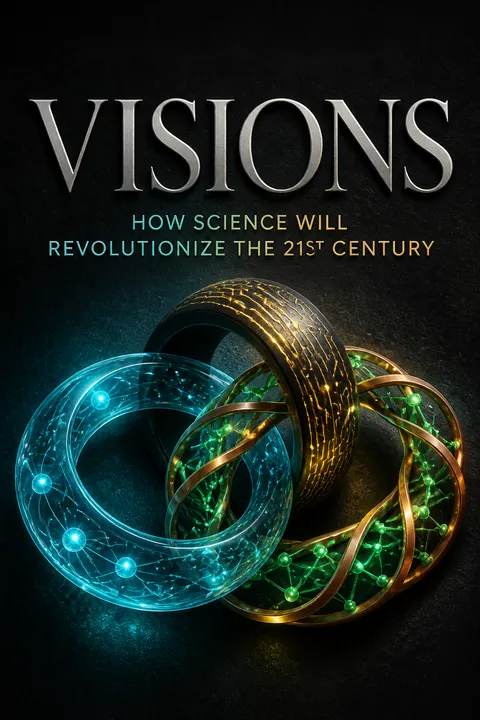
Visions: How Science Will Revolutionize the 21st Century receives mostly positive reviews, with readers praising Kaku's ability to explain complex scientific concepts and make accurate predictions. Many find the book thought-provoking and informative, covering topics like computer science, biotechnology, and quantum physics. Some readers note that parts of the book are now outdated, but still find value in comparing Kaku's predictions to current reality. A few criticisms mention repetitiveness and occasional difficulty in understanding technical concepts.
People Also Read





Glossary
Ubiquitous computing
Computing embedded everywhereA vision of computing in which numerous small, inexpensive, networked devices are embedded throughout everyday environments rather than concentrated in a desktop computer. Such devices could sense people and surroundings, communicate with one another, and provide information or services with little visible interaction. The term is associated in the book with computer scientist Mark Weiser.
Moore's law
A trend in chip growthA rule of thumb, not a fundamental law of nature, that the number of components or computing power available on a chip grows rapidly, traditionally described as roughly doubling every eighteen months. Kaku uses it to explain why computer costs fall and why forecasts about near-term computing seemed possible, while also emphasizing that physical limits eventually challenge continued miniaturization.
Top-down approach
Program intelligence from rulesAn artificial intelligence strategy that attempts to create intelligent behavior by explicitly programming logic, knowledge, and rules into a computer. The system is expected to reason from this internal representation of the world. Kaku describes its difficulty as the enormous challenge of writing down enough rules to handle the complexity and ambiguity of everyday life.
Bottom-up approach
Learn through interactionAn artificial intelligence strategy inspired by biology, in which a system develops abilities through feedback and interaction with its environment rather than relying entirely on a detailed prewritten model. Kaku's examples include insectlike robots that learn to move through trial and error, and neural networks that adjust their connections as they encounter examples.
Molecular medicine
Medicine targeting molecular mechanismsAn approach to diagnosis and treatment that studies disease at the level of genes, proteins, cells, and their interactions. Rather than relying only on visible symptoms, it seeks to identify the molecular processes that cause disease and target them more specifically. Kaku presents it as a shift toward earlier prediction and treatments designed around the biological weaknesses of pathogens or cancer cells.
Germ-line gene therapy
Inherited genetic alterationA proposed form of gene therapy that changes reproductive cells or early embryos so that the alteration can be passed to descendants. It differs from somatic cell therapy, which changes cells in a treated person but is not inherited. The book presents germ-line intervention as ethically contentious because future generations cannot consent and unintended changes could persist.
Type I, II, and III civilizations
Energy-based civilization categoriesCategories associated with Nikolai Kardashev that classify hypothetical civilizations by the scale of energy they command. Type I uses energy at a planetary scale, Type II harnesses the energy of a star, and Type III commands energy across a galaxy. Kaku uses the categories to frame humanity's possible long-term development and the cooperation such scales would require.
Microelectromechanical systems
Miniature sensors and motorsDevices that combine small mechanical components, such as sensors or motors, with electronic systems, often fabricated using techniques developed for microchips. The book describes them as an early, practical class of miniaturized machines, distinct from more speculative molecular machines. Proposed uses include air-bag sensors, medical analysis, and monitoring stress in structures.
Quantum computer
Computer using quantum statesA proposed computer that uses quantum properties rather than only ordinary binary states. Its basic information unit, the qubit, can exist in a superposition of states, enabling certain calculations to be approached in ways unavailable to conventional computers. Kaku describes its potential for difficult calculations and code breaking, while stressing the challenge of isolating and controlling delicate quantum systems.
Anthropic Principle
Life-compatible physical conditionsThe observation that the measured constants of the universe fall within ranges that permit stable matter and life. Kaku discusses the principle alongside the multiverse idea: if many universes have different physical constants, observers could only arise in those whose conditions allow them to exist. The idea addresses why the universe appears compatible with life, but does not by itself settle why such conditions exist.
FAQ
What's Visions: How Science Will Revolutionize the 21st Century about?
- Exploration of Future Science: The book delves into how advancements in science, particularly in artificial intelligence, genetics, and nanotechnology, will reshape society in the 21st century.
- Three Scientific Revolutions: Michio Kaku identifies three key revolutions: the computer revolution, the biomolecular revolution, and the quantum revolution, each expected to significantly impact our understanding and manipulation of matter, life, and intelligence.
- Interdisciplinary Approach: Kaku combines physics, engineering, and biology to explore how these fields intersect and contribute to future innovations, providing a comprehensive understanding of potential advancements.
Why should I read Visions: How Science Will Revolutionize the 21st Century?
- Insightful Predictions: The book offers a well-researched look into the future of technology and its implications for humanity, based on interviews with over 150 scientists.
- Engaging Writing Style: Michio Kaku's ability to explain complex scientific concepts in an accessible manner makes the book enjoyable for both lay readers and experts.
- Broader Implications: It not only discusses technological advancements but also their societal impacts, prompting readers to think critically about the future.
What are the key takeaways of Visions: How Science Will Revolutionize the 21st Century?
- Three Pillars of Science: The book outlines the three pillars of modern science: matter, life, and intelligence, which will drive future scientific discoveries and innovations.
- Emerging Synergy: Kaku discusses the synergy between the computer, biomolecular, and quantum revolutions, expected to accelerate scientific progress and create new opportunities.
- Future Predictions: Predictions are categorized into three time frames: developments expected by 2020, from 2020 to 2050, and beyond 2050, helping readers understand when to expect various technological advancements.
What are the best quotes from Visions: How Science Will Revolutionize the 21st Century and what do they mean?
- “There are three great themes in science in the twentieth century—the atom, the computer, and the gene.”: Highlights the foundational discoveries of the last century that have shaped modern science and will continue to influence future advancements.
- “Prediction is very hard, especially when it’s about the future.”: Reflects the inherent uncertainty in forecasting scientific progress, acknowledging the challenges of making accurate predictions.
- “We are now making the transition from amateur chess players to grand masters, from observers to choreographers of Nature.”: Signifies the shift in human capability to manipulate natural processes through science, encapsulating the book's central theme of empowerment through scientific understanding.
What are the three scientific revolutions discussed in Visions: How Science Will Revolutionize the 21st Century?
- Computer Revolution: Focuses on the rapid advancements in computing technology, predicting that computers will become so integrated into our lives that they will be invisible yet omnipresent.
- Biomolecular Revolution: Pertains to advancements in genetics and molecular biology, allowing us to manipulate life at the molecular level, with potential for personalized medicine and genetic engineering.
- Quantum Revolution: Involves understanding and manipulating matter at the quantum level, with breakthroughs in quantum physics leading to new technologies that can control matter in unprecedented ways.
How does Michio Kaku define the role of scientists in shaping the future in Visions?
- Collaborative Efforts: Emphasizes that no single individual can invent the future; it requires the collective efforts of many scientists across various disciplines.
- Emerging Consensus: Highlights the importance of an emerging consensus among scientists regarding future predictions, making them more reliable than individual opinions.
- Choreographers of Nature: Describes scientists as "choreographers" who will actively shape the future through their discoveries, illustrating their proactive role in directing technological advancements.
What are the potential societal impacts of the scientific revolutions according to Visions?
- Economic Shifts: Scientific revolutions will lead to significant changes in the economy, with new industries emerging and existing ones transforming, resulting in job displacement and new opportunities.
- Ethical Considerations: Raises important ethical questions regarding genetic engineering, artificial intelligence, and the manipulation of life, encouraging readers to consider the moral implications.
- Global Cooperation: Suggests that advancements in science and technology will necessitate greater global cooperation to address complex challenges like climate change and public health.
How does Michio Kaku envision the future of artificial intelligence in Visions?
- Emerging Intelligent Systems: Predicts the development of intelligent systems capable of learning and adapting to their environments, enhancing daily lives and working alongside humans.
- Self-Aware Robots: Speculates that by 2050, robots may achieve a degree of self-awareness, raising questions about their rights and roles in society.
- Integration with Humans: Discusses the possibility of merging human intelligence with artificial systems, creating cyborgs that enhance human capabilities and redefine what it means to be human.
What role does nanotechnology play in the future according to Visions: How Science Will Revolutionize the 21st Century?
- Molecular Machines: Discusses the potential of nanotechnology to create molecular machines that could perform tasks at the atomic level, revolutionizing various industries.
- Applications in Medicine: Envisions these machines being used to target diseases, clean up the environment, and repair cellular damage, potentially leading to breakthroughs in healthcare.
- Skepticism and Challenges: Acknowledges significant technical challenges before nanotechnology can be fully realized, despite its exciting possibilities.
How does Visions address the concept of room temperature superconductors?
- Energy Efficiency: Describes room temperature superconductors as a breakthrough that could drastically reduce energy loss in power transmission, making energy systems more efficient.
- Potential Applications: Outlines applications like maglev trains and advanced medical imaging technologies that could become feasible with room temperature superconductors.
- Current Research Status: Provides an overview of ongoing research efforts and breakthroughs in superconductivity, emphasizing the challenges that remain.
What are the implications of the multiverse theory discussed in Visions?
- Parallel Universes: Introduces the concept of the multiverse, where multiple universes exist simultaneously, each with different physical laws and constants.
- Anthropic Principle: Provides a framework for understanding the Anthropic Principle, suggesting that our universe is just one of many that could support life.
- Philosophical Considerations: Raises profound philosophical questions about existence, consciousness, and the nature of reality, encouraging contemplation of living in a universe that may be just one of countless others.
How does Visions explore the future of space exploration?
- Interplanetary Missions: Outlines plans for future missions to Mars and beyond, emphasizing the importance of robotic exploration as a precursor to human colonization.
- Colonization of Other Planets: Discusses the potential for humanity to establish colonies on other planets, driven by the need for survival and exploration.
- Technological Innovations: Speculates on technologies that will enable space travel, including advanced propulsion systems and life support technologies, envisioning a future where space travel becomes routine.
About the Author
Other books by Michio Kaku

Download PDF
Download EPUB
.epub digital book format is ideal for reading ebooks on phones, tablets, and e-readers.








