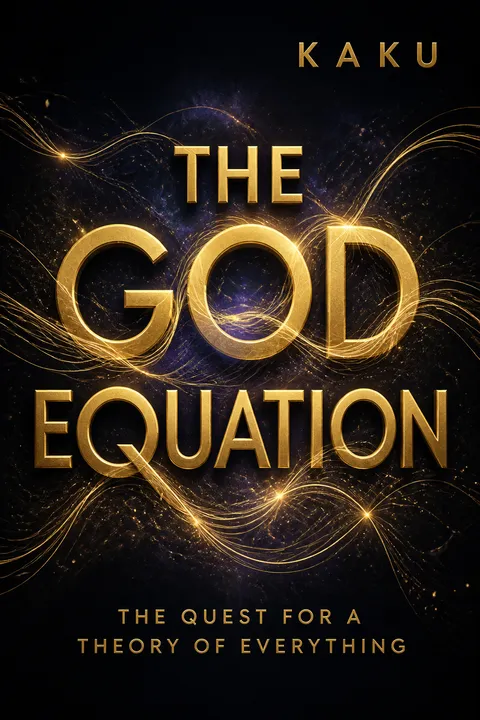


Key Takeaways
The theory of everything is physics' unfinished bid to unite four forces
One pattern, many revolutions. The book follows physics as it repeatedly discovers that seemingly separate phenomena obey shared laws. Newton connected an apple's fall with the Moon's orbit. Faraday and Maxwell united electricity and magnetism, revealing that light is an electromagnetic wave. Einstein joined space with time, and matter with energy. Each unification reshaped technology, from engines and electric power to computers and communications.
The remaining divide. Physicists seek a framework that includes gravity, electromagnetism, and the strong and weak nuclear forces. Such a theory might clarify the Big Bang and black holes, but the goal remains unfinished. Kaku presents string theory as the leading candidate, not an experimentally established answer.
The book's historical structure makes unification feel less like abstract tidiness and more like a recurring scientific strategy: find a law that explains several observations at once, then see what else follows. The key qualification is that a deeper theory does not make earlier ones useless. Newtonian mechanics remains excellent for ordinary engineering, even though relativity is more fundamental. Scientific progress often resembles a map gaining new scales, not a ladder where every older map is discarded. A final theory, if found, would explain the foundations, but it would not automatically make every complex phenomenon easy to derive.
Treat symmetry as a clue that can predict unseen particles
What stays unchanged. In physics, symmetry means that a law remains the same after a transformation, such as rotating a system or exchanging certain components. Newton's gravitational law works regardless of the direction from which a planet is viewed. Maxwell's equations connect electric and magnetic fields, while Einstein's relativity treats space and time as parts of one structure.
More than elegance. Symmetry has helped physicists organize discoveries and anticipate them. Dmitri Mendeleyev arranged known elements into a table and predicted properties of elements not yet found. Paul Dirac's relativistic equation for the electron implied antimatter, later confirmed in the form of the positron. In this account, symmetry is a powerful guide, but its beauty alone cannot establish that a theory describes nature.
Symmetry is valuable because it compresses many observations into a rule and exposes what a theory permits or forbids. That resembles a form of scientific compression: a compact description earns attention when it explains existing data and generates risky new predictions. Yet mathematical symmetry can also be imposed on a model without nature cooperating. The history of physics contains elegant proposals that did not survive evidence. Symmetry is therefore best treated as a search heuristic, a way to ask sharper questions, rather than a certificate of truth.
Quantum mechanics sacrifices certainty, yet predicts the measurable world
Energy comes in packets. Max Planck proposed that hot objects emit energy in discrete units, called quanta, to solve a problem in calculations of their glow. The idea explained why flames change color with temperature and lets astronomers infer the Sun's temperature from its light. Einstein then showed that light also behaves as particles, while experiments showed electrons can produce wave-like interference.
Probability replaces certainty. Schrödinger's equation describes these particle waves, and its solutions explain electron shells and the recurring structure of the periodic table. In the standard probabilistic account, the wave gives the likelihood of finding a particle, not a definite path. Einstein and Schrödinger objected to the implications, but quantum predictions have been tested with extraordinary precision and underpin technologies such as transistors and lasers.
Quantum theory forces a useful distinction between unpredictability and ignorance. A forecast can be probabilistic because the world itself behaves probabilistically according to the theory, not merely because an observer lacks information. That distinction remains philosophically contested, especially around measurement and the meaning of the wave function. In practice, the theory's reliability is not in doubt: it supports technologies built on precise control of matter. The enduring lesson is methodological humility. A theory can be extraordinarily successful at predicting outcomes while leaving open what its mathematical description says about reality.
Relativity and quantum theory work brilliantly, but resist a shared framework
Two powerful descriptions. Special relativity emerged from Einstein's realization that light's speed stays constant for observers in motion, requiring space and time to change with motion. General relativity extends this picture: gravity is associated with the curvature of space-time. Its effects are practical, too. GPS systems must account for both motion and gravity because satellite clocks and ground clocks tick at different rates.
A deep incompatibility. Quantum theory describes the small through probabilities and particle interactions; general relativity describes gravity through the geometry of space-time. Each succeeds in its domain, but their mathematical rules do not combine cleanly under extreme conditions. The book frames their reconciliation as the central obstacle to a theory of everything, especially when studying the earliest universe or the interior of a black hole.
This is not simply a contest between an old theory and a new one. Relativity and quantum mechanics have both survived severe tests, so the problem is that nature appears to require both descriptions in settings where each matters. Similar tensions arise in other sciences when models operate at different scales, but here the mismatch concerns the foundations themselves. The challenge also illustrates why practical prediction and conceptual unity are different achievements. A theory may calculate reliably within its range while failing to describe the full structure that makes its success possible.
The Standard Model explains three forces, but leaves gravity out
A remarkable particle map. The Standard Model organizes known elementary particles and describes the electromagnetic, strong, and weak forces. Its strong-force account uses quarks and gluons; its electroweak account joins electromagnetism with the weak force. The Higgs boson, found at the Large Hadron Collider in 2012, completed a major part of the model's particle inventory.
Success with loose ends. The model fits a vast range of particle experiments, yet it does not include gravity. It also relies on roughly twenty parameters, such as particle masses and interaction strengths, that must be supplied rather than derived. Its structure is a patchwork of theories joined together, not the single elegant account Einstein sought. It is powerful physics, but not a complete explanation of nature.
The Standard Model shows why scientific incompleteness should not be confused with failure. A map can be extraordinarily accurate and still omit a major feature of the territory. Its many adjustable parameters also pose a question about explanation: does a theory explain a value if it must take that value as an input? The answer depends on the research purpose. For predicting experiments, fitted parameters can be useful. For explaining why the universe has its particular properties, their unexplained status marks genuine unfinished work.
String theory makes gravity unavoidable, but requires hidden dimensions
Particles as vibrations. String theory proposes that the basic ingredients of nature are tiny vibrating strings rather than point-like particles. Different vibration patterns would appear as different particles. Crucially, the theory includes a vibration that behaves like the graviton, the proposed quantum particle of gravity. Kaku argues that this makes string theory a promising route to combining quantum mechanics with gravity.
A stranger geometry. The mathematics requires ten dimensions in the versions described in the book, with six imagined as curled up too small to observe. An eleventh-dimensional framework, M-theory, connects five distinct string theories and includes higher-dimensional membranes. These ideas are mathematically rich, but the underlying principles are incomplete. The extra dimensions and proposed supersymmetric partners have not been experimentally confirmed in the account presented here.
String theory's appeal is not only that it offers a candidate particle for gravity. It tries to explain why gravity and quantum mechanics belong in the same mathematical structure, and why apparently different particles might share one origin. That ambition is intellectually significant even if the theory remains unverified. The cost is a chain of assumptions that are difficult to test directly, including hidden dimensions and partner particles. A framework's ability to absorb known problems is encouraging, but it becomes compelling physics only when it constrains what observations should find.
Let mathematical beauty guide discovery, but demand evidence before belief
A productive compass. Many major advances began with mathematical structure that suggested something unseen. Dirac's equation pointed toward antimatter, and symmetry helped organize the subatomic particle zoo. String theory's defenders likewise value its consistency and its capacity to bring gravity into quantum physics.
A compass is not a verdict. The Large Hadron Collider found the Higgs boson but, as Kaku describes the situation, did not provide the hoped-for evidence for string theory or supersymmetry. Directly reaching the theory's characteristic energy scale may be far beyond existing accelerators. Kaku therefore discusses indirect clues, such as dark matter, gravitational waves, and deviations from gravity's inverse-square behavior. These are possible avenues of inquiry, not confirmations. The theory's beauty keeps the search alive; its testability remains a serious problem.
The tension here is a classic problem in philosophy of science: a theory can be mathematically coherent without being empirically well supported. Beauty can guide researchers toward fruitful questions, but it is not independent evidence. At the same time, demanding an immediate laboratory test can be too narrow if a theory concerns energies or scales currently inaccessible. The strongest standard is flexible but firm: allow indirect tests and novel deductions, while asking that evidence distinguish the theory from its competitors. Otherwise, elegance risks becoming a reason to protect a theory from correction.
Use black holes and the Big Bang to probe physics at its limits
Extreme environments expose gaps. General relativity predicts black holes, regions bounded by an event horizon from which light cannot escape. The 2019 image of the black hole in galaxy M87 made this object visible through radio signals combined from telescopes around Earth. Applying quantum ideas to black holes led Stephen Hawking to predict faint radiation and gradual evaporation, raising the question of whether information falling in can ever be recovered.
Solutions are not sightings. Einstein's equations also permit wormhole-like connections and mathematical paths that resemble time travel. Their existence or practicality is not established by those equations alone. The Big Bang presents a similar boundary: classical gravity becomes inadequate near the beginning. These puzzles matter because a complete quantum theory of gravity could clarify where current descriptions break down.
Black holes function as conceptual stress tests: they force gravity, quantum theory, and information to confront one another in a single setting. This resembles the role of extreme cases in mathematics and engineering, where a system's limits reveal hidden assumptions. But a mathematical solution is not automatically a physical object. Distinguishing permitted by equations from present in the universe is essential, especially for wormholes and time travel. The scientific value of these possibilities lies partly in showing what a future theory must explain, not in promising that science fiction is achievable.
A multiverse may explain fine-tuning while making prediction harder
Most of the cosmos is unseen. The book estimates that ordinary atoms make up about 4.9 percent of the universe, with dark matter at 26.8 percent and dark energy at 68.3 percent. Dark matter is inferred from gravitational effects on galaxies; dark energy is associated with the universe's accelerating expansion. Inflation, a proposed burst of rapid early expansion, can explain why the observable universe appears so flat and uniform, and may imply many bubble universes.
Many solutions, one problem. String theory appears to allow a vast landscape of possible universes. The anthropic principle says observers can only find themselves in a universe compatible with their existence. That can explain why conditions seem life-friendly, but it does not identify which universe is ours or make the theory's predictions more precise. Proposed signals from dark matter or cosmic background radiation remain possible tests, not settled evidence for a multiverse.
The multiverse offers a selection effect: observers necessarily inhabit a place where observers can arise. This is logically useful, but it can become difficult to test if every possible observation is accommodated by some universe in the collection. The distinction between explaining why a value is observed and predicting that value matters here. Dark matter and dark energy also remind readers that a theory can describe measurable effects while leaving the underlying entity unknown. The honest position is neither dismissal nor certainty, but careful separation of evidence for cosmic phenomena from claims about their ultimate explanation.
Let physics explain origins, but do not ask equations to supply purpose
Different kinds of questions. Kaku distinguishes a personal God who intervenes in human affairs from the order and intelligibility associated with Spinoza's conception of God. Physics can investigate cosmic history and the laws governing it, but even a final equation would leave open why those laws exist. The book revisits the First Cause argument and notes that explaining the Big Bang with a multiverse still leaves the origin of the multiverse or its governing theory unexplained.
Meaning is not a measurement. Kaku calls himself agnostic about God's existence because the question is not settled by ordinary scientific tests. He also argues that people create meaning through struggle and commitment, rather than receiving it from a formula. A unified theory might deepen our account of the universe without deciding what a human life is for.
This boundary is important because explanatory power can tempt people to treat scientific accounts as complete worldviews. Physics can describe relationships among measurable quantities, but purpose and value involve questions that are not reducible to measurement alone. That does not make philosophical or religious answers equivalent to scientific theories; they face different standards of argument. The distinction also protects science from both overreach and underappreciation. A final physical law could be a breathtaking account of how the universe behaves, while leaving moral responsibility, personal meaning, and the source of the laws themselves open.
Analysis
The book's central narrative is a history of unification, but its deeper subject is how science earns the right to claim that apparently separate things are one. Newton's gravity succeeds because it links terrestrial motion to planetary orbits and makes accurate predictions. Maxwell's fields connect electricity, magnetism, and light. Relativity and quantum mechanics then show that familiar intuitions are not reliable guides to fundamental structure. The story builds toward string theory because ordinary methods for joining quantum physics to gravity have failed, not because mathematical elegance alone has settled the matter.
Kaku's strongest contribution is to present theoretical physics as both an intellectual history and an ongoing wager. Symmetry repeatedly helps scientists organize observations and predict phenomena, yet the Standard Model demonstrates that an accurate theory can remain conceptually patchy. String theory may resolve the incompatibility between gravity and quantum mechanics, but the book's account also makes clear that its characteristic claims lack direct experimental confirmation and that its landscape of possible universes complicates prediction. This tension is not a minor caveat. It is the main test of whether the framework can move from mathematical promise to established physical explanation.
The phrase theory of everything needs careful interpretation. Even a successful fundamental theory would not literally calculate every event without initial conditions, computational limits, or higher-level concepts. Nor would it answer every philosophical question. The book's movement from equations to God and meaning is valuable precisely when it distinguishes physical explanation from metaphysical interpretation. A theory could explain how the universe evolves while leaving open why its laws exist or what human beings should value.
The most durable lesson is therefore methodological rather than triumphant: unification is a powerful research aim, beauty can point toward structure, and evidence must decide how much confidence a theory deserves. The quest matters even before its destination is known because it reveals both the reach and the limits of scientific explanation.
Review Summary
The God Equation receives mixed reviews, with praise for its accessible overview of physics history and string theory, but criticism for its brevity and lack of depth. Some readers appreciate Kaku's clear explanations and philosophical musings, while others find the content superficial and misleading. The book's use of "God" in the title is controversial. Reviewers note that much of the material is familiar from other popular physics books, with limited new insights. The final chapters on string theory and its implications are considered the most interesting, albeit too brief.
People Also Read






Glossary
Standard Model
Particle physics frameworkThe established framework describing known elementary particles and three fundamental interactions: electromagnetism, the strong nuclear force, and the weak nuclear force. It incorporates quarks, leptons, force-carrying particles, and the Higgs boson. It fits many experiments but does not include gravity, and several of its parameters must be measured rather than derived.
quantum electrodynamics (QED)
Quantum theory of lightA theory describing how light, represented by photons, interacts with electrically charged particles such as electrons. It combines quantum mechanics with special relativity and uses renormalization to produce finite predictions from calculations that initially yield infinities. Its predictions, including properties of the electron, agree with experiments to remarkable precision.
quantum chromodynamics (QCD)
Quantum theory of quarksThe theory of the strong nuclear force, which binds quarks together inside particles such as protons and neutrons. It describes interactions through gluons, the force-carrying particles that act between quarks. In the book's account, QCD emerges from applying Yang-Mills fields to quarks and their color symmetry.
symmetry breaking
Loss of an original symmetryA process in which a system governed by a symmetrical set of possibilities settles into a state that does not display the full symmetry. In the book's account of the early universe, the Higgs field is associated with the breaking of an original symmetry, allowing particles and forces to acquire the distinct properties observed today.
supersymmetry
Matter-force particle symmetryA proposed symmetry relating fermions, which make up matter, to bosons, which carry forces. It implies that known particles have partner particles, such as an electron's proposed selectron partner. In string theory, contributions from the two particle types can cancel certain problematic infinities. The proposed partner particles have not been experimentally confirmed in the book's account.
string theory
Vibrating-string physics frameworkA proposed framework in which the fundamental constituents of nature are tiny strings whose different vibration patterns appear as different particles. Unlike ordinary approaches to quantum gravity described in the book, string theory includes a graviton-like vibration and may yield a finite quantum theory of gravity. Its mathematical versions require additional dimensions, and its physical claims remain unconfirmed.
M-theory
Eleven-dimensional unifying frameworkA proposed framework that relates five apparently distinct versions of string theory as different descriptions of a deeper theory in eleven dimensions. It includes membranes as well as strings. The book presents M-theory as a unifying development, while emphasizing that its fundamental principles and a complete mathematical formulation remain unknown.
landscape problem
Too many possible universesThe challenge that string theory appears to permit an enormous number of internally consistent solutions, each corresponding to a possible universe with different properties. If the theory does not determine which solution describes our universe, its predictive power is weakened. The problem is connected to the multiverse and to the question of how initial conditions are selected.
Hawking radiation
Quantum emission from black holesA faint radiation that Stephen Hawking predicted black holes should emit when quantum effects are considered near their boundaries. In the book's explanation, quantum activity in the vacuum can produce particle pairs, with one particle escaping while the other falls inward. The process implies that a black hole can lose energy and eventually evaporate.
anthropic principle
Observer-based selection effectThe idea that the properties we observe in the universe are constrained by the fact that observers can exist only under conditions compatible with life. In a multiverse picture, many universes might have different properties, while observers necessarily find themselves in one that permits their existence. This offers a selection explanation, but does not by itself identify our universe or provide a specific physical prediction.
FAQ
What's "The God Equation: The Quest for a Theory of Everything" about?
- Unified Theory Goal: The book explores the quest for a single framework that unites all the forces of the universe, from the motion of galaxies to subatomic particles.
- Historical Journey: It traces the history of physics, from ancient dreams of unification to modern string theory, highlighting key scientific revolutions.
- String Theory Focus: The narrative centers on string theory as the leading candidate for a theory of everything, explaining its potential to unify gravity with quantum mechanics.
- Philosophical Implications: The book also delves into the philosophical questions about the universe's origin, structure, and meaning.
Why should I read "The God Equation: The Quest for a Theory of Everything"?
- Comprehensive Overview: It provides a thorough overview of the history and current state of theoretical physics, making complex ideas accessible.
- Scientific Insight: Readers gain insight into the minds of great physicists like Einstein and Hawking and their contributions to the quest for unification.
- Philosophical Exploration: The book addresses profound questions about the universe's purpose and the existence of a grand design.
- Engaging Narrative: Michio Kaku's engaging writing style makes the intricate world of physics both understandable and fascinating.
What are the key takeaways of "The God Equation: The Quest for a Theory of Everything"?
- Unification Dream: The pursuit of a unified theory has been a long-standing goal in physics, aiming to explain all natural forces with a single equation.
- String Theory's Role: String theory is currently the most promising candidate for a theory of everything, proposing that the universe is made of tiny vibrating strings.
- Challenges and Criticisms: Despite its potential, string theory faces significant challenges, including lack of experimental evidence and the landscape problem.
- Philosophical Questions: The book raises questions about the universe's origin, the possibility of a multiverse, and the role of a creator or grand design.
How does Michio Kaku explain string theory in "The God Equation"?
- Vibrating Strings Concept: Kaku explains that string theory posits the universe is composed of tiny, vibrating strings, with each vibration corresponding to a different particle.
- Dimensionality: The theory suggests that the universe has ten dimensions, with six of them curled up and unobservable at our scale.
- Inclusion of Gravity: Unlike other theories, string theory naturally includes gravity, making it a strong candidate for unifying all forces.
- Supersymmetry: The theory incorporates supersymmetry, which posits a symmetry between particles that make up matter and those that mediate forces.
What are the main criticisms of string theory according to "The God Equation"?
- Lack of Testability: Critics argue that string theory is difficult to test experimentally, as it requires energies far beyond current capabilities.
- Infinite Solutions: The theory predicts a multiverse with an infinite number of solutions, making it hard to determine which one describes our universe.
- Complexity and Elegance: While mathematically elegant, some physicists question whether beauty alone is a reliable guide in physics.
- Anthropic Principle: The reliance on the anthropic principle to explain why our universe is special is seen as unsatisfactory by some scientists.
What is the significance of the "God Equation" in Michio Kaku's book?
- Ultimate Goal: The "God Equation" refers to the ultimate equation that would unify all physical laws, explaining everything from the Big Bang to subatomic particles.
- Einstein's Dream: It represents the culmination of Einstein's quest for a unified field theory, a pursuit that has driven physicists for over a century.
- String Theory's Promise: String theory is seen as the closest approach to achieving this equation, with its potential to unify gravity and quantum mechanics.
- Philosophical Implications: The equation raises questions about the universe's design, purpose, and the existence of a creator.
How does "The God Equation" address the concept of a multiverse?
- Inflation Theory: The book discusses how inflation theory suggests our universe is one of many bubbles in a larger multiverse.
- String Theory's Landscape: String theory's landscape problem implies an infinite number of possible universes, each with different physical laws.
- Philosophical Questions: The multiverse concept challenges traditional notions of a single, unique universe, raising questions about our place in the cosmos.
- Anthropic Principle: The existence of a multiverse is used to explain why our universe appears fine-tuned for life, as we exist in one of the few universes where life is possible.
What are the best quotes from "The God Equation" and what do they mean?
- "The universe is a symphony of strings." This quote encapsulates the essence of string theory, suggesting that all particles and forces are manifestations of vibrating strings.
- "Did God have a choice in creating the universe?" This question, posed by Einstein, reflects the search for a unique, inevitable set of physical laws governing the universe.
- "Sometimes God throws the die where you cannot find them." Hawking's quote highlights the uncertainty and unpredictability inherent in quantum mechanics, especially in black holes.
- "Beauty is truth, truth beauty." This Keats-inspired sentiment underscores the belief that the universe's fundamental laws are both beautiful and true, guiding physicists in their quest.
How does Michio Kaku address the philosophical implications of a theory of everything?
- Existence of God: Kaku explores whether a theory of everything implies a grand design or creator, considering both scientific and theological perspectives.
- Meaning of Life: The book raises questions about whether understanding the universe's fundamental laws can provide insight into life's purpose and meaning.
- Human Understanding: Kaku suggests that a complete theory should be understandable by everyone, allowing all to participate in discussions about existence.
- Limitations of Science: He acknowledges that some questions, like the origin of the laws themselves, may remain beyond the reach of science, entering the realm of metaphysics.
What role does symmetry play in "The God Equation"?
- Unifying Principle: Symmetry is a central theme, seen as the key to unifying all forces and particles in the universe.
- Predictive Power: Symmetry helps predict new particles and phenomena, as seen in the discovery of antimatter and quarks.
- Eliminating Infinities: In string theory, supersymmetry helps cancel out infinities that plague other quantum theories, making it a candidate for a finite theory of gravity.
- Aesthetic Appeal: Symmetry is also associated with beauty in physics, guiding the search for elegant and simple explanations of complex phenomena.
How does "The God Equation" explain the relationship between quantum mechanics and general relativity?
- Conflicting Theories: The book highlights the fundamental conflict between quantum mechanics, which governs the small, and general relativity, which governs the large.
- String Theory's Promise: String theory offers a framework to reconcile these two theories by describing particles as strings, naturally incorporating gravity.
- Quantum Gravity: The quest for a theory of quantum gravity aims to unify these theories, explaining phenomena like black holes and the Big Bang.
- Experimental Challenges: Despite theoretical progress, testing the unification of these theories remains a significant challenge due to the high energies required.
What is Michio Kaku's perspective on the future of string theory?
- Ongoing Evolution: Kaku believes string theory is still evolving, with new mathematical layers being uncovered, suggesting it is not yet in its final form.
- Mathematical Consistency: He argues that the theory's ultimate validation may come from its mathematical consistency and ability to derive known physical constants.
- Experimental Hopes: While direct experimental evidence is challenging, Kaku remains hopeful that future discoveries, like dark matter or mini black holes, may support the theory.
- Patience Required: He emphasizes that scientific progress can be slow, and the ultimate understanding of string theory may take time, much like past scientific revolutions.
About the Author
Other books by Michio Kaku



Download PDF
Download EPUB
.epub digital book format is ideal for reading ebooks on phones, tablets, and e-readers.








