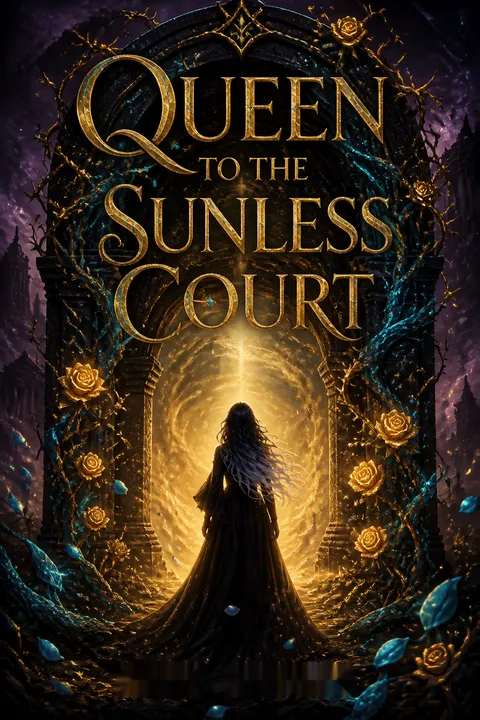


Plot Summary
Blood Beside the Prince
King Theron brought Calliste, a priestess of the healing goddess Epione, from Mount Hellecon to help his young son, Kalias, who has fallen into an unnatural sleep. Then Theron finds Calliste bleeding beside the boy, a ragged wound over her heart and her knife untouched by blood. No guard heard a struggle, and the secure chamber shows no sign of an intruder.
The court physician operates while Theron waits outside, blaming himself for bringing her into danger and fearing he has lost her. When Calliste survives, the physician admits her injury could not have come from an ordinary weapon. Her attack deepens the mystery surrounding Kalias and makes the palace's safest room feel compromised.
The injury turns a private healing mission into a crisis that neither medicine nor palace security can explain. Theron's helpless vigil exposes the limits of his usual tools: rank, guards, and decisive action cannot protect Calliste or diagnose his son. The unexplained clawlike wound also links the bodily danger in Anthemos to a hidden supernatural conflict. The story begins by making care itself risky. Calliste is not merely summoned to repair a prince; her willingness to help has placed her within the reach of forces that can cross the boundaries protecting the royal household.
The Tree of Calliste
While her body lies under the physician's care, Calliste wakes in the Everlasting Enclave, a luminous forest where each soul has a tree recording its life. A wound remains across her chest, and the three-headed guardian Cerberus pursues her along a glowing path. Thanatos, god of death, stops the hound and explains that Calliste is suspended between life and death.
To give the healers in Anthemos time, she must reach her own tree and try to reconnect with her mortal body. She finds it by its turquoise light and kneels among its roots. The moment restores warmth to her chest. When she returns to awareness, she learns Theron stayed beside her rather than returning to his duties.
The Enclave makes the story's spiritual system intimate: a soul's tree is not an abstract record but a place where life can be felt and renewed. Calliste's peril is not overcome by force; she survives by recognizing and approaching the source that connects her to her body. Cerberus embodies the danger of being neither fully alive nor properly dead, while Thanatos's intervention establishes that divine rules can admit exceptions. Her return also deepens the bond with Theron, whose watchfulness gives her mortal life an emotional counterpart to the tree's supernatural pull.
Hypnos Wants Obedience
Thanatos escorts Calliste across the Styx to Hades's court, where the Underworld ruler asks what happened in the Roots, a dangerous region tied to Kalias's illness. Dream god Hypnos, Calliste's patron and former guide, reacts with anger when she admits a hostile presence had warned her about him.
Under questioning, she reveals that Hypnos nearly plunged them into the Styx after she rejected his advances. Hades orders him away and gives the investigation to his son Morpheus, god of visions. Calliste then recounts how a possessed Condemned attacked her and how Epione's power helped drive the invader from its host. The gods learn that a hostile immortal may be endangering the Underworld itself.
Hypnos's authority rests on a familiar imbalance: he is an immortal patron, while Calliste is a mortal whose livelihood and spiritual practice depend on divine favor. Her account makes clear that guidance can become coercion when gratitude is treated as a claim on her choices. Hades's intervention does not erase the imbalance, but it makes consent a condition of service and gives Calliste room to speak. Morpheus's appointment shifts the investigation toward collaboration rather than possession, a crucial contrast to the control that has shaped her past.
A Queen Without a Trial
While resting in Hades's palace, Calliste dreams under Hypnos's influence and glimpses a powerful immortal trying to bend her desire and future. Morpheus wakes her before the spell settles, then uses his vision gift to recover the name Calliste heard during her fight: Amatheia Amyntasides, Theron's dead wife and Kalias's mother.
Hades realizes Amatheia never reached his court for judgment, despite her royal status and proper burial. Morpheus suspects the unknown deity has used her Shade to hide in the Roots and pull Kalias's missing tree there through their maternal bond. Since only an immortal could do this, Calliste's attacker is likely a god. Hades orders her to tell Theron everything and bring him to the Underworld.
The revelation changes Kalias's illness from a mysterious affliction into a family crisis that spans life and death. Amatheia's absence from Hades's court is not a minor administrative gap; it signals that the natural passage of souls has been interrupted. At the same time, Calliste's dream shows how easily intimacy can be engineered by a god with access to the mind. The section makes memory a contested resource: Morpheus helps retrieve it, while Hypnos tries to shape what Calliste believes she wants.
The King Hears Everything
Back in Anthemos, Calliste tells Theron that Kalias's sleep is tied to the Underworld, describes her investigation and near-death, and identifies the remaining Shade as Amatheia. Theron accepts her account, then admits the history he has hidden behind his public grief. After his parents died defending the kingdom, he accepted an arranged marriage to Amatheia for political stability and an heir.
He was emotionally numb, treated her as a duty, and never became the husband she needed. Calliste understands his guilt but asks for distance while they face the truth of Amatheia's presence. Theron agrees to take her to Hades's court, where they may learn why his wife never crossed the Styx.
The two disclosures unsettle the romance without making either character a simple victim or villain. Calliste has withheld information because she fears Theron's hostility toward the gods; Theron has withheld his marital history because guilt has become a private sentence he believes he deserves. His account distinguishes grief from remorse: he mourns what his choices did to Amatheia, not an idealized love he never felt. Their willingness to speak creates a new kind of intimacy, one based less on attraction than on the risk of being judged accurately.
Themis Draws a Sword
Morpheus carries Theron and Calliste to Hades's court, where the ruler confirms that Charon refused Amatheia because she had no coin for the crossing. Theron insists he placed a sacred, engraved coin with her before the funeral pyre, and remembers that her father, Solon, approached the body afterward. Before they can pursue that lead, Hypnos confronts the couple and threatens Theron.
The king's amethyst pendant awakens, forming a purple blade and shield that repel the god's attack. Morpheus explains that Theron's family carries the favor of Themis, goddess of justice. Hades sends Theron and Calliste to the Roots, now able to defend themselves with divine protection and a return portal.
The coin converts Theron's private memory into evidence: he knows he performed the rite, so the failure points toward interference rather than neglect. His conflict with Hypnos also turns the romance into a political and divine confrontation. Theron's newly revealed patronage matters because it answers the imbalance established earlier: Calliste is no longer the only mortal carrying divine power. Themis's protection suits a king whose authority depends on law, while the weapon she grants lets him act rather than merely defend his choices in conversation.
Amatheia Names Eris
In the Roots, Theron and Calliste find Amatheia beside Kalias's trapped tree. Her Shade swings between confusion and anger, accusing Theron of choosing her for her beauty and family connections, then abandoning her emotionally. Calliste recognizes that the hostility does not belong to Amatheia alone and identifies Eris, goddess of discord, as the force possessing her.
Eris tears free and escapes toward the caverns leading to Tartarus. Once herself again, Amatheia explains that she accepted Eris's offer to retrieve her missing coin, not knowing Eris intended to use her as cover while gathering Condemned and pulling Kalias's tree into the Roots. She asks Theron and Calliste to help her cross the Styx.
Amatheia's anger restores her personhood before it supplies information. Her accusations force Theron to hear the marriage from the perspective he could not access while treating it as a regrettable political mistake. Calliste's recognition of Eris depends on pattern rather than spectacle: the goddess has manufactured conflict among allies while hiding behind another soul. The queen's account also gives the antagonist a concrete method and motive, but not a complete plan. Eris exploits grief and unfinished obligations, turning human vulnerabilities into infrastructure for a larger assault.
Solon Kept the Coin
Theron and Calliste visit Solon at his villa, where grief and drink have hollowed out Amatheia's father. Solon admits he removed her coin after the funeral because a voice promised he might see her again. Calliste suspects Eris planted the temptation. Solon reveals that he hid the coin in a hollow rose on Amatheia's statue in Theron's neglected rooftop garden.
Theron returns to the garden with Calliste, confronting a place he avoided after his parents' deaths and his wife's funeral. Captain Lykos has secretly restored the grounds. Calliste spots the route through the hedge maze by following red roses, and Theron retrieves the coin from the statue. The sacred object is now within reach, but Amatheia remains trapped.
Solon's confession shows how Eris's strategy reaches beyond gods: she can convert a father's grief into a sacrilege that harms both his daughter and the realm of the dead. His guilt has not repaired the harm; it has simply consumed him. The rooftop garden, meanwhile, holds several layers of family memory, and Lykos's quiet maintenance preserves a place Theron could not bear to visit. Calliste's ability to read the roses turns her attention into practical agency, while Theron must enter a landscape of memory to recover the object that can change the present.
The Fire He Survived
As trust grows between them, Calliste reveals that she was left as a child at Hera's temple and later accepted marriage to the merchant Ariston as her only escape from its harsh control. Ariston demanded obedience, blamed her for their childlessness, and eventually branded her with a fire poker after she tried to leave.
Calliste struck back and fled, believing she had killed him when she pushed him into a fireplace. Theron has secretly investigated and shows her the official divorce record: Ariston survived, though badly burned and blind in one eye. Later, injuries from the siege of Anthemos left him unable to walk, and addiction ruined what remained of his life. Calliste can finally stop carrying the belief that she is a murderer.
Calliste's mistaken belief about Ariston has made survival feel morally indistinguishable from guilt. The divorce record restores a fact she could not verify, but it does not minimize the abuse that drove her to fight back. Theron's response matters because he does not use his authority to turn her disclosure into a trial. His investigation is still a breach of trust, yet its result frees her from a false burden. The scene reframes her past not as a stain on her character, but as a record of constrained choices made under threat.
The Labyrinth of Fear
Returning to the Roots, Theron and Calliste find a spiked labyrinth built over a deep chasm. Eris conjures Kalias on a crumbling bridge, pleading for rescue, but Calliste reminds Theron that their son is safe in the palace.
He recognizes details the illusion gets wrong and leads them across before the bridge collapses. Inside, their pendant guides them toward Kalias's tree. A clearing then recreates Theron's father's death, and a wall of ice separates the pair.
On Calliste's side, the frozen surface shows a fabricated scene of Theron courting noblewoman Kleio and mocking Calliste. The image traps Calliste in ice until Theron breaks through. His warmth and the power of their pendants free her, and they follow the melting water toward the maze's center.
Eris's traps attack attachment rather than strength. The false Kalias exploits Theron's fear of failing as a father, while the Kleio scene targets Calliste's insecurity about her scars and place beside a king. Each illusion gains force from something emotionally plausible, which makes discernment more valuable than brute resistance. Theron identifies his son's habits; Calliste must trust what she knows of Theron's character despite the spectacle. Their separation demonstrates how easily fear can isolate them, but their reunion turns mutual knowledge into a defense the enchantments cannot fully counterfeit.
The Temple on Fire
The water carries them toward a false Mount Hellecon, where Eris presents a burning temple and a wounded likeness of Calliste's mentor, Leontia. Calliste recognizes that the cruel words are unlike the woman she knows and refuses to believe the image.
Six Condemned appear, and Theron leaves Calliste's protective sphere to fight them with his purple sword. When three combine into a chimera, he creates a shield from Themis's power and destroys the fused creature.
Calliste sends healing energy through the remains, freeing the abandoned Shades trapped inside them. The false temple collapses, revealing Kalias's tree ahead, no longer wrapped in Eris's parasitic vines. Amatheia, with Eris still inside her, waits beside it for their final confrontation.
The false temple tests Calliste through her oldest source of belonging, but her response shows that memory can be a defense when it is grounded in actual knowledge of another person. Theron handles the physical threat, while Calliste restores the trapped Shades rather than treating them as disposable enemies. Their distinct powers work in concert: justice cuts through the threat, healing releases what has been corrupted. The tree's exposed state signals progress, but the return of Eris in Amatheia's Shade means that defeating her will require more than winning a fight.
The Last Pact
Calliste presents Eris with the Last Pact, an ancient bargain that requires a mortal's blood and an immortal's agreement. She offers Eris a chance to continue her schemes in exchange for leaving Amatheia's Shade long enough for Theron to speak with his wife. Eris guesses they recovered the coin, but Theron uses a silver coin as a decoy and keeps Amatheia's golden one hidden.
When Eris accepts the bargain, Theron gives Amatheia her coin and tells her Solon seeks forgiveness. The coin restores her Shade, and she vanishes toward the Styx. Kalias's tree returns to the Enclave. Eris demands Calliste, and Calliste snaps Theron's moonstone pendant to send him away, leaving herself bound to the bargain.
The Pact makes sacrifice a contract rather than a vague gesture of devotion. Calliste sets terms, uses Eris's ambition to secure a brief opening, and separates the decoy from the true coin. Yet the bargain costs her control over her own fate: she knowingly removes Theron from danger and remains behind. This is not a simple triumph of cleverness. Her plan succeeds for Amatheia and Kalias, but it places her alone before the antagonist. Love here means neither possession nor rescue at any cost; Calliste acts to protect others even when she cannot guarantee her own survival.
Erebus Wakes
Alone with Eris, Calliste lets the goddess possess her, hoping Epione's healing power can cleanse the madness caused by Eris's use of Erebus's energy. Instead, Eris rejects the healing and attacks, then unleashes her full power near the sleeping primordial. Erebus awakens and seizes Eris, dragging her into the darkness beneath the Roots.
He then examines Calliste and reveals that the gift she carried contains his own power of renewal, passed through Epione. Calliste offers it freely, accepting the cost rather than letting Erebus's anger destroy both realms. The emerald light leaves her body, and Erebus returns to sleep. Calliste is left alive but gravely damaged, her power and the source of her healing gone.
Calliste's attempt to heal Eris is ethically consistent but strategically dangerous: she treats even an enemy as someone who might be restored. When that approach fails, she chooses a different form of care, offering Erebus what he requires to return to sleep. The revelation that her gift contains primordial renewal recasts her power as something entrusted, not owned. Its loss therefore creates a crisis of identity as well as a physical cost. Her courage is not fearlessness; she understands the likely price and acts because the alternatives threaten everyone she loves.
A Kingdom Wakes
Hades lets Theron return to the Roots, where he finds Calliste pale, white-haired, and barely alive. Hypnos discovers that she is caught between realms after losing the gift she carried; she must understand that loss before she can return. Meanwhile, Amatheia reaches the Styx with her coin, and Kalias's tree returns to the Enclave, allowing the boy to wake in Anthemos.
Theron brings Calliste home and stays beside her through twenty days of unconsciousness. When she finally wakes, Kalias is nearby, eager to meet the healer who watched over him. Calliste touches her cracked, colorless pendant and realizes her healing power is gone. She tells Theron she would rather have died, then asks him to leave.
The resolution of the external crisis does not automatically heal the person who resolved it. Kalias's return gives Theron the relief he has spent the novel seeking, but Calliste wakes to a self that no longer matches her vocation or her visible identity. Her declaration that she would rather be dead is not ingratitude; it is a measure of how completely she linked her worth to the gift she lost. Theron's inability to fix her with affection marks a necessary limit: care must remain present without pretending grief can be hurried away.
The Healer Without Power
For thirty days, Calliste withdraws from Theron and mourns the loss of Epione's power. Kalias sneaks into her room and helps her name the difference between anger and sadness, asking where she might find another pendant. His question breaks through her certainty that nothing remains to be done.
Calliste apologizes to Theron, who reminds her that her knowledge, judgment, and compassion still matter without divine energy. Before their journey to Mount Hellecon, Lykos admits he has loved the court musician Eumelia since they met, while Theron reveals that his public courtship of her was only a shield against other suitors. Calliste chooses to travel with Theron, and he leaves Lykos in charge of Kalias.
Kalias does not solve Calliste's grief; he helps her describe it without confusing sadness for moral failure. His practical question about replacing the pendant opens a small space between the loss and the identity she has built around it. Theron's reassurance also shifts value from supernatural capacity to learned skill and character. Meanwhile, Lykos's confession exposes the cost of secrets in a loyal friendship: Theron tried to protect Eumelia but accidentally obscured Lykos's sincere feelings. Calliste's influence reaches beyond romance because she notices what others avoid naming.
A Future Beyond the Temple
On the road to Mount Hellecon, Theron and Calliste stop in Aganeeios, where he reunites her with Elpis, the village woman who once sheltered her after she fled Ariston. Calliste can finally thank her, and Theron invites Kassandros to their future wedding. At the temple, Leontia welcomes Calliste and explains that losing her divine gift does not erase her knowledge or service.
She also questions the claim that Calliste was barren, since Ariston's drinking may have made him infertile instead. Calliste sees that Mount Hellecon is no longer her only home. Theron asks her to become his queen, and she accepts. The book closes with her returning to the place of their first argument, now choosing a future shaped by love and responsibility.
The ending brings together three forms of belonging that Calliste once experienced separately: the sanctuary that educated her, the village kindness that helped her survive, and the royal household where she has built intimate ties. Leontia does not demand that Calliste resume an old role; she releases her to choose a new one. The possible explanation for her infertility reopens a future she had treated as settled, without promising certainty. Theron's proposal offers status, but Calliste's acceptance is not a reward for being healed. She chooses a life in which her worth exceeds the power she has lost.
Analysis
The novel binds its romantic plot to a problem of interrupted passage: Kalias cannot wake, Amatheia cannot cross the Styx, and Calliste eventually cannot return easily to herself. Each crisis asks what happens when a life is held at a threshold by someone else's will or by an unfinished obligation. The Underworld's rules give those questions physical form through trees, coins, portals, and the dangerous river. The resolution depends not on overpowering every divine force, but on understanding the rules well enough to act within them.
Calliste's vocation is both her strength and her vulnerability. She has learned to define herself through usefulness, first as a servant and then as a healer. Her willingness to offer her power to protect others is courageous, but it leaves her facing the possibility that she has nothing without the gift. The long aftermath insists that sacrifice does not instantly produce serenity. She must grieve the loss, and other people must recognize that her knowledge and judgment remain valuable even when her supernatural ability does not.
Theron's arc interrogates duty as a form of avoidance. He married Amatheia for political reasons, then converted guilt into a private substitute for grief. His love for Calliste does not erase the harm of that marriage; instead, it requires him to describe it honestly and accept that another person has her own path. The romance becomes most persuasive when he offers care without claiming ownership. Hypnos provides a darker mirror, treating favor as a debt and affection as entitlement.
The story's quieter relationships extend this argument. Lykos preserves Theron's abandoned garden, while Calliste sees his feelings for Eumelia before Theron does. Elpis's kindness, Leontia's counsel, and Kalias's plain questions all demonstrate care through concrete action. Against Eris's use of division, the book proposes a fragile counterforce: people who pay attention, tell the truth, and let others choose what their lives will mean.
Review Summary
Queen to the Sunless Court received mixed reviews, with many praising its Greek mythology-inspired world, beautiful writing, and emotionally rich romance. Readers appreciated the character development and slow-burn romance between Calliste and Theron. However, some found the pacing slow and the plot predictable. Critics noted excessive infodumping and unnecessary subplots. Despite these criticisms, many readers found the book a satisfying conclusion to the duology, with compelling characters and an immersive fantasy world. The spice level and romantic elements were frequently mentioned as highlights.
People Also Read







Characters
Calliste
The mortal healerA priestess of Epione, Calliste is attentive to suffering and skilled at reading both bodies and motives. Orphaned young and shaped by years of dependence, she learned to make herself useful before she learned to defend her own wishes. Her healing vocation is genuine, but it can also become a measure by which she judges her value. She is brave without being invulnerable, and her instincts often reveal what more powerful people overlook. Calliste's central struggle is to remain compassionate without surrendering her autonomy. Her relationships with Theron, Kalias, Leontia, and the gods test whether she can accept care and belonging without letting others define her.
Theron
The grieving kingKing of Hesperis and father to Kalias, Theron is disciplined, protective, and accustomed to carrying public responsibility alone. The deaths of his parents and the obligations of the throne taught him to treat personal desire as expendable. His bluntness can harden into control, especially when fear makes him believe that protecting someone means deciding for them. Beneath his authority is a man who carries guilt more readily than grief and who struggles to imagine a future not dictated by duty. Calliste challenges both his reserve and his assumptions, drawing out a more honest account of the choices that shaped his family and reign.
Kalias
The sleeping princeTheron's seven-year-old son is curious, affectionate, mischievous, and eager to be treated as capable. His illness drives the search into the Underworld, but his personality is more than a plot stake: his ordinary habits help distinguish him from the frightening illusions used against his father. Kalias notices emotional shifts adults try to hide and approaches distress with direct, practical questions. He is close to Theron and gradually forms a trusting bond with Calliste, whose care makes her feel connected to a family beyond her order.
Hypnos
The god of dreamsA powerful god of sleep and dreams, Hypnos has long served as Calliste's patron and guide. He is elegant, persuasive, and accustomed to having his favors accepted as proof of his importance. His relationship with Calliste reveals the tension between genuine support and the expectation that gratitude should become obedience. He can influence dreams and beliefs, making his attention both alluring and unsettling. His son Morpheus provides a contrast in temperament, and his brother Thanatos understands how dangerous his pride can become when challenged.
Eris
The goddess of discordA goddess associated with strife, Eris is patient enough to turn private grief into public danger. She relies on misdirection, emotional pressure, and other people's unresolved wounds rather than announcing herself openly. Her long view of events lets her exploit the gap between what people believe and what they can prove. Eris represents conflict as a practiced method: she seeks situations in which every response risks dividing allies or escalating a larger crisis.
Hades
The Underworld's rulerHades governs the Underworld and judges the souls who arrive there. He is formidable, observant, and more emotionally attached than his severe manner suggests, especially when the subject is his absent wife, Persephone. He values order but can be too proud to seek help beyond his realm. His authority is not absolute against the larger forces at play, so he relies on Calliste and Theron when his own court cannot safely intervene.
Morpheus
The god of visionsMorpheus is Hypnos's son and a god of visions, able to enter memories and perceive possible futures. Calm, curious, and perceptive, he helps Calliste without demanding obedience in return. His measured manner contrasts with his father's possessiveness, though he is still shaped by the politics and pride of the Underworld. Morpheus often recognizes patterns before he can explain their full consequences, making him a useful guide through uncertain supernatural territory.
Thanatos
The god of deathThanatos guides the dead and guards the boundary between mortal life and the Underworld. He is restrained, watchful, and direct when a situation threatens those in his care. His relationship with Hypnos is marked by familial frustration, but he does not confuse brotherhood with approval. Thanatos treats Calliste with respect even when she is a mortal operating in a dangerous divine realm.
Amatheia
The former queenAmatheia is Theron's former wife and Kalias's mother, a queen whose memory remains present in the palace and in the lives of those who loved her. She was expected to embody royal grace while living inside a marriage shaped by political need and emotional distance. Her history complicates Theron's self-image and forces him to confront the human cost of decisions made in the name of the kingdom.
Lykos
The king's loyal captainTheron's closest friend and military commander, Lykos is sharp-witted, capable, and fiercely protective of the king and Kalias. His humor gives the court moments of ease, but it also hides how seriously he takes loyalty. He often acts before Theron can ask, including preserving places and people the king has abandoned. Lykos's history with Eumelia reveals a more vulnerable man than his reputation as a carefree flirt suggests.
Xanthos
The king's adviserXanthos is Theron's chief adviser, a disciplined administrator who keeps the Assembly functioning when the king is absent. He favors practical decisions and is wary of emotional entanglements that could endanger the state. His loyalty is real, but his narrow focus on political stability can make him underestimate what personal bonds mean to Theron. He is a trusted voice whose judgment the king eventually learns to question.
Gaiane
The palace's steady handGaiane oversees the palace household with calm authority and a keen understanding of the people around her. She has known Theron since he was young and is willing to challenge him when he neglects his own needs. Her practical care often arrives as food, a prepared room, or a clear-eyed observation. She offers warmth without sentimentality and serves as a maternal presence in the royal household.
Melitta
The candid court friendGaiane's daughter, Melitta is warm, sociable, and unafraid to say what others leave unsaid. She befriends Calliste and helps her navigate the palace's customs and emotional currents. Her own romantic disappointment has taught her to value honest chances over imagined futures, so she encourages Calliste to choose experience rather than retreat. Her playfulness does not conceal a serious capacity for loyalty.
Panakeios
The court physicianPanakeios leads the School of Asklepios and trusts the discipline of medical practice. His pride initially makes him suspicious of Calliste's unfamiliar healing, but experience forces him to reconsider the limits of his own approach. Beneath his severity is a physician who takes responsibility for every life he treats. His professional skill becomes an important counterpoint to divine healing.
Leontia
Calliste's mentorLeontia leads the Sisterhood at Mount Hellecon and has been Calliste's teacher, protector, and chosen family. She combines spiritual authority with the practical understanding of a healer, seeing the person beneath a patient's symptoms. Leontia does not measure worth solely by rank or supernatural ability. Her guidance encourages Calliste to treat duty as a choice rooted in care, not a chain imposed by gratitude.
Solon
Amatheia's grieving fatherSolon is Amatheia's father, a once influential nobleman whose grief has narrowed his life. He clings to memory and struggles to distinguish the wish to repair the past from actions that can actually help. His relationship with Theron carries the strain of shared loss, while his tenderness toward his daughter remains visible beneath his self-destruction.
Ariston
The transactional merchantAriston is a merchant who approaches marriage as an arrangement of duties and expectations. He values obedience and family status more than mutual understanding, leaving little room for Calliste's needs or independence. His worldview reflects the social power husbands can wield over wives, especially when a woman has few ways to leave.
Eumelia
The guarded court musicianEumelia is a gifted musician whose work matters more to her than courtship or status. She is reserved, self-protective, and serious about maintaining control over her own future. Her friendship with Theron offers her a measure of safety at court, while her difficult history with Lykos complicates his attempts to approach her.
Kassandros
The royal treasurerKassandros is a trusted royal official and soldier whose private life has left him grieving and withdrawn. He is generous in practical ways, helping people who need repairs or protection without seeking attention. His quiet competence makes him a dependable member of Theron's circle, even when his own circumstances are unsettled.
Elpis
The village benefactorElpis is an elderly woman from Aganeeios, remembered for offering practical kindness to a stranger in distress. She is warm, modest, and inclined to treat help as an ordinary human obligation rather than a grand deed.
Kleio
The noble court candidateKleio is one of the highborn women considered as a possible royal match. Her confidence and privilege make her useful to the illusions that prey on Calliste's insecurities, though she is not a central participant in the supernatural conflict.
Plot Devices
The Everlasting Enclave trees
Souls made visibleEach soul in the Enclave has a tree that holds a record of mortal life and anchors it to the afterlife. Calliste's tree helps her reconnect with her injured body, while Kalias's missing tree signals that something has disrupted the ordinary passage of souls. Eris exploits the bond between the prince and his mother to draw his tree into the Roots. The trees make spiritual disorder legible, turning a cosmic threat into a visible problem the characters can trace.
The golden crossing coin
Passage across StyxThe Underworld coin is a sacred payment that allows a dead soul to cross the Styx and continue toward judgment. Theron places one with Amatheia before her funeral, but she later arrives without it. Its disappearance becomes a mystery linking Solon's grief to Eris's interference. Recovering the coin gives Theron a concrete way to help Amatheia, while the distinction between the true golden coin and a silver decoy supports Calliste's plan.
Calliste's emerald pendant
A conduit for healingThe emerald pendant connects Calliste to Epione's power and reflects the state of her healing energy. Its color fades when she is depleted and brightens as she recovers, giving the characters a visible measure of her condition. The pendant also supports spiritual protection and helps guide her through danger. Its eventual damage makes the loss of her power tangible, a physical sign of the identity crisis that follows.
The Last Pact
A bargain enforced by fateThe Last Pact is an ancient agreement initiated by a mortal and completed by an immortal. Calliste prepares it with her blood, and it requires Eris's consent and ichor to take effect. It lets Calliste offer an exchange that appeals to Eris's ambition, creating a moment for Theron to return Amatheia's coin. The Pact is not a free solution: its binding terms leave Calliste exposed to Eris after Theron is sent away.
Themis's royal patronage
Justice made weaponTheron's family bears the favor of Themis, goddess of justice, though he has not understood the sign until the crisis in Hades's court. Morpheus identifies the clues in the royal crest and Theron's conduct. The patronage allows Theron to summon a purple sword, shield, and wings in the Underworld, giving him a means to fight beside Calliste. It pairs political authority with a divine obligation to uphold law and fairness.
Download PDF
Download EPUB
.epub digital book format is ideal for reading ebooks on phones, tablets, and e-readers.








