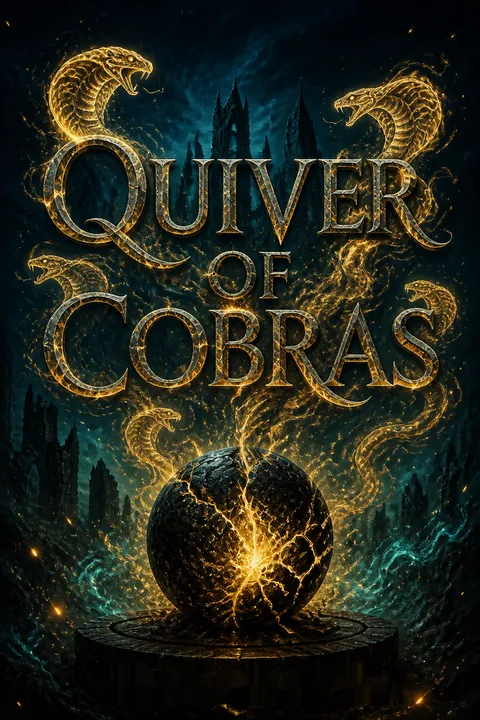


Plot Summary
Prologue
Before her memory vanished, Madrona watched Morgan from across the street, still trapped in Rubus’s service and trying to keep the dangerous dragon sphere out of his hands. When Charrie, a bogle working for Rubus, reported that the dragon Chen had died and that the sphere was missing, he explained that Rubus would torture his family to uncover its hiding place.
Charrie was already dying of cancer, so he chose to take a memory-erasing potion and die before Rubus could force the secret from him. Madrona prepared a rowan-coated sword and the potion, but Charrie drank the baneberry that would kill him before she could persuade him to choose another plan.
The prologue makes secrecy an act of care that requires its participants to destroy their own lives. Charrie’s decision protects his children and the wider human population, but it leaves Madrona carrying a task she cannot remember choosing. Her insistence that she should take the risk instead reveals a familiar moral reflex: she treats self-sacrifice as the only reliable form of goodness. The memory potion complicates the idea of accountability. Forgetting may shield Madrona from unbearable knowledge, yet it also deprives her of the context needed to judge herself and act deliberately.
The Madhatter Plays Along
Ten days after losing her memory, Madrona finds herself under the control of Rubus, a faery leader determined to seize Chen’s sphere and use it to reopen the road home, even if the magic destroys humanity. On a rooftop, Rubus tests her by handing her a brick to drop onto pedestrians. She throws it wide, preserving her cover without killing anyone.
Morgan, Rubus’s brother and her former partner, secretly reaches her in a restroom and confirms that the sphere is safe, though Jinn has died. Morgan offers to take her away. Madrona refuses: Rubus has another plan, and she believes staying close to him is the only way to discover it. Her first act of loyalty is therefore a performance, but the danger is real.
Madrona’s amnesia separates her present choices from the history that might explain them, but it does not make her morally blank. She still refuses to let Rubus turn an ordinary street into a killing ground, then chooses danger over immediate safety because she sees an unfinished threat. The decision also exposes the cost of her strategy: Morgan reads her continued proximity to Rubus as a possible romantic choice, while she regards it as necessary intelligence work. The story begins with her trying to act ethically through a persona designed to look cruel, a contradiction that will repeatedly test whether performance can remain separate from character.
A Trap in the Laboratory
Rubus explains that a magical truce prevents faeries from harming one another, though it leaves creatures such as bogles and Redcaps outside its protection. He sends Madrona to Carduus, an apothecary, hoping to recover her memories.
In the laboratory, Galanthus secretly claims to serve Morgan and urges her to drink a potion and flee. Madrona recognizes the encounter as a loyalty test, names Galanthus to Rubus, and admits that she has already met Artemesia, Carduus’s estranged niece.
She even reveals where Artemesia had been hiding, confident that the apothecary will be too late to catch her. Rubus is impressed by her apparent ruthlessness, but his request that she bring him Julie, a soap actor, gives Madrona a new task and another person to protect.
This sequence shows Madrona using disclosure as camouflage. She gives Rubus enough truth to appear useful, yet her amnesia prevents her from knowing whether the old Madrona would have made the same calculation. The laboratory’s false escape route also makes trust a staged commodity: Rubus manufactures disloyalty so he can reward her for exposing it. His control depends less on physical confinement than on keeping every relationship suspect. Madrona’s quick reading of the trap grants her temporary freedom, but it leaves Artemesia exposed and turns strategic cleverness into a source of guilt rather than uncomplicated triumph.
The Safe Behind the Wall
A taxi driver’s account of a recent fire sends Madrona to Chen’s ruined building. Morgan appears there independently, and together they use faery magic to reconstruct the rooms’ former surfaces.
The glamour reveals a gap where a safe had been built into the wall, evidence that someone removed it before the fire consumed the house. Morgan gives Madrona a shell that lets them communicate securely, then urges her to learn whether Rubus took the safe. The discovery changes the problem: the sphere may not be the only dangerous object Chen kept.
Madrona returns to Rubus’s hideout with a new lead, while their growing intimacy remains unsettled by her past engagement to Morgan and the possibility that her previous abandonment of him was not freely chosen.
The reconstructed room offers a useful image of memory’s limits: magic can restore the visible arrangement of a place, but it cannot recover what was removed or explain why. Madrona and Morgan can identify absence more easily than intention. Their partnership likewise depends on reading gaps, since neither can rely on her missing memories to settle the history between them. The shell is both practical intelligence equipment and an invitation to remain connected. By linking romance to investigation, the scene makes intimacy consequential: each of them must decide whether the other’s actions are evidence of affection, strategy, or both.
Lunaria’s Secret Search
Madrona takes Rubus’s devotee Lunaria shopping, trying to keep the woman close while quietly probing her loyalties. A rooftop follower escapes her pursuit, and Madrona later learns from Artemesia that her old self had been engaged to Morgan before abruptly joining Rubus.
A note from an unknown ally warns that Lunaria is searching for video evidence. Madrona finds CCTV recordings on Lunaria’s laptop: she is checking golf courses for footage from the night Madrona lost her memory.
Madrona and Morgan return to the course to retrieve the recordings, but the files from that night have been corrupted after someone downloaded them. The intruder, Mendax, confronts the group and shows a photograph of Madrona standing over Charrie’s body with a sword.
The investigation turns memory loss from a private wound into a public vulnerability. Madrona can neither confirm nor deny what the image proves, so she must face the possibility that her self-conception is being built around missing evidence. Lunaria’s surveillance also reveals how Rubus governs through delegated suspicion: even a devoted follower can be made an investigator of the people nearest him. The photograph is not a full account of Charrie’s death, but it is powerful precisely because it appears to settle the question. The scene forces Madrona to distinguish evidence of an action from knowledge of its motive.
A Murder in the Frame
Mendax claims he is a dragon and Chen’s friend, seeking the sphere so he can destroy it. He says Madrona killed Charrie, and the image on his phone makes her fear that the accusation is true. He also admits to taking Chen’s safe and burning the building, where he found an oath-breaking magical branch.
Mendax offers an exchange: Morgan must obtain Rubus’s inherited ring, and Mendax will provide the branch and the video. The group debates whether a dragon can be trusted, but the sphere cannot safely remain hidden forever. Madrona accepts the need to pursue the bargain, even as the image deepens her shame and Morgan’s uncertainty about what she may have done.
Mendax makes proof itself a bargaining chip. The image gives him leverage over Madrona, while his claimed ability to destroy the sphere gives him leverage over the group’s fear of future catastrophe. Neither form of authority is neutral: visual evidence can be incomplete, and a promise can conceal its own agenda. Madrona’s willingness to keep acting despite the possibility that she murdered Charrie signals a shift from innocence-seeking to responsibility-taking. She cannot restore a clean identity by denying the evidence. She can only decide what to do with the dangerous choices still in front of her.
The Fault Behind the Borders
After finding a chest of pixie dust and returning it to Rubus, Madrona hears his account of the past. He claims that, at nineteen, she cast a spell intended to close the borders between demesnes for forty-eight hours; instead, the borders stayed shut, trapping the faeries in this world.
He says she confessed the truth to him and that he used the threat of telling Morgan to force her away from her fiancé and into his service. A Truth Spider on Rubus confirms that he believes this account. Madrona now understands why the homesick faeries follow him, but she also sees how he turns her guilt into control. The revelation leaves her less certain that self-punishment is the same as responsibility.
The revelation gives Madrona’s guilt a concrete origin, but it does not make guilt a reliable guide to action. Her youthful spell caused a catastrophe without the intended duration, while Rubus converted the mistake into a means of possession. His coercion works because Madrona already seems inclined to treat suffering as a fair sentence. The distinction between causing harm and choosing what happens next becomes central: Rubus uses an old consequence to excuse present danger, whereas Madrona must decide whether accountability means repeating his logic or interrupting it. Her lack of memory makes that distinction emotionally difficult, not ethically impossible.
Selling Dust, Choosing Allies
To strengthen her position with Rubus, Madrona agrees to sell pixie dust, an addictive drug that eases homesickness. Lunaria accompanies her, and Madrona makes the woman take a sample to persuade Paeonia, a librarian, to accept the dust. She uses the moment to enlist Paeonia in contacting Artemesia and warning Vandrake, a former addict.
At the Travotel, Begonius, who prefers his human life and its small responsibilities to a return home, confirms that Vandrake has reached Morgan. Madrona gives Begonius dust despite knowing the risk, then finds Artemesia and admits that she caused the border crisis. Morgan accepts her remorse without treating it as a reason to abandon her; she asks him only to hold her, and he does.
Madrona’s undercover work becomes morally costly when she uses addiction as both a tool and a threat. She tells herself that each compromised choice serves a larger rescue, yet Lunaria and Begonius bear immediate consequences. Their different responses expose the limits of a simple homecoming ideal: one fears relapse, while the other values the ordinary purpose he has built in exile. Madrona’s confession to Artemesia marks a change from using secrets to gain trust toward surrendering one to share responsibility. Morgan’s embrace does not absolve her. It gives her enough emotional steadiness to continue without confusing punishment with repair.
Julie’s Dangerous Dinner
Madrona arranges a dinner between Rubus and Julie, hoping to distract him and get his pinky ring out of his possession. She persuades him that Julie dislikes jewelry, so he leaves the ring in his car’s glove compartment. During dinner, Julie reveals that she is a vampire and that the men Rubus attacked were hunters, not ordinary stalkers.
Madrona interrupts before Julie can expose more, but Rubus’s interest shifts from suspicion to fascination. Morgan takes the car and retrieves the ring. While Finn watches the restaurant with Madrona, she makes a false emergency call that brings police inside and draws Rubus into a confrontation; he is arrested. The diversion gets Julie away safely and gives Morgan the object needed for the exchange.
The dinner is a collision between performance and disclosure. Julie uses her acting skill to make herself seem harmless to Rubus, then deliberately reveals enough to redirect his attention. Madrona’s own performance is more instrumental: she exploits Rubus’s vanity, then stages a police emergency to secure the ring and separate him from Julie. The maneuver succeeds, but its collateral damage is real, including frightened diners and misuse of emergency services. The scene refuses to make cleverness morally pure. Madrona is effective because she can manipulate a room; the question is whether she can remain accountable for the people used to shape it.
The Branch Takes Hold
Mendax trades the oath-breaking branch for Rubus’s ring. Artemesia identifies the red object as a branch that can break the truce only between blood relatives, meaning Morgan must use it against his brother.
The group fears what this might unleash, but believes they need Rubus vulnerable before the sphere can be destroyed. They stage a public rejection: Morgan appears to propose to Madrona, she refuses, and he throws the branch at Rubus. It attaches to Rubus’s face, and he grows visibly weak.
Madrona rushes after him to preserve her cover. Rubus then orders his followers to abandon the hideout, leaving her behind to guard his belongings. She cannot tell whether the truce has truly broken or whether their apparent success has opened a new danger.
The branch turns a family tie into a weapon, making kinship both the route to protection and the route to harm. Morgan’s staged proposal uses the couple’s painful history as cover, but the public rejection still presses on feelings neither can neatly fake. More importantly, the group treats the branch as a tactical instrument without knowing its full consequences. Their gamble illustrates how an apparently bounded solution can shift the balance of power rather than remove danger. Madrona’s return to Rubus’s side is not a simple betrayal of Morgan; it is the final stage of a plan whose reliability remains uncertain.
The Dragon Was Rubus
Alone in the emptied hideout, Madrona breaks into Rubus’s bedroom and finds a medical kit, black contact lenses, and a vial that burns like rowan. Beneath his laundry she discovers Chen’s stolen safe. The clues connect: Rubus had been injecting rowan to sustain a glamour, using Madrona’s account of her own poisoning to impersonate Mendax.
Carduus’s supposed sphere-locating potion was another deception, meant to make Morgan hand the sphere to Rubus. Madrona runs for the library, where Morgan is preparing to give the sphere to the supposed dragon. She slows time to reach them, but the magic nearly overwhelms her. At the last moment, she snatches the sphere away and identifies the impostor before it can change hands.
The twist works because it makes earlier details newly legible rather than replacing them: Rubus’s illness, the lenses, Carduus’s guarded supply, and the claimed dragon’s voice all become parts of one sustained deception. Madrona’s discovery also reverses the power relation established by her amnesia. She has been manipulated because she thought she was the strategist; now she acts on evidence she assembled herself. Her use of time magic is both resourceful and dangerous, echoing the older mistake that caused the borders to close. The scene asks whether agency can be reclaimed through the very power that once escaped control.
The Sphere Stays Unclaimed
Rubus drops the dragon disguise and reveals that the oath breaker has released him from the truce, while Morgan and the other faeries remain bound by it. He takes a gun and threatens to use the sphere to flood the world with magic, dismissing the deaths of humans as acceptable. Finn tackles him, but the faeries close in and armed police arrive.
Madrona takes the sphere, then grabs the gun and draws the officers’ attention, deliberately creating a chance for the object to be held as evidence rather than handed to Rubus. She slows time long enough to explain her plan to Morgan. When time resumes, a police bullet strikes her. The story ends as she loses consciousness, with the sphere still secured for the moment and Rubus’s fate unresolved.
The climax converts Madrona’s recurring self-punishment into a deliberate tactic, but does not let the tactic become uncomplicated heroism. She engineers the police response because she believes the evidence process can keep the sphere away from Rubus, while also deciding that her own body is expendable. Her choice protects others in the immediate crisis, yet repeats the pattern Charrie established in the prologue: one person absorbs the cost so many others might survive. The unresolved ending leaves open whether this is courage, guilt, or both. It also keeps the central ethical question alive: saving a world should not require treating its defenders as disposable.
Analysis
Quiver of Cobras builds its conflict around the difference between wanting a home and having a right to return to it at any cost. Rubus offers the exiled faeries a vivid promise: an end to homesickness and a route back to Mag Mell. The cost is borne by humans who have no part in the faeries’ exile. His followers are not simply foolish; many are responding to a real, prolonged ache. That makes the political danger more persuasive than a villain’s arbitrary desire for power.
Madrona’s amnesia gives this ethical conflict a psychological shape. She cannot use memory to reassure herself that she has always been good, nor can she rely on a complete account of her past wrongdoing. Other characters offer competing versions of her: Rubus frames her as naturally ruthless, Morgan sees the possibility of a better self, and the evidence of Charrie’s death forces her to consider what she may have done. The book’s answer is not that identity is fixed or that forgetting erases responsibility. Madrona becomes accountable through what she chooses under pressure.
Her humor and theatrical cruelty help her survive Rubus’s organization, but they also risk making harm feel like a game. The pixie-dust episodes are especially sharp: Madrona uses addiction to demonstrate loyalty, then sees the people who bear the cost. Her good intentions do not erase their vulnerability. Julie’s independent resistance and Begonius’s attachment to his life in exile further challenge the idea that everyone wants the same rescue.
The ending complicates heroism by echoing Charrie’s self-sacrifice. Madrona tries to preserve the sphere and protect others by making herself vulnerable to the police, but the story stops before revealing whether her plan succeeds. That unresolved ending leaves the moral question open: sacrifice may be necessary in a crisis, yet a world should not depend on its most guilt-ridden people deciding they are expendable.
Review Summary
Quiver of Cobras received mixed reviews, with ratings ranging from 1 to 5 stars. Many readers enjoyed the humor and found Madrona's character entertaining, while others found her annoying and the plot lacking. Some praised the twist ending and character development, while others criticized the cliffhanger and pacing. Several reviewers noted the book's improvement over the first in the series, but some felt it dragged or relied too heavily on certain plot devices. Overall, opinions were divided on the book's merits and shortcomings.
Characters
Madrona
Amnesiac faery infiltratorMadrona wakes without the memories that would explain her relationships or choices, but she keeps her quick wit, appetite for provocation, and instinct to protect people in immediate danger. She adopts the Madhatter persona to convince Rubus she belongs in his organization, even as she investigates his plans for the sphere. Her sharp humor often masks discomfort with her own motives: she wants to be good, yet distrusts the idea that she deserves goodness. Her dynamic with Morgan carries both old intimacy and present uncertainty, while Rubus exploits her guilt and need for belonging. Madrona is compelling because her moral growth depends not on recovering a perfect past, but on making consequential choices without certainty about who she used to be.
Morgan
Principled faery leaderMorgan is Rubus’s brother and Madrona’s former partner, a patient leader who favors restraint over a reckless return to Mag Mell. His instinct is to protect people, including Madrona, but he struggles to separate that care from the temptation to decide what risks she should take. He offers her a secure way to communicate and works with her even when her choices frighten him. Morgan’s love for her is complicated by their history and her memory loss; he cannot rely on promises or shared recollection to rebuild trust. His steadiness is not passivity. He is willing to act forcefully when the danger demands it, though the consequences of acting against his family weigh on him.
Rubus
Charismatic faery insurgentRubus is Morgan’s brother and a persuasive organizer who promises the exiled faeries a way back to Mag Mell. He combines personal charm with coercion, using pixie dust, loyalty tests, and Madrona’s private shame to keep followers close. His ambition is bound to homesickness, but he treats the human world as expendable when its survival conflicts with his goal. Rubus understands that people want more than orders: they want purpose, relief, and the sense that sacrifice will lead somewhere. He uses those needs skillfully. His relationship with Madrona is possessive and psychologically manipulative, while his rivalry with Morgan turns their family bond into a political contest.
Charrie
Bogle with divided loyaltiesCharrie is a bogle who works within Rubus’s organization while remaining deeply concerned about the danger Rubus poses to the human world. He trusts Madrona enough to share the crisis surrounding Chen’s sphere and asks her to help protect it. His loyalty is practical as well as moral: Rubus can threaten his family, and Charrie knows that hesitation carries consequences. His choices reveal the vulnerability of magical beings who are not protected by the faery truce.
Finn
Grieving Redcap protectorFinn is a Redcap and Julie’s fierce protector, blunt enough to turn grief into anger and suspicion. He distrusts Madrona because her actions have entangled her with the deaths and dangers around Rubus, yet he still joins the effort to keep the sphere away from him. His physical strength contrasts with his emotional exposure: the loss of family leaves him with few ways to express fear except hostility. Finn is not bound by the faery truce, which makes him a valuable ally and a potential source of escalation.
Julie Chivers
Vampire soap actorJulie is a famous actor and a vampire whose apparent glamour conceals a life under threat from hunters. She is resourceful, practiced at reading people, and unwilling to let others define her as someone who must simply be protected. Her decision to approach Rubus reflects her desire to defend the only home she knows, even when Madrona fears the danger. Julie’s professional skill is more than a disguise: she uses performance deliberately, choosing what to reveal and when. Her bond with Finn is protective, while her friendship with Madrona combines affection with a refusal to obey blindly.
Artemesia
Independent faery apothecaryArtemesia is Carduus’s niece, a skilled apothecary who keeps her work and location guarded. She distrusts Madrona for understandable reasons, especially when Madrona’s attempts to win Rubus’s confidence put other people at risk. Still, Artemesia is intellectually curious and willing to revise her judgment when new information changes the problem. Her expertise offers alternatives to Rubus’s coercive use of potions and pixie dust. She is a practical ally, not a devoted follower, and her independence keeps the group from mistaking loyalty for agreement.
Lunaria
Devoted faery followerLunaria is a tall faery in Rubus’s circle whose devotion to him shapes her self-image and hopes for the future. She is warm, eager to please, and hungry for recognition, qualities that make her vulnerable to both Rubus’s attention and his promises of homecoming. Madrona sees her as a useful companion at first, but Lunaria’s insecurity forces Madrona to confront the human cost of treating people as tools. Her capacity for doubt is present beneath her enthusiasm, even when she struggles to act on it.
Carduus
Rubus’s apothecaryCarduus is Artemesia’s uncle and a potion maker who serves Rubus’s organization. He is proud of his laboratory and treats magical knowledge as a source of authority, although his confidence exceeds his practical skill. His work is shaped by obedience to Rubus and competition with his niece, whose expertise he resents. Carduus’s experiments connect the political struggle to the intimate mechanics of addiction, memory, and disguise.
Mendax
Reclusive dragon claimantMendax is an elderly, oddly voiced figure who claims to be a dragon and a close friend of Chen. He follows Madrona, possesses evidence about the night of her amnesia, and bargains with Morgan over a magical object. His suspicion of the faeries is matched by their suspicion of him, so every exchange becomes a negotiation over what can be proven. Mendax’s attachment to Chen and his interest in the sphere make him a consequential outsider to the feud between Rubus and Morgan.
Begonius
Homesick hotel keeperBegonius works under the human name Timmons at a Travotel, where he has built a modest life and sense of authority. He misses Mag Mell but does not assume that returning home would make him happier. His conflict exposes a different kind of exile: the pain of longing for home alongside genuine attachment to the place and work one has found elsewhere.
Paeonia
Librarian with resolvePaeonia is a faery librarian who has considered taking pixie dust but also understands the danger of becoming dependent on it. Madrona asks her to carry information to other allies, and Paeonia’s willingness to help shows a capacity for courage that is not built on power or status. Her work makes her an important link between the hidden resistance and everyday life in the city.
Vandrake
Recovering dust userVandrake is a faery with a history of pixie-dust use who attends recovery meetings. His struggle makes the drug’s promised relief concrete: it can soften homesickness while creating a new dependence. He represents someone whose safety requires distance from the people selling the substance.
Jinn
Finn’s Redcap brotherJinn is one of Finn’s brothers and part of the Redcap resistance around Rubus. His connection to Finn gives the conflict a family cost beyond the rivalry between the faery brothers. Jinn’s presence in the events surrounding Julie and Madrona helps explain why Finn’s protection often comes edged with grief.
Winn
Finn’s Redcap brotherWinn is Finn’s brother and a practical member of the Redcap group. He is associated with the careful preparation that lets the Redcaps operate around Rubus’s organization. Through Finn’s attachment to his brothers, Winn helps establish the close family loyalties that make the conflict personal.
Amellus
Rubus’s loyal guardAmellus is a faery enforcer who guards Rubus and believes in his promise to lead the exiles home. He is suspicious of Madrona and protective of the organization’s hierarchy. His loyalty illustrates how Rubus’s cause is sustained not only by addiction but by followers who see discipline and obedience as proof of hope.
Plot Devices
Chen’s dragon sphere
A world-changing power sourceChen created the sphere as a magical object capable of drawing in power from other places. Rubus wants to use it to reopen the route to Mag Mell, but doing so would flood the human world with magic and threaten its inhabitants. Morgan and Madrona seek to keep it from Rubus, while Mendax claims the sphere should be destroyed. Its danger is not merely that someone might possess it, but that the faeries’ homesickness makes its catastrophic promise emotionally persuasive.
The faery truce
A magical limit on violenceThe faeries bound themselves to a truce that prevents them from harming one another. Creatures such as bogles and Redcaps are outside its protection, giving Rubus leverage over those who serve him. The truce shapes every confrontation: Madrona cannot simply attack Rubus, while non-faery allies can act more freely. Its apparent permanence makes the discovery of an oath-breaking branch especially dangerous, because changing who is protected may shift the entire balance of power.
Madrona’s amnesia
A past hidden from its ownerMadrona’s lost memories leave her dependent on other people’s accounts of her former relationships and choices. She remembers skills and instincts but not why she joined Rubus, abandoned Morgan, or came to the golf course. The gap makes her vulnerable to manipulation, while also allowing her to judge present actions without the certainty of a fixed self-image. Evidence, magical clues, and other characters’ recollections gradually reconstruct parts of the past without resolving every question.
Truth Spiders
Pain-backed truth extractionRubus uses magical spiders to force answers from people who lie while the creatures are on them. Their threat lets him bypass the faery truce and reach secrets through pain rather than trust. The spiders also shape how Madrona and her allies communicate: even accurate knowledge can become dangerous if Rubus gains access to the person holding it. When Rubus places one on himself to support a revelation, the creature serves as apparent proof, though it cannot guarantee that the larger account is complete.
The oath-breaking branch
A loophole with a blood priceThe red branch is a magically charged object that can break the truce only when used by one blood relative against another. Mendax presents it as a way for Morgan to make Rubus vulnerable, and the group treats it as a tool for removing Rubus from the crisis. Its restriction is crucial: it does not free every faery from the truce, but it changes the rules for the brothers. Using it produces consequences the group has not fully understood.
The Fractured Faery Series Series
About the Author
Other books by Helen Harper


Download PDF
Download EPUB
.epub digital book format is ideal for reading ebooks on phones, tablets, and e-readers.








