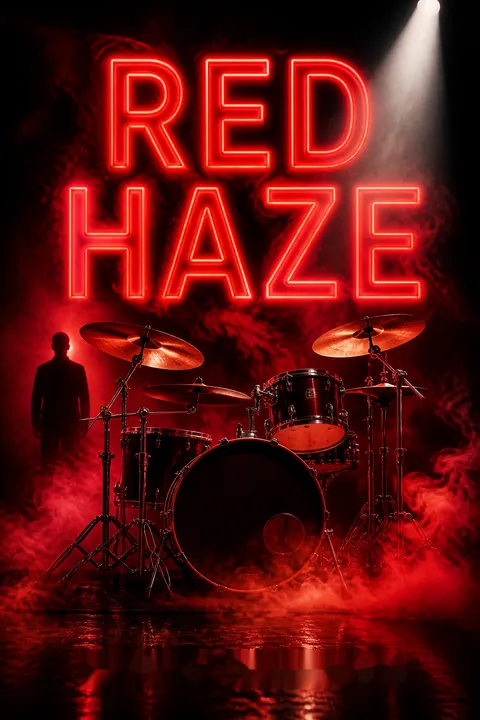


Plot Summary
The Drummer Who Drowned
At eighteen, Caffeine Daydreams' drummer Arlo Beckett wakes after missing another show, drunk and convinced his bandmates have finally had enough. Their sudden fame has given him money and escape from the abusive estate where he grew up, but freedom feels like another thing he can lose. Bassist Silas recognizes that Arlo is trying to ruin his place in the band before anyone else can take it from him.
Singer Luca and guitarist Kai promise that the four of them will not replace him. Arlo agrees to try harder, yet privately believes he is a burden and hides how close he feels to giving up. Years earlier, a college open day and an empty drum kit brought him to the three friends who became his refuge.
Arlo's self-sabotage is not simple youthful excess. He has learned to treat security as temporary, so he tries to control abandonment by causing it himself. The band offers an alternative model of attachment: Luca, Kai, and Silas refuse to make his worth conditional on flawless performance. Yet their reassurance cannot immediately undo the private shame that makes Arlo feel less essential than the others. Music gives him a place in a group, but depression leaves him unable to trust that belonging will last. His drumming holds the band in time while he cannot imagine anyone holding him.
A Guard Named Jack
When the band's new manager, Kevin Hale, assigns ex-SAS soldier Jack Stokes to Arlo, the drummer is immediately attracted to him. Jack's strict protection soon feels like babysitting: he interrupts hookups, pushes water on Arlo, and cuts nights short when he thinks the singer is too drunk. Arlo retaliates by lying about visiting his parents, slipping away from Jack, and using cocaine at a club.
Jack finds him in a compromising situation and, angry at the drugs and public risk, calls him spoiled and undeserving of his success. Arlo answers that Jack has no idea what he survived. The discovery that Arlo's childhood was not the privileged story Jack assumed forces Jack to question his briefing and his own judgment.
The club confrontation turns a professional disagreement into a collision between two survival strategies. Jack trusts observation, control, and risk reduction; Arlo has learned to use defiance to preserve agency when other people have controlled his body and choices. Jack's mistake is not merely factual. By reading visible recklessness as entitlement, he repeats the logic that has taught Arlo to hide pain. Arlo's blunt correction unsettles that story, but neither man is ready to discuss what lies beneath it. Attraction makes the conflict more charged, while their unequal roles give Jack's protective instincts real power over Arlo's freedom.
Christmas at Arlo's
Jack's own past explains why he understands danger but struggles with intimacy. After twelve years in the military, he left the SAS following a mission in Kabul where his friend Mike was killed and fellow soldier Corey was devastated by the loss.
Assigned to Arlo, Jack initially sees only the unreliable young star described by Kevin. He changes his mind after their argument and begins noticing Arlo's withdrawn days, tapping fingers, and attempts to conceal distress.
When he learns Arlo will spend Christmas alone, Jack cancels his family visit and arrives with food from a petrol station. Arlo lets him in. Their holiday becomes the first of several private traditions, turning a guarded work arrangement into a friendship neither man names aloud.
Jack's competence has been shaped by a world where vigilance can keep people alive, but Mike's death shows him the limits of that competence. He has chosen emotional distance as protection against another devastating attachment. Arlo's loneliness draws him across that boundary through a small, practical act rather than a dramatic confession: Jack brings food and stays. The gesture matters because it gives care a routine, and routine becomes a form of trust. Their holiday traditions begin to resemble family life, even as Jack's refusal to explain himself and Arlo's hunger for attention leave the relationship uneven.
Cash for His Parents
At twenty-three, Arlo secretly returns to the estate carrying cash after his parents demand fifty thousand pounds and threaten to expose him to the press. He has paid them off before, ashamed that their control persists despite his fame, and hopes one more payment will protect the band. Jack notices Arlo's lies and follows him to the flat.
Inside, Arlo's father and two men have him pinned while his mother gathers the money. Jack breaks in and attacks the father after seeing bruises on Arlo's throat. When the other men run to summon help, Jack gets Arlo out and drives them away. Arlo is furious that Jack fought for him without permission, but Jack insists on accompanying him whenever his parents threaten him again.
The return to the estate reveals that wealth has changed Arlo's circumstances without erasing the coercive bond of childhood. He pays not because he believes his parents deserve the money, but because their threats reach the only thing he trusts, his place in the band. Jack's intervention protects Arlo physically, yet it also risks reproducing the very loss of control Arlo fears. Their disagreement exposes a central tension: care can be real and still become paternalistic when the cared-for person is not allowed to choose. The rescue deepens their intimacy while making Jack's protectiveness more difficult to keep within professional bounds.
Protection Becomes Intimacy
After the assault, Jack arranges a restraining order against Arlo's parents and becomes increasingly involved in his daily life. He researches mental-health care, brings Arlo to a psychiatrist, and stays with him through a diagnosis of severe depression and the adjustment to medication.
Arlo's bandmates still do not know the full extent of his illness, but Jack becomes his dependable support, often sleeping at Arlo's home and sharing holidays and late-night games.
Years later, when Arlo's frustration and loneliness spill into a night of smoking and reckless behavior, he tells Jack what kind of sexual intimacy he wants. Jack, who has never understood his own limited attraction, agrees to help him reach orgasm. Arlo experiences the encounter as a long-awaited opening; Jack thinks of it as protection.
The care Jack provides has tangible benefits: Arlo receives treatment, gains language for his depression, and no longer faces every bad day alone. At the same time, the arrangement concentrates too much of Arlo's emotional life in one person, while Jack's identity narrows around keeping him safe. Their first sexual encounter makes the imbalance unmistakable. Arlo approaches it through desire and hope; Jack rationalizes his participation as another protective service. The scene is not a mutual misunderstanding in equal measure, because Jack has more power to define what their intimacy means. His tenderness is genuine, but his failure to ask what Arlo needs leaves tenderness capable of hurting him.
Kevin Finds the Door
Arlo and Jack repeat their sexual encounters, while Jack continues to clean him up and return to ordinary routines as if nothing emotional has changed. Arlo grows more attached and uses the intimacy to quiet the criticism he faces from Kevin and the label, who pressure him to take on more promotional work.
After a difficult meeting, Arlo pulls Jack into a storage cupboard for comfort. Kevin discovers them. Jack sends his former SAS friend Corey to stay with Arlo, then meets Kevin alone.
Kevin reveals he has compromising photographs from an earlier club encounter and can use them to get Arlo fired. To keep Arlo in the band, Jack accepts reassignment to Luca, agrees to end their personal relationship, and secures a contract change requiring band approval before a member can be dismissed.
The photographs convert private vulnerability into institutional leverage. Kevin can threaten Arlo because the label values his marketability unequally, especially when his sexuality can be framed as scandal. Jack's sacrifice appears protective, but he repeats his most damaging habit: making a decision for Arlo without sharing the facts. His contract condition shows that he does understand the structural danger and tries to limit it, yet secrecy deprives Arlo of any chance to choose alongside him. For Arlo, the reassignment feels like rejection because Jack presents it as a personal decision. The resulting rupture is caused less by lack of love than by Jack's belief that love must operate through unilateral control.
Four Years Apart
Jack tells Arlo that their friendship must end, and Arlo loses the person who had become his closest support. His bandmates help him through a depressive episode, and he eventually tells them about his diagnosis and Kevin's pressure.
They challenge the contract clause, secure a change, and refuse to let the label isolate Arlo in solo meetings. Jack, meanwhile, stays assigned to Luca and hides his continued concern behind professional distance.
At a later party, Arlo needles Jack about finding someone else and finally states that he wants Jack in his life, but will not accept their cycle of jealousy and silence indefinitely. Jack cannot answer. Six months later, Arlo has blocked his messages, while threatening letters and photographs from an unknown stalker begin to make his home feel unsafe.
Separation makes visible what the earlier relationship concealed: Arlo has a network beyond Jack, and that network can hold him through illness and professional pressure. The band's intervention corrects the isolation Kevin exploited, while Arlo's boundary with Jack marks a shift from pleading for scraps to naming what he wants. Jack's continued watchfulness, including his private attention to Arlo's routines, is care without accountability. The stalking plot then puts pressure on that unresolved distance. Arlo needs protection, but cannot simply return to Jack's orbit without risking the emotional dependency he has worked to survive.
The Gallery Host
Arlo's stalker sends increasingly threatening letters, bypasses his home security, and leaves an envelope at his door. The police find little evidence, so Arlo's friends and guards add cameras and plan extra protection for a fundraiser supporting Louis's youth work.
Arlo insists on attending rather than allowing the threats to dictate his life. At the gallery, host Duncan Smith draws him aside and reveals that he has been sending the letters. He resents Jack for once stepping between them at an earlier event and interprets Arlo's easy warmth with Jack as humiliation.
Duncan has hidden a weapon and threatens to take Arlo away. Arlo uses the agreed code word in a casual-sounding sentence, alerting his guards that he is being coerced without provoking Duncan.
The fundraiser brings Arlo's public life and private vulnerability into the same room. His choice to attend resists the shrinking of his world, but the event's social polish also gives Duncan cover: he can approach as a respected host rather than an obvious threat. His fixation grows from a remembered slight into a fantasy of possession, transforming Arlo's ordinary kindness toward Jack into evidence in a story Duncan has invented. The code word is a practical device that returns agency to Arlo under surveillance. He cannot openly ask for rescue, so he communicates danger through a phrase that only trusted people know how to hear.
Jack Takes the Feed
Arlo's guards try to separate him from Duncan, but Duncan keeps a weapon concealed and forces Arlo to appear willing to leave. Outside the gallery, Jack monitors camera feeds from a Phoenix security van.
Recognizing Duncan from a previous confrontation with Arlo, he alerts the team and coordinates the exits, evacuating the other guests while guards track the pair. When Arlo delivers his code word, the team understands that he is being held against his will. They surround Duncan near his car and discover that his supposed gun is a bottle.
Jack disables him, and the guards restrain him before he can take Arlo. Shaken, Arlo runs into Jack's arms. Jack then steps aside as Arlo's bandmates crowd around him, refusing to make the rescue another claim on Arlo.
Jack's remote role forces him to protect Arlo without using the familiar shortcut of taking over physically. His coordination depends on trusting the team and interpreting Arlo's signal, not simply overriding him. The staged weapon creates uncertainty, but the guards wait until they can act without putting Arlo in greater danger. Their restraint contrasts with Jack's earlier violence at Arlo's parents' flat and shows that protection can involve disciplined collaboration. Jack's decision to withdraw after the rescue is equally important: he recognizes that Arlo's friends, not his own possessiveness, should shape the immediate comfort Arlo receives.
Released Without Charge
The police release Duncan without charge, saying the available footage and the guards' account cannot prove that Arlo was forced to leave the gallery. With Duncan still dangerous, Arlo's friends arrange for him to hide in a remote Welsh cabin owned by Corey.
Jack offers to accompany him, and Arlo chooses him over the other Phoenix guards. On the drive, Jack explains that he has realized he is demisexual: attraction comes for him through emotional connection, and Arlo is the only person he desires.
Arlo remains wary because Jack has misunderstood their intimacy before, but hears him promise that he wants a relationship, not simply another chance to protect him. At the cabin, Jack searches the property and finds photographs of Corey and Mike, revealing the place's history as their shared retreat.
The police decision shifts the story from public protection to self-protection. Arlo must leave his home because the system cannot act on a credible danger until it can prove one, and the cabin becomes both refuge and forced proximity. Jack's account of demisexuality gives his past behavior a new explanation, but it does not erase the harm of how he treated Arlo. The distinction matters: a label can clarify desire, yet trust depends on conduct over time. Finding Mike's photographs also brings Jack's grief into the refuge, reminding him that intimacy has always carried the risk of loss.
The Truth About Kevin
At the cabin, Arlo and Jack begin a more reciprocal sexual relationship, with both men asking for reassurance and responding to the other's boundaries. Afterward, Jack tells Arlo that Kevin blackmailed him with the photographs and threatened both their careers.
Jack accepted reassignment to Luca and pretended the separation was his own choice, believing that preserving Arlo's place in the band mattered more than preserving their bond. He also reveals that he spent holidays parked near Arlo's house, unable to stay away completely.
Arlo is furious that Jack decided what he could survive without telling him, but understands that Jack acted from fear rather than indifference. He tells Jack that he has loved him all along, and Jack returns the confession.
The revelation reinterprets the separation without absolving it. Jack's secrecy was intended as sacrifice, but it turned Arlo into the object of a decision rather than a partner in it. Arlo's anger acknowledges that good intentions do not cancel consequences; his willingness to remain acknowledges that accountability can open a path back. Their new sexual reciprocity matters because it reverses the earlier pattern of Arlo giving while Jack defined the encounter. The emotional center is not a sudden cure for distrust. It is the possibility of choosing one another with fuller knowledge, including the knowledge of how badly they have failed each other.
Duncan Finds the Cabin
For several days, Jack watches Duncan's home through Phoenix surveillance while Arlo and Jack settle into the cabin and rebuild their relationship. Then the police force Phoenix to stop monitoring Duncan, after he accuses them of harassment.
Jack worries Duncan may already be moving, and soon the cabin's proximity alarms register someone approaching. Duncan arrives with a real gun and searches for Arlo. Jack sends Arlo into the concealed crawl space behind the bookcase, then tries to disarm Duncan alone.
Duncan taunts Arlo through the room, and Arlo, unable to bear the thought of Jack being shot, opens the hiding place. Jack attacks before Duncan can aim at him, wrestles away the gun, and beats him until Arlo reaches him and stops him. Duncan is dead, and Jack fears he will face a murder charge.
The attack turns Jack's protective instinct into a moral and physical crisis. Arlo's hidden space offers safety only while he can tolerate being separated from Jack, so Duncan's threat exploits the couple's deepest vulnerability. Arlo opens the bookcase not because he ignores the plan, but because Jack's life matters more to him than the plan's logic. Jack's violence is understandable in the immediate danger, yet his inability to stop after Duncan is incapacitated reveals how trauma and rage can overtake professional discipline. The scene makes protection inseparable from risk: saving Arlo may cost Jack his freedom.
A Favor for Sebastian
After Duncan's death, Jack expects the evidence at the cabin to lead to arrest. Arlo refuses to accept that outcome and contacts River, a bartender who had earlier offered unconventional help. River sends Sebastian, a severe-looking man who says he can remove the body and arrange the scene to resemble a fatal car accident.
He asks only for a photograph for his husband, a Caffeine Daydreams fan. Jack and Arlo accept, and Sebastian takes charge while they leave the cabin. Three months later, the police have not connected them to Duncan's death, and the couple has moved in together.
They remain alert to the possibility that the secret could surface, but Arlo is no longer facing the stalker alone. Jack travels with him on tour while building his security business with his former military friends.
Sebastian's intervention resolves the immediate danger through a morally compromised act rather than lawful justice. The book does not treat this as a clean victory: Jack and Arlo accept help that may bind them to people whose methods they cannot fully know. Their decision is shaped by a failed system that released Duncan and by Jack's fear of losing Arlo again. The three-month interval allows the romantic resolution to become practical: they share a home, establish security measures, and make room for Jack's independent work. The ending is hopeful, but it carries the cost of secrecy rather than pretending the cost has vanished.
A Home of Their Own
Two years later, Jack works at Phoenix and considers a security case involving actor Tristan Wells, while Arlo calls to hurry him home. The brief epilogue reveals that they married after returning from the cabin and are approaching their first anniversary. They have begun discussing children, a future Arlo once might have struggled to imagine after his childhood.
Jack has already researched adoption and baby equipment. He still watches over Arlo, but his care now sits inside a shared life rather than a one-sided professional duty. When Jack reaches home, Arlo is drumming in the basement, at ease in the music that first gave him a way forward. Jack settles in to watch, then joins him in the life they chose together.
The epilogue answers the opening's fear that Arlo is destined to drown alone, but it does not claim that love has cured depression or erased trauma. Arlo still plays, still has difficult periods, and depends on a broader circle of people as well as Jack. The significant change is that care is now reciprocal and chosen, not secured through secrecy or professional obligation. Their possible family represents a deliberate revision of inheritance: Arlo can build a home shaped by safety rather than fear. The return to the basement and the drums closes the story by reconnecting fame, friendship, and ordinary domestic life.
Epilogue
Two years later, Jack is building Phoenix while Arlo calls him home from work. They are married and nearing their first anniversary, and Arlo has raised the possibility of children. Jack has already begun researching adoption, imagining a family they can create with intention.
At home, Arlo is drumming in the basement, still anchored by music and supported through the difficult days by Jack and their friends. The former bodyguard now shares Arlo's life as a husband, not as the person solely responsible for keeping him safe.
The ending makes domestic life the measure of change, not celebrity or romantic intensity. Jack's security work continues, but he no longer has to make protection his entire identity; Arlo's music remains important, but it no longer has to carry him out of danger alone. Their discussion of children turns the damage of Arlo's upbringing toward a future he can help shape. The epilogue preserves the reality of depression while showing a meaningful shift in its conditions: Arlo has chosen relationships in which support can be shared rather than hidden or earned.
Analysis
Red Haze links romantic intimacy to the question of who gets to decide what safety means. Arlo has survived a childhood in which other people controlled his body and his access to security; his later fame changes his resources but not the reflex to hide need behind bravado. Jack's military training offers a contrasting survival logic: notice danger early, take responsibility, and act before anyone can be hurt. Their first bond flourishes through care, but the same impulse that makes Jack dependable also tempts him to make choices for Arlo. The novel's central rupture follows from that contradiction. Jack's secrecy preserves Arlo's career at the cost of his trust, showing that sacrifice is not automatically loving when the person supposedly protected has no say. The supporting relationships correct the couple's isolation. Luca, Kai, and Silas build a band culture that can withstand illness and conflict; Simon and the Phoenix team turn security into collaborative work. Arlo's depression is not treated as a puzzle solved by romance. Therapy, medication, music, friendship, and Jack's presence all matter, and none erases the condition. Jack's demisexuality likewise becomes meaningful not as a twist that guarantees compatibility, but as language through which he can understand a desire he had mistaken for a defect. The stalker plot externalizes the danger of confusing admiration with entitlement: Duncan's fixation turns an old rejection into a private permission structure. When lawful systems fail, Jack and Arlo accept an unlawful intervention, leaving their happy ending morally unsettled. Their future is hopeful because they begin choosing together, not because the past has been cleanly repaired. Love becomes credible when it includes disclosure, boundaries, shared protection, and the willingness to keep building a life outside the emergency.
Review Summary
Red Haze is a romance novel featuring Arlo, a drummer, and Jack, his bodyguard. Readers praise the emotional depth, chemistry, and character development, particularly appreciating the mental health representation and demisexual awakening storyline. Many found the slow-burn romance and pining satisfying, though some felt frustrated by the characters' lack of communication. The book includes cameos from other series, which delighted some readers but confused others. Overall, fans of the series found it a fitting conclusion, with strong themes of found family and self-discovery.
People Also Read






Characters
Arlo Beckett
The guarded rock drummerArlo is the drummer of Caffeine Daydreams, a working-class young man whose music offered escape from an abusive childhood and a place among friends. Fame gives him money but does not silence his depression or his fear that anything good will be taken away. He can be funny, impulsive, and fiercely loyal, yet he often disguises need as defiance and shame as self-sabotage. His attachment to Jack grows from years of practical care, but his deepest struggle is learning that accepting support need not mean surrendering control. Therapy, music, and the band's loyalty help him understand himself beyond the role of the unreliable one.
Jack Stokes
The watchful former soldierJack is an ex-SAS soldier who moves into personal security after military loss makes continued service impossible. He is disciplined, observant, and highly skilled at reading physical danger, but less able to name his own emotional needs. Grief over his friend Mike has taught him that attachment can end suddenly, so he tries to make devotion manageable by turning it into duty. His relationship with Arlo exposes the cost of that strategy: protection without communication can become control, and sacrifice without consent can wound the person it intends to save. Jack's growing understanding of his sexuality and emotional dependence challenges the rigid self-image he has relied on.
Luca
The band’s determined frontmanLuca is Caffeine Daydreams' ambitious lead singer and one of the friends who first welcomed Arlo into the band. His drive helped the group seize its sudden success, and his blunt loyalty makes him a forceful defender when management pressures Arlo. Luca can initially minimize what he does not understand about depression, but he is willing to listen and show up when Arlo needs him. His relationship with Ollie gives the band's found-family circle another model of committed affection.
Kai
The band's quiet guitaristKai is Caffeine Daydreams' guitarist, a steady presence whose care for Silas shapes much of his emotional life. He supports Arlo alongside Luca and Silas, offering practical loyalty rather than demanding that Arlo explain every struggle. His long, complicated closeness with Silas makes him particularly attuned to the pain of loving someone while believing that love cannot be returned. Kai's eventual partnership with Silas reinforces the band's sense of chosen family.
Silas
The bassist who understandsSilas is Caffeine Daydreams' bassist and the bandmate most willing to recognize the fear beneath Arlo's reckless behavior. His own childhood trauma gives him an instinctive understanding of why sudden success can feel precarious rather than liberating. He is close to Kai, whose reliable presence helps him feel grounded, and he offers Arlo a similar reminder that friendship can endure a bad period. Silas is calm in manner, but his empathy comes from hard-won knowledge rather than easy optimism.
Kevin Hale
The calculating managerKevin is Caffeine Daydreams' manager, experienced enough to understand the label's demands and self-interested enough to use them as leverage. He pressures Arlo to accept promotional work and treats the drummer's lower commercial profile as a problem to manage. Kevin's decisions are shaped less by personal loyalty than by protecting his own position. He understands the power of contracts and damaging publicity, making him a threat through institutional influence rather than physical force.
Corey
Jack’s guarded comradeCorey is Jack's former SAS teammate and one of his closest surviving friends. The military bond between them was forged through shared danger and the loss of Mike, leaving Corey wary of new attachments. He can seem severe and emotionally closed, but he responds when Jack asks him to look after Arlo. His quiet competence makes him a trusted member of the security circle, even when his past remains difficult to discuss.
Simon
Luca’s attentive guardSimon is Luca's personal guard and later part of Arlo's protection detail. He is tactful, observant, and willing to challenge Jack when professional care has become excessive. Simon respects confidentiality but does not confuse silence with safety; he pushes the people around Arlo to take the stalking threats seriously. His calm presence helps make security a shared responsibility rather than a burden Arlo must carry alone.
Ollie
Luca’s perceptive partnerOllie is Luca's partner, a perceptive and practical presence within the band's close circle. He contributes sharp observations when the group's security is tested and supports Arlo without treating him as fragile. His relationship with Luca adds warmth and stability to the found family surrounding the band.
Betty
The band's fierce managerBetty takes over as the band's manager after Kevin's tenure. Small in stature and formidable in temperament, she approaches the band with a protective, almost maternal investment in their safety and well-being. She advocates for stronger precautions when Arlo is threatened and supports the band's right to make decisions about its own staff.
Louis
Kai’s community-minded brotherLouis is Kai's brother and a tattoo artist who uses his business to support young people from impoverished backgrounds. He develops a work scheme for them and insists on raising funds through a public fundraiser rather than relying entirely on his famous friends. His commitment gives Arlo a concrete way to turn memories of his own childhood into help for others.
Will
Jack’s perceptive teammateWill is one of Jack's former military friends and a partner in Phoenix. He combines a friendly manner with sharp judgment, and he is willing to challenge Jack when self-protection has become cowardice. Will helps Jack consider asexual-spectrum identities and recognize that his attraction to Arlo is connected to emotional intimacy. His candor gives Jack a way to understand himself without treating difference as damage.
Alex
Phoenix’s precise strategistAlex is Jack's former military teammate and a Phoenix partner whose polished manner conceals decisive competence. He helps coordinate security and challenges Jack when grief or romantic fear distracts him from a dangerous situation. Alex values clear thinking and direct action, making him an important counterweight to Jack's tendency to shoulder responsibility alone.
Duncan Smith
The polished gallery hostDuncan is an influential gallery owner and fundraiser host whose social standing gives him access to celebrity events and wealthy circles. He presents himself as a gracious benefactor, but his interest in Arlo carries an unsettling intensity. His public respectability makes it difficult for others to distinguish harmless attention from a threat, and his presence tests how much safety reputation can actually provide.
Mike
Jack’s cherished comradeMike served in Jack and Corey's SAS unit and shared a close bond with Corey. Photographs of him at the Welsh cabin preserve a history of friendship, travel, and ordinary happiness that Jack has struggled to revisit.
River
The knowing bartenderRiver is a bartender at the gay club Jack frequents. He has a teasing manner and an unusual talent for recognizing what people refuse to admit about themselves. His acquaintance with Jack and Arlo provides both comic friction and access to unexpected help.
Sebastian
The severe problem solverSebastian is a composed, intimidating man whom River sends to assist Jack and Arlo in a crisis. His brusque manner contrasts with the tenderness he shows his husband, revealing a private devotion beneath his hard professional exterior.
Plot Devices
The Kabul Watch
A ritual of remembranceJack wears a watch set to the time in Afghanistan, where Mike died during their final mission. The time setting is not a practical need but a private act of remembering, shared by men from the same unit. It gives the story a physical image for grief that Jack cannot easily put into words. When Arlo discovers the watch's meaning, he sees that Jack's reserve is not indifference but a way of carrying loss. The watch also links the cabin's photographs to Jack's earlier life, making memory part of the couple's present rather than a sealed-off military past.
Arlo's Drum Kit
A measure of belongingThe drums first draw Arlo toward Luca, Kai, and Silas, giving him a reason to enter their rehearsal room and join their band. Drumming offers rhythm and purpose when home gives him neither safety nor a future. As fame grows, it becomes both his livelihood and a source of pressure, intensifying his fear that he can be replaced. His practice sessions also show his emotional state through action: playing can help him settle, but an empty studio can make loneliness more visible. The instrument ties Arlo's survival to the group while allowing him to build an identity beyond his past.
Kevin's Photographs
Blackmail disguised as leverageKevin keeps compromising photographs of Arlo from a club encounter and uses them to threaten the drummer's place in Caffeine Daydreams. Their power comes from the label's homophobia and its willingness to treat Arlo's private life as a commercial liability. Kevin uses the images to pressure Jack into accepting reassignment and ending his personal relationship with Arlo. The photographs explain the separation that Arlo interprets as rejection, while Jack's silence compounds the injury. Later, Jack reports the blackmail, and the band changes its contracts so that members cannot be removed without collective approval.
The Stalker Code Word
A hidden call for helpAs threats against Arlo intensify, his security team agrees on code words that can be used without alerting a watcher. At the gallery, Duncan forces Arlo to appear willing to leave with him, so Arlo works the word indicating danger into an ordinary sentence. Simon recognizes the signal and alerts the Phoenix team, allowing them to coordinate an extraction. The device gives Arlo a narrow but crucial form of agency under coercion. It also demonstrates that trust is operational: the guards must know the signal, and Arlo must believe they will respond without demanding that he explain himself first.
The Welsh Cabin
A refuge with a pastCorey's remote cabin becomes a temporary safe house after the police release Duncan without charge. Its alarms, cameras, and concealed crawl space give Jack and Arlo practical protection, while its photographs reveal that it belonged to Corey and Mike. The place therefore holds two kinds of history at once: an old friendship marked by military loss and a new relationship trying to recover from years of separation. The cabin's hidden space becomes especially important when Duncan tracks them down. What should be an invisible shelter instead forces Arlo and Jack to confront how fear, loyalty, and the desire to protect one another can drive them into danger.
Caffeine Daydreams Series


About the Author
Other books by Lark Taylor







Download PDF
Download EPUB
.epub digital book format is ideal for reading ebooks on phones, tablets, and e-readers.








