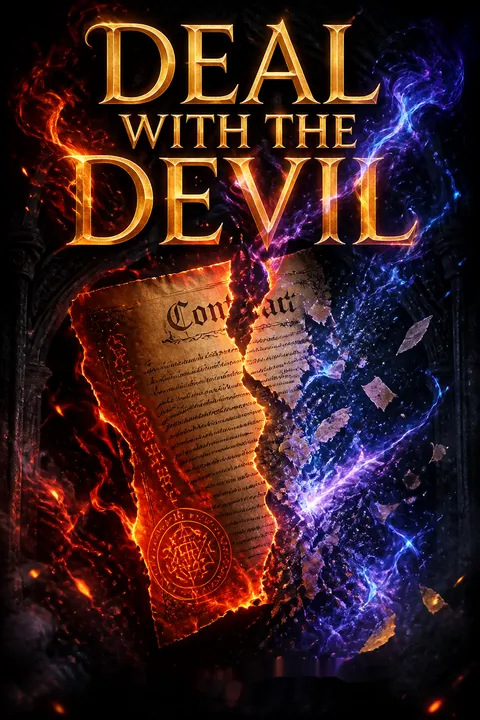


Plot Summary
Prologue
In 1922, Mori refuses Lucifer’s order to kill Eric, the human he loves. His brothers Cal and Harlow stand with him, but Dagon remains in Hell, unable to defy any other order. Mori and his brothers break free of their father’s rule, and Mori builds a life with Eric while hiding his demonic nature.
Decades later, he returns from a mission to find Eric dead of old age. His attempts to mark Eric have never worked, and now they cannot. Mori is left with grief, guilt, and the belief that his love could not protect the man who gave him a reason to escape Hell.
The prologue makes love both Mori’s first act of rebellion and the source of his deepest wound. Defying Lucifer gives Mori a life beyond Hell, but it cannot overcome the mortal limit he tries to deny by repeatedly attempting to mark Eric. His failure becomes a private accusation: he treats the mark as proof that his love was insufficient, rather than accepting that love cannot guarantee permanence. Dagon’s constrained choice also plants a different kind of cost, one that will matter when the brothers later face danger together. Mori’s history explains why a new bond feels less like a gift than another opportunity to lose someone.
A Brother's Dangerous Bargain
Four months after his twin Blaise disappears, River arrives at a nightclub owned by Mori, one of Lucifer’s demon sons. Blaise had accidentally killed the mate of Mori’s brother Harlow, so River knows the demons have reason to want him dead. He also knows the ghasts who took Blaise are draining his power and leaving him little time.
River hides his identity as a powerful mage beneath a glamour and presents himself as a frightened human seeking help. Mori agrees to track Blaise in exchange for one carefully limited favour, but River insists on joining the search and securing both brothers’ safety. He conceals the truth that he already suspects where Blaise is being held, and that he intends to prevent Mori from killing him.
River’s opening choice is not simply a lie for convenience. It is a calculated attempt to keep two incompatible loyalties alive: his obligation to save Blaise and the demon’s grievance against him. The glamour lets River control what Mori can know, but it also makes genuine trust impossible before their relationship even begins. Mori’s willingness to offer a bounded favour signals his effort to live by rules different from Lucifer’s, yet River can only see the danger in accepting a demon’s help. Their bargain therefore establishes the story’s central tension in practical terms: each man needs the other, while each withholds the information that might make cooperation safer.
The Road North
Mori meets River the next morning and takes him north in his cherished red Mustang. River gives him Blaise’s silver chain, but the tracking imprints are clouded, partly because the twins’ traces overlap and partly because River has altered the chain with magic.
River directs Mori toward Scotland while continuing to pass as human. On the journey, their guarded silences give way to teasing, shared food, and a cold night camping in a field. River slips into Mori’s tent for warmth, and they wake tangled together, though neither admits how natural the closeness feels.
Then River is struck by a violent surge of Blaise’s pain through their twin bond. Mori steadies him, but River hides the cause. The episode deepens Mori’s suspicion even as his concern for River grows.
The journey converts the bargain from a transaction into a test of perception. Mori is skilled at reading supernatural traces, but the muddied imprint forces him to rely on River, whose apparent vulnerability is itself a performance. Their physical closeness makes the deception harder to maintain: River needs Mori’s care, and Mori responds to distress before he knows whether it is genuine. The pain shared through the twin bond also makes River’s devotion tangible, while his refusal to explain it creates a second layer of isolation. Their growing intimacy is therefore built on genuine acts of tenderness that coexist with serious concealment, rather than replacing it.
Blood in the Forest
Mori’s tracking finally leads them near the McKenzie werewolf territory. A storm cancels the ferry to Barra, forcing another night’s delay. While Mori steps into the woods, the pack attacks him for crossing its land.
Outnumbered, he is bitten repeatedly, and wolf venom begins shutting down his healing. River hears the fight, drops his glamour, and kills the wolves by pulling the blood from their bodies. He then drains the venom from Mori and holds shut a severed artery until the demon’s healing returns.
Mori wakes long enough to recognize that River is a mage and his fated mate. When Harlow arrives and threatens River over Blaise’s role in Bailey’s near-death, Mori shields River from his own brother. He still refuses the bond, blaming River’s deception.
The forest attack overturns the roles both men have been performing. River is not a helpless human but a formidable mage, and Mori is not an invulnerable protector but someone whose survival depends on the person he has misjudged. River’s power is revealed through action, not confession: he chooses to save Mori even when exposure may cost him the help he needs. The mate revelation intensifies that reversal, but it does not resolve their conflict. Mori’s shield protects River from immediate violence while his rejection denies him emotional safety. The scene makes clear that destiny can identify a bond, but it cannot repair trust on its own.
A Rescue Without River
Mori returns to the hotel and discovers River has collapsed on the stairs, still suffering the effects of Blaise’s torture through their shared bond. The brothers realize the ghasts are draining River’s power as well as Blaise’s. Mori finds a loophole in the bargain: he must track Blaise and return him to River, but River never required that he be present during the rescue.
To keep River from further danger, Mori leaves him with Harlow and flies with Cal and Dagon to the ghasts’ cave on Barra. They kill the captors and free Blaise, who is so exhausted he asks them to end his life. Mori refuses, carries him back, and leaves him with River. Then Mori rejects River again and flies away, believing distance will protect them both.
Mori’s decision to leave River behind is an act of care distorted by fear. The loophole allows him to honour the literal contract while denying River the agency he demanded when he first made the deal. He imagines that danger can be managed by separation, although the mating bond makes that separation emotionally costly and physically consequential. Blaise’s rescue also complicates the moral arithmetic: the demons save the person they still blame for Bailey’s suffering because River’s bargain and Mori’s growing attachment require it. Mori fulfils his promise, but his choice to withdraw turns practical protection into another rejection.
Eric's Last Permission
After Blaise recovers enough to be left alone, River returns to Mori’s life with jokes, visits, and a determination to make him face their attraction. Mori finally follows him home and watches River pleasure himself, then tastes him and tries to call the encounter even. At the club, jealousy drives Mori to kiss River and take him home, where he binds and pleasures him.
But when River asks for more, Mori abruptly ends things and says he cannot love him. River leaves. That night Mori dreams of Eric in their old home. Eric reassures him that his love was real, but urges him not to deny River the chance to choose him. Mori wakes holding Eric’s old paintbrush, a tangible sign that the dream has changed his resolve.
Mori’s retreat is not caused by a lack of desire but by the meaning he assigns to desire. He treats loving River as a threat to the memory of Eric and to his own capacity to survive future grief. The dream confronts that false opposition through Eric himself: remembering a lost love need not require refusing a living one. The paintbrush gives the encounter material weight, preventing Mori from dismissing it as a convenient fantasy. River, meanwhile, has made himself emotionally available, so Mori’s words inflict harm precisely because their physical intimacy has suggested a different future. The moment forces Mori to see that avoidance is also an action with consequences.
A Fight for Forgiveness
The next morning, River goes to Bailey and Harlow’s gym to exhaust his anger. Mori finds him there and, when River refuses a conversation, climbs into the boxing ring instead. Their sparring turns into a fierce contest, giving River room to confront Mori without pretending the rejection did not hurt.
Mori admits he lied because he feared losing River as he lost Eric, and River agrees to hear him out but will not accept a mark until Mori proves he is committed.
They have sex, then Harlow accidentally kills Mori with a blade after Mori embarrasses Bailey. River attacks Harlow until Mori revives, revealing how fiercely he will defend his mate. At River’s home, Mori apologizes plainly, and River agrees to try again, with one condition: no more pushing him away.
The boxing ring gives the reconciliation a physical grammar suited to these two characters. River refuses to be soothed into forgiveness; he requires Mori to meet his anger directly, while Mori must stop treating protection as a substitute for honesty. Their fight also exposes mutual desire without erasing the harm that preceded it. Harlow’s abrupt killing of Mori, meant as retaliation for embarrassment, turns River’s protective instinct into public evidence of attachment. Yet River does not treat that intensity as sufficient proof. His refusal to accept the mark sets a boundary around consent and forces Mori to earn a shared future rather than assume fate has already granted it.
Two Pence and Forever
Mori asks Blaise what would make a meaningful date for River and takes him to their old Southsea arcade. They spend hours at the coin-pusher machines before sharing fish and chips by the water. Mori’s effort to understand River’s private history helps River trust that he wants the person, not merely the fated bond.
River decides he is ready to be marked. On the seawall, they speak openly about the risks and promise to face danger as partners, not as protector and protected.
River accepts Mori’s mark, and their magic binds into a shared bond that lets each feel the other’s emotions. They celebrate in the car, then return to Mori’s flat, where River feeds Scratch and makes himself at home. Their relationship becomes a chosen commitment, not just a supernatural fact.
The date works because Mori does not try to impress River with a generic display of wealth or romance. He learns that the arcade belongs to River’s memories with Blaise and makes room for that history in their shared future. River’s decision to accept the mark follows a sequence of earned trust rather than the mere discovery that they are mates. Their promise to save one another revises Mori’s older model of love, in which devotion meant unilateral protection. The bond’s emotional exchange then makes that reciprocity literal. Even the return home matters: River’s care for Scratch turns the extraordinary commitment into a domestic life made of small, repeated acts.
A Rebellion Beneath Hell
Weeks of happiness are interrupted when Cal’s family captures Sal, a higher demon caught near Oscar’s school after a suspected attempt to abduct him. Dagon tortures Sal for information, and River joins Harlow in breaking his resistance.
Sal reveals that demons are directing the ghasts, who grow stronger by draining mages. The group plans to attack Mori and his brothers, their mates, and then Lucifer, believing the sons’ deaths will weaken the ruler of Hell. The revelation makes River and the other partners targets, even though River’s new bond protects him from being drained like Blaise.
The brothers begin hunting named conspirators, reinforcing wards, and training Bailey and Oscar. River joins the preparations rather than retreating, accepting the risks of the family he has chosen.
The revelation expands a personal rescue plot into a political threat rooted in the supernatural order. The conspirators turn the ghasts’ hunger for mage power into an instrument of rebellion, making the earlier torture of Blaise part of a deliberate strategy rather than an isolated atrocity. River’s bond protects him from one danger, but it also makes him a target because the attackers understand what Mori would risk for him. His decision to help with wards and training marks a shift from outsider bargaining for assistance to participant in collective defense. The family’s preparations are protective, but the threat also exposes how love creates leverage for anyone willing to exploit it.
Lucky's Hidden Bruises
As the brothers prepare, Mori notices that Lucky, the young bartender, keeps arriving injured and refuses to explain why. River and Oscar persuade him to talk by sharing Oscar’s history of domestic abuse and the help that finally gave him a way out.
Lucky admits no details, but the story makes clear that he feels trapped and alone. When Dimitri, an archangel long entangled with Dagon, enters the club, he recognizes Lucky on sight and reacts as though he has found someone he had been searching for.
Lucky is bewildered, and Dimitri leaves to find Dagon. Before the group can pursue the mystery, Mori’s wards at River’s home are breached. The attackers take River and begin draining his power, while the bond sends his pain crashing into Mori and Blaise.
Lucky’s storyline echoes Oscar’s without making the two experiences interchangeable. Oscar offers the history of how isolation and fear can masquerade as a private problem, giving Lucky a route toward disclosure without demanding it. Mori’s instinctive concern is important because Lucky has not yet earned protection through confession; the group chooses to care before it knows the whole story. Dimitri’s recognition introduces a different kind of claim, one that Lucky does not understand and has not consented to explore. The sudden abduction of River then shifts care from an ethical choice to an emergency. The narrative binds these threads through a shared question: what does it mean to answer another person’s vulnerability responsibly?
Taken Through the Wards
Mori collapses when the ghasts attack River through their bond, and Blaise arrives at the club weakened by the same power drain. Harlow, still furious about Bailey, nearly attacks Blaise until Blaise instinctively shields Toby instead of himself.
That choice helps Harlow stop, and Bailey offers Blaise forgiveness. The brothers trace River to a house on the Isle of Wight, where eighteen ghasts hold him beside another captive mage. A force of demons waits upstairs, including members of Lucifer’s inner circle.
Dagon and Dimitri join the rescue despite their unresolved conflict, while Blaise stays outside to block escapes. Mori’s group enters expecting an ambush, knowing the attackers have arranged the capture to draw them into a fight and weaken them through River.
The capture compresses the book’s relational conflicts into a single crisis. Blaise’s instinct to protect Toby offers a small but consequential act of responsibility, while Bailey’s forgiveness interrupts the cycle of vengeance without pretending Blaise’s earlier choice did no harm. Harlow’s anger remains real, but he is no longer allowed to define Blaise solely by the injury to his mate. Meanwhile, Dagon and Dimitri’s cooperation shows that unresolved intimacy does not erase obligation. The assault on River is designed to weaponize attachment, but the rescue party’s willingness to unite across old grievances resists that design. The chosen family becomes a practical alliance, not just a sentimental ideal.
The Bond Calls Him Back
The rescue party fights through the house, but the ghasts’ repeated attacks leave River near death and Mori badly weakened. Mori reaches the basement, shields River and the captive mage, then burns the ghasts with hellfire.
Holding River as his life fades, he calls in the favour from their original bargain and begs him to return. The bargain’s magic guides River back through their bond. A demon stabs Mori as River revives, but River drains the attacker’s blood and uses his restored power to kill the remaining enemies at once.
The brothers finish those who can reincarnate. The captive mage is Wilson, a seer from River and Blaise’s clan. The battle is won, but Wilson is too depleted to survive, and the danger to the family has not erased its cost.
The bargain that began as River’s desperate tool becomes the means by which Mori calls him back from death. This reversal gives the contract emotional force: what once concealed River’s identity now carries his promise into the darkness. River’s return depends on connection, but his victory is not passive rescue. He rises and uses his own power to end the battle, preserving the agency that Mori’s earlier protectiveness often threatened to override. The enemy’s plan fails because the bond strengthens the partners rather than merely making them vulnerable. Yet Wilson’s condition prevents triumph from becoming simple relief. Survival is real, but it does not cancel the damage already done.
A Seer's Unfinished Warning
River and Blaise hold Wilson’s hands as he dies, and the seer manages one final warning: Dagon, Dimitri, and a human are connected to the cause and solution of the crisis. He gives no explanation.
Dimitri is injured in the battle, and Dagon tends to him before fleeing the club, convinced his instincts have led him into pain for centuries. The others return to Southsea, where Mori and River reassure each other that they will face future danger together.
The uprising’s immediate force has been defeated, but Wilson’s prophecy and Dagon’s departure leave the wider conflict unresolved. River’s rescued brother remains alive, the demon family remains united, and Mori and River’s bond holds. Their private future is secure even as the supernatural world’s next danger takes shape.
Wilson’s final words resist the comfort of a complete resolution. They connect Dagon and Dimitri’s long history to Lucky, whose importance has surfaced through recognition rather than explanation. Dagon’s flight is not framed as cowardice alone; he is trying to reclaim agency from instincts he experiences as a source of repeated suffering. The prophecy, however, suggests that withdrawal may not separate him from the larger consequences of his choices. Mori and River’s return to Southsea provides an emotional counterweight: they can affirm what they have built without pretending the broader danger has vanished. The ending distinguishes romantic closure from political closure, allowing one to be earned while the other remains uncertain.
Epilogue
Three years later, Mori returns to the house he shares with River, where a yellow note bearing one of River’s terrible jokes waits on the door. The couple’s wall of photographs now records a life built together, from seaside walks to family weddings. Mori still remembers Eric with tenderness, but the memory no longer prevents him from coming home to River.
Blaise is preparing to marry, and Mori has been away only briefly while River helped with the wedding preparations. He finds River in bed playing with Scratch, then retrieves the rope they keep for their private games. Their reunion is ordinary, playful, and secure: the life Mori once feared he would lose has become the home he chooses to return to.
The epilogue answers the prologue through an image that has changed meaning. The light in the window once led Mori toward the discovery of Eric’s death; now the house, the note, and River waiting inside signify a return rather than a coming loss. Mori’s love for Eric remains part of him, but it no longer functions as a prohibition against loving again. The photographs turn memory into a shared practice, placing old grief among new experiences rather than erasing it. Even the rope signals continuity: the couple’s playful intimacy has become part of a stable domestic life. The conclusion offers not immunity from grief, but a reason to keep coming home.
Analysis
Deal With the Devil makes the question of protection intimate before it makes it political. Mori’s history with Eric has taught him to equate love with the duty to prevent loss, so he repeatedly tries to manage River’s danger by withholding truth, choosing separation, or refusing the bond. River, by contrast, insists that care cannot be genuine if it removes his right to choose. Their conflict is not a simple clash between a protective partner and an independent one. Both are powerful, both are capable of rescuing the other, and both must learn that dependence need not mean surrender.
The novel’s supernatural systems sharpen that argument. A demon’s mark offers immortality and protection, but it cannot substitute for consent. A bargain can guarantee safety in carefully worded terms, yet loopholes reveal how little a contract can guarantee emotional responsibility. A glamour conceals River’s nature, but not the material facts of his loyalty. The strongest revelations arrive through action: River drains the wolves’ blood to save Mori, Blaise shields Toby rather than himself, and Mori uses the bargain to call River back when their bond is failing.
The book also links private intimacy to chosen family. Mori’s brothers protect one another, their human partners help restrain the violence that could consume them, and River gradually becomes part of that network by acting rather than merely being welcomed. Oscar’s account of abuse gives Lucky a chance to speak without coercion; Bailey’s forgiveness shows that accountability and compassion can coexist. Against Lucifer’s hierarchy, these relationships propose a different form of power, one based on loyalty, negotiation, and shared risk.
The romance reaches a clear resolution when Mori and River choose the mark together, then proves its durability under threat. The uprising remains dangerous, and Wilson’s prophecy leaves Dagon’s path uncertain, but the central emotional conflict is settled. Mori no longer treats his past love as a reason to refuse the present. River is not protected by being kept at a distance. They become safer by facing danger as equals.
Review Summary
Deal With the Devil received mostly positive reviews, with many praising the chemistry between Mori and River. Readers enjoyed the banter, steamy scenes, and character development. Some found the relationship progression too fast, while others appreciated the emotional depth. The book's world-building and integration with the series were well-received. Many readers expressed excitement for the next installment, particularly regarding Dagon's story. Overall, fans of paranormal romance and fated mates tropes found this a satisfying addition to the series.
People Also Read





Characters
Mori
The grieving demon trackerMori is a son of Lucifer who has left Hell, built a life on Earth, and works as a supernatural tracker while running a nightclub. His quiet manner conceals an intense, protective temperament shaped by an abusive father and the loss of Eric, the human he loved for decades. Mori wants the security of a fated partner but fears the grief that such love could bring. He tends to confuse care with control, assuming he should decide what risks others can bear. His dry humour and fierce loyalty surface most clearly around his brothers and the people under his protection. He is drawn to partners who challenge him, even as he initially believes he needs someone more docile.
River
The fearless mage in disguiseRiver is a powerful water mage, Blaise’s twin, and a restless traveller who values family and human connection. He has spent much of his long life adapting his manner to survive difficult situations, which makes deception feel like a familiar tool rather than an exceptional betrayal. Beneath his playfulness and sharp teasing is a determined protector who will take dangerous risks for the people he loves. River wants a lasting partner, not a passing affair, and he refuses to surrender his independence in exchange for care. His confidence, sensuality, and willingness to challenge authority make him a natural counterweight to Mori’s guardedness. He values honesty and consent, especially when a bond could shape an entire immortal life.
Blaise
River's reckless twinBlaise is River’s twin and one of the last close members of their mage clan. Impulsive and proud, he can act before considering the damage his choices may cause. His bond with River is deep enough that each can feel the other’s suffering, and River’s loyalty to him persists even when Blaise’s actions place others in danger. Beneath his bravado, Blaise struggles with guilt and with the belief that he is less valuable than his more capable twin. He is not motivated by cruelty, but good intentions do not prevent him from making serious mistakes.
Eric
Mori's first great loveEric was a gentle human artist who shared a long life with Mori. His attention to small beauty and kindness gave Mori an alternative to the brutality of Hell, though he did not know the full truth of Mori’s nature. Eric represents a love built through daily care, not supernatural power. Mori’s grief and guilt remain shaped by his inability to protect Eric from age and death. Remembered through paintings and intimate domestic details, Eric is not simply a lost ideal. His importance lies in the life he helped Mori imagine beyond violence.
Lucifer
The tyrant fatherLucifer rules Hell and raised Mori and his brothers as weapons, demanding obedience through fear and punishment. He regards affection for humans as weakness and treats his sons as instruments of power rather than family. His command that Mori kill Eric becomes the breaking point that drives the brothers toward freedom. Lucifer’s influence persists even after they leave, because the brothers have to unlearn the violence and control he taught them. He is both a personal abuser and the political centre of the demonic order.
Cal
The eldest brotherCal is Mori’s eldest brother, a formidable fighter who often speaks for the family and tries to keep its conflicts practical. He is deeply committed to his brothers and to Oscar, his human mate. Cal’s steadiness can become bluntness, especially when danger demands quick decisions, but his loyalty is consistent. He prefers physical combat to weapons and takes responsibility for organizing the family when the demonic threat escalates.
Harlow
The volatile protectorHarlow is Mori’s younger brother, a powerful demon with a theatrical streak and a fierce attachment to Bailey. His tendency toward vengeance comes from how intensely he loves and fears losing the people close to him. He can be funny and meddlesome one moment, frighteningly violent the next. Harlow understands how damaging it can be to feel unworthy of a mate, which informs his willingness to advise Mori and River even when they resist his interference.
Dagon
The restless youngest brotherDagon is one of Mori’s brothers, a restless demon who has long sought distraction through travel, sex, and dangerous work. Of the brothers, he was most openly hostile to life in Hell, yet he remained there when he could not defy every order Lucifer gave. His history with the archangel Dimitri is emotionally complicated, and his instinct to flee often competes with his deep loyalty to his family. He resists having his life defined by supernatural expectations.
Bailey
Harlow's gentle anchorBailey is Harlow’s human mate and a former teacher who brings calm and compassion to the demon family. He has built a life with Harlow and owns a gym with him. Bailey is not naïve about violence; his gentleness coexists with the courage to set limits and offer forgiveness when he believes it is right. His response to Blaise’s role in his near-death reflects a desire not to let injury dictate every future relationship.
Oscar
The survivor who reaches outOscar is Cal’s human mate, an avid reader of romance and paranormal fiction. His past includes an abusive relationship that left him isolated and afraid, so he recognizes when another person may feel trapped. Oscar offers Lucky his own story without forcing him to disclose more than he is ready to share. His warmth and directness complement Cal’s severity, while his experience gives the family a more human understanding of fear and recovery.
Toby
Mori's sharp-eyed managerToby is a vampire who has managed Mori’s club for decades. He is irreverent, observant, and far more socially agile than his demon employer. Toby takes threats to the staff seriously and is willing to confront both supernatural danger and a panicked mage. His teasing often exposes what Mori is trying to avoid admitting, but beneath it is long-standing loyalty.
Lucky
The guarded young bartenderLucky is a young bartender at Mori’s club who keeps to himself and prefers to remain at work rather than return to an uncertain home. Orphaned as an infant, he grew up in care and has learned to handle vulnerability by minimizing what is wrong. His recurring injuries alarm Mori and Toby, though Lucky resists their attempts to intervene. His guardedness suggests someone who has survived by expecting little help from others.
Dimitri
The searching archangelDimitri is an archangel whose long connection to Dagon is marked by desire, frustration, and mutual concern. He is powerful and self-assured, but his emotional certainty does not make him skilled at respecting distance or reading Dagon’s reluctance. His attention to the club’s young bartender reveals that his life contains more than the old bond he has struggled to define.
Wilson
The clan's seerWilson is a seer from River and Blaise’s mage clan. He once points River toward Mori when other options have failed. His knowledge of future possibilities makes him a source of guidance, though what he sees is not always easy to interpret.
Anya
The lost clan leaderAnya led River and Blaise’s mage clan and was the partner of Willow. Her authority helped hold the scattered mages together, and her loss leaves River with fewer people he can call family.
Willow
Anya's beloved partnerWillow was Anya’s mate and an important figure in the mage clan. Her absence is part of the grief and instability surrounding River’s search for Blaise and the scattered remnants of their community.
Sal
The captured conspiratorSal is a higher demon connected to the faction challenging Lucifer. His capture gives the brothers and their allies a chance to learn how the ghasts fit into the uprising.
Marcus
The hostile pack leaderMarcus leads the McKenzie werewolf pack, whose territorial aggression puts Mori in danger during the search for Blaise. He uses the pack’s size and reputation to intimidate supernatural visitors.
Plot Devices
The Demonic Bargain
A contract with consequencesRiver’s agreement with Mori requires Mori to track Blaise, return him to River’s care, and protect both brothers. River insists on precise safeguards and owes Mori one limited favour. The bargain gives the search legal and supernatural force, but its exact wording also allows Mori to leave River behind during the rescue, believing this will protect him. Later, when River is dying, Mori calls in the favour to compel him back through the bond. The same contract first creates distance between them and then becomes the means of their reunion.
The Twin Imprint
A trail through shared painMori tracks supernatural beings by reading their unique imprints, traces left by their presence. River and Blaise’s twin imprints overlap, and River’s glamour further muddies Mori’s reading of Blaise’s chain. Their shared mage bond also lets River feel Blaise’s torture, while the ghasts’ draining of Blaise begins to weaken River. The device turns the rescue into an urgent pursuit and makes River’s hidden identity physically consequential. It also allows Mori to understand that River’s suffering is tied to someone beyond the bargain.
The Fated Mark
A bond chosen togetherDemons can mark a mate, binding their lives and powers, but the true mate is fated rather than freely selected. Mori learns River is his mate only after River saves him and drops his glamour. Mori’s fear initially makes him reject the bond, while River refuses to accept a mark until Mori proves he wants a relationship rather than obeying destiny. When River finally consents, the bond lets them sense each other’s emotions and protects River from being drained by the ghasts. The mark therefore carries both supernatural protection and a demand for mutual consent.
Glamour and Wards
Protection with blind spotsRiver uses a glamour to appear human, concealing his mage identity and altering how Mori reads him and Blaise’s tracking trace. Wards protect the club, the brothers’ homes, and the places their mates frequent, creating controlled safe spaces. Yet the ghasts can cross wards that stop other supernatural beings, allowing them to abduct River from his home and bypass the group’s preparations. These magical protections have limits, so the characters must rely on trust, vigilance, and direct action rather than assuming a boundary is secure.
The Ghast Army
Power drained into rebellionGhasts are unnatural beings able to drain mages’ power, and a faction of demons learns to control them. Each mage taken gives the ghasts and their allies greater strength, turning individual abductions into preparation for a coordinated uprising against Lucifer and his sons. The device connects Blaise’s captivity to the larger political threat and explains why Mori’s family and their mates become targets. The threat escalates again when attackers use River’s bond to exhaust Mori during the rescue. Destroying the local force ends the immediate battle, but does not fully settle the wider conflict.
The Reckless Damned Series


About the Author
Other books by Lark Taylor




Download PDF
Download EPUB
.epub digital book format is ideal for reading ebooks on phones, tablets, and e-readers.








