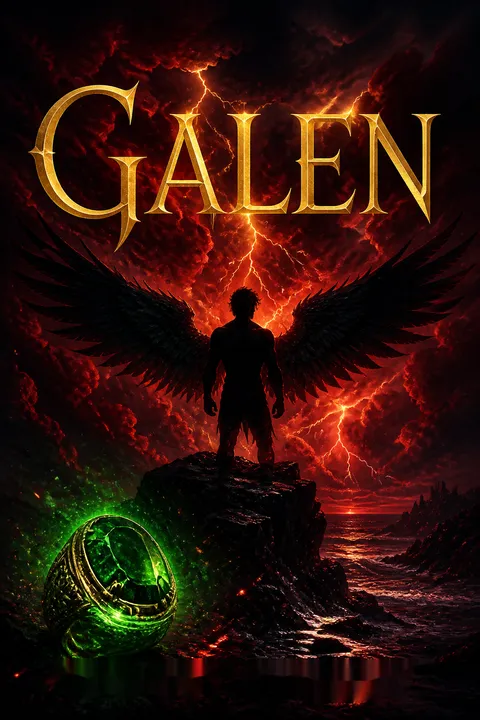


Plot Summary
Prologue
Long before the present, Galen and his brothers walk through a village destroyed by Lucifer’s demons and decide the slaughter must end. They are the firstborn sons of seven fallen angels, half-human warriors cursed to embody their fathers’ sins.
Raised by the angel Lazarus, they join the fight against Lucifer and finally bind him beneath the earth, though they cannot destroy him. The brothers survive as humanity’s guardians, carrying both the power to fight demons and the shame of a rebellion they did not choose.
The opening makes inherited guilt literal: the brothers bear their fathers’ sins in their bodies, although they were innocent children when the curse was imposed. Their mission to protect humans therefore begins inside a contradiction. They are treated as dangerous consequences of angelic rebellion, yet they spend their lives preventing others from suffering its violence. Galen’s anger is introduced not as simple aggression but as a response to helplessness before mass death. The ruined village gives that anger an object, while the brothers’ decision to fight establishes the moral purpose against which their later struggles with power, choice, and self-control will be measured.
The Ravenwood Ring
After a humiliating date, Simon Parks returns to his antique shop and sorts through auction crates from Ravenwood Mansion. His employee and friend, Kyo, helps with the store while Simon discovers a locked wooden box marked with unfamiliar symbols. A towering stranger named Galen arrives, demands access to the unsorted stock, and leaves furious when Simon refuses.
Later, Simon finds the box unlocked and opens it, revealing a gold ring set with a green stone. Before he can investigate its strange markings, Galen breaks into the shop and takes the box, insisting the ring is a family heirloom. He pays Simon five thousand dollars, but the dark force sealed inside the ring has already drawn attention to the shop.
The ring enters the story through an ordinary act of work, not a deliberate search for magic. Simon’s curiosity is professional as well as personal: he buys, studies, and assigns value to objects whose histories others have discarded. Galen’s theft disrupts that familiar world, but his payment complicates Simon’s first impression of him. The exchange establishes a recurring tension between ownership and responsibility. Simon legally owns the box, yet neither he nor Galen understands the power inside it. The object’s danger begins before anyone knows its purpose, turning the antique shop’s trade in hidden histories into the mechanism that pulls Simon into a much older conflict.
Shades At The Door
An auburn-haired stranger visits Simon’s shop looking for the box, knows Simon’s name, and threatens him when he lies about its theft. That night, shades break through the window of Simon’s loft and attack him in the dark. Unable to see the smoke-bodied demons clearly, Simon is clawed and bitten as he tries to reach the exit.
Galen arrives with his brother Castor, kills the creatures, and carries Simon away before his wounds can prove fatal. Simon wakes in Galen’s seaside mansion, where he learns the attackers were demons and that Galen’s group hunts them. The stranger’s threat and the attack make clear that the box has turned Simon from a curious dealer into a target.
Simon’s danger is made bodily before it becomes intellectually credible. He begins by explaining the stranger’s threat through familiar categories, such as crime and paranoia, but the shades defeat those explanations by leaving wounds he cannot dismiss. His survival depends on the same Galen who previously stole from him, making trust an urgent practical choice rather than an abstract virtue. The rescue also exposes the cost of Galen’s earlier secrecy: taking the ring away did not remove the trail it left behind. Simon’s ordinary life is not simply interrupted; its basic assumptions about what can harm him have stopped being reliable.
Seven Sins At Home
While Simon recovers, Galen explains that he is a Nephilim, half angel and half human, and that his six brothers embody Pride, Gluttony, Lust, Greed, Sloth, and Envy. The mansion’s inhabitants include commanding Alastair, sleepy Gray, teasing Castor, food-loving Raiden, flirtatious Bellamy, and guarded Daman.
They were raised as warriors to protect humanity, but Simon’s presence violates their rule against bringing humans home. Alastair resents the risk; Galen refuses to abandon Simon, whose injuries cannot yet be safely treated at a human hospital. Simon is unsettled by their powers and their arguments, but their attention gradually makes the mansion feel less like a prison. He remains there while the brothers investigate the ring.
The household turns a supernatural exposition into a social test. Each brother’s sin shapes a recognizable habit, but their teasing, meals, and concern for Gray also resist the idea that a curse exhausts a person’s identity. Simon initially encounters the group as a vulnerable outsider under guard; the brothers encounter him as a security breach. Their competing responses reveal how protection can shade into control. Galen’s decision to keep Simon close is both ethically consistent with his duty and personally unexplained, while Alastair’s objections arise from a real history of enemies exploiting human connections. The mansion’s warmth does not erase its restrictions, but it gives Simon relationships that complicate his desire to escape.
Lazarus Takes The Ring
When Alastair cannot open the box, Simon succeeds because its ancient wards block angels and demons but not a human. The brothers feel the ring’s power as soon as he lifts the lid. Its inscription is a demonic binding spell, and even Alastair falters when he touches it.
Lazarus arrives, recognizes the object as a binding ring, and takes it to the celestial realm without explaining what it can bind or why its existence alarms him. Simon faints after seeing Lazarus’s wings, then wakes to find Galen carrying him back to bed. The ring is now beyond the brothers’ reach, but Lazarus’s fear and refusal to share information leave them with more questions than answers.
The ring’s first opening rearranges the group’s power hierarchy. Simon, dismissed by some as a fragile human, is the only person able to release it, while the trained warriors and their angelic supervisor can neither explain nor control what it contains. Lazarus’s arrival promises authority and knowledge, yet his decision to take the ring without briefing the brothers repeats the paternal secrecy that has governed their lives. His intervention solves the immediate problem while deepening their dependence on someone who treats them as soldiers rather than participants. Simon’s fainting is comic in the moment, but it also marks the limits of how quickly an ordinary mind can absorb a world that has suddenly become real.
Daylight, With A Guard
As shades continue hunting, Simon asks to return to his shop and misses Kyo, his customers, and the life he built there. Alastair offers a difficult choice: leave and risk losing contact with the warriors, or remain under their protection. Simon stays, and Galen agrees to escort him to work by day and bring him home before the demons hunt at night.
The two grow closer through their time at the shop and in the mansion. Galen’s first sexual encounter with Simon is intense, but his abrupt departure afterward leaves Simon wanting more than a convenient release. When Galen later bites him during sex, Daman identifies it as a possessive mark, forcing Galen to admit he has claimed Simon without intending to.
Simon’s choice is not a simple surrender to romance. He preserves a piece of his own life by returning to work, while accepting the danger that makes Galen’s daily escort necessary. That arrangement lets the relationship develop in a space where Simon remains competent and socially connected, rather than becoming only a patient in Galen’s house. The first sexual encounter exposes their mismatch: Galen treats sex as a bounded act, while Simon is already susceptible to tenderness and attention. The involuntary mark makes Galen’s body contradict his stated detachment. Its possessive meaning troubles Simon even as it reassures him, revealing how affection can feel both affirming and dangerously unequal.
The Witch’s Warning
Clara Locksley, whose grandmother owned Ravenwood Mansion, visits Simon’s shop searching for the box. She explains that an ancestor made the ring for demons serving a fallen angel, then hid it after regretting the bargain. Clara believes its power could endanger the world if returned to the wrong hands.
Simon gives her Galen’s account, and she exchanges contact details with him. Later, Phoenix appears while Galen is guarding the shop and warns that the Nephilim will soon have to kneel to a new king or die. Galen connects the threat to Belphegor, a powerful demon general. Before they can learn more, Alastair receives word that Joseph, the human he loves, is near death.
Clara supplies the ring with a human history that neither Lazarus nor the warriors has offered. Its danger is not an accidental curse but the consequence of a maker’s compromised choice and a family’s long attempt to contain the result. Phoenix’s warning shifts the threat from pursuit of one object to a political claim over the world. The sequence also places private vulnerability beside public danger: Galen is guarding Simon when the news about Joseph reaches Alastair. That juxtaposition matters because the warriors’ emotional attachments are precisely what their enemies can exploit. Their relationships do not distract from the conflict; they define what the conflict can take from them.
Love Against The Loss
Joseph dies in hospice, and Alastair’s grief passes through the brothers’ supernatural bond, silencing the household. Galen seeks Simon’s closeness, then tells him about Marcus, the gladiator he once freed and loved. Belphegor’s demons killed Marcus, and Galen’s grief once drove him into a murderous rage that nearly ended with Lazarus killing him.
Galen also explains that binding a mortal’s life to a Nephilim makes them share one fate, a danger underscored by their lost brother Kallias, who died after his human lover was killed. Simon still admits he loves Galen. Galen stops denying his own feelings and chooses to be with him, though he cannot yet promise a safe future.
Joseph’s death gives Galen’s fear a present-tense example: love can be lost even without violence, and immortality offers no protection from witnessing decline. His story about Marcus explains why restraint has become a survival strategy, not merely an emotional failing. Yet Simon does not answer the disclosure by demanding guarantees. He names his love while recognizing the danger, making his choice informed rather than naïve. Galen’s decision to reciprocate marks a change from using distance to prevent grief toward accepting that distance cannot prevent it. The bond among the brothers also makes mourning collective, so Alastair’s private loss becomes a crisis the household must hold together.
Lucifer’s Power
At a family dinner, Lazarus returns and reports that demons are gathering in the underworld. He admits the ring carries the essence of Lucifer, the Morningstar, who may have placed some of his power inside it before the Nephilim imprisoned him. The ring cannot be destroyed, so Lazarus has hidden it in the celestial realm.
Simon asks whether Lucifer could have had a surviving child, and Lazarus reveals that he killed all three of Lucifer’s sons during the ancient war. When Lazarus dismisses the brothers as potentially disposable, Simon defends each man’s character and condemns the way they were taken from their mothers and trained for battle. Lazarus leaves without resolving the danger, but Simon’s loyalty changes how the brothers see him.
The ring’s power now connects an old military victory to an unresolved political succession. Lazarus’s confession that he killed Lucifer’s sons suggests that his certainty about ending the threat may rest on morally brutal choices, not complete knowledge. Simon’s challenge matters because he refuses the angel’s framing of the brothers as dangerous bloodlines or useful weapons. He describes their concrete acts of care, making personhood an argument grounded in behavior rather than ancestry. His defense also enlarges his place in the household: he is no longer merely the human Galen protects, but someone willing to confront the authority that shaped Galen and his brothers.
The Veil Comes Down
Castor disappears after a vampire at the supernatural club betrays him to Belphegor’s demons. Soon afterward, Lazarus crashes onto the mansion’s balcony, badly wounded, and gives Simon the ring. He reports that Ramiel and other angels attacked the celestial vaults and joined the enemy. Belphegor uses Castor’s blood to weaken the mansion’s protective veil, allowing shades to swarm the house.
During the battle, Simon tries to lock the ring in its box, but an unseen force breaks the box and drives the ring onto his finger. Its power overwhelms him, and Phoenix’s group carries him away. Gray is left gravely wounded by a celestial blade, which defeats the brothers’ healing until Clara arrives and treats him with witchcraft.
The breach collapses the brothers’ assumptions about safety from both directions. Their haven depends on a spell, their access to the celestial realm depended on trust, and both protections fail through betrayal. Simon receives the ring not because he understands it but because Lazarus has run out of alternatives. When the ring acts through him, agency becomes the central horror: his body obeys a power he is actively trying to contain. Gray’s injury then demonstrates that the brothers’ strength has limits, while Clara’s intervention shows that survival will require allies beyond the original warrior family. The crisis makes their isolation untenable.
A King Below
Simon wakes chained in the underworld beside a tortured Castor, his index finger amputated in an attempt to remove the ring. Castor explains that Belphegor used psychological torture to extract the mansion’s location.
Phoenix then reveals that Simon descends from the human woman who bore Lucifer’s children, which explains why the ring recognized his blood. The power possessed Simon because its intended wearer was near. The captives are taken before Asa, a winged ruler who identifies himself as Lucifer’s firstborn son and says the ring held his essence while his body remained elsewhere.
Asa plans a public celebration, sending Castor to fight in a death pit and Simon to the kitchens to be prepared as food. Simon’s family connection has made him both key and captive.
The reveal turns Simon’s apparent ordinariness into a contested inheritance without making his character reducible to blood. His lineage explains the ring’s response, but it does not mean he chose or understands the power it imposes on him. The underworld’s beauty unsettles familiar moral geography: it is not a simple landscape of fire, yet its social order permits torture and planned execution. Asa’s ceremonial treatment of violence also contrasts with the brothers’ protective use of force. Simon and Castor face different forms of spectacle, one as combatant and the other as food, but both are being converted into objects for a ruler’s display.
Wrath Breaks Loose
Galen, Alastair, Raiden, Bellamy, and Daman enter the underworld to recover Simon and Castor. Kyo follows and reveals a hidden identity as a water dragon, giving the rescue an unexpected ally. The brothers learn Castor is in the fighting pit and Simon has been taken toward the kitchens. Galen releases the full force of Wrath when he fears Simon is dead, tearing through demons but losing control of himself.
Simon escapes the kitchen and reaches the battlefield as Asa’s forces begin to retreat. Galen turns on his own brothers, so Simon approaches despite their warnings and calls him back through touch and memory. Galen recognizes him, gathers him close, and the group escapes through the portal before it closes.
The rescue succeeds through force, but force alone cannot finish it. Galen’s unleashed power defeats the enemy while making him a danger to the people he came to save. Simon’s intervention is not a claim that love cures violence; it is an appeal to a shared history that gives Galen a route back to himself. Kyo’s reveal likewise widens the alliance beyond the seven brothers, suggesting that survival depends on connections the warriors did not anticipate. Simon’s escape from the kitchen gives him an active role in the climax, while his choice to approach Galen carries real risk. The victory is therefore relational as well as military.
An Eternity Chosen
Back at the mansion, Galen heals Simon’s damaged hand, though the lost finger cannot be restored. The brothers recover, Clara continues helping, and Simon and Galen confront what their relationship will mean beyond the immediate danger. Galen asks Simon to bind their life forces, a ritual that would make them share mortality rather than leave Simon to age alone.
Simon accepts after confirming Galen understands the risk. Beside the sea, the brothers, Clara, and Kyo witness their vows and shared wine. In private, Galen completes the bond by sharing blood with Simon during sex. Their souls and life forces join, and the story closes with Simon choosing the strange, perilous family and future he has found.
The ending converts the romance’s central fear into a negotiated decision rather than a magical guarantee of safety. Simon and Galen accept shared mortality, meaning the bond offers permanence only by making each vulnerable to the other’s death. Galen’s choice also contests the role imposed on him as a weapon whose private desires must always yield to public duty. Simon does not erase that duty; he chooses to live beside it. The sea, which has carried Simon’s memories of his parents and later his intimacy with Galen, becomes the setting for a new commitment witnessed by their chosen family. Their future remains dangerous, but it is now mutually chosen.
Analysis
The novel’s central conflict is not simply between angels and demons. It is between inherited identity and chosen conduct. The brothers are punished for their fathers’ rebellion before they can act, and Lazarus continues to treat them as instruments whose ancestry makes them suspect. Simon’s defense of them is powerful because it cites ordinary evidence: meals shared, care given, and risks taken. He judges them by what they do, not by the bloodline assigned to them.
The romance gives that ethical argument a private form. Galen’s Wrath is both a weapon against demonic violence and a force capable of harming the people he loves. His history with Marcus makes emotional withdrawal seem rational, while Simon’s presence does not magically erase his danger. Instead, Simon becomes someone Galen must learn to trust without claiming that protection grants ownership. The early mark complicates this question, as Galen’s possessive instinct precedes his willingness to make a mutual commitment.
The ring turns hidden history into bodily consequence. Simon’s blood gives a buried power access to him, but his ancestry never determines his moral choices. He resists the ring, protects the brothers, and chooses a life whose risks are explained to him. The climax tests whether Galen can return from violence through recognition rather than domination, while the conclusion tests whether both lovers will accept the consequences of binding their lives. The story’s answer is deliberately costly: love does not remove mortality or danger. It makes facing them a shared decision.
Review Summary
Galen received mixed reviews, with many praising the world-building, characters, and overall concept of seven nephilim brothers embodying deadly sins. Readers enjoyed the romance between Galen and Simon, though some found it rushed. The family dynamic among the brothers was widely appreciated. Critics noted issues with pacing, character development, and excessive information dumping. Despite these concerns, many readers expressed interest in continuing the series, particularly anticipating Gray's story. The audiobook narration by Nick J. Russo was highly praised.
People Also Read






Characters
Simon Parks
The curious human keeperSimon is a twenty-nine-year-old antique dealer who runs Timeless Antiques & Curiosities and prefers strange objects to ordinary stock. He is witty when anxious, sensitive to rejection, and more emotionally perceptive than he gives himself credit for. After losing both parents, he has built a modest life around the shop and his friendship with Kyo. His curiosity draws him toward the Ravenwood ring, but his strongest quality is his willingness to care even when fear would make withdrawal easier. Simon values being treated as a person rather than a problem to manage. His humor, tenderness, and stubbornness allow him to meet Galen’s guardedness without surrendering his own perspective.
Galen
Wrath’s guarded protectorGalen is an immortal Nephilim, the half-human son of a fallen angel and the avatar of Wrath. Towering, physically formidable, and trained to fight demons, he initially treats casual sex as an escape from anger and grief. He has seen how attachment can make loss unbearable, and an earlier tragedy left him afraid of the violence inside himself. His protectiveness toward Simon begins as responsibility for a human endangered by the ring, then becomes difficult to separate from desire and care. Galen’s defining struggle is not simply controlling anger; it is deciding whether a life organized entirely around duty leaves room for joy, trust, and chosen intimacy.
Alastair
The proud household leaderAlastair, the avatar of Pride, leads the seven brothers and expects them to follow his judgment. His composure, intelligence, and love of books help him maintain order, but pride also makes him reluctant to admit when he cannot protect someone. He is deeply attached to Joseph, a human whose illness confronts him with the limits of his power. Alastair’s caution about Simon comes from real experience: enemies have used human companions to find the brothers before. Beneath his stern authority is a man who carries grief quietly and feels responsible for everyone in his household.
Gray
The sleepy heart of homeGray embodies Sloth, drifting into sleep after brief bursts of energy. He is the smallest of the brothers and often looks younger than he is, which makes the others especially protective of him. His open affection softens the mansion’s rougher edges; he curls beside people he trusts and makes a home out of simple comforts. Gray’s gentleness is not weakness, and his closeness to Galen gives the older warrior an important emotional anchor. He is also the son of a powerful demon, a fact that complicates the brothers’ understanding of family and allegiance.
Castor
Greed with a quick grinCastor is the red-haired avatar of Greed, drawn to expensive possessions and prone to turning nearly anything into a wager. His teasing humor keeps tension from settling too heavily over the household, though his history with Galen shows that charm does not prevent friction. Castor is loyal to the brothers and protective of the people they accept into their circle. He often hides seriousness behind irreverence, using jokes to keep control when danger or discomfort presses close.
Raiden
Gluttony’s generous giantRaiden, the avatar of Gluttony, channels excess into food, drink, and obsessive training. Huge and powerfully built, he is also warm, playful, and happiest when feeding the household or sharing a movie. His appetite makes him an easy target for his brothers’ jokes, but it also gives him a practical way to bring people together. Raiden can be careless, yet he feels responsibility keenly when his choices put someone he loves at risk.
Bellamy
Lust with a velvet smileBellamy is the beautiful, flirtatious avatar of Lust, comfortable with desire and reluctant to be tied to one partner. His changing eye color reflects what each person finds attractive, but his charm is more than vanity. Bellamy reads social tensions quickly, supports his brothers in battle, and uses humor to needle Galen when he sees him denying his feelings. His casual approach to sex coexists with genuine loyalty and a capacity for tenderness.
Daman
Envy’s wary observerDaman embodies Envy and tends to keep to himself, watching the household from the edges and expressing distrust more readily than affection. His sharp tongue and guardedness can make him seem hostile, especially toward humans, but his attention to others reveals a protective streak. Daman is an artist and a capable, stealthy fighter. He notices the risks that more optimistic brothers would rather ignore.
Lazarus
The angelic commanderLazarus leads the celestial army and raised the seven brothers as warriors after taking them from their mothers. He is disciplined, formidable, and sparing with information, treating the Nephilim primarily as soldiers in a continuing war. His decisions are shaped by the fear that powerful enemies will return, but his severe methods leave the brothers feeling used and excluded. Lazarus believes preparation requires control, even when that control damages trust.
Clara Locksley
Ravenwood’s witch heirClara is a witch whose grandmother owned Ravenwood Mansion and whose family has guarded a dangerous inheritance for generations. Practical, outspoken, and skilled in healing magic, she refuses to let Galen’s suspicion define her. She is angry about her father’s choices and protective of the legacy she inherited, but she can recognize when others share her aims. Clara’s willingness to help turns her from a source of information into a potential ally.
Kyo
Simon’s enigmatic best friendKyo works at Simon’s antique shop and is his closest friend. He brings customers in, manages the shop’s website and social media, and supports Simon with an easy confidence that often offsets Simon’s self-doubt. He is observant, adventurous, and more capable than his quiet employee role first suggests. Kyo’s loyalty is practical as well as affectionate: when Simon is in danger, he is willing to risk far more than his job.
Phoenix
The underworld’s smiling threatPhoenix is an upper-level demon and Belphegor’s lieutenant. He looks nearly human, but his woodsmoke scent, shifting eyes, and casual cruelty reveal the danger beneath his polished manner. He taunts the Nephilim, threatens Simon, and treats violence as a tool for leverage. Phoenix is ambitious enough to make threats on behalf of larger powers, yet his confidence can falter when events exceed his control.
Belphegor
The demon generalBelphegor is a powerful general of the underworld who commands demons and seeks greater authority. He is strategic and willing to use psychological torture to obtain information, making him a dangerous opponent for the Nephilim. His actions suggest a preference for influence and calculated pressure over empty spectacle. Belphegor’s relationships within the underworld are not as simple as the brothers assume, and his personal loyalties complicate his reputation.
Joseph
Alastair’s mortal loveJoseph is the human Alastair visits in hospice care. A former Marine, he has spent a lifetime loving sunsets and the natural world. His illness leaves Alastair facing the limits of immortal strength and healing. Even as memory and health fail him, Joseph remains the center of a bond that has shaped Alastair’s private life and his understanding of loss.
Asa
The beautiful claimantAsa is a winged, commanding figure whose authority in the underworld draws demons to him. His beauty makes his presence almost disarming, but his appetite for power and willingness to treat captives as entertainment expose a ruthless nature. Asa is not yet at full strength when encountered, and the gap between his grand claims and his present limitations makes him volatile as well as dangerous.
Konnar
The neutral vampire hostKonnar is an ancient vampire who owns a nightclub where supernatural beings can gather without exposing themselves to humans. He values order among the different paranormal communities and is cautious about committing his people to another faction’s war. His neutrality does not prevent him from offering information or quietly hoping the Nephilim survive.
Marcus
Galen’s lost gladiatorMarcus was a celebrated gladiator whom Galen freed from his former master. Beneath his fighting skill, he valued a quiet life and cared for the land around the home he shared with Galen. His memory explains why Galen associates love with both refuge and devastating vulnerability.
Kallias
The lost eighth brotherKallias embodied Melancholy and was once the eighth brother among the cursed Nephilim. His love for the Spartan warrior Elasus became a lasting cautionary story within the family. Galen remembers him as a brother whose grief revealed how completely a shared life can join two people.
Elasus
Kallias’s Spartan belovedElasus was a Spartan warrior who met Kallias during a conflict involving demons and possessed humans. Their connection became the model for the life-binding magic the brothers fear. His story shapes their belief that love can create a bond powerful enough to make separation fatal.
Ramiel
A celestial officerRamiel is an angel within the celestial realm’s hierarchy. His name becomes important as the brothers investigate whether the threat surrounding the ring reaches beyond the underworld. He represents the possibility that loyalty inside the angelic ranks is less secure than Lazarus has led them to believe.
Sven
The underworld chefSven is a strange, insectlike demon cook assigned to prepare food for the underworld’s celebration. His cheerful interest in Simon’s menu turns the captive’s danger into grotesque dark comedy, making the threat of being eaten feel both absurd and immediate.
Plot Devices
The Ravenwood ring
A vessel for forbidden powerThe gold ring, hidden inside a warded wooden box, is the object that draws Simon into the conflict. Its inscription contains a binding spell, and its power attracts demons while making angels wary. Because Simon can open the box when the Nephilim cannot, he becomes central to the search before anyone understands why. The ring eventually responds to Simon’s ancestry and acts on its own, turning an inherited object into an immediate physical threat. Its power cannot be destroyed, so keeping it safe becomes a shifting problem of access, custody, and trust.
The seven sins
Inherited power and burdenThe firstborn sons of seven fallen angels are cursed to embody Pride, Gluttony, Lust, Greed, Sloth, Envy, and Wrath. The sins shape the brothers’ instincts but do not wholly define their character. Galen’s anger can make him terrifying, yet his restraint and protectiveness matter just as much; Raiden’s appetite becomes hospitality, and Gray’s sloth coexists with deep affection. The curse explains their unusual powers and the family’s sense of inherited shame, while also creating the central question of whether a person can be held responsible for what they were made to carry.
The mate binding
Love joined to mortalityNephilim can bind their life force to a chosen partner through vows, shared wine, blood, and a private union. The magic prevents the human partner from aging, but the two lives become dependent on one another: if either dies, the other dies as well. The brothers avoid this ritual because an immortal warrior’s death could weaken their defense of humanity, and earlier losses have made its risk concrete. The possibility forces Simon and Galen to consider whether love is worth accepting a shared vulnerability that neither can control.
The protective veil
A hidden refuge under pressureA magical veil conceals the brothers’ seaside mansion from ordinary discovery, while protective runes guard it against demons. The property gives the Nephilim a rare place to sleep, recover, and live together outside the constant hunt. Its safety is conditional, however. Belphegor uses Castor’s blood to weaken the barrier, and the attack demonstrates that a haven is only as secure as the knowledge and loyalties protecting it. The veil’s breach turns the mansion from shelter into a battlefield and makes the brothers reconsider how much they can rely on isolation.
Celestial blades
Weapons that stop healingCelestial blades can injure angels and Nephilim in ways their ordinary healing powers cannot quickly repair. The brothers know these weapons from earlier conflicts, but their sudden appearance in the demons’ hands changes the stakes of combat. Cuts from such a blade can leave even powerful warriors helpless and require other forms of treatment. The weapons make the brothers vulnerable to forces that would otherwise be outmatched, and Clara’s healing magic becomes vital when their own abilities fail.
Sons of the Fallen Series




About the Author
Other books by Jaclyn Osborn
Download PDF
Download EPUB
.epub digital book format is ideal for reading ebooks on phones, tablets, and e-readers.








