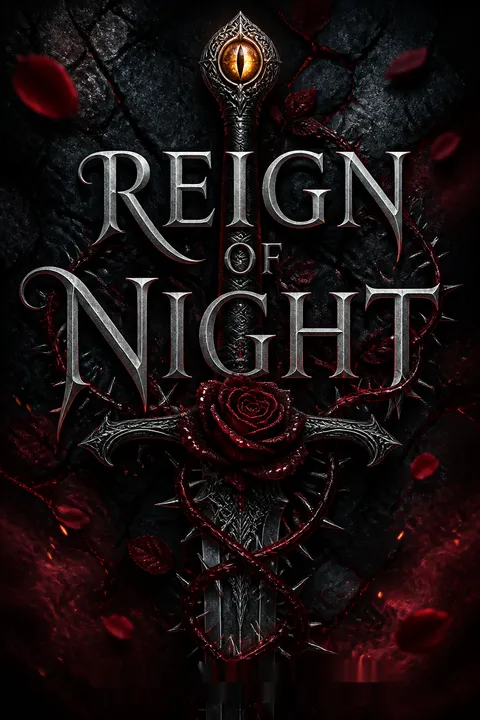


Plot Summary
A Hunter's Hidden Bond
After killing a vampire in the mires, Lyssandra Yonvrode, a veteran of the Helius Order, travels home with Steifan, her inexperienced trainee. Human servants attack them on the road. Lyssandra kills the attackers and throws her heavy sword with strength no ordinary hunter could manage, saving Steifan from death.
He presses her for an explanation, so she admits she is a vampire's human servant, though he laughs as if she has made a grim joke. Lyssandra has hidden the truth for years: she is bound to Asher, the vampire who made her his servant, and killing him would kill her too. She still wants him dead, and each hunt offers a chance to find him.
The opening makes Lyssandra's competence inseparable from concealment. Her unnatural strength saves Steifan, but the rescue also makes her secret harder to keep. Her divided identity is not a simple conflict between hunter and vampire: she has retained the Order's discipline and her own will, even while bound to the creature she seeks to kill. Steifan's disbelief gives her brief protection, yet it also underscores her isolation. She has learned to treat intimacy as risk because any truthful account of herself could become evidence against her.
The Rose in Mela's Chest
At Castle Helius, Lyssandra is assigned to investigate a killing in Bordtham with Tholdri, her longtime friend, and Steifan. The victim, Mela, has a red rose placed in the wound where her heart was taken. Lyssandra recognizes Karpov's signature: he killed her uncle Isaac years earlier and left Lyssandra alive. Mela's matching red hair makes the murder feel aimed at her personally.
The victim's mother remembers nothing because Karpov has bewitched her, but wakes near dawn, placing his resting place close to the village. Lyssandra follows the vampire's presence into the dark, where his young flock attacks. Karpov appears and orders his followers to seize her while they overwhelm Tholdri and Steifan.
Karpov turns violence into communication. The rose and the victim's hair transform a murder investigation into a message tailored to Lyssandra's private history, making her vengeance useful to an enemy before she has agreed to anything. Her response is shaped by guilt as much as courage: Isaac's death still feels like an unfinished obligation. The assignment also exposes the Order's utilitarian ethic. The Potentate sends an inexperienced trainee into danger because the mission requires it, not because the hunters' lives are precious. Duty here protects people, but it also spends them.
Karpov's Impossible Offer
Lyssandra wakes inside a coffin in a crypt, disarmed and alone with Karpov. He has left Tholdri and Steifan to fight his newly made vampires, and she cannot know whether they survived. Karpov claims the vampire clans are nearing war: he wants to overturn the old territorial rules that restrain indiscriminate killing, while Asher stands in his way.
He offers to lead Lyssandra to Asher if she helps destroy him. The bargain tempts her because it promises the target she has hunted for years, but it would leave Karpov alive and eventually kill her through their bond. She escapes the crypt and finds her companions waiting near Bordtham. When Steifan and Tholdri hear the truth, both choose to protect her secret.
The bargain makes vengeance ethically unstable. Karpov offers Lyssandra exactly what she wants, but only as a means to strengthen a political project that would endanger the people she is sworn to protect. Her willingness to consider the offer reveals how grief has narrowed her sense of possible futures: death seems acceptable if it buys revenge. Tholdri and Steifan interrupt that solitary logic. Their loyalty does not erase her danger, but it gives her a reason to treat survival as a shared responsibility rather than a price she can pay alone.
The Seeing Sword Wakes
Back at Castle Helius, Lyssandra and her friends tell the Potentate a cover story about Karpov. He knows they are hiding something, but instead of exposing them, he reveals the Voir L'épée, an ancient sword whose eye opens when Lyssandra takes its hilt. The blade can warn her of danger, and the Potentate orders her to use it against Karpov.
He also forbids her to return without the vampire's head. Lyssandra prepares to leave, only to find Tholdri and Steifan waiting with horses and supplies. They refuse to let her face the hunt alone. Although she cannot explain that Karpov expects to meet her in three nights, she accepts their help and rides out with them.
The sword functions as recognition from an institution that may not truly understand Lyssandra. The Potentate's relic declares her worthy, while the Order's rules would condemn the secret that defines her strength. That contradiction makes belonging provisional: she can inherit the Order's most sacred tool only so long as she hides what she is. Tholdri and Steifan offer a different form of legitimacy. They know enough to choose her as a companion, not because she is blameless or safe, but because they trust her judgment and want her alive.
The Altar Beneath Charmant
In Charmant, a young villager named Egar asks the hunters to find his missing sister Nina and her lover, Thom. Blood in the fletcher's shop suggests the couple were taken, while Egar's guarded home and a locked storage shed make Lyssandra suspicious. She and Tholdri break into the shed and discover a hidden tunnel ending at an altar crowded with human remains.
Nina appears below and reveals herself as a Nattmara, a life-draining creature whose power comes from a sealed urn. She bites Lyssandra repeatedly. The Seeing Sword points to the urn, and Asher lends Lyssandra strength through their bond. Lyssandra impales Nina, then smashes the urn. Tholdri and Steifan reach her alive, but she is gravely wounded.
The Charmant episode widens the book's moral vocabulary beyond hunter and vampire. Nina's human appearance and Egar's family loyalty complicate the easy assumption that a monster can be identified by its face or relationships. Yet Nina's violence remains real, and Lyssandra's survival depends on responding to evidence rather than sentiment. The sword supplies knowledge, while Asher supplies power; neither alone would be enough. Their combined intervention unsettles Lyssandra's belief that she can separate her life from the bond she resents, even as she continues to resist what that dependence might mean.
Egar Escapes Charmant
After Lyssandra recovers enough to walk, she learns that Tholdri killed Egar's father, the blacksmith, while trying to reach the trapped hunters. Egar is arrested, but at the village hearing he uses glamour to make the crowd doubt Lyssandra and to free himself from his restraints. He tells her privately that she helped release him from his father's control, then vanishes.
The villagers blame the hunters and chase them from Charmant. As they flee on hastily bridled horses, Lyssandra understands that killing Nina has also unleashed a new danger. She is still expected to meet Karpov, but now she lacks her gear, remains wounded, and has no safe place to return.
Egar's escape turns a victory over Nina into an unsettled consequence. The blacksmith had tried to keep the hunters away from his daughter, and his death removes the restraint that limited Egar's power. Lyssandra's decision to investigate was reasonable, yet good intentions do not prevent collateral damage. The villagers' hostility sharpens her sense of social exclusion: the Order calls her useful, but ordinary people see a threatening stranger. Her hunt therefore becomes more than a contest of strength. She must learn to act without assuming that the truth will automatically persuade those frightened by it.
Four Ancients Close In
Lyssandra meets Karpov at the appointed crypt, hoping to learn Asher's location. Instead, she finds three other ancient vampires waiting with him. They explain that they need her unusual bond with Asher to get close enough to weaken him, then force her to drink Asher's blood so he will be inclined to heal her.
They slash her with wounds tainted by dark magic and leave her near death in the mires. Asher finds her and carries her to a crypt, where his blood heals her. When she wakes, she confronts him about saving her and refuses to leave without answers. He tells her to walk away and promises to find her again, leaving her free to choose whether to flee or continue the dangerous pursuit.
Karpov's faction treats Lyssandra's bond as a tactical instrument, reducing a complicated relationship to a route into Asher's defenses. Their coercion makes the supposed gift of vampiric blood feel less like intimacy than forced dependence. Asher's rescue complicates that pattern: he acts to preserve her, but still controls when and where they meet. Lyssandra's insistence on answers is an effort to reclaim interpretation of her own history. Her body has been shaped by other people's decisions; asking why becomes one of the few forms of agency she can exercise.
The Sire Behind Karpov
Rather than escape the mires, Lyssandra reaches a village troubled by fresh vampire killings. Elizabeth, a young bread seller who wants to learn to fight, helps her meet the victims' families.
That night Lyssandra kills a young vampire couple who have been hunting their former village; Asher restrains the grieving woman until Lyssandra ends the threat. He explains that ancient vampires once imposed territorial limits to prevent reckless slaughter and keep their kind from drawing hunters down on every human settlement.
Karpov wants those limits abolished. Asher also reveals that he sired Karpov and feels responsible for the monster he became. Finally, he admits Lyssandra's conversation with him years earlier mattered because he had been isolated and despairing.
Asher's history reframes him without absolving him. He has participated in the violence that made vampire rule necessary, yet he now sees restraint as a practical obligation toward humans and a moral response to his own past. His confession about Lyssandra's first conversation gives her emotional significance without making her responsible for repairing him. The village killings also prevent that intimacy from becoming a simple romance: Lyssandra must still judge and kill vampires who endanger people. Her understanding expands, but her professional obligations remain concrete and sometimes brutal.
Elizabeth Becomes Leverage
After Asher parts from Lyssandra, Karpov and his allies seize Elizabeth and her sister Mira. Karpov promises to spare the sisters if Lyssandra brings Asher to him, then makes Elizabeth his human servant to ensure Lyssandra cannot simply kill him. Lyssandra is trapped between the girl's life and her own freedom. Hunters Isolde and Markus arrive with Niall, sent by the Potentate to find her.
When they discover her beside Asher, Lyssandra refuses to let them attack him and explains that Karpov's faction is holding a hostage. Asher leaves before the hunters can capture him. The old woman Sarsa, whose grandson Lyssandra killed as a vampire, burns to death in her cottage, deepening the cost of the village's violence.
Karpov exploits the difference between Lyssandra's unusual independence and Elizabeth's dependence on her maker. By turning Elizabeth into a servant, he weaponizes the very bond Lyssandra has spent years resisting. Her choice to protect Asher from the hunters is not proof that she has forgiven him; it is a strategic refusal to let Karpov dictate every available action. Sarsa's death complicates the clean arithmetic of monster hunting. Even when a killing prevents further victims, grief can leave survivors with no way to imagine a future.
Mira Ends Karpov
Lyssandra returns to Mira's home expecting Karpov to punish her for failing to bring Asher. Instead, Karpov enters with Elizabeth, now his servant, and demands that Lyssandra complete the bargain. Asher arrives, but Lyssandra will not leave until Elizabeth is safe. Karpov admits he has changed the girl to prevent Lyssandra from killing him.
He attacks, and the wounded Lyssandra cannot stop him from biting her. Mira grabs the Seeing Sword and cuts off Karpov's head, ending the threat while Elizabeth remains beyond rescue. Asher kills the ancient woman fighting him and gives Lyssandra his blood to keep her alive. Outside, the other hunters destroy Karpov's young vampires and surviving ancient allies.
The climax transfers decisive agency to Mira, the person most directly bereaved by Karpov's strategy. Lyssandra's sword has warned, guided, and empowered others, but it is Mira who uses it to sever the chain of coercion. The victory cannot restore Elizabeth, and that irreversibility prevents the scene from becoming a simple triumph. Lyssandra's choice to drink Asher's blood marks a shift from treating survival as a shameful extension of his control to accepting it as a condition for continuing her work. The battle resolves Karpov's immediate threat, not the larger vampire conflict.
A Secret Shared
After the fighting, Lyssandra helps prepare the dead for burning and finally attends Elizabeth's pyre. She recognizes that the young woman's trust gave her a reason to live beyond revenge. Markus and Isolde then promise not to report what they saw: Markus reveals that he, too, is a human servant, though he refuses to explain his own bond.
Isolde says she wants someone who understands Markus's experience to help keep him from pursuing his maker. Lyssandra returns to Castle Helius with Tholdri and Steifan, but the Potentate hears only a partial account. She is back inside the Order, yet Asher's warning remains: other vampires still intend to overturn the old laws, and the danger has only begun.
The aftermath offers Lyssandra a fragile form of belonging. Markus's revelation does not make her secret safe, but it breaks the assumption that she is the only hunter living inside this contradiction. Elizabeth's death becomes a source of responsibility rather than merely another wound: Lyssandra chooses to keep fighting because someone trusted her to protect others. The Order's silence is conditional, and the Potentate's withheld knowledge keeps institutional safety uncertain. The ending therefore closes the personal revenge plot while leaving Lyssandra more connected, more suspicious, and more willing to survive.
Epilogue
Lyssandra, Tholdri, and Steifan return to Castle Helius and report Karpov's defeat, leaving Asher out of their account. After several days of rest, they resume hunting as vampire attacks increase, and the Order forbids hunters to travel alone.
Asher does not appear, though he leaves a yellow daisy on Lyssandra's pillow. She suspects the Potentate knows more than he admits, including how he learned she was in danger. Grieving Elizabeth, Lyssandra resolves to keep protecting people and to uncover what has changed within the Order.
The epilogue refuses the comfort of a settled return. Castle Helius looks familiar, but Lyssandra now knows how much of its safety depends on secrets and selective truth. The daisy is a small, ambiguous gesture from Asher: it may signal affection, mockery, or simply his continued watchfulness, and Lyssandra cannot yet decide which. More consequential is her suspicion of the Potentate, whose knowledge remains unexplained. Elizabeth's death has changed Lyssandra's motive from private revenge toward an ongoing obligation to protect others. The ending grants her a homecoming, but not restoration; she returns with sharper loyalties and a larger field of danger.
Analysis
Reign of Night builds its central conflict around a contradiction that Lyssandra cannot solve by becoming stronger. She is a vampire hunter whose strength comes partly from a vampire's intervention, and her bond with Asher gives her both power and a possible death sentence. The book treats this dependence as ethically charged: saving a life does not erase the absence of consent, but resentment alone cannot explain every later act of care. Lyssandra must judge Asher by what he does, not simply by what he is.
The vampire conflict also resists a clean division between monstrous beings and virtuous humans. Karpov's project threatens large-scale human slaughter, while Asher's old laws offer only a restrained form of predation, not innocence. The Helius Order protects villages, yet it spends hunters' lives and hides knowledge from its members. Egar's family and Sarsa's grief further complicate the certainty with which Lyssandra can label a threat and move on. Every victory leaves consequences that cannot be folded neatly into a success report.
The most consequential shifts come through chosen relationships. Tholdri and Steifan turn Lyssandra's secret from a solitary liability into a shared risk. Elizabeth gives her a reason to imagine survival as service rather than retreat from vengeance. Mira's action at the climax makes that idea concrete: the person Lyssandra could not save becomes the person whose trust and sisterhood make the killing of Karpov possible. Lyssandra's eventual choice to live does not resolve her bond or the brewing war. It changes the purpose for which she endures them. The novel closes not with certainty, but with a more demanding form of hope, one grounded in continued responsibility and an insistence on seeing beyond appearances.
Review Summary
People Also Read


Characters
Lyssandra Yonvrode
The divided huntressA skilled hunter of the Helius Order, Lyssandra is disciplined, blunt, and accustomed to measuring danger before emotion can interfere. Her defining contradiction is that she seeks to destroy vampires while carrying a bond to one herself. She distrusts pity and tends to frame self-sacrifice as practical, especially when grief gives her a target. Beneath that hard economy is a strong protective instinct, visible in how she trains Steifan and responds to villagers who cannot defend themselves. Her red hair makes her conspicuous in the Ebon Province, while her hidden nature makes genuine belonging difficult. Lyssandra's central psychological struggle is whether survival can serve a purpose beyond revenge.
Asher
The vampire she huntsAn ancient vampire with white hair and a capacity for unsettling stillness, Asher is wary of power struggles and the destruction they bring. He once made Lyssandra his human servant, an act she experiences as a violation even though he believes he saved her life. Their bond allows him to sense her danger and affect her strength, creating dependence where she wants distance. Asher is not harmless or detached from vampire violence; he has lived long enough to see its consequences and now favors limits on how vampires prey upon humans. His guarded attachment to Lyssandra emerges through action more readily than explanation, leaving trust between them contested.
Tholdri Radran
Lyssandra's steadfast allyTholdri is a clever, teasing hunter who grew up alongside Lyssandra and knows how to read the silences she uses to hide fear. His humor can irritate her, but beneath it lies a serious loyalty: he follows her into danger and insists that her life matters independently of her vengeance. Tholdri is observant enough to detect inconsistencies in Lyssandra's stories, yet he responds with trust rather than automatic judgment. He represents the kind of closeness she resists, one built through shared history, practical care, and the willingness to challenge her self-destructive choices.
Steifan Syvise
The earnest traineeSteifan is a wealthy young hunter assigned to Lyssandra for training, though his early field experience is limited and his nervousness sometimes puts others at risk. He is neither naturally fearless nor especially graceful, but he learns from failure and proves more perceptive than Lyssandra first assumes. His willingness to keep her secret grows from gratitude into genuine loyalty. Steifan's development matters because he does not need to become a perfect fighter to become useful; he learns that courage includes listening, admitting weakness, and staying beside a friend when the truth makes that friendship dangerous.
Karpov
The ancient vampire rebelKarpov is an ancient vampire known for theatrical killings, including the rose he leaves where he takes a victim's heart. He is patient enough to turn personal history into a weapon and perceptive enough to recognize Lyssandra's hatred of him as something he can exploit. His political ambition is bound up with a desire to remove the limits that restrain vampire violence. Karpov's threat lies not only in his physical power but in his talent for manipulating other people's loyalties, grief, and hopes. He treats bargains as instruments of control, even when he presents them as mutual advantage.
The Potentate
The Order's stern leaderThe silver-haired head of the Helius Order, the Potentate rose to authority through force as well as command. He expects hunters to obey their vows and treats a mission's success as more important than personal comfort. His decision to entrust Lyssandra with the Seeing Sword shows that he recognizes exceptional ability, but his guarded manner leaves his motives difficult to read. He embodies the Order's protective purpose and its willingness to demand sacrifice from the people who serve it.
Elizabeth
The aspiring village defenderA young bread seller in the mires, Elizabeth lives with her older sister and longs to learn how to defend herself. She is compassionate without being passive, taking Lyssandra's danger seriously even when she lacks the training to understand it. Her hope in the possibility of protecting others reaches Lyssandra at a moment when vengeance has begun to consume every other purpose. Elizabeth's practical courage and open-hearted curiosity offer Lyssandra a kind of connection that is not founded on a long history or a shared institution.
Mira
Elizabeth's protective sisterMira is Elizabeth's older sister and the person who has taken responsibility for keeping their small household intact. Fear makes her guarded and occasionally sharp, but her concern comes from a life narrowed by loss and the danger surrounding the village. She does not share Elizabeth's appetite for adventure; she wants her sister safe. Mira's protective instincts give their relationship its force, and her caution offers a counterpoint to Lyssandra's tendency to rush toward danger alone.
Markus
The severe senior hunterMarkus is an experienced hunter whose authority is physical and direct. He expects others to follow a plan and is suspicious of anyone who compromises the Order's mission. His sternness can look like simple rigidity, but it comes from an understanding of the cost of trusting the wrong person. He is closely allied with Isolde and often acts as the more measured voice between them. His guarded private life gives him a perspective on the boundaries between hunter and vampire that few colleagues can share.
Isolde
The formidable rival hunterIsolde is a highly capable female hunter whose sharp manner and visible resentment of Lyssandra shape their uneasy encounters. She has survived in an order where women are often underestimated, but she does not respond to that pressure with easy solidarity. Her loyalty to Markus is profound, and her judgment is more complicated than her scorn suggests. Isolde is a reminder that shared circumstances do not automatically produce intimacy; respect must be earned through decisions made under pressure.
Egar
The guarded village brotherEgar approaches the hunters as a worried brother searching for his missing sister, but his nervousness and careful omissions make him difficult to read. His family is marked by secrets and by an uneasy relationship with the supernatural. Egar's desire to escape his father's control complicates his actions: he is neither merely helpless nor simply malicious. He represents the danger of treating apparent vulnerability as proof of innocence.
Nina
The missing sisterNina is Egar's sister and the young woman whose disappearance draws Lyssandra's party into the family's hidden history. Her relationship with Thom and her place within a complicated household make her more than a simple missing-person case. Nina's story tests the hunters' assumptions about what can hide behind an ordinary face.
Isaac
Lyssandra's slain guardianIsaac was Lyssandra's uncle and guardian, the hunter who trained her from childhood. His death at Karpov's hands became the defining wound behind her pursuit of vengeance. The memory of his discipline and care remains a private measure against which Lyssandra judges her own choices.
Niall
The junior hunterNiall is a younger Helius hunter who accompanies Markus and Isolde. He has little authority in their group and is still learning the practical demands of the work. His presence reflects how quickly inexperienced hunters can be pulled into conflicts shaped by far older powers.
Plot Devices
The human-servant bond
Power with a priceA vampire can make a human servant, granting the person unusual strength and a supernatural connection to the maker. The bond also makes the servant's life dependent on the vampire's survival, turning Lyssandra's vow to kill Asher into a possible act of suicide. It lets Asher sense when she is in danger and lend her strength, while giving Karpov a way to use her as a path to his rival. The device makes power inseparable from consent, dependence, and the question of whether protection can justify an irreversible violation.
The Seeing Sword
A warning with agencyThe ancient Voir L'épée awakens when Lyssandra grips it and warns her when danger approaches. It helps her identify the Nattmara's hidden source of power and later becomes the weapon Mira uses against Karpov. Its open eye makes the sword feel less like a tool than a witness with its own judgment. By guiding people beyond Lyssandra, it also complicates the idea that the hunter alone controls the violence carried out in its name.
Karpov's rose
A murder as messageKarpov leaves a rose in the wound where he has taken a victim's heart. The signature allows the Helius Order to identify his return, but the red-haired victim in Bordtham makes the message personal to Lyssandra. The rose therefore performs two jobs at once: it advances the investigation and manipulates the hunter's grief, drawing her toward a confrontation on Karpov's terms. It turns evidence into bait.
The territorial laws
A fragile vampire truceAncient vampires once divided territory and agreed to restrain younger vampires whose killings could attract hunters. Asher presents the system as a practical limit on slaughter, while Karpov seeks to abolish it and hunt without consequence. The laws make the conflict larger than a personal feud: Lyssandra's choice about Asher and Karpov may determine whether human villages face a wider wave of violence. Their fragility also shows that order depends on powerful beings continuing to accept limits.
The Nattmara's urn
Power anchored in an objectNina's Nattmara power is sustained by a sealed urn kept beneath the blacksmith's property, surrounded by an altar of human remains. Lyssandra cannot defeat Nina by force alone; the Seeing Sword reveals the urn as the source that must be destroyed. The device converts an otherwise overwhelming fight into a problem of perception, timing, and endurance. It also gives the hidden room's ritual violence a concrete center, connecting Nina's survival to the lives she has consumed.
A Study in Shadows Series
About the Author


Download PDF
Download EPUB
.epub digital book format is ideal for reading ebooks on phones, tablets, and e-readers.








