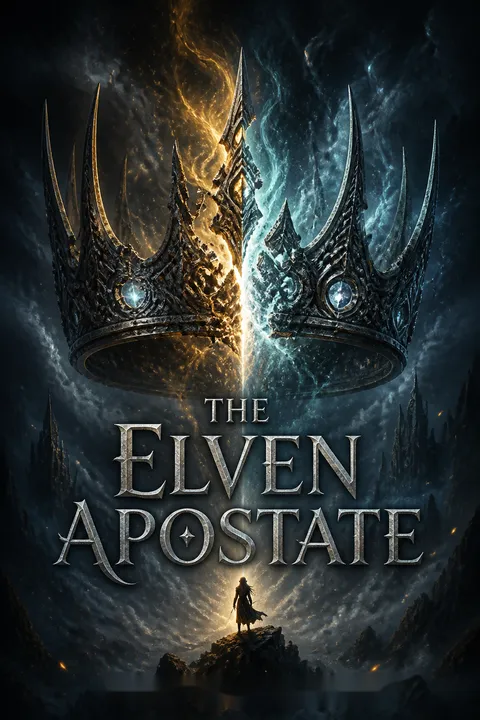


Plot Summary
Skaristead Under Siege
While Faerune is still being rebuilt, Alluin, the Valeroot tracker, persuades Elmerah and the grieving priestess Saida to travel with him to Skaristead. They hope to escort arriving Valeroot clans and gather support against Egrin Dinoba, the emperor threatening their people. A wounded elf reaches the town and dies warning of demons.
Elmerah and her sister Rissine strike the approaching spiders and quill-backed boars with lightning, but the creatures push past them to seize Saida. Elmerah reaches Alluin too late: Saida has been carried away by Malon, a rebel elf wearing the Crown of Arcale. Saida wakes in his custody, learns he blames Faerune's leaders for its suffering, and discovers he intends to remake the realm with new allies.
The attack turns a political mission into a personal failure: Elmerah has promised to protect Saida, yet the demons exploit the very division the group hopes to overcome. Malon’s rescue of Saida is also a calculated violation of her agency, wrapped in the language of salvation. His claim that he seeks justice is not disproved by his cruelty, which makes him more dangerous than a simple villain. The opening establishes the book’s central problem in concrete terms: communities damaged by old hierarchies may seek change, but the desire to repair injustice can become another excuse to control other people.
Faerune’s Unquiet Survivors
At dawn, Elmerah, Alluin, and Alluin’s sister Vessa find the missing clans, but fifteen elves have been killed by the demons. Elmerah and Alluin burn the dead, then tell Saida’s father, Ivran, that Malon took his daughter. Alluin wants to search for Saida; Elmerah argues they must first stop Egrin, since his defeat may be the only way to bring Saida home.
She proposes a secret journey with Alluin and Isara, whose magic can disrupt other enchantments, rather than wait for Faerune’s weakened council. Their decision carries personal cost: Alluin is haunted by the bodies of his kin, while Elmerah avoids speaking about her own mother’s death. Still, they leave before grief can turn into another reason to delay.
The dead clans make the cost of indecision visible, but Elmerah’s plan is not a triumph of certainty. She is choosing a narrow, dangerous mission partly because public deliberation could expose them to spies and partly because she cannot bear to remain among reminders of loss. Alluin’s grief is similarly practical and unresolved: he keeps moving because stillness brings back the murdered kin he could not save. Their alliance rests on an unspoken bargain, each recognizing the other’s avoidance without demanding an immediate confession. The story treats action as both moral commitment and emotional escape, leaving open whether the two can be separated.
A Gate Opens Downward
Elmerah and Alluin slip from Faerune with Isara, but Celen, a scarred Arthali ally, catches them before they reach the gates and refuses to let them face Egrin without him. Elmerah lights a guard tower as a diversion while Alluin distracts the sentries and opens the gate pulley. When guards corner him on a shattered crystal wall, Celen raises the earth beneath it, carrying Alluin safely down through a cloud of dust.
Back in the city, Rissine learns her sister is heading toward Egrin. She admits to Celen that she wants revenge because Egrin forced the clans to destroy Shadowmarsh witches, including their mother; she once chose to save Elmerah instead of their mother. Rissine sails after Elmerah with Merwyn and a small crew.
The escape makes allegiance physical. Celen risks his place among the Faerune survivors, while Alluin accepts help from someone he would rather distrust. Rissine’s admission reframes her protectiveness: it is not merely possessiveness, but a survival strategy forged by an impossible choice and sustained by guilt. Her revenge motive complicates the alliance she has built, since she has concealed the depth of her personal stake from Elmerah. Across both departures, the characters refuse to wait for permission, yet each carries a different private reason for doing so. Their courage and their secrecy are intertwined.
Two Crowns Answer
Malon carries Saida across the Helshone Desert, keeping her sedated until the heat and distance make escape nearly impossible. He reveals that his spies stole the Crown of Cindra from Ivran’s cellar, giving him both that relic and the Crown of Arcale.
When Egrin tracks them down with four Dreilore lords, Malon warns that the crowns must work together. Saida places Cindra’s circlet on her brow and links hands with Malon. Their joined power kills two attackers and drives the others back, proving that Saida’s priestly gifts are far greater than she believed.
Egrin withdraws but gives Saida a deadline: return the crowns by the next full moon or Faerune’s survivors will die. Saida is left fearing that her choice has placed her father and friends in greater danger.
Saida’s first experience of power is inseparable from coercion: Malon has stolen the relic, carried her into the desert, and made the emergency in which she must use it. Yet the act also reveals a capacity that Faerune’s institutions never helped her understand. The crowns produce strength through cooperation, though the partnership begins under conditions neither person freely chose. Egrin’s threat then converts a victory into a moral trap. Saida must weigh the lives of people far away against a power she neither trusts nor fully understands. Her fear is not weakness; it is recognition that every available choice has consequences for others.
The Demon King Named
On the forest road, strange Fogfaun spirit Elmerah’s companions, Celen and Isara, and demand that she close a nearby passage to the underworld. Elmerah descends alone into the cavern, where the portal opens and a huge black-scaled demon attacks.
When it pins her, her fire surges beyond the blade she normally uses to direct it, burning the creature to death. The Fogfaun heal her wound and return Celen and Isara, then reveal what Isara has pieced together: Egrin Dinoba is the demon king who entered this world long ago.
Elmerah agrees to kill him, though she mistrusts the spirits’ promise that she has greater gifts waiting within her. The revelation changes their mission from stopping an emperor’s campaign to preventing a demon sovereign from claiming the realm.
The cavern gives Elmerah a frightening glimpse of power that does not behave like a tool she can simply pick up or put down. Her familiar cutlass becomes irrelevant at the moment of greatest danger, and the magic saves her by overwhelming her own sense of control. The Fogfaun’s revelation expands the stakes, but their methods are ethically suspect: they use her friends as leverage and withhold the demon’s presence below. Elmerah’s agreement is therefore neither pure heroism nor blind trust. It reflects a choice made under pressure by someone who has learned that being feared does not exempt her from responsibility.
The Oasis Turns Green
Malon brings Saida to a Makali desert settlement, hoping to recruit the nomadic people by demonstrating the crowns’ power. Saida refuses to stage a mere show of force. Instead, she and Malon join their magic at a dwindling oasis: water rises, the pool spreads, and trees and useful plants grow along its banks.
The transformation persuades the Makali leaders that the pair can offer the fertile northern lands they want. But when Saida uses the circlet, a woman’s voice warns her that the elder Urali intends her harm.
Saida tells Malon she will not be his instrument in recruiting an army, and he agrees to wait while she offers the Makali a genuine gift. Her act creates a new source of life, but also makes her valuable to people with competing plans.
Saida distinguishes power by its purpose. Malon wants a political demonstration that can purchase an army; she uses the same force to answer the material scarcity shaping Makali life. This is not a simple rejection of politics, since the expanded oasis persuades the leaders precisely because it changes their prospects. Rather, Saida insists that political trust must be earned through tangible benefit instead of spectacle. The warning voice complicates her success: a generous act can create obligations and envy as well as gratitude. Saida’s first independent decision with the crowns is therefore both compassionate and politically consequential.
A Curse At The Oasis
Urali’s plot reaches Saida through a curse hidden in her food, leaving her feverish and trapped in a dark, pain-filled state. Malon gives her the Crown of Cindra and links his own magic to hers; Saida forces the curse out of her body as black sludge.
Later, Brosod, a Makali woman who suspects a traitor, leads Saida toward Malon, only for Urali’s warriors to surround them. Saida challenges Urali to protect Brosod, and discovers Phaerille helped arrange the curse because she wanted Saida removed.
Urali beats Saida nearly unconscious, but a herd of enormous desert beasts shakes the settlement. Saida uses the circlet to bring water and trees to the herd’s path, then burns Urali when the elder attacks again. Malon and the others survive, and Saida chooses to leave the desert for Egrin.
Saida’s endurance here is not a clean conversion into a warrior. She is poisoned, deceived, and badly beaten; survival depends on an ally’s intervention and on the restorative use of power she once feared. Her decision to redirect the oasis toward the approaching herd extends the ethic she established earlier: even an animal threatening the settlement has a claim to water. Urali’s death is harsher. Saida does not control the flames that kill her, and her horror registers the difference between defending life and mastering violence. Phaerille’s betrayal also shows how longing for belonging can be recruited into cruelty.
Isara Runs Into Chains
As Elmerah’s party travels north, a Galterran checkpoint reveals that the emperor has relaxed the exile for some Arthali while placing others with the militia. Alluin’s unease proves justified when he finds a young Nokken, Killian, spying on the road.
Killian explains that Egrin threatened to burn the Nokken forests unless they supplied information. At a nearby village, Isara and Celen seek news, but Dreilore spot Isara and pursue them. She deliberately runs toward the soldiers so they will take her to her brother Daemon, hoping to help Elmerah later.
Daemon admits he understands Egrin’s true nature but remains at his side for safety and privilege. He orders Isara kept alive, while the Dreilore take her away from the port and the friends racing toward it.
This section makes information itself a form of coercion. Killian’s people spy not because they are persuaded by imperial promises, but because their home has been made hostage. Isara then reverses the pattern: she chooses capture as a tactical act, trying to keep the pursuit away from Elmerah. Her decision is brave but also isolates her, since her companions cannot know whether she will remain safe. Daemon’s candor is chilling because it removes ignorance as an excuse. He understands the danger Egrin represents and still chooses proximity to power, making his attachment to his sister more complicated than simple loyalty.
Sisters Reach The Docks
Rissine reaches Port Aeluvaria ahead of Elmerah and learns that Egrin has enlisted Arthali to hunt the Shadowmarsh sisters. Celen and Killian arrive searching for news, and Rissine realizes the hunters may soon sense their magic.
She leads them back toward the docks to evacuate her crew, including Zirin, whose wind-working could expose them. Elmerah and Alluin hear the port erupt in shouting and ride in to help. There, Rissine is holding militia back with lightning while Celen, Killian, and Valeroot elves wait behind her.
A ship carrying Arthali hunters approaches, led by Tunisa, a former clan ally who admits she had already agreed to serve the emperor. At the same time, Daemon brings Dreilore toward the port. The arriving forces trap the group between two enemies.
Rissine’s arrival reverses her usual instinct to protect Elmerah by keeping her at a distance. She chooses to bring the crew into danger rather than abandon them, while Celen makes the same calculation about the threat posed to Zirin. The port becomes a collision of political reversals: exiles have been recruited as hunters, and former allies are now imperial weapons. Tunisa’s betrayal is especially pointed because it reveals that Rissine’s effort to unite the Arthali has been undermined from within. The scene’s pressure comes not from uncertainty about who is hostile, but from the shrinking space in which anyone can remain neutral.
The Port Burns Bright
Elmerah and Rissine attack the forces converging on the docks: Rissine directs lightning at Tunisa’s Arthali, while Elmerah unleashes fire against Daemon’s Dreilore. The fire grows beyond Elmerah’s control, burning her and leaving charred bodies across the port.
Alluin shoots Daemon before he can kill her, but the wounded man survives. Tunisa shackles Rissine and Celen and threatens to kill Rissine unless Elmerah surrenders. Isara reaches the docks with Vessa and Merwyn, and suppresses the magic of the attackers, turning their advantage into an ordinary fight.
Killian, disguised as one of the Arthali, knocks Tunisa down; the elves free the captives, and the remaining hunters flee. Isara saves Daemon from execution, so Elmerah allows him aboard Rissine’s ship. The survivors leave before the Dreilore can return.
The climax turns on two incompatible forms of power. Elmerah’s fire can break an army’s defense, but its uncontrolled scale makes victory feel like a fresh disaster; Isara’s gift instead removes the supernatural advantage and gives ordinary allies room to act. The rescue depends on a collective rather than a single champion: Alluin’s arrow, Killian’s deception, Vessa’s return, and the elves’ intervention all matter. Elmerah’s choice to take Daemon alive honors Isara’s needs despite her own judgment that he is dangerous. The escape resolves the immediate siege, not the larger war, and leaves the group carrying both physical injuries and moral unease.
A Desert Army Turns
After Urali’s defeat, Saida rejects Malon’s plan to travel deeper into the desert and seek a Lukali army. She proposes instead that they go directly to the Capital and kill Egrin, then use Brosod’s curseworking to locate Elmerah. Malon accepts, though he warns that the route will be dangerous.
The next day, the Makali catch up with them. Their new leader offers the clan’s service, persuaded by the life Saida brought to the oasis. They also deliver Phaerille, bruised and bound, for judgment.
Saida refuses to answer betrayal with execution: she orders Phaerille brought along, still restrained and silent. With an army now behind them and the crowns in their keeping, Saida claims responsibility for choosing the next course. Her return to the wider conflict is no longer simply a rescue mission.
Saida’s decision marks a shift from being carried by other people’s plans to setting the destination herself. She still depends on Malon’s knowledge, Brosod’s skills, and the Makali’s numbers, but she negotiates the terms of that dependence. Her treatment of Phaerille is neither absolution nor vengeance: she keeps the woman accountable without making death the automatic answer. The Makali army’s allegiance is also grounded in what Saida did, not merely in her claim to divine power. Leadership here is practical and morally costly. She must decide not only where to go, but what kind of authority she will exercise over those who follow.
Epilogue
The final glimpse holds several journeys at once. Elmerah and her allies sail toward the Capital, while Saida and Malon travel north with a Makali army behind them. High King Hotrath follows Saida’s circlet through the mist, still intent on claiming it.
In Galterra, Egrin prepares to turn Elmerah’s allies against her rather than face her power directly. He wants the crowns and Elmerah’s magic so he can restore the woman he lost, even if the realm must become a kingdom ruled by demons. The survivors have escaped the port, but their enemies are already shaping the next conflict.
The ending refuses the comfort of a single victory. The port battle has freed the immediate captives, yet the separate routes toward the Capital leave Saida and Elmerah exposed to different threats. Egrin’s wish to recover his lost love gives his campaign an intimate center, but it does not soften the scale of the violence he is willing to impose on the living. His intended weapon is distrust: he means to break the relationships that make Elmerah formidable. The parallel journeys thus test the book’s central counterforce to domination, the fragile, chosen network of people who keep returning for one another.
Analysis
The novel’s central conflict is not simply between a tyrant and his enemies. It is a struggle over who gets to define protection, justice, and belonging after institutions have failed. Malon identifies real grievances against Faerune’s High Council, but his response repeats the structure he condemns: he takes Saida, manages her access to knowledge, and treats her power as a resource for his political project. Egrin’s rule is more openly destructive, yet even his allies are drawn by fear, safety, and the hope of status rather than a single shared ideology.
Against these forms of control, the book builds an ethic of chosen interdependence. Elmerah needs Alluin’s steadiness; Saida’s power becomes effective with Malon’s, even as she resists his authority; Isara’s ability matters because others make room for her to set terms. The port battle makes this principle literal. Elmerah’s enormous force cannot resolve the crisis without Isara, Killian, Vessa, and the people who return for the captives. Power is necessary, but its scale can become a danger of its own.
The sisters’ histories sharpen the theme. Rissine’s protective secrecy grew from a choice made under threat, while Elmerah’s refusal to discuss their mother leaves love tangled with blame. Their eventual cooperation does not erase that history, but it creates the possibility of speaking about it. Saida’s leadership follows a different path: she learns to make decisions without confusing authority with punishment, most clearly when she refuses to execute Phaerille.
The book’s ending holds triumph and uncertainty together. The immediate captives are rescued, but Egrin’s aim to turn trust into a weapon threatens the relationships that made the rescue possible. The lasting question is not whether these characters possess enough power. It is whether they can remain answerable to one another while wielding it.
Review Summary
People Also Read
Characters
Elmerah
Storm-wielding Arthali outcastElmerah is a powerful Shadowmarsh witch whose bluntness, appetite for danger, and impatience with authority make her difficult to command and hard to ignore. She is fiercely protective of Saida and increasingly relies on Alluin, though she often hides tenderness behind sarcasm and action. Her history with her sister Rissine is shaped by a family catastrophe Elmerah has never fully confronted. She distrusts the people who fear her, yet she also fears what her own magic may become. Her central tension is between self-protection and responsibility: she would rather be left alone, but repeatedly risks herself for people who may never welcome her.
Saida
Grieving moon priestessSaida is a Faerune priestess raised within the protection of the High Temple and trained to serve, not to wield the kind of power others suddenly demand from her. Her mother’s murder and the threat to her father make grief inseparable from duty. She begins uncertain of her own abilities and resentful of being treated as a symbol or weapon, especially by Malon. Yet she is observant, capable of questioning the purpose behind a plan, and attentive to the lives affected by it. Saida’s instinct is to protect rather than dominate. Her growing authority comes from making choices about how power should be used, even when those choices frighten her.
Alluin
Valeroot tracker and shieldAlluin is a skilled Valeroot tracker whose loyalty to his people is shadowed by years of suspicion from Faerune’s elves. He reads danger quickly, fights with bow and blade, and often serves as the practical counterweight to Elmerah’s impulsive decisions. His confidence in the field does not protect him from grief: the deaths of his kin leave him sleepless and reluctant to return to the room where memory waits. His relationship with Elmerah is built through shared risk and an unusual willingness to notice what she avoids saying. He is most compelling when duty and affection point in the same direction, leaving him no reason to pretend he can remain detached.
Rissine
Protective pirate witchRissine is Elmerah’s older sister, an Arthali witch with a commanding presence, a sharp tongue, and a life shaped by ships and hard bargains. She values strength and survival, often expressing care as control because she believes danger is always close. Her relationship with Elmerah carries a buried family wound neither sister has known how to discuss. Rissine also wants justice for the Shadowmarsh clans, though her methods and motives are not always visible to her allies. She is perceptive about threats and willing to take risks for her crew, but her guardedness has consequences: even the people she loves may mistake secrecy for indifference.
Malon
Rebel with two crownsMalon is a Faerune elf whose intelligence and ambition have turned him against the High Council. He believes the established order has failed many people, and he seeks to build a new one with the help of powerful allies. His charm and strategic patience coexist with a willingness to abduct, drug, and manipulate Saida for his cause. That contradiction makes him difficult to classify as either savior or enemy. He recognizes Saida’s potential before she does, but often treats recognition as permission to direct her. Malon’s deepest conflict lies in whether he can pursue change without reproducing the coercion he condemns.
Isara
Magic-silencing human scholarIsara is a human scholar with a talent for disrupting magic and a habit of withdrawing into books when the world becomes frightening. She is Daemon’s sister and Egrin’s cousin by family understanding, though her ties to the powerful are more complicated than she first knows. Careful, anxious, and compassionate, she dislikes violence even when she recognizes that refusing to act can leave others unprotected. Her alliance with Elmerah forces her to state the boundaries she has long kept to herself, especially where her brother is concerned. Isara’s courage is not fearlessness; it is the choice to move despite fear, sometimes even accepting capture when she believes it will protect her companions.
Egrin Dinoba
Ruthless empire-building rulerEgrin is the emperor whose forces have devastated Faerune and drawn the Dreilore, militia, and other peoples into his expanding conflict. He is patient enough to plan across generations and ruthless enough to treat entire communities as expendable. His interest in Elmerah and the crowns suggests that conquest is not his only aim; he is searching for power capable of completing a private, deeply personal purpose. Egrin understands that fear alone cannot secure loyalty, so he exploits people’s competing needs for safety, status, and belonging. His confidence is formidable, but the emergence of allies who can resist his magic has made him wary of confronting them directly.
Celen
Scarred earth-working allyCelen is a broad, scarred Arthali with earth-working magic and a protective streak he rarely softens with gentle words. He has a history of helping Elmerah and continues to defend her choices, even when he disagrees with them. His familiarity with the woods and his willingness to risk himself make him an important counterweight to the group’s more solitary fighters.
Daemon Saredoth
Isara’s compromised brotherDaemon is Isara’s brother, a polished and status-conscious man who serves Egrin because he sees protection and privilege in the emperor’s regime. He knows more about Egrin than he admits to others, but knowledge has not made him morally brave. His attachment to Isara persists beneath his self-interest, creating a painful divide between what he wants for himself and what he feels for his sister.
Killian
Fox-eared Nokken runawayKillian is a young Nokken who can change his appearance and has been assigned to watch Faerune. He is nervous, talkative, and much less hardened than the fighters around him. His people’s forest home has been threatened by Egrin, leaving him caught between loyalty to his kin and resistance to the emperor. Beneath his uncertainty is a genuine wish to do something useful.
Brosod
Makali guide and defectorBrosod is a Makali woman who understands the desert’s customs and has some knowledge of curseworking. She risks her place among her people to protect Saida, guided by the belief that the oasis can bring life to the desert. Her pragmatism is matched by a strong sense of responsibility, even when her choices leave her without a secure home.
Phaerille
Desert-born rebel attendantPhaerille is an elf of mixed Faerune and Valeroot heritage who joins Malon’s movement in search of belonging. She tends to Saida during the desert journey and knows the Makali’s customs better than the other captives. Her desire to be valued makes her vulnerable to stronger personalities and competing loyalties.
Ivran
Grieving Faerune fatherIvran is Saida’s father and a surviving Faerune leader, burdened by the death of his wife and the disappearance of his daughter. Though grief leaves him visibly shaken, he can still assess political realities and recognize the motives behind Elmerah’s choices. His trust in the women around him is one of the few supports he has left.
Merwyn
Poisoned Akkeri survivorMerwyn is a frail Akkeri whose body has been damaged by toxins, though his concern for Saida remains strong. He has survived among people who distrust his kind and understands that apparent weakness does not erase resolve. He travels with Rissine’s crew and offers a perspective shaped by vulnerability and persistence.
Vessa
Valeroot hunter and sisterVessa is Alluin’s sister, a Valeroot hunter with practical skill and a keen sense of her people’s danger. She is cautious about entering battles she may not survive, but her regrets can push her to reconsider retreat. Her loyalty to Alluin is steady without making her a simple follower.
Vail
Shipboard healerVail is a healer who joins Rissine’s crew because the group needs medical care. She is composed in crisis and willing to tend even an enemy when immediate survival requires it.
Zirin
Winter Isles wind-workerZirin is a Winter Isles Arthali who can influence the wind and serves aboard Rissine’s ship. He is direct, observant, and willing to follow her into danger without demanding a full account of the mission.
Tunisa
Turncoat Arthali commanderTunisa is an Arthali commander whose wind-working and command of a hunting party make her a formidable presence. Her decision to serve the emperor reflects the divisions running through clans already shaped by exile and fear.
Urali
Makali elder and curseworkerUrali is an influential Makali elder with earthen magic and authority over her nomadic settlement. She believes power can secure her people’s future, but her ambitions make her distrustful of any rival source of influence.
Hotrath
Akkeri king pursuing relicsHotrath is the High King of the Akkeri, a leader with dark magic and a persistent interest in Saida’s circlet. His pursuit continues beyond the events at the desert settlement.
Plot Devices
The paired crowns
Godly power in tandemThe Crown of Arcale and Crown of Cindra are powerful moonstone relics associated with the Faerune gods. Malon steals both, then uses them with Saida to channel magic on a scale neither can manage in the same way alone. Their linked power can kill enchanted opponents, but Saida later uses it to enlarge an oasis and redirect water toward a herd. The crowns therefore do not dictate a single moral use. Their danger lies in the fact that rulers, rebels, and priestesses can all treat divine power as a means to their own ends.
Demon portals
A breach beneath the forestPassages between the world and the underworld allow demons to enter the realm. The Fogfaun warn that more breaches mean more creatures arriving, then lead Elmerah to one hidden beneath the forest. A greater demon waits inside until she descends and draws it into the open with her fire. The portal broadens the conflict beyond Egrin’s armies: even if the political war paused, the holes would continue to threaten the land. The Fogfaun’s demand that Elmerah close the breach also reveals how much the spirits fear the forces emerging from below.
Magic suppression
Turning enchantments powerlessIsara can interrupt magic, including the enchantments on Dreilore blades and the powers of Arthali witches. This ability makes her essential when the group faces opponents whose weapons would otherwise overwhelm them. At the port, she suppresses magic across the battlefield, giving the Valeroot archers and other allies a chance to free the captives. Her gift is potent but not a substitute for ordinary skill: the blade at Rissine’s throat remains dangerous, and the attackers can still fight with their bodies and weapons. It changes the balance of a confrontation rather than ending it by itself.
Nokken shapechanging
A face that opens doorsNokken can alter their appearance, allowing them to move through places where their true forms would attract suspicion. Killian uses this ability to disguise himself as a human while seeking information, then later imitates an Arthali during the port battle. The gift is especially useful for reconnaissance and escape, but it carries risk: a convincing appearance does not guarantee that a frightened or inexperienced person can behave convincingly under pressure. Killian’s disguises let him gather knowledge and intervene at crucial moments, turning an underestimated runaway into an effective ally.
Moonstone Chronicles Series
About the Author




Download PDF
Download EPUB
.epub digital book format is ideal for reading ebooks on phones, tablets, and e-readers.








