

Plot Summary
The Road Beyond Death
Weeks after Malon carried her through a portal against her will, Saida trudges beside him across an empty realm, angry that he chose her fate for her. He carries the Crown of Arcale and the remaining portal-making powders, leaving her dependent on the man she no longer trusts. A distant city finally rises ahead, and they discover its inhabitants resemble the Arthali witches Saida knows.
The city’s priestess, Noireé, welcomes them in their own language and names the place Aranthemar. She explains that the Arthali once came from this realm, that Ilthune’s circlet holds the goddess’s life force, and that Ilthune wants to return with them. To earn the circlet, Saida and Malon must survive Noireé’s trials.
The opening conflict is not simply captivity but a dispute over who gets to decide what sacrifice is necessary. Malon treats Saida as a partner in a plan he has already chosen; Saida experiences that decision as a betrayal precisely because their shared danger had once required mutual trust. Aranthemar then destabilizes the pair’s familiar map of history. Saida’s people are not merely a scattered magical group, but descendants of a population displaced between realms. Noireé offers a path home, yet makes belonging conditional on obedience to a goddess and a test administered by a suspicious priestess.
Rain in the Arena
The first trial asks them to solve three riddles by placing earth, metal, and water in enchanted basins. Saida and Malon manage the first two, but have no water. When Noireé attacks them with living darkness before sunset, Malon shields Saida and is swallowed by the spell. A voice inside Saida urges her to fight; she calls rain from the evening sky, completing the trial and breaking the assault.
Noireé admits she had expected them to fail. At the feast afterward, Shale, one of their guards, secretly explains that the arena nullifies magical objects, so the test was rigged against them. Shale believes Noireé is acting against Ilthune and offers help with the next trial.
The rain marks a change in the source of Saida’s agency. Until this point, she has relied on learned skills and the circlets associated with other gods; in the arena, power arrives through an unfamiliar voice and through her attunement to night. Yet the rescue is not a clean victory. Malon’s instinct to protect her repeats the intimacy between them while leaving intact the original imbalance: he still decides what risks she faces. Shale’s covert warning also complicates the city’s apparent order. Its rules are not neutral tests of worth, but instruments that can be manipulated by those who control them.
The Tower of Fire
For the second trial, Saida and Malon must climb a tower against two Arthali who wield wind and fire. Shale has secretly supplied Saida with rope and a fighting staff, giving her a chance against the opponents’ magic. Malon anchors the rope, then falls from the platform with the wind-wielder; Saida survives a fire attack by using speed and the staff to send her opponent over the edge.
Malon climbs back up, battered but alive, and the pair claim the trial. Certain Noireé will make the final test impossible, Saida and Malon decide to steal Ilthune’s circlet rather than wait to be killed. Shale helps Saida reach the temple roof while Malon creates a diversion at the city gates.
The tower turns survival into a practical form of cooperation. Malon’s plan depends on Saida’s endurance, while Saida’s victory depends on equipment and judgment rather than suddenly matching the Arthali’s raw power. Her choice to exploit her smaller size is a response to a world that keeps measuring her by someone else’s strength. The decision to steal the circlet is also the pair’s first genuinely shared decision since their arrival. Trust remains damaged, but Malon offers Saida the choice between escape and continued struggle, and she accepts the danger on her own terms.
Ilthune Leaves Aranthemar
Saida climbs along a temple ledge and reaches the statue where Ilthune’s circlet rests, but Noireé catches her before she can escape. The priestess admits she wants the goddess’s power for herself and attacks Saida with lightning. Saida grabs the circlet, draws on its darkness, and kills Noireé; Shale helps her escape to the square, where Malon is cornered by guards.
The Arthali kneel when Saida displays the circlet, and she chooses to let anyone who wishes to leave join them. With Shale, her mate Tauren, and two companions, she uses Egrin’s remaining powders to open a portal. They emerge on a Shadowmarsh beach, where the formerly cursed Akkeri watch them from the trees.
Noireé’s defeat gives Saida the power she came for, but the way she acquires it matters: she is pushed into lethal action while trying to escape a ruler who has disguised possession as religious duty. Her immediate horror at killing Noireé prevents the circlet’s power from reading as uncomplicated triumph. She also refuses to replace one coercive authority with another. By inviting the city’s people to choose whether to follow, she recognizes their agency even while carrying the object that could make her a new source of fear.
A Mother in Shadowmarsh
On the beach, Saida realizes the watchers are Akkeri whose curse has lifted, but they have no usable ship. Malon leaves camp to find a demon portal and disappears. While searching the island, Saida’s party meets Nialin, a fire-wielder who looks remarkably like Rissine.
Nialin recognizes Saida’s account of Aranthemar and explains that she once lived in the demon realm, where time passes differently. She is Rissine and Elmerah’s mother, and says both daughters inherited powerful magic from their Arthali and demon heritage.
Nialin describes how Egrin, once known as Soren Dinoba, hunted their family to study its magic. Before Saida can bring Nialin back to her daughters, demons attack the cottage and claim Malon is already being taken toward Galterra.
Nialin’s story turns the sisters’ past from a private wound into a consequence of interrealm history. Egrin’s violence was not only political conquest; he treated people as specimens whose bodies might explain how to survive in a world that weakened him. The revelation also reframes the sisters’ fearsome magic without reducing them to it. Their inheritance is both a source of danger and a record of relationships that survived displacement and concealment. Saida’s inability to reunite Nialin with her daughters immediately keeps this discovery emotionally incomplete, as the danger around Malon demands action before anyone can settle into family truth.
The Portal Takes Elmerah
Back in Galterra, Elmerah’s search for Saida is complicated by uncontrolled fire, visions of Egrin, and growing demon incursions. A Dreilore hunter, Briar, and her partner Gliora reveal that a powerful demon is operating in the city; Elmerah joins them despite their peoples’ history of war. They trap the demon in a tavern, but he opens a portal and drags Elmerah through.
Rissine and Thera follow her, while Alluin is left behind. At the same time, Galterra’s citizens revolt against the elves, and demons exploit the unrest. Alluin learns the city is under attack and must choose between searching for Elmerah and defending the elven settlement. He stays to help his people, accepting a Dreilore ring that may later guide him to her.
Elmerah’s danger grows from a strength she cannot yet reliably govern. Her fire defeats threats but also exhausts and frightens her, while Egrin’s apparitions give that fear a voice that resembles her own worst judgments. The alliance with the Dreilore is therefore more than a tactical convenience: she has to cooperate with people she has reason to distrust without pretending their history has vanished. Alluin’s decision to remain with the besieged elves is not a rejection of Elmerah. It recognizes that love cannot make every obligation disappear, even when separation feels unbearable.
The Demon City’s Prisoner
Elmerah, Rissine, and Thera land in the demon realm after the portal closes, then follow evidence of the dead ruler Ashmial toward Matha Nalore, a city built under a dark sky. Rissine is too injured to enter, so Elmerah and Thera leave her hidden outside the gates. Inside, Elmerah discovers Malon chained before a crowd.
Pirvatta, Ashmial’s mate, presses an enchanted crystal into his bleeding arm and uses another crystal to command him to kneel. The demons intend to take him, with the Crown of Arcale, through a portal to Galterra and seize Egrin’s hidden trove. Elmerah disguises herself as a guard and follows the soldiers toward the portal, unable to stop them without exposing herself.
The demon city makes the earlier fear of Malon’s power literal: others have found a way to turn him into a weapon by severing power from consent. The crystals convert the body into a command surface, giving Pirvatta political control without needing to persuade or ally with him. Elmerah’s inability to intervene immediately is not passivity but a calculation made under surveillance, with Rissine already vulnerable outside the city. Her choice to follow the invaders keeps her close to the threat, though it also carries her into the very battle she hopes to prevent.
Saida Chooses the Darkness
The demon twins attack Nialin’s cottage and scatter Saida’s companions inside a cloud of darkness. When the attackers reveal they have Malon and are taking him to Galterra, Saida reaches for Ilthune’s circlet. The goddess warns that its magic comes at a cost, but Saida accepts, absorbs the darkness, and drives the demons back.
In the fight, Tauren is killed and Ovran is left motionless; one wounded twin escapes with the other. Shale and Faylyn blame Saida for acting too slowly, while Nialin warns that Ilthune may consume her will. Grief-stricken and unable to face the survivors, Saida uses the circlet to travel toward Galterra, determined to reach Malon.
Saida’s use of Ilthune’s power is both a rescue and a moral injury. She gains enough control to turn darkness against its makers, but the price is not abstract: Tauren dies before she can protect him, and her delayed understanding of the circlet’s capacity becomes inseparable from that loss. Nialin’s warning names the deeper risk, that survival through borrowed power may gradually reorganize the self around the power’s demands. Saida’s departure is driven by urgency and guilt, not a settled mastery of the circlet.
The Capital Breaks Open
Pirvatta brings Malon and her soldiers through a portal, using the Crown of Arcale to smash the Capital’s defenses. Isara’s allies prepare to resist, while the Makali refuse further fighting and the city’s rebellion continues. Inside the castle, Elmerah confronts Pirvatta as Isara suppresses demon magic.
Saida appears in a burst of darkness and stops a spear meant for Malon; Elmerah knocks the control crystal from Pirvatta’s hand. Micaile, a Faerune scholar who has secretly joined the demons, grabs it and tries to claim control herself. Saida’s darkness kills Micaile and injures her father Ivran before Saida can pull the magic back. Pirvatta escapes briefly, but Gliora and Alluin help Elmerah kill her. The remaining demons flee.
The climax gathers the book’s competing forms of power in one room: Isara can suppress magic, Pirvatta can command through crystals, Malon carries destructive force, and Saida can absorb darkness. The battle turns not on a simple contest of strength but on who can interrupt another person’s control. Micaile’s betrayal shows that the demons’ offer of restored greatness can recruit people who already believe their society has failed them. Saida’s rescue of Malon is therefore inseparable from collateral harm: she stops the weaponization of one person but nearly destroys another relationship in the process.
Promises Before Escape
After the battle, Isara refuses to abandon her rule. She lifts the Arthali exile, pardons the Nokken, and promises the Makali that the Helshone will be regrown, while setting severe penalties for breaking new laws. Saida keeps vigil beside Ivran, burdened by his injuries, Tauren’s death, and the people she left behind.
She tells Elmerah that Nialin is alive in Shadowmarsh and asks for help rescuing Malon, who remains imprisoned with the crystal in his arm. Elmerah steals the Crown of Arcale and Crown of Cindra for her, and Saida takes the control crystal. Isara and Celen reconcile after she confronts him for keeping secrets. Saida walks toward Malon’s cell, intending to free him and fulfill her promise before destroying the circlets.
The political settlement is deliberately fragile. Isara extends belonging to groups previously treated as threats, yet couples those reforms with punishments severe enough to expose her fear that authority will otherwise dissolve. Saida’s private decision echoes the book’s opening: she is once again choosing a dangerous path for someone she loves. The difference is that she now names the cost and asks others to trust her judgment, rather than assuming she can control every consequence. Her plan remains unresolved, as does the question of whether Malon can be freed without restoring the same power that made him dangerous.
Epilogue
After Alluin falls asleep, Elmerah checks the drawer where she has stored Ilthune’s circlet. Its dark stones glow, and Egrin appears behind her, curious about what she might do with its power.
Elmerah refuses to be frightened or tempted, closes the drawer, and returns to bed. As she drifts off, she thinks she hears the circlet call her name, though she will not remember it in the morning.
The epilogue refuses the comfort of a fully closed victory. Egrin’s physical defeat has not ended his presence in Elmerah’s life, and the circlet’s faint response suggests that power can persist as an invitation even when its bearer rejects it. Elmerah’s changed reaction is significant: she no longer gives the apparition the fear it seeks, but she still cannot make the object inert by will alone. The closing uncertainty shifts attention from a defeated enemy to inheritance, temptation, and the possibility that the next conflict may begin inside the people who survived this one.
Analysis
The novel’s central problem is the conversion of people into instruments. Egrin dissects Arthali to understand their magic; Noireé frames political possession as divine duty; Pirvatta uses crystals to make Malon obey; and Malon himself repeatedly decides what Saida must risk for a larger cause. These acts differ in scale, but each treats another person’s consent as negotiable. The story’s most meaningful reversals occur when characters interrupt that pattern: Saida chooses whether to accept Ilthune’s power, Isara extends civic belonging to groups treated as enemies, and Elmerah learns that secrecy can injure the people she hopes to protect.
Magic is therefore never merely an advantage. The circlets amplify agency while exposing their bearers to manipulation, inheritance, and loss of self. Saida’s darkness saves her companions but leaves her frightened by what she has become; Malon’s crown can defend him or make him a weapon in someone else’s hands. The narrative resists a clean division between healing and destruction, because both may be used either to care for people or to govern them.
The interwoven plotlines also test how communities respond to historical harm. The Makali, Nokken, elves, Arthali, and Dreilore carry grievances that are real, yet inherited blame repeatedly makes cooperation harder and leaves openings for demons to exploit. Isara’s reforms do not erase those histories; they create a provisional structure in which old enemies might act together. The ending preserves uncertainty rather than claiming repair is complete. Saida still has to free Malon, fulfill her promise to the Makali, and decide what to do with the circlets. Survival has opened a future, not settled what power should become.
Review Summary
People Also Read


Characters
Saida
Reluctant goddess-bearerSaida is an elf whose practical courage is often quieter than the people around her expect. She is perceptive, stubborn, and wary of anyone who treats her consent as a detail that can be managed for the greater good. Her bond with Elmerah gives her a rare place of uncomplicated trust, while her relationship with Malon is strained by affection, anger, and the repeated need to decide whether his ends justify his methods. Saida wants to protect people without becoming their ruler or weapon. Her growing connection to Ilthune’s power tests that distinction, because the darkness offers immediate agency while threatening to change what she considers acceptable.
Malon
Dangerous reformerMalon is an elf shaped by military discipline, historical study, and a deep distrust of political systems that preserve injustice. He is intelligent and strategic, comfortable taking responsibility for decisions others would rather avoid. That confidence can become paternalism: he often acts first and assumes Saida will understand later. His relationship with her draws out a more personal, less abstract capacity for care, but does not erase his fear of losing control of the Crown of Arcale or the future he imagines. Malon wants to remake a broken world, yet his methods repeatedly force the people he hopes to protect to judge whether they can trust him.
Elmerah
Unruly fire-wielderElmerah is an Arthali witch with formidable fire magic, a sharp tongue, and a habit of moving toward danger before she has a plan. Beneath her defiance sits a fear of losing control and becoming the monster other people already suspect she is. She is fiercely loyal to Saida and Rissine, but also resists being cared for, especially when she thinks her choices might endanger Alluin. Her relationship with the Valeroot elves forces her to confront prejudice without pretending it has disappeared. Elmerah’s instinct is to protect through action; her harder task is learning that secrecy and self-sacrifice can wound the people she means to keep safe.
Isara
Scholar on the throneIsara is an erudite, bookish leader thrust into the work of governing a city fractured by war. She would rather study in a quiet library than manage petitions, shifting alliances, and people who distrust her authority. Her empathy helps her recognize coercion and displacement, but it also makes punishment difficult, leaving her vulnerable to being seen as weak. Daemon advises her, Brosod helps her navigate Makali politics, and her trust in Celen grows through shared danger. Isara’s central struggle is not whether she can care for people, but whether she can convert that care into decisions that protect a population without reproducing the cruelty that shaped the city.
Alluin
Steady Valeroot hunterAlluin is a skilled hunter and a member of the Valeroot elves, valued for competence as much as steadiness. His affection for Elmerah is genuine, but he is not blind to the ways fear and guilt make her withdraw from him. He wants to protect his people and the woman he loves, two commitments that do not always lead him to the same place. Alluin’s restraint contrasts with Elmerah’s impulsive force; he tends to build, wait, and endure, though he can act decisively when danger arrives. His evolving ties with Arthali and Nokken challenge inherited boundaries without requiring him to deny the losses his people have suffered.
Rissine
Defiant elder sisterRissine is Elmerah’s older sister, an Arthali witch whose sharp humor and sharper suspicion are both forms of self-protection. She expects betrayal and prefers to keep leverage over the people she allows close, yet her loyalty to Elmerah is deep enough to override her own safety. Rissine is proud, politically alert, and impatient with sentimental explanations that do not account for power. Her complicated bond with Thera reflects her belief that trust must be earned through action, not claimed through remorse. She also carries a strong attachment to Arthali identity and community, even when her sister would rather focus only on the immediate crisis.
Noireé
Aranthemar’s priestessNoireé is the imposing priestess who governs Aranthemar in the name of Ilthune. She is controlled, ceremonious, and accustomed to being obeyed, presenting danger as if it were a natural part of religious order. Her confidence comes from proximity to the goddess’s power and from a belief that her city’s survival depends on keeping that power at home. Noireé treats visitors as subjects to be tested rather than guests with independent claims. Her polished authority makes it difficult to tell where devotion ends and personal ambition begins.
Shale
Secretive Arthali allyShale is an Arthali guard who knows more than she is initially willing to show. Her sharp attention to the city’s politics makes her valuable to Saida, while her practical boldness lets her act where others hesitate. She is devoted to her friend Faylyn and to her mate Tauren, but resents the tradition that chose her marriage for her. Shale longs for a life beyond Aranthemar and is willing to gamble on an unfamiliar world to claim one. Her loyalty is real, though it is shaped as much by personal freedom as by religious faith.
Nialin
Hidden fire-wielderNialin is an isolated Arthali woman with a strong command of fire and a guarded knowledge of the past. She is cautious with strangers, alert to threats that others might mistake for old history, and protective of the people she loves even at personal cost. Her life has been shaped by separation, concealment, and the effort to keep dangerous attention away from her family. Nialin’s knowledge challenges the assumptions others hold about Arthali origins and the boundaries between realms. She speaks with the authority of someone who has survived by remembering what others were forced to forget.
Egrin Dinoba
Architect of old terrorEgrin Dinoba is a powerful former ruler whose long life has been devoted to magic, political control, and the pursuit of knowledge at terrible human cost. In the past he also lived under the name Soren Dinoba, a fact that links his imperial history to the persecution of the Arthali. He is observant and manipulative, able to identify the private fears that make people vulnerable to his influence. Egrin’s presence in Elmerah’s mind unsettles her because it resembles an accusation she already fears is true. He represents a form of scholarship that treats living people as material to be studied rather than as subjects with claims of their own.
Celen
Arthali loyalistCelen is a scarred Arthali fighter and a dependable friend to Elmerah. He is blunt, physically imposing, and more willing than she is to take responsibility for the group’s practical needs. His loyalty extends beyond his own people, though he is often skeptical of those who have recently been enemies. Celen supports Isara in the difficult work of holding Galterra together and becomes an important bridge among its factions. His dry humor softens an otherwise protective nature, but his instinct to manage a crisis for others can lead him to withhold information they have a right to know.
Daemon
Isara’s wary advisorDaemon is Isara’s brother and closest political adviser, a polished court figure accustomed to reading motives before others admit to having them. He has served dangerous rulers and understands how power survives through fear, performance, and information. His relationship with Isara combines familial loyalty with a hard-edged skepticism about her gentler instincts. Daemon is not easily trusted by the city’s elves, and he knows it. Beneath his cynicism, he wants his sister to remain alive and effective, even when his idea of effective leadership differs sharply from hers.
Ivran
Scholar and Saida’s fatherIvran is Saida’s scholarly father, a thoughtful elf whose first response to extraordinary events is to ask what evidence might explain them. He is deeply concerned for his daughter but does not mistake worry for ownership; he expresses faith in her strength even when circumstances frighten him. His learning makes him useful to Elmerah’s search through Egrin’s journals, while his calm manner steadies people facing unfamiliar magic. Ivran values understanding, family, and the preservation of knowledge, but he is also capable of revising his assumptions when the world proves stranger than the books he has studied.
Micaile
Faerune scholarMicaile is an experienced Faerune scholar with a strong interest in magical history and the reconstruction of her people’s society. She is proud of her learning and concerned about Faerune’s vulnerability after its destruction. Her political instincts are shaped by a belief that a weakened people need more than rebuilding; they need power capable of deterring future enemies. Micaile is skeptical of alliances that seem to compromise Faerune’s standing, especially when those alliances involve groups her people have distrusted. She is perceptive, ambitious, and willing to challenge the official account of events.
Briar
Dreilore demon hunterBriar is a Dreilore hunter trained to track and kill demons that threaten her homeland. Her manner is severe, her judgment quick, and her trust difficult to earn. She approaches cooperation as a tactical arrangement rather than a promise of friendship, especially with people whose communities have fought her own. Briar carries enchanted weapons and devices developed through hard experience with demon magic. Her partnership with Gliora is intimate as well as professional, a bond expressed through shared vigilance and the precise coordination that keeps them alive.
Gliora
Dreilore blade-hunterGliora is Briar’s Dreilore partner, a swift and formidable fighter who uses enchanted blades against demons. She is suspicious of Elmerah and blunt about the danger of trusting former enemies. Her guardedness is not empty hostility: she has survived by recognizing threats before they become personal. Gliora’s partnership with Briar gives her a rare place of mutual trust, and their shared work has taught them to communicate through small signals as readily as words. She values competence and direct action over promises of peace.
Thera
Elf who sees magicThera is a Faerune elf whose unusual sight lets her perceive magic and see through Nokken illusions. Her past includes service under Egrin, leaving her alert to the ways power can disguise coercion. She is cautious and sometimes difficult to read, but she is willing to act when someone’s survival depends on it. Thera’s relationship with Rissine is built on a fraught history in which loyalty cannot simply be declared. Her wish to understand what happened to her mother gives her a personal reason to keep searching for the truth.
Brosod
Makali spear-wielderBrosod is a Makali warrior and one of Isara’s most reliable political allies. She speaks both the common tongue and Kaleth, allowing her to bridge conversations between the empress and the Makali elders. Practical and candid, she has little patience for leaders who make promises without considering what they will cost. Brosod believes Saida will honor her commitment to the Makali, but she also understands why her people might choose to leave. Her loyalty to Isara grows from shared work rather than unquestioning obedience.
Tauren
Shale’s devoted mateTauren is Shale’s mate, chosen for her under Aranthemar’s marriage customs. He is warm, handsome, and generous with practical help, though his command of the forbidden common tongue is limited. Shale’s feelings toward him are complicated by the fact that their union was arranged, not chosen freely. Tauren does not force her affection, and his patience allows their relationship to become more than the role assigned to them. He represents the difference between a bond imposed by tradition and the care that may grow within it.
Faylyn
Shale’s sharp-eyed friendFaylyn is Shale’s close friend, a slight Arthali woman whose appearance disguises her strength and resolve. She is attentive to the histories and customs of her people, including the rare signs associated with divine ancestry. Faylyn is practical under pressure and willing to speak plainly when others misunderstand what is happening. Her loyalty to Shale brings her into dangerous situations, but she is not merely a follower; she reads the stakes and acts on her own judgment.
Ovran
Young Arthali fire-bearerOvran is a large, good-humored young Arthali with considerable fire magic and a habit of entertaining his companions. He is still growing into his strength and sometimes reveals uncertainty beneath his confident size. His family history connects him to a rare magical inheritance, though he has not been raised with a complete account of where that inheritance began. Ovran’s willingness to travel with Saida’s group reflects both loyalty and curiosity about life beyond Aranthemar.
Killian
Nokken ally in disguiseKillian is a Nokken able to disguise himself as a human youth, a talent that makes him valuable as a spy and vulnerable to suspicion. He is caught between his own people and the city where he has found friends. His sister Cheta’s choices complicate how the Nokken community sees him, even though Killian wants to help them return home. He is observant, loyal, and willing to take risks when others need his particular abilities.
Viorin
Grieving Faerune heirViorin is a young Faerune elf who has postponed taking his late father’s High Council seat in order to meet Isara. He is proud of his people and deeply shaped by the losses they have suffered. His anger toward the Nokken comes from personal grief as well as inherited political hostility, making him quick to treat an entire people as responsible for particular crimes. Viorin is capable of formal courtesy, but it is easily displaced when he believes Faerune’s sacrifices are being dismissed.
Vessa
Alluin’s resilient sisterVessa is Alluin’s sister, a lively Valeroot elf who maintains her hope even when her people face danger. She recognizes her brother’s feelings for Elmerah and teases him into admitting how deeply he worries about her. Vessa’s warmth gives Alluin a family connection that is not defined solely by battle or loss.
Pirvatta
Demon ruler in mourningPirvatta is a powerful demon whose grief over Ashmial sharpens into a determination to avenge him and secure power for her city. She is commanding and politically astute, using spectacle, military force, and enchanted devices to make obedience appear inevitable. Pirvatta’s interest in the god-touched is not abstract curiosity; she sees their abilities as instruments that could change the balance between realms. Her poise makes her threats more unsettling, because she treats domination as a practical answer to loss.
Plot Devices
The Three Divine Circlets
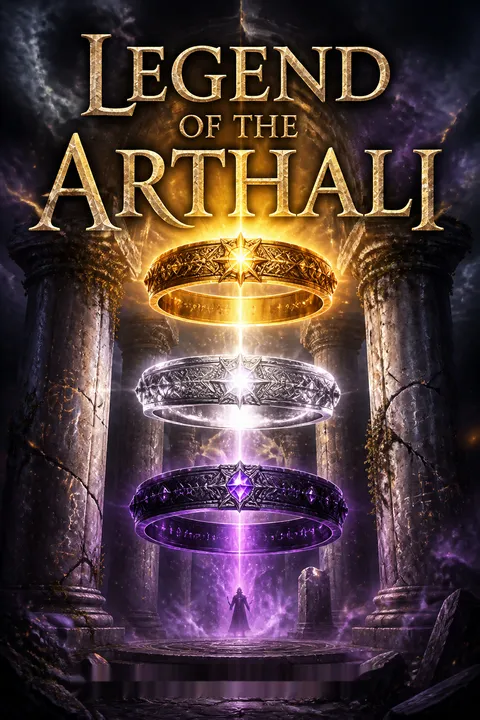
Power with a bloodlineThe circlets associated with Ilthune, Arcale, and Cindra store or channel divine power, but not everyone can draw on that power. They connect the rulers and histories of different realms to Saida, Malon, and the Arthali. The Crown of Arcale carries destructive force, while the Crown of Cindra is associated with healing; Ilthune’s circlet offers Saida command over darkness and weather. Their presence drives the search for a way home, gives the demon factions a reason to target the protagonists, and raises the question of whether divine power can be used without becoming its instrument.
Egrin’s Portal Powders
A route between realmsThe powders left from Egrin’s ritual provide the means for Saida and Malon to open a large portal from Aranthemar. Malon understands the process, while Saida must supply the power of Ilthune’s circlet. The resulting passage carries their group to Shadowmarsh, but it does not guarantee a safe landing or a return route. The powders are therefore a limited resource that makes the first journey possible without solving the larger problem of crossing realms at will.
Noireé’s Trials
A rigged test of worthThe trials are presented as a way to determine whether Saida and Malon deserve Ilthune’s circlet. A riddle arena tests interpretation and magic; a tower climb pits the pair against Arthali wielding fire and wind. The arena’s wards suppress magical objects, and Noireé exploits the circumstances to make failure more likely. Shale’s secret assistance gives Saida tools to compete, while Saida’s own adaptability turns the trials from a measure of obedience into a struggle for survival.
The Control Crystals
Power severed from consentPirvatta’s people develop wire-wrapped crystals that are pressed into Malon’s arm and used to command him. One crystal allows an external controller to direct his actions, turning the Crown of Arcale into a weapon without his agreement. This device gives the demon attack its urgency and makes the distinction between Malon’s own choices and imposed behavior central to the final confrontation. The crystals also attract Micaile, who believes controlling the god-touched could restore power to a weakened Faerune.
Dreilore Enchantments
Protection against demon magicBriar and Gliora use enchanted metal, blades, orbs, and an amulet to counter the demons’ ability to steal breath, freeze victims, or escape through darkness. Their tools let Elmerah survive a confrontation that would otherwise leave her helpless, and later help the hunters contain demons long enough to strike. The enchantments are scarce and require skill, so the Dreilore treat them as hard-won defenses rather than gifts to distribute freely. The amulet becomes an uneasy sign of temporary trust between former enemies.
Moonstone Chronicles Series
About the Author


Download PDF
Download EPUB
.epub digital book format is ideal for reading ebooks on phones, tablets, and e-readers.








