


Key Takeaways
Entrepreneurship is a trained change of identity, not a dramatic resignation
The first day was costly. In 1978, Kiyosaki left Xerox and watched his reliable salary disappear. His first day as an entrepreneur brought a disrupted flight, a missed sales meeting, and no income, while new expenses piled up: rent, supplies, insurance, and professional services. He learned that a business owner must manage costs an employer once handled behind the scenes.
The book presents this transition as more than changing jobs. Employees are generally rewarded for reliability and following established procedures. Entrepreneurs must seek opportunities, work with uncertainty, and accept responsibility for the whole venture. Kiyosaki contrasts the desire for security with the desire for freedom, but his story also shows the price of pursuing freedom: financial exposure, fear, and a steep learning curve.
The vivid contrast makes entrepreneurship feel less like a lifestyle upgrade and more like a change in the kind of uncertainty someone agrees to carry. That distinction is useful: a person may value autonomy yet still prefer the predictability of employment, and neither choice is morally superior. Modern careers also blur the boundary, since employees may face instability without owning the upside, while founders can build substantial support around themselves. The practical question is not whether fear disappears, but whether the work offers enough meaning and control to justify its risks. A financial runway and family agreement are not signs of weak ambition. They are part of making risk deliberate.
Design the business before chasing the product
A product is only a start. Kiyosaki’s nylon wallet business grew rapidly, but its founders mistook sales and attention for a durable company. They neglected advice, failed to protect their product, and did not strengthen the operations beneath the growth. Success amplified those weaknesses until the business collapsed. The book argues that hard work can temporarily prop up poor design, but it cannot make a founder-dependent operation robust forever.
Kiyosaki cites a statistic that roughly 99 percent of startups fail within ten years, based on claims that nine in ten fail in their first five years and nine in ten survivors fail before year ten. His more practical test is whether the business can keep functioning and improving when its founder steps away. If income stops when the owner stops working, the owner may have created a demanding job rather than a transferable business asset.
The wallet story captures a classic scaling trap: demand can expose operational defects faster than a business can repair them. Organizational design research makes a similar point. Growth increases coordination costs, so success depends on roles, processes, and decision-making that can absorb new volume. Still, the book’s job-versus-business distinction should not become a status hierarchy. A highly skilled independent professional may deliberately prefer a small practice, personal control, and direct client relationships. The useful test is whether the structure matches the owner’s goals, not whether every company becomes large. The failure-rate figure is best treated as a warning, since the book does not specify its underlying dataset.
Treat mistakes as data, but keep experiments survivable
Failure needs a useful sequel. Kiyosaki says his first business failed when he was nine, and that the attempt taught him lessons he used in a second venture the same year. The point is not that failure automatically creates wisdom. It creates an opportunity to stop, identify what went wrong, learn a missing skill, and change the next attempt. His father’s ice cream franchise offers the counterexample: when customers stayed away, his father cut costs and blamed others instead of examining the business and correcting course.
Kiyosaki calls prolonged planning without action “Analysis Paralysis”: repeatedly revising a plan to avoid the possibility of being wrong. He recommends starting, learning from results, seeking mentors or training, and adjusting. Yet the book distinguishes calculated experiments from random risk. A failed cold call is cheap feedback; an unprotected product or a gamble with money needed for family expenses may not be.
This is a strong case for learning loops rather than confidence as a prerequisite. In experimental science, a hypothesis becomes valuable when a test can disconfirm it and the result informs the next test. The entrepreneurial version works best when experiments are small enough to survive and fast enough to teach something specific. That qualification matters because repeated failure can also reflect bad assumptions, inadequate resources, or a market that does not exist. Persistence is not proof that a strategy is sound. The key discipline is to make failure informative, then revise the decision rather than simply celebrate endurance.
Audit all five business functions before betting your livelihood
A business has several jobs. The B-I Triangle is Kiyosaki’s framework for checking whether a venture has the functions needed to operate. It identifies five: product, legal protection, systems, communications such as sales and marketing, and cash flow. A strong product cannot compensate indefinitely for a weak function elsewhere.
His father’s ice cream shop had a good product and an established franchise system, but an obscure location and weak customer acquisition left it without enough sales. Kiyosaki argues that each function needs an owner, whether that person is a founder, employee, advisor, or partner. Before launching, map who will handle each one and what evidence will show the work is succeeding. The checklist is meant to reveal gaps before customers, creditors, or regulators reveal them more painfully.
The framework’s value lies in forcing founders to look beyond the product they are excited about. It resembles a systems map: each function depends on others, and a failure at one point can disrupt the whole operation. The ice cream example makes marketing concrete. Location is not decoration; it determines whether customers encounter the offer at all. The checklist is deliberately broad, however, and cannot replace industry-specific analysis. A software company, a restaurant, and a medical practice face different legal, operational, and cash constraints. The framework is most useful as a first diagnostic, followed by deeper research into the venture’s particular risks.
Become exceptional in one function, and recruit the rest
No founder covers everything. Kiyosaki argues that an entrepreneur needs a general understanding of the business, but does not need to be the strongest specialist in every area. He chose communications, especially sales and teaching, as his own area of focus. Others supplied skills he lacked. When his wallet company struggled, new partners brought manufacturing experience, financial discipline, and accounting guidance.
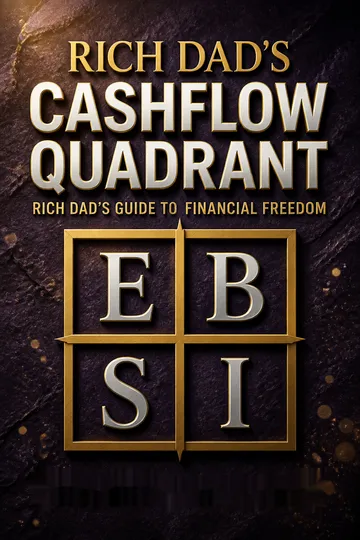
The CASHFLOW Quadrant is his model for four roles in business and finance: employee, self-employed person, big-business owner, and investor. The shift from self-employment to ownership, in his account, requires trust in other people and systems rather than insisting on doing every task personally. That means building a team around the venture’s needs, listening to qualified advisors, and retaining responsibility for the final decisions.
This advice combines specialization with coordination. A founder who knows one function deeply can recognize quality and make sharper decisions there, while collaborators supply complementary expertise. The model also highlights a common transition problem: people who succeed through personal skill may struggle to delegate because the original service depends on their judgment. Yet delegation is not simply hiring smart people. Incentives, communication, and decision rights determine whether expertise can work together. The useful ambition is not to become a universal expert, but to become an informed leader who can ask precise questions, evaluate advice, and assemble a team whose skills fit the actual business.
Choose a mission that earns cooperation beyond the paycheck
Purpose can organize a team. Kiyosaki distinguishes three kinds of motivation he calls competitive, cooperative, and spiritual money. Competitive money comes from winning against rivals. Cooperative money comes from working with partners and sharing value. Spiritual money, in his terminology, is the reward of pursuing work that feels necessary because it serves a larger purpose, not simply because it pays.
His experience in Vietnam made mission feel consequential: he concluded that equipment and resources cannot make up for a divided commitment to the cause. He later describes The Rich Dad Company as a financial-education venture built around a shared service mission. Its founders initially took no salary, while partners contributed expertise and distribution. The point is not that purpose replaces revenue, but that a credible mission can help people coordinate around work that matters to them.
A mission can function as a coordination device. It helps partners decide which opportunities fit, what trade-offs are acceptable, and why the work deserves effort when immediate rewards are limited. That is especially powerful in early ventures, where formal structures and compensation may be thin. But purpose language can also obscure weak economics or excuse overwork. A mission becomes credible through choices: who benefits, what the organization declines, and whether the business can keep serving people without exhausting its team. The author’s account of mission attracting collaborators is persuasive as a story, though it cannot establish that purpose alone caused the company’s commercial success.
Scale by packaging what you know into systems others can use
Make the founder less necessary. Kiyosaki calls the transition from personal service to replicable value passing through the “eye of the needle.” In his use of the metaphor, the founder’s knowledge must become a product, system, or protected asset that can reach people without requiring the founder to deliver every instance personally.
After years of teaching business seminars to relatively small groups, Kiyosaki and Kim developed the CASHFLOW game and book products to carry financial lessons to a wider audience. Strategic partnerships and licensing gave the company access to manufacturing, publishing, and distribution systems it did not need to build alone. The book reports that the company eventually operated in more than eighty countries and used partners rather than growing its own workforce at the same pace. The lesson is to design for reach, not just founder effort.
This is a practical account of leverage through codification and distribution. In knowledge businesses, a repeatable tool can preserve a teacher’s insight while lowering the cost of reaching each additional learner. Partnerships can provide capabilities that would be expensive to construct internally. The trade-off is control: licensing can extend a brand, but partners influence quality, timing, and customer experience. Nor does every kind of expertise translate neatly into a product. Tacit judgment, trust, and bespoke service may resist standardization. The founder’s task is to identify what can be made repeatable without stripping away the feature customers value.
Price for a defined customer, not the cheapest possible sale
Price is a positioning decision. The book describes the Five Ps as a marketing checklist: product, person, price, place, and position. The CASHFLOW game’s early focus groups suggested a price far below its production cost, while the creators worried that customers would see it as ordinary entertainment rather than financial education. They chose to present it as a substantial learning tool and set a much higher price, supported by books and seminars that helped customers understand its purpose.
Kiyosaki warns that the lowest price can attract customers who demand more than they pay for, and that the middle price often leaves a product indistinct. His prescription is not simply to charge more. The offer, customer, channel, and perceived value must fit together. The game reportedly sold more than 350,000 copies by 2004, with a return rate below one percent, according to the book.
The episode illustrates that price communicates category as well as cost. A learning product can be evaluated against entertainment, education, or financial advice, and each comparison changes what a buyer considers reasonable. The book’s positioning lesson is useful, but premium pricing is not a universal cure for weak demand. A high price can screen out the intended audience or mask an untested value proposition. The stronger method is to identify a customer with a real need, test whether the product solves it, and choose channels where that customer will recognize the value. Price should reinforce that fit, not substitute for it.
Quit failing ventures when necessary, but do not quit learning
Persistence is not stubbornness. Kiyosaki rejects the idea that winners never quit. He distinguishes abandoning entrepreneurship because a difficult period feels unpleasant from closing a business that has reached a dead end or no longer serves its purpose. His own path included failed ventures, shutdowns, rebuilding, and deliberate exits.
In 1983, he left the rock-merchandising business after seeing harmful working conditions in its overseas factories, despite the company’s renewed success. A decade later, he and Kim sold their seminar business after becoming financially independent and began designing a way to reach far more learners. For someone considering a first venture, the book recommends preparation and practice before leaving a job: gain experience, study the business functions, build relationships, and examine the cash requirements. A venture can end without ending the learning process.
This distinction resembles the difference between persistence toward a goal and attachment to one particular strategy. Behavioral economics describes the sunk-cost trap: past investment can make people continue a losing course simply because stopping feels like admitting defeat. The book offers a humane alternative, where a founder can preserve the larger ambition while changing the vehicle. Still, a mission can become a convenient story for either staying too long or leaving too soon. Useful exit criteria should be explicit: financial limits, evidence of customer demand, ethical boundaries, and whether the venture still fits the founder’s aims.
Analysis
The book is a hybrid of entrepreneurial memoir, motivational argument, and operating checklist. Its strongest organizing idea is that starting a company is not the same as designing one. Kiyosaki revisits personal failures to make the case that products, founders, and early sales are insufficient without legal protection, systems, communication, and financial control. The stories give these abstractions emotional weight: the failed franchise shows the cost of refusing to learn, the wallet business shows how success can expose weak infrastructure, and the game company illustrates how expertise can be packaged and distributed.
The framework-driven sections are most useful when treated as prompts for inquiry rather than universal laws. The five business functions provide an accessible diagnostic, while the distinctions between employee, self-employed person, owner, and investor clarify why personal skill can become a ceiling. Yet the book sometimes treats entrepreneurship as a route to freedom and employment as a route to fear. That contrast is rhetorically powerful but incomplete. Employment can offer meaningful autonomy and social value; business ownership can bring dependence on customers, lenders, partners, and markets. The relevant comparison is between actual arrangements, not labels.
The book’s treatment of failure also needs a boundary. Experimentation is essential when it produces information, but a founder should not confuse preventable harm with education. Kiyosaki and Lechter partly address this through planning, advisors, legal preparation, and cash analysis. Their advice is strongest when risk-taking is paired with feedback, financial limits, and a willingness to change course.
Finally, the mission and scaling arguments complement one another. Purpose gives a team a reason to cooperate, while systems and partnerships make that purpose reachable beyond the founders’ own labor. The book’s lasting contribution is this combined model: learn the business as a whole, build with people whose abilities differ, and make the enterprise less dependent on individual heroics. Its optimism is most credible when matched with operational discipline.
Review Summary
Rich Dad's Before You Quit Your Job receives mixed reviews. Many readers find it insightful for aspiring entrepreneurs, offering practical advice on business fundamentals and mindset. The book emphasizes learning from failures, building a strong team, and focusing on long-term customer relationships. However, some critics note repetition from Kiyosaki's other works and find the content overly simplistic. The B-I Triangle concept and emphasis on developing sales skills are highlighted as valuable takeaways. Overall, readers appreciate the real-life examples and entrepreneurial perspective, despite some shortcomings in depth and originality.
People Also Read









Glossary
B-I Triangle
Business-function checklistKiyosaki’s framework for examining five functions a business needs: product, legal protection, systems, communications, and cash flow. The outer structure also emphasizes mission, team, and leadership. It is meant to help founders identify missing capabilities before launch and diagnose weaknesses when a company struggles or grows.
CASHFLOW Quadrant
Four work-and-income rolesA model that groups people by how they earn income: employees, self-employed people or small-business operators, big-business owners, and investors. The book uses these categories to distinguish earning through personal labor from building an organization that can operate through systems and other people.
Analysis Paralysis
Planning that prevents actionKiyosaki’s label for becoming so focused on research, planning, and eliminating uncertainty that a person never begins. The term does not mean preparation is useless. It warns that planning has diminishing returns, and that some questions can only be answered by testing an offer in the real world.
Competitive money
Rewards earned through competitionOne of the book’s three motivational categories for work. Competitive money comes from competing for jobs, promotions, customers, market share, or contracts. Kiyosaki regards competition as a real and sometimes useful force, but contrasts it with value created through partnership and work guided by a larger purpose.
Cooperative money
Rewards built through partnershipA category describing value earned by collaborating rather than relying only on competition. In the book’s business examples, cooperation includes sharing capabilities, distribution, investment, or expertise through teams and strategic partners. The aim is for multiple participants to benefit from the enterprise’s growth.
Spiritual money
Purpose beyond financial rewardKiyosaki’s term for the nonfinancial reward associated with work someone feels called to do because it addresses a problem or serves others. It may attract collaborators who share the purpose. The book does not define it as charity or unpaid labor, and treats it as distinct from conventional income.
Eye of the needle
Turning expertise into leverageA business metaphor for converting a founder’s knowledge or skill into a product, intellectual property, or repeatable system that can serve people without requiring the founder to perform every task. The book uses examples such as mass production, franchising, licensing, and educational products.
Five Ps
Marketing-fit checklistA marketing checklist covering product, person, price, place, and position. It asks what is being sold, which customer it serves, what that customer will pay, where the offer should be available, and how it should be understood relative to alternatives. Kiyosaki uses it to explain why price and product must fit a specific market.
FAQ
What's Rich Dad's Before You Quit Your Job about?
- Entrepreneurial Focus: The book emphasizes transitioning from employee to entrepreneur, offering ten real-life lessons for building a multimillion-dollar business.
- Dual Perspectives: Robert Kiyosaki contrasts lessons from his rich dad with those from his poor dad, highlighting different mindsets towards money and business.
- Practical Guidance: It provides actionable advice on preparing for entrepreneurship and understanding various business roles.
Why should I read Rich Dad's Before You Quit Your Job?
- Learn from Failures: Kiyosaki teaches that failure is integral to success, encouraging readers to view mistakes as learning opportunities.
- Mindset Shift: The book challenges conventional job security beliefs, promoting entrepreneurship as a path to freedom.
- Real-World Insights: Kiyosaki shares personal experiences, making the lessons relatable and applicable to aspiring entrepreneurs.
What are the key takeaways of Rich Dad's Before You Quit Your Job?
- Job vs. Work: Understand the difference between getting paid for a job and doing your work, emphasizing preparation.
- Process Over Goal: The journey of learning and growing is more important than the end goal for long-term success.
- Embrace Risk: Taking calculated risks and learning from failures are essential parts of the entrepreneurial journey.
What are the best quotes from Rich Dad's Before You Quit Your Job and what do they mean?
- “A successful business is created before there is a business.” This highlights the importance of planning and visualizing your business model in advance.
- “Winners fail until they succeed.” It underscores perseverance, encouraging readers to see failures as steps toward success.
- “The process is more important than the goal.” This emphasizes the value of the learning journey in entrepreneurship.
What is the B-I Triangle mentioned in Rich Dad's Before You Quit Your Job?
- Framework for Success: The B-I Triangle includes Product, Legal, Systems, Communications, and Cash Flow, essential for business success.
- Interconnected Roles: Each component plays a critical role; neglecting one can affect the entire business.
- Team Building: Entrepreneurs should build a team that covers all five jobs to handle various challenges effectively.
How does Kiyosaki define an entrepreneur in Rich Dad's Before You Quit Your Job?
- Opportunity Pursuit: Entrepreneurship is about seeking opportunities without regard to current resources.
- Risk-Taking: Entrepreneurs are willing to take risks and learn from mistakes to design a scalable business.
- Learning from Experience: Continuous learning, especially from failures, is crucial for entrepreneurial growth.
What are the common mistakes entrepreneurs make according to Rich Dad's Before You Quit Your Job?
- Lack of Preparation: Many fail to prepare adequately, building a job rather than a scalable business.
- Ignoring Financials: Overlooking cash flow and financial management can lead to business failure.
- Team Neglect: Not surrounding themselves with skilled individuals can hinder success.
How can I turn bad luck into good luck as suggested in Rich Dad's Before You Quit Your Job?
- Embrace Mistakes: View mistakes as learning opportunities to build resilience.
- Perspective Shift: Focus on learning from failures rather than dwelling on them.
- Take Action: Proactively correct mistakes and move forward quickly.
What is the significance of working for free in Rich Dad's Before You Quit Your Job?
- Learning Opportunity: Working for free provides valuable experience without financial pressure.
- Skill Building: It helps develop necessary skills and knowledge for future success.
- Networking: Offers opportunities to build industry connections and relationships.
How does Kiyosaki differentiate between street smarts and school smarts in Rich Dad's Before You Quit Your Job?
- Different Skills: School smarts focus on analytical skills, while street smarts emphasize creativity and people skills.
- Real-World Application: Street smarts are crucial for navigating the business world through practical experiences.
- Team Balance: A balanced team with both skill sets is essential for business success.
How does Kiyosaki suggest raising money for a business?
- Business Plan: A well-thought-out business plan is crucial for attracting investors.
- Financial Projections: Investors need realistic projections to see profitability potential.
- Networking: Building relationships and presenting a compelling business story are key to securing funding.
What role does mindset play in entrepreneurship according to Rich Dad's Before You Quit Your Job?
- Positive Attitude: Maintaining optimism helps overcome challenges.
- Brutal Honesty: Self-awareness about strengths and weaknesses is crucial for growth.
- Learning from Failure: Viewing failures as learning opportunities fosters resilience and adaptability.
Rich Dad Series



About the Author
Other books by Robert T. Kiyosaki






Download PDF
Download EPUB
.epub digital book format is ideal for reading ebooks on phones, tablets, and e-readers.








