

Key Takeaways
GM's Futurama sold car-centered cities as a future worth building
The model was a sales pitch. At the 1939 New York World's Fair, General Motors presented a vision of 1960: expressways through cities, sprawling suburbs, and homes reached by car. Five million visitors saw this polished future and left with a pin declaring they had seen it. The exhibition made an auto-oriented life feel not merely possible, but inevitable and desirable. Its planners did not ask the public what sort of cities they wanted. They showed a future that promised convenience and abundance while leaving out displacement, pollution, and danger.
Policy followed the picture. Designer Norman Bel Geddes had developed similar ideas for Shell Oil. After the fair, he advised President Franklin Roosevelt's administration on transportation policy. The book's point is not that corporate designers predicted the future. Their vision gained influence because business interests, public agencies, and political leaders helped build it.
What's striking is how a model city can function as a political instrument while looking like harmless entertainment. The exhibition bundled a preferred lifestyle with an infrastructure plan, making each seem to validate the other. This resembles the way contemporary scenario planning can narrow public debate before a project begins: once a future is rendered as vivid and technically achievable, alternatives can look like mere nostalgia. Still, visions do not build themselves. The story also reveals openings for public influence, because a proposal becomes real only through budgets, laws, and institutional decisions that can be challenged.
Car freedom was built with public money and paid for in lives
The street was remade. Early urban streets were shared by pedestrians, bicycles, streetcars, and horse-drawn vehicles. As cars multiplied, residents protested deaths and demanded controls. In 1923, more than one in ten Cincinnati residents signed a petition for speed limiters. The automobile industry helped defeat the measure, then won more street space and public road investment. Highways later divided neighborhoods, while federal housing policy and redlining favored white suburban homeownership and excluded many Black families.
The costs became ordinary. Since 1899, motor vehicles have killed 3.7 million people in the United States, according to the book. Roads, parking, zoning, and legal rules also helped make driving necessary for many residents. This system, often called automobility, is the dependence on cars embedded in transport, land use, and everyday life. The apparent freedom of the individual driver rests on public subsidies and extensive social costs.
The historical record shifts the question from whether cars are useful to who controls the conditions under which they become necessary. That distinction matters because people can rely on a car without endorsing the policies that make alternatives impractical. It also guards against blaming individual drivers for a system designed around their vehicles. The book's account is especially strong on how race and class shaped access to suburban wealth and exposure to highway harms. A complete transition must therefore address housing access and mobility together, not simply offer better transport to people already able to remain in their neighborhoods.
Silicon Valley's lone-genius myth hides public funding and political choices
Public investment built the base. Silicon Valley's familiar story features gifted founders and free markets. The book traces a less celebrated foundation: government contracts, military research, university grants, and public infrastructure. From the mid-1970s to 2000, federal grants supplied 70 percent of academic research funding in computer science and electrical engineering. The internet and many technologies later commercialized by private firms grew from public research.
Individualism became an ideology. The Californian Ideology describes a blend of market economics, countercultural individualism, and faith that technology itself can deliver social change. Technological solutionism, a term used by critic Evgeny Morozov, is the habit of treating complex social conflicts as technical problems with neat fixes. Elite projection, a term from transit planner Jarrett Walker, is the assumption that what influential people prefer must work for everyone. These ideas help companies present commercial choices as universal progress.
This history usefully separates the source of an invention from the decisions about who owns it, who benefits, and what problem it serves. Publicly funded research can support radically different outcomes depending on later rules for access and control. The critique also has relevance beyond transport: a platform may improve a narrow task while weakening workers' bargaining power or shifting public decisions into private systems. Yet public origin alone does not guarantee public benefit. The key issue is governance, including whether communities can shape a technology's purpose and contest its harms.
An electric car cuts exhaust, not the costs of car dependence
A cleaner engine is not a new system. Electric vehicles can reduce lifecycle greenhouse gas emissions compared with gasoline cars, but they still take up road and parking space and can sustain sprawling development. The first electric-vehicle boom also shows that technology alone does not determine which transport system wins. The Electric Vehicle Company sought to control urban transport in the late 1890s, but failed to coordinate electricity providers or standardize production before Ford made gasoline cars cheaper to manufacture.
Batteries shift some harms upstream. Cobalt mining in the Democratic Republic of Congo has been linked to dangerous conditions and child labor; lithium extraction in South America threatens water supplies. The International Energy Agency projected that meeting climate goals could quadruple mineral demand by 2040, with about 80 percent of the increase tied to passenger and light commercial vehicles. The argument is not to reject electrification, but to pair it with fewer car trips and more transit, walking, and cycling.
Lifecycle analysis improves on the narrow habit of counting only what leaves a vehicle's tailpipe. It makes extraction, manufacturing, electricity, and disposal visible, including harms borne far from the driver. That wider accounting helps distinguish a cleaner vehicle from a sustainable mobility system. At the same time, electrification remains important where motor vehicles are needed, and the book recognizes that electric vehicles can emit less over their lifetimes than conventional cars. The sharper policy question is how to decarbonize essential driving while avoiding a resource-intensive replacement of every private vehicle.
Uber's convenience grew by worsening traffic and transferring risk to drivers
The app changed the interface, not the service. Uber's early pitch drew on the jitney, an informal car service that briefly competed with streetcars in the 1910s. Jitneys offered flexible rides but also created safety, congestion, and labor problems, leading cities to regulate them. Uber revived the story while omitting those costs. In San Francisco, hours spent in traffic rose 62 percent between 2010 and 2016, and researchers identified ride-hailing as the largest factor behind the increase. A separate study estimated that a private hailed trip could generate 2.8 miles of driving for every mile of passenger travel.
Drivers absorbed the expense. Uber expanded by subsidizing fares, evading taxi rules, and classifying drivers as contractors responsible for vehicles, fuel, insurance, and maintenance. California's Proposition 22 campaign promised a wage floor, but one estimate put the effective guarantee at just $5.64 per hour. The company made rides feel easier while shifting costs and insecurity onto workers.
The story shows why evaluating a transport service only by price and convenience gives an incomplete picture. A cheap ride may conceal investor subsidies, unpaid vehicle costs, additional traffic, and reduced transit use. Those costs do not disappear; they move between riders, workers, taxpayers, and other street users. Ride-hailing can still serve people who need a flexible or accessible trip, and traditional taxi regulation can protect incumbents as well as workers. The policy challenge is to preserve useful service while applying fair labor, accessibility, safety, and congestion rules across providers.
Self-driving cars automate the steering, not the politics of the street
The promised timeline kept slipping. In 2012, Google's Sergey Brin said ordinary people could experience self-driving cars within a handful of years. The idea had been promoted for decades, from radio-guided highway experiments to military-funded research, yet reliable driving in all conditions remained elusive. The book emphasizes that a vehicle's sensors cannot fix road design, unequal access, or the pressures companies face to deploy systems quickly.
A fatal test exposed the stakes. In 2018, an Uber autonomous test vehicle struck and killed pedestrian Elaine Herzberg in Tempe, Arizona. The system struggled to classify her, Uber had disabled the vehicle's automatic braking, and the safety operator was distracted. Investigators also found inadequate safety oversight. The crash illustrates a broader danger: when a new system is tested in public, people nearby can bear risks created by corporate design and regulatory decisions.
Automation changes where judgment sits; it does not remove judgment from the system. Decisions about acceptable risk, sensor design, testing, and who must adapt to a machine are political choices, even when presented as engineering details. Human-factors research also warns that people monitoring automated systems can lose attention during repetitive tasks, a concern the investigation identified as automation complacency. This does not mean automated driving has no useful applications. It does mean that claims of safety require independent evidence, meaningful liability, and protections for pedestrians, rather than an assumption that a more advanced machine is automatically safer.
New lanes and tunnels invite more driving instead of curing congestion
Road capacity creates demand. Induced demand is the increase in driving that follows added road capacity, as people change routes, take more trips, or move farther away. Houston expanded the Katy Freeway from eight lanes to twenty-three at a cost of nearly $3 billion. Although travel times initially improved, 85 percent of commuters had longer commutes after the expansion. The road did not simply accommodate fixed demand; it helped generate more driving.
New dimensions preserve old assumptions. Elon Musk's Boring Company proposed tunnels to move cars beneath congestion, while Uber promoted small flying vehicles above it. Both approaches offered privileged ways around crowded streets without changing car dependence. The Las Vegas Loop eventually opened as a 1.7-mile tunnel using human-driven vehicles, rather than the high-speed autonomous system originally advertised. These projects redirected attention toward spectacular infrastructure instead of the less flashy work of moving more people efficiently.
Induced demand is powerful because it treats transport behavior as responsive to the built environment, not as a fixed volume that planners merely need to serve. That insight applies to rail, buses, and cycling infrastructure too: better alternatives can attract trips that were previously difficult or made by car. Road expansion can still provide local relief in particular cases, so the principle is not that every new lane instantly fails. The relevant test is whether a project improves access across the whole network or simply makes driving easier until land use and travel patterns adapt.
Treat sidewalks as public infrastructure, not startup inventory
Small devices can claim public space. Micromobility refers to short-distance travel on bicycles, electric bikes, and scooters. Dockless rental companies placed vehicles on sidewalks with little consultation, creating obstacles for pedestrians and wheelchair users. Delivery robots made the same assumption that sidewalks were underused. In Pittsburgh, a Starship robot blocked a curb ramp needed by wheelchair user Emily Ackerman, leaving her in the street as traffic moved.
The business model matters. Some dockless scooters lasted only weeks before needing replacement, despite companies' sustainability claims. Pennsylvania legislation even classified delivery robots as pedestrians, allowing devices up to 550 pounds and 12 miles per hour on sidewalks. The issue is not that every scooter or robot is inherently harmful. It is that companies and lawmakers can allocate public space without ensuring accessibility, durability, or meaningful public benefit.
Sidewalk disputes reveal how infrastructure is often defined by whose movement counts. A curb ramp is not spare space; it is essential access for disabled people. Similarly, a scooter may offer a useful alternative to a car while its parking practices obstruct someone else's route. The important distinction is between a mobility tool and the rules governing its deployment. Permits, designated parking, accessibility requirements, and durable equipment can help reconcile uses, but only if disabled pedestrians and other affected residents have real influence over the terms.
Build mobility around shared public access, not premium escape routes
Change the street and the service together. Oslo removed 650 parking spaces from its center and used the space for cycle lanes, seating, play areas, and other public uses. Paris shifted road space toward buses, bicycles, and pedestrians, helping reduce car use by 20 percent over several years. These examples show that governments can shape travel by changing what streets make easy, not just by waiting for technology to improve.
Make the transition equitable. The book calls for frequent and accessible transit, safe walking and cycling, stronger intercity rail and bus networks, and public accountability over transport data. Housing policy matters too: improved transit can raise nearby costs and push out the people it was meant to serve. The aim is not to ban useful technology, but to direct it toward collective access and give communities power over planning.
The most consequential proposal is institutional rather than gadget-based: treat mobility as a public service and plan it alongside housing, labor, and land use. That approach avoids defining success only as speed for people who can pay for a private shortcut. The examples also resist easy imitation. Paris and Oslo have different histories and constraints, and transit improvements can trigger displacement if affordable housing is not protected. A fair transition therefore needs both transport investment and safeguards that let residents remain in the communities those investments improve.
Analysis
The book's central contribution is to treat transportation technologies as parts of political and economic systems, rather than isolated inventions. Its recurring historical pattern is precise: a compelling future is marketed, public institutions build the conditions for it, and its costs are distributed unevenly. The automobile's history makes the argument vivid, while the comparison with Silicon Valley shows how the language of disruption can obscure familiar concentrations of power. The strongest chapters connect lofty promises to operational details: cars circulating between rides, batteries dependent on extractive supply chains, or sidewalks treated as unclaimed commercial space.
The approach also corrects a common category error. Electric cars, autonomous vehicles, and ride-hailing may alter how a car is powered, driven, or accessed, but these changes do not necessarily alter the land use and resource demands of car dependence. This distinction is crucial for climate policy. Cleaner vehicles can lower emissions per trip, yet reducing vehicle travel and improving alternatives can address a broader set of harms. The book's polemical force sometimes makes corporate intent seem more uniform than the evidence requires. A service can be exploitative in one respect and useful in another; a private car can be necessary in a place where transit is absent. A rigorous policy response should separate the value of a technology from its ownership, regulation, and distributional effects. That refinement strengthens rather than weakens the book's thesis: outcomes are shaped, not predetermined.
The practical challenge is to turn critique into durable institutions. Public transit needs reliable funding, adequate service, accessibility, and housing protections. Community consultation must influence decisions rather than merely legitimize them. Technology can help coordinate these systems, but public oversight must determine its goals and limits. The book ultimately asks readers to evaluate transport proposals by a tougher measure: not whether they look futuristic, but whether they expand people's real freedom of movement without exporting costs to workers, marginalized communities, or future generations.
Review Summary
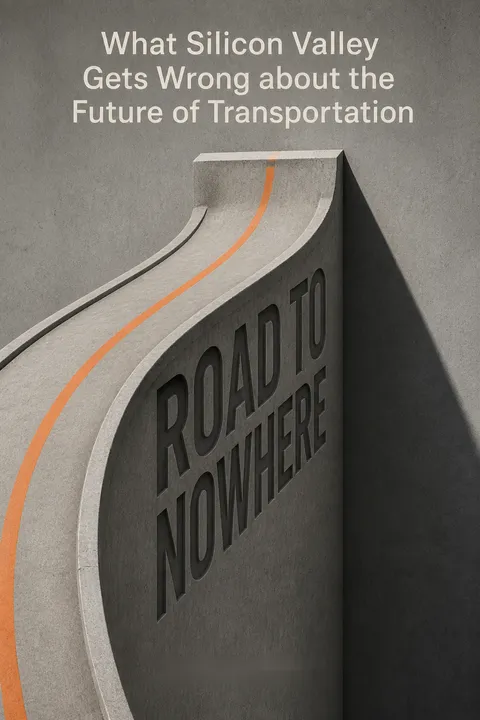
Road to Nowhere: What Silicon Valley Gets Wrong about the Future of Transportation offers a critical examination of tech industry approaches to transportation. Marx argues that Silicon Valley's vision prioritizes profit over public good, perpetuating car-centric systems and ignoring societal inequalities. The book covers topics like electric vehicles, ride-sharing, and autonomous cars, exposing their flaws and environmental impacts. While some readers found it repetitive, many praised its historical context and critique of capitalist ideologies. Marx advocates for community-focused, sustainable transportation solutions, though some felt the proposed alternatives lacked practicality.
People Also Read






Glossary
Automobility
Car-centered transport systemA system in which cars shape not only travel, but also land use, public spending, daily routines, and access to services. In the book, automobility describes dependence created by roads, parking, suburban development, and the decline of alternatives, rather than simply the act of driving.
Californian Ideology
Tech individualism plus market faithA worldview combining faith in free markets and technological progress with an individualist, countercultural language of personal empowerment. The book traces how this blend minimizes the role of government and collective politics, while presenting technology and entrepreneurship as routes to social change.
technological solutionism
Technical fixes for social problemsAn approach that frames complex, contested social problems as if they could be solved by narrow technical interventions. In the book, this mindset encourages tech leaders to propose attractive products before investigating the political causes of problems such as congestion, unequal mobility, or unsafe streets.
elite projection
Treating elite preferences as universalThe mistaken assumption that what relatively privileged and influential people find convenient or appealing will benefit society as a whole. The book uses the concept to explain why transport proposals designed around wealthy users can be promoted as universal solutions despite excluding or burdening other residents.
induced demand
More road space creates more drivingThe increase in vehicle travel that can follow an expansion of road capacity. People may change routes, make additional trips, or live farther from destinations when driving becomes easier. The book uses this concept to explain why road widening often fails to deliver lasting congestion relief.
micromobility
Short trips by small vehiclesA category of short-distance travel that includes bicycles, electric bicycles, and electric scooters. In the book, the term often refers to app-based rental services, especially dockless fleets, whose placement, durability, prices, and accessibility can affect how public sidewalks and streets are used.
digital redlining
Digital systems reinforcing exclusionThe use of technologies, rules, and investments that reproduce class boundaries or discriminate against particular groups. The book applies the term to digital systems that appear to make services more convenient while embedding unequal access and reinforcing existing disadvantages.
subscriber city
Urban access controlled by platformsA model of urban life in which platforms mediate access to services and places through accounts, data, and payment relationships. As control shifts toward platform owners, access can become unpredictable, and residents may have limited ways to challenge an exclusion or decision.
FAQ
What's Road to Nowhere about?
- Critique of Silicon Valley: The book critiques Silicon Valley's tech industry for its flawed approach to the future of transportation, focusing on technological solutions while ignoring social and political implications.
- Historical Context: Paris Marx provides a historical overview of how the automobile reshaped urban life, emphasizing that the current system is driven by corporate interests rather than public demand.
- Call for Change: The author advocates for a transportation system prioritizing public transit, cycling, and walkable communities over car-centric development.
Why should I read Road to Nowhere?
- Understanding Transportation Issues: Essential for those interested in urban mobility and environmental impacts, offering a critical lens on tech promises like self-driving cars.
- Historical Insight: Provides context on how corporate interests have historically shaped urban environments, crucial for current debates on mobility and sustainability.
- Vision for the Future: Offers a vision for equitable transportation, valuable for activists, policymakers, and those concerned with climate change and social justice.
What are the key takeaways of Road to Nowhere?
- Tech Solutions Are Insufficient: Technological advancements alone can't solve transportation issues; political and social considerations are necessary.
- Historical Lessons Matter: Understanding automobility's history is crucial for addressing current challenges, revealing how profit has been prioritized over public good.
- Advocacy for Public Transit: Emphasizes shifting towards public transit and non-motorized transportation as more sustainable and equitable urban mobility options.
What are the best quotes from Road to Nowhere and what do they mean?
- "The corporations didn’t predict a car-centric, consumerist future—they made it a reality.": Highlights how corporate interests actively shaped the transportation landscape.
- "Technology alone cannot resolve the inequities of the existing transport system.": Stresses that without addressing political and social dimensions, tech solutions will fail.
- "We must be wary of embracing sweeping master plans that fail to properly consider the full effects.": Cautions against accepting tech-driven solutions without examining broader implications.
How does Road to Nowhere critique the automobile's impact on society?
- Displacement of Communities: Discusses how automobiles led to the displacement of marginalized communities, disrupting social networks.
- Environmental Consequences: Highlights environmental degradation from car-centric development, contributing to climate change and public health issues.
- Social Isolation: Argues that automobiles foster social isolation, particularly in suburban areas designed around car travel.
What does Road to Nowhere say about electric vehicles?
- Not a Panacea: Argues that EVs don't address fundamental issues of car dependency and urban design, still requiring resource extraction.
- Historical Context: Notes that EVs were once viable but overshadowed by internal combustion engines due to corporate interests.
- Need for Systemic Change: Emphasizes that replacing gas-powered vehicles with EVs won't solve broader transportation issues; a comprehensive approach is needed.
How does Road to Nowhere address the role of Silicon Valley in transportation?
- Techno-Utopianism: Critiques the belief that technology alone can solve transportation problems, a central theme in the book.
- Corporate Interests: Highlights how Silicon Valley's transportation proposals are often profit-driven, neglecting broader community needs.
- Historical Influence: Connects current tech-driven narratives to historical patterns of corporate influence over transportation policy.
What are the implications of ride-hailing services discussed in Road to Nowhere?
- Increased Congestion: Argues that ride-hailing services like Uber worsen traffic congestion by adding more cars to the road.
- Impact on Public Transit: Discusses how ride-hailing draws riders away from public transit, undermining its viability.
- Labor Exploitation: Highlights precarious working conditions for ride-hailing drivers, reflecting broader labor exploitation trends in the gig economy.
How does Road to Nowhere propose to improve transportation systems?
- Focus on Public Transit: Advocates for prioritizing public transit over personal vehicles, investing in supportive infrastructure.
- Community-Centric Planning: Emphasizes designing urban spaces that foster community interaction and accessibility.
- Addressing Inequities: Calls for a transportation system addressing social and economic inequities, ensuring reliable and affordable mobility for all.
How does Road to Nowhere critique the concept of autonomous vehicles?
- Overpromising Technology: Argues that the tech industry overpromises autonomous vehicles' capabilities, potentially exacerbating existing problems.
- Vulnerabilities in Systems: Discusses how reliance on autonomous vehicles could create new vulnerabilities in transportation networks.
- Need for Infrastructure: Highlights that successful implementation requires extensive infrastructure improvements, often not feasible in many urban areas.
What alternatives to autonomous vehicles does Road to Nowhere suggest?
- Low-Tech Solutions: Advocates for improved public transit, cycling infrastructure, and pedestrian-friendly design as more effective solutions.
- Community Engagement: Emphasizes involving communities in transportation planning to ensure solutions meet their needs.
- Political Will: Argues for political action prioritizing public welfare over corporate interests, reallocating resources to support public transit.
How does Road to Nowhere relate to historical transportation trends?
- Historical Context: Provides an overview of transportation trends, particularly automobility's rise and its urban impact.
- Lessons from the Past: Draws parallels between past policies and current trends, highlighting historical mistakes to inform better decision-making.
- Changing Urban Landscapes: Discusses how historical decisions shaped cities, often to pedestrians' and public transit's detriment, essential for envisioning a more equitable future.
Download PDF
Download EPUB
.epub digital book format is ideal for reading ebooks on phones, tablets, and e-readers.








