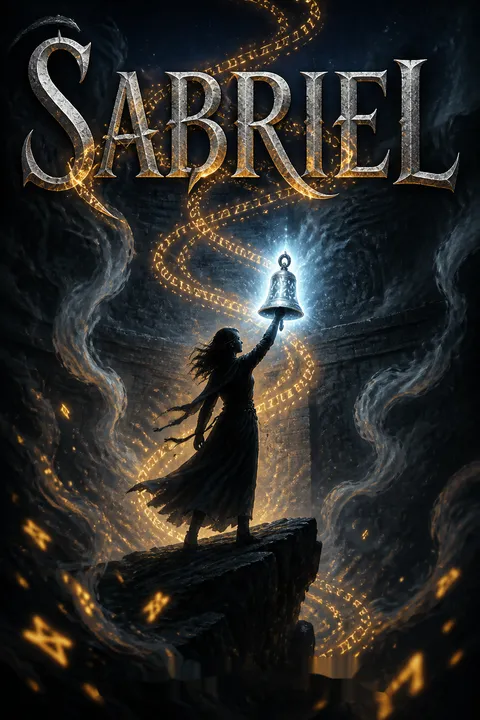


Plot Summary
Prologue
Near the Wall, Abhorsen finds a woman dead beside her stillborn daughter and insists the child has not passed beyond recovery. A Charter Mage names the baby Sabriel, and the mark of the Charter settles on her forehead. In Death, Abhorsen confronts Kerrigor, a powerful spirit trying to seize the infant as she drifts toward the First Gate.
Sabriel’s tiny hands cling to Kerrigor’s shadow, burning him; Abhorsen takes her back and rings a bell to drive him away. The child wakes alive in the freezing camp. Abhorsen takes her as his daughter, setting the inheritance of his dangerous office beside the tenderness that will shape her life.
The opening makes Sabriel’s inheritance physical before she can understand it. Her life is held in place by the Charter, yet it is her instinctive grip that injures Kerrigor, suggesting that the power she will later wield is not merely a tool passed down by her father. Abhorsen’s rescue is an act of intimate care performed through frightening expertise: he enters Death, confronts an ancient enemy, and returns with a baby. The scene also establishes a crucial distinction between necromancy that exploits the dead and Abhorsen’s duty to release them. Sabriel’s origin therefore binds affection, danger, and responsibility together from the first breath.
A Rabbit Crosses Back
At Wyverley College, Sabriel brings a rabbit back to life after a car kills it, then recoils from how easily she crossed the boundary she has been taught to respect. She is considering university and a safer distance from the Old Kingdom when her father misses his usual visit. That night a dead servant breaks into the dormitory carrying a sack.
Sabriel enters Death, recognizes the creature’s message, and takes the parcel before it is swept through the First Gate. Inside are Abhorsen’s sword and seven bells, tools for binding and laying the Dead to rest. The missing visit now has a cause: her father is trapped or dead, and Sabriel vows to cross the Wall and find him.
The rabbit is not a miniature adventure so much as Sabriel’s first unsupervised test of her own power. She saves a creature she can see and love, but immediately understands that the same impulse could become dangerous when applied to people. Her father’s absence turns this private anxiety into an urgent ethical problem: she must act without the guidance that has kept her power contained. The bells make inheritance practical rather than ceremonial. Sabriel receives not a reassuring explanation, but instruments and a responsibility whose meaning she must discover under pressure.
Across the Charter Wall
At the Ancelstierran Perimeter, soldiers mistake Sabriel’s Charter magic for a threat until Colonel Horyse recognizes her mark and her father’s insignia. He explains that Abhorsen once stopped the Dead from rising near the crossing by placing silent wind flutes among the defenses. Sabriel warns that those bindings may fail if her father is gone. Horyse lets her pass alone.
Beyond the Wall, she finds a dead soldier, then seven beheaded members of a patrol on the path to Cloven Crest. A message preserved in a bridge post identifies their killer as a Mordicant serving a Greater Dead. At the hilltop, Sabriel finds a Charter Stone split by a blood sacrifice, evidence that the enemy is deliberately opening doors into Death.
The Perimeter exposes the gap between institutional control and actual knowledge. Ancelstierre has trenches, rifles, and regulations, but its soldiers still depend on Abhorsen’s unseen work to keep the dead buried. Horyse respects Sabriel because he recognizes the scale of that dependence, not because she has proved herself in battle. The patrol’s mutilation gives her first evidence that her father’s disappearance is part of a wider assault. The broken stone matters as both a tactical breach and a damaged civic bond: the enemy is not simply killing people, but dismantling the structures that make communal life possible.
The Hill Opens Its Mouth
At the broken stone, Sabriel enters Death to summon a guide. Her mother’s protective sending gives directions to Abhorsen’s House, then warns her that a Dead creature is approaching. Thralk, a revenant feeding on human life, crosses the failed ward. Sabriel wounds him with her father’s sword, binds him with Saraneth, and uses Kibeth to send him through the Gates.
His warning that he serves Kerrigor leaves her with a name she cannot yet place. The larger threat arrives as a Mordicant pursues her up the cliff path. Sabriel finds the hidden door by ringing Mosrael, escapes into a tunnel, and reaches the river island where Abhorsen’s House stands, collapsing at its gate.
Sabriel’s first fight in the Old Kingdom is a lesson in the difference between knowledge and command. Her schooling supplies the right tools, but exhaustion, fear, and a broken Charter Stone leave her vulnerable. She survives because she can choose among the bells rather than treat magic as a single, overwhelming force. The mother-sending offers guidance without rescue, preserving Sabriel’s agency while acknowledging the care she has been denied in life. Thralk’s reference to Kerrigor widens the danger beyond one encounter. The Mordicant then turns the journey itself into a pursuit, forcing Sabriel to trust the protections of a home she barely remembers.
Abhorsen's House Awaits
Sabriel wakes in the House, where the bound cat Mogget and the Charter sendings serve her. Mogget tells her that her father is dead and that the office of Abhorsen now belongs to her. Sabriel refuses to accept that conclusion, convinced she sensed her father alive in Death.
She learns that he left for Belisaere after a plea for help, while Mogget describes a Kingdom without a ruler, weakened by broken Charter Stones. From the observatory, Sabriel sees enslaved villagers building a bridge of grave dirt across the river so the Dead can reach the island. Mogget offers two defenses: summon a flood or escape in an old Paperwing. With the Dead closing in, Sabriel chooses both preparations.
The House gives Sabriel shelter, but not certainty. Its loyal sendings treat her as their mistress before she has decided whether she can bear the title, while Mogget translates succession into a blunt fact. Her refusal to believe her father dead is more than denial: it preserves the possibility of a personal reunion inside a role that threatens to consume the person she was. The view of the grave-dirt bridge makes that conflict material. The Dead are turning the dead themselves into an instrument against the living, and Sabriel must use inherited power before she fully understands its cost.
The Paperwing Falls
Sabriel summons a flood that destroys the Dead’s bridge, but the wave also sweeps away enslaved villagers and wreckage from hundreds of miles upstream. The sendings outfit her for travel, and Mogget draws a map before joining her in the Paperwing. Gore crows attack as they fly over the delta.
Sabriel calls a wind strong enough to escape them, then loses control as it spirals the craft toward the ground. With the Paperwing falling, Mogget urges her to remove his collar and use the silver ring he gave her. Freed into a blazing Free Magic form, he levels the aircraft, but they crash into a sinkhole. Sabriel survives; the Paperwing burns, and Mogget’s true nature is no longer a secret to her.
The flood forces Sabriel to confront the distance between a necessary decision and a clean one. She protects the House, yet people die because she summons power whose reach exceeds her intention. The Paperwing offers a contrasting image of inherited craft: a creation designed with care, whose magic responds to skill but cannot compensate for Sabriel’s inexperience. Mogget’s collar and ring complicate the idea of a servant. His rescue depends on Sabriel breaking a binding she does not understand, an act that risks releasing something dangerous. Survival here is neither triumph nor mastery; it is a bargain with consequences still unfolding.
The Wooden Prisoner
Bruised and stranded at the sinkhole’s bottom, Sabriel finds a hidden passage into a royal burial ground. There, among the funerary ships of the Old Kingdom’s rulers, an unfinished vessel bears a young man’s likeness as its figurehead. Mogget is asleep in a patch of catbalm, so Sabriel decides for herself to enter Death and retrieve the spirit trapped beneath the water.
She hauls it back to Life despite a Dead creature stalking her. A breath against the wooden face restores the young man’s body. He calls himself Touchstone, though he cannot remember his original name, and learns that two centuries have passed. He offers his service, while Sabriel, still uncertain of her authority, insists they travel together without claiming his oath.
Touchstone’s rescue mirrors Sabriel’s rabbit rescue, but at a far greater moral scale. Again she acts before she has the strength or information a cautious mentor might demand. Her choice gives a person back to himself, yet it also adds a companion whose memories carry unresolved history. Touchstone’s self-description as a fool and his formal servility reveal a psyche organized around shame: he treats service as safer than equality because he believes his past has disqualified him. Sabriel’s refusal to accept an oath she has not earned shows a different kind of uncertainty. She is not yet comfortable commanding, and that reluctance preserves a space in which trust can develop.
Nestowe's Last Refuge
Touchstone remembers a hidden stair, and the three emerge near the coastal village of Nestowe. Flooded fields, silent pumps, and a broken Charter Stone show that the Dead have emptied the settlement. At the harbor, survivors hold a small island behind a gap in their breakwater. Sabriel finds the village healer sacrificed before the stone and burns her body to release her spirit.
In the crowded refuge, she senses a Dead parasite riding inside a fisherman named Patar. It drains him to ash and escapes his body, but Touchstone pins it with his enchanted swords while Sabriel binds and banishes it. Because a Mordicant is tracking her, the group leaves by boat. A child, Aline, recites a rhyme that hints at the Great Charters.
Nestowe tests whether Sabriel’s office is limited to defeating monsters or includes responsibility to people who cannot follow her. She cleanses the island but cannot promise to restore the mainland, so her help is concrete and incomplete. Patar’s death makes that limitation painful: identifying the threat does not mean every victim can be saved. The survivors’ fear also reveals how easily communal trust can collapse when a hidden enemy wears a familiar face. Aline’s classroom rhyme offers knowledge in an unheroic form, suggesting that the Kingdom’s deepest structure is carried not only by rulers and adepts, but by ordinary teaching and memory.
A Name Beneath the Sea
The voyage toward Belisaere gives Touchstone’s memory room to return. He tells Sabriel that two centuries earlier, Prince Rogir, his childhood friend, drew the Queen and her party to the Great Stones under false pretenses. Rogir’s followers sacrificed two of his sisters and broke two stones; he then killed the Queen.
Touchstone killed the guards who joined the plot and wounded Rogir, but Rogir’s body was already sustained by Free Magic. The Abhorsen of that era arrived too late to save the royal family and imprisoned Rogir’s spirit in Death. Mogget identifies the enemy Sabriel knows as Kerrigor with Rogir, whose long campaign has weakened the Kingdom. Touchstone admits that his trust helped make the massacre possible.
Touchstone’s confession turns his silence into a psychological defense with a historical cost. He has not merely lost memories; he has organized his identity around the belief that remembering would make him responsible all over again. The revelation confirms that the Kingdom’s collapse began with intimate betrayal, not an impersonal catastrophe. Rogir exploited the Queen’s trust and Touchstone’s loyalty to gain access to the Great Stones, converting family bonds into instruments of power. Sabriel’s listening matters because she neither absolves Touchstone nor reduces him to his worst action. The sea’s temporary loosening of the binding lets the truth surface, but it does not erase guilt.
The City Behind Water
Belisaere is not empty: its harbor and central valley bustle with trade, while aqueducts hold the Dead back from the surrounding hills. Sabriel senses that the city’s safety rests on a narrow, guarded boundary. On the way out of the protected quarter, she sees scavengers driving chained children ahead as bait for the Dead. Mogget stops her from attacking a larger force before she can reach the children.
Sabriel chooses to continue toward the reservoir, where she believes her father’s body lies, and promises herself she may return. Touchstone leads her through the ruined Palace Hill park to an entrance beneath the ornamental caves. They descend into the dark water chamber, where the broken Great Stones make every step physically sickening.
Belisaere presents survival as a compromised arrangement rather than a restored society. The aqueducts protect the living, but the city’s boundary leaves the hills to the Dead and its scavengers exploit children to make that boundary more profitable. Sabriel’s choice to pass the chained children is morally consequential, even though Mogget’s warning has practical force. She does not mistake urgency for innocence; she knows what she is postponing. Touchstone’s willingness to lead her through the palace grounds also signals that the past is not merely his private burden. The reservoir is the site where his guilt began and where Sabriel’s search for her father must now enter the same history.
The Fourth Gate
In the reservoir, Sabriel finds Abhorsen suspended inside a diamond of protection, still alive in body but absent in spirit. She and Touchstone join their Charter magic to build a second diamond around him. Sabriel enters Death and crosses its Gates, finding her father imprisoned within the Fourth Gate. By ringing Mosrael and Kibeth together, she frees him and returns with him to Life.
Abhorsen explains that Kerrigor’s original body lies beneath a cairn near Wyverley in Ancelstierre; destroying it will weaken the spirit that keeps returning. He also identifies Touchstone as the surviving royal heir and Mogget as a remnant of the Wallmakers. Sabriel now has a way to fight Kerrigor, but only if they reach the body before his next attack.
The rescue answers Sabriel’s deepest personal question, but it does not restore the family life she hoped to recover. Abhorsen’s knowledge immediately turns reunion into a plan, revealing how thoroughly his office has shaped even their intimacy. Sabriel is forced to accept that love cannot undo time or cancel the rules governing death. The combined Charter diamond also marks a shift from solitary competence to shared action: Touchstone’s strength makes possible what Sabriel could not sustain alone. The revelations about his ancestry and Mogget widen the struggle from a father-daughter search into a conflict over the Kingdom’s sources of authority.
The Bell of Sorrow
As Kerrigor’s Dead gather in the reservoir, Abhorsen sees that the enemy wants the blood of Sabriel and Touchstone to break the remaining Great Charters. He gives Sabriel a route to the surface and takes Astarael, the bell that draws everyone who hears it into Death. Sabriel and Touchstone run for the southern stair as her father sounds it behind them.
The bell nearly strips them from their bodies; Sabriel revives Touchstone with a desperate kiss, and they escape the reservoir. Abhorsen does not return. With Mogget’s fate uncertain and her father gone, Sabriel follows his instructions to the Palace’s West Yard, where he said help would be waiting.
Abhorsen’s final act is both a strategic sacrifice and the fulfillment of the law he has taught Sabriel: no one can remain indefinitely outside the proper course of death. He does not offer a sentimental solution or ask his daughter to choose between love and duty; he makes the choice himself, buying her time at the cost of his remaining life. Sabriel’s rescue of Touchstone is an intensely embodied answer to Astarael’s pull. The kiss is not a cure for grief, but a deliberate insistence on life when both have been summoned away from it. Her grief continues, yet it no longer prevents action.
The Clayr's Frozen Map
At the West Yard, Sabriel finds the Clayr twins, Sanar and Ryelle, waiting with two Paperwings. They use a vision held in a sheet of ice to show her Kerrigor’s living body inside a bronze sarcophagus under the cairn at Docky Point, close to Wyverley. The image confirms the target but also reveals that the enemy can sense them.
Sabriel and Touchstone fly south and cross back into Ancelstierre, where Colonel Horyse meets them at the Perimeter. The kingdoms’ different passage of time means the full moon, when Abhorsen’s wind-flute bindings will fail, is due that night. Horyse commits soldiers and Charter Mages to Sabriel’s plan, while the approaching fog warns that Kerrigor is already moving.
The Clayr’s vision converts a diffuse supernatural conflict into a location and a deadline. Their knowledge is powerful but partial: the image identifies Kerrigor’s body without making the journey safe or guaranteeing success. The Paperwings also connect the Old Kingdom’s magic to Ancelstierre’s geography, fulfilling the reason Sabriel’s father sent her south as a child. Horyse’s decision to help brings institutional force into a conflict his command structure cannot officially explain. The full moon sharpens the pressure by turning time itself into an adversary. Sabriel must act before a protective system fails, not simply before an enemy arrives.
The Cairn at Wyverley
Horyse leads Sabriel, Touchstone, and his Charter-marked soldiers to Docky Point. The closer they pry into the cairn, the more Kerrigor’s Free Magic sickens them.
Their first linked spell cannot open the sarcophagus, so Horyse moves the coffin by horse-drawn wagon to Wyverley College, where Sabriel can summon the older students trained in Charter magic. As the fog reaches the village, the school’s lights fail and the Dead attack. Sabriel organizes the soldiers and students into a handfast ring around the coffin.
Their joined power finally tears its lid free, revealing Rogir’s preserved body. Before Sabriel can complete the funeral spell, Kerrigor blasts through the Hall wall, and the creature once known as Mogget arrives carrying Abhorsen’s sword and Astarael.
The school’s transformation into a defensive stronghold brings Sabriel’s two worlds into direct contact. Wyverley once protected her by teaching a limited, disciplined version of magic; now its students must use that training in a real emergency. Their participation is not a triumphant proof that children are ready for war. It is a response to the fact that the danger has crossed the boundary adults hoped would contain it. The failed first spell also prevents the climax from becoming a simple test of individual strength. Sabriel succeeds only by linking different levels of knowledge and authority, while the arrival of Kerrigor and Mogget makes clear that collective effort has bought a chance, not safety.
Two Bells Against Darkness
Kerrigor kills and wounds defenders while Mogget attacks him, then is swallowed by the Greater Dead. Sabriel uses Saraneth and Kibeth to force Kerrigor back into Rogir’s body, but both bells shatter. The silver ring Mogget gave her tightens around Kerrigor’s neck; he impales Sabriel with her own sword before the binding strips away his body. Lying wounded, she rings Ranna.
Its sleep settles across the Hall, and the dark mass divides into two cats, one white and one black, each collared and bound. Touchstone survives, but Sabriel drifts into Death. In the epilogue, the spirits of past Abhorsens send her back because she is the last of their line. She wakes among survivors, with Kerrigor contained and the Kingdom’s immediate threat ended.
The victory depends on combining instruments that do not promise a clean triumph. The bells can command and redirect Kerrigor, but they break under the force of that use; the ring can contain him, but not before he wounds Sabriel. Ranna then changes the terms of the ending, turning a battlefield into sleep and dividing the fused powers of Mogget and Kerrigor into separate bound forms. Sabriel’s return from Death does not erase the deaths around her. The ancestors’ intervention makes survival a responsibility passed forward, not a reward for heroism. Her work continues because the living still need an Abhorsen.
Epilogue
Sabriel drifts in Death, expecting to pass beyond the Ninth Gate after her work is done. A gathering of past Abhorsens stops her, insisting that she must return because she is the last of their line. She finds the strength to reach Life again. Touchstone is holding her, and the soldiers are tending the wounded as ambulances arrive from town.
Sabriel senses the dead: Horyse, Magistrix Greenwood, Ellimere, other students, and many soldiers. Two cats sleep nearby, each wearing a bell collar, while the silver rings lie on the floor. Touchstone finally realizes she is alive. Sabriel answers him, and pain returns with consciousness.
The ending refuses to equate survival with restoration. Sabriel wakes to a world that has been saved from Kerrigor’s immediate assault, but the losses in the Hall remain visible and individually consequential. The former Abhorsens bring her back not because she has defeated death, but because the office must continue through someone living. That intervention transforms inheritance from an imposed burden into a reciprocal bond: the dead who shaped Sabriel now depend on her to carry their work. Touchstone’s relief anchors this immense supernatural return in a human relationship. Her first return to feeling is pain, a reminder that life is valuable partly because it is vulnerable.
Analysis
Sabriel is a story about the ethics of power when love and duty cannot be neatly separated. Sabriel’s first act of necromancy for a rabbit anticipates the larger temptation to reverse death for someone she loves. The book does not treat that impulse as foolish; it treats it as morally serious, then asks what happens when the private wish to restore one person collides with the public need to protect many.
The distinction between Abhorsen and other necromancers gives this conflict its structure. The bells do not make death disappear. They let Sabriel guide the Dead toward a proper end, while Kerrigor’s power depends on refusing that end and feeding on living people. His attack on the Charter Stones therefore represents more than a bid for magical dominance. He attacks the shared conditions that let communities remain safe, turning graveyards, family blood, and familiar bodies into tools of control.
Inheritance is both necessary and costly. Abhorsen protects Sabriel by sending her away, but the safety he creates also leaves her ignorant of the Kingdom she must eventually serve. Touchstone’s buried history shows another form of inheritance: guilt that survives its original moment and shapes a person’s self-conception for centuries. Sabriel does not resolve either burden through a clean act of forgiveness. Instead, she learns to work with others, accepting help from Touchstone, Horyse, the Clayr, schoolgirls, and the House’s sendings.
The two kingdoms complicate the fantasy of a clean boundary between modernity and magic. Ancelstierre’s machines fail near the Wall, yet its soldiers, schools, and civic warnings become indispensable. The novel’s answer is not that one world is superior, but that survival requires cooperation across their different forms of knowledge. Sabriel’s adulthood arrives through action: she inherits the office, but gradually makes it her own by choosing when to risk herself, when to accept another person’s strength, and when the dead must be allowed to go.
Review Summary
Sabriel received generally positive reviews, with readers praising its unique magic system, world-building, and strong female protagonist. Many found it captivating and action-packed, with memorable characters like Mogget the cat. Some criticized the underdeveloped romance and pacing issues. Readers appreciated the blend of fantasy and horror elements. While some felt it hadn't aged well, others considered it a classic YA fantasy. The audiobook narrated by Tim Curry was well-received. Overall, it's recommended for fans of YA fantasy and adventure stories.
People Also Read


Characters
Sabriel
The reluctant AbhorsenRaised at Wyverley College in Ancelstierre, Sabriel is the daughter of Abhorsen and a gifted student of Charter magic. Her training has made her capable, but not omniscient: she knows the dead intimately while remaining inexperienced in the wider history and customs of the Old Kingdom. She is disciplined, observant, and often more comfortable with practical decisions than emotional ones. Her instinct to protect vulnerable life can outrun her caution, as her early rescue of a rabbit demonstrates. Sabriel is driven by love for her father, then by the responsibility that unfolds around that love. Her central struggle is learning to exercise inherited authority without allowing the title to erase her judgment, tenderness, or sense of self.
Abhorsen
Sabriel's father and mentorSabriel’s father holds the ancient office of Abhorsen, a necromancer who binds the Dead and helps them pass beyond the final boundary. He is powerful, secretive, and accustomed to carrying danger without sharing its full weight. His visits to Sabriel at school reveal affection expressed through lessons, gifts, and careful preparation rather than ordinary family life. He has taught her to use the Charter and the bells, while withholding much of the political history that would explain why her skills matter. His identity as both parent and public servant creates a lasting tension: he loves his daughter, but his work repeatedly places the Kingdom’s survival ahead of the life he might have shared with her.
Mogget
The bound white catMogget serves Abhorsen’s household in the form of a white cat wearing a red collar and a tiny bell. Sardonic, observant, and resistant to sentiment, he knows far more about the Old Kingdom than he is willing or permitted to explain. His sharpness often exposes Sabriel’s ignorance, but he also protects her and supplies knowledge when she has few alternatives. Mogget’s behavior shifts between practical loyalty and flashes of anger at the limits imposed on him. The collar is not decorative; it signals a binding that constrains his nature and speech. He is difficult to classify as pet, servant, or companion, and that ambiguity makes his relationship with Sabriel a continuing negotiation of trust.
Touchstone
The guarded young warriorTouchstone is a young man Sabriel encounters in a state of profound magical imprisonment, with gaps in his memory and an instinctive deference to authority. He is an accomplished swordsman and Charter Mage, though his reserve can make him seem less capable than he is. Formal manners give him a structure to cling to when his identity feels uncertain; self-reproach is never far beneath them. Touchstone wants to serve, partly because he finds equality difficult to accept and believes his past has made him unworthy of it. Sabriel challenges this posture by insisting on honesty and companionship rather than obedience. His developing trust in her gives the story a human counterweight to the inherited duties that dominate both their lives.
Kerrigor
The returning Greater DeadKerrigor is an ancient and exceptionally powerful Dead spirit whose servants and constructs spread fear across the Old Kingdom. He is not content to haunt isolated places: his designs target the Charter Stones and the structures that protect living communities. His power depends on Free Magic, necromancy, and an enduring connection to Life, making him both a supernatural adversary and a political threat. Kerrigor is calculating, cruel, and theatrical, using fear to make opponents feel that resistance is futile. His long campaign reflects a refusal to accept the limits that govern other beings. Sabriel’s task is therefore not simply to defeat a dangerous creature, but to interrupt a strategy capable of changing the conditions of life and death.
Colonel Horyse
The Wall's soldier-mageHoryse commands part of Ancelstierre’s Perimeter garrison and belongs to the small group of soldiers who possess Charter marks. Experience has taught him that the Wall cannot be treated as an ordinary military border, even when distant authorities insist otherwise. He recognizes Sabriel through her father’s reputation and understands the importance of letting her cross. Horyse balances duty to his troops with the need to act against a danger that ordinary military methods cannot contain. His authority is practical rather than magical, and he earns trust by making difficult decisions instead of demanding certainty.
Magistrix Greenwood
Sabriel's Charter-magic teacherThe senior magic teacher at Wyverley College, Magistrix Greenwood gives Sabriel a disciplined foundation in Charter magic. She is intelligent, composed under pressure, and willing to recognize the limits of her own specialty. Her presence connects Sabriel’s school education to the older, more dangerous traditions of the Old Kingdom. Greenwood takes the students’ training seriously and responds to danger by organizing people rather than indulging panic. She represents the value of formal instruction, while Sabriel’s journey shows how much practical knowledge that instruction cannot provide.
Sanar
A Clayr seer and pilotSanar is one of the Clayr twins, a member of a family whose collective visions can reveal events across distance and time. She travels with her sister to guide Sabriel and Touchstone, contributing both sight and Paperwing skill. Sanar’s knowledge arrives through shared vision rather than complete control of the future, so she remains a collaborator, not an all-knowing oracle. Her calm confidence helps Sabriel understand that uncertainty can coexist with useful foresight.
Ryelle
A Clayr seer and pilotRyelle is Sanar’s twin and one of the Clayr chosen to help Sabriel reach Ancelstierre. Her particular skill with a Paperwing makes her a practical partner as well as a seer. The twins speak and work in close coordination, but their abilities and roles are not identical. Ryelle’s presence shows how the Clayr distribute responsibility across a family rather than relying on a single exceptional visionary.
The Mother-Sending
A mother's distant guideSabriel’s mother appears in Death as a protective sending summoned by a paper boat. She can answer questions and offer direction, but her presence is limited and cannot replace a living parent or companion. Her guidance helps Sabriel find the route to Abhorsen’s House and warns her against lingering near danger. The sending makes maternal care tangible without pretending that death has made the relationship ordinary.
The Elder of Nestowe
A village's wary leaderThe elderly leader of Nestowe has watched his community shrink under attacks by the Dead. His first response to strangers is caution, but he recognizes Abhorsen’s insignia and understands that the island’s survivors need help. He is pragmatic rather than idealistic, focused on keeping people alive with the few resources they still possess. His authority rests on memory and local trust, both increasingly fragile in a devastated Kingdom.
Aline
A child who remembersAline is a young survivor from Nestowe whose school lessons preserve a rhyme about the Great Charters. Her clear memory gives Sabriel a clue that experienced adults cannot freely explain. She represents how knowledge can survive through ordinary teaching, even when the institutions that once protected it are failing.
Jacinth
Sabriel's grateful schoolmateJacinth is a younger Wyverley pupil whose rabbit, Bunny, is the first creature Sabriel brings back from death. Her affection for the animal gives Sabriel a small, immediate reason to use her power, while her startled reaction reminds Sabriel that magic can frighten people who do not understand it.
Mrs. Umbrade
Wyverley's formidable headmistressMrs. Umbrade runs Wyverley College with a strong attachment to order, reputation, and the routines of school life. She is not trained to understand the Old Kingdom’s dangers, but her institutional authority helps define the protected world Sabriel is leaving behind. Her practical concern for the students contrasts with the extraordinary crisis that interrupts the school.
Patar
A fisherman used as hostPatar is a fisherman among Nestowe’s survivors, carrying a Dead parasite without the villagers realizing it. His ordinary appearance makes him a painful example of how the Dead exploit trust and conceal danger inside the living. His fate forces Sabriel to confront the limits of rescue under pressure.
Plot Devices
Charter magic and stones
The world's binding structureThe Charter is the magical order that links people, places, and living things. Charter marks can protect, reveal, heal, open, and bind, while Charter Stones anchor that power in communities and the landscape. Sabriel’s training gives her access to the marks, but her strength is limited by knowledge, physical condition, and the state of the stones around her. When a stone is broken through blood sacrifice, the surrounding area becomes vulnerable to the Dead and Charter spells become harder to use. The Great Charters have roots in bloodlines and in monumental structures, so damage to them threatens the whole Kingdom. The system makes magic an infrastructure, not merely an individual talent.
The seven bells
Tools for governing DeathEach of Abhorsen’s seven bells has a distinct voice and effect. Some induce sleep or restore movement; others bind, command, give voice, or drive a Dead spirit onward. Their uses demand discipline because a bell can affect its bearer as well as its target. The bells are carried in a bandolier beside Abhorsen’s sword, and their Charter markings distinguish this work from necromancy that raises the dead for service. Sabriel learns to select and ring them under extreme pressure, sometimes combining bells when one alone cannot perform the needed task. Their limits matter as much as their powers: careless handling can be dangerous, and great force can damage the instruments themselves.
The Wall and Perimeter
A border between two worldsThe Wall separates Ancelstierre, where modern technology generally works, from the Old Kingdom, where Charter magic and the Dead shape daily life. The boundary affects weather, time, and the reliability of machines, so crossing it is not simply a matter of geography. Ancelstierre’s Perimeter is built with trenches and firearms, but its soldiers also carry swords and Charter-marked defenses because ordinary weapons may fail against supernatural threats. The Wall’s stability depends on the Charter, while the crossing point concentrates danger when the dead are not properly bound. For Sabriel, the Wall also divides the life of a schoolgirl from the responsibilities she inherits in the Kingdom, though the two worlds ultimately prove impossible to keep separate.
The Paperwing
A magical route across distanceThe Paperwing is an aircraft built from magically strengthened sheets of paper, shaped like a narrow boat with broad wings. It responds to Charter marks carried through whistled notes, allowing its pilot to call lifting winds, steer, and descend. The craft is a legacy of earlier Abhorsens, and its construction shows that magical inheritance can take the form of careful design as well as ritual or combat. Its flight depends on the pilot’s skill and the weather; summoning too much wind can make it difficult to control. The Paperwing lets Sabriel cross dangerous terrain quickly, but it never removes risk. Its vulnerable material and magical responsiveness make every flight a negotiation between the pilot, the craft, and the forces around them.
The silver ring
A binding hidden as jewelryMogget gives Sabriel a plain silver ring set with a ruby, then tells her she will understand its purpose if she needs it. The ring can change size and shape, responding when Sabriel grips it with intent. Its magic connects Free Magic to the Charter, making it capable of restraining a power that ordinary Charter spells cannot contain. The object’s significance is deliberately withheld from Sabriel until danger leaves no time for instruction. It also reflects Mogget’s constrained nature: what looks like a small, portable tool is tied to a much older binding and to the question of what happens when that binding is loosened. The ring becomes essential to the story’s final containment of supernatural power.
FAQ
Synopsis & Basic Details
What is Sabriel about?
- A necromancer's journey begins: Sabriel, a young woman trained in magic at a boarding school in Ancelstierre, learns her father, the Abhorsen, is trapped in the Old Kingdom. She must journey across the Wall to find him.
- Balancing life and death: As Sabriel travels, she confronts the Dead and learns about her own necromantic powers, which are used to lay the Dead to rest, not raise them.
- Facing a growing darkness: Sabriel discovers a powerful evil is rising in the Old Kingdom, threatening both the living and the dead, and she must embrace her destiny to stop it.
Why should I read Sabriel?
- Unique magic system: The novel features a fascinating magic system based on Charter Magic and necromantic bells, creating a rich and compelling world.
- Strong female protagonist: Sabriel is a complex and relatable character who faces difficult choices and demonstrates courage in the face of adversity.
- Exploration of life and death: The story delves into profound themes about the balance between life and death, duty, and sacrifice, offering a thought-provoking reading experience.
What is the background of Sabriel?
- Divided world: The story is set in a world divided by the Wall, with Ancelstierre representing a technologically advanced society and the Old Kingdom embodying a land of ancient magic and necromancy.
- Historical inspiration: The setting draws inspiration from historical conflicts and border regions, creating a sense of realism and depth.
- Thematic conflict: The clash between technology and magic reflects broader themes of progress versus tradition, and the consequences of unchecked power.
What are the most memorable quotes in Sabriel?
- " 'Does the walker choose the path, or the path the walker?'": This quote, appearing in both Sabriel's almanac and The Book of the Dead, encapsulates the theme of destiny and the question of free will, highlighting Sabriel's predetermined role as Abhorsen.
- "I am a necromancer, but not of the common kind. Where others of the art raise the dead, I lay them back to rest.": This quote defines Abhorsen's unique role and sets him apart from other necromancers, emphasizing his commitment to maintaining the balance between life and death.
- "The Old Kingdom welcomes you.": This quote, spoken by Horyse as Sabriel crosses the Wall, is laced with irony and foreshadows the dangers and challenges that await her in her homeland.
What writing style, narrative choices, and literary techniques does Garth Nix use?
- Detailed world-building: Nix creates a vivid and immersive world with intricate details about the magic system, geography, and culture of both Ancelstierre and the Old Kingdom.
- Character-driven narrative: The story is primarily focused on Sabriel's internal journey and her relationships with other characters, making her experiences relatable and emotionally resonant.
- Foreshadowing and symbolism: Nix uses subtle foreshadowing and recurring symbols, such as the bells and the Wall, to create a sense of mystery and build suspense throughout the narrative.
Hidden Details & Subtle Connections
What are some minor details that add significant meaning?
- Lavender-scented rabbit: Jacinth's rabbit, Bunny, smelling of lavender water, highlights the contrast between the mundane and the magical, foreshadowing Sabriel's ability to restore life and the disruption of natural order.
- Wind flutes' silence: The wind flutes carved by Abhorsen, described as making no sound in the living world, symbolize the unseen forces at play and the subtle balance he maintains between life and death.
- The almanac's annotations: The spidery remark in Sabriel's almanac, "Winter. Bound to be snowing. Skis or snowshoes," foreshadows the harsh conditions she will face in the Old Kingdom and the practical preparations she must make.
What are some subtle foreshadowing and callbacks?
- The First Gate vision: Abhorsen's vision of Kerrigor at the First Gate in the prologue foreshadows Kerrigor's later emergence and the challenges Sabriel will face in containing him.
- Fighting Arts ranking: Sabriel's second-place ranking in Fighting Arts foreshadows her skill in combat but also hints at a potential flaw or weakness that will be tested later in the story.
- "Travel without regret": Sabriel's advice to the dead soldier, "Travel without regret. Do not look back," echoes throughout her journey, urging her to focus on the present and future despite the losses she experiences.
What are some unexpected character connections?
- Touchstone and Rogir's brotherhood: The revelation that Touchstone and Kerrigor (Rogir) are half-brothers adds a layer of complexity to their relationship and highlights the tragic consequences of Kerrigor's choices.
- Sabriel and the Clayr's kinship: The Clayr's reference to Sabriel as "cousin" reveals a shared lineage and connection to the Great Charters, emphasizing the interconnectedness of those who wield power in the Old Kingdom.
- Mogget and the Wallmakers: Mogget's connection to the Wallmakers, hinted at through his origins and abilities, suggests a deeper history and purpose beyond his role as a servant of the Abhorsen.
Who are the most significant supporting characters?
- Magistrix Greenwood: As Sabriel's teacher and mentor, Miss Greenwood provides guidance and support, representing the importance of education and knowledge in the face of danger.
- Colonel Horyse: Horyse's past connection to Abhorsen and his understanding of the Old Kingdom make him a valuable ally, offering practical assistance and strategic insight.
- The Clayr: The Clayr's ability to see the future and their connection to the Great Charters position them as powerful figures who influence the course of events, providing Sabriel with crucial information and support.
Psychological, Emotional, & Relational Analysis
What are some unspoken motivations of the characters?
- Abhorsen's protective instinct: Abhorsen's decision to send Sabriel to Ancelstierre stems from a deep-seated desire to protect her from the dangers of the Old Kingdom, even if it means sacrificing their close relationship.
- Touchstone's desire for redemption: Touchstone's eagerness to serve Sabriel is driven by a need to atone for his past actions and find meaning in his prolonged existence, seeking redemption through service and sacrifice.
- Mogget's conflicting loyalties: Mogget's behavior is influenced by his conflicting loyalties to the Abhorsen and his own Free Magic nature, creating internal tension and making his actions unpredictable.
What psychological complexities do the characters exhibit?
- Sabriel's internal conflict: Sabriel struggles with the weight of her responsibilities as Abhorsen, balancing her desire for a normal life with the demands of her destiny, leading to internal conflict and emotional turmoil.
- Touchstone's fragmented memories: Touchstone's fragmented memories and guilt over his past actions create a complex psychological profile, making him a vulnerable and sympathetic character.
- Kerrigor's twisted ambition: Kerrigor's descent into evil is driven by a twisted ambition for power and a desire to break the natural order, reflecting a deep-seated psychological imbalance and a rejection of his humanity.
What are the major emotional turning points?
- Abhorsen's message: The arrival of the Dead servant with Abhorsen's tools marks a major emotional turning point for Sabriel, forcing her to confront the reality of her father's danger and embrace her role as Abhorsen.
- The discovery at Cloven Crest: Sabriel's discovery of the broken Charter Stone and the sacrificed Charter Mage evokes a sense of horror and dread, highlighting the growing power of the Dead and the personal cost of fighting against them.
- The Paperwing crash: The Paperwing crash and Mogget's transformation force Sabriel to confront her own limitations and the unpredictable nature of magic, leading to a moment of vulnerability and self-doubt.
How do relationship dynamics evolve?
- Sabriel and Touchstone's bond: The relationship between Sabriel and Touchstone evolves from a formal alliance to a deeper connection based on mutual respect, trust, and affection, providing emotional support and strength in the face of adversity.
- Sabriel and Mogget's dynamic: The dynamic between Sabriel and Mogget is characterized by a mix of dependence, distrust, and reluctant respect, reflecting the complex nature of their bond and the challenges of working with a Free Magic creature.
- Sabriel and Abhorsen's connection: Sabriel's relationship with her father is defined by a deep love and respect, but also by a sense of distance and unspoken expectations, highlighting the challenges of balancing personal relationships with the demands of duty.
Interpretation & Debate
Which parts of the story remain ambiguous or open-ended?
- Mogget's true nature: The full extent of Mogget's powers and his ultimate motivations remain ambiguous, leaving readers to speculate about his true allegiance and the role he will play in future events.
- The Clayr's prophecies: The Clayr's prophecies and visions are often cryptic and open to interpretation, leaving the future uncertain and raising questions about the nature of fate and free will.
- The fate of Ancelstierre: The long-term consequences of Kerrigor's actions and the future of Ancelstierre remain open-ended, leaving readers to imagine the challenges and opportunities that lie ahead.
What are some debatable, controversial scenes or moments in Sabriel?
- Sabriel's decision to use the flood: Sabriel's decision to unleash the floodwaters to protect Abhorsen's House raises ethical questions about the use of power and the potential consequences of sacrificing innocent lives for the greater good.
- Sabriel's relationship with Touchstone: The romantic undertones between Sabriel and Touchstone, given their age difference and her role as Abhorsen, may be viewed as controversial or problematic by some readers.
- The treatment of Mogget: The use of the collar to bind Mogget and suppress his true nature raises ethical questions about the morality of controlling and exploiting Free Magic creatures, even for benevolent purposes.
Sabriel Ending Explained: How It Ends & What It Means
- Sacrifice and succession: Abhorsen's death and Sabriel's acceptance of her role as the new Abhorsen highlight the theme of sacrifice and the cyclical nature of duty, emphasizing the importance of upholding the balance between life and death.
- The burden of responsibility: Sabriel's final act of sending her father beyond the Ninth Gate signifies her acceptance of the heavy burden of responsibility that comes with being Abhorsen, acknowledging the personal cost of her destiny.
- Hope for the future: Despite the losses and challenges she faces, Sabriel's survival and her commitment to fighting against the Dead offer a glimmer of hope for the future of the Old Kingdom and Ancelstierre, suggesting that even in the darkest of times, there is always the possibility of renewal and restoration.
Abhorsen Series
Download PDF
Download EPUB
.epub digital book format is ideal for reading ebooks on phones, tablets, and e-readers.








