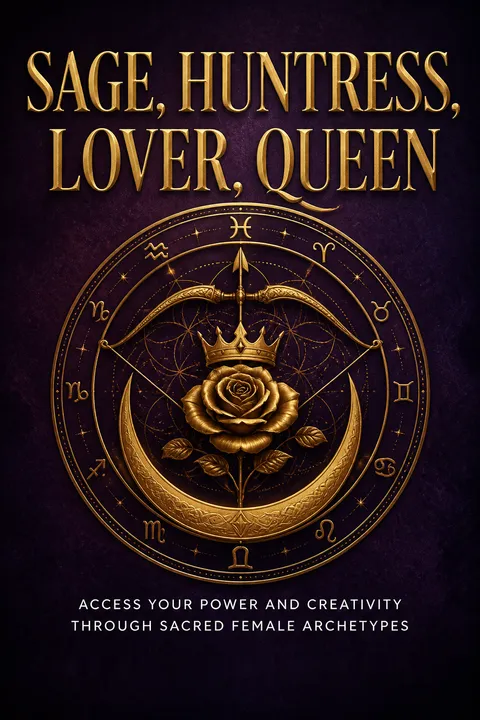


Key Takeaways
Treat the seven archetypes as capacities, not boxes or life stages.
A flexible inner map. Branscombe draws on Jung’s idea of archetypes, recurring patterns of human experience, to offer seven feminine figures: Maiden, Mother, Sage, Huntress, Lover, Mystic, and Queen. Each represents a capacity, such as curiosity, nurture, discernment, courage, intimacy, spiritual imagination, or leadership. They are not age brackets, personality tests, or roles reserved for women. Anyone can draw on them, and different ones may become useful at different points in life.
Every strength has a shadow. The Maiden’s appetite for new beginnings can become people-pleasing; the Mother’s care can become over-giving; the Queen’s leadership can harden into perfectionism. The aim is not to become one ideal figure, but to notice which quality is missing or overextended and bring it back into balance.
The map is most useful as a vocabulary for complexity, not a claim that people fit universal feminine types. Naming a pattern can make it easier to discuss without turning it into an identity: someone can notice a nurturing impulse without deciding that caretaking is her destiny. This resembles parts-based approaches to self-understanding, which treat conflicting impulses as workable aspects of a person. The caution is cultural: linking care or sensuality to femininity can reinforce stereotypes unless readers retain the book’s more expansive premise that these capacities are available across genders.
Name the old survival story before it keeps choosing your life.
Patterns have histories. The book argues that childhood experiences can shape adult coping strategies. A child who learned that approval depends on pleasing others may carry that habit into relationships, work, and decisions, even when it now creates resentment. Branscombe calls attention to the personal narrative beneath repeated behavior: the assumptions a person learned about safety, worth, and belonging.
Curiosity interrupts repetition. Instead of condemning a pattern, ask when it began, what it once protected, and whether it still helps. Journaling, meditation, and reflective questions are offered as ways to connect present reactions with earlier experiences. The point is not to blame caregivers or treat every difficulty as trauma. It is to see a learned response clearly enough to choose a different one.
This approach sits close to narrative psychology, where people examine the stories that organize their identity and revise them in light of present choices. The practical strength is its shift from self-attack to inquiry: a behavior can be understandable without remaining useful. The distinction matters, since insight alone does not resolve trauma, and intense memories can be destabilizing. For serious or persistent distress, reflective exercises may need the support of a qualified clinician rather than being treated as a stand-alone cure.
Schedule creativity to reclaim the self that people-pleasing silenced.
Make room to make. The Maiden represents fresh starts, curiosity, and creative courage. Her shadow appears when fear of change or eagerness to please others buries personal interests and desires. Branscombe argues that creativity is not limited to recognized art forms: gardening, dancing, writing, singing, or making things by hand can all restore a sense of agency.
A myth of return. The Greek story of Persephone gives this journey a shape. Taken into the underworld, Persephone loses the life she knew, confronts darkness, and returns with a changed understanding of herself. The practical version is less dramatic: set aside regular time for an activity done for its own sake, notice what brings energy, and let yourself begin again without treating age or past choices as a verdict.
A scheduled creative practice turns self-expression from a vague aspiration into protected time. That matters because autonomy is strengthened through repeated choices, not simply through insight about what one wants. The Persephone story also offers a useful metaphor for change that includes loss, rather than pretending every transition feels like immediate liberation. Still, creativity should not become another performance demand. Its value here depends on making, exploring, or playing without requiring the result to prove talent, productivity, or personal transformation.
Nurture others without making depletion the proof of your love.
Care needs reciprocity. The Mother archetype represents the ability to sustain people, projects, and communities. Its shadow is over-giving, difficulty receiving help, and the victim or martyr pattern: doing everything, declining support, then feeling unseen or resentful. Branscombe’s remedy is practical as well as emotional: recognize personal limits, ask for help, rest, and make boundaries part of care rather than its opposite.
Care begins at home. The book asks readers to tend to the body, emotions, thoughts, and speech as if tending separate gardens. It also connects caregiving to the earth through Gaia, the Greek personification of Earth, and urges reciprocal choices rather than treating nature as an unlimited resource. Its ancestral healing language invites readers to identify harmful family patterns while carrying forward inherited strengths.
The distinction between generous care and self-erasure is valuable in a culture that often praises caregivers for being endlessly available. Boundary-setting can preserve relationships by making help sustainable and explicit. The environmental parallel extends the idea from household labor to stewardship: receiving nourishment creates obligations of reciprocity. Claims about ancestral trauma passing across generations are best treated cautiously, however. Family patterns can be transmitted through behavior, stories, and institutions, while spiritual language about inherited wounds is meaningful to some readers but is not, by itself, a clinical explanation.
Quiet emotional noise before treating a feeling as intuition.
Listen, then discern. The Sage represents emotional awareness, patience, and mature judgment. Branscombe distinguishes intuition from anxiety by their felt quality: anxiety tends to arrive with a story of past hurt or imagined future danger, while an intuitive impression feels more immediate. This distinction is presented as a guide for reflection, not a guarantee that every strong feeling is accurate.
A repeatable creative process. The book’s named Pillars of Creativity to Activate Intuitive States can be recast as five moves: clarify what matters, notice thoughts and body sensations, meet self-criticism with compassion, take a flexible next step, and create accountability through a friend, calendar, or journal. The Sage’s work also includes naming emotional states rather than suppressing them, which can make it easier to understand what needs attention.
The practice of naming feelings has a useful connection to affect labeling: putting an emotion into words can create distance from an immediate reaction. That distance may improve reflection, but bodily certainty is not an infallible truth detector. Anxiety can contain relevant information, and an intuition can reflect bias or incomplete evidence. The strongest use of this distinction is as a prompt to investigate: What am I feeling, what facts support it, and what small action could test the impression safely?
Let courage serve a cause, not your need to win.
Strength includes softness. The Huntress is the book’s image of focused courage, self-respect, and action in service of a meaningful cause. Her shadow has two forms: shrinking from conflict and risk to avoid rejection, or becoming so defensive and self-reliant that every disagreement becomes a battle. In both cases, fear directs the behavior, even when it looks like passivity or force.
Track fear into action. Branscombe recommends noticing what fear feels like, asking where it comes from, and finding a safe way to express anger rather than burying it. The Huntress then chooses where to put her energy, seeks support when needed, and takes steps aligned with her values. Advocacy for justice, human and animal rights, or environmental protection can give personal courage a purpose beyond proving oneself right.
This account resists the familiar equation of power with dominance. In leadership, assertiveness is more effective when paired with listening, emotional regulation, and a clear purpose. The emphasis on identifying fear’s source can help distinguish a real hazard from an old expectation of rejection. Yet not every conflict can be solved through individual courage or inner work. Structural barriers and unequal power matter too, so personal agency is most useful when joined to collective action and realistic assessments of risk.
Make self-respect the ground of intimacy, not a prize from it.
Love is not self-abandonment. The Lover archetype joins sensuality and emotional openness with self-awareness and boundaries. Its shadow can involve chasing validation, repeating relationship drama, fixating on appearance, or avoiding intimacy to escape vulnerability. Branscombe argues that self-love is built through everyday care, honest attention to the body, and the ability to recognize when past hurt is shaping a present relationship.
Forgiveness has limits. The book frames forgiveness as a way to loosen the hold of resentment and self-blame, not as a demand to excuse harm or resume contact. Intimacy also requires communicating what feels welcome or unwelcome and choosing safe, trusted people with whom to do so. When grief or trauma is involved, the invitation is to find support and allow healing to take time, not to force a quick return to positivity.
The strongest idea here is that self-respect supports connection rather than competing with it. Intimacy needs both closeness and separateness, a balance familiar in contemporary relationship psychology. The distinction between forgiveness and reconciliation is especially important: a person can release some emotional burden while maintaining distance or accountability. The book’s language of love as a universal remedy is evocative, but love alone cannot make an unsafe relationship safe. Boundaries, material support, and professional care remain essential where abuse or trauma is present.
Keep spiritual insight grounded in ordinary choices and honest boundaries.
Mystery needs discernment. The Mystic represents wonder, imagination, spiritual inquiry, and attention to subtle signals. Branscombe pairs these with grounding in the body, daily responsibilities, and practical choices. Visualization and meaningful rituals can help a person clarify a desired direction, but they are meant to support action, not replace it.
Beware spiritual bypassing. This term describes using spiritual practices or beliefs to avoid emotional pain, practical problems, or personal responsibility. The book also warns against surrendering judgment to a charismatic teacher or community. Hildegard of Bingen offers a historical model of mystical conviction joined to tangible work: she was a medieval composer, healer, writer, and religious visionary whose creative output became widely recognized centuries after her death. The Mystic’s test is whether a practice increases clarity and agency or diminishes them.
This is one of the book’s more grounded cautions. Ritual can provide structure and meaning, while visualization can make goals easier to articulate; neither establishes that supernatural messages are objectively true. The warning about spiritual bypassing also aligns with trauma-informed practice, which treats emotional avoidance as different from healing. Hildegard’s example usefully connects contemplative life with scholarship and craft. A sound discernment rule is to assess spiritual guidance by its consequences: does it support informed choice, accountability, and care for others?
Choose intention over perfection, then organize a vision into action.
The Queen makes choices. The Queen represents leadership, clear speech, strategy, and service. Her shadow is perfectionism: overanalyzing, controlling details, and delaying work until conditions feel flawless. Branscombe suggests replacing the impossible demand for certainty with a clear intention and a willingness to adapt as circumstances change.
Turn vision into steps. The book’s Queen’s Formula asks readers to picture a desired project, identify practical actions and needed support, then clarify how their particular strengths can serve others. A personal sanctuary, a quiet place at home or in nature, can help protect attention and restore perspective. The Queen does not wait for every resource to be in place; she uses what is available, adjusts the plan when necessary, and treats failure as information rather than proof that she should stop.
The shift from perfection to intention echoes a useful distinction in goal-setting: a valued direction can remain stable while tactics change. Visualizing an outcome may sharpen motivation, but it works best when paired with planning for obstacles and concrete next steps. The Queen’s emphasis on collaboration also counters the myth of the lone leader. A caution is that service can become another perfectionist burden if every personal ambition must be justified by its benefit to humanity. Personal meaning is a sufficient reason to create.
Weave different inner strengths together instead of demanding one fixed identity.
Integration is the practice. The Weaver is Branscombe’s image for bringing the seven archetypes into a responsive whole. One day may call for the Maiden’s experimentation; another, the Mother’s steadiness, the Sage’s reflection, or the Huntress’s decisive action. The Lover, Mystic, and Queen add intimacy, imagination, and leadership. None is meant to dominate every situation.
Treat life as ongoing craft. The book invites readers to observe changing needs, use creative practices and reflection to learn from experience, and revise their self-understanding as circumstances shift. Its phrase life as a living ceremony means bringing deliberate attention to ordinary acts, not escaping ordinary life. The Weaver’s work is therefore neither a final perfected identity nor a one-time breakthrough. It is the repeated process of choosing which capacities to draw on, noticing their shadows, and adjusting the pattern.
The weaving metaphor makes integration more realistic than the pursuit of a single ideal self. People behave differently across roles and contexts, and flexibility is not necessarily inconsistency. This view also guards against the tyranny of self-optimization: the goal is not to keep improving every trait, but to respond well to the situation at hand. Its limitation is that metaphor alone cannot resolve competing duties. When values collide, explicit priorities, practical constraints, and conversations with affected people are still needed.
Analysis
Branscombe’s book is a spiritual self-development guide organized around seven archetypes and a final figure, the Weaver, who integrates them. Its distinctive contribution is less a new theory of personality than a memorable, image-rich vocabulary for recurring tensions: care versus self-erasure, courage versus defensiveness, intuition versus anxiety, and leadership versus perfectionism. The structure makes inner work feel like a journey, with myths, natural imagery, and rituals giving emotional texture to familiar practices such as journaling, movement, reflection, and boundary-setting.
The framework is most persuasive when used provisionally. An archetype can help a reader recognize a pattern without treating it as a fixed identity. The repeated pairing of each archetype with a shadow is especially useful because it prevents strengths from becoming unquestioned virtues. Nurture can conceal control; independence can conceal fear of vulnerability; spiritual openness can conceal avoidance. The book encourages readers to ask not only what quality they want, but what need or fear is shaping its expression.
Its principal limitation is evidentiary. Jungian archetypes, elemental associations, divine timing, energy fields, and ancestral healing appear together without a clear boundary between metaphor, spiritual belief, and psychological claim. Readers may find rituals meaningful without treating them as proof of supernatural guidance or clinical treatment. Similarly, the claim that intuition can be distinguished from anxiety by its immediacy is a reflective prompt, not a dependable diagnostic test. Feelings deserve attention, but decisions also benefit from evidence, feedback, and external support.
The book is best approached as a workbook of invitations, not a universal account of womanhood or a substitute for therapy. Its own more expansive claim, that these capacities are available beyond gender, helps loosen the framework from biological essentialism. The most durable practical lesson is to notice which inner capacity is underused or overused, then make a grounded choice that expresses it without surrendering agency.
Review Summary
Sage, Huntress, Lover, Queen receives mixed reviews. Some readers praise its accessible approach to feminine archetypes and meditation exercises, finding it empowering and insightful. Others critique its writing style as overly fluffy and repetitive, with excessive spiritual jargon. The book is generally considered a good introduction for beginners but may lack depth for more experienced practitioners. Several reviewers note formatting issues and spelling errors. Overall, it's seen as a tool for self-discovery and personal growth, particularly appealing to those new to exploring feminine archetypes and inner work.
People Also Read







Glossary
Feminine archetypes
Seven inner capacitiesBranscombe’s applied set of seven recurring patterns: Maiden, Mother, Sage, Huntress, Lover, Mystic, and Queen. Each represents a human capacity, such as creativity, nurturance, discernment, courage, intimacy, spiritual imagination, or leadership. The author treats them as available throughout life and beyond gender, rather than as fixed personality types or age-specific stages.
shadow
A capacity’s distorted expressionThe shadow is the unhelpful or imbalanced form of an archetype’s strengths. In Branscombe’s examples, care can become over-giving, courage can become defensiveness, and leadership can become perfectionism or control. Recognizing a shadow is meant to support compassionate self-inquiry and change, rather than to label a person as bad or broken.
Pillars of Creativity to Activate Intuitive States
A five-part creative processA process Branscombe proposes for creative work, life decisions, or personal change. It asks a person to clarify an intention, remain attentive to present experience, respond to self-criticism with compassion, take action while allowing the plan to evolve, and build accountability through practices such as scheduling, journaling, or sharing progress with a trusted person.
current frequency
Present mind-body stateBranscombe’s term for a person’s present emotional, mental, physical, and relational condition, including how they interpret and respond to daily events. She encourages readers to observe this state through practices such as meditation, movement, and journaling, then notice what needs care. The term functions as a spiritual and somatic metaphor, not a measured scientific quantity.
Mother wound
Painful inherited care patternsThe book’s phrase for wounds and expectations associated with maternal relationships, caregiving, and family history. Branscombe encourages readers to examine how learned patterns, such as normalizing unhappiness or putting others first, influence present-day self-care and boundaries. She also frames the work as identifying valuable family strengths to carry forward, not only painful patterns to change.
spiritual bypassing
Using spirituality to avoid painUsing spiritual beliefs, teachers, or practices to avoid emotional healing, practical responsibilities, or difficult truths. Branscombe warns that spirituality can become a route to disconnection when a person follows a community unquestioningly, gives away personal authority, or uses ritual to escape ordinary life. Grounded practice, honest self-questioning, and clear boundaries are presented as safeguards.
Queen’s Formula
A vision-to-action methodBranscombe’s method for developing a project or intention by first imagining the desired result, then identifying the actions and support needed to pursue it, and finally clarifying how the effort can express a person’s strengths in service. It is meant to pair imagination with practical action while allowing plans to change when circumstances or priorities shift.
Weaver
The integrator of archetypesThe culminating figure in Branscombe’s framework, representing the ability to combine the Maiden, Mother, Sage, Huntress, Lover, Mystic, and Queen as a situation requires. The Weaver is not another fixed personality type. The image describes an ongoing practice of learning from experience, drawing on different capacities, and revising one’s way of living as life changes.
FAQ
What's Sage, Huntress, Lover, Queen about?
- Exploration of Archetypes: The book explores seven sacred female archetypes—Maiden, Mother, Sage, Huntress, Lover, Mystic, and Queen—each representing different facets of feminine power and creativity.
- Empowerment and Healing: It aims to empower women by helping them reclaim their power and creativity, facilitating both personal and collective healing.
- Practical Tools: Mara Branscombe provides rituals, meditations, and somatic practices to help readers embody these archetypes and integrate their wisdom into daily life.
Why should I read Sage, Huntress, Lover, Queen?
- Personal Transformation: The book serves as a guide for self-discovery, helping readers navigate their life’s journey with intention and authenticity.
- Connection to the Divine Feminine: It invites readers to reconnect with the divine feminine, emphasizing self-worth and love.
- Rich Resources: Filled with practical exercises and insights, it enhances emotional, spiritual, and creative well-being.
What are the key takeaways of Sage, Huntress, Lover, Queen?
- Embrace Your Archetypes: Understanding and embodying the seven archetypes can lead to a deeper understanding of oneself and one's life purpose.
- Healing Through Ritual: The book emphasizes the importance of rituals and practices in reclaiming personal power and facilitating healing.
- Collective Healing: It highlights the interconnectedness of personal healing with the healing of the collective, urging readers to contribute positively to the world.
What are the best quotes from Sage, Huntress, Lover, Queen and what do they mean?
- Maya Angelou's Quote: “It’s a wonderful day, I have never seen this one before.” encourages embracing each day as a unique opportunity for growth.
- Healing Potential: “There is healing in these pages.” suggests the transformative potential of the book for personal healing and empowerment.
- Ancestral Connection: “You are of this ancient composition.” reminds readers of their connection to ancestral wisdom and the timeless nature of the feminine experience.
How does Sage, Huntress, Lover, Queen define the Maiden archetype?
- Creativity and Authenticity: The Maiden is characterized by vibrant creativity and authenticity, representing a youthful spirit that embraces life as an adventure.
- Navigating Shadows: The book discusses the Maiden's shadow, including people-pleasing and fear of new beginnings, emphasizing overcoming these challenges.
- Embodiment Practices: Readers are encouraged to engage in creative expression and self-reflection to embody the Maiden.
What practices does Sage, Huntress, Lover, Queen suggest for embodying the Mother archetype?
- Radical Self-Love: The Mother archetype emphasizes nurturing oneself and others, encouraging practices of radical self-love.
- Healing Ancestral Wounds: Insights on healing ancestral wounds and breaking cycles of co-dependency are provided.
- Daily Rituals: Incorporating daily rituals that foster connection to the earth and self enhances the nurturing qualities of the Mother.
How does the author define the Huntress archetype in Sage, Huntress, Lover, Queen?
- Dynamic Power: The Huntress embodies the dynamic power to set boundaries and push forward into the unknown.
- Mindful Activation: She invites readers to engage in mindful practices that enhance presence and listening skills.
- Transformation Through Presence: Being present and aware can transform one's state of being, leading to greater clarity and balance.
What practices does Sage, Huntress, Lover, Queen suggest for embodying the Lover archetype?
- Daily Self-Love Rituals: Engage in daily practices that nurture self-love, such as journaling and meditation.
- Awareness of Intimacy: Emphasizes being aware of emotional states and their effects on relationships.
- Compassionate Communication: The Lover archetype teaches the value of compassionate communication to foster healthy relationships.
How can I apply the teachings of the Mystic archetype from Sage, Huntress, Lover, Queen?
- Intuitive Listening: Develop the ability to listen to one's inner voice and intuition for guidance.
- Embracing Silence: Silence and stillness are gateways to accessing deeper wisdom and creativity.
- Connecting with Nature: Engaging with the natural world enhances spiritual practice and connects with the mystical aspects of life.
What is the significance of the Queen archetype in Sage, Huntress, Lover, Queen?
- Leadership and Service: The Queen embodies leadership, vision, and service, encouraging responsibility for one's life and impact on others.
- Empowerment Through Boundaries: She teaches the importance of setting healthy boundaries and prioritizing self-care.
- Integration of Wisdom: The Queen integrates lessons from all other archetypes, representing the culmination of feminine wisdom and strength.
How does Sage, Huntress, Lover, Queen address the concept of aging?
- Embracing Aging: Aging is viewed as a beautiful journey filled with wisdom and growth.
- Celebrating Life Stages: Each stage of life is an opportunity to deepen self-love and acceptance.
- Reclaiming Power: With age comes the power to embrace one's true self and live authentically.
What role does nature play in the teachings of Sage, Huntress, Lover, Queen?
- Source of Inspiration: Nature is a vital source of inspiration and healing, encouraging connection for guidance and support.
- Cycles of Life: Recognizing and honoring the cycles of nature reflect our own life experiences and transformations.
- Grounding Practice: Engaging with nature cultivates presence, awareness, and a sense of belonging in the world.
About the Author
Other books by Mara Branscombe
Download PDF
Download EPUB
.epub digital book format is ideal for reading ebooks on phones, tablets, and e-readers.








