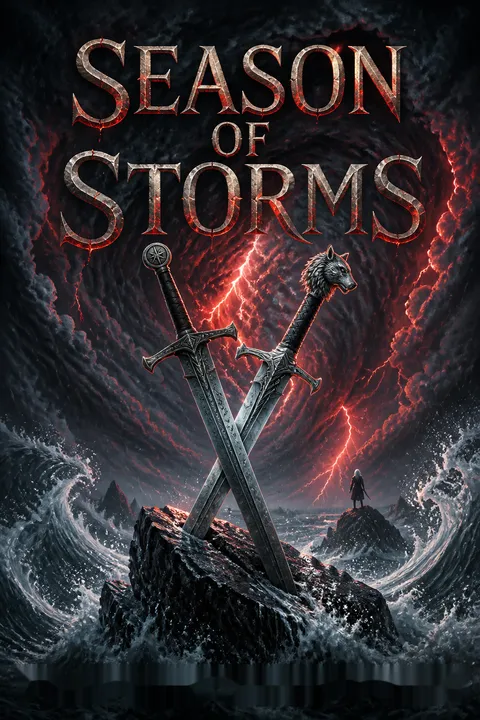


Plot Summary
The Arachnomorph’s Bait
A monster uses a family traveling through the woods as bait. Geralt kills the arachnomorph before it can reach the little girl, but the father is torn apart and the mother survives only because Geralt shoves her from the road. He knows he misjudged the creature’s trick and that his intervention has left the child without her father.
At the district office, administrator Albert Smulka tries to inflate Geralt’s agreed fee from fifty crowns to eighty, expecting him to accept a cut of the theft. Geralt refuses. The rescue earns him no comfort, and his refusal to cooperate with a corrupt official gives the authorities another reason to target him.
A Prisoner Without Swords
In Kerack, Geralt surrenders his swords at the gate and enters the city unarmed. At a trial built on an anonymous accusation that he inflated monster-hunting invoices, he rejects a guilty plea and is released only after someone pays his heavy bail. Dandelion, his poet friend and cousin to royal investigator Ferrant de Lettenhove, identifies the mysterious benefactor as the sorceress Lytta Neyd, known as Coral, who also helped put him in prison.
Geralt returns to the guardhouse for his weapons and learns they have vanished. A forged registry entry claims he collected them. When the guards provoke him, he fights back, but the death of the storage clerk further entangles him in a case he cannot escape without appearing guilty.
Coral’s Dangerous Invitation
Geralt confronts Coral, who admits that the arrest and release were meant to demonstrate her power, while hinting that influential wizards have plans involving him. She also explains that some sorcerers turned against him after his separation from Yennefer. Geralt later meets Coral’s apprentice, Mozaïk, and carelessly uses her presence to provoke her mistress.
Coral retaliates by magically twisting Mozaïk’s hand. The girl tells Geralt that Coral’s punishment is familiar and warns him not to worsen her position. Geralt goes back with a freesia, and his attraction to Coral overwhelms his caution. Their affair begins, but Mozaïk sees that he is still grieving Yennefer and warns him that Coral knows it.
Water Shows the Swords
When Geralt tells Coral that his swords were stolen, she uses the fountain in her garden to divine their location. The water reveals the blades in unfamiliar hands, an auctioneer announcing them for sale, and a strange rock shaped like a key.
It also briefly shows a dark-haired woman, Yennefer, because Geralt’s thoughts stray from the swords. Dandelion recognizes the rock as the landmark above Ravelin, a fortified criminal compound. There the crime boss Pyral Pratt confirms that the swords were offered to him and directs Geralt toward an upcoming Novigrad auction.
Before sharing the information, Pratt forces Geralt to fight a magically bred lizard in an arena. Geralt survives by turning a fallen iron bar into a weapon, then leaves with a lead and a wound.
A Prince’s False Test
After the arena, a disguised Prince Egmund tries to blackmail Geralt into helping remove King Belohun and his brothers from the succession. He presents fabricated records of witcher fraud and threatens to ruin Geralt’s name.
Geralt refuses to commit regicide, and the trap is revealed as a test arranged by Egmund and Ferrant: Egmund wanted to learn whether Geralt could be bought or frightened into betraying his principles. The prince then offers to hire him to protect Belohun during a royal wedding, once Geralt’s stolen swords are recovered.
Dandelion collects money from Pratt and buys Geralt a replacement blade through Antea Derris, a broker posing as a widow. Geralt leaves Kerack wary of the royal family and determined to keep his own plans private.
The Plate from Rissberg
A summons brings Geralt to Rissberg, where wizards sell magical goods to crowds while conducting secret research inside the castle. Geralt shows the senior mages a metal plate taken from a murdered arachnomorph.
They identify it as an old experimental specimen created by Idarran, a predecessor to the researchers at Rissberg. The revelation matters because another creature bearing such a plate has killed people near Angegis. The wizards initially defend their work rather than address the deaths.
Behind the confrontation, Geralt learns that a demon is suspected of possessing someone and massacring remote settlements. Because the wizards fear their own research may be involved, they hire Geralt to patrol the forested foothills and find the killer.
The Clearing of Corpses
Geralt patrols the settlements with Frans Torquil, a constable who has investigated three massacres. Their routes pass ordinary workers who keep felling timber and making charcoal even beside fresh graves. At Rogowizna, Torquil describes mutilated bodies and a pyramid of severed heads; two corpses were missing.
Geralt suspects that the supposed demon is a cover for a human decision to unleash violence. The Rissberg mages insist that their patrols can prevent another attack, though Geralt doubts they have hidden the investigation from the culprit.
At Pine Copse, he finds another slaughter and discovers Sorel Degerlund, a young Rissberg wizard, lying among the bodies with human entrails wrapped around his wrist. Degerlund claims he remembers nothing and offers to teleport them back.
A Portal to the Trap
Geralt refuses to kill the apparently helpless Degerlund and agrees to travel with him through a magical sigil. The teleport takes them to Degerlund’s hidden laboratory, where the wizard reveals that he staged his possession and used two engineered giants, Bue and Bang, to slaughter the settlements.
A hunchback assistant helps restrain Geralt while Degerlund injects him with scorpion venom and boasts of his ambition, his experiments, and his plan to harvest Geralt’s night vision for Archmaster Ortolan.
The venom weakens Geralt but cannot kill him; he uses a Sign to stun Degerlund, then forces the wizard to open another portal. Geralt escapes with his sword, but the unstable transfer strands him in a swamp, separated from Roach and far from Kerack.
The Road Through Blood
Geralt reaches a road and finds Redanian soldiers brutalizing a family over disputed border taxes. He intervenes, but Captain Shevlov has him bound and calls him a Temerian mercenary.
Shevlov tests Dandelion’s replacement sword against his own; the blade breaks, leaving Geralt without a usable weapon and confirming that the supposed widow sold the bard a poor substitute. Degerlund’s party then catches up with the soldiers. Its giants kill Shevlov and several men while Degerlund scatters the rest with magic, giving Geralt a chance to escape on a stolen mare.
At a post station, Shevlov’s surviving followers try to seize horses. A dwarf named Addario Bach helps Geralt defeat them and disguises them from pursuing Temerian soldiers, then agrees to travel with him toward Novigrad.
The Fox in the Swamp
Addario and Geralt board the sloop Prophet Lebioda, whose merchants claim they are searching for the kidnapped daughter of elf businesswoman Briana de Sepulveda. Geralt discovers they instead bought another elf girl, intending to sell her as an exotic curiosity.
Their expedition leader, Javil Fysh, refuses to release her. Below deck, the drunken guard Parlaghy has killed the child. A vulpess, a fox-like shapeshifter, pursues the ship through the swamp, confusing the crew with false channels, snakes, and a whirlpool.
Some dangers are real, including a vodyanoi that damages the rudder. When the crew plots to cast the dead girl and Parlaghy overboard, Geralt protects them anyway. The vulpess takes her child’s body and warns Geralt that she will return for him.
The Auction Goes Without Him
Storm, swamp, and delay keep Geralt from reaching Borsodi’s auction in time. In Novigrad, Antea Derris, Pyral Pratt’s daughter, uses Dandelion’s help to sell Geralt’s stolen swords. Yennefer secretly buys them and arranges for the young sorceress Tiziano Frevi to return them to Geralt. Meanwhile, Geralt reaches Kerack without knowing who owns his blades.
Coral is occupied with a dangerous childbirth and keeps their reunion brief; Mozaïk tells him that the birth went badly. Geralt learns that Ferrant’s investigation has stalled and chooses to honor his agreement to guard Belohun’s wedding, hoping the payment will fund proper swords. Before he leaves, Pinety returns the recovered Roach and gives Geralt his own finely made blade.
The Citadel’s Hidden Door
Pinety tells Geralt that Rissberg captured Degerlund but shielded him from public justice, confining him in a fortified mountain laboratory. The wizards have called Degerlund’s murders an experiment gone wrong and kept their own complicity out of view.
Geralt refuses to let the matter end there. He asks Otto Dussart, a werewolf he once spared, to track a route into the mountain. Dussart’s sensitive nose identifies a cave passage marked by the smell of a house cat. Inside, Geralt finds the bodies Degerlund has stored, a frightened captive boy, and Bue and Bang guarding the approach.
He kills the giants and their hunchback assistant, then confronts Degerlund in the laboratory. When Degerlund blames others, Geralt kills him, ending the threat himself rather than trusting Rissberg’s bargain.
The Wedding’s Hidden Blades
At Belohun’s wedding, Geralt watches the brothers and their factions while Ferrant admits he had fabricated evidence under orders. Egmund’s captain, Ropp, later tries to force Geralt into helping kill the king and threatens Dandelion with a blade. Geralt attacks Ropp’s men instead, saving his friend.
Before they can warn Belohun, the king is strangled by the gold chain of a medallion given to him by his bride, Ildiko Brackley. Mercenaries from the black-sailed Acheron take control of the palace. They install Viraxas, the king’s long-exiled eldest son, who claims the throne and announces his intention to marry Ildiko. Ferrant urges Geralt and Dandelion to leave before the new regime can connect them to the palace violence.
The Seventh Wave
After the wedding, rats flee the waterfront and a storm rises from a clear sky. A wall of water smashes Kerack’s port and floods Palmyra. Geralt dives from the cliff to pull children from a drifting roof, while Antea and Mozaïk help bring them to safety. A strong guard woman rescues Geralt from the current, but a beam pins Antea beneath the water and kills her.
Coral returns to treat the wounded, yet she and Geralt cannot bridge the distance between them; she walks away with Mozaïk. The city begins burying its dead and caring for survivors. Geralt discovers that his borrowed sword and jacket have been stolen amid the wreckage. Once again, he leaves Kerack with no weapon and no wish to stay.
The Swords Come Home
On the road, the mutant witcher Brehen tries to force Geralt into a duel over a royal reward. Geralt refuses, and Tiziano Frevi returns the original swords, explaining that Yennefer entrusted them to her. A court summons from Rissberg follows, demanding repayment for work Geralt never completed. He travels on with Dandelion and reaches ruined grounds where the vulpess appears with a girl who seems to be her daughter.
Geralt realizes the child had survived the ship and that the vulpess had hidden the truth with an illusion. The fox briefly takes Yennefer’s likeness, then vanishes with the girl. Geralt and Dandelion continue down the road together, carrying their unfinished questions into another stretch of the world.
Epilogue
A century later, Nimue, a young woman traveling toward the sorceresses’ school at Aretuza, enters a forest feared by local workers. Exhaustion overtakes her, and she dreams that Geralt saves her from a numbered monster and speaks with her about the legend of the Witcher.
She wakes beside a road, unable to tell whether she met a ghost or only dreamed one. A passing merchant offers her a ride toward Dorian. Nimue accepts and continues toward her destination, still holding to the story that brought her so far from home.
Nimue’s frame turns memory into the final enchantment of the book. The future has industrialized the landscape and nearly erased the forests, yet its people still tell stories about monsters and the witcher who faced them. Her dream leaves open whether legend has summoned Geralt, or whether her exhaustion has given familiar material a vivid shape. Either way, the tale persists because it answers a need the modern world cannot engineer away: someone must recognize danger when others dismiss it. Nimue’s decision to continue toward Aretuza makes her more than a listener. She becomes the next person willing to enter the dark.
Analysis
Season of Storms makes Geralt’s missing swords the visible thread through a story about institutions that repeatedly misname their own violence. Kerack calls extortion and political murder matters of law; Rissberg calls experimentation progress; the merchants call exploitation a rescue. Geralt’s work depends on distinguishing a real monster from a convenient label, yet the human systems around him use labels to evade responsibility. That distinction is the book’s moral pressure point. Geralt does not possess a pure code that solves every case. He hesitates over Degerlund, protects the sailors who helped cause their own danger, and repeatedly acts without knowing whether restraint or force will do greater harm. His choices are costly precisely because he cannot outsource judgment to law, wizardry, or custom.
The novel also treats technological and magical progress as an ethical question, not a synonym for improvement. Rissberg’s inventions promise public benefit, but secrecy and hierarchy make accountability disappear. The forest workers killed by experiments are quickly replaced because industry still demands charcoal. Their deaths become an administrative inconvenience, while Geralt’s refusal to accept that accounting becomes a threat to the institution. The same logic governs Kerack, where the king’s concern for succession masks control of women and the princes’ competing ambitions turn security into manipulation.
Personal intimacy offers no refuge from power. Coral’s affair with Geralt begins amid coercion and performance, while Mozaïk’s dependence on Coral makes even a careless joke dangerous. Yennefer’s absence remains active, shaping Geralt’s desire and the choices others make on his behalf. Yet Dandelion, Addario, Dussart, and even the vulpess repeatedly show forms of loyalty that do not require grand declarations. The closing frame extends this tension across time: forests shrink, legends grow, and danger persists. The book’s final reassurance is not that progress will end darkness, but that people may still choose to answer when someone calls for help.
Review Summary
People Also Read





Characters
Geralt of Rivia
The reluctant protectorA mutant trained to hunt monsters, Geralt survives through discipline, observation, and an instinctive refusal to confuse a contract with a license to harm. He distrusts officials and sorcerers because both repeatedly try to use his reputation while denying him ordinary fairness. His dry humor and emotional restraint conceal a powerful sense of responsibility: he feels accountable for deaths he could not prevent, yet still intervenes when people are in danger. Yennefer remains an important emotional presence even when absent, complicating his attachment to Coral. Geralt’s defining conflict is not whether he can kill, but how to act when institutions call cruelty necessary and his own code offers no easy answer.
Lytta Neyd, called Coral
The formidable sorceressCoral is an accomplished sorceress whose beauty, wealth, and political fluency make her difficult to intimidate. She treats control as both a professional skill and a personal defense, using favors, threats, and carefully staged encounters to shape events around her. Her work providing reproductive care to women clashes with King Belohun’s attempts to regulate their lives, while her ties to powerful wizards pull her into schemes she does not fully control. Coral is perceptive enough to see Geralt’s unresolved attachment to Yennefer, but she is also capable of enjoying the emotional game rather than resolving it. Beneath her sharpness lies a desire for intimacy she would rather disguise as strategy.
Dandelion
The loyal storytellerDandelion is a celebrated poet, Geralt’s friend, and a practiced survivor of courts and taverns. His vanity and appetite for attention often make him look unserious, but he is brave when Geralt needs him and resourceful when official channels fail. His family connection to Ferrant gives him access to Kerack’s political circles, and his curiosity helps turn a strange divination into a usable lead. Dandelion also understands the practical force of stories: he knows that Geralt’s reputation affects his wages, and he helps maintain the legends that make a witcher’s work possible. His affection is expressed through comic talk, practical assistance, and a refusal to leave his friend alone in danger.
Yennefer of Vengerberg
The absent belovedYennefer is a powerful sorceress whose dark hair, violet eyes, and defining obsidian star make her vivid even when she appears only through visions and other people’s accounts. Her past relationship with Geralt remains emotionally significant to him, though the book gives little direct access to her private feelings. She acts decisively when she learns that Geralt’s swords are for sale, arranging their return through Tiziano rather than meeting him herself. Yennefer represents a bond Geralt cannot simply replace with a new affair. Her presence exposes the difference between physical closeness and emotional availability.
Mozaïk
Coral’s watchful apprenticeMozaïk is Coral’s apprentice, a young woman whose intelligence and sharp humor survive a position of dependence. She knows how easily Coral’s displeasure can affect her future, so she often warns Geralt not to intervene in ways that might make her life harder. Her injured hand makes the power imbalance in Coral’s household concrete, while her candor about Geralt’s grief reveals an emotional perceptiveness he would rather avoid. Mozaïk wants to become a sorceress and understands that her education is also her route to independence. She is neither merely a victim nor a romantic accessory; she is learning how to survive a system that controls her choices.
Sorel Degerlund
The ambitious young mageDegerlund is a young wizard who craves advancement and recognition within Rissberg’s research hierarchy. His carefully cultivated appearance and claims of scientific ambition help him win the confidence of older mages, while his real talent lies in manipulating their expectations. He is fascinated by experimental magic and genetic alteration, but his drive for status overwhelms any concern for human lives. Degerlund’s confidence depends on believing that other people are naïve instruments in his plans. He embodies the danger of institutions that reward prestige and technical achievement without asking who bears the cost.
Algernon Guincamp, called Pinety
The conflicted wizardPinety is a Rissberg wizard who enjoys fishing, has a cultured manner, and understands the political compromises surrounding the castle’s research. He helps bring Geralt into the investigation and later reveals the limits of what the wizards are willing to do about their own colleague. His sympathy for Geralt is real, but he remains shaped by an institution that values quiet containment over public accountability. The sword he gives Geralt carries both personal gratitude and an unstated hope that Geralt may act where the wizards will not.
Frans Torquil
The persistent constableTorquil is a constable who has spent years policing the forest settlements and knows the workers by name and trade. He investigates the massacres with an insistence that the victims’ low social standing should not make their deaths easier to ignore. His bluntness and practical courage contrast with Rissberg’s evasive language. Torquil trusts Geralt’s competence, but he also warns that the wizards may make him a scapegoat. His commitment to justice is personal and physical: he follows the killers even when doing so costs him dearly.
Addario Bach
The resourceful dwarfAddario is a dwarf miner and musician who travels with an easy command of roads, customs, and practical improvisation. His jokes about dwarven stereotypes show that he refuses to be reduced to them, while his quick violence on the sloop proves he is more capable than his jovial manner suggests. He treats strangers generously but has little patience for exploitation. As Geralt’s companion through the marshes, Addario supplies both physical help and a grounded moral perspective, especially when merchants begin proposing ways to sacrifice others for their own safety.
Pyral Pratt
Ravelin’s crime bossPyral Pratt is a regional crime boss who presents himself as a harmless, aging host while running a heavily guarded compound. He understands that information, spectacle, and political access can all be sold. His bargain with Geralt is deliberately coercive, turning a request for information into an arena performance before offering a practical lead. Pratt’s ambition has shifted from private indulgence toward political influence, but he still measures people by their usefulness and the prestige they can bring him.
Ferrant de Lettenhove
The law’s uneasy servantFerrant is Kerack’s royal investigator and Dandelion’s cousin. He believes in evidence and procedure, but his work takes place under a king and princes who treat justice as a tool of rule. His cautious manner frustrates Geralt, who suspects him of complicity, and Ferrant is not always truthful about the orders he follows. He nevertheless tries to protect the law’s appearance and, at moments, its substance. His divided loyalties show how an official can oppose corruption privately while still helping it function.
King Belohun
Kerack’s self-made kingBelohun inherited a small kingdom built from his family’s commercial power and rules it as though its people exist to preserve his comfort and succession. He treats women’s reproductive choices as a threat to order and views wealth as proof of a ruler’s worth. His large family and repeated marriages make succession a constant political contest. Belohun is vain and domineering, but he is not blind to every threat around him; he uses uncertainty among his sons to preserve his own authority.
Prince Egmund
The calculating princeEgmund is one of Belohun’s adult sons and a serious claimant to the Kerack throne. He is controlled, observant, and skilled at presenting ambition as service to the kingdom. His political maneuvers show a mind that prefers leverage and preparation to open confrontation. The court’s succession struggle makes him wary of both his father and his brothers, while his calm demeanor can conceal a dangerous confidence.
Prince Viraxas
The exiled firstbornViraxas is Belohun’s eldest son, exiled after a quarrel with his father and nearly erased from court conversation. His absence hangs over the succession as a reminder that the king has removed rivals before. He is linked to the black-sailed Acheron and to Ildiko Brackley, placing him at the edge of Kerack’s political currents long before he appears in person. The silence around his name suggests how thoroughly a court can turn political defeat into official forgetting.
Ildiko Brackley
The ambitious royal brideIldiko is Belohun’s young bride, once a student at Aretuza whose education ended after a theft. She has moved from the margins of sorceress society into the center of Kerack’s succession politics. Her polished appearance conceals a history of scheming, and Coral’s dislike of her is mutual. Ildiko’s marriage is not simply a private arrangement: it gives her proximity to the crown and places her in a kingdom where women’s bodies and political futures are tightly controlled.
Otto Dussart
The discreet werewolfDussart is a werewolf who has learned to live with his condition without harming other people. Geralt once spared him, and Dussart built a family with another lycanthrope after leaving the community that mistrusted him. His extraordinary sense of smell makes him a useful tracker, but his first instinct is to protect the quiet life he has made. When he helps Geralt, he acts from gratitude and solidarity rather than a desire for adventure.
The Vulpess
The fox-shaped guardianThe vulpess is a shapeshifting fox being whose people survive by protecting and transforming their young. She can create elaborate illusions that mislead human senses, making her dangerous without relying solely on physical strength. Her pursuit of the sloop is driven by the child taken from her, and her anger is sharpened by the humans’ willingness to treat the girl as property. She is not simply a monster to be hunted; her actions expose the competing meanings of family, rescue, and possession.
Antea Derris
The broker with a maskAntea is Pyral Pratt’s daughter and a broker whose work blurs legitimate trade with deception. She can pose as a widow to enlist Dandelion’s help in moving Geralt’s swords, and she is comfortable bargaining among people who underestimate her. Her relationship with her father is strained, though they can cooperate when business requires it. Beneath her practiced opportunism is a capacity for decisive action when other people are in danger.
Tiziano Frevi
The traveling sorceressTiziano is a young sorceress traveling as an independent apprentice after finishing her formal schooling. She is curious, direct, and unafraid to speak plainly in a tense room. Yennefer entrusts her with a delicate errand because Tiziano is moving south and can pass through Geralt’s path without drawing attention. Her developing profession gives her a connection to the wider magical world beyond Rissberg’s closed hierarchy.
Brehen
The dangerous Cat witcherBrehen is a witcher from the Cat school, marked by a cat medallion and a reputation for violence. He is volatile and openly resentful of the social shelter Geralt can still find at Kaer Morhen. His challenge grows from competition for a royal reward and a conviction that witchers who claim moral distinction are hypocrites. He serves as a dark reflection of Geralt’s profession, not a simple monster to be dispatched.
Nimue
The future studentNimue is a young traveler from the village of Vyrva who is making her way toward Aretuza. She has crossed a long route alone, earning money by selling gathered plants and learning how to deflect the suspicion and mockery she meets. Local stories frighten her, but they also give her a map of the world and a reason to keep moving. Her curiosity about Geralt’s legend links the distant future to the dangers and choices that shape his story.
Archmaster Ortolan
The idealistic inventorOrtolan is Rissberg’s celebrated archmage, an inventor who wants magical discoveries to improve ordinary life. His projects repeatedly fail or become dangerous, yet he continues to pursue them with the conviction that progress can serve the common good. His generosity and fascination with experimentation coexist uneasily with a research culture that hides its failures and treats people as material. Ortolan’s ideals make him more complicated than the institution around him, but they do not automatically make his work safe.
Kevenard van Vliet
The fearful shipownerVan Vliet is a wealthy leather merchant who owns the Prophet Lebioda and helps finance the search for an elf child. His generosity is sincere, but he is inexperienced with the dangers and moral compromises of the expedition. As events turn against him, fear competes with his instinct to protect the people he has hired. He shows how charitable intentions can become entangled with an enterprise built on other people’s suffering.
Violetta
The hard-bitten guardVioletta is a muscular guard woman whom Geralt encounters in Kerack’s rough gatehouse. She is blunt, combative, and comfortable using physical force. Her rough treatment of strangers makes her an obstacle at first, but she is also capable of courage when disaster strikes. Violetta’s presence complicates Geralt’s habitual distrust of guards by showing a person whose toughness can serve protection as well as intimidation.
Plot Devices
Geralt’s Witcher Swords
The lost tools of tradeGeralt’s steel and silver swords are essential to his work and to his sense of identity. Their disappearance turns a routine visit to Kerack into a chain of arrests, forged records, political leverage, and travel. The stolen blades pass through criminal brokers and an auction house before Yennefer arranges their return through Tiziano. Geralt’s temporary replacements repeatedly prove inadequate, making the loss materially dangerous rather than merely symbolic. Their return does not end his difficulties: a court claim from Rissberg and the theft of another borrowed sword keep the question of ownership and security unsettled.
The Rissberg Experiments
Progress without accountabilityRissberg’s research creates magical hybrids and devices, from useful creatures to lethal experimental beings. The metal plates on monsters identify their origin and connect Geralt’s earlier kills to a hidden program. The wizards’ ambition to make magic beneficial to everyone is contradicted by their secrecy, political self-protection, and willingness to treat deaths as collateral. Degerlund exploits this culture by disguising murder as demonology and scientific advancement. The experiments supply the book’s central institutional danger: the monsters are not only escaped creations, but products of a system that can hide their makers.
Coral’s Divining Fountain
A watery trail to dangerThe enchanted fountain is linked to Coral and used for divination. When Geralt concentrates on his missing swords, it shows their handlers, a future auction, and a distinctive rock near Ravelin. Its images are not a straightforward map: Geralt’s thoughts of Yennefer intrude, and the vision also gives Coral an ominous image she cannot interpret. The fountain turns magic into a practical clue while emphasizing its limits. Seeing an image does not explain its context, and the people who interpret it must still make choices under uncertainty.
The Vulpess’s Illusions
A landscape made unreliableThe vulpess uses illusion to alter what the crew sees and believes about the swamp. False channels, misleading compass readings, snakes, and a whirlpool make the ship circle through danger. Some threats are illusions, but others, including the vodyanoi, are real, so the crew cannot safely dismiss what appears before them. This uncertainty forces Geralt to assess each danger rather than rely on a simple rule. The illusions also reveal the vulpess’s grief and anger as a form of power, making the conflict a contest over perception as much as survival.
The Wandering Frame
Legend carried into the futureNimue’s journey, set more than a century after Geralt’s adventures, frames the novel with the persistence of stories. She travels toward Aretuza through landscapes transformed by industry, while local people still warn of monsters in the remaining forest. Her dream of Geralt saving her echoes the novel’s opening rescue and makes the ending deliberately uncertain: she may have encountered a supernatural return, or her exhaustion may have shaped a legend into a dream. Either way, the frame shows how stories preserve the need for courage after the people who first lived them are gone.
The Witcher Series

About the Author

Download PDF
Download EPUB
.epub digital book format is ideal for reading ebooks on phones, tablets, and e-readers.








