

Plot Summary
The Lake's False Lady
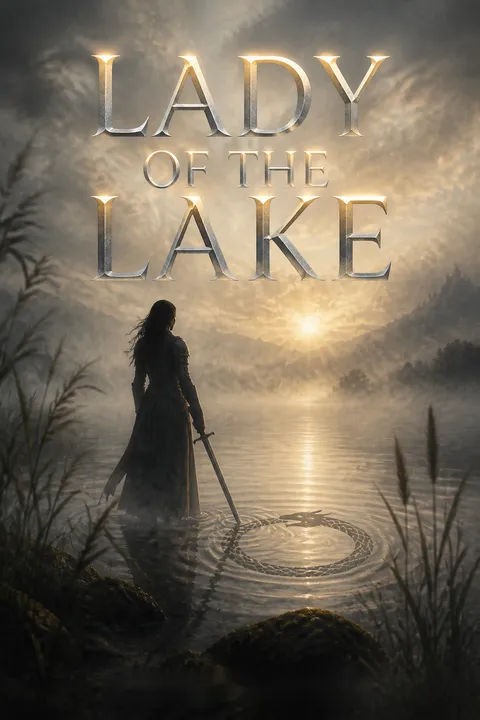
A young knight named Galahad hears singing beside a still mountain lake and discovers a wounded, silver-streaked woman washing blood from her shirt. He mistakes her for the Lady of the Lake from the legends of his own world and expects her to hand him a sword. Instead, she introduces herself as Ciri, keeps her weapon, and explains that she arrived by river from a place whose stars and calendar he cannot recognize.
She has escaped a land where she was held prisoner, but she will not yet return. Galahad notices the blood and the scar; Ciri sees his innocence and his hunger for a story. When he asks what happened, she begins at the beginning, though she doubts her story has one.
The opening turns a familiar legend inside out. Galahad expects a magical benefactor who confirms his inherited story; Ciri is a traumatized traveler who refuses to perform that role. Her insistence on her name and her sword makes identity an act of self-protection rather than a title bestowed by others. The scene also establishes the book's unstable relation to time: what is Ciri's present is already a legend in another world. Galahad's innocence offers a listening space, but his desire to shape events into a happy tale anticipates the conflict between lived experience and comforting narrative.
Nimue Hunts the Ending
Centuries later, the sorceress Nimue brings the gifted oneiromancer Condwiramurs Tilly to her island tower to investigate the legend of Ciri, Geralt, and Yennefer. Nimue's gallery holds paintings of remembered scenes, but no authentic portrait of Ciri, so Condwiramurs uses the images as anchors for dreams.
Her first visions identify the false Ciri, a girl trained to impersonate the missing princess and presented at Emperor Emhyr's court. Nimue also recounts how a village storyteller first made her dream beyond the narrow life planned for her.
The dreamer sees Emhyr speak privately with the double, ask her true name, confess responsibility for her kidnapping, and let her remain with the kind Countess Stella. Nimue insists that legends conceal unfinished events, not tidy endings.
Nimue's scholarship is not detached antiquarianism. She studies Ciri because the legend once offered her a route out of a life defined by labor and restricted female roles, and because adulthood has made the softened version feel inadequate. Condwiramurs, meanwhile, must confront a basic epistemic problem: dreams carry the dreamer's desires and fears as well as possible truth. The false princess makes that problem concrete. Historical images record power's public theater, while her private exchange with Emhyr reveals a more morally complicated man. The section argues that stories preserve what official records omit, but never provide a neutral window onto the past.
Toussaint's Golden Cage
After his company is wounded in the search for Ciri, Geralt accepts the Duchess Anna Henrietta's hospitality in Toussaint. The vineyards, feasts, and local monster contracts give Milva, Cahir, Regis, and Angouleme time to recover, while Geralt's work and growing bank balance make departure easier to postpone.
Fringilla Vigo, the Duchess's sorceress cousin, offers access to the palace library and information about Ciri's ancestry. She is also reporting to the Lodge of Sorceresses, which wants Geralt kept in Toussaint and monitored for clues.
Their affair becomes intense, though Geralt remains fixed on finding Ciri. Dandelion, meanwhile, falls in love with Anna Henrietta and decides to stay as her favored poet. The company grows comfortable, but Geralt's companions recognize that comfort is turning into delay.
Toussaint offers real care, yet its pleasures also blunt urgency. Geralt is not simply distracted by sex or luxury; he has been carrying a rescue mission so long that rest resembles a life he might keep. Fringilla's divided role makes intimacy politically porous: she genuinely desires him while using the relationship to gather information and influence his choices. Dandelion's decision to remain exposes a contrasting response to refuge. He treats romantic happiness as a possible destination, while Geralt experiences it as a dangerous pause. The section tests whether safety is a recovery that enables action or a beautiful enclosure that prevents it.
The Cellar's Listening Tubes
A monster contract leads Geralt through old tunnels beneath Toussaint's vineyards, where he finds chained human bones, an engineered listening chamber, and brass tubes carrying a secret meeting. Nilfgaardian nobles and the disgraced official Stefan Skellen are conspiring to kill Emhyr and install a pliable successor.
Their plan depends on Yennefer, whom they believe Vilgefortz has imprisoned and conditioned to assassinate the Emperor. Geralt also learns Vilgefortz is hiding at Castle Stygga.
Fringilla confirms that Yennefer never joined Vilgefortz willingly and may still be alive, then trades the location for a personal goodbye. Geralt leaves despite her plea to stay, gathers his companions, and refuses to let Toussaint's safety replace the search. The secret he carries gives the rescue a destination.
The listening tubes turn a cellar into an image of political life: hidden actors speak through structures built by earlier powers, while ordinary people move above without knowing who is arranging their fate. Geralt's discovery redirects a private rescue into an imperial crisis, but he does not accept the conspirators' logic that people are expendable pieces in statecraft. Fringilla's choice is similarly divided. She has helped him and loves him, yet her final exchange still treats knowledge as leverage. Geralt leaves not because intimacy meant nothing, but because he refuses to let affection become a bargain that keeps him from those he has promised to find.
The Alders' Bargain
Ciri's escape through the Tower of the Swallow has delivered her to the Aen Elle, elves who keep her in a beautiful country she cannot leave. Their sage Avallac'h identifies her Elder Blood descent from Lara Dorren and demands that she bear a child for their king, Auberon Muircetach.
He frames the demand as repayment for an ancient human theft and promises that she may return home afterward. Ciri refuses, but the elves' magical boundary makes refusal costly. Auberon tells her that his people need her bloodline to reopen travel between worlds and escape the coming White Frost.
Eredin, commander of the Red Riders, warns that she is trapped and presses her toward compliance. When Auberon dies after their drug-assisted attempts fail, Ciri understands how little control any of them has admitted to having.
The Aen Elle convert Ciri's ancestry into a claim over her body. Their language of debt, species survival, and ancient grievance makes coercion sound like historical justice, but Ciri recognizes the person being asked to pay. The contrast between their immaculate world and her confinement exposes the moral poverty beneath their refinement. Auberon's grief and hesitation complicate the demand without undoing it; Eredin's practical menace makes clear that a gentler manner can still serve a coercive system. Ciri's refusal is neither ignorance of the stakes nor simple rebellion. It is her insistence that survival cannot be purchased by treating her as a reproductive instrument.
A Map Made of Worlds
After Auberon's death, Ciri learns that Eredin's people conquered their present world and massacred its original inhabitants. She allies with Ihuarraquax, the unicorn she once healed, and other unicorns who oppose the Aen Elle's attempt to control the Gate of Worlds.
Their escape carries her through places and eras: a ruined industrial landscape, a plague-stricken port, and other worlds where familiar stars and languages fail her. She can leap, but cannot reliably choose her destination.
Meanwhile, Condwiramurs dreams of Ciri's journey, and Nimue uses a magical mirror and tapestry to open a passage toward the ruined castle where the legend's final battle belongs. When Ciri's wandering brings her within reach, Nimue calls her through the portal, giving the fugitive a route toward Geralt and Yennefer.
Movement through worlds grants Ciri extraordinary power but not immediate agency. She can escape a pursuer, yet every leap risks landing in another form of danger, from ecological ruin to epidemic death. The unicorns' help matters because they oppose possession rather than seeking to inherit the power themselves. At the same time, Nimue's dreamwork shows that historical study can become an intervention: images do not merely illustrate Ciri's past but help guide her through it. The passage links two kinds of navigation, Ciri's instinctive crossings and Nimue's patient interpretation, while insisting that knowledge is useful only when it accepts the uncertainty of its map.
Jarre's Bloodied History
Jarre, a temple-trained scholar, leaves Ellander to volunteer for the Northern armies, despite Mother Nenneke's objections. On the road, a gang of recruits nearly robs him and a merchant; two mercenaries intervene, exposing how patriotic language coexists with ordinary predation.
At Vizima, Jarre is assigned to the Poor Fucking Infantry and reaches the Battle of Brenna as Nilfgaard's advance collides with the northern coalition. The dwarven and mercenary formations hold under brutal pressure, while reinforcements turn the battle against Field Marshal Coehoorn.
Jarre survives a cavalry charge but loses his arm. Brenna ends Nilfgaard's northern offensive and forces peace negotiations, yet the victory leaves refugees, propaganda, reprisals, and ethnic hatred. Years later, Jarre writes the battle's history with his remaining hand.
Jarre's storyline refuses the clean division between patriotic courage and cynical self-interest. He chooses enlistment freely, but the army assigns him to a unit whose risks expose the gap between his ideals and institutional reality. His education gives him a language for the battle, not protection from it. Later, writing history becomes a second form of service: he can correct omissions and propaganda, though his own account remains bounded by loss and memory. Brenna is a military victory whose consequences do not amount to moral repair. The campaign ends, but its habits of dehumanization survive in the treatment of settlers, nonhumans, and the wounded.
Ciri Enters Stygga
The path opened through Nimue's mirror delivers Ciri to Castle Stygga, a ruined fortress crowded with Stefan Skellen's mercenaries. She asks for Yennefer and encounters the bounty hunter Leo Bonhart, who once tortured her and forced her to fight in an arena.
Vilgefortz, scarred and still formidable, binds Ciri with magic and blocks her ability to flee through time. She offers herself in exchange for Yennefer's life, but he rejects the bargain. His goal is not simply to father a child: he intends to extract placental blood, seize Ciri's power, and rule across worlds.
His assistants begin preparing her for an invasive procedure. Ciri's arrival was deliberate, but she cannot control what happens next; the rescue she hoped to enable has become a race against an experiment designed to make her body and abilities serve Vilgefortz.
Ciri's voluntary arrival is easily mistaken for surrender, but it is an attempt to exchange her own safety for Yennefer's. Vilgefortz destroys that moral logic by refusing reciprocity: he wants the benefits of her sacrifice without accepting any obligation in return. His language of research and world-saving strips violence of its visible name, making the laboratory more chilling than a battlefield. The scene also returns Ciri to the role imposed by the elves, but escalates it. The Aen Elle wanted a child; Vilgefortz wants biological material and an instrument of rule. Her body is the contested territory on which several ambitious visions of the future converge.
Stygga's Rescue Costs Blood
Geralt, Milva, Cahir, Regis, and Angouleme storm the fortress while Vilgefortz's attention remains on Ciri. Milva holds a gallery against a trained archer, kills him, and is mortally wounded in return.
Regis reaches the laboratory in monstrous bat form and frees Ciri, but she refuses to leave without Yennefer. Geralt finds Yennefer in chains and removes her dimeritium restraints before they confront Vilgefortz. Elsewhere, Cahir and Angouleme encounter Bonhart and send Ciri toward the others.
Cahir stays to fight him; Angouleme, already badly wounded, dies after helping Ciri escape. Regis, Geralt, and Yennefer are now inside the same besieged castle, but the rescue has cost three companions and left Ciri facing the enemy who shaped her worst memories.
The rescue is built from acts of care that are effective precisely because they do not guarantee survival. Milva uses her skill to create an opening; Regis risks becoming a frightening spectacle to free Ciri; Cahir and Angouleme choose to delay Bonhart rather than preserve themselves. Their deaths are not abstract prices paid for a mission. Each follows from a specific choice to protect someone else. Ciri's refusal to abandon Yennefer repeats the loyalty that brought her to Stygga, but now carries the knowledge of what that loyalty can cost. The section strips heroism of triumphal polish while preserving its human force.
Two Enemies Fall
Ciri faces Bonhart among the broken beams of the castle, using the balance and timing Geralt taught her at Kaer Morhen. She wounds him, drives him from the beam, and approaches when he lies apparently beaten; when he attacks with a hidden knife, she kills him. In another part of Stygga, Geralt and Yennefer face Vilgefortz's spells together.
Regis attacks to interrupt the sorcerer's control of Yennefer, but Vilgefortz destroys him with burning magic. Geralt survives by using the protective amulet Fringilla made for him, then defeats Vilgefortz with his sword. Ciri reaches Geralt and Yennefer afterward. Their reunion is intimate but exhausted: the three have found one another, while the friends who made the rescue possible are gone.
The paired confrontations give Ciri and Geralt distinct forms of mastery. Ciri wins through embodied training, patience, and learning from an earlier defeat; she does not mistake apparent vulnerability for safety. Geralt's victory depends partly on a tool made by the woman he left, turning an imperfect intimacy into practical aid. Yet the cost of victory prevents the scene from becoming simple restoration. Regis is lost, and the lovers' reunion cannot return the company to what it was. The book's central ethical claim is not that goodness guarantees success, but that people can still choose how to act inside systems designed to make them instruments.
Duny's Last Bargain
Emhyr arrives at Stygga after the fighting and privately reveals that he is Duny, the hedgehog prince who married Pavetta and fathered Ciri. He explains that a prophecy convinced him Ciri's child could rule the world, and admits he planned to make his daughter his wife.
Geralt condemns the plan and challenges Emhyr to confront what he has done, including Pavetta's death during the staged shipwreck meant to hide their escape to Nilfgaard. Emhyr initially intends to take Ciri south, while Geralt and Yennefer prepare to die rather than help him.
But Ciri's open defiance and the couple's willingness to accept death break the Emperor's resolve. He withdraws his people and leaves them free. At court, the trained double is ultimately treated as the imperial heir, while the real Ciri escapes the throne he meant for her.
Emhyr's confession exposes the difference between remorse and repair. He can explain his motives, name the violence, and feel the force of Ciri's refusal, but none of that restores Pavetta or erases years of pursuit. His withdrawal matters because he finally declines to convert prophecy into permission. The double's political use shows how dynastic systems absorb the absence of a person by substituting a convincing image. Ciri's survival therefore does not resolve the machinery that claimed her. The Emperor changes course at the intimate scale, releasing his daughter, while the state continues to preserve its succession through a fabricated identity.
Dandelion Escapes the Axe
On the journey north, Geralt and Ciri's paths diverge, and Geralt travels with Dandelion. In Beauclair, the poet is sentenced to death for insulting Anna Henrietta, slandering the court, and disgracing the nobility through his notorious affairs.
The Duchess commutes the punishment to decapitation, then a last-minute pardon saves him from the executioner's axe but orders him out of Toussaint for good. Geralt and Ciri force their way through the crowd, take Dandelion with them, and leave before Anna Henrietta can reverse the reprieve.
Once clear of the principality, Dandelion learns that Milva, Cahir, Regis, and Angouleme died at Stygga. His romantic certainty gives way to grief, and he leaves behind the memoirs he had written in Toussaint, deciding that the account will have to be begun again.
Dandelion's escape is comic in its bureaucratic absurdity, but it also closes the fantasy he chose in Toussaint. He believed love could make him an exception to rank and consequence; the court's decree makes clear that Anna Henrietta can cherish him and still dismiss him. His return to Geralt does not restore their old company. Instead, he must absorb the deaths that Geralt has been carrying alone. Abandoning the memoirs suggests that experience has invalidated the story he had been preparing to tell. His gift is language, but the losses demand a new account rather than a polished version of the old one.
The Lodge Claims Ciri
Yennefer brings Ciri before the Lodge of Sorceresses at Montecalvo, where Philippa Eilhart and the others propose that Ciri become Prince Tancred's lover and bear a child who will strengthen their political influence.
The Lodge presents this arrangement as protection and service to the world, but Ciri recognizes another attempt to decide what her body is for. She chooses the name Cirilla of Vengerberg, daughter of Yennefer, and insists that she must first meet Geralt in Rivia. The sorceresses divide over whether to let her go.
Philippa casts the deciding vote in Ciri's favor, arguing that trust and hope must temper discipline. Triss accompanies them. On the road, Ciri leaves Geralt and Dandelion to reach Rivia separately, promising to return within six days, while refusing to let the Lodge define her as merely a dynastic asset.
The Lodge repeats Vilgefortz's language of necessity in a more polished form. Its members offer education, status, and political security, yet still imagine Ciri's future through the child she can produce. Ciri's resistance is more strategic than her earlier refusals: she names her own lineage, recognizes the difference between coercion and alliance, and requests time to speak with the people she loves. Philippa's vote matters because it prevents institutional unity from becoming absolute. The decision leaves the Lodge's agenda intact, but it creates a space in which Ciri can deliberate rather than obey. Trust becomes a political practice, not a sentimental luxury.
Rivia Turns Against Its Neighbors
At Rivia, Geralt and Dandelion arrive amid postwar hostility toward nonhumans. A crowd attacks the dwarves and elves in the city; Geralt takes up Zoltan's sword and fights through the mob to defend them.
An attacker disguises a pitchfork strike as a plea for mercy and drives the weapon into Geralt's abdomen. Ciri and Yennefer reach the city as the violence spreads. Yennefer and Triss refuse to flee, and their spell unleashes a hailstorm that breaks the mob long enough for the soldiers to restore order.
But Geralt is dying, and Yennefer's magic cannot heal him. Ciri, aided by Ihuarraquax, touches the unicorn's horn and Geralt, then carries him and Yennefer into a boat that vanishes into the lake fog. Her choice leaves their fate uncertain to those watching.
Rivia makes visible what the peace settlement could not abolish: violence now operates through crowds, civic prejudice, and opportunistic political manipulation rather than open armies. Geralt's return to the sword is not a heroic relapse but a refusal to watch neighbors be slaughtered. The attackers exploit gestures of mercy, turning recognition into a weapon. Yennefer and Triss likewise choose to remain, though their magic can disperse violence only temporarily. Ciri's departure with Geralt and Yennefer crosses the boundary between rescue and farewell. The fog preserves possibility, but it also denies the witnesses the certainty that conventional narrative endings demand.
The Story Rides On
After the boat disappears, Geralt wakes beneath apple branches with Yennefer beside him, alive and unable to say where they are. The scene offers reunion but no dependable explanation of how they survived or what world holds them. In the Arthurian frame, Ciri tells Galahad that Geralt and Yennefer married, built a home, and lived happily.
She presents the ending as a fairy tale, then admits through her tears that she does not want their story to end. Galahad invites her to Camelot. Ciri accepts his hand and rides with him toward the setting sun, leaving the lake behind. She has not returned to her old world, but she is no longer trapped in the one the Aen Elle chose for her. Another road lies ahead.
The ending does not settle whether the lovers have been restored to life, carried into an afterworld, or placed inside a story Ciri needs to tell. Its ambiguity is ethically meaningful: certainty would offer emotional comfort at the cost of simplifying the losses that precede it. Ciri's invented wedding and home are less a factual report than an act of care, a way to give Galahad and herself an ending she can bear. Yet she does not stay inside that fiction. She rides onward, accepting another world and another relationship on her own terms. The legend continues because Ciri remains a moving subject, not a completed symbol.
Analysis
Lady of the Lake asks whether a person can escape the roles that make her valuable to others. Ciri is successively treated as a princess, a bloodline, a prophecy, a reproductive vessel, a political marriage, and a legend. Each claimant offers a different justification, from species survival to world peace, but the underlying operation is similar: convert her future into someone else's plan. Her resistance is not a rejection of care or connection. She continues to seek Geralt and Yennefer, accepts help from the unicorns, and returns to the Lodge willing to listen. What she rejects is the idea that love, history, or necessity entitles others to decide for her.
The novel's political world also resists the simple moral arithmetic of victory. Brenna defeats Nilfgaard's advance, yet peace brings expulsions, reprisals, and pogroms. The mechanisms of harm change form rather than disappear. Courts, treaties, markets, and crowds can produce violence as effectively as armies, often while claiming legality or popular justice. Geralt's despair at this altered landscape is therefore not mere cynicism. He recognizes that the monsters he once hunted are no longer the only danger, and that institutions can authorize cruelty while calling it order.
The frame narrative makes storytelling part of that ethical problem. Nimue seeks the truth behind a legend, Condwiramurs dreams through its images, Jarre records a battle, and Dandelion continually revises his account. None possesses a complete or neutral version. The book suggests that stories can distort, preserve, or rescue, depending on who controls them and what they leave out. Ciri's final fairy-tale ending for Galahad is knowingly uncertain, yet emotionally necessary. It does not erase the dead or prove a happy resolution. It lets her carry love forward without surrendering the right to continue her own story.
Review Summary
People Also Read








Characters
Ciri
World-crossing heirCirilla, called Ciri, is the daughter of Pavetta and the granddaughter of Queen Calanthe. Her Elder Blood gives her an unusual relation to space and time, making her valuable to rulers, sorcerers, and elves who want to shape the future. She is brave, observant, and often sharply defensive, especially when others speak of her as a resource rather than a person. Her scars and memories make her wary of grand promises, but her loyalty to Geralt and Yennefer remains a source of strength. Ciri's struggle is not simply to master her abilities; it is to decide what obligations she accepts and what claims over her life she refuses.
Geralt of Rivia
Reluctant monster hunterGeralt is a witcher, a trained monster hunter whose work depends on distinguishing actual threats from rumor and prejudice. His bond with Ciri and Yennefer gives his wandering life a purpose that he once resisted acknowledging. He is economical with emotion, suspicious of political ideals, and more loyal than his practiced detachment suggests. Friends often force him to see how much he relies on them, while his profession gives him practical skills without protecting him from grief. Geralt's deepest conflict is between self-preservation and the instinct to intervene when someone is being harmed. He distrusts grand accounts of destiny, yet repeatedly acts as though other lives are his responsibility.
Yennefer
Ciri's fierce protectorYennefer is a powerful sorceress and one of Ciri's closest guardians. Her pride, intelligence, and command of magic conceal a deep capacity for attachment, especially toward the girl she has helped raise. She refuses to let others reduce her relationship with Ciri to a substitute for motherhood, even as that bond becomes central to her choices. Yennefer's instinct is to control danger before it can reach the people she loves, but political institutions repeatedly test whether protection has become another form of control. Her sharp tongue and formidable presence are not merely defenses; they allow her to confront people who expect women to yield.
Nimue
Keeper of the legendNimue is a sorceress known as the Lady of the Lake, living generations after Ciri's adventures. Raised in poverty, she found possibility in stories of powerful women and pursued magic and scholarship to escape the future expected of her. Her study of Ciri's legend becomes an obsession because the accepted accounts leave crucial events unresolved. Nimue is disciplined and exacting, but her research is also personal: she needs the past to be more than a set of comforting distortions. She treats Condwiramurs as a collaborator rather than a mere student, while maintaining firm boundaries around her private life and magical work.
Condwiramurs Tilly
Dreaming historianCondwiramurs is a talented oneiromancer and academy adept whom Nimue recruits to investigate Ciri's legend through dreams. She is intelligent, self-assured, and proud of her skill, yet she knows that dreams can mix evidence with expectation. Her task requires her to combine detailed knowledge of art and history with a willingness to interpret uncertain visions. Condwiramurs' practical skepticism balances Nimue's emotional investment, and her work demonstrates that research can be collaborative without becoming certain.
Dandelion
Poet and loyal friendDandelion, also known as Viscount Julian de Lettenhove, is a celebrated poet, performer, and Geralt's longtime friend. His appetite for romance, attention, and elegant language can make him seem frivolous, but he repeatedly risks comfort and reputation for the people he loves. He believes passionately in the stories he tells, sometimes mistaking desire for evidence. His friendship with Geralt is built on affection and friction: Dandelion sees emotional truths that Geralt avoids, while Geralt is willing to puncture the poet's fantasies when they become dangerous.
Emhyr var Emreis
Emperor with a secretEmhyr is the Emperor of Nilfgaard, a ruler whose decisions are governed by a mixture of ambition, insecurity, and political calculation. He rose from exile and danger to reclaim his throne, and his belief in prophecy gives him a grand justification for personal and dynastic violence. He rarely permits others to see uncertainty, yet his private encounters reveal that power has not erased his capacity for guilt. Emhyr's central contradiction is that he can recognize the humanity of an individual while still treating whole populations as instruments of state.
Fringilla Vigo
Sorceress with divided loyaltiesFringilla is a Nilfgaardian sorceress and a relative of the Duchess Anna Henrietta. Her beauty, confidence, and social ease help her move through court, while her magical skill makes her valuable to the Lodge of Sorceresses. She approaches Geralt with both political purpose and genuine desire, a combination that prevents her from being reduced to a simple spy or lover. Fringilla wants to be chosen freely, yet she is skilled at using information and influence to keep people close. Her intelligence is matched by an awareness of the emotional costs of that strategy.
Vilgefortz
Sorcerer seeking dominionVilgefortz is an exceptionally powerful sorcerer whose charisma and strategic intelligence mask an appetite for control. He interprets prophecy, magic, and human bodies as tools that can be organized toward his own ascendancy. His confidence makes him dangerous not only because he can wield force, but because he can explain exploitation as necessity. He treats resistance as an obstacle to be overcome rather than as evidence that his plans are morally wrong.
Emiel Regis
Scholar and steadfast allyRegis is a learned vampire who travels with Geralt's company. He is measured, courteous, and intellectually curious, often bringing perspective when more impulsive companions argue or despair. His monstrous nature contrasts with his ethical restraint, allowing the story to question whether appearances reliably identify danger. Regis values friendship and takes practical risks for the people he considers his own, while remaining aware that his strength can frighten those he wants to protect.
Milva
Unflinching archerMilva is an expert archer who joins Geralt's search and becomes a fiercely dependable member of his company. Her rough humor and guarded manner conceal a private tenderness and a strong aversion to being pitied. She is most comfortable when action offers a clear purpose, but she is not immune to loneliness or the desire for a life beyond constant danger. Her bond with the group is expressed less through declarations than through the risks she accepts beside them.
Cahir Mawr Dyffryn aep Ceallach
Penitent Nilfgaardian knightCahir is a young Nilfgaardian nobleman who once frightened Ciri and later becomes one of Geralt's companions. His pursuit of her begins in duty and confusion, but his growing loyalty requires him to confront the harm he caused and the identity imposed by his country. Cahir is earnest, courageous, and often more emotionally transparent than Geralt. His need to atone can make him reckless, but it also gives his service a moral seriousness that distinguishes it from simple obedience.
Angouleme
Quick-witted young survivorAngouleme is a bold young woman who joins Geralt's company after surviving a harsh life among bandits and criminals. She speaks with irreverent confidence, jokes about money and pleasure, and is quick to imagine a future on her own terms. Beneath the bravado is a need for belonging and a fear of being discarded. She admires Geralt's competence and gradually treats his company as a place where she can be more than her past.
Leo Bonhart
Predatory bounty hunterBonhart is a brutal bounty hunter who uses skill, intimidation, and spectacle to dominate those he captures. He collects witcher medallions as proof of his prowess and treats violence as both employment and entertainment. His fixation on Ciri is partly professional rivalry and partly a desire to control the person who escaped him. Bonhart's composure makes his cruelty more unsettling: he does not need rage to inflict harm.
Avallac'h
Aen Elle sageAvallac'h is an Aen Elle sage who understands Ciri's ancestry and the passage between worlds. He is learned, patient, and capable of genuine complexity, but his priorities remain shaped by his people's long history and ambitions. He offers Ciri explanations and promises while supporting a plan that would make her body serve elven needs. His calm manner can soften the appearance of coercion, making the distance between intelligence and ethical wisdom one of his defining tensions.
Eredin
Commander of the Red RidersEredin commands the Aen Elle's Red Riders and speaks to Ciri with a mixture of contempt, manipulation, and calculated charm. He understands how fear can be used to make confinement seem inevitable. His polished manners do not hide his willingness to threaten or exploit those who stand between him and power.
Auberon Muircetach
King of the AldersAuberon is the ancient king of the Aen Elle, marked by a melancholy that has outlasted ordinary human time. He carries the authority of a ruler but behaves with a weariness that makes his motives difficult to read. His conversations with Ciri reveal the distance between elven understandings of time and the urgency of a human life. He is not simply a villain or a rescuer, but a king unable to separate private grief from his people's political needs.
Jarre
Scholar turned chroniclerJarre is a young scholar trained at the Temple of Melitele who volunteers for the Northern army out of patriotic conviction and personal feeling. He carries books and learned language into a world of coercion, propaganda, and battlefield injury. His education does not make him immune to suffering, but it gives him a reason to record what others would rather simplify or erase. Jarre's connection to Ciri remains private and idealized, a measure of the distance between the person he imagines and the woman she has become.
Triss Merigold
Sorceress torn by loyaltyTriss is a sorceress whose friendship with Yennefer and affection for Ciri place her between personal loyalty and the Lodge's political agenda. She is compassionate, capable, and more vulnerable to guilt than she lets others see. Triss understands how institutions justify sacrifice, yet she struggles when those abstractions prevent her from helping specific people. Her courage is often tested not by whether she feels fear, but by whether she acts while feeling it.
Ihuarraquax
Unicorn guideIhuarraquax is a unicorn Ciri once healed, and he becomes a guide and ally during her movement between worlds. He communicates through thought and is connected to a larger community of unicorns. His aid is based on a remembered act of compassion, offering a counterpoint to the political powers that view Ciri primarily through her usefulness.
Plot Devices
The Elder Blood
Power across worldsCiri's inherited Elder Blood links her to Lara Dorren and gives her an unusual capacity to travel through space and time. Different groups interpret the ability according to their own needs. The Aen Elle want it to reopen the Gate of Worlds, Vilgefortz wants to control it, and the Lodge sees it as a means to secure political succession. For Ciri, the power is at first erratic and frightening. Its narrative function is to make her mobility both a form of escape and the reason she is repeatedly pursued. The bloodline matters, but it never erases her right to choose what she does with it.
Dreams and Anchors
Recovering hidden historyCondwiramurs uses objects, artworks, and images as anchors for oneiromantic dreams. Nimue supplies paintings and historical material, hoping the dreams will reveal events missing from the accepted legend. The method creates a productive uncertainty: a vision may uncover a neglected event, but it can also reflect what the dreamer wants or fears. Nimue's tapestry and magical mirror eventually turn research into a literal passage, helping direct Ciri toward the decisive meeting. Dreams therefore serve both as a historical method and as a narrative bridge between Ciri's lived experience and the later culture that retells it.
The Ouroboros
Time folds back on itselfThe serpent biting its own tail becomes a recurring image for the novel's circular structure. Ciri's present becomes an old legend in Nimue's era, while images and stories guide her back toward events that have already entered historical memory. The symbol also complicates the idea of destiny. A repeated pattern can look inevitable after it has happened, but the characters' choices still shape what comes next. The Ouroboros gives the book a way to connect beginnings and endings without claiming that every event was predetermined.
The False Ciri
A person becomes a political maskThe double trained to impersonate Ciri allows Nilfgaard to preserve a dynastic image when the real princess is missing. Condwiramurs discovers the girl's existence through a dream, and Emhyr's private treatment of her reveals that the performance has not erased her individuality. The double's role exposes how monarchies can value a person as a symbol while overlooking the person beneath the costume. Her presence also keeps the political plot active after the real Ciri escapes the court's reach.
The Witcher's Sword
A profession made tangibleGeralt's weapons, especially the sword made by Zoltan Chivay, embody the work and identity he has carried for years. He relies on them in combat, returns Zoltan's blade when he believes he can no longer remain a witcher, then takes it up again during the Rivia pogrom to defend the dwarves. The sword's return does not simply cancel his decision. It shows how a person can reject a role's old meaning yet still answer a specific call for help. The weapon makes the conflict between retirement and responsibility visible without resolving it neatly.
The Witcher Series



About the Author

Download PDF
Download EPUB
.epub digital book format is ideal for reading ebooks on phones, tablets, and e-readers.








