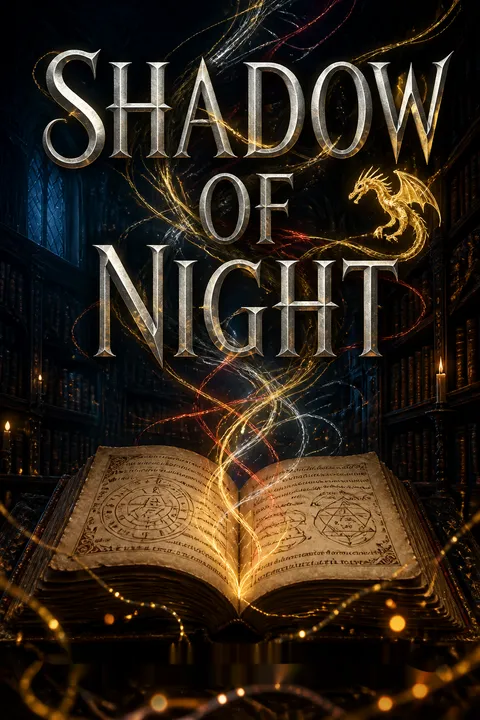


Plot Summary
The Old Lodge Landing
Diana Bishop1 and Matthew Roydon2 tumble into 1590 Oxfordshire, escaping enemies in their own time and hoping to find a witch who can teach Diana1 magic. At Matthew's2 house, Diana1 meets Christopher Marlowe,8 who treats her as an intruder until Matthew2 reveals she is his wife1 and a witch.
The guests include poet George Chapman, astronomer Thomas Harriot, the Earl of Northumberland, and Walter Raleigh, all friends Matthew2 has known for centuries. Diana1 recognizes the historical figures, then realizes her husband2 is the obscure Matthew Roydon2 associated with their intellectual circle. Her modern accent and unfamiliarity with household customs make concealment difficult from the start.
Diana's historical expertise gives her a false sense of preparation: she recognizes names but cannot yet inhabit the social rules that govern their world. Matthew's return to old friends also exposes the distance between his guarded modern self and the lively man he once was. Their marriage provides protection, but it cannot make them socially invisible.
The Withered Quince
Diana's1 hair changes, her magic shifts, and even arranging flowers drains their life. Matthew2 summons Widow Beaton, Woodstock's wary healer, despite Diana's1 warning that attention could endanger them both. Beaton dismisses Diana1 as powerless after she fails a traditional test involving a bell, a book, and a candle.
Angry, Diana1 draws the sunlight from a quince, shriveling it in front of Matthew's2 friends. Beaton leaves convinced that the household is dangerous, while rumors spread through the village. Soon the minister and local tradesmen accuse Diana1 of afflicting Beaton and a shoemaker's son. Matthew2 drives them out, but the visit makes clear that his influence cannot silence every human suspicion.
The failed test measures Diana by inherited rules that do not describe her abilities. Her spontaneous response reveals a power that is real but not yet governable, while Beaton's fear shows how quickly a community's need for explanation becomes a threat. Diana's anger gives her evidence of strength, but also makes her more visible to people prepared to punish difference.
Three Masters Call
Matthew's2 vampire nephew Gallowglass7 and fellow vampire Hancock arrive with news that Scottish authorities are imprisoning witches after the North Berwick panic. Their presence exposes Matthew's2 hidden roles: he serves the Congregation and works as an English intelligencer, while also acting for his father,3 Philippe de Clermont.3
Diana1 learns that Kit8 has fueled village gossip, partly from jealousy and fear of losing Matthew.2 Then a letter summons Matthew2 to France because Philippe3 believes him dead. Matthew2 decides to take Diana1 with him, choosing their bond despite the risks. Before leaving, he directs his allies to protect her and continue searching Oxford for the mysterious Ashmole 782.
Matthew's secrecy is not merely a personal habit. It is the survival method of a man serving institutions that demand incompatible loyalties. Diana's anger at his concealment is therefore also a demand to be treated as a partner rather than another danger to manage. The summons makes that conflict immediate: Matthew must choose whether duty means obedience to his father or fidelity to Diana.
A Book Survives
In modern Seville, librarian Rima Jaén finds an anonymous English commonplace book from the late sixteenth century among a neglected archive's possessions. Its pages contain notes on coins, clothing, cooking, and several abbreviated names, along with rosemary and lavender pressed into the binding.
Rima's director dismisses it as insignificant and forbids her to photograph it, but she keeps the volume close rather than returning it to storage. Its uncertain handwriting and practical contents suggest an ordinary woman, not a famous scholar. Rima cannot identify the author, yet her attention preserves a trace of Diana's1 life that the larger historical record will otherwise overlook.
This quiet interlude turns ordinary record-keeping into a second form of survival. The commonplace book matters precisely because its author did not write for posterity: lists and recipes preserve the texture that grand historical narratives discard. Rima's decision to value an anonymous woman's evidence parallels Diana's own struggle to make a life in a past that offers her few recognized roles.
Philippe Sets the Terms
At Sept-Tours, Matthew2 and Diana1 face Philippe,3 the formidable father3 Matthew2 has not seen for decades. Philippe3 recognizes that the couple come from another time and questions Diana1 about the dangers following her. He will not initially shield a witch, fearing that doing so could endanger his family during France's religious wars.
He also reveals that Matthew's2 private vows and ring do not make them legally married or fully mated. Diana1 must sleep apart from Matthew,2 and Matthew2 proposes leaving for Milan. She refuses to be treated as a dependent passenger and begins learning the household's workings, insisting she needs the ability to manage without him.
Philippe's authority forces private love into public and legal terms. Diana's vulnerability is structural: without family, money, or recognized status, affection alone cannot protect her. Her decision to learn the household is an early shift from being shielded to acquiring practical agency. Matthew's resistance to her independence reveals how care can become control when he assumes protection is his sole responsibility.
The Church Remembers
On the birthday of his dead son Lucas, Matthew2 kneels in the church he helped build, and Diana1 finds him there. He tells her about Lucas and his first wife, Blanca, whose deaths left him convinced that he had failed them. He also reveals that, after Nazi torture broke Philippe3 in the twentieth century, Matthew2 ended his father's3 life at Philippe's3 request by drinking his blood.
Matthew2 has carried that act as a private condemnation. Diana1 does not turn away from what he has done; she understands it as mercy and reminds him that Philippe3 trusted him with the family. The confession gives Matthew's2 reluctance to love another person a history deeper than fear of the Congregation.
Matthew's scientific command and political competence coexist with a moral life organized around guilt. He treats survival as evidence of debt, not permission to begin again. Diana's response does not erase the violence of his past; it places the act within its context and refuses his conclusion that he is therefore unworthy of love. Their intimacy grows through truthful recognition rather than absolution without cost.
Blood Makes Kin
Philippe3 tests Matthew2 in the hay barn with a sword fight, provoking the blood rage Matthew2 has long feared. Matthew2 attacks his father3 and wounds servant Pierre before Philippe3 reaches him with forgiveness. Philippe3 then marks Diana1 with his blood, making her his daughter and giving her the de Clermont family's protection.
When the wizard André Champier later tries to force Diana's1 memories from her, she stabs him before he can take them; Matthew2 kills him, and Philippe3 arranges their public wedding. The ceremony binds them before the village, and they consummate the marriage that night. Diana's1 new family status gives her more than shelter: it makes her a recognized participant in the household.
The sequence links kinship to responsibility rather than sentiment alone. Philippe makes Diana family through a ritual that carries political consequences, while Diana's defense against Champier demonstrates that protection cannot mean passivity. Matthew's rage reveals a danger he cannot simply reason away, yet Philippe's forgiveness suggests that a feared inheritance need not dictate every action.
A London Pregnancy
After Advent and a wedding celebrated by Saint-Lucien, Matthew2 and Diana1 travel to London, where the Blackfriars offers more privacy than Woodstock. Diana1 befriends the learned Countess of Pembroke, Mary Sidney,9 and joins her alchemical experiments. Her own magic makes a bee and snake leap from Mary's9 embroidered shoes, confirming that it now reaches into living things.
On Christmas morning, Matthew2 realizes Diana1 is pregnant, an outcome both consider biologically impossible. They keep the news private while Matthew2 worries that a child will expose them to the Congregation and Diana1 insists she needs to understand her powers before returning home. Their search for Ashmole 782 continues alongside this new, fragile future.
The pregnancy transforms the couple's forbidden relationship into a challenge to the assumptions that organize their species. Diana refuses to be treated as a vessel whose safety overrides her judgment, while Matthew's scientific caution struggles against his hope for a family. Mary's laboratory offers Diana a rare intellectual friendship in a world that usually grants women learning only under carefully managed conditions.
The Weaver's Door
Diana1 seeks a teacher through London vampire Andrew Hubbard,10 who assigns the young witch Annie Undercroft16 to serve her. Annie's16 aunt Susanna11 tests Diana1 with an egg, but Diana's1 effort to crack it instead hatches a chick. Goody Alsop6 recognizes the act as evidence that Diana1 is a weaver, a witch who creates spells from need rather than merely learning inherited formulas.
Diana's1 pregnancy can exist because a weaver can join powers other creatures cannot. The revelation also explains why her magic has seemed inconsistent: she borrows threads from the world instead of commanding one element outright. Goody Alsop6 organizes lessons with several London witches, despite Matthew's2 fear of exposing Diana.1
The egg test reverses the logic of Diana's earlier failures. Her magic does not obey the literal task; it answers the deeper desire she has not yet learned to articulate. This makes curiosity both her instrument and her risk. The revelation that weaving is creative rather than hereditary knowledge also reframes her isolation: she is not an inadequate practitioner but a different kind of one.
A Child Lost
Diana's1 pregnancy ends in miscarriage, leaving both spouses grieving and unsure how to approach each other. Matthew2 withdraws into drink and opiates with Kit,8 while Diana1 tries to decide whether his distance is grief or rejection. He eventually explains that he also feels powerless to stop the Scottish witch trials, where Agnes Sampson has been executed despite his earlier choice not to interfere with history.
Diana1 finds offerings left by witches and children who want her help, which Matthew2 had hidden to keep her safe. She tells him that secrecy has denied her the chance to act as a witch and neighbor. Matthew2 agrees to accompany her to Goody Alsop's6 next lesson.
The miscarriage and Sampson's execution are distinct losses, but Matthew experiences both through the same belief that intervention arrives too late. Diana's grief does not make her willing to surrender her agency. The hidden offerings show that her presence has already created obligations in London; protection that isolates her from those obligations would repeat the very exclusions she came to escape.
The Firedrake Appears
At Goody Alsop's6 forspell, Diana1 sees magic as threads and resists the urge to seize them. The power gathers into a firedrake, a two-legged creature of fire and water that becomes her familiar. Diana1 also meets the goddess, who reminds her that she once offered her own life to save Matthew;2 the goddess accepted that bargain, though Diana1 remains alive.
The witches realize Diana1 can move between life and death as well as time. Later, Diana1 learns to knot colored cords into a disguising spell and recognizes that her magic answers questions and desire. She keeps the bargain's full meaning from Matthew,2 fearing that he will see her powers as a threat.
The firedrake gives form to Diana's unresolved nature: elemental powers that seem incompatible become one living creature. Her encounter with the goddess places her agency inside a debt she chose under pressure, complicating any simple celebration of power. She can create, but creation carries obligations. Keeping this knowledge from Matthew shows that even a relationship grounded in honesty has boundaries shaped by fear.
Dee's Missing Book
In London, Diana1 and Matthew2 trace Ashmole 782 to John Dee, Elizabeth's astrologer. Dee shows them the Voynich manuscript, the wrong book, and explains that his assistant Edward Kelley18 took a prized alchemical volume to Emperor Rudolf's19 court in Prague. The queen then orders Matthew2 to retrieve Kelley,18 while Mary Sidney9 secures Diana's1 permission to accompany him.
Diana's1 lessons with Goody Alsop6 continue as the couple prepares to leave. Before they reach Prague, a glimpse of the future shows Verin and Gallowglass7 responding to signs of historical anomalies, while Ysabeau5 discovers a message from Philippe3 about Matthew's2 future happiness. Their past journey is already leaving marks in the present.
The failed identification at Dee's house is productive because it replaces a vague hunt with a chain of custody: Kelley, Rudolf, Prague. The historical quest becomes entangled with state power when Elizabeth claims the alchemist for England. The brief future scenes widen the story's scale, suggesting that seemingly minor records may carry messages across centuries without making time a controllable machine.
Rudolf's Court of Wonders
In Prague, Matthew's2 standing with Rudolf19 remains uncertain until he offers the emperor a Bosch altarpiece. Rudolf19 accepts the gift and commands Matthew2 to bring both the book and the witch. Diana1 becomes a court curiosity, receiving an elaborate astronomical instrument and invitations from imperial artists, while Matthew2 warns that the Congregation might hand her over if Rudolf19 demands her.
She meets the Jewish scholar Rabbi Judah Loew, who confirms that Kelley18 once possessed the mysterious book but could not read it. Loew directs Diana1 to Abraham,15 a Jewish weaver who made the clay golem Yosef. Diana1 recognizes in Abraham15 a rare counterpart, while his warning that the book must come to her conflicts with Matthew's2 plan to seize it.
Rudolf's court turns knowledge into possession: books, artists, alchemists, and Diana herself are treated as treasures to collect. Matthew understands the political danger but defaults to strategy and force. Rabbi Loew and Abraham introduce a different model of authority, grounded in learning and responsibility to vulnerable communities. Diana's contact with them expands her magical education beyond the lessons arranged by her husband.
The Son in Disguise
Diana's1 growing independence sharpens conflict with Matthew,2 whose vampire instincts make him intensely possessive. In Prague's Jewish Town, she meets Herr Fuchs,14 a vampire connected to Abraham,15 and senses a dangerous history without identifying it. After Rudolf's19 advances and Diana's1 meeting with another weaver, Matthew2 admits that her scent has become difficult for him to bear because he cannot distinguish her from everyone around her.
Diana1 invites him to drink from the vein near her heart, the vampire ritual that shares complete knowledge rather than asserting dominance. Through that exchange, Matthew2 learns she encountered Fuchs14 and realizes he is Benjamin,14 his estranged son,14 whose blood rage makes him dangerous even when lucid.
The blood-sharing ritual makes intimacy an epistemic act: Matthew seeks not simply closeness but an end to the secrets that structure vampire life. Diana's consent turns a potentially coercive instinct into a negotiated exchange. Yet the knowledge it reveals is not comforting. Benjamin's return introduces a family danger that cannot be solved by greater possession or surveillance.
The Book of Life
At Rudolf's19 spring masque, Diana1 plays the moon goddess and asks the emperor to show her Roger Bacon's alchemical book. Rudolf19 eventually produces Ashmole 782. Its missing pages contain images of a tree, an alchemical wedding, and intertwined dragons; its parchment, Matthew2 realizes, is made from the skins of witches, vampires, and daemons, with their biological traces preserved in the book.
Diana1 recognizes threads binding herself and Matthew2 to it. Kelley18 becomes distraught, then tears out the three pages before Matthew2 and Gallowglass7 can stop him. They escape Prague with the damaged manuscript, while Matthew2 returns it to Dee's custody on the journey home. Diana1 is pregnant again, but the book's meaning remains unreadable.
The discovery changes the manuscript from a source of abstract doctrine into a material record of bodies sacrificed to preserve knowledge. Its pages embody the violence that the creatures' institutions prefer to keep hidden. The lost leaves prevent the revelation from becoming a complete answer, while the surviving genetic traces make the book potentially more dangerous than the couple first imagined.
Knox Finds the Wolf
In 2010, Peter Knox13 finds a letter from Rabbi Loew hidden in a Prague library book. It says Edward Kelley18 removed three pages from the Book of Life and gave one to Abraham ben Elijah,15 while warning Benjamin14 to seek help from his father.2 Knox13 identifies Benjamin14 as Matthew's son14 and persuades Gerbert to share what he knows.
Their discovery convinces Knox13 that Matthew2 may hold secrets about the manuscript and that the missing pages are still recoverable. Gerbert agrees to support an effort against the de Clermonts, despite knowing Benjamin's14 blood rage. The letter turns the family's private history into a target, while the return of strange historical objects signals that Diana1 and Matthew's2 past journey is affecting the present.
Knox reads archival evidence as leverage, not as a warning about the danger of the knowledge itself. The letter's intimate appeal to Benjamin's family becomes a map for political coercion. By connecting the missing pages to Matthew's estranged son, the novel makes genealogy both a source of belonging and a vulnerability that hostile institutions can exploit.
The Father Arrives
Back in 1591 London, Diana's father12 Stephen Proctor12 arrives from the twentieth century, having timewalked into the past. He recognizes her as a weaver and helps her stop separating spellcraft from elemental magic. With Goody Alsop's6 coven watching, Diana1 calls fire without fear and releases her firedrake.
The creature speaks its name, Corra, and settles back inside Diana1 by choice. Stephen12 tells Diana1 that he and Rebecca have always known more about her magic than she realized, then presses the couple to consider how much they have altered the past. His presence gives Diana1 a rare chance to know her father12 as an adult, but his stay is brief.
Stephen's arrival offers Diana recognition without making him a flawless authority. His advice links magic to an integrated self rather than a set of manageable compartments, directly challenging the fear that has limited her. At the same time, his warning about temporal consequences punctures the couple's assumption that good intentions make intervention harmless.
A Telescope and Farewell
Stephen12 leaves after two weeks, and Diana1 says goodbye without knowing when she will see him again. Before departing, she arranges for Thomas Harriot and craftsman Nicholas Vallin to build a telescope, preserving a discovery the historical record would otherwise lose.
She gives the earring that brought her to 1590 to the young Rebecca and Bridget White, securing the object that will later guide her back. Diana1 also forgives Marlowe8 and urges Matthew2 to reconcile with him. After returning Ashmole 782 to Dee, Diana1 and Matthew2 leave London with their cords and memories. A modern news report later reveals the telescope's discovery, confirming their influence on history.
Diana's final interventions differ from her earlier attempts to control outcomes: she preserves a useful idea and entrusts an object to people who can carry it forward. Her farewells acknowledge that belonging does not require possession. The telescope becomes tangible evidence that the past has changed, while the earring shows how an intimate gift can outlast its original purpose.
The Long Way Home
Diana1 and Matthew2 arrive first at the empty Bishop house, where blood from their shared past has grown into a tree that produces the missing manuscript page and a car key. They reach Sept-Tours by way of modern transports, keeping clear of the routes their enemies might watch. Sarah,20 Ysabeau,5 and Sophie meet them on the road, with Sophie holding her daughter Margaret.
Diana1 reunites with her aunts and accepts Matthew's mother's5 welcome. Then Ysabeau5 hears three heartbeats: Diana1 is carrying twins. Matthew,2 who has crossed centuries fearing that family means loss and obligation, finally walks into Sept-Tours beside the people waiting for him. The return closes the journey, but the missing pages and Knox's13 threat remain unresolved.
Homecoming does not restore the world to its earlier state. The family has expanded, Diana's body carries new life, and the book remains incomplete. Matthew's movement into the château matters as much as the destination: he accepts connection rather than standing apart from it. The closing joy remains vulnerable because the future's political danger has followed them home.
Epilogue
In 1593, Annie16 brings Father Hubbard10 the small Diana statue that Marlowe8 left for her, along with a hidden note. Hubbard10 recognizes that Marlowe8 has died and lets Annie16 keep the message.
She later shows it to Shakespeare, who reshapes Marlowe's8 dark verse into a more memorable line about hell, daemons, and night. The change gives Shakespeare material for a future play, while the statue and note preserve a trace of Diana's1 vanished household.
The epilogue makes authorship another kind of time travel. Shakespeare's revision does not simply steal from Marlowe; it transforms a private message into language that can survive in public memory. Annie carries the human cost of that transformation, preserving objects whose meanings exceed what she knows. The ending echoes the novel's central concern with transmission: bodies, stories, and loyalties all pass through imperfect hands.
Analysis
The novel treats history not as a sealed record but as a material inheritance: books, rings, scars, houses, and family habits carry information across generations. Diana's1 work as a historian initially encourages her to believe that knowledge means control. Her magic repeatedly frustrates that belief. She can perceive threads, but cannot command them all; her most effective spells begin when she asks what is needed rather than insisting on a predetermined result. Matthew2 faces a parallel problem. His centuries of survival depend on secrecy and self-control, yet the same habits make intimacy feel like a threat. Their marriage becomes credible not because they eliminate difference, but because they negotiate its costs through consent, truth, and shared responsibility.
The book also links private history to political violence. The Covenant claims to protect creatures by keeping them hidden, while its enforcement leaves witches exposed to human panic and permits powerful vampires to intervene selectively. Ashmole 782 makes that contradiction literal: the knowledge of supernatural origins is written on the bodies of the beings whose histories it records. Its beauty and horror cannot be separated. Likewise, the novel questions the difference between creation and destruction. Diana's1 abilities animate objects, drain life, and generate new forms; Abraham's15 golem raises the question of whether making life also means taking responsibility for it. The firedrake embodies this double nature without resolving it into a simple moral answer.
Finally, the novel's attention to commonplace books, instruments, recipes, and invented devices challenges the idea that history is made only by rulers. Diana1 alters what survives not through conquest but by recognizing Harriot's telescope, preserving an earring, educating Annie,16 and leaving ordinary evidence in the world. Those acts do not prevent grief or guarantee a safe future. They create continuities that later people can find, interpret, and use. The ending's hope is therefore neither restoration nor mastery. It is the possibility that families and knowledge can survive change without pretending that loss never happened.
Review Summary
Shadow of Night receives mixed reviews. Many praise its rich historical detail, character development, and expansion of the magical world. Fans appreciate the romance between Diana and Matthew, as well as new characters introduced. However, some find the pacing slow and the plot convoluted. Critics note excessive historical information and name-dropping. Despite divided opinions, most readers find the book engaging and look forward to the trilogy's conclusion, though some express disappointment compared to the first installment.
People Also Read







Characters
Diana Bishop
The curious weaverDiana is an American historian and witch whose scholarship makes her attentive to evidence, context, and the ordinary objects through which people leave traces. Her curiosity is not detached: it drives her toward forbidden books, unfamiliar magic, and other people's hidden histories. She resists being treated as a dependent or a vessel, even when danger makes others want to decide for her. Her deepest tension is between control and openness. She wants to understand every consequence before acting, yet her distinctive power answers desire and uncertainty rather than orderly instructions. Diana's intelligence, stubbornness, and capacity for attachment make her both a difficult partner to protect and a powerful agent in her own right.
Matthew de Clermont
The secretive vampireMatthew is an ancient vampire, scientist, warrior, and political operative whose many identities have taught him to survive by controlling information. He is drawn to Diana's1 independence even as his instincts make him protective and possessive. His disciplined intellect cannot easily manage grief, hunger, or the blood rage inherited through his family. Matthew's conflict is not simply between darkness and goodness, but between a wish to protect others and the conviction that his own nature makes him dangerous to them. His tenderness appears most clearly when he listens, shares responsibility, or allows another person to see the parts of himself he would rather keep sealed.
Philippe de Clermont
The formidable patriarchPhilippe is the ancient head of the de Clermont family and a powerful figure in the Knights of Lazarus. He combines political calculation with an expansive, sometimes disconcerting sense of family duty. His authority can feel absolute, but he uses tests and difficult truths to reveal what people are willing to risk for one another. Philippe understands that protection requires more than force: a family must give its members recognition, resources, and a place in its shared history. His affection is rarely soft or uncomplicated, yet his loyalty is unmistakable.
Sarah Bishop
Diana's fierce auntSarah is Diana's1 aunt and a practiced witch who raised her after her parents' deaths. Blunt, protective, and fiercely independent, she trusts inherited craft and established rules more readily than Diana's1 unruly talents. Her love is expressed through practical care as much as affection, though her secrecy can leave Diana1 feeling shut out. Sarah's bond with Emily and her place in the Bishop family make her one of Diana's1 strongest connections to home.
Ysabeau de Clermont
The watchful matriarchYsabeau is Matthew's mother2, a formidable vampire whose pride in her family coexists with a deep suspicion of witches. She is observant, elegant, and slow to trust, but she understands the cost of grief better than most. Her attachment to Matthew2 has been shaped by centuries of fear for him, and her first response to Diana1 is colored by that protective instinct. She values family continuity and remembers the people others would prefer to leave behind.
Goody Alsop
The elder weaverGoody Alsop is an elderly London witch and the leader of Diana's1 gathering. Her second sight and experience allow her to recognize that Diana's1 powers do not fit conventional witchcraft. She teaches without pretending to have every answer, and she gives Diana1 room to discover spells through need and attention. Her authority rests on accumulated knowledge and care rather than command. She treats Diana's1 difference as a responsibility, not a defect.
Gallowglass
The loyal wandererGallowglass is Matthew's nephew2, a vampire warrior with a dry humor and a long history of loss. He guards the people he loves while pretending that loyalty is merely a duty. His loyalty to Philippe3 and Matthew2 is complicated by old grief, and he is often more perceptive than he admits. Around Diana1, his teasing gives way to careful protection, but he respects her courage and treats her as family.
Christopher Marlowe
The jealous playwrightMarlowe is a brilliant, restless daemon and writer whose dependence on Matthew2 combines intellectual admiration, emotional longing, and material need. He resents Diana1 as a rival for Matthew's2 attention and struggles to separate devotion from possession. His sharp wit can make him entertaining, but his insecurity leaves him vulnerable to flattery and influence. Marlowe's creative ambition and private loneliness are closely intertwined.
Mary Sidney
The learned countessMary Sidney, the Countess of Pembroke, is a poet, alchemist, patron, and mother who has learned to pursue intellectual work within the limits imposed on women of her time. She gives Diana1 friendship and access to a serious laboratory, while remaining cautious about the supernatural world. Mary understands that women often preserve power through learning, self-command, and selective silence. Her generosity is practical as well as emotional.
Andrew Hubbard
London's vampire rulerHubbard is a former priest turned vampire who governs a mixed community of London's witches, daemons, and vampires. He frames authority as parental care and gathers vulnerable people into a tightly controlled family. His genuine concern for his followers does not erase his appetite for information or obedience. Hubbard is a political actor who can be courteous, calculating, and threatening in the same exchange.
Goody Susanna Norman
The practical midwifeSusanna is a London witch, midwife, and mother whose experience is grounded in household medicine and childbirth. She is cautious about Matthew2 and wary of the risks Diana1 brings to her family. Her knowledge is practical rather than grand, and her reluctance to help reflects the precarious position witches occupy in a suspicious city. She values safety, family, and work that produces visible results.
Stephen Proctor
Diana's timewalking fatherStephen is Diana's father1, an anthropologist and a witch who understands timewalking through observation rather than rigid theory. He is warm and teasing, but his habit of watching before speaking can make his daughter1 unsure what he is thinking. When he does challenge her, he refuses to let affection become reassurance without substance. Stephen sees Diana's1 magic as a whole system and encourages her to live with uncertainty rather than divide herself into safe and dangerous parts.
Peter Knox
The ambitious witchKnox is a learned, politically ambitious witch who serves on the Congregation. He believes that powerful knowledge should be controlled by people capable of using it, and he regards Diana's1 connection to Ashmole 782 as a strategic opportunity. His polished rationality conceals a willingness to harm others when he sees them as obstacles. Knox's faith in his own judgment makes him especially dangerous to people he considers disorderly or expendable.
Benjamin de Clermont
The estranged vampireBenjamin is Matthew's2 estranged vampire son, living under another identity in Prague. He is intelligent, watchful, and difficult to read, with a history that places him at the center of family tensions and fears. His presence unsettles Matthew2 because it connects old acts of violence to the possibility of renewed danger. Benjamin's choices are shaped by his complicated relationship to the family that made him.
Abraham ben Elijah
The maker of YosefAbraham is a Jewish weaver in Prague who creates the clay golem Yosef. He is wary of Matthew2 because of the vampire's power over Jewish communities, but he recognizes Diana1 as a fellow maker of spells. Abraham's work raises difficult questions about animation, responsibility, and whether a created being can be given freedom. His skill is matched by a sharp awareness of the dangers facing his community.
Annie Undercroft
The young witchAnnie is a young witch raised within Hubbard's10 household after losing her mother. At first she is anxious, underfed, and accustomed to doing what adults require. Diana1 gives her proper clothes, education, and a place in the Blackfriars home. Annie is observant and loyal, but her life remains shaped by the narrow choices available to a poor girl in Elizabethan London.
Jack Blackfriars
The resourceful orphanJack is a quick-fingered orphan whose talent for theft has kept him alive on London's streets. Diana1 brings him into her household, where he finds food, education, and adults who take his fears seriously. His energy and curiosity often create trouble, but he is also observant and capable of kindness. Jack's nightmares reveal how much fear a child can carry beneath a bold front.
Edward Kelley
The volatile alchemistKelley is a daemon and alchemist in Rudolf's19 service, gifted at exploiting the ambitions of powerful patrons. His relationship to Dee's lost book gives him leverage at court, while his unstable behavior makes him difficult to trust. Kelley wants status and protection, but his attempts to secure both draw him into dangerous conflicts.
Rudolf II
The imperial collectorRudolf is the Holy Roman Emperor and a collector of books, artworks, curiosities, and talented people. His court offers refuge to some creatures, but his generosity is entangled with appetite and possession. He enjoys the chase of rare things and resists surrendering what he has acquired. His fascination with alchemy makes him both a patron of knowledge and a threat to those who embody it.
Sarah Bishop
Diana's aunt and guardianSarah is Diana's1 aunt, a witch who helped raise her and remains one of her strongest family ties. She is practical, sharp-tongued, and protective, with a deep commitment to the craft's inherited methods. Sarah's confidence in established forms can clash with Diana's1 unusual magic, but her concern comes from love and from knowing how exposed witches can be.
Plot Devices
The Timewalking Objects
Anchors across centuriesDiana1 uses three objects to reach the past: Matthew's2 manuscript copy of Doctor Faustus, a silver chess piece shaped like the goddess Diana, and an earring associated with her family. These objects anchor her timewalking to a specific destination, while her own weaving is needed for the return journey. Their histories connect Kit8, the Norman family, and the Bishop line across generations. The device makes time travel material and relational: objects carry memory, ownership, and unfinished obligations rather than serving as neutral machinery.
Ashmole 782
The book of originsThe alchemical manuscript first draws Diana1 and Matthew2 together, then sends them through the courts of Elizabeth and Rudolf19 in search of its owner and meaning. It is more than a source of hidden spells: its vellum is made from the skins of creatures, preserving biological traces in the material of the book. The manuscript connects creation, extinction, family history, and the politics of supernatural knowledge. Its missing pages and unreadable text prevent easy answers, while making possession of it dangerous to every species.
The Weaver's Cords
Questions become spellsDiana's1 colored silk cords help her identify and combine the world's magical threads into new spells. Knots can disguise her, focus borrowed elemental power, or open a path through time. Unlike witches who repeat inherited formulas, Diana1 creates magic from need and desire, often before she understands what she is asking. The cords externalize a difficult discipline: she must distinguish among powers, accept that she cannot command all of them, and shape intention without mistaking control for safety.
The Creature Covenant
A law of enforced separationThe Covenant regulates how witches, vampires, and daemons relate to one another and to humans. Its rules protect secrecy, forbid interspecies relationships, and give the Congregation authority to punish those who cross its boundaries. Matthew's2 membership makes him both a protector and an enforcer, while Diana's1 marriage challenges the system's claim that difference must remain separate. The Covenant also shapes political decisions, from the Scottish witch trials to Rudolf's19 court, showing how a rule designed for safety can become a mechanism for control.
Blood and the Heart Vein
Intimacy through shared knowledgeVampire feeding is shaped by status and relationship. Taking blood from a stranger or subordinate differs from drinking from a mate's vein near the heart, which carries a deeper exchange of knowledge and belonging. Matthew2 resists the act because his blood rage threatens his control, while Diana's1 consent turns a feared instinct into a mutual choice. The ritual reveals information Matthew2 cannot obtain through interrogation and exposes the emotional burden of secrecy in vampire culture.
All Souls Series
About the Author
Other books by Deborah Harkness

Download PDF
Download EPUB
.epub digital book format is ideal for reading ebooks on phones, tablets, and e-readers.








