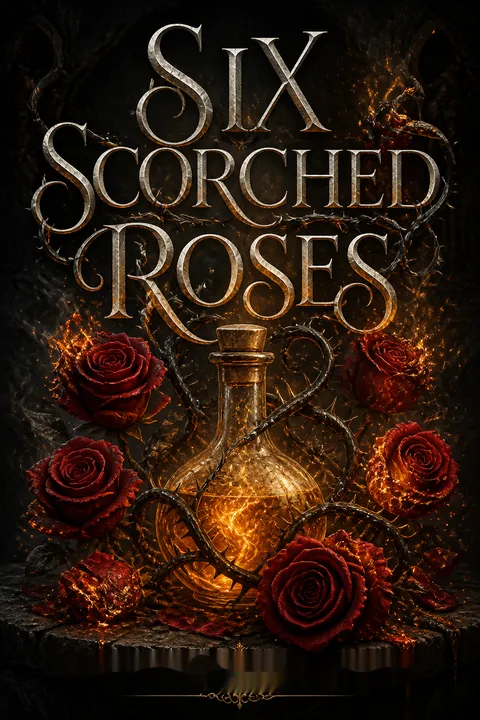


Plot Summary
Frost over Adcova
Lilith has spent her life expecting death: she was born frail, and her mother died giving birth to her younger sister, Mina. Years later, when the crops fail, Lilith's father curses Vitarus, the god of abundance and decay. A plague follows, consuming Adcova and leaving Lilith's father among its first victims.
At thirty, Lilith is a trained scientist, but her medicines have not stopped the disease from stripping skin into dust. Mina is now weakening in their home, and Lilith has no time to spare. She clips one of the black-and-red roses growing in the blighted fields, packs her instruments, and sets out for the mansion of Vale, a reclusive vampire whose blood she believes may offer a new path to treatment.
The opening makes Lilith's scientific drive inseparable from her intimate knowledge of mortality. Death is not a distant abstraction for her: it marks her birth, her mother's absence, her father's collapse, and the dust accumulating around Mina. Yet she does not respond by seeking comfort in faith. Her father's curse and the plague make divine power appear arbitrary, while her own experiments offer at least the possibility of a testable answer. The rose is already an unstable emblem: it is beautiful in a town where life has become difficult to sustain, and Lilith carries it toward a being associated with death because she is willing to examine what others fear.
Six Roses for Vale
Vale greets Lilith as an intruder in his crowded, dust-covered mansion, but her bluntness keeps the meeting from becoming a simple exchange of fear and power. She explains that Adcova's plague is spreading and asks for his blood, offering a rose at every monthly visit.
Vale initially refuses, insisting that he now acts only on his own wishes. The flower changes his attention: Lilith promises that six of them will prove special, and he accepts the arrangement.
She draws several vials from his arm, discovering blood that looks almost black and heals the puncture almost at once. Vale dismisses knowledge as insufficient by itself, valuing curiosity instead. Lilith leaves with the samples and a bargain that gives her both experimental material and a reason to return.
The bargain gives both characters a way to approach intimacy without naming it. Lilith translates need into a research transaction, while Vale accepts the roses as payment even though their significance is not yet visible to him. Their unequal lifespans and social positions matter, but each recognizes something familiar in the other's attention to detail. The blood draw is practical, even clinical, yet it also makes them physically attentive to one another. Vale's emphasis on curiosity quietly aligns with Lilith's way of living: she does not merely want facts as possessions; she wants to keep asking questions where accepted explanations have failed.
Blood Beneath the Lens
Lilith takes the sample to Farrow, a university scholar and former lover, hoping he can help her separate vampire blood's useful properties without relying on magic. Farrow recognizes the danger of her source and urges her to stop, but she leaves without revealing everything or accepting his offer to work together.
On her next visit, she finds Vale with another vampire, then collects his blood and presses him about his origins. He confirms that he is a Rishan of the House of Night, whose rival Hiaj clan has ruled since his side lost a war two centuries earlier.
Vale's mockery gives way to a cautious invitation to stay until morning, but Lilith declines. Back home, she finds Mina shaken by the disease and sweeps away the growing layer of shed skin.
This section places three different responses to attachment beside one another. Farrow offers collaboration and familiar tenderness, but Lilith distrusts the promise of a shared solution and withdraws before he can expect more from her. Vale's history gives his isolation a political cause: he is not simply eccentric or reclusive, but a defeated general who chose distance after losing the House he served. Lilith's curiosity lets her approach him without the reverence others might show a vampire, while his teasing tests whether she will retreat. At home, Mina's worsening body makes every emotional deferral costly. Lilith's work is an act of care, but it is also how she avoids the vulnerability of being present.
Wings in the Storm
After weeks of exhausting experiments, Lilith runs out of Vale's blood during a storm and sets off for his mansion before the agreed date. A band of starving men ambushes her on the forest road and takes her bag.
When their leader threatens her, a young robber named Filip shows visible hesitation, but Lilith cannot talk her way free. Vale arrives in a blur of silver-white wings and kills the attackers; Lilith is injured in the chaos and loses consciousness. She wakes in Vale's bed several days later.
Though she insists on returning home, he keeps her there until she can stand and arranges for a human errand boy to check on Mina. To occupy her, he reads vampire histories aloud, then lets her explore his collection of weapons and learn that he once served as a general.
The rescue changes the scale of Lilith's understanding without erasing the moral discomfort of what she sees. Vale's wings and violence confirm that the legends are not inventions, but the helplessness of the injured Filip complicates any clean division between monster and victim. Lilith's first response is not to deny Vale's brutality; she is disturbed by her own inability to intervene. In turn, Vale discovers that her composure has limits and that her body is far more vulnerable than her relentless work suggests. His protection of Mina, his reading, and his willingness to share his history turn the mansion from a laboratory site into a place of mutual attention.
A Cure Takes Shape
Once Lilith and Vale begin studying together, he translates books from his library while she tests ways to refine his blood. A letter from Obitraes asks Vale to return and help the Rishan regain power; he rejects the summons, unwilling to lead another war.
Lilith challenges his refusal by comparing it with the passivity she sees in people who keep praying while Adcova dies. He then offers his books, knowledge, and blood to her work. After recovering at his estate, Lilith returns home on his horse and they exchange increasingly frequent letters.
Vale eventually finds old experimental notes that solve a problem in her formulas. Her rats recover, and she produces a promising medicine. When Farrow warns that Adcova's priest, Thomassen, is mobilizing men against Vale, Lilith injects Mina and rides toward the estate with Farrow.
Lilith's argument with Vale forces both characters to confront the costs of refusal. He has treated withdrawal as a matter of principle, while she sees delay measured in the bodies of people who cannot wait for ideal circumstances. His decision to help is therefore not simply romantic generosity; it is a reconsideration of what loyalty requires after defeat. The letters preserve that collaboration across distance, making scientific exchange a form of sustained closeness. Meanwhile, Mina's illness and Thomassen's religious presence expose the peril of a cure built from forbidden material. Lilith's injection is hopeful but not conclusive: she acts before certainty is available because waiting for perfect proof would itself become a choice with consequences.
The Estate Runs Red
Lilith and Farrow reach Vale's estate to find bodies scattered across the grounds and Vale badly burned by daylight, his wings wounded. Thomassen and a few surviving followers are preparing to finish him, convinced that killing a vampire will appease Vitarus and end the plague.
Lilith steps between them and Vale, but when Thomassen raises his sword, she strikes him with the small axe she brought. Vale kills the remaining attackers, while Farrow helps Lilith drag him indoors.
Realizing that the death of a priest may draw divine attention, Lilith sends Farrow back to Adcova with the experimental medicine and stays behind. At Vale's instruction, she burns the bodies, finds his healing potions, and tends his wounds as he tells her he has decided to return to the House of Night.
The attack turns the town's fear into a concrete political and bodily threat. Thomassen's theory is attractive because it offers a target and a ritual solution, but it mistakes a vampire's presence for proof of divine causation. Lilith's first act of violence is especially significant: the scientist who has spent years measuring harm becomes a participant in it when no argument can protect Vale. At the same time, sending the medicine away separates her personal attachment from her public responsibility. She stays to care for Vale, but ensures the cure has a chance to reach Adcova. Their survival now carries a further danger, since the priest's death may make an indifferent god pay attention.
A Rose Between Them
After burning the attackers, Lilith treats Vale's wounds and learns that he plans to return to Obitraes, the homeland he once abandoned. He describes the House of Night as the great love he lost with the war, while Lilith admits that her own life has always been shortened by illness.
Vale accepts her limits without asking her to promise a future, and the two finally give in to the desire their visits and letters have been circling. In the morning, Lilith sees unnatural clouds gathering over Adcova.
She urges Vale to leave so his presence will not worsen the danger, then rides home alone. The cottage is empty; in the field, she finds Mina standing among the roses, strangely free of the dust that had marked her decline. Above her, Vitarus has appeared.
The intimacy between Lilith and Vale rests on a difficult form of consent: he does not ask her to deny her illness, and she does not pretend that desire can erase the time she believes she has left. For Lilith, being wanted without a demand for more is a sharp departure from her experience with Farrow and Mina, whose need she has often met through action rather than affection. Yet the night does not suspend consequence. Vitarus's arrival turns their private decision into a crisis for the whole town, and Mina's sudden strength makes the divine encounter more unsettling, not less. The roses bind the erotic, scientific, and religious strands together just as the cost of the bargain comes into view.
Soil, Roses, and Blood
Vitarus confronts Lilith over the slain acolyte and the town's connection to Nyaxia, the vampire goddess. When Lilith offers a bargain, he reveals that her father had made one with him years earlier, contradicting her belief that his anger alone brought the plague.
Lilith understands that the roses and her own prolonged life belong to the same divine exchange. She offers Vitarus soil, a flower, and herself in return for the abundance her father sought and the town's release.
Vitarus accepts, then draws the years of illness he had held back into Lilith's body. As she collapses, Vale returns with a rose and offers her the choice to live as a vampire. Lilith accepts his blood, and the human life that has defined her gives way to a dangerous transformation.
The revelation recasts Lilith's childhood without making her father's choice easier to forgive. What she understood as senseless divine punishment was also the consequence of a desperate bargain, one whose benefits and costs were distributed across his family and town. Vitarus's reasoning is neither compassionate nor conventionally moral; he treats suffering as part of an exchange and is drawn to Lilith's willingness to make one. Her offer of herself is an attempt to convert helplessness into agency, but it demands the very life she has spent trying to preserve for others. Vale's return introduces a different kind of choice: not a cure imposed on her, but a future she must consent to enter.
Life on the Other Side
Lilith wakes weeks later on the coast of Pikov, disoriented by heightened senses and sustained by Vale's blood. Vale confirms that he Turned her only after she chose life; he had returned because the roses revealed that she was god-touched and because he could not accept leaving her.
News from Adcova brings a second reprieve: Vitarus's anger has passed, no new plague cases are appearing, and Lilith's medicine is curing those already sick. Mina enters the room restored to health, and the sisters embrace without the old fear of an imminent goodbye.
After Mina returns to her own life, Vale asks Lilith to accompany him to the House of Night. She gives him the final rose she owes him, then accepts, ready to spend her new life exploring an unknown world beside him.
The resolution answers the story's opening fear of time without pretending that survival comes without grief or change. Lilith's transformation preserves her life, but it also separates her from the human body she has studied and distrusted since birth. Her consent matters because the narrative has repeatedly shown how little control she had over illness, divine action, or mortality. Mina's recovery provides the emotional counterweight: the sisters finally meet in a moment not organized around one of them leaving. The cure and the transformed roses link scientific labor to the divine bargain, while Vale's invitation offers Lilith a future defined not by the years she lacks, but by the questions she can still pursue.
Analysis
Six Scorched Roses makes mortality a practical problem before it makes it a romantic one. Lilith's body has taught her to count time, while the plague turns that private knowledge into a communal crisis. Her scientific method is not presented as coldness so much as a form of care she can reliably perform: she cannot always read Mina's needs or offer comfort in familiar ways, but she can test a compound, keep records, and keep working. The tragedy is that these skills do not exempt her from the emotional consequences of love. They sometimes help her avoid them.
Vale first appears as an object of study, but their connection develops through reciprocal attention. Lilith examines his blood; Vale learns to notice the labor and vulnerability behind her confidence. Their conversations about knowledge, war, and time turn a transactional arrangement into a relationship between two people who recognize each other's estrangement. Vale's history as a defeated general and Lilith's lifelong illness are different forms of loss, yet both have made them cautious about promising a future.
The novel also refuses a comforting account of divine justice. Vitarus governs both abundance and decay, but his power does not make him morally wise. The plague's origin in a bargain, rather than a simple act of divine spite, sharpens the story's concern with desperation and unintended costs. Human communities answer uncertainty with worship, blame, and violence; Lilith answers it with experiments and, finally, another bargain. Neither approach is free of risk.
The ending does not treat survival as a return to normal. Lilith's transformation demands that she accept a different body and a future she once thought impossible. The cure saves Adcova, but the deeper resolution is relational: Mina understands the love Lilith struggled to express, and Vale offers a life in which curiosity can continue. Time, once only a resource running out, becomes a landscape she can enter.
Review Summary
Six Scorched Roses is a highly praised novella set in the Crowns of Nyaxia world. Readers love the well-developed characters, Vale and Lilith, and their slow-burn romance. The story is praised for its beautiful writing, engaging plot, and strong world-building. Many reviewers note that despite its short length, the novella feels like a full-length novel. The book is often described as a Beauty and the Beast retelling with a unique twist. Readers appreciate the representation of a neurodivergent protagonist and the exploration of themes like sacrifice and love.
People Also Read





Characters
Lilith
The dying scientistLilith is a sharp, tireless scientist from Adcova whose lifelong illness has taught her to treat time as a scarce resource. She trusts observation, experiments, and precise facts more readily than prayer or social intuition. Her difficulty reading expressions and expressing affection can make her seem cold, but her work is often how she tries to protect the people she loves. She is especially devoted to her sister, Mina, and fiercely curious about Vale and the world he represents. Lilith's central tension is not a lack of feeling, but the conviction that feeling is useless unless it can be turned into action.
Vale
The exiled vampire generalVale is a Nightborn vampire of the Rishan clan, a formidable former general who has lived in seclusion far from his homeland. His mansion is crowded with books, art, and weapons, traces of a past he neither fully abandons nor readily discusses. He uses mockery and seductive teasing to keep others at a distance, yet Lilith's curiosity draws out his own appetite for knowledge and conversation. Vale's history has left him wary of leadership and loyalty, but he is not indifferent to people in danger. He is fascinated by Lilith's directness and by the way she studies him without reducing him to a monster.
Mina
Lilith's warm-hearted sisterMina is Lilith's younger sister, a lively and emotionally perceptive presence whose warmth contrasts with Lilith's reserve. As the plague weakens her, she still tries to draw her sister into shared moments and notices what Lilith attempts to hide. Mina is not merely a patient waiting to be saved; she has her own fears, judgments, and understanding of Lilith's habits. Her need for companionship exposes the cost of Lilith's belief that practical help can stand in for affection.
Farrow
The scholar who staysFarrow is a university scholar, Lilith's former lover, and one of the few people whose intellect and emotional openness she trusts. He responds to new discoveries with visible wonder, but his concern for Lilith can make him question the risks she takes. Farrow offers collaboration and closeness, while Lilith struggles to accept either without fearing that she cannot give enough in return. His commitment to her persists even when she makes choices he would not make himself.
Thomassen
Adcova's devoted priestThomassen is Adcova's head priest and a devoted servant of Vitarus. He once knew Lilith's father and has shown kindness to the sisters, which gives his religious authority a personal history in their household. As the plague devastates the town, his faith becomes bound to the need for an explanation and a remedy. He represents the way communal fear can harden belief into certainty, especially when people feel abandoned by the power they have worshipped.
Vitarus
God of abundance and decayVitarus governs both plenty and its opposite, embodying the unstable boundary between growth and ruin. He is a powerful figure in Adcova's religious life, but his attention is fickle and his view of human suffering differs sharply from the villagers' own. He regards mortals as one form of life among many, not as beings whose pain automatically deserves intervention. His presence makes divine power tangible while refusing the comfort of a predictable moral order.
Filip
A hesitant young robberFilip is a young, impoverished man among the robbers Lilith encounters on the forest road. He shows visible reluctance as the group's threats escalate, distinguishing his uncertainty from the older leader's aggression. His brief presence complicates Lilith's view of danger by revealing fear and conscience inside a situation where she has almost no power.
Plot Devices
Vale's blood
A forbidden medical sampleLilith's bargain for monthly blood samples gives her a material subject for experiments that have failed with ordinary medicines and religious remedies. She examines the blood through a magical scientific lens, then tries to distill its properties into a treatment that no longer resembles blood. Vale's samples make the cure possible, but their source also places Lilith at odds with the White Pantheon and exposes Vale to suspicion from Adcova's fearful residents. The device links scientific inquiry to bodily intimacy: Lilith studies Vale closely, while he gradually becomes a collaborator rather than a specimen. Its use turns curiosity into both a method of research and a bond between them.
The six roses
Payment and hidden evidenceLilith promises Vale one rose at each visit in exchange for his blood. The flowers are striking black and red, and Vale initially sees little beyond their appearance. Their refusal to wither gives them a significance neither character understands at first, tying the blighted fields to Lilith's unusual relationship with mortality and the gods. The roses also measure the development of the bargain: each flower recalls a visit, a blood draw, and the growing trust between Lilith and Vale. The final rose, already crumbling when she gives it to him, carries both the history of their exchange and the possibility of a life beyond the town.
The god's bargain
A price for divine changeBargaining provides Lilith a way to engage Vitarus when prayer, offerings, and appeals to compassion have failed. The god is interested in exchange and novelty rather than human fairness, so Lilith frames her request as a game with a price. His revelation that her father made an earlier bargain transforms her understanding of the plague and the roses. Lilith offers soil, a flower, and herself, accepting a personal cost in exchange for the town's release. The device echoes the original bargain while giving Lilith a choice her father made under different circumstances. It also makes divine intervention consequential rather than a simple rescue.
The vampire Turning
A chosen passage through deathTurning is the dangerous transformation in which a vampire drinks from a human and then gives the human vampire blood. Vale has earlier explained that most humans do not survive it, establishing the risk before Lilith faces the choice. After Vitarus restores the illness that had been held back from her, Lilith is close to death; Vale offers the possibility of continuing, and she chooses to drink. The process changes her body and allegiance, but its emotional meaning rests on consent rather than rescue imposed without her will. It resolves Lilith's lifelong expectation of an early death while opening a future that she must learn to inhabit.
The experimental cure
Science against the plagueLilith's research turns vampire blood into a sequence of testable preparations. Her early mixtures fail, but she studies their effects, consults Farrow, and later works with Vale's translated records until the formula succeeds with sick rats. The medicine remains uncertain when she gives it to Mina, yet it is the only treatment with evidence behind it. Farrow carries the vials away from the attack on Vale's estate, allowing the cure to reach Adcova while Lilith stays to help the wounded vampire. Its eventual success resolves the practical crisis the story begins with, while preserving the cost and risk of experimentation under pressure.
FAQ
Synopsis & Basic Details
What is Six Scorched Roses about?
- A scientist's desperate quest: Lilith, a brilliant but sickly scientist, seeks a cure for a devastating plague ravaging her town, Adcova, after her father's death and her sister's illness.
- An unlikely alliance: She forms a dangerous pact with Vale, a reclusive vampire, trading unique roses for his blood, believing it holds the key to a cure.
- A battle against time and prejudice: Lilith races against time, battling not only the plague but also the fear and prejudice of her town, as she delves deeper into the mysteries of vampire blood and her own mortality.
Why should I read Six Scorched Roses?
- Unique blend of genres: It combines elements of fantasy, romance, and science, creating a compelling narrative that explores themes of life, death, and sacrifice.
- Complex characters: The story features well-developed characters with compelling motivations, particularly Lilith, a strong female lead, and Vale, a morally gray vampire.
- Intriguing world-building: It introduces a rich world with its own mythology, including the White Pantheon and the vampire kingdoms of Obitraes, adding depth and intrigue to the story.
What is the background of Six Scorched Roses?
- A world with gods and vampires: The story is set in a world where gods directly influence human lives, and vampires, exiled by the White Pantheon, exist as a separate, powerful society.
- A town cursed by a god: Adcova, Lilith's hometown, is cursed by Vitarus, the god of abundance and famine, leading to a devastating plague and widespread suffering.
- Vampire society of Obitraes: The vampire world of Obitraes is divided into three houses: Night, Shadow, and Blood, each with its own unique characteristics and history, adding a layer of political intrigue.
What are the most memorable quotes in Six Scorched Roses?
- "Curiosity,": Vale's response when asked what the real treasure is, highlights a central theme of the story and his own character, emphasizing the importance of exploration and discovery.
- "Wanting something doesn't count for anything,": Lilith's statement to Vale reveals her pragmatic nature and her struggle to reconcile her desires with her responsibilities.
- "You are saving them,": Vale's words to Lilith, recognizing her efforts and shifting the focus from his blood to her actions, highlight her agency and impact.
What writing style, narrative choices, and literary techniques does Carissa Broadbent use?
- First-person perspective: The story is told from Lilith's point of view, allowing readers to deeply connect with her thoughts, feelings, and scientific observations.
- Detailed descriptions: Broadbent uses vivid and sensory language to describe the settings, characters, and the effects of the plague, immersing the reader in the world.
- Foreshadowing and symbolism: The author employs subtle foreshadowing and recurring symbols, such as the roses, to create a sense of mystery and anticipation, enhancing the story's depth.
Hidden Details & Subtle Connections
What are some minor details that add significant meaning?
- The state of Vale's mansion: The mansion's cluttered and inconsistent style reflects Vale's long life and his detachment from the human world, hinting at his past and his internal struggles.
- The description of the blood: The way Lilith describes Vale's blood as "beautiful" and "graceful" foreshadows her growing fascination with him and the vampire world.
- The recurring motif of dust: The presence of dust, especially around Mina, symbolizes the progression of the plague and the fragility of human life, emphasizing the urgency of Lilith's quest.
What are some subtle foreshadowing and callbacks?
- Lilith's early encounters with death: Her repeated mentions of meeting death foreshadow her eventual transformation into a vampire, blurring the lines between life and death.
- Vale's comment about "other things I wanted to do first": This line foreshadows his later romantic interest in Lilith, hinting at his hidden desires beyond their initial bargain.
- The mention of the Hiaj and Rishan clans: This detail foreshadows Vale's past as a general and the political turmoil in Obitraes, which becomes relevant later in the story.
What are some unexpected character connections?
- Lilith and her father's shared fate: The revelation that her father made a deal with Vitarus mirrors Lilith's own bargain, highlighting a pattern of desperation and sacrifice within her family.
- Farrow's unrequited love for Lilith: His deep concern for her safety and his willingness to help her, despite the danger, reveals a hidden depth to his character and his feelings.
- Thomassen's past kindness to Lilith: The revelation that he once defended her family adds a layer of complexity to his betrayal, highlighting the destructive power of fear and prejudice.
Who are the most significant supporting characters?
- Mina: Lilith's sister, whose illness drives Lilith's actions and whose eventual recovery symbolizes the success of Lilith's efforts, highlighting the importance of family.
- Farrow: Lilith's friend and confidant, who provides a human perspective and offers unwavering support, showcasing the value of loyalty and friendship.
- Thomassen: The head priest, whose actions as an antagonist highlight the dangers of blind faith and the destructive power of fear, adding a layer of conflict and tension.
Psychological, Emotional, & Relational Analysis
What are some unspoken motivations of the characters?
- Vale's desire for connection: Despite his reclusive nature, Vale is driven by a longing for connection and a desire to escape his past, which is why he is drawn to Lilith's unique perspective.
- Lilith's fear of vulnerability: Her scientific approach and her focus on logic are a way to protect herself from emotional pain, stemming from her early experiences with death and loss.
- Mina's desire for connection with Lilith: Mina's frustration with Lilith's workaholic tendencies stems from her desire for a deeper connection with her sister, highlighting her need for love and attention.
What psychological complexities do the characters exhibit?
- Lilith's struggle with mortality: Her lifelong awareness of her own mortality leads to a complex relationship with death, driving her scientific pursuits and her desire to control her fate.
- Vale's internal conflict: He grapples with his past as a general and his desire for a different life, torn between his loyalty to his people and his growing feelings for Lilith.
- Thomassen's fear-driven actions: His betrayal of Lilith and Vale is driven by his fear of the unknown and his desperate attempt to appease his god, highlighting the dangers of blind faith.
What are the major emotional turning points?
- Lilith's decision to offer herself to Vitarus: This act of sacrifice highlights her love for her sister and her willingness to give up her own life for the sake of others.
- Vale's decision to turn Lilith: This act of love and desperation marks a significant shift in their relationship, blurring the lines between life and death.
- Lilith's acceptance of her new vampire nature: Her decision to embrace her new life with Vale signifies her growth and her willingness to embrace the unknown.
How do relationship dynamics evolve?
- Lilith and Vale's initial bargain: Their relationship begins as a transactional agreement, but it evolves into a deep connection based on mutual respect, curiosity, and love.
- Lilith and Mina's sisterly bond: Their relationship is marked by love and frustration, but it ultimately strengthens as they learn to understand and accept each other's differences.
- Lilith and Farrow's friendship: Their friendship is tested by Farrow's unrequited love for Lilith, but it remains a source of support and loyalty, highlighting the complexities of human relationships.
Interpretation & Debate
Which parts of the story remain ambiguous or open-ended?
- The true nature of Vitarus: The god's motivations and his relationship with humans remain ambiguous, leaving the reader to question the nature of divine power and its impact on mortal lives.
- The future of Obitraes: The political landscape of the vampire world and the challenges that Vale and Lilith will face remain open-ended, hinting at future conflicts and adventures.
- The long-term effects of Lilith's transformation: The full extent of Lilith's new vampire nature and its impact on her personality and relationships are left open to interpretation, inviting speculation about her future.
What are some debatable, controversial scenes or moments in Six Scorched Roses?
- Lilith's decision to offer herself to Vitarus: Some readers may debate whether her sacrifice was necessary or if there were other ways to save her town, raising questions about the nature of selflessness.
- Vale's decision to turn Lilith: Some may question the morality of his decision, as it forces a significant change upon her, while others may see it as an act of love and desperation.
- The portrayal of the White Pantheon: The gods' cruelty and indifference may spark debate about the nature of faith and the role of religion in the story, challenging traditional views of divinity.
Six Scorched Roses Ending Explained: How It Ends & What It Means
- Lilith's transformation: Lilith's transformation into a vampire is a symbolic rebirth, representing her escape from the limitations of her human life and her embrace of a new, powerful existence.
- The end of the plague: The plague's end signifies the success of Lilith's scientific efforts and her ability to overcome seemingly insurmountable odds, highlighting the power of knowledge and determination.
- A new beginning for Lilith and Vale: Their departure for Obitraes marks the beginning of a new chapter in their lives, filled with both challenges and opportunities, emphasizing the importance of love and companionship in the face of adversity.
Crowns of Nyaxia Series


About the Author
Other books by Carissa Broadbent



Download PDF
Download EPUB
.epub digital book format is ideal for reading ebooks on phones, tablets, and e-readers.








