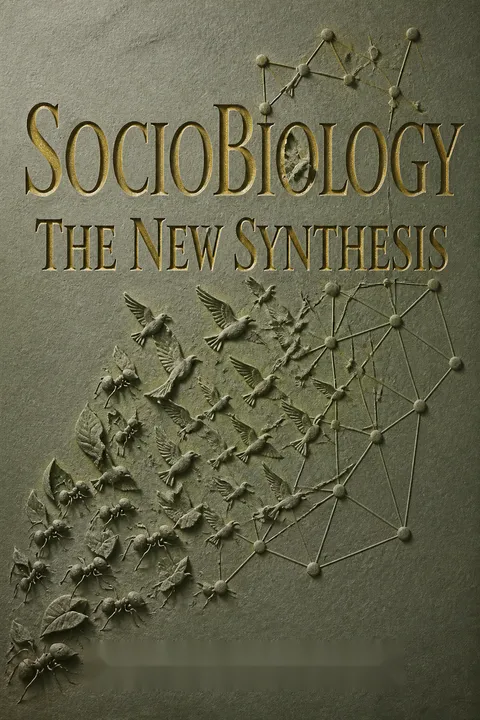


Key Takeaways
Explain social behavior by linking genes, populations, and ecology
A science of social behavior. Wilson defines sociobiology as the systematic study of the biological basis of social behavior. Its central move is to connect animal behavior with population biology, ecology, and evolution, then ask whether comparable principles apply from termites to primates. The book’s 27 chapters are overwhelmingly zoological; its discussion of humans occupies only 30 of 575 pages.
The human extension. Wilson’s later preface argues that biology and culture interact: inherited biases shape development, while culture shapes what people learn and do. The ambition is not to reduce society to genes, but to connect fields that had been kept apart. The controversy arose partly because some readers heard genetic destiny where the proposed model was interaction.
The book’s distinctive ambition is to make unlike systems comparable through shared questions about populations, behavior, and selection. That resembles systems science, which links levels without assuming a whole can be explained by one component alone. The guardrail matters: biological influence does not prove that a particular social arrangement is genetically fixed, inevitable, or morally justified. Wilson’s human chapter is a small part of the book, but it turns the synthesis into a bold argument about disciplinary boundaries.
Treat altruism as a genetic trade, not a moral paradox
Kin can make sacrifice pay. Kin selection is evolutionary change caused by effects on relatives who share genes through common descent. Hamilton’s concept of inclusive fitness adds an individual’s own reproduction to the effects of its actions on relatives, weighted by relatedness. A worker ant that gives up reproduction may still help shared genes spread by raising its sisters. In haplodiploid insects, sisters can share three-quarters of their genes, though this fact alone does not explain every origin of sociality.
Not all cooperation is kin-based. Reciprocal altruism is cooperation between individuals that can benefit both if help is returned. Wilson distinguishes these explanations from interdemic selection, in which differences between populations matter. That process is possible in theory, but it must overcome selection favoring selfish individuals within each population.
This framework separates the evolutionary consequences of an action from the actor’s feelings or intentions. That distinction connects naturally to game theory, which studies when cooperation persists despite incentives to defect. The kinship calculation is powerful, but its application depends on measurable costs, benefits, and relatedness, not a vague resemblance between behavior and sacrifice. Nor does an evolutionary explanation make an act less meaningful to the people involved.
Separate societies from populations before predicting social behavior
Two boundaries, two questions. Wilson defines a society by cooperation and communication among members, while a population is bounded by reduced gene flow. The boundaries often overlap, but need not. Yellow baboon troops can closely match local breeding populations; chimpanzee groups are more permeable, with members moving among subgroups.
Groups have emergent properties. An emergent property is a pattern of the whole that cannot be predicted simply by adding up isolated individuals. In rhesus monkeys, alliances change rank: a male’s position may depend on support from an alpha or from peers, not just on who wins pairwise contests. To explain a society, researchers must measure its relationships and population structure, not merely catalog individual behavior.
The distinction anticipates a central problem in network science: a boundary defined by communication may not match one defined by reproduction or resource use. Choosing the wrong unit can make a sound explanation look false. At the same time, boundaries are not always stable or sharp. Chimpanzee group membership, for instance, can shift with circumstance, so any model of social units must be tested against observed movement rather than imposed by definition.
Expect tiny behavioral shifts to reshape whole social systems
Behavior gets amplified. The multiplier effect describes how a small change in individual behavior can produce a much larger change in social organization. Closely related olive and hamadryas baboons differ in how persistently males control females. That difference helps organize troops in profoundly different ways, even though it might seem minor when watching a single pair.
Behavior can change with conditions. Behavioral scaling means that the form or intensity of behavior shifts with life stage, density, or environment. Snowy owls usually maintain vast ranges without overt territorial defense, but defend much smaller areas when crowded during lemming peaks. Wilson proposes that behavior often shifts before anatomy does, making it a possible evolutionary pacemaker.
A small change in individual rules can have nonlinear effects on a group, much as a minor shift in a network can change how information or resources move. That insight discourages explanations based solely on dramatic physical traits. Yet a behavior’s usefulness in a given setting does not prove it evolved for that purpose. The multiplier effect describes how consequences spread; it does not, by itself, identify the selection process that produced the original behavior.
Let ecology and evolutionary history limit social strategies
Pressure meets history. Phylogenetic inertia means that a species’ inherited traits and existing biological architecture constrain how readily it can change. Ecological pressure points evolution in a direction, but history shapes the available route. A new food source may favor cooperation, while a species without the relevant behavioral variation may not respond quickly.
There is no universal social ladder. Wilson uses r selection for strategies that exploit unstable habitats through rapid reproduction and dispersal, and K selection for success in stable, crowded environments through competition and efficient resource use. These pressures can favor different forms of social organization. They are tendencies rather than sealed categories: many species face both, and environmental conditions can shift which matters more.
This is a useful corrective to the idea that evolution steadily pushes species toward greater complexity. The same ecological problem can produce different strategies depending on a lineage’s history. The r and K labels make a broad contrast memorable, but real populations rarely fit neatly into two boxes. Their lasting value is as prompts to ask which conditions shape reproduction, competition, and dispersal in a specific case.
Track age, fertility, and mortality before explaining a society
Demography shapes behavior. Adaptive demography is the age, sex, and caste composition of a population when that composition directly affects its survival or reproduction. A social insect colony with too few soldiers may be destroyed; one with too few nurses may lose its larvae. In many vertebrate populations, by contrast, age structure can be an incidental result of individual survival and reproduction rather than a group-level adaptation.
Count future contributions too. Reproductive value is an individual’s expected contribution to future generations, which varies with age. A young adult ready to breed may matter more to population growth than an older, nonbreeding animal. Life tables, which record survival and fertility by age, let researchers connect behavior to population change instead of treating group size as a static fact.
Demographic measurement keeps social explanations grounded in consequences that can be counted. It also resembles public-health analysis, where age structure and rates of birth and death can reveal pressures hidden by a single population total. The important caution is that a stable age distribution does not mean a population is thriving: it may still be declining toward extinction. Structure is evidence to interpret, not proof of successful adaptation.
Treat division of labor as an evolved bargain, not progress
Specialists need coordination. A caste is a group of individuals limited to particular roles; polyethism is the division of behavior among categories such as castes or age groups. In many social insects, food, pheromones, or other environmental cues help determine a larva’s caste. In the ant Pheidole fallax, small workers find food and recruit nestmates with an odor trail; larger soldiers defend the food but cannot forage effectively alone.
The colony is the unit of design. Wilson’s ergonomic theory asks whether the mix of workers minimizes failures and maximizes colony reproduction. Sematectonic communication occurs when evidence of work already done guides further work. Termites, for example, can build complex nests without a supervisor or blueprint. Vertebrate societies also show roles, but their patterns are usually less fixed and more dependent on individual relationships.
The comparison with human organizations is tempting: specialists can outperform groups of generalists, but only when their work is coordinated. The insect examples make that principle vivid. They also warn against treating division of labor as progress in itself. A caste system can improve colony performance while imposing severe costs on individual members, and the claim that a particular arrangement is optimized requires evidence about alternatives and tradeoffs.
Read territories as resource contracts, not simply patches of land
Defense defines territory. A home range is an area an animal learns and uses; a territory is a part of that space occupied more or less exclusively through aggression or advertisement. Animals defend different resources: food, nest sites, shelter, or access to mates. Some defend fixed boundaries, while others defend only the place they currently occupy or use a scent or song as a warning.
Size reflects costs and rewards. A territory should be large enough to provide needed resources, but not so large that defending it wastes energy or increases danger. Male Uganda kob defend display sites rather than feeding grounds; song sparrow territories, by contrast, grow with the number of competing species. Territoriality can stabilize population density, but Wilson argues this is usually a by-product of individuals defending resources for themselves.
The resource-contract framing helps separate the observable fact of exclusion from the question of what is being defended. It also connects territorial behavior to economics: access has value only in relation to scarcity and the cost of enforcement. The same patch of land can serve different purposes for different species, so maps alone are insufficient. A convincing explanation must identify the resource and show that defense changes survival or reproduction.
Make evolutionary explanations compete in falsifiable tests
Plausible is not proven. Strong inference means proposing competing hypotheses, designing a test that distinguishes among them, and revising the explanation when evidence rules one out. Wilson argues that social behavior invites easy storytelling because many explanations can fit the same observation. A cicada aggregation, for example, might bring mates together, overwhelm predators with prey, or do both.
Field evidence matters. A model can show what is possible, but it cannot establish which conditions occur in nature. Wilson contrasts testable theory with advocacy, where a researcher gathers persuasive examples for a preferred account. Careful work can be demanding: Schaller spent 2,900 hours observing Serengeti lions, while researchers of courtship have analyzed thousands of feet of film. The method is slow, but it narrows speculation.
This methodological demand remains one of the book’s strongest contributions. It anticipates modern practices that distinguish hypothesis generation from hypothesis testing and that ask researchers to compare alternatives rather than defend a favorite story. Social behavior still poses a special difficulty: explanations can be compatible rather than mutually exclusive. Good tests therefore need to estimate relative importance, not merely demonstrate that one mechanism can occur.
Measure animal signals without mistaking information for language
Communication changes behavior. Wilson defines biological communication as an action that alters the probability of another organism’s behavior in an adaptive way. Animal signals can be graded, combined, or interpreted differently by context. Yet the display repertories of even highly social vertebrates generally contain only about 10 to 40 basic signals, and no clear example of humanlike syntax is established in the book.
The bee dance has limits. A returning honeybee signals the direction and distance of a food source through a dance. Wilson estimates that followers receive about four bits of directional information, enough to distinguish roughly 16 compass sectors. This is a sophisticated code, but its meanings and rules remain tightly constrained. Information theory measures uncertainty reduced by a signal, not the full richness of what it means to the animals.
Information theory offers a disciplined way to compare signals across species without relying only on human impressions. But bits measure the precision of transmission, not intelligence, intention, or semantic depth. A scent that changes physiology over hours and a call that triggers an instant retreat are also different kinds of communication. The book is strongest when it treats measurement as one tool, not as a translation of animal experience into human language.
Treat human nature as developmental bias, not a fixed script
Genes shape probabilities. Wilson calls epigenetic rules the inherited regularities of mental development that bias perception, learning, and response without dictating a single outcome. He points to predispositions in color perception, fear of ancient dangers, infant and partner bonding, and children’s language development. Culture and biology are interwoven: learning follows some paths more readily than others, while cultural change also alters the conditions under which biological evolution occurs.
Nature matters ethically too. Wilson argues that human psychology developed in natural environments long before cities and agriculture. His biophilia hypothesis proposes that some deep human responses to living systems reflect that history. He links this idea to the case for stabilizing population, securing decent living conditions, and preserving biodiversity, while acknowledging that the evidence for biophilia remains early and incomplete.
The developmental-bias model avoids both a blank-slate theory and a rigid genetic script. It also gives conservation a potentially powerful human dimension: wild nature may matter not only as a resource but as part of the setting in which human minds evolved. That possibility is worth investigating, but it cannot settle an ethical question by itself. A biological affinity for nature, even if demonstrated, would support rather than replace explicit arguments about what deserves protection.
Analysis
Sociobiology: The New Synthesis is simultaneously a vast zoological survey and a bid to reorganize the human sciences. Its most durable contribution is not a single claim about genes, but a way to connect levels of explanation: an individual’s behavior alters relationships, relationships shape population structure, and ecological conditions change which social arrangements persist. The insistence that a troop, colony, and breeding population have different boundaries is especially useful because many disputes about social evolution begin by assuming the wrong unit of analysis.
The book is strongest where it combines natural history with explicit models. Termite nest-building, baboon alliances, and territorial songbirds become more than anecdotes when tied to demography, communication, and competing explanations. Wilson also recognizes a central evidentiary problem: a behavior that appears useful may have several possible origins. His call for falsifiable alternatives is therefore more reliable than his occasional confidence about what a behavior must mean.
The human argument is both the book’s most consequential extension and its most vulnerable part. The interactionist account of biology and culture is more careful than the caricature of genetic determinism, but the 1999 preface sometimes treats critics as if political commitments explain their objections. Genetic influence on personality or intelligence does not establish that a specific social behavior is an adaptation, and neither evolutionary history nor prevalence makes a practice morally acceptable. Multilevel selection, kin selection, and individual selection are analytical tools whose relative importance must be established case by case.
The book’s picture of a ladder toward complexity is less persuasive than its account of divergent strategies. A socially elaborate insect colony, a fluid chimpanzee society, and a human institution solve different problems rather than occupy simple rungs on one scale. Read with that caution, the synthesis still offers a strong agenda: connect evolutionary causes to measurable mechanisms, preserve the difference between explanation and justification, and treat human culture as part of biology without reducing it to biology.
Review Summary
Sociobiology: The New Synthesis receives mostly positive reviews for its groundbreaking approach to studying animal and human behavior through an evolutionary lens. Readers praise Wilson's comprehensive analysis and encyclopedic knowledge, though some find it dense and dated. The book's application of sociobiological principles to humans sparked controversy, with critics arguing against genetic determinism. Despite criticisms, many acknowledge its significance in founding the field of sociobiology and influencing subsequent research in evolutionary psychology.
People Also Read







Glossary
Sociobiology
Biology of social behaviorWilson defines sociobiology as the systematic study of the biological basis of social behavior. It combines behavioral biology, population biology, ecology, and evolutionary theory to explain how social structures arise and function. The book applies this framework across animal groups, then asks how biological influences interact with culture in human societies.
Kin selection
Selection through genetic relativesEvolutionary change in a trait caused by its effects on relatives who share genes through common descent. An individual may reduce its own reproduction while helping relatives reproduce, allowing shared genes to increase. The advantage depends on the degree of relatedness and on the costs and benefits of the behavior.
Inclusive fitness
Direct and kin-based reproductionHamilton’s accounting of an individual’s own reproductive success plus the effects of its actions on relatives’ reproductive success, weighted by their relatedness. The concept explains how a costly act can still favor the genes associated with it. It is an evolutionary measure, not a conscious motive or a claim that organisms seek copies of their genes.
Phylogenetic inertia
Limits imposed by evolutionary historyThe way inherited traits, existing biological structures, and available genetic variation constrain the direction and speed of evolutionary change. Environmental pressure can favor a new social adaptation, but a lineage may lack the variation or developmental pathways needed to reach it quickly. Inertia limits change without making change impossible.
Behavioral scaling
Behavior shifts with conditionsVariation in the intensity or form of a behavior that correlates with factors such as population density, life-cycle stage, or environment. A species may move along a behavioral range, for example from little territorial defense to strong defense as crowding increases. The potentially adaptive trait is the range of responses, not one isolated point.
Adaptive demography
Fitness-relevant population structureThe distribution of ages, sexes, and castes when their proportions directly affect survival or reproduction. A social insect colony may be harmed by having too few soldiers or nurses. This differs from population structure that merely results from individual-level selection without itself contributing to the group’s fitness.
r selection
Selection for rapid population growthSelection favoring high intrinsic population growth, often in short-lived or fluctuating habitats where rapid reproduction and dispersal exploit temporary opportunities. The r refers to the rate of population increase. Wilson presents it as a contrast with K selection, while noting that real species can experience both pressures.
K selection
Selection near carrying capacitySelection favoring competitive success in relatively stable environments where populations live near carrying capacity, represented by K. It can favor efficient resource use, persistence, and competitive ability rather than rapid reproduction alone. Wilson’s distinction from r selection is a useful model, not a claim that species fall into only two fixed types.
Strong inference
Testing competing explanationsA research method that begins with alternative hypotheses, designs a test that distinguishes among them, carries out the test, and revises the explanation based on the results. Wilson contrasts this with advocacy, in which researchers marshal evidence for a preferred idea. It is especially valuable when several explanations fit the same social behavior.
Sematectonic communication
Signals in completed workCommunication through the physical results of work already done. A structure or modification can guide later behavior without direct signaling between the individuals involved. In social insects, completed nest architecture can influence where and how workers continue building; Wilson uses the term for this broader process.
Epigenetic rules
Inherited biases in developmentInherited regularities in mental development that bias how people perceive, classify, learn, and respond without dictating one fixed behavior. Wilson uses the term for the pathways through which genetic evolution influences cultural learning. Examples include predispositions in color perception, fear, bonding, and language development.
Reproductive value
Expected future contributionAn estimate of an individual’s expected contribution to future generations, which changes with age. A young adult approaching its first breeding opportunity may have greater reproductive value than an older, nonbreeding individual. The concept helps explain why mortality at different ages can have unequal effects on population growth and evolution.
Mass communication
Colony-level signaling effectA social-insect process in which many individual signals combine to regulate a colony-wide response. For example, the number of workers recruited to food can depend on the total amount of trail pheromone laid by successful foragers. The colony’s response reflects the summed activity of many members, not a message passed between only two individuals.
FAQ
What is Sociobiology: The New Synthesis by Edward O. Wilson about?
- Comprehensive study of social behavior: The book systematically explores the biological basis of social behavior across a wide range of species, from insects to humans, integrating genetics, ecology, ethology, and evolutionary biology.
- Introduction of sociobiology as a discipline: Wilson defines sociobiology as the systematic study of the biological basis of all social behavior, arguing that social traits are shaped by evolutionary forces just like physical traits.
- Focus on social insects and vertebrates: A significant portion details the social structures of ants, bees, wasps, termites, and vertebrates, drawing parallels and contrasts to human societies.
- Unification of disciplines: The work bridges biology, anthropology, and sociology, aiming to present a unified theory of social evolution and organization.
Why should I read Sociobiology: The New Synthesis by Edward O. Wilson?
- Foundational text in sociobiology: The book is considered a seminal work that established sociobiology as a scientific field, offering a thorough theoretical framework and extensive empirical data.
- Interdisciplinary insights: Wilson integrates concepts from genetics, ecology, ethology, and anthropology, making it valuable for readers interested in both biological and social sciences.
- Understanding human nature: The book extends its analysis to human societies, providing a biological perspective on human social structures, altruism, dominance, and cultural evolution.
- Guidance for future societies: Wilson discusses the implications of sociobiology for planning and understanding future human societies, emphasizing the importance of genetic and cultural evolution.
What are the key takeaways from Sociobiology: The New Synthesis by Edward O. Wilson?
- Biological roots of social behavior: Social behaviors, including altruism, dominance, and communication, have deep evolutionary and genetic foundations across species.
- Kin selection and inclusive fitness: Altruism is explained through kin selection theory, where genes promoting self-sacrifice can spread if they benefit related individuals.
- Complexity of social organization: The book details how division of labor, castes, and communication systems evolve to enhance group efficiency and survival.
- Human sociality as both biological and cultural: Wilson argues that human social behavior is shaped by both genetic predispositions and cultural learning, resulting in high behavioral plasticity.
What are the most important concepts and definitions introduced in Sociobiology: The New Synthesis by Edward O. Wilson?
- Sociobiology defined: The systematic study of the biological basis of all social behavior, integrating evolutionary biology, population genetics, and ecology.
- Society, sociality, and castes: Societies are groups of the same species organized cooperatively, with sociality measured by traits like group size, role differentiation, and information flow; castes are specialized roles, especially in insects.
- Altruism and kin selection: Altruism is behavior benefiting others at a cost to oneself, explained by kin selection and inclusive fitness.
- Communication and ritualization: Animal communication is analyzed through signal types, channels, and the process of ritualization, with information theory applied to measure signal efficiency.
How does Edward O. Wilson explain altruism and kin selection in Sociobiology: The New Synthesis?
- Gene-centered view: Organisms act as vehicles for genes, and altruistic behaviors can evolve if they increase the reproductive success of relatives sharing those genes.
- Kin selection theory: Altruism is favored when the genetic benefit to relatives outweighs the cost to the individual, formalized by Hamilton’s rule.
- Inclusive fitness: The concept includes both direct fitness (personal reproduction) and indirect fitness (helping relatives), providing a unifying explanation for self-sacrificial behaviors.
- Application to social insects: High genetic relatedness in haplodiploid insects like ants and bees facilitates the evolution of sterile worker castes and extreme altruism.
What is the role of communication and signaling in social behavior according to Sociobiology: The New Synthesis by Edward O. Wilson?
- Communication as social glue: Effective communication is essential for coordinating activities, maintaining hierarchies, and ensuring group cohesion in animal societies.
- Diverse communication modes: Wilson explores chemical, visual, auditory, tactile, and electrical signals, showing how species evolve specialized systems suited to their ecological needs.
- Ritualization and efficiency: Many signals evolve from functional behaviors through ritualization, becoming more stereotyped and efficient for social purposes.
- Information theory application: The book uses information theory to quantify the efficiency and complexity of animal communication, analyzing signal diversity and redundancy.
How does Sociobiology: The New Synthesis by Edward O. Wilson explain the evolution of social behavior in insects?
- Origin of insect sociality: Wilson traces the transition from solitary ancestors to complex eusocial societies, emphasizing the roles of genetic relatedness and ecological pressures.
- Caste differentiation and ergonomics: The evolution of distinct castes (workers, soldiers, queens) is explained as an adaptive division of labor, with colony efficiency driving caste evolution.
- Chemical communication: Pheromones are key mediators of social coordination, used for alarm, recruitment, and reproductive regulation in insect colonies.
- Multiple evolutionary routes: Eusociality in bees, ants, and termites has arisen independently through both parasocial and subsocial pathways, illustrating convergent evolution.
What are the main patterns of social evolution in vertebrates described by Edward O. Wilson in Sociobiology: The New Synthesis?
- Diversity of social systems: Vertebrates display a wide range of social organizations, from solitary living to complex group structures with dominance hierarchies and cooperative breeding.
- Ecological and evolutionary drivers: Factors like predation, resource distribution, and parental care shape the evolution of sociality in fish, amphibians, reptiles, birds, and mammals.
- Kin selection and cooperation: Helpers in bird and mammal societies often increase their inclusive fitness by aiding relatives, linking vertebrate sociality to sociobiological theory.
- Human uniqueness: Humans represent a pinnacle of social complexity, with language, culture, and flexible social structures distinguishing them from other vertebrates.
How does Edward O. Wilson address human social behavior and culture in Sociobiology: The New Synthesis?
- Biological basis of human behavior: Wilson argues that many human social behaviors, including kinship, altruism, and dominance, have evolutionary roots.
- Cultural evolution and plasticity: Human societies exhibit extreme variability and adaptability, with culture evolving alongside biology through learning, tradition, and socialization.
- Language and symbolic communication: The evolution of language is highlighted as a unique human trait, enabling complex social organization and cultural transmission.
- Ethics and morality: Wilson discusses human ethics and social conventions as products of both evolutionary and cultural processes, shaped by genetic predispositions and environmental influences.
What is the significance of dominance systems and aggression in animal societies according to Sociobiology: The New Synthesis by Edward O. Wilson?
- Dominance hierarchies: Social organizations where individuals have ranked status regulate access to resources and mating opportunities, reducing conflict and stabilizing groups.
- Aggression as a social tool: Aggression is analyzed for its proximate causes (hormonal, neurological) and ultimate evolutionary functions, often being ritualized to minimize injury.
- Hormonal regulation: Hormones like testosterone and adrenal corticoids modulate aggressive behavior, with dominance often correlating with physiological changes.
- Adaptive value and constraints: Dominance systems and aggression have adaptive value but are limited by ecological and evolutionary constraints, varying across species.
How does Sociobiology: The New Synthesis by Edward O. Wilson explain the evolution of mating systems and sexual selection?
- Diversity of mating systems: Wilson categorizes systems such as monogamy, polygyny, and lekking, explaining how ecological and social factors influence their evolution.
- Sexual selection mechanisms: Intrasexual competition and intersexual choice drive the evolution of sexual dimorphism and mating behaviors, including courtship displays and mate guarding.
- Parental investment theory: The parent investing more in offspring (usually females) influences mating systems, sexual conflict, and the evolution of secondary sexual characteristics.
- Human sexual behavior: The book extends sexual selection theory to humans, discussing the interplay of biological and cultural influences on mating patterns and parental care.
What are the best quotes from Sociobiology: The New Synthesis by Edward O. Wilson and what do they mean?
- On social evolution: “The insect societies are the most complex and highly organized animal societies known, and their study is essential to understanding social evolution.” This underscores the importance of social insects as models for sociobiology.
- On altruism: “Altruism is a behavior that benefits another individual at a cost to oneself, and its evolution is best explained by kin selection.” This encapsulates the genetic basis of self-sacrificial behavior.
- On communication: “Communication is the foundation of social organization, enabling individuals to coordinate and cooperate.” This highlights the central role of signaling in maintaining social systems.
- On human nature: “Human social behavior is deeply rooted in biology, yet profoundly shaped by culture and learning.” This reflects Wilson’s integrative approach to understanding human sociobiology.
About the Author




Download PDF
Download EPUB
.epub digital book format is ideal for reading ebooks on phones, tablets, and e-readers.








