

Key Takeaways
Make farming an act of repair, not a campaign to control nature
A revelation became a farm. At twenty-five, Masanobu Fukuoka left plant pathology after a near-fatal illness and an experience that changed how he saw the natural world. He returned to his family’s farm to test that view in practice. His aim was not simply to grow food, but to show that farming could work with nature rather than repeatedly correcting it. On his Japanese farm, he eventually grew rice without plowing or keeping the fields flooded, and the soil improved over time. After twenty-five years, he reported yields comparable to or higher than leading farms in Japan, with far less machinery and chemical input.
The experiment was practical. Fukuoka’s central proposal is that food production and ecological restoration belong together. The measure of success is not only the harvest, but whether the land becomes more fertile and life-supporting.
The book’s strongest move is to treat a farm as a relationship, not a production line. That shift changes the question from how to maximize output this season to what conditions allow soil, crops, and other organisms to keep functioning together. It also makes Fukuoka’s farm a valuable demonstration rather than proof that one method fits every landscape. His reported yields matter, but they do not settle questions about labor, climate, or crop reliability elsewhere. The transferable insight is the test he proposes: judge farming by both what it harvests and what it leaves capable of growing.
Do less only after rebuilding the systems that can do the work
Neglect is not natural farming. When Fukuoka first inherited his family’s orchard, he stopped pruning its citrus trees, hoping they would return to a natural form. Diseases followed, and more than two hundred trees died. The failure taught him that doing nothing on damaged land is not the same as restoring its natural processes. He then began introducing plants suited to particular jobs, including deep-rooted vegetables to loosen soil and clover and vetch to cover and enrich it.
Work can decline as a system recovers. In the early years, Fukuoka had to intervene. As vegetation, soil fertility, and ecological balance developed, many tasks became unnecessary. His version of “do-nothing farming” means removing avoidable work, especially work created by earlier interventions, not abandoning responsibility for the land.
This distinction keeps the book’s appealing simplicity from becoming a slogan. In restoration, there is often a transitional period when people must repair conditions that prevent natural processes from operating. The practical question is whether each intervention builds future capacity or creates permanent dependence on more intervention. Fukuoka’s orchard offers a useful standard: pruning, fertilizing, or controlling pests should not be treated as automatically necessary or automatically wrong. Their value depends on what the land can sustain without them. Less work is an outcome of restored function, not a substitute for understanding what is broken.
Build fertility with living roots, cover, and layered diversity
Plants can do soil work. Instead of relying on repeated tillage, fertilizer, or buried organic matter, Fukuoka used plants with different rooting patterns and growing seasons. Deep-rooted species helped open compacted ground. White clover formed a low cover that suppressed weeds and enriched the surface, while winter-growing vetch continued the work when clover grew less strongly. Acacia trees contributed roots and biomass deeper in the soil; when cut, their roots remained to decay.
The farm became multi-layered. His orchard developed into a mix of tall trees, fruit trees, shrubs, vines, vegetables, ground cover, and animals. In the rice fields, he broadcast seed directly and used straw and clover to manage weeds, rather than plowing and transplanting seedlings. The principle is to keep soil covered and let diverse roots, residues, and organisms contribute to fertility.
This is the book’s most concrete ecological insight: fertility is not merely a nutrient supply, but a process maintained by living systems. Different roots reach different soil layers, while continuous cover reduces exposure and returns organic material. Diversity can also spread risk, since a mixed planting is less dependent on a single crop thriving under every condition. Yet complexity is not a magic ingredient. Species must suit the place, and dense mixtures can compete or make harvesting difficult. Fukuoka’s approach is best read as an invitation to observe how plants interact locally, not as a universal planting recipe.
Sow a desert with ecological partners, not a single miracle tree
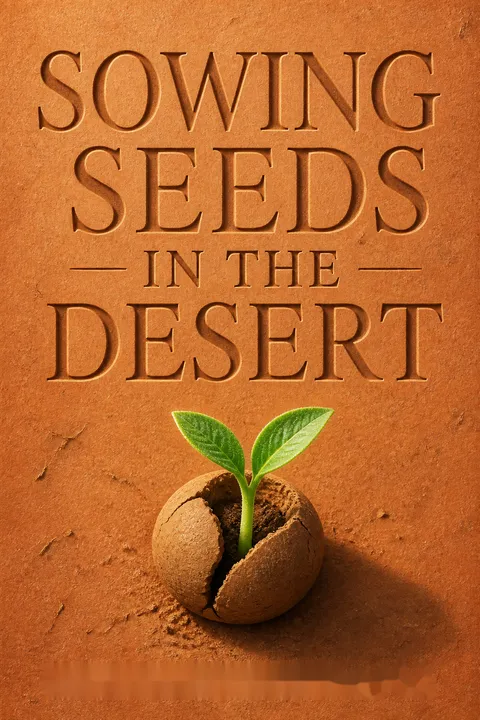
Revegetation needs a community. Fukuoka proposed sowing many kinds of seeds together, including trees, grasses, legumes, vegetables, and soil microorganisms. He called this large-scale restoration plan the “Second Genesis”: rather than trying to recreate a lost landscape exactly, give nature a broad range of possibilities and let plants suited to present conditions survive. He recommended enclosing seeds in clay pellets, which protect them from animals and help retain moisture as they wait for rain.
Failure is part of the proposal. Fukuoka expected many seeds to die, with some hardy plants surviving and creating shade and cover for others. He described aerial seeding and experiments in India, Africa, and elsewhere, but his large-scale plan had not been proven across deserts. He also argued for mixing species from different regions, a bold proposal whose ecological risks require serious scrutiny.
The strength of this proposal is its refusal to reduce a damaged landscape to a tree-planting target. Soil organisms, ground cover, shrubs, and trees can support one another, and a mixed starting point can reveal which species fit conditions that planners may not fully understand. The risk is that indiscriminate mixing can introduce invasive species, pests, or pathogens, especially when seeds cross ecological boundaries. Fukuoka’s criticism of rigid restoration recipes is valuable, but broad experimentation needs safeguards and monitoring. The soundest version of his principle is diversity within an informed ecological context, not the assumption that every seed belongs everywhere.
Use plants to guide water before engineering new water supply
Restore the landscape’s water cycle. Fukuoka argued that desert restoration should begin with vegetation, not dams, canals, or large irrigation schemes. He proposed “plant-based irrigation,” in which riverbank vegetation and belts of trees help retain water, cool soil, and extend green cover away from waterways. Roots can draw on underground moisture, while fallen leaves and other organic matter gradually improve the soil’s capacity to hold water.
He warned about engineered fixes. Irrigated desert farms can lose water to evaporation, leaving salts behind and sometimes shifting pollution elsewhere. The book describes farms abandoned after salinization, as well as concern that dams can submerge forests and displace communities. Fukuoka’s preferred sequence is to restore vegetation and soil so water can circulate through a living landscape, rather than treating water as a resource to pump and distribute in isolation.
The broader systems lesson is persuasive: water, soil, vegetation, and livelihoods cannot be managed as unrelated departments. A project that delivers irrigation while degrading soil or displacing residents may solve one accounting problem by creating another. Vegetation can reduce heat and help retain moisture, but it cannot manufacture rainfall on demand, and planting alone will not repair every arid region. The practical value of Fukuoka’s proposal is to ask what maintains water locally before building infrastructure. That question does not rule out dams or irrigation; it demands that their full ecological and social costs be counted.
Judge agriculture by net energy and soil, not yields alone
A larger harvest can hide a loss. Fukuoka compared the energy used to grow grain with the food energy harvested. He reported that in the United States, about fifty years before his account, one unit of energy invested produced roughly two units of rice or barley. Later, the balance reached parity, and he said that two units invested produced only one unit of grain. He argued that machinery, chemical production, and fossil fuel use can make apparent agricultural productivity depend on consuming more resources than the food provides.
The same accounting challenges animal production. Fukuoka criticized feedlots that depend on large amounts of transported grain and fish farms that, as he described them, used around ten pounds of small fish to produce one pound of high-value seafood. His point is that output figures alone can conceal the energy and ecological costs of producing food.
This is a useful accounting challenge because harvest weight is not the same as net contribution. A system can produce more food per acre while drawing heavily on fuel, mined materials, water, or soil fertility. Energy ratios make those dependencies visible and connect food policy to infrastructure and resource use. However, the figures in the book are historical claims, and a single energy ratio cannot capture nutrition, labor, land quality, or the value of reliable yields. The larger lesson survives those limits: assess agricultural performance across the whole production chain, not only at the point of harvest.
Food security begins with local control of seeds and livelihoods
Cash crops can displace food systems. Fukuoka recounts hearing that colonial policies in parts of Africa encouraged crops such as coffee, cotton, and sugarcane while restricting the production of food for local use. He also describes how boundaries and protected areas disrupted nomadic grazing patterns. In his account, communities lost not only access to land, but the ability to sustain themselves through established local practices.
Seeds can restore agency. At an Ethiopian refugee settlement, Fukuoka handed seeds to children, who planted small patches of vegetables in the sand. Women and older residents joined after seeing the seedlings grow. He took this as evidence that local people could participate directly in food production when they had seeds and room to act. His proposal links ecological restoration with self-sufficiency, rather than treating hungry communities as passive recipients of imported technology.
This section makes food security a question of power as well as supply. A community may have fertile potential and capable growers yet remain vulnerable if it cannot choose crops, retain seeds, or access land. The children’s gardens show how quickly people can engage when the materials and opportunity are present. Still, seed distribution alone cannot repair land tenure, conflict, poverty, or political restrictions. Fukuoka’s account is strongest when it insists that aid should strengthen local capacity rather than replace it. Restoration plans are more durable when the people who depend on the land help decide what is restored.
Read pests and weeds as feedback, not automatic enemies
Damage can reveal imbalance. Fukuoka observed insects and diseased leaves on his farm, yet estimated that crop losses stayed below five percent. He interpreted some losses as part of the food available to insects and birds, and as a way weaker plants were thinned. He rejected the automatic division of organisms into useful and harmful, arguing that their roles depend on the wider living system.
Look beneath the obvious cause. When pine trees in Japan began dying, forestry officials blamed nematodes carried by beetles and used aerial spraying. Fukuoka’s own investigation led him to suspect that changes in soil fungi and the decline of matsutake, a fungus associated with pine roots, came earlier in the process. He acknowledged that his research was limited. The example supports a method of inquiry: investigate relationships before treating the most visible organism as the root cause.
The ecological value of this perspective is that it replaces blame with diagnosis. A pest outbreak may be a symptom of stressed plants, simplified habitats, or disrupted relationships, so killing the visible organism can leave the underlying conditions untouched. But the pine investigation is Fukuoka’s hypothesis, not conclusive proof that his proposed chain of causes was correct. That uncertainty strengthens rather than weakens the lesson: ecological problems often have interacting causes, and interventions should be tested for side effects. Integrated management can still control serious crop losses while asking what conditions made them likely.
Use science as a tool, not a claim to own nature
Analysis can mistake parts for the whole. Fukuoka’s philosophical argument is that people divide nature into objects, categories, and measurable causes, then confuse those useful descriptions with complete understanding. He illustrated this with “the cave of the intellect,” a picture of people digging deeper while trying to explain the world through analysis. His warning is that added knowledge can also produce more interventions and unintended consequences.
Practice remains his test. Fukuoka challenged conventional scientific agriculture, but he also observed fields, tried different plants, and changed methods after failures, including the loss of his citrus trees. His argument is not easy to reduce to a rejection of all practical knowledge. He asks farmers to remain alert to what the land actually does, rather than assuming that a theory or technique gives them full command of it.
The distinction between a map and a territory is valuable here: measurement can answer narrow questions without capturing every relationship that sustains a landscape. Fukuoka’s insistence on humility helps counter the confidence that complex systems can be fully controlled. Yet scientific methods are also essential for detecting hazards, comparing outcomes, and correcting appealing but mistaken theories. His own observations gain force when treated as testable hypotheses, not as a substitute for evidence. A productive balance is to use science rigorously while resisting the idea that measurement grants ownership or total understanding.
Analysis
Sowing Seeds in the Desert moves between memoir, farming manual, environmental critique, and spiritual argument. Its narrative anchor is Fukuoka’s attempt to make a worldview tangible: after a revelation in young adulthood, he spends decades testing how little a farmer can do while still restoring fertility and producing food. That lived experiment gives the book its force. The account of a neglected orchard that lost hundreds of trees is especially important because it prevents “natural” from meaning simply unmanaged. The method begins with repair, observation, and patience, then aims to reduce inputs as the land regains function.
The book’s most durable contributions are practical questions rather than universal prescriptions. Does a farm build soil while feeding people? Does its apparent productivity depend on consuming fossil energy and soil reserves? Are water, vegetation, and community being considered together? These questions remain useful even for readers who reject Fukuoka’s dismissal of scientific knowledge. His argument that human classification can conceal interdependence is compelling, but his alternative evolutionary account and some of his causal claims are not established by the observations he offers. The reader should distinguish the ethical insight, that knowledge is incomplete, from the stronger claim that scientific analysis is inherently unable to understand nature.
The desert-restoration vision is similarly inspiring and risky. Clay pellets and mixed planting offer an imaginative way to establish vegetation across difficult terrain, but the proposal to distribute species globally overlooks the possibility that introduced organisms could become harmful. Restoration should be locally informed, monitored, and shaped with the people who use the land. Fukuoka’s emphasis on local seeds and self-reliance points in that direction, even when his broadest proposals do not.
The book is best read as a challenge to agricultural habits of thought, not as a complete technical blueprint. Its lasting test is whether a farming practice makes the next season less dependent on the inputs and corrections required by the last.
Review Summary
Sowing Seeds in the Desert receives mostly positive reviews for its philosophical approach to natural farming and environmental restoration. Readers appreciate Fukuoka's insights on working with nature, though some find his ideas idealistic. The book combines personal experiences, travels, and reflections on sustainable agriculture. While some readers hoped for more practical advice, many found the book thought-provoking and inspiring. Critics note the anecdotal nature of evidence and rejection of scientific research, but overall, the book is praised for challenging conventional farming methods and promoting a holistic view of nature.
People Also Read





Glossary
Natural farming
Farming with natural processesFukuoka’s approach to agriculture, developed on his family farm, avoids plowing, synthetic chemicals, prepared compost, and many routine interventions. It uses practices such as direct seeding, straw cover, and mixed plantings to support soil fertility and ecological relationships. The aim is to produce food while allowing the farm’s living systems to recover and perform more of the work.
do-nothing farming
Avoiding unnecessary farm workFukuoka’s shorthand for reducing interventions that are unnecessary or that create further problems. It does not mean abandoning damaged land. His early failure to care for citrus trees showed that restoration may require deliberate work at first. As soil, vegetation, and ecological balance improve, some tasks can become unnecessary.
Second Genesis
Broad-scale ecological reseedingFukuoka’s proposed approach to severely damaged landscapes, especially deserts. It calls for sowing a wide range of plant seeds and soil microorganisms so that species suited to current conditions can establish themselves. Rather than recreating a former ecosystem exactly, the proposal gives nature many possibilities for developing a new balance. Fukuoka advocated using clay pellets to protect seeds.
plant-based irrigation
Vegetation moving and retaining waterFukuoka’s term for using trees and other plants to help water move through and remain in a landscape. Vegetation along rivers and in greenbelts can shade soil, support soil formation, and draw on underground moisture. The method contrasts with relying mainly on pumps, concrete canals, and large irrigation networks to deliver water to fields.
clay seed pellet
Clay coating that protects seedsA small ball of clay containing seeds, and sometimes microorganisms or other materials, intended to protect its contents until conditions permit germination. Fukuoka used pellets for direct seeding and proposed them for aerial revegetation. The clay can help shield seeds from animals and insects and retain moisture. The book’s appendix describes adding binding materials and herbs for large-scale use.
Dharma Wheel Theory of Flux in All Things
Evolution as expansion and contractionFukuoka’s proposed alternative image of biological development. Rather than viewing evolution only as a linear sequence of organisms competing and branching over time, he describes nature as a unified whole that expands and contracts in many dimensions. The theory reflects his philosophical view that living forms are fundamentally connected, but the book does not establish it as a scientific alternative to evolutionary biology.
money-sucking octopus economy
Wealth drawn toward central powerFukuoka’s metaphor for an economy in which political and commercial centers draw resources and money away from local communities. Its many “legs” represent systems such as transportation, communications, finance, education, and information control. He argues that this structure can weaken local farmers and economies while concentrating wealth and authority at the center.
mu
Awareness before separationA Japanese term Fukuoka uses for an empty or non-discriminating state of awareness, before the mind separates an observing self from the world it observes. In his philosophy, mu points toward direct experience of nature without imposing categories such as subject and object. The book uses the concept spiritually and philosophically, not as a technical farming method.
Download PDF
Download EPUB
.epub digital book format is ideal for reading ebooks on phones, tablets, and e-readers.








