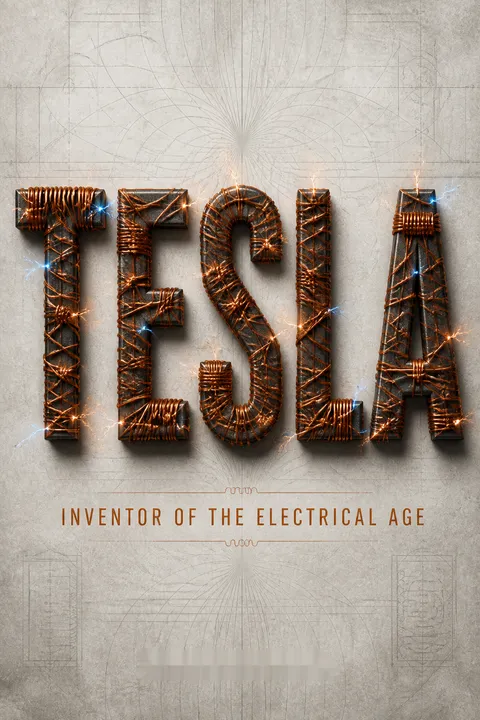


Key Takeaways
Understand invention as a negotiation with nature and society
A rise with two sides. In 1894, reporter Arthur Brisbane found Tesla dining at Delmonico’s, celebrated as America’s foremost electrician. Only ten years earlier, Tesla had arrived in New York nearly penniless. His AC motor helped transform electric power, yet his later wireless-power ambitions stalled, and his reputation fell with them. The biography argues that neither rise nor decline can be explained by genius alone.
Two negotiations matter. To invent, Tesla had to discover what nature would permit, then persuade people that a device was useful. His motor had to work through electromagnetic principles, but it also needed patents, investors, manufacturers, and customers. The book follows both tracks, showing how invention joins experimental work to social and commercial persuasion.
What's striking is how this approach avoids the familiar habit of treating success as proof of genius and failure as proof of madness. An invention is not finished when its principle is understood. It must survive engineering, finance, regulation, and public interpretation. That wider lens is useful well beyond electrical history: it helps explain why technically sound ideas can languish, while imperfect prototypes sometimes attract powerful support. The framework does not make every outcome predictable, but it makes the conditions around invention visible, which is a more credible account than either hero worship or hindsight-based dismissal.
Train imagination to find principles, then test what it builds
A mind that rehearsed machines. As a child, Tesla saw sparks leap from his hand while stroking the family cat, Macak. He later described vivid mental images that could intrude on ordinary perception. By practicing self-control, he learned to direct that imagination, first into imagined journeys and then into devices. He called this mental simulation mental engineering: working out a machine in the mind before building it.
The motor began as an ideal. At school, Tesla watched a DC motor’s commutator spark and imagined a motor without one. He eventually conceived a rotating magnetic field that could induce currents in a rotor. Yet his first physical motor in Strasbourg needed an iron core where he had used brass. The idea was powerful; the material still had a vote.
The account connects creative insight to disciplined simulation rather than treating invention as a lightning bolt. Mental rehearsal can help a designer explore possibilities cheaply, but it also risks making an imagined machine feel more complete than it is. Tesla’s brass-core mistake gives the distinction a physical edge: a mental model can clarify a principle while hiding material behavior. The strongest version of his method therefore combines internal visualization with external tests. Imagination expands the design space; experiments determine which imagined paths nature actually allows.
Let technical elegance meet the infrastructure people already use
A brilliant motor, an awkward system. Tesla’s early polyphase motors used multiple alternating currents to create the rotating magnetic field. His first arrangements needed four or six wires between generator and motor, while electrical companies were building simpler two-wire systems. The machines expressed the principle he valued, but installing them could require replacing existing equipment and wiring.
Practicality changed the design. Tesla’s backer Alfred Brown pressed him to develop motors that could run on single-phase circuits. Tesla devised split-phase versions, using different circuit properties to create currents out of phase. He was less enthusiastic about these designs than the elegant polyphase system, and delayed patenting them. Westinghouse engineers later adapted Tesla’s ideas for production, including by changing materials and motor construction. A sound invention still needs a route into the systems already in place.
This is a vivid case of the difference between a component and a platform. A motor can be technically effective yet commercially inconvenient if it demands new generators, wiring, and operating standards. Innovation research often calls attention to network effects: the value of a device depends partly on what else is compatible with it. Tesla’s preference for conceptual symmetry was a creative advantage, but it could make existing infrastructure look like an obstacle to remove rather than a resource to use. Brown’s pressure helped translate elegance into adoption.
Make an invention legible before asking anyone to fund it
A spinning tin can was not enough. When Tesla demonstrated a small motor to Alfred Brown, the result did not yet communicate its industrial value. Tesla instead built the Egg of Columbus apparatus: a rotating magnetic field made a copper-plated egg stand and spin without being touched. The familiar story of Columbus balancing an egg gave the demonstration a memorable frame, and Brown and Charles Peck agreed to support the motor.
Promotion had a method. Their strategy was to patent the invention, attract expert endorsement, demonstrate it, publish technical accounts, and then sell or license the rights. Tesla’s 1888 lecture to the American Institute of Electrical Engineers helped make his motor credible to manufacturers. In the book’s vocabulary, an illusion is not necessarily a lie. It is a persuasive picture of what an untested invention might make possible.
The egg worked as a boundary object: a simple demonstration that engineers could analyze and non-specialists could remember. That is a powerful lesson in communication. A prototype does not explain itself, so inventors need representations that connect unfamiliar mechanisms to shared expectations. But the same narrative tool can become dangerous when the promised future outruns the tested device. Good promotion makes a possibility understandable; it should not substitute for measurements of reliability, cost, and performance.
Credit the network behind technological triumphs, not just the celebrated inventor
Niagara was a collective achievement. Tesla had imagined polyphase power, but he did not design the complete Niagara Falls system. He helped persuade Edward Dean Adams, the project’s key decision-maker, that alternating current could transmit power to Buffalo. Westinghouse engineers, especially Benjamin Lamme and Charles Scott, improved the motors and equipment. General Electric built part of the transmission line, and construction required years of work.
The system made the principle consequential. The 1893 Chicago World’s Fair gave Westinghouse a public demonstration of an integrated AC network. Niagara began sending power to Buffalo in 1896. Tesla’s contribution was substantial: he helped establish the principle and influence the choice. Yet the power station’s success depended on financiers, engineers, manufacturers, and infrastructure working together.
The story complicates the lone-inventor model without diminishing Tesla’s role. Major technologies often emerge from networks in which one person contributes a governing idea, another improves the machinery, and others organize capital and deployment. This is close to how modern systems engineering treats complex projects: performance belongs to the arrangement, not just its most famous component. Historical credit remains difficult because the public sees a finished system, while the work that made it viable is distributed across firms and teams.
Do not mistake a promising signal for proof of a global system
Tesla chose a different wireless path. Marconi focused on sending telegraph messages through the air. Tesla explored circuits that used grounding and high-frequency current, and he hoped to transmit power through the Earth. In Colorado Springs, he studied lightning signals and concluded that electromagnetic disturbances could form stationary waves, patterns created when waves traveling in opposite directions reinforce one another. He believed such waves might carry energy over enormous distances.
A clue became a grand claim. Tesla recorded signals at a distance and photographed lamps powered near his transmitter. The book also describes a later proposal that some beeps he heard may have come from Jupiter’s moon Io, rather than intelligent life. These observations were intriguing, but they did not establish that Wardenclyffe could send usable power around the globe. A phenomenon, a working demonstration, and a commercial system are different achievements.
This section shows why technological history should not be told as a simple race toward radio. The same discovery can lead inventors toward distinct goals, shaped by their interests and assumptions. Tesla’s focus on power was genuinely imaginative, but ambition can cause a local effect to be mistaken for evidence of a scalable system. A useful discipline is to label claims by level: observed signal, repeatable apparatus, reliable service, and economical network. Each level demands stronger evidence than the one before it.
Design experiments to disprove your favorite theory, not merely confirm it
Colorado offered reasons to test harder. Tesla’s sensitive instruments detected lightning-related signals and he reported measurements at distances up to about a mile. But he did not arrange systematic, independent distance tests that would show where transmission failed. He often inferred long-range performance from short-range observations and calculations. Photographs of spectacular electrical discharges documented the apparatus, but some images used multiple exposures and did not prove long-distance transmission.
Wardenclyffe raised the stakes. Tesla built a laboratory and a 187-foot wooden tower, with a deep well and pipes intended to connect his transmitter to the Earth. He pictured the planet as a medium that could carry electrical pulses with little loss. The biography argues that the Earth behaves more like a lossy medium than the ideal reservoir Tesla imagined. Without tests designed to challenge his model, he could not settle that central question before money and confidence ran out.
Tesla’s case makes confirmation bias concrete: evidence that fits a cherished model feels decisive, while missing evidence can be treated as a temporary obstacle. The scientific method’s value lies not only in collecting supportive observations but in constructing tests where rival explanations make different predictions. Independent witnesses, calibrated instruments, and declared failure thresholds would have strengthened Tesla’s case whether it succeeded or not. This is not a demand that inventors suppress boldness. It is a way to keep boldness answerable to the world.
Pair visionary inventors with partners who can turn prototypes into products
Tesla had the right partner for his motor. Charles Peck and Alfred Brown funded his laboratory and helped him navigate patents, technical endorsements, and negotiations with Westinghouse. Peck understood both invention and business promotion. After Peck died in 1890, Tesla’s later supporters were less involved in day-to-day development. Edward Dean Adams could arrange finance, and J. P. Morgan advanced $150,000 for a 51 percent interest in wireless patents, but neither became the close technical and commercial partner Tesla needed.
The relationship changed the project. Morgan declined further advances in 1903, amid both Tesla’s lack of demonstrated results and speculative activity in the wireless industry. Tesla struggled to attract replacement investors because new backers would have had to share control and value with Morgan. The problem was not simply a shortage of money. It was a deal structure and partnership that made the next investment unattractive.
The contrast between Peck and Morgan illustrates that capital alone is not mentorship. A useful partner challenges assumptions, helps choose what to finish, and understands how technical uncertainty affects commercial risk. In startup language, this is the difference between funding a vision and building an organization capable of learning. The relationship also has limits: a practical adviser can ground an inventor, but too much pressure for immediate returns can crowd out radical research. Productive partnerships protect exploration while demanding clear tests and milestones.
A beautiful mechanism still loses when materials and markets refuse to cooperate
The turbine kept the pattern alive. After Wardenclyffe failed, Tesla pursued a bladeless turbine. Instead of blades, closely spaced disks were meant to gain motion from a fluid’s viscosity and adhesion. A prototype weighing under ten pounds produced 30 horsepower, but at speeds near 35,000 revolutions per minute its disks stretched out of shape. Larger models delivered impressive power, yet material stress remained a serious obstacle.
A good principle is not a finished product. Turbine manufacturers focused on established blade designs, while automobile and aviation firms pursued piston engines. Tesla’s device sat between industries, without a committed market or a material solution. His work still generated useful ideas, including pump designs, but it did not become the transformative engine he expected. The same tension runs through his career: identify a powerful principle, then build the engineering and commercial bridge that lets others use it.
The turbine is a fitting final example because it separates conceptual originality from product readiness. A striking prototype can establish that a mechanism produces motion, but not that it can survive long use, be manufactured economically, or fit buyers’ needs. That gap is where materials science and market strategy meet. Tesla’s history encourages ambition, but it also shows why development work is not merely cleanup after the creative act. It is the work that determines whether an idea becomes infrastructure.
Analysis
Carlson’s central achievement is to replace the legend of an all-purpose genius with a history of invention as a coupled process. Tesla’s mind supplied unusual power: he could simulate machines, identify principles, and pursue designs that reversed prevailing assumptions. Yet the book shows that invention also depended on workshops, patents, investment, manufacturing, professional credibility, and public storytelling. His AC motor became consequential because the ideal of the rotating magnetic field was joined to practical designs, experienced backers, and Westinghouse’s engineering organization. The same inventor’s strengths became liabilities when the wireless-power project lacked equivalent checks and collaborators.
The book’s terms ideal and illusion are most useful when kept distinct. An ideal is the underlying principle Tesla sought to embody. An illusion is the cultural image that helped others imagine what the invention might do. Together they explain both his persuasive demonstrations and his vulnerability to overconfidence. Yet the language can romanticize the gap between an inventor’s belief and a technology’s actual performance. The account corrects for this by attending to records, patents, witnesses, and the limits of Tesla’s experiments. Its strongest lesson is not that imagination needs to be restrained, but that imagination needs institutions and tests capable of correcting it.
The narrative also challenges winner-centered histories. Tesla’s influence on AC and radio was real, but neither technology belonged to him alone. The Niagara system required a broad industrial network, and radio emerged through many contributors pursuing different applications. That distinction matters: inventors may originate principles without controlling the systems that make those principles useful. Tesla’s career therefore offers neither a simple triumph of genius nor a cautionary tale against dreaming. It shows that disruptive ideas need translation, and that translation is technical, commercial, and social work. His lasting significance lies in both what he helped build and in how clearly his unfinished ambitions reveal the conditions that invention must satisfy.
Review Summary
Tesla: Inventor of the Electrical Age receives mixed reviews averaging 3.87/5 stars. Readers praise Carlson's thorough research, neutral approach, and detailed technical explanations of Tesla's inventions, particularly his AC motor work. The biography effectively demystifies Tesla, showing him as a brilliant but flawed engineer who lacked business acumen. However, many readers find the book excessively dense and technical, with extensive engineering details that overwhelm the personal narrative. Non-technical readers struggled with the scientific jargon, while those with engineering backgrounds appreciated the comprehensive treatment. Most agree it's the definitive Tesla biography for serious scholars, though lacking accessibility for general audiences.
People Also Read


Glossary
ideal
underlying inventive principleIn Carlson’s account, an ideal is the basic principle an inventor tries to identify in a natural phenomenon and embody in a device. Tesla’s ideal for the AC motor was the rotating magnetic field. An ideal can guide design before a practical machine exists, but it still has to be tested against materials, engineering constraints, and social use.
illusion
persuasive image of possibilityCarlson uses illusion to mean the story, demonstration, or public image that helps other people imagine what an untested invention could accomplish. It need not be a deliberate deception. Tesla used striking demonstrations and cultural metaphors to make unfamiliar technology compelling. The concept also marks a danger: a persuasive picture can get ahead of evidence about performance or feasibility.
mental engineering
mental simulation of machinesMental engineering is Tesla’s practice of imagining a machine in detail, mentally operating it, and revising its parts before constructing it. Carlson connects this ability to Tesla’s unusually vivid visual imagination and his method of refining designs internally. It could help generate and improve ideas, but physical experiments remained necessary because imagined operation could miss real material constraints.
subjective rationality
reasoning from internal ideasJoseph Schumpeter’s term for reasoning guided by an internal idea or ideal, rather than by information drawn primarily from the external market. Carlson applies it to Tesla, who often tried to reshape technical systems and social expectations around principles he considered compelling. It contrasts with objective rationality, in which decisions respond more directly to observed needs and conditions.
polyphase
multiple phase-shifted AC currentsPolyphase describes an alternating-current system using two or more currents that reach their peaks at different times, or phases. Tesla used these currents to create a rotating magnetic field in an AC motor. Polyphase systems enabled efficient power transmission and became important to electrical networks, though early designs could require more wires and new equipment than existing systems.
telautomatics
remote control of machinesTesla’s term for the field of controlling mechanical devices from a distance through transmitted signals. His radio-controlled boat used electromagnetic signals to operate its propeller, rudder, lights, and other mechanisms. Tesla imagined that such machines could transform warfare by removing people from direct combat. The term reflects his interest in combining wireless communication with automated action.
stationary waves
standing pattern from opposing wavesStationary waves form when waves of the same frequency travel in opposite directions and reinforce one another in a stable pattern. Tesla interpreted recurring signals from lightning storms as evidence that such waves existed in the Earth and could support long-distance transmission. Carlson treats the observations as significant while distinguishing them from proof that Tesla’s proposed global power system would work.
magnifying transmitter
resonant high-voltage transmitterTesla’s magnifying transmitter was a large resonant electrical system built from coils, capacitors, and a high-voltage source. It was designed to amplify electrical effects and send currents into the ground through an elevated terminal and a deep earth connection. Tesla used versions in Colorado Springs and planned a larger installation at Wardenclyffe to transmit messages and power.
patent-promote-sell
patent, publicize, then sellThe business strategy Tesla used with his early AC motor, guided by Charles Peck and Alfred Brown. They protected inventions through patents, promoted them with demonstrations, expert endorsements, lectures, and press coverage, then sought to sell or license the rights to established manufacturers or investors. This approach avoided the cost of building a manufacturing business but depended on credibility and persuasive negotiation.
Logos
divine order within thingsIn the Orthodox Christian tradition discussed by Carlson, Logos refers to the ordering principle through which the universe is understood as a coherent whole. Each thing has an inner principle that can be discerned. Carlson suggests that Tesla’s religious upbringing may have shaped his search for fundamental principles behind inventions, even though Tesla did not appear to practice his faith regularly as an adult.
Download PDF
Download EPUB
.epub digital book format is ideal for reading ebooks on phones, tablets, and e-readers.








