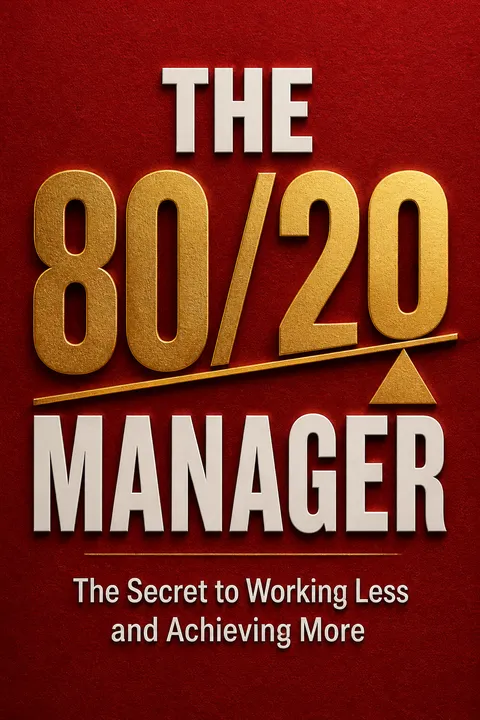


Key Takeaways
Stop treating every task as equal: a few inputs drive most results
Work is uneven by nature. The 80/20 Principle describes a recurring pattern: a small share of causes often produces most of the results. The ratio is a rule of observation, not a promise that every situation divides into exactly 80 and 20. The practical point is that effort and value are rarely distributed evenly. Koch argues that managers lose time when they assume every task, customer, product, or decision matters equally.
Look for the outliers. Apple illustrated the approach when Steve Jobs cut most of its product lines after returning to a struggling company, then concentrated on a few products and features customers valued. The manager's job is to identify high-value inputs, strengthen them, and stop feeding activities that create little return.
The principle is useful because it challenges the comforting assumption that equal attention is fair or efficient. In complex systems, outcomes often cluster around a few influential inputs, so averages can conceal the real mechanisms of success. The caution is that an observed imbalance does not automatically identify its cause. A product may appear weak because it supports a more profitable one, and a task may create value that shows up only later. The strongest use of 80/20 thinking is therefore investigative: find the skew, then test what produces it before cutting.
Find the customers and products paying for everything else
Measure true contribution. When Richard Koch and his associates took over Filofax, they found that just 4 percent of its product lines generated 93 percent of revenue, while most of the rest lost money. A small group of retailers also accounted for 91 percent of sales. Listening to those retailers revealed that Filofax had priced itself too far above a new competitor. The market had not disappeared; Filofax had lost share.
Separate winners from drains. The owners cut prices, simplified the product range, and reduced costs. Sales volumes quadrupled within three years, and the investors earned seven times their money. The lesson is to examine customer-level costs, acquisition expenses, discounts, and service demands, rather than trusting averages or assuming every sale is profitable.
This approach resembles activity-based costing: instead of spreading overhead evenly, it asks which customers and products actually consume resources and generate returns. It can expose cross-subsidies that conventional accounts hide. But the data need careful interpretation. A low-margin customer may create referrals, stabilize demand, or help a product reach scale, while abruptly withdrawing service can damage reputation. The useful question is not simply who is profitable today, but which relationships create durable value and what changes could improve the economics without sacrificing strategic assets.
Build weak ties beyond your usual circle
Fresh information travels outward. Sociologist Mark Granovetter's research on job searches found that people often learned about opportunities through acquaintances rather than close friends. Close contacts tend to know much of the same information; distant contacts connect different social worlds. Koch calls these casual, low-maintenance relationships weak links.
A small contact changed a company. When Koch and colleagues launched their consulting firm LEK, they had no major clients. A drink with Nicholas Walt, a former colleague Koch barely knew, led to a chance to pitch a large conglomerate. LEK was chosen after the initial favorite lost the client's confidence. That contract helped the young firm gain momentum. The practical habit is to revive old connections, meet people outside one's department, and introduce useful contacts to one another without treating every conversation as a transaction.
Weak ties function like bridges between information networks. Their value is not that acquaintances are more loyal than close friends, but that they are more likely to carry unfamiliar knowledge across social boundaries. This helps explain why diverse professional networks can improve opportunity discovery and innovation. Still, networking can become performative if contacts are collected solely for advantage. Trust grows through reciprocity and genuine curiosity, not a ledger of favors. A useful test is whether a connection would still be worth having if it never produced a job lead or business deal.
Give people attention, honesty, and room to do their best work
Small acts can unlock effort. Consultant Matthew Kelly described factory productivity gains that vanished after a project team left. The technical improvements had helped, but the outside team had also listened to workers and managers. When headquarters stopped visiting and asking questions, engagement faded. On returning, the consultants involved employees in solving problems and arranged mentoring and collaboration across plants. The argument is that people often contribute more when someone takes their work seriously.
Care needs standards. A mentoring manager offers timely encouragement, shares mistakes as well as successes, and helps people develop strengths. A liberating manager gives capable employees room to act, while expecting candor and high performance. This is not hands-off neglect: it combines support with clear responsibility, and it works best in organizations where trust and honest feedback are possible.
Attention is a management resource with unusually high leverage because it can improve both competence and motivation. The idea connects with psychological safety, the shared sense that people can raise concerns without humiliation, and with coaching practices that make feedback specific and actionable. Yet warmth alone cannot repair poor systems, inadequate staffing, or unsafe conditions. Nor does autonomy suit every task or every worker equally. Effective managers pair discretion with explicit goals, regular feedback, and fair consequences, so care is experienced as investment rather than favoritism.
Multiply your impact with levers instead of more effort
Find force multipliers. Koch identifies seven managerial levers: caring, confidence, ideas, decisions, trust, people, and money. Each can make a limited input travel further. Caring keeps attention on a problem long enough for unexpected connections to emerge. Ideas can be borrowed from another industry and adapted. Trust reduces the supervision required, while strong colleagues can take on work that would otherwise bottleneck with the manager.
Spend effort where it compounds. The book argues that managers should make fewer routine decisions, delegate them to capable people, and reserve attention for consequential choices. It also encourages backing ambitious projects with company resources when the case is sound. Leverage is not simply doing less; it is choosing a position, tool, or team that converts the same effort into substantially more useful output.
The lever metaphor shifts attention from personal productivity to system design. In physics, a lever changes the relationship between force and effect; in organizations, delegation, reusable ideas, and clear decision rights can do something similar. This also explains why a manager's best contribution may be designing conditions rather than personally completing tasks. Leverage can amplify mistakes as easily as good judgment, however. Trust requires competence and accountability, and capital magnifies downside risk. The wise sequence is to test an idea at manageable scale, learn from it, then increase commitment when evidence supports expansion.
Choose work where your unusual strengths solve valuable problems
Meaning comes from contribution. Koch draws on Viktor Frankl's view that meaning grows through worthwhile achievement, not through chasing happiness directly. In work, this means finding activities that use distinctive abilities to meet real needs. He recommends looking for rare knowledge, compatible colleagues, an organization with room for initiative, and a business that is growing rather than merely coasting.
Make the fit deliberate. Koch suggests treating a career as something its owner must shape, not a plan delegated to a boss or human resources department. He offers a rough screen for a strong business: annual sales growth above 10 percent and return on capital employed above 20 percent. These are his practical guideposts, not universal laws. Experimenting across roles can reveal strengths that a static job description would never expose.
This view links meaning to person-environment fit: people often feel more engaged when their abilities, values, and daily tasks align. It also treats career development as discovery rather than a rigid ladder, which leaves room for changing interests and learning. The limitation is that not everyone can freely choose an ideal employer or leave a poor one; financial obligations and labor-market conditions constrain mobility. Even within those limits, small changes in task mix, mentors, or responsibility can improve fit. Meaning is not a luxury reserved for founders; it can grow through useful work in imperfect settings.
Protect thinking time by doing one high-impact task first
Busyness is not output. Researcher Henry Mintzberg observed managers being interrupted repeatedly and spending about nine minutes on an issue before moving on. Koch argues that this pattern rewards visible activity over considered judgment. In a separate Boston Consulting Group experiment described in the book, teams required to take predictable time away from email and work reported better job satisfaction, learning, and communication; their clients also rated the work more highly than clients of teams following normal routines.
Start with the day's real result. Before opening email or attending to routine requests, identify one important task that could justify the day's work and complete it first. Then batch administrative work, screen interruptions, and gradually reduce working hours. The goal is not to schedule every minute, but to reclaim enough uninterrupted space to think and act on consequential work.
The argument anticipates modern research on attention: frequent task switching imposes cognitive costs, and uninterrupted periods can support deeper reasoning. A protected priority also makes trade-offs visible instead of letting the inbox dictate them. Still, a single daily priority cannot substitute for responsiveness in roles involving emergencies, care, or interdependent operations. The principle works best when teams agree on coverage and escalation rules. Otherwise, one person's focus can simply transfer hidden costs to colleagues. Time autonomy is a design problem as much as an individual discipline.
Make the core so simple customers can recognize and choose it
Complexity quietly accumulates. Managers add products, meetings, reports, and exceptions because each seems reasonable on its own. Together, they blur what the organization does best. Ford chief Alan Mulally reduced the company's sprawling collection of brands and models, arguing that simplification made a substantial difference. Apple took a similar product approach by making core features easier to use and removing distractions.
Distill before you communicate. A strong simplification identifies the central customer need, the few capabilities that meet it best, and everything that can be removed without weakening the offer. Koch points to a Scottish executive who diagnosed a struggling brokerage business as suffering from profitless growth: new product lines had disrupted its profitable core. Removing them helped restore performance. Simplifying is not pretending every problem is simple; it is choosing the important problems where reduction clarifies action.
Simplicity lowers the effort required to understand, buy, and use a product. It can also make organizations easier to coordinate because fewer priorities compete for attention. In design, this is a form of constraint: removing options can improve usability when the essential function is clear. But simplicity can become destructive if it erases accessibility, resilience, or meaningful customer choice. A short strategy is valuable only when it preserves the complexity that truly matters. The discipline is not to remove everything, but to distinguish useful complexity from the kind that survives only through habit.
Be lazy about low-value work, relentless about the result
Laziness can be strategic. Koch's term does not mean apathy or sloppiness. It describes intelligent managers who resist chores that others accept automatically, so they can spend more attention on distinctive, high-impact work. Bruce Henderson, founder of Boston Consulting Group, quickly moved away from routine consulting and focused on recruiting exceptional thinkers and developing influential ideas. Bill Bain likewise built a firm around deep relationships with a relatively small number of major clients instead of chasing every possible assignment.
Earn the right to do less. This approach depends on judgment, ambition, and the ability to delegate or redesign work. It also requires a role with discretion; someone whose work is tightly regulated cannot simply ignore essential procedures. The test is whether a task can be eliminated, simplified, or handled by someone better suited to it without lowering quality or unfairly shifting the burden.
Strategic laziness resembles the economic idea of opportunity cost: time spent on one task is time unavailable for another. It can protect attention from low-value activity and create space for ideas that routine execution would crowd out. The concept is also easy to misuse. Senior people may label work beneath them while transferring tedious tasks to less powerful colleagues. Ethical delegation requires fair workloads, recognition, and development opportunities. The relevant distinction is not between working and avoiding work, but between effort that creates value and effort that persists because nobody has questioned it.
Reinvent the industry's economics, not just its products
Strategy changes the rules of value creation. Strategic managers do more than improve existing offerings. They find a different way to serve customers, organize talent, or earn revenue that can lower costs, raise value, or ideally do both. Egon Zehnder reshaped executive search by recruiting highly capable, collaborative consultants, sharing profits across offices, and charging clients a fixed fee rather than taking a percentage of a placed executive's salary. The model aligned incentives differently from industry convention.
A breakthrough needs execution. Koch's examples, from Southwest Airlines to Google, pair a distinctive insight with a business model that customers value and economics that work. A clever idea alone is not enough. The manager needs evidence of a real customer need, a meaningful advantage over current options, and the determination to organize people and resources around the change.
This is a strategy-as-system view: advantage often comes from the fit among customers, incentives, operations, and talent, not from a single feature. A rival can copy a product more easily than it can reproduce a coherent operating model and culture. The emphasis on dramatic change usefully challenges incrementalism, but novelty is not proof of advantage. A model must survive customer adoption, competition, and changing conditions. Small experiments can reduce uncertainty before a company commits at scale. Strategic ambition is most credible when paired with an economic mechanism that explains how the promised value will actually be delivered.
Analysis
The book's central move is to replace a workload mindset with a distribution mindset. Rather than asking how to process every demand, the manager asks which small number of decisions, customers, products, relationships, or capabilities produce disproportionate value. This reframes productivity as selection, not speed, and management as designing leverage rather than demonstrating effort. The narrative examples make the argument memorable: Filofax was not rescued by generalized hustle, but by diagnosing an unusually profitable product core and correcting an avoidable pricing error. The weak-link story shows the same pattern in careers, where a seemingly minor relationship opens access to an opportunity unavailable within a familiar circle.
The book is strongest when it turns an abstract statistical pattern into practical questions: Which customers are truly profitable? What work deserves an uninterrupted morning? Which employee needs a few minutes of guidance? It also broadens managerial success beyond profit, tying it to autonomy, meaningful work, and the development of other people. That combination keeps efficiency from becoming mere extraction.
Its main risk is treating a useful empirical tendency as if it were an all-purpose law. The 80/20 ratio varies, and an activity that looks unproductive in isolation may support learning, resilience, or future demand. A manager who cuts based on short-term accounting can weaken the system that generates long-term value. Similarly, advice to work less assumes discretion and organizational power that many workers do not possess. The book acknowledges this unevenness, but its most ambitious claims still lean toward individual agency over structural constraint.
A careful application therefore needs two checks. First, measure results at the right time horizon and include indirect effects, not just immediate profit. Second, ask who bears the cost when a manager removes work or delegates it. Properly used, the Principle is a method for discovering leverage and freeing capacity. Poorly used, it is a slogan for concentrating rewards while exporting toil. Its humane promise depends on making the people who contribute to high-value outcomes beneficiaries of the resulting efficiency.
Review Summary
The 80/20 Manager receives mixed reviews, with an average rating of 3.75/5. Readers appreciate its core message of strategic time management but criticize its redundancy and lack of practical applications for some industries. Many find the 80/20 principle valuable, though some struggle to relate to the executive-level focus. Positive reviews highlight life-changing insights, while critical reviews suggest the book could benefit from its own principles by being more concise. Some readers recommend focusing on the summary for key takeaways.
People Also Read










Glossary
80/20 Principle
Unequal cause and effectAn observed pattern in which a relatively small share of causes, inputs, or activities accounts for a disproportionately large share of results. The familiar 80 to 20 ratio is a benchmark, not a fixed law. Koch applies the idea to managerial choices, asking people to identify the few customers, products, decisions, and actions that matter most.
80/20 manager
Results-focused managerA manager who applies the 80/20 Principle to work and leadership. Rather than treating activity as proof of value, this manager concentrates on high-impact outcomes, simplifies low-value work, uses leverage, and gives capable people room to contribute. The aim is to achieve unusually strong results without equating long hours with effectiveness.
sixteenfold improvement
Large performance gapKoch's illustration of the productivity gap implied by an exact 80/20 distribution. If 20 percent of workers produce 80 percent of output, the average person in that group produces sixteen times as much as the average person in the remaining 80 percent. The number is approximate and depends on the actual distribution, but it encourages managers to look for large gains rather than settle for marginal improvements.
weak links
Distant social connectionsCasual or infrequent relationships that connect a person to social circles and information beyond those of close friends and colleagues. Sociologist Mark Granovetter's work showed how such ties can provide new job information because they are less likely to duplicate what an individual's close network already knows. Koch encourages managers to maintain these connections and help contacts meet one another.
Superconnector
Bridge between networksA person with many diverse relationships who actively connects people from different social or professional circles. In Koch's account, superconnectors help information and opportunities travel across otherwise separate groups. Their value comes not merely from knowing many people, but from using those connections to introduce people who may be able to help one another.
core resources
Durable sources of advantageThe limited set of capabilities and assets that make a company distinct and help it create value. Drawing on David Collis and Cynthia Montgomery, Koch says a resource should be difficult to copy, slow to lose value, controlled by the company, resistant to substitution, and superior to comparable resources held by rivals. A firm may possess only a few resources that meet all these tests.
Theory X and Theory Y
Control versus trust assumptionsDouglas McGregor's framework describing contrasting assumptions about people at work. Theory X assumes employees need close supervision and external incentives to perform. Theory Y assumes people can be motivated by curiosity, collaboration, responsibility, and the use of their abilities. Koch applies the distinction to argue that creative work benefits from trust and autonomy, alongside demanding standards.
Small World Problem
How networks connect peopleA research question examined by Stanley Milgram and colleagues: how many social connections are needed to link people who do not know one another? In Milgram's folder experiments, some chains reached a distant target through a small number of intermediaries. The results suggested that networks can connect distant people through short paths, often relying heavily on a few highly connected individuals.
About the Author
Other books by Richard Koch


Download PDF
Download EPUB
.epub digital book format is ideal for reading ebooks on phones, tablets, and e-readers.








