

Plot Summary
Florence's Last Afternoon
Thirty-year-old Tom Cook1 has spent two weeks traveling in search of direction, but his final day in Florence finds him as lost as when he left home. At work, his father’s3 expectations have pushed him into mergers and acquisitions, where he feels stalled; his girlfriend6 has also left him, judging his prospects dim.
As Tom1 sits alone in a plaza, an elderly, brisk-moving stranger2 notices his sadness and draws him back to Michelangelo’s4 David. The stranger2 explains that several artists failed to see what an old block of marble might become before Michelangelo4 shaped it.
Tom1 begins to consider the comparison: other people’s judgments may describe his current circumstances, not his capacity. For the first time, his disappointment has an alternative explanation.
The opening gives Tom’s crisis a social shape. His career, romantic rejection, and parents’ doubts all reinforce one verdict: that his current performance is his permanent worth. The statue offers a counterimage, but the book makes the crucial move through Tom’s attention rather than through a miraculous change in his circumstances. He has to look again, and more closely, before the marble’s potential becomes legible. The old man’s teaching therefore begins as a challenge to Tom’s habit of accepting other people’s assessments as facts. The scene is persuasive as a fable, though it treats inner potential as something already present and waiting, rather than something shaped by circumstance.
The Father's Chosen Road
The old man2 connects Tom’s1 choices to Michelangelo’s4 conflict with his father,8 Lodovico,8 who wanted his son to pursue business, status, and family wealth. Instead, Michelangelo4 became an apprentice to painter Domenico Ghirlandaio,7 then found support from Lorenzo de’ Medici.
His father8 eventually accepted the path only after the young artist had proved himself. Tom1 recognizes the pattern in his own life: he pursued business largely to earn his father’s3 pride, not because the work suited him.
He admits that he is already rebelling through lateness and neglected reports, behavior that hurts his performance without moving him toward a better life. The old man2 presses him to separate his father’s3 disappointment from his own future, and Tom1 begins imagining a creative career with a mentor’s help.
This section reframes underperformance as information. Tom’s disengagement at work is not presented as proof that he lacks ability; it is evidence that he has invested himself in a role chosen to satisfy someone else. The distinction matters psychologically because it turns shame into a question of fit, while still leaving Tom responsible for what he does next. Michelangelo’s story offers a precedent for disappointing a parent without rejecting the parent as a person. The book’s model of autonomy is not simple rebellion: it asks Tom to tolerate disapproval and choose a direction he can inhabit. His first change is internal, as he begins to name whose ambitions he has been serving.
David Before the Sling
Standing close to the statue, Tom1 studies David’s fixed gaze, furrowed brow, sling, and stone. The old man2 explains that Michelangelo4 chose the moment before David’s battle with Goliath, rather than the familiar image of the victorious warrior beside his enemy’s severed head.
In the political climate of Florence, that alert, unshaken figure was meant to signal that the city could defend itself. Tom1 identifies the quality in David’s posture as confidence.
The old man2 then directs the lesson toward Tom:1 confidence can grow from working in areas where a person has real strengths, rather than repeatedly measuring himself in a role he dislikes and performs poorly. Tom1 accepts the point and starts to see his lack of confidence as a consequence of his current work, not a permanent defect.
The sculpture’s timing is the key: David’s confidence appears before the victory that might seem to justify it. That makes self-trust a condition for action, not merely a reward for success. For Tom, the idea counters a damaging feedback loop. Work he dislikes invites avoidance, avoidance weakens performance, and poor performance then seems to confirm that he has little ability. The old man proposes breaking that loop by finding work that draws on Tom’s creativity and willingness to learn. The advice is practical but incomplete if taken as a guarantee that passion automatically produces competence. The stronger insight is that confidence grows when a person repeatedly exercises abilities that the current environment has left unused.
The Marble's Hidden Precision
The old man2 asks Tom1 to circle David and search for what makes this version so compelling. At first Tom1 sees only a lifelike statue; after another close inspection, he notices the sculpted toes, veins, muscles, ribs, face, and hair.
The old man2 links that realism to Michelangelo’s4 study of anatomy, including the dissection of human bodies, and argues that mastery comes from attending to small details. Tom1 compares this patience with his own approach to financial work, where he does only enough to get by because he feels no investment in it.
He begins to understand how passion might change his standards: work that absorbs him could make careful effort sustainable. The statue’s beauty becomes an argument for excellence built from specific, practiced attention.
The lesson gives the book’s language of passion a craft-based foundation. Feeling inspired is not enough; the visible result depends on hours spent learning how bodies fit together and noticing what a casual observer overlooks. Tom’s current work offers a revealing contrast: even tasks demanding accuracy become burdens when he has no connection to their purpose. The old man does not excuse careless work, but suggests that sustained attention is easier when the work matters to the worker. This section also complicates the idea of natural talent. Michelangelo’s realism is presented not as magic but as observation, study, and repeated refinement. The ideal life, by implication, is not merely chosen; it must be made with care.
Head, Hands, and Practice
Tom1 spots that David’s head and hands are larger than strict proportion would allow. The old man2 explains that the elevated statue needed a larger head to appear balanced from below, then draws a broader lesson from the artist’s4 connection between thought and manual skill.
David could defeat Goliath because he had practiced with a sling long before the decisive encounter; intention alone would not have made his hand accurate. Tom1 understands that imagining a creative life is not the same as creating one.
He will need to pair ideas with trained action, rather than remain among people who dream without beginning or people who act without direction. The lesson turns his career question from a wish into a practical demand: both vision and skill must be developed.
The oversized head and hands serve as more than a neat visual analogy. They make imbalance visible: thought without execution remains private possibility, while activity without thought can become motion without direction. The old man’s example of David introduces practice as the bridge between them. This places responsibility back with Tom after the earlier appeal to passion. He cannot simply discover an authentic self and wait for the world to recognize it; he must build the capacity to carry his intention into action. The book’s image of the hand obeying the mind also suggests that disciplined repetition can make a future less abstract. A dream becomes credible to its dreamer when some part of it is already being practiced.
Sketch Before the Chisel
The old man2 takes Tom1 to Arturo’s5 sculpture workshop, where unfinished pieces and artists at different stages fill the room. At an untouched block of marble, Tom1 notices drawings, tools, and small models.
The old man2 explains the sequence: plan on paper, test the idea in a smaller form, then mark the marble, because a misplaced cut cannot simply be erased. He applies that caution to careers. Studying a subject or completing an internship may offer only a partial view of the daily work, so people should investigate what a job is really like before committing years to it.
Tom,1 drawn to the workshop’s creative energy, listens as his excitement grows. The lesson does not tell him to abandon his job overnight; it gives him a way to prepare a more thoughtful transition.
The workshop shifts the story from inspiration toward risk management. Passion can help Tom choose a direction, but planning protects him from confusing an appealing image of a career with its daily reality. The distinction between an erasable sketch and an irreversible cut captures the book’s concern with costly commitments. Its advice also resists a simplistic leap of faith: Tom is encouraged to investigate, model, and prepare before making a consequential move. There is a productive tension here. Too much planning can become another disguise for fear, yet acting without testing can create avoidable harm. The old man’s formulation leaves room for both caution and momentum, asking Tom to gather evidence without surrendering his ambition.
The First Blow
A young apprentice10 places a chisel against a small block and strikes off a piece, hoping to shape a lion. The old man2 tells Tom1 that every finished work begins with such a first action; weeks of planning cannot produce a sculpture if the artist never starts. He asks what Tom1 himself has postponed. Tom1 admits he has always wanted piano lessons but fears that he will lack talent and that his father3 will mock the choice.
The old man2 recommends a modest first step after Tom1 returns home: find a teacher and arrange a lesson. Tom1 recognizes that fear, not a lack of opportunity, has kept the piano in the realm of fantasy. The book does not show him taking the lesson, but he leaves the workshop understanding what beginning would require.
The apprentice’s strike is deliberately small, which is why it matters. The future lion is not yet impressive, but the work has crossed from imagination into material consequence. Tom’s piano wish makes the point intimate: his fear is not only of failing but of being seen trying at something his father considers unserious. That fear protects him from embarrassment while also ensuring he never discovers what he can learn. The old man’s proposed action is intentionally modest, lowering the emotional cost of starting. Importantly, the story stops short of showing Tom follow through. This keeps the lesson honest as a challenge rather than a solved problem: recognition can prepare action, but it cannot substitute for it.
Four Passes Through Stone
From the center of Arturo’s5 workshop, Tom1 can see sculptors chipping, shaping, sanding, and polishing different pieces. The old man2 maps those stages onto a life: remove habits that conceal a person’s better qualities, shape yourself through chosen relationships and reading, let difficult circumstances teach endurance, and accept recognition only after the earlier work.
He urges Tom1 to seek friends who challenge and encourage him, and to learn from enduring books rather than whatever ideas are fashionable. When Tom1 asks about hardship, the old man2 treats it as a chance to develop perseverance and perspective, not as something automatically beneficial.
The final polish matters, but it cannot replace the rough work beneath it. Tom1 feels overwhelmed by the many lessons and agrees to remember them gradually.
The four stages protect the book’s success message from becoming a simple promise of immediate transformation. The self is depicted as both something to uncover and something to construct: some traits must be removed, while habits, relationships, and ideas actively give life its shape. The sanding stage is the most psychologically delicate. Adversity can deepen a person, but only if it is interpreted and met in a way that supports learning; suffering alone does not guarantee wisdom. By placing polishing last, the book questions a culture that prizes visible achievement while ignoring the less visible formation underneath. Tom’s overwhelm also acknowledges a limit of inspirational teaching: insight accumulates quickly, but its integration has to happen over time.
A Long Table, Long Career
At dinner, Tom1 admits that he expected to be earning far more and to hold a higher position by thirty. The old man2 challenges those expectations: Tom1 has been measuring himself against rare success stories while trying to advance in work he does not care about.
He points to the months Michelangelo4 spent shaping David, using the slow progress as evidence that major work develops through steady effort. The old man2 asks Tom1 to treat his career as a sequence of learning stages rather than a race to a title.
He also urges him to redirect his thoughts from what he lacks toward gratitude for what he has and what he is learning. Tom1 begins to imagine ambition without constant self-punishment, a change that makes patience feel active rather than resigned.
Tom’s impatience comes partly from comparison: he takes highly visible exceptions as the proper measure of an ordinary career. The old man challenges not his ambition but its clock. By separating progress from rank and income, the story makes room for apprenticeship, skill-building, and uncertainty without calling them failure. Its appeal to gratitude is a form of attention training: what Tom rehearses mentally will influence how he experiences the present. Yet the advice is not a defense of passivity. Tom is still expected to find meaningful work and pursue it; he is asked to stop demanding that the finished result arrive before the necessary learning. Patience here means sustained effort without treating every unfinished stage as evidence of inadequacy.
The Name on the Card
For his last lesson, the old man2 shows Tom1 how Michelangelo’s4 major works built toward the Sistine Chapel: early relief work, the Pietà, David, and eventually the celebrated ceiling. He urges Tom1 to pursue excellence in whatever work he takes on, because strong work and character can open opportunities that cannot be forced.
After dinner, he gives Tom1 a written list of the day’s lessons. At six the next morning, they meet in the plaza near Tom’s1 hotel. Tom1 hands over his business card and asks the old man’s2 name.
He receives the surname Buonarroti, recognizes it as Michelangelo’s, and turns back to find the man gone. The revelation transforms the guide’s2 lessons into an uncanny encounter, but Tom’s1 journey remains his own: he must carry them home and act.
The final reveal makes the day feel like more than a chance conversation, yet it does not remove the practical burden from Tom. The mentor vanishes precisely when Tom is about to leave, so no continuing authority can make his choices for him. The paper list is a tangible residue of the encounter, a portable structure for remembering what otherwise might dissolve into holiday inspiration. The Sistine Chapel lesson also gathers the book’s argument into a sequence: excellence is developed through earlier work, not summoned on demand. The supernatural turn offers emotional closure, while the unresolved question of what Tom will actually do preserves the story’s central distinction between being changed by an idea and changing one’s life.
Analysis
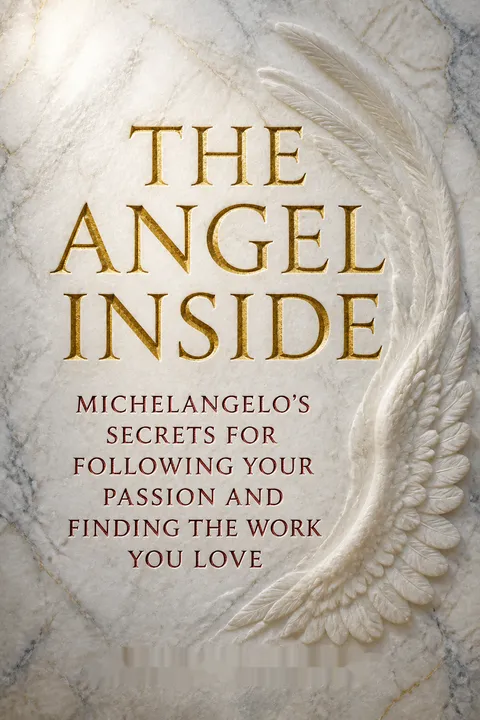
The Angel Inside uses a brief encounter in Florence to convert a career crisis into a sequence of practical questions. Tom1 begins by treating other people’s disappointment as evidence that he has little value. The old man2 redirects his attention through sculpture: a block of marble can be judged as useless or understood as unfinished, and the difference depends on what the observer can imagine and what the craftsperson can do. That metaphor does not simply celebrate hidden talent. The book repeatedly insists on study, planning, practice, detail, patience, and the willingness to begin.
Its strongest psychological insight is that external pressure can become internal habit. Tom’s father3 need not appear in Florence for his standards to govern Tom’s1 choices; Tom1 has learned to evaluate himself through the same measures of money and status. The proposed remedy is neither blame nor instant escape. Tom1 must recognize what he values, test possible work, find mentors, build skills, and tolerate the uncertainty of a slower path. The lessons about confidence and action then counter two common forms of avoidance: waiting until one feels entirely ready, and remaining busy in work that never tests one’s genuine strengths.
The story’s method is deliberately allegorical. Each object in the gallery or workshop carries a lesson, and the old man’s revelation as Michelangelo gives the teaching an almost mythic authority. That ending is emotionally satisfying, but it also leaves the real resolution open. Tom1 has not yet quit his job, found a creative mentor, or taken piano lessons. The book ends at the point where inspiration must become behavior. This makes its central promise both hopeful and demanding: a person may possess unrealized capacity, but potential becomes a life only through choices repeated over time.
Review Summary
The Angel Inside receives mostly positive reviews, praised for its inspiring message about finding one's passion and pursuing dreams. Readers appreciate the storytelling approach, weaving life lessons through a fictional narrative set in Florence. Many find it a quick, motivational read that encourages self-reflection and personal growth. Some critics note the advice is basic, but overall, readers value its emphasis on living authentically and persevering through challenges. The book's connection to Michelangelo's work adds depth and historical interest for many readers.
People Also Read









Characters
Tom Cook
A stalled creative spiritTom is a thirty-year-old business analyst who has followed his father’s3 idea of success into mergers and acquisitions, despite a longstanding creative streak. He arrives in Florence discouraged by stalled work, a breakup, and the sense that he has disappointed the people whose approval matters to him. His self-doubt is reinforced by habits of avoidance, including arriving late and neglecting reports. The old man’s2 lessons help him identify the conflict between the life he performs and the work he might value. Tom is open to advice and eager to learn, but he is not portrayed as instantly transformed: the story ends before showing whether he changes careers or begins piano lessons. His central struggle is turning insight into action.
The Old Man
A Florentine life mentorThe old man is a physically vigorous, formally dressed Florentine who approaches Tom1 in a plaza and guides him through the city’s art and craft traditions. He teaches through questions, anecdotes, and close observation, moving from the David to a sculptor’s workshop and a long dinner. His manner is confident and theatrical, but he also listens for Tom’s1 particular fears, including his wish to create and his anxiety about his father’s3 judgment. He presents ambition as a combination of passion, practice, planning, patience, and character. The old man’s certainty gives Tom1 a temporary structure for reconsidering his life, while his emphasis on Tom’s1 own choices keeps the responsibility with his student.
Tom's Father
The inherited standardTom’s father is a highly successful corporate executive whose confidence in business and wealth shaped his son’s1 education and career. He has encouraged Tom1 to see financial achievement as the surest route to respect and security. Though he is not present in Florence, his imagined judgment controls much of Tom’s1 thinking, from career choices to fear of taking piano lessons. The book does not reduce him to a villain; his influence comes from a powerful model of success that Tom1 has absorbed, and perhaps from a desire to guide his son1. His role exposes how parental expectations can become an internal voice long after a child is grown.
Michelangelo
The artist behind the lessonsMichelangelo is the historical artist whose David and other works anchor the old man’s2 teachings. The book presents him as someone who chose art despite his father’s8 preference for business, learned through apprenticeship, studied the human form, and built skill through sustained work. His career gives the old man2 concrete examples for discussing passion, preparation, detail, and gradual achievement. Michelangelo functions less as a fully dramatized personality than as a model through which Tom1 can reconsider his own choices. His artistic legacy also gives the story its central image: a block of stone can contain possibilities that others fail to recognize.
Arturo
The working sculptorArturo is a sculptor who owns the Florence workshop the old man2 visits with Tom1. He welcomes them among his workers and unfinished pieces, providing a real setting for lessons about planning and the stages of making art. His presence grounds the old man’s2 ideas in a craft practiced by working hands, rather than leaving them at the level of metaphor. Arturo is friendly with the old man2 and takes pride in the physical labor of sculpture.
Tom's Former Girlfriend
A measure of rejectionTom’s girlfriend has recently ended their relationship because she doubts his future prospects. Though she appears only in Tom’s1 account, her judgment deepens his belief that he is falling short. Her departure is one of several pressures that send him searching for direction in Europe.
Domenico Ghirlandaio
Michelangelo's first mentorGhirlandaio is the painter Michelangelo4 apprenticed with as a teenager. He represents the practical importance of finding a teacher and learning a craft, especially when a young artist’s ambitions conflict with family expectations.
Lodovico
The artist's doubtful fatherLodovico, Michelangelo’s4 father, hopes his son4 will restore the family’s wealth and standing through business. His resistance to Michelangelo’s4 artistic path mirrors the pressure Tom1 experiences from his own father3.
The Gallery Guard
A witness to the mentorThe guard at the Accademia recognizes the old man2 and says he has seen him guide many visitors. His brief endorsement encourages Tom1 to take the lesson seriously and hints that the encounter is part of a larger pattern.
The Apprentice
A sculptor just beginningA young workshop apprentice prepares a small block of marble and strikes it once, hoping to make a lion. His first cut gives the old man2 a concrete example of how action begins a project that planning alone cannot complete.
Plot Devices
Michelangelo's David
Potential made visibleThe statue gives the old man2 a shared object through which to teach Tom1. Its history as a block other artists could not use becomes an image for abilities that others may overlook. Its poised moment before the fight with Goliath supports a lesson in confidence, while its anatomy illustrates attention to detail. The head and hands, enlarged to suit the viewing angle, prompt a discussion of imagination joined to practice. The David is not merely a symbol pasted onto Tom’s1 career crisis; it is the sequence of observations that moves him from passive discouragement toward specific questions about his strengths and choices.
The Sculptor's Workshop
A model for makingArturo’s5 workshop turns abstract advice into visible labor. Tom1 sees artists working on pieces at different stages, a prepared marble block surrounded by drawings and models, and an apprentice10 making a first cut. These objects let the old man2 distinguish planning from testing, testing from execution, and rough shaping from finishing. The setting also introduces relationships and books as tools that shape a life, alongside adversity as a kind of refinement. By grounding lessons in a working shop, the story gives Tom1 a practical model for changing careers without suggesting that inspiration alone will make the transition.
The Lesson List
A portable reminderAfter their final dinner, the old man2 gives Tom1 a paper listing the lessons from the day. It gathers the scattered advice about passion, strengths, detail, planning, action, hardship, time, and excellence into something Tom1 can carry back from Florence. The list serves both as a summary of the encounter and as a practical prompt for remembering it after travel ends. It cannot make Tom1 act, which preserves the book’s distinction between learning a principle and applying it.
Buonarroti's Disappearance
The mentor's hidden identityAt the plaza before Tom1 leaves Florence, the old man2 identifies himself by Michelangelo’s4 surname. Tom1 recognizes the name from the museum plaques, turns around, and finds no one there. The disappearance reveals that the guide was Michelangelo4 himself, turning the day’s historical examples into an uncanny personal encounter. It supplies a final surprise and gives Tom1 a reason to remember the lessons, but it does not resolve the practical question of what he will do when he returns home.
About the Author

Download PDF
Download EPUB
.epub digital book format is ideal for reading ebooks on phones, tablets, and e-readers.








