

Key Takeaways
Treat a decisive election as a mandate, not a negotiating inconvenience
A state split in two. Pakistan joined a western wing to an eastern one separated by India. East Pakistan had more people, but power rested with West Pakistani elites. Many Bengalis felt politically and economically subordinated. A devastating 1970 cyclone, followed by an inadequate government response, deepened that alienation. In the first direct national election, the Awami League won all but two of East Pakistan’s 169 contested seats and an outright majority in the assembly. Its leader, Sheikh Mujib, was positioned to become prime minister.
The vote was set aside. On March 1, 1971, Yahya Khan postponed the assembly indefinitely. Bengalis saw the decision as the theft of their electoral victory. The United States could have pressed for a power-sharing arrangement, but chose not to challenge Pakistan’s rulers.
An election does more than choose officeholders. It gives political losers evidence that peaceful participation can change who governs. When a powerful group cancels that possibility after losing, it makes future bargaining less credible. The book’s account also shows why electoral legitimacy alone could not settle Pakistan’s competing fears about autonomy and national survival. But ignoring the result stripped negotiation of its strongest foundation. The lesson applies beyond foreign policy: institutions remain peaceful only when powerful actors accept outcomes that threaten their own position.
Use leverage before an ally's crackdown makes warnings look like excuses
The danger was foreseeable. Before the army moved, U.S. officials warned that roughly 20,000 Pakistani troops could not control a hostile population of about 75 million. They predicted a bloodbath and doubted the army could restore lasting control. The United States had supplied Pakistan with weapons and economic aid, and Yahya valued his relationship with President Nixon. This gave Washington potential influence, even if it could not guarantee a peaceful outcome.
Washington chose silence. Kissinger argued against warning Yahya, fearing that even a mild intervention could offend him or appear to encourage Pakistan’s breakup. On March 25, the army launched its crackdown. The choice was not between invasion and doing nothing. It was whether to use diplomatic pressure, aid, or arms policy to discourage mass violence.
The key distinction is between controlling another state and trying to influence a partner whose choices depend partly on outside support. Respect for sovereignty can prevent coercive overreach, but it can also become a convenient shield for avoiding foreseeable responsibility. The administration could not know that a warning would stop the crackdown. Yet refusing to test its influence removed one possible constraint before violence began. In policy design, the timing of leverage matters: an early condition can shape expectations, while a late protest often looks like reputation management.
Record what the ground sees, even when the capital wants quiet
Witnesses kept reporting. Archer Blood, the U.S. consul general in Dacca, and his staff gathered accounts from aid workers, professors, missionaries, and other trusted witnesses. They reported killings at Dacca University, burned neighborhoods, and attacks on civilians, with Hindus especially targeted. On March 28, Blood sent a cable describing what he called selective genocide. On April 6, he transmitted a formal dissent telegram backed by 20 American officials, condemning Washington’s silence and refusal to defend the election results.
The label needs care. The consulate’s early use of genocide was not a legal finding, and its staff initially disagreed about which group was being targeted. Blood’s reporting later focused more clearly on the campaign against Hindus. He was removed from Dacca, and his career stalled.
Blood’s importance lies not in a perfect diagnosis but in refusing to let professional routine disguise what eyewitnesses were seeing. In organizations, information often travels upward through people rewarded for reassuring their superiors. A written dissent preserves evidence against that pressure and makes a decision traceable. The episode also offers a useful discipline: distinguish observed events from interpretation. Naming atrocities can break through bureaucratic indifference, but a morally urgent label is strongest when the targeted group, evidence, and uncertainty are made explicit.
Supplying weapons while refusing to object is still a policy choice
U.S. equipment was in use. Pakistani forces deployed American-made tanks and jeeps, F-86 aircraft, and C-130 transports during the crackdown. Washington knew that U.S.-supplied equipment was being used in East Pakistan, yet never clearly told Pakistan not to use it against civilians. A formal arms embargo was still in place, although President Nixon had made exceptions for new sales. The State Department quietly slowed major shipments, partly to limit political damage.
The pipeline did not vanish. Congressional investigators later found that about $3.8 million in U.S. munitions reached Pakistan between March and September, despite public claims that arms deliveries had stopped. In December, as war began, Nixon and Kissinger knowingly arranged for U.S. aircraft to reach Pakistan through Iran and Jordan, despite legal warnings that such transfers were prohibited.
Material support communicates policy even when public statements do not. Weapons, spare parts, and transport capacity can sustain a partner’s military while officials insist they are not taking sides. This is a classic gap between declared neutrality and operational involvement. The distinction between direct intervention and indirect support matters, but it does not erase responsibility for foreseeable use. The case also shows why transparent arms controls matter: without reliable accounting, executive officials can describe a shipment as minor while its political signal is much larger.
Keep borders open, but count the human and political costs honestly
India did not shut the gate. As Bengalis fled killings and persecution, India kept its long border open. By the end of the crisis, about ten million refugees had entered the country. Indian officials estimated that roughly 90 percent were Hindus, a stark pattern reflecting their particular vulnerability. Many refugees lived in overcrowded camps with poor sanitation, inadequate food, and cholera. Indian citizens in already poor border regions faced rising prices, strained services, and growing tension with newcomers.
Compassion had strategic value. India’s leaders wanted the refugees to return safely, but also feared permanent settlement, political unrest, and further pressure on West Bengal. They withheld the Hindu majority figure from many domestic audiences to avoid inflaming communal conflict. International contributions were far below the cost India carried, and aid did not resolve the cause of displacement.
A border decision can be both humane and politically consequential. Allowing people to escape immediate danger protected lives, while the scale of arrival changed India’s security calculations and strengthened public demands for action. Treating compassion and national interest as mutually exclusive would miss how policy works under pressure. At the same time, describing an open border as uncomplicated virtue ignores the resources and local tensions that followed. Honest accounting helps distinguish a morally defensible choice from a cost-free one, and makes clear who bears the burden when other countries offer limited help.
Separate a rescue mission from the strategic war built around it
India built a shadow war. Its government secretly provided Bengali fighters with training, weapons, camps, and access across the border. These guerrillas became known as the Mukti Bahini. Indian leaders also prepared for a conventional war, but their generals urged a delay until the monsoon ended and winter weather limited the threat from China. India’s motives included solidarity with Bengalis, ending the refugee crisis, weakening Pakistan, and limiting instability in its own border states. Indian forces crossed into Pakistan before the December war, despite public denials.
Pakistan struck first in the full war. On December 3, Pakistan launched air attacks on Indian airfields. India then invaded East Pakistan and won a swift victory. The book rejects the claim that India was simply an unprovoked rescuer, while also distinguishing its intervention from Pakistan’s earlier campaign of mass repression. Indian-backed camps included boys as young as ten, an especially troubling feature of the insurgency.
Humanitarian action and strategic advantage often travel together, especially when a crisis spills across borders. Mixed motives do not automatically invalidate an intervention, but they make scrutiny essential: who chooses the military objective, who bears the risk, and whose interests define success? India’s covert support helped a popular independence movement, yet it also shaped the conflict and exposed young recruits to danger. The case resists both patriotic simplification and cynical equivalence. A useful standard is to judge motives, means, and outcomes separately rather than letting one redeem or condemn the others.
Do not let a diplomatic back channel erase an ally's civilian victims
Yahya opened a door to Beijing. Nixon and Kissinger used Pakistan’s president to carry secret messages to China, culminating in Kissinger’s July 1971 trip to Beijing. Secrecy and trust mattered to the opening, and the White House worried that condemning Pakistan might undermine the channel. But Pakistan was not the only possible route before the spring of 1971. Other contacts, including Romania and France, were still under consideration before the Chinese leadership settled on Yahya.
China was not the only motive. Nixon had long favored Pakistan and disliked India. Both leaders saw India as too close to the Soviet Union, while Nixon also felt personal loyalty to Yahya. The China initiative reinforced an existing tilt rather than creating it from nothing. Once the opening succeeded, the administration also wanted China to see the United States as a reliable friend to Pakistan.
Secret diplomacy can produce genuine strategic gains, but secrecy also narrows the circle of people able to challenge its costs. Here, a leader’s usefulness as an intermediary became entangled with the treatment of civilians in his own country. That is a principal-agent problem: the channel’s value to Washington depended on Yahya, while the victims had little access to the decision. The book’s evidence also cautions against a single-cause explanation. China mattered greatly, but prior alliance habits, personal loyalties, and anti-Indian sentiment shaped what the administration was willing to sacrifice.
Let public scrutiny constrain policy before bureaucratic resistance becomes the last brake
Pressure altered the margins. American newspapers reported the killings and refugee crisis. Senator Edward Kennedy, other lawmakers, and some Republicans challenged the administration’s support for Pakistan. Within government, diplomats including Blood and ambassador Kenneth Keating urged a stronger response, while State Department officials quietly slowed major arms shipments. These pressures did not persuade Nixon and Kissinger to condemn Yahya or press seriously for a political settlement, but they made continuing arms deliveries more difficult.
Relief came under scrutiny too. Kennedy’s visit to refugee camps helped expose the scale of suffering and criticized the administration’s limited aid. U.S. assistance increased, and the government supported food relief in East Pakistan to reduce the risk of famine. Public and institutional pressure therefore helped restrict some harm, even though it arrived too late to undo the initial policy of nonintervention.
This is a case where democratic checks worked imperfectly but materially. A free press made distant suffering visible; legislators converted reporting into political cost; and career officials used administrative authority to resist choices they considered dangerous. Those mechanisms did not control the president, but they narrowed his options. The lesson is not that public opinion always produces humane policy. It can be inconsistent, partisan, or brief. Rather, institutions give evidence more than one route to influence, which matters when a small inner circle dominates foreign policy decisions.
India won Bangladesh in two weeks; the region inherited decades of distrust
The military outcome was swift. Pakistan’s December 3 airstrikes opened a conventional war. On December 16, its forces surrendered in the east, creating an independent Bangladesh. India then declared a ceasefire in the west rather than continuing toward a wider victory. The United States sent a carrier group toward the Bay of Bengal and urged China to move troops near India’s border, raising the danger of a broader confrontation. Historical estimates of Bengali deaths vary sharply; one study cited in the book estimated about 269,000, while contemporary claims ran much higher.
Victory did not settle the region. Bangladesh soon suffered political turmoil, and Mujib was assassinated in 1975. Pakistan’s defeat intensified military power and revenge politics. India’s triumph strengthened Indira Gandhi’s authority before her Emergency rule, which suspended democratic freedoms. The United States emerged with damaged relations with India and a record of support for Yahya that many Pakistanis still viewed as betrayal.
A decisive battlefield result can resolve a territorial conflict without repairing the political conditions that produced it. Bangladesh’s independence ended West Pakistan’s rule in the east, but did not guarantee stable democracy or reconciliation. The consequences also crossed borders: Pakistan’s defeat fed insecurity, India’s victory bolstered a leader who later curtailed democracy, and U.S. policy weakened trust across the region. The book’s broad lesson is not that intervention reliably creates peace. It is that refusing to address mass violence can also shape future conflict, often in ways that outlast the crisis.
Analysis
Bass builds an archival narrative around a stark asymmetry: Pakistan’s army initiated a campaign of mass repression after an election, while India supported the Bengali struggle and ultimately used force, but the actors did not hold equivalent responsibility for the crisis. The story’s strongest analytical move is to treat nonintervention as an active policy, not an absence of policy. Washington supplied Pakistan, declined to warn its leaders, muted reports, and prioritized alliance management. The distinction between passivity and complicity is therefore central.
The book also resists a clean morality play. India left its borders open and responded to immense public pressure, yet it covertly armed an insurgency, prepared for war, concealed its role, and pursued strategic advantage. That complexity strengthens rather than weakens the humanitarian argument: moral action can emerge through democratic pressure without leaders being pure or selfless. But the case also warns that humane language can legitimize force whose aims exceed immediate protection.
The method matters. White House recordings expose private reasoning that official statements obscured, while diplomatic cables and interviews place decisions beside events on the ground. The convergence is persuasive, though the account openly lacks a comprehensive Bangladeshi record. The disputed death toll and the evolving use of the word genocide require care. They do not erase the well-documented mass killings or targeted persecution, but they make precision essential.
The episode connects foreign policy to institutional design. A narrow executive circle could protect a secret diplomatic initiative from public scrutiny, while Congress, journalists, and career officials imposed partial limits. The failure was not simply that leaders lacked information. They received warnings and discounted them. The durable question is how democratic systems can make human consequences count before strategic commitments, personal loyalties, and secrecy turn avoidable risks into irreversible choices.
Review Summary
The Blood Telegram is praised as a well-researched, comprehensive account of the 1971 Bangladesh genocide and Nixon-Kissinger's complicity. Readers appreciate the detailed portrayal of diplomatic maneuvering, Cold War politics, and the moral failings of key figures. The book is commended for its use of declassified documents and White House tapes, providing insight into the decision-making process. While some find the writing occasionally academic, most reviewers consider it an important, eye-opening work that sheds light on a often-overlooked historical event.
People Also Read






Glossary
Blood telegram
Diplomats' formal dissentThe April 6, 1971, cable sent by U.S. consul general Archer Blood and supported by 19 other officials in Dacca. It condemned the Nixon administration’s failure to criticize Pakistan’s suppression of democracy and violence against Bengalis. Blood added his own endorsement. The cable became a prominent example of Foreign Service officers using an internal channel to challenge official policy.
Six Points
Bengali autonomy programSheikh Mujib-ur-Rahman’s political program for East Pakistan. It called for a democratic federal system with a greatly limited central government, largely responsible for defense and foreign affairs, and greater economic and political autonomy for the eastern wing. West Pakistani leaders feared the program would make Pakistan ungovernable or become a path toward independence.
Mukti Bahini
Bangladeshi liberation forceThe Bengali armed resistance that fought Pakistan’s military during the 1971 war. Its fighters included Bengali soldiers who left Pakistan’s forces, police, and civilian volunteers. India supplied training, arms, camps, and cross-border support. The force conducted guerrilla attacks and later fought alongside the Indian army during the campaign that secured Bangladesh’s independence.
two-nation theory
Hindu and Muslim nationhood claimThe political argument that Hindus and Muslims constituted distinct nations, used to justify creating Pakistan as a homeland for Muslims during the 1947 Partition. The separation of East Pakistan, whose Bengali population was mostly Muslim, challenged the theory’s claim that religion alone could hold a nation together across profound geographic, linguistic, and political divisions.
nonalignment
Avoiding Cold War blocsIndia’s stated policy of avoiding formal alignment with either the United States-led or Soviet-led bloc during the Cold War. In practice, India maintained relationships with both sides, but its growing reliance on Soviet arms and support led Nixon and Kissinger to view it as pro-Soviet. The 1971 crisis pushed India into closer cooperation with the Soviet Union.
Hamoodur Rehman Commission
Pakistan's postwar inquiryA Pakistani judicial commission established after the 1971 defeat to investigate the military collapse in East Pakistan. Its report criticized military leadership and included testimony about killings, rape, looting, and other abuses. The report was suppressed for decades, and its recommendations to investigate and prosecute those responsible for atrocities were not carried out.
FAQ
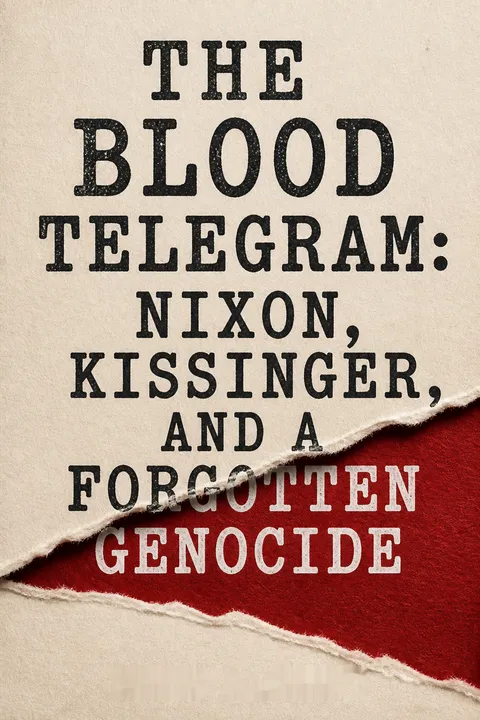
What is The Blood Telegram: Nixon, Kissinger, and a Forgotten Genocide by Gary J. Bass about?
- Historical focus: The book examines the 1971 Bangladesh genocide, the U.S. government’s controversial response, and the interplay of Cold War politics, especially involving Nixon and Kissinger.
- Key events: It covers the Pakistan army’s crackdown on Bengalis, the resulting refugee crisis in India, and the Indo-Pakistan war that led to Bangladesh’s independence.
- Themes: Central themes include the moral failures of U.S. foreign policy, the tension between realpolitik and human rights, and the limits of international intervention during humanitarian crises.
- International context: The narrative situates the crisis within the broader Cold War, highlighting the roles of the Soviet Union, China, and India.
Why should I read The Blood Telegram by Gary J. Bass?
- Unveiling forgotten genocide: The book brings to light a largely overlooked genocide and the complicity of powerful nations, filling a critical gap in understanding U.S. foreign policy failures.
- Insight into diplomacy and ethics: It offers a nuanced analysis of how realpolitik and strategic interests often override humanitarian concerns, especially through the actions of Nixon and Kissinger.
- Comprehensive research: Bass’s work is grounded in extensive archival research, including diplomatic cables, government documents, and personal interviews, making it a definitive source on the 1971 crisis.
- Lessons for today: The book provides enduring lessons on the costs of ignoring human rights in international relations, relevant to current global politics.
What are the key takeaways from The Blood Telegram by Gary J. Bass?
- U.S. policy failure: Despite clear evidence of genocide, the Nixon administration prioritized Cold War alliances and the opening to China over human rights, supporting Pakistan’s military regime.
- Role of dissent: Archer Blood’s courageous documentation and protest through the “Blood Telegram” exposed the brutal crackdown but was ignored, leading to his dismissal.
- India’s pivotal intervention: India’s support for Bengali insurgents and eventual military intervention were crucial in ending the genocide and creating Bangladesh.
- Limits of humanitarian intervention: The book highlights the challenges and failures of international intervention when strategic interests dominate, raising questions about moral responsibility in foreign policy.
Who was Archer Blood, and what was his significance in The Blood Telegram by Gary J. Bass?
- U.S. Consul General: Archer Blood was the American diplomat stationed in Dacca during the 1971 genocide, witnessing firsthand the atrocities committed by the Pakistan army.
- The Blood Telegram: He sent a strongly worded telegram to Washington condemning the genocide, which became a rare and direct official U.S. protest against the Pakistani crackdown.
- Whistleblower and dissenter: Blood’s efforts to raise awareness were largely ignored by the Nixon administration, and he was eventually removed from his post.
- Legacy of dissent: His moral courage and documentation are central to the book’s narrative about the failure of U.S. policy and the importance of principled dissent.
How did Nixon and Kissinger shape U.S. policy during the Bangladesh genocide, according to The Blood Telegram by Gary J. Bass?
- Realpolitik over morality: Nixon and Kissinger prioritized geopolitical strategy, especially the U.S. opening to China and maintaining Pakistan as a Cold War ally, over addressing the genocide.
- Support for Pakistan: The administration continued to provide military and economic aid to Pakistan despite evidence of mass killings, reflecting a calculated choice to support a strategic partner.
- Diplomatic secrecy: Kissinger’s secret trips to China and back-channel communications with Pakistan’s leadership influenced U.S. policy, often sidelining humanitarian concerns.
- Personal biases: Nixon’s personal friendship with Yahya Khan and his hostility toward India further complicated the U.S. stance.
What was the "Blood Telegram," and why is it significant in Gary J. Bass’s The Blood Telegram?
- Definition: The "Blood Telegram" was a dissent cable sent by Archer Blood and nearly his entire consulate in Dacca, formally repudiating U.S. policy and condemning the government’s silence on the atrocities.
- Content: The telegram accused the U.S. of "moral bankruptcy," highlighted the suppression of democracy, and warned of genocide against Bengalis.
- Impact: It exposed deep divisions within the U.S. government and became a symbol of principled dissent against realpolitik, though it led to Blood’s removal.
- Historical importance: The telegram is now recognized as a vital eyewitness account and a rare official protest against genocide.
How did India and Indira Gandhi respond to the Bangladesh genocide, as described in The Blood Telegram by Gary J. Bass?
- Humanitarian and military support: India hosted millions of Bengali refugees and covertly supported the Mukti Bahini guerrillas fighting for Bangladesh’s independence.
- Diplomatic efforts: Indira Gandhi sought international support, signing a friendship treaty with the Soviet Union to secure backing against Pakistan and China.
- Preparation for war: As political solutions failed, India prepared for full-scale war, with the Indian army planning a swift offensive to liberate East Pakistan.
- Balancing challenges: Gandhi’s government managed internal political challenges and the enormous burden of the refugee crisis while navigating global diplomatic obstacles.
What was the Mukti Bahini, and what role did it play in the 1971 conflict according to The Blood Telegram by Gary J. Bass?
- Bengali guerrilla force: The Mukti Bahini were Bengali insurgents fighting for Bangladesh’s independence, trained and supported covertly by India.
- Military significance: They conducted sabotage, ambushes, and attacks on Pakistani military targets, weakening Pakistani control in East Pakistan.
- Challenges faced: The rebels operated under severe shortages and harsh conditions, often training child soldiers and lacking adequate supplies.
- Paving the way: Their insurgency provided India with a strategic advantage and pretext for military intervention, accelerating the path to Bangladesh’s independence.
How did Cold War dynamics and the U.S. opening to China influence the Bangladesh crisis, as explained in The Blood Telegram by Gary J. Bass?
- U.S.-China rapprochement: Nixon and Kissinger’s secret opening to China relied on Pakistan as a trusted intermediary, leading them to support Yahya Khan despite his regime’s atrocities.
- Soviet-India alliance: India signed a friendship treaty with the Soviet Union to counterbalance Pakistan and China, shifting Cold War alignments in South Asia.
- Geopolitical calculations: Both superpowers sought to avoid direct confrontation but used the crisis to advance their interests, often at the expense of Bengali suffering.
- Impact on policy: The opening to China shaped U.S. policy to prioritize this relationship over condemning Pakistan’s actions, influencing the handling of the Bangladesh crisis.
What were the main diplomatic and moral failures of the U.S. during the 1971 Bangladesh crisis, according to Gary J. Bass?
- Complicity in atrocities: The U.S. knowingly supported Pakistan’s military dictatorship, supplying weapons used in the massacre of Bengalis.
- Ignoring diplomatic warnings: Despite detailed reports and urgent warnings from diplomats like Archer Blood and Ambassador Kenneth Keating, the White House remained silent and dismissive.
- Cover-up and distortion: Nixon and Kissinger engaged in efforts to sanitize records, block access to documents, and distort the historical record to protect their legacy.
- Suppression of dissent: Dissenting diplomats were sidelined or punished, reflecting the administration’s intolerance for internal criticism during the crisis.
What were the consequences of the 1971 war for Bangladesh, Pakistan, India, and the United States, as detailed in The Blood Telegram by Gary J. Bass?
- Bangladesh: The war resulted in independence but left deep scars—massive loss of life, political instability, and ongoing struggles with justice for war crimes.
- Pakistan: The defeat was a national trauma, leading to political upheaval, increased military dominance, and a drive to develop nuclear weapons.
- India: The victory boosted national pride and Indira Gandhi’s popularity but also led to increased authoritarianism and a souring of relations with the U.S.
- United States: The U.S. faced moral criticism for supporting Pakistan’s atrocities, legal violations, and a lasting stain on its foreign policy legacy.
What are some of the best quotes from The Blood Telegram by Gary J. Bass, and what do they mean?
- On forgetting atrocities: Milan Kundera’s epigraph highlights how global crises can overshadow human suffering, emphasizing the world’s tendency to move on and forget.
- Blood’s cable phrase: The consulate described the crackdown as “Selective Genocide,” underscoring the targeted and systematic nature of the killings, especially against Bengali Hindus.
- Kissinger on realpolitik: “We don’t even pretend high-sounding morality on some of these issues, except in the deepest sense,” reflects the cynical prioritization of strategic interests over humanitarian values.
- Nixon’s cold comparison: Nixon’s remark, “I don’t like it, but I didn’t like shooting starving Biafrans either,” reveals his realpolitik approach, equating different humanitarian crises to justify inaction.
Download PDF
Download EPUB
.epub digital book format is ideal for reading ebooks on phones, tablets, and e-readers.








