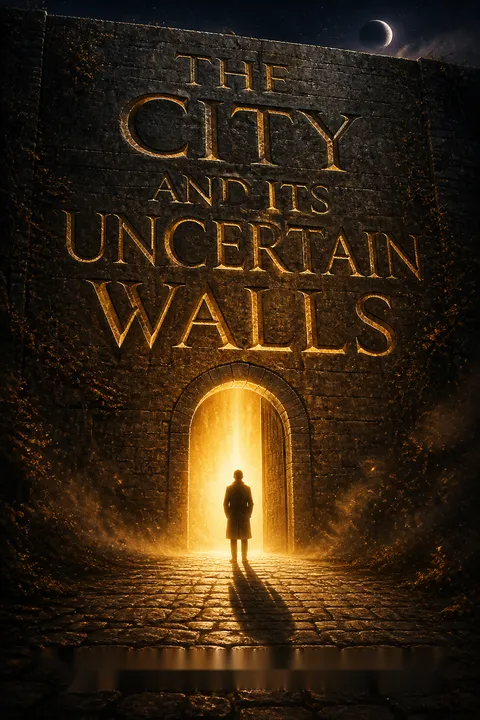


Plot Summary
The Town They Invented
At a high-school essay ceremony, a shy boy meets a younger girl whose writing honors the grandmother she loves. They begin exchanging long letters, then meet whenever they can, finding in each other the rare pleasure of being fully heard. During one summer, the girl describes a walled town where her true self works in a library and the boy is destined to read stored dreams.
He records her details in a notebook, helping turn their shared imagining into a place with a river, three bridges, horned beasts, and a gatekeeper. Their invented world becomes the private language of a first love neither is ready to explain to anyone else.
The town begins as a joint act of attention. The girl supplies images, while the boy preserves them, and their roles already resemble the later librarian and Dream Reader. Their intimacy depends less on physical possession than on careful listening and imaginative collaboration. Yet the story quietly plants a danger: the more precisely the boy records the girl's inner world, the more he may mistake his version of her for the person herself. The town is at once a love token and a structure built to hold what ordinary life cannot.
Letters Into Silence
The girl's moods sometimes seize her so completely that she cannot speak, eat, or leave her room. During one such episode, she still forces herself to reach their meeting place and confides that she feels like a shadow whose real self lives elsewhere. She imagines that self inside the town they invented, and asks the boy to wait until she can give herself to him fully.
Months later, her letters stop. After repeated unanswered calls, a final letter explains that she cannot make words connect and fears she is only a shadow. It is the last he receives. He leaves home for university in Tokyo, but years of work and other relationships never loosen his attachment to the vanished girl.
The girl's withdrawal turns a private metaphor into a wound the boy cannot verify or repair. Her image of being a shadow may describe psychological estrangement, a supernatural fact, or both, but he receives it as a promise that the imagined town can resolve. His patience becomes a way to preserve hope, yet it also freezes him at the moment before loss. The letters matter because they are evidence of mutual feeling and the only record he has. Once they stop, devotion and uncertainty become difficult to separate.
The Gate Without Return
By middle age, the narrator has built a stable but lonely life, unable to trust love after the girl disappeared. Then he wakes in a hole near the town from his youth's stories. The Gatekeeper offers him entry but explains the cost: newcomers must surrender their shadows, and the Dream Reader's eyes will be injured.
The narrator agrees because he hopes to find the girl, though he knows the gate permits no ordinary return. The Gatekeeper tears his shadow from him and keeps it in an enclosure outside the wall. With his vision damaged and his old self left behind, the narrator crosses into the place he and the girl once made together.
The threshold literalizes the narrator's long emotional bargain. He has already lived as though part of him were missing; now he consents to make that division physical. The Gatekeeper presents the sacrifice as orderly procedure, a contract disguised as routine, which makes the choice feel both deliberate and strangely passive. The narrator enters for love, but the cost is not simply distance from the outside world. He leaves behind the part of himself capable of doubt, anger, and contradiction, whether or not he understands what that loss will mean.
The Library of Dreams
Three days after arriving, the narrator finds the old library and meets the girl working behind its counter. She looks as she did in his memories, but has no recognition of him. His altered eyes prove he is qualified to handle the old dreams stored where books should be. The girl prepares bitter herbal tea to soothe his injured vision and selects dreams for him to read.
He warms each egg-shaped container in his hands, trying to receive its scattered images and muffled voice. Every evening he works beside her, then walks her home along the river. Her kindness restores a daily closeness, but her silence about their past leaves him loving someone who cannot share his memories.
Recognition is split between body and memory. The girl remains visually continuous with the beloved the narrator lost, but the relationship they once built has no place in her present awareness. His work with dreams mirrors his effort to recover their shared past: he can feel traces, yet cannot make them yield a coherent account. The routine offers comfort while preventing resolution. By accepting care from someone who does not know him, he begins to encounter the ethical limit of memory: remembering a person intensely does not give him ownership of who that person is now.
A Wall That Moves
The narrator tries to map the wall, but townspeople cannot agree on its shape and see no reason to investigate. Along the neglected perimeter, he finds abandoned houses and traces of a population that seems to have vanished from local memory. The wall allows him to walk, yet watches him closely.
Soon he falls ill with a fever and dreams that the wall keeps changing its form, defeating his measurements. An old man nurses him and tells of seeing a beautiful apparition during wartime, then risking everything to view the hidden side of her face. The old man's warning, together with the town's winter deaths among the horned beasts, makes curiosity feel both necessary and dangerous.
The narrator's mapmaking challenges a society that survives by not asking how it came to be. The wall's shifting shape turns knowledge into a contest between an inquisitive mind and a system that can revise its own boundaries. The old soldier's story adds a psychological cost: looking beyond a partial image may reveal truths a person cannot absorb. The town's apparent serenity rests on exclusions, forgotten history, and recurring sacrifice. The narrator's fever marks his body entering that order, while his questions keep him from being fully assimilated into it.
The Shadow's Last Week
The narrator visits the Gatekeeper's enclosure and finds his abandoned shadow weakened by cold and forced labor burning dead beasts. The shadow warns that he will die soon unless they reunite, then argues that the town may be a manufactured refuge where painful feelings are removed and stored as old dreams.
He believes the southern pool is not a lethal trap but an exit disguised by fear. The narrator and the girl later approach the pool together and watch a piece of wood get sucked beneath its still surface. Despite the danger, the shadow's theory gives the narrator a possible way out. He must decide whether his longing for the girl outweighs his fear of returning to an uncertain life.
The shadow speaks for the capacities the narrator surrendered: suspicion, appetite, and the ability to resist a comforting explanation. His account of the town is persuasive but remains a hypothesis, which forces the narrator to choose without reliable proof. The pool concentrates that dilemma into a physical threshold. Its danger may be real, or fear may be the town's most effective fence. By letting the shadow make the case for escape, the story tests whether an inner self can be trusted even when it cannot guarantee survival.
Snow at the Southern Pool
When the shadow grows gravely ill, the narrator finally carries him out of the enclosure and steals the Gatekeeper's horn. Blowing the familiar signal draws the beasts toward the gate, delaying pursuit while the pair flee through deep snow. A wall appears where the path should be, but the shadow urges the narrator through it, and they pass as if through a yielding substance.
At the pool, the shadow prepares to dive toward the outside world. The narrator refuses to follow, choosing the town and its work instead. The shadow jumps alone and does not resurface. Later, the narrator wakes in the ordinary world with his own shadow restored, unable to explain how he returned.
This choice refuses the story's easiest resolution. The narrator does not reunite with his shadow or escape with him; he accepts separation because the town gives him a role and relieves his loneliness. Yet the return to ordinary life undoes any clean reading of that decision. The restored shadow suggests that the self cannot be permanently reduced to the part one chooses to abandon. The episode makes commitment consequential without making it final, leaving the narrator with an experience that feels real but cannot be organized into a stable account.
A Library in Fukushima
Back in Tokyo, the narrator resumes work at a book distributor, but the life he has constructed feels unreal. After reaching forty-five, he quits and spends two months barely moving. A dream of working in a modest library gives him a direction, so he asks Oki, a former colleague, to find him a rural position.
In the mountain town of Z, he interviews with Tatsuya Koyasu, whose navy beret matches the one in the dream. Koyasu has already chosen him as successor to the library's head position. The narrator moves into a furnished house near the river and begins a quieter life among handwritten lending records, reserved staff, and a teenage reader in a conspicuous Yellow Submarine parka.
The move is prompted not by a career plan but by a dream that converts inward paralysis into a practical task. Choosing a library also recalls the narrator's earlier role as Dream Reader, though he cannot yet explain the connection. Z** gives him a routine and a community, but not immediate belonging: patrons barely notice him, and the head librarian's beret signals an uncanny continuity between dream and waking life. The transition suggests that recovery may begin through work before a person can articulate what the work is repairing.
Dinner Without Armor
The narrator begins visiting a nameless coffee shop, where its owner, a divorced woman from Sapporo, serves coffee and blueberry muffins. They discover that both have left previous lives behind and moved to Z without close ties. He invites her to dinner, cooks for her, and listens as she explains how her marriage ended after her husband had an affair.
Later she tells him that sex has always been painful and that she cannot participate in it. The narrator admits attraction but accepts her boundary; they continue meeting, sharing books, food, whiskey, and conversation. Their tentative affection brings warmth into his solitary routine, while her protective undergarment gives visible form to a distance she needs to maintain.
This relationship offers a counterpoint to the narrator's adolescent ideal of total union. The coffee-shop owner does not promise that intimacy will eventually become uncomplicated; she names a limit and asks him to meet her within it. His willingness to stay does not erase his desire, but it gives both people room to negotiate closeness without coercion. The protective garment is not merely a symbol of damage. It is a chosen boundary, and the narrator's response tests whether he can value a relationship without demanding access to every part of another person.
Koyasu Has No Shadow
Koyasu invites the narrator to the library's locked underground room, where an old woodstove burns with applewood. There he reveals that he died more than a year earlier and now appears only to a few people. Librarian Mrs. Soeda confirms the secret: she has continued to manage the library with his guidance, while the town's staff cannot see him.
She explains that Koyasu arranged for the library's assets and succession before his death, then selected the narrator from the applicants. The narrator understands why Koyasu's beret and the basement room felt familiar, but not why he was chosen. Koyasu's presence makes the library a meeting place between the living and the dead, held together by work and memory.
Koyasu's ghost is not presented as a solved supernatural mechanism. He is a practical caretaker whose continued concern for the library gives his afterlife a purpose, while his missing shadow echoes the narrator's earlier separation from himself. The administrative details matter: a will, a succession plan, and Soeda's concealed cooperation make the uncanny feel embedded in ordinary institutions. The narrator's appointment is therefore both employment and inheritance, though he does not yet know what Koyasu believes he is inheriting.
The Family He Lost
Soeda recounts how Koyasu once hoped to write fiction but returned from Tokyo to manage his family's sake brewery. He later married a woman who continued her career in Tokyo, and they eventually settled together after she became pregnant. Their son Shin died at five when a truck struck his bicycle.
His wife sank into grief, blamed herself over the bicycle and a missing saltshaker, then drowned herself in a swollen river, leaving two scallions on their bed. Koyasu never understood that final gesture. He sold the brewery and used his fortune to establish the library. When he explains his attachment to the narrator, he recognizes in him the same lasting wound left by a love abruptly severed.
Koyasu's history refuses the comforting notion that time automatically repairs loss. His wife turns chance details into evidence of personal guilt, while Koyasu cannot reach her through reassurance. The scallions remain an unreadable message, much like the vanished girl's final letter: an intimate trace whose meaning cannot be recovered by the person left behind. The library becomes a response to grief, not a cure for it. Koyasu creates a place where other people's inner lives can be held without pretending they can be completely understood.
The Boy Draws a Door
The teenage reader, known as Yellow Submarine Boy, asks the narrator's birth date and instantly names its weekday. After overhearing the narrator describe the walled town at Koyasu's grave, he draws a remarkably accurate map and sends it to him. The narrator returns a corrected copy, and the boy later states that he must go there and read its old dreams.
Soon the boy disappears from his locked home during a fever, leaving behind his clothes and no practical route out. His father and brothers search the town and question the narrator, while police treat the case as a possible runaway. The narrator dreams of finding the boy's discarded wooden body in a forest, where it bites his ear.
The map turns listening into transmission. The boy can reconstruct a place from scattered speech, but his wish to enter it raises a question the narrator cannot answer on his behalf. His disappearance makes the town's imaginative power consequential in the ordinary world, where a family is left searching and the narrator cannot offer a credible explanation. The dream-bite leaves a bodily mark in memory rather than evidence anyone else can use. The boy's exceptional perception may be a route to freedom, but it also makes him difficult for others to protect.
The River Runs Backward
After the boy's disappearance and Koyasu's final conversations, the narrator dreams of walking upstream through the river of his childhood. As he moves, his middle-aged body grows younger until he reaches the summer when he was seventeen and the girl was sixteen. They sit together on a sandbank, and she confides that both of them are shadows of someone else.
The scene does not explain whether he has returned to a memory, crossed into another reality, or entered the town's hidden source. Soon afterward, inside the walled town, he sees Yellow Submarine Boy across the river. The boy's presence breaks the narrator's settled routine and links the missing teenager to the place he longed to reach.
The river makes memory bodily: the narrator does not simply recall adolescence, he travels through age until his past becomes present again. Yet the girl adds no comforting clarification; her statement deepens the uncertainty of identity. This is the hinge between the two worlds and between two generations of outsiders. The boy's arrival suggests that the town is not a finished fantasy preserved in the narrator's notebook. It can be entered, revised, and inherited by someone whose needs differ from his.
Two Readers Become One
Yellow Submarine Boy begins appearing across the river, then reaches the narrator in the night without passing through the guarded gate. He has left his former body outside and asks to merge with the narrator so he can become the Dream Reader. The narrator consents when the boy bites his left earlobe.
Their shared work transforms the library: the narrator coaxes old dreams from their shells, while the boy can understand their messages, allowing them to read far more in one night. The girl praises their progress and bakes apple sweets for them. The narrator also gains access to the boy's vast private store of books, though an unruly longing begins to stir within him and resists the town's stillness.
The merger is a collaboration rather than a simple takeover. The narrator offers warmth and empathy, while the boy brings extraordinary comprehension; each supplies what the other lacks. The old dreams can now speak more fully, but their efficiency unsettles the town's carefully maintained equilibrium. At the same time, the narrator's growing restlessness shows that integration does not mean surrendering choice. The self he shares with the boy contains incompatible desires, and the boy's knowledge cannot decide which one should govern.
The Candle Goes Dark
In their candlelit meeting place inside the narrator's consciousness, Yellow Submarine Boy explains that the narrator's restless heart is urging him to leave. The boy will remain in the walled town and take over the Dream Reader's work; the narrator must trust that his other self, now living outside, will catch him.
On his final walk with the girl, the narrator replaces his habitual farewell for the next day with a genuine goodbye. Then he tells the boy he has decided to go, closes his eyes, and extinguishes the candle with one breath. Darkness follows, and the novel stops before showing where he arrives. His departure depends not on a visible gate but on believing that another version of himself can receive him.
The ending turns the book's repeated division of self into an act of trust. The narrator cannot prove that the outside double exists, just as he could never prove what happened to the girl, but he no longer treats uncertainty as a reason to remain suspended. His farewell to the library girl recognizes that affection does not guarantee permanence. The boy's choice to stay is equally meaningful: each self commits to a different form of life. The extinguished candle leaves the outcome open while making the decision itself unmistakable.
Analysis
The novel treats identity not as a hidden object waiting to be discovered, but as a relationship among memory, embodiment, and the stories people tell about themselves. The narrator's shadow, the librarian girl, Koyasu's ghost, and Yellow Submarine Boy each make different versions of this problem visible. None can be reduced to a single answer about which self is original. Instead, the book asks what each version can feel, remember, and do for another.
Its libraries offer opposing but connected models of containment. Z's library preserves accessible books through care and community, while the walled town stores dreams in sealed forms and assigns a reader to quiet them. In both places, reading is labor performed for others. The difference is whether the institution welcomes interpretation or tries to manage what feeling might escape. The narrator's work becomes meaningful not because he solves the dreams, but because he makes room for them to speak.
The story also questions the romantic ideal of total union. The narrator's first love remains powerful precisely because it was interrupted before ordinary life could test it. The coffee-shop owner, by contrast, sets explicit limits, and the narrator must learn that closeness can exist without access to everything. His final departure echoes his earlier choices but changes their emotional logic: he does not leave because he has found certainty, but because remaining would mean mistaking stillness for safety.
The ending preserves ambiguity without making choice meaningless. The narrator cannot know whether another self will catch him, whether the town is literal, or whether memory has altered the path. Yet he acts. The book's claim is not that belief guarantees rescue, but that a life cannot be lived solely as an attempt to avoid falling.
Review Summary
The City and Its Uncertain Walls has received mixed reviews. Many praise Murakami's signature style, exploring themes of love, loss, and the blurred lines between reality and fantasy. Readers appreciate the novel's dreamlike atmosphere and philosophical musings. However, some find it repetitive and overly long, lacking the tight narrative of his earlier works. Critics note familiar Murakami tropes and symbolism, with some viewing it as a culmination of his literary career. Overall, fans of Murakami's magical realism generally enjoy the book, while others find it less engaging than his previous novels.
Characters
The narrator
The divided Dream ReaderAn introspective boy becomes an adult who has built his life around books, routine, and the memory of a first love. He is patient and observant, but his patience can harden into a refusal to risk new attachment. His movement between ordinary life and the walled town tests whether he can distinguish fidelity from fixation, and whether a person must choose one version of himself as the only real one. He listens closely to others, often more successfully than he can explain his own needs. His central drive is to find meaning in experiences that resist proof, while learning that care for another person need not require possessing their whole inner life.
The first love
The town's absent centerA perceptive, private girl who first connects with the narrator through letters and an imagined town. She carries complicated feelings about family, belonging, and a self that seems displaced from ordinary life. Her ability to describe dreams and inner states gives the narrator a language for experiences he cannot name, but she does not make herself fully knowable. She values emotional closeness while needing time and control over how it develops. The town's librarian is shaped by the narrator's memories of her, yet is not simply interchangeable with the girl he knew. Her role exposes the difference between loving someone's image and meeting the person as she exists now.
Yellow Submarine Boy
The human libraryA withdrawn teenager with an extraordinary memory and a hunger for books, he struggles to fit the ordinary routes laid out for him. He communicates selectively, often through gestures and writing, and his weekday calculations offer a precise but unconventional way of approaching people. His attention is intense rather than socially fluent; when a subject matters to him, he can assemble details others would overlook. He seeks a place where reading is not an eccentricity but a necessary vocation. His relationship with the narrator begins through the narrator's account of the walled town, making storytelling itself a possible bridge between isolation and belonging.
Tatsuya Koyasu
The library's devoted keeperA thoughtful, unconventional man whose love of books survives the collapse of his early literary ambitions and the demands of a family business. He creates a library as a practical gift to his town and takes a personal interest in people who do not fit easily into its expectations. Koyasu is courteous and private, with a distinctive beret and skirts that express a self he does not explain to everyone. His manner combines administrative competence with a willingness to accept mysteries without forcing them into tidy answers. He recognizes loneliness in others and offers help through attention, work, and carefully timed counsel.
Mrs. Soeda
The library's steady anchorA capable librarian who keeps the small-town library functioning through careful records, sound judgment, and close attention to people. She is reserved about her private life but perceptive about others, especially those the town finds difficult to accommodate. As a fellow outsider, she understands the value of a place where someone can remain quietly present without being forced to perform sociability. Her loyalty to the library is practical rather than sentimental: she manages staff, patrons, and daily decisions with equal care. She becomes an important source of continuity for the narrator as he learns the town and its rules.
The coffee-shop owner
A guarded new companionA divorced woman who leaves Sapporo to run a small coffee shop in Z**. She is self-reliant, sociable in measured doses, and frank about the limits she needs in relationships. Books, jazz, coffee, and modest end-of-day rituals give shape to her solitary life. Her conversations with the narrator create a possible intimacy grounded in mutual respect rather than grand declarations. She is not a replacement for his first love; she is a distinct person whose needs challenge his habit of treating waiting as the only form of devotion.
The Gatekeeper
Keeper of the thresholdA strong, disciplined worker who guards the town's only open gate and oversees the horn that summons the beasts. He treats the town's rules as durable facts and expects residents to accept their limits. Though coarse in appearance, his work is meticulous, from maintaining tools to managing the daily movement of animals. He embodies the system's authority without appearing to question its origins, making him both a practical guide and an obstacle to anyone seeking a way out.
The old man
The fever's caretakerA quiet resident who nurses the narrator through the fever that follows his arrival. He is a former soldier with a limp and a few vivid memories from a life outside the town. His story about an apparition teaches the narrator that curiosity can expose a person to knowledge they may not be able to absorb. He offers care without demanding intimacy, and his patient presence gives the narrator a rare glimpse of the town's preserved and altered past.
The boy's father
The uncertain educatorAn ambitious educator and businessman who has succeeded with his two older sons but does not know how to reach his youngest. He values order and achievement, yet admits that his attempts to connect with the boy have failed. His concern is genuine, though shaped by conventional expectations about schooling and development. He seeks practical answers when the boy's behavior exceeds what he can explain, revealing how love may coexist with helplessness when a parent cannot understand a child's way of being.
The older brothers
The searching siblingsThe boy's two older brothers have followed successful academic and professional paths in Tokyo. They return to help their parents search for him, bringing different temperaments: one thinks in legal and practical terms, while the other is more open to psychological or spiritual explanations. Their worry contains regret over how little contact they had with their younger brother. They represent family ties that remain real even when everyday understanding has failed.
Oki
The library-job connectorA former colleague from the narrator's book-distribution company who works with libraries. Quiet and dependable, Oki helps him locate a position in a rural library after he quits his job. His practical assistance sets the narrator's second life in motion, even though he cannot know the strange reasons behind the move.
Plot Devices
The walled town
A refuge with a priceFirst imagined by the teenage couple, the town develops into a place with its own geography, rules, and apparent will. Its wall keeps people in as well as out; entering requires surrendering a shadow, and the Dream Reader's injured eyes allow him to handle old dreams. The town's quiet order offers relief from ordinary pain, but its residents have little curiosity about history or the outside world. The changing wall and dangerous southern pool make its borders unstable. It functions as both a refuge and a test of whether protection can become another form of confinement.
Shadows
The divided selfShadows can separate from people, speak, and in the walled town become figures with their own needs and limited lifespans. The town's residents believe they have lost their shadows, while newcomers must give theirs up to enter. The narrator's relationships with his shadow and with the boy make it impossible to treat the shadow as a mere absence. This device gives physical form to the parts of a person that are disowned, suppressed, or mistaken for less real. The story keeps open whether body or shadow is the original, asking instead how each sustains the other.
Old dreams
Stored fragments of feelingEgg-shaped objects fill the town library's shelves in place of books. The narrator warms them in his hands, allowing their indistinct images and voices to emerge before they fade. Their content is difficult for him to understand, but the act of reading lets buried emotions pass through him. The boy's exceptional ability later makes the messages intelligible. Old dreams connect the town's orderly surface to the feelings it tries to contain, and they turn librarianship into a form of emotional labor rather than information management.
The hands-less clock
Time without progressThe town's clock tower has a face but no hands, and residents follow daily rhythms without measuring hours. The image appears again in the world outside, linking the narrator's memories to the library in Z** and to Koyasu's watch. It suggests that time can continue as routine while losing its ordinary sense of forward movement. The clock also marks the difference between the narrator's long attachment to the past and the possibility of choosing a new future. It does not prove that time has stopped, but gives the characters a concrete sign of that uncertainty.
The map and candle
A route made by beliefThe boy's map reconstructs the walled town from the narrator's fragmentary descriptions, and the narrator's corrections establish a quiet exchange between them. Later, in a candlelit room inside the narrator's consciousness, the boy explains that the narrator can leave by making a choice and trusting his other self. The map makes an imagined place tangible; the candle concentrates the final decision into one physical action. Neither device supplies certainty about what is real or what happens next. Together they show how attention and belief can create a route where no ordinary map can.
FAQ
Synopsis & Basic Details
What is The City and Its Uncertain Walls about?
- A journey into the self: The novel follows a protagonist who, after a significant loss, finds himself drawn to a mysterious town enclosed by high walls, a place where people have no shadows and time seems to stand still.
- Exploring reality and illusion: The story explores the nature of reality, memory, and the human psyche as the protagonist navigates this strange town, works as a Dream Reader in a library filled with old dreams, and confronts his past.
- Seeking connection and meaning: The narrative delves into themes of love, loss, identity, and the search for meaning in a world where the boundaries between the real and the imagined are blurred, ultimately questioning what it means to be truly alive.
Why should I read The City and Its Uncertain Walls?
- Classic Murakami themes: Readers familiar with Murakami will appreciate his signature blend of surrealism, philosophical musings, and introspective character studies, all wrapped in a compelling narrative.
- Exploration of complex emotions: The novel delves into profound themes of loss, identity, and the search for meaning, offering a deeply emotional and thought-provoking experience.
- Unique and imaginative world-building: Murakami creates a captivating and unsettling world with its own rules and logic, inviting readers to question their own perceptions of reality and the nature of existence.
What is the background of The City and Its Uncertain Walls?
- Revisiting earlier work: The novel expands upon Murakami's 1980 novella, "The City, and Its Uncertain Walls," revisiting and deepening its themes and characters after decades of literary experience.
- Personal and historical context: Written during the COVID-19 pandemic, the novel reflects themes of isolation, uncertainty, and the search for meaning in a world disrupted by external forces.
- Literary influences: The novel draws upon elements of magical realism, philosophical fiction, and Japanese folklore, creating a unique blend of genres and influences that reflects Murakami's diverse literary background.
What are the most memorable quotes in The City and Its Uncertain Walls?
- "There's always a place ready for you there.": This quote, spoken by the girl about the town, encapsulates the promise of belonging and acceptance that draws the protagonist to the mysterious walled city. It highlights the theme of seeking refuge and finding one's place in the world.
- "People there all have shadows with them.": This statement, used to describe the world outside the wall, emphasizes the weight and complexity of human existence, contrasting it with the seemingly simpler, yet ultimately incomplete, existence within the town. It underscores the theme of duality and the importance of embracing both light and darkness.
- "Once you get rid of your shadow, you really understand, for the first time, that shadows have their own weight.": This quote reveals the paradoxical nature of the town, where the absence of something as fundamental as a shadow leads to a deeper understanding of its significance. It speaks to the theme of loss and the realization of what truly matters when it is gone.
What writing style, narrative choices, and literary techniques does Haruki Murakami use?
- Surreal and dreamlike atmosphere: Murakami employs vivid imagery, unexpected juxtapositions, and a blurring of reality and fantasy to create a captivating and unsettling atmosphere that draws readers into the protagonist's inner world.
- Introspective and philosophical narration: The story is told from a first-person perspective, allowing for deep exploration of the protagonist's thoughts, feelings, and memories, often delving into philosophical questions about identity, existence, and the nature of time.
- Recurring motifs and symbolism: Murakami utilizes recurring motifs such as walls, shadows, dreams, and music to create layers of meaning and connect seemingly disparate elements of the narrative, inviting readers to interpret the story on multiple levels.
Hidden Details & Subtle Connections
What are some minor details that add significant meaning?
- The Clock Tower without Hands: The clock tower, prominently placed in the town, lacks hands, symbolizing the altered perception and experience of time within the walled city. This detail reinforces the theme of timelessness and the detachment from the outside world's temporal constraints.
- The Gatekeeper's Shaved Head: The Gatekeeper's meticulously shaved head and face, contrasted with his coarse appearance, suggests a rigid adherence to order and control within the town. This detail highlights the town's artificiality and the suppression of individuality.
- The Color Green: The recurring color green, particularly in the girl's dress, symbolizes nature, youth, and a connection to the outside world. Its presence serves as a subtle reminder of what has been left behind and the potential for renewal.
What are some subtle foreshadowing and callbacks?
- The Girl's Description of the Town: The initial description of the town by the girl foreshadows the protagonist's eventual journey and experiences within its walls. Her words act as a blueprint for the reader's understanding of the town's unique characteristics and the challenges it presents.
- The Handkerchief with Lily of the Valley: The handkerchief, lent to the protagonist by the girl, becomes a tangible symbol of their connection and a reminder of their shared past. Its reappearance throughout the story serves as a callback to their lost love and a source of both comfort and longing.
- The Gatekeeper's Warning: The Gatekeeper's advice, "When you have a plate on top of your head it's best not to look up at the sky," foreshadows the dangers of questioning the town's reality and the potential consequences of seeking forbidden knowledge. It serves as a warning against disrupting the established order and a reminder of the limitations imposed upon the town's inhabitants.
What are some unexpected character connections?
- The Old Man and the Gatekeeper: The old man's past as a soldier and the Gatekeeper's role in maintaining the wall create an unexpected connection between characters from different parts of the protagonist's journey. This connection highlights the cyclical nature of history and the enduring themes of war, loss, and confinement.
- The Coffee Shop Owner and the Girl: The coffee shop owner's description of her past and her move to the town mirrors the girl's disappearance and the protagonist's own journey to find meaning in a new place. This connection suggests a shared sense of displacement and a search for belonging.
- The Protagonist and Yellow Submarine Boy: The merging of the protagonist and Yellow Submarine Boy represents a merging of past and present, reality and illusion. This connection highlights the theme of duality and the potential for transformation through embracing one's shadow self.
Who are the most significant supporting characters?
- The Gatekeeper: As the guardian of the wall and enforcer of the town's rules, the Gatekeeper represents the rigid control and limitations imposed upon the town's inhabitants. His interactions with the protagonist reveal the town's hidden power dynamics and the challenges of living within its confines.
- Mrs. Soeda: As the capable and dedicated librarian, Mrs. Soeda embodies the town's commitment to knowledge and order. Her practical nature and her connection to Mr. Koyasu provide a grounded perspective amidst the town's surreal elements.
- Yellow Submarine Boy: As a mysterious figure with unique abilities, Yellow Submarine Boy represents the potential for change and transformation within the town. His connection to the protagonist and his desire to merge with him highlight the themes of duality and the search for self-acceptance.
Psychological, Emotional, & Relational Analysis
What are some unspoken motivations of the characters?
- The Protagonist's Desire for Connection: Beneath his outward stoicism, the protagonist seeks a deep connection with the girl, driven by a longing for the love and intimacy he lost in the real world. This unspoken desire fuels his journey into the town and his willingness to embrace its mysteries.
- The Girl's Yearning for Escape: Despite her role in maintaining the town's order, the girl harbors a secret yearning for escape, hinted at in her letters and her fascination with the outside world. This unspoken desire creates a tension within her character and adds to the town's sense of confinement.
- Mr. Koyasu's Need for Redemption: Haunted by the loss of his family, Mr. Koyasu seeks redemption through his dedication to the library and his mentorship of the protagonist. His unspoken guilt and grief drive his actions and shape his understanding of the town's purpose.
What psychological complexities do the characters exhibit?
- The Protagonist's Dissociation: The protagonist struggles to reconcile his past and present selves, experiencing a sense of dissociation from his own identity. This psychological complexity is reflected in his detachment from the real world and his fascination with the town's illusions.
- The Girl's Internal Conflict: Torn between her loyalty to the town and her yearning for something more, the girl exhibits a complex internal conflict. Her inability to fully embrace either world highlights the challenges of living in a place where emotions are suppressed and individuality is discouraged.
- Yellow Submarine Boy's Social Isolation: The boy's social awkwardness and his reliance on his unique abilities suggest a deep-seated sense of isolation and a struggle to connect with others. His desire to merge with the protagonist reflects a longing for acceptance and a fear of being alone.
What are the major emotional turning points?
- The Protagonist's Decision to Enter the Town: This decision marks a major emotional turning point, as the protagonist chooses to leave behind his familiar world and embrace the unknown. It reflects his willingness to confront his past and seek a new sense of purpose.
- The Protagonist's Encounter with His Shadow: The meeting with his shadow forces the protagonist to confront his inner demons and question his own identity. This encounter is a catalyst for self-reflection and a deeper understanding of his desires.
- The Protagonist's Realization of Mr. Koyasu's Death: This revelation shatters the protagonist's perception of reality and forces him to confront the impermanence of life. It prompts him to question the nature of existence and the meaning of his own journey.
How do relationship dynamics evolve?
- The Protagonist and the Girl: Their relationship evolves from a shared dream to a complex interplay of longing, duty, and acceptance. The protagonist's desire to connect with the girl is challenged by her role in the town and the limitations imposed upon their relationship.
- The Protagonist and His Shadow: Their relationship shifts from one of separation and conflict to one of understanding and acceptance. The shadow's guidance and the protagonist's willingness to listen lead to a reconciliation of their inner selves.
- The Protagonist and Mr. Koyasu: Their relationship evolves from a mentorship to a deep connection based on shared experiences and a mutual understanding of the town's mysteries. Mr. Koyasu's guidance and support help the protagonist navigate his journey and find meaning in his new life.
Interpretation & Debate
Which parts of the story remain ambiguous or open-ended?
- The True Nature of the Town: The novel never definitively reveals whether the town is a real place, a shared dream, or a psychological construct. This ambiguity invites readers to interpret the story on multiple levels and to question the nature of reality itself.
- The Fate of the Girl: The girl's ultimate fate remains uncertain, leaving readers to wonder whether she ever escapes the town's limitations or finds true happiness. This open-endedness underscores the theme of longing and the elusive nature of fulfillment.
- The Meaning of the Old Dreams: The specific content and purpose of the old dreams remain largely unexplained, leaving readers to speculate about their significance and the role of the Dream Reader in deciphering their messages. This ambiguity highlights the subjective nature of interpretation and the limitations of human understanding.
What are some debatable, controversial scenes or moments in The City and Its Uncertain Walls?
- The Protagonist's Relationship with the Underage Girl: The power dynamics and ethical implications of the protagonist's relationship with the sixteen-year-old girl in the town are open to debate, raising questions about consent, exploitation, and the blurring of boundaries in a surreal setting.
- The Graphic Description of Violence and Loss: The novel's depiction of violence, particularly the death of the child and the wife's suicide, can be seen as gratuitous or as a necessary exploration of the depths of human suffering.
- The Protagonist's Decision to Leave the Town: The protagonist's final decision to leave the town and abandon his role as Dream Reader can be interpreted as an act of self-preservation or as a betrayal of his responsibilities and the people he left behind.
The City and Its Uncertain Walls Ending Explained: How It Ends & What It Means
- The Protagonist's Return to the Real World: The protagonist's return to the real world signifies a rejection of the town's illusions and a commitment to embracing the complexities of human existence. It represents a choice to live in a world with both light and darkness, joy and sorrow.
- The Merging of Self and Shadow: The merging of the protagonist and his shadow symbolizes the integration of his inner selves and the acceptance of his past experiences. It represents a newfound sense of wholeness and a readiness to face the future.
- The Enduring Power of Memory and Love: Despite the uncertainties and losses he has experienced, the protagonist retains his memories of the girl and the town, suggesting the enduring power of love and the importance of cherishing the past. The ending emphasizes the cyclical nature of life and the possibility of finding meaning even in the face of loss.
About the Author
Other books by Haruki Murakami








Download PDF
Download EPUB
.epub digital book format is ideal for reading ebooks on phones, tablets, and e-readers.








