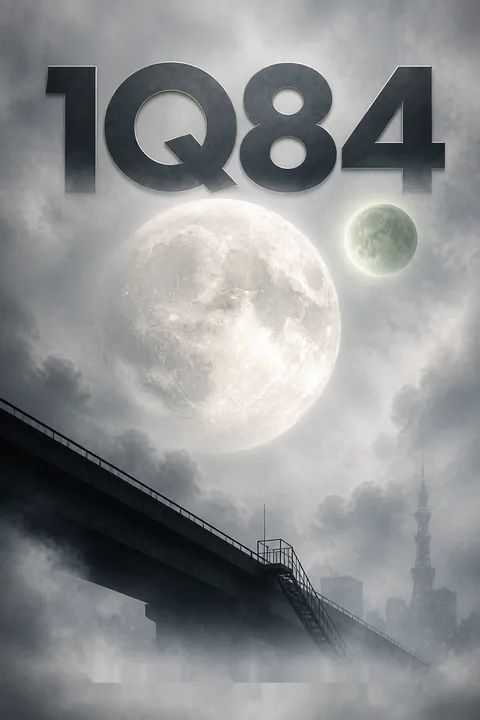


Plot Summary
The Stairway and the Needle
In April 1984, Aomame is trapped in a Tokyo traffic jam with an urgent appointment ahead. A taxi driver directs her down an emergency stairway from the expressway, warning that ordinary appearances may soon feel unreliable. She descends in stockings, reaches the city, and notices a policeman wearing a uniform and carrying a weapon she does not recognize.
At a Shibuya hotel, she disguises herself as an employee and enters the room of Miyama, an oil specialist who has brutally abused his wife. Using a needle sharpened to find a lethal point at the base of the brain, Aomame kills him and makes his death look like a heart attack. Her work is precise, but the changed policeman leaves a question she cannot ignore.
Aomame’s first decisive act is both practical and morally charged: she uses bodily expertise to answer violence that the legal system has failed to stop. The emergency stairway matters because it is an ordinary route repurposed into a threshold. Yet the unfamiliar uniform unsettles the confidence with which she moves between worlds. Her discipline protects her, but it cannot explain why reality itself seems to have shifted.
Komatsu's Dangerous Edit
Tengo, a mathematics teacher and unpublished novelist, reads Air Chrysalis while screening competition entries for his editor, Komatsu. The story is clumsy but strangely powerful, and Komatsu proposes a scheme: Tengo will rewrite it while seventeen-year-old Fuka-Eri receives sole credit.
Tengo recognizes the fraud and worries about professional ethics, but the chance to shape the story grips him more strongly than his objections. The plan promises a prize, publicity, and money, while Komatsu hopes to embarrass a literary establishment he despises.
Tengo’s private life has been built around avoiding obligations and attention. Accepting the rewrite therefore changes more than his workload: for the first time, he chooses a risky act because a story seems to demand it of him.
The collaboration begins as a transaction, but each man invests a different desire in it. Komatsu treats literature as both a weapon against institutions and a game he believes he can control. Tengo is drawn less by ambition than by the story’s unresolved force. His choice exposes the weakness in his carefully managed neutrality: refusing responsibility has been his way of surviving, but writing now makes him responsible for what his words release.
The Girl Who Didn't Submit
When Tengo meets Fuka-Eri, she tells him she did not submit Air Chrysalis and has no wish to become a novelist. Her younger companion, Azami, typed the story from Fuka-Eri’s dictation and sent it in. Fuka-Eri has difficulty reading and writing at length, but the limitation has not dulled her imagination.
She gives Tengo permission to change the manuscript, apparently unconcerned with authorship or reputation. Then she insists the Little People in the story actually exist and asks Tengo to meet her guardian, Professor Ebisuno. The meeting becomes less a negotiation over a manuscript than an entry into a world Fuka-Eri treats as factual, while Tengo remains unsure whether her certainty is insight or warning.
Fuka-Eri’s silence is not emptiness. It is a refusal to perform the familiar social exchange in which an author explains, claims, and markets a work. Her story has value to her before it becomes a public object. Tengo’s impulse to make it readable gives that private material a new reach, but also changes who can use it. Her insistence that the Little People are real unsettles the distinction between imaginative creation and testimony.
A Commune Turns Inward
Professor Ebisuno explains that Fuka-Eri grew up in Sakigake, a farming commune founded by her father, Tamotsu Fukada, after the student movements of the late 1960s. The community split: the moderate group remained Sakigake, while militant members formed Akebono and later fought police in a deadly mountain gun battle.
Sakigake then became a legally protected religious organization, closed its gates, and stopped communicating with Ebisuno. Fuka-Eri had escaped to his home as a silent ten-year-old, but her parents had never contacted her again. Though Ebisuno fears that the group has changed radically, he allows Tengo to rewrite the story, hoping its publication might draw attention to what happened inside.
Ebisuno’s account reframes the novel as a possible record of institutional change. Sakigake began with a political ideal of communal life, then acquired the protections and secrecy of religion. The shift is not merely ideological: it removes outside scrutiny and leaves a child’s disappearance unresolved. Ebisuno’s consent is therefore strategic as well as protective. He accepts a literary fraud because he believes fiction may reach places where formal investigation cannot.
A Bestseller Without Its Author
Tengo spends ten days reshaping Air Chrysalis, preserving Fuka-Eri’s strange story while giving it a clear, compelling form. The competition judges choose it unanimously. Fuka-Eri attends the press conference, answers questions in her own disarming way, and the magazine sells out; the book then climbs the bestseller lists.
Publicity draws scrutiny toward her background and Sakigake. Before the hardcover edition appears, Fuka-Eri disappears from both her country home and Tokyo apartment.
Professor Ebisuno files a search request, while Komatsu urges Tengo to stay silent about the rewrite. Fuka-Eri later sends Tengo a tape saying she is safe and has chosen to hide, but warns him that the Little People may be angry their story has entered print.
The book’s success turns private material into a force the creators cannot govern. The deception initially appears to protect Fuka-Eri by letting the work reach readers, but publicity makes her past visible to the very organization she escaped. Tengo’s craft gives the story a wider audience, while the fame attached to her name exposes her to danger. The tape preserves her agency, yet its warning makes authorship feel less like invention than an act with consequences.
Aomame Names 1Q84
After seeing a policeman with unfamiliar equipment, Aomame checks old newspapers and discovers that major events are missing from her memory: a bloody gun battle at Lake Motosu, a collector’s stabbing, and a change in police weapons. A bartender confirms that the new uniforms have existed for years, not days.
Aomame concludes that the world, rather than her memory, may have changed. That night she sees two moons, one familiar and one small and green. She names this altered year 1Q84, a year marked by a question. The theory does not make the changes easier to explain, but it gives her a way to track them, compare evidence, and adapt before the differences become dangerous.
Aomame responds to the impossible with the habits that have kept her alive: dates, records, comparison, and a provisional theory. Calling the year 1Q84 does not solve the mystery; it gives the mystery a usable boundary. The second moon is both evidence and an instrument of estrangement. Her method is rational, but the facts she gathers exceed rational explanation, forcing her to live with uncertainty without surrendering judgment.
Ayumi's Last Night
Aomame meets Ayumi, a lively policewoman frustrated by the routine and sexism of her job. The two women begin sharing dinners and nights out, and Ayumi’s openness gradually draws Aomame into something like friendship. Ayumi also reveals that male relatives abused her when she was a child, helping explain why she seeks intimacy with strangers yet fears lasting attachment.
Aomame recognizes the parallel with her own guarded life but keeps emotional distance. Then Ayumi is found strangled in a Shibuya hotel, handcuffed and alone. Aomame grieves for her and understands that Ayumi’s risky encounters were not simply appetite. They were a way to quiet an old wound, and Aomame’s caution may have left her without the companionship she needed.
Ayumi’s cheerfulness is a social skill, not proof that she is unhurt. Her police uniform gives her authority at work, but it cannot undo the childhood violations that shape her private choices. Aomame understands the danger yet protects herself by withholding closeness. Ayumi’s death makes that defense feel costly: Aomame cannot know whether greater intimacy would have changed events, but she must face the fact that she declined a bond she valued.
Tsubasa's Silent Testimony
The dowager shelters Tsubasa, a ten-year-old girl who has fled Sakigake nearly unable to speak. Medical evidence shows that she has suffered repeated sexual violence, and the dowager believes the cult’s secretive Leader has abused several prepubescent girls. Tsubasa names the Little People but cannot explain what they mean.
The dowager, whose own daughter died after domestic abuse, asks Aomame to help stop the Leader because legal channels cannot protect the child or reach the closed religious compound. She explains that the Leader travels under heavy security but has a private physical weakness. Aomame accepts the mission, knowing that afterward she may have to abandon her name, face, work, and life in Tokyo.
Tsubasa’s silence turns her body into evidence that she cannot yet narrate. The dowager refuses to treat the absence of a usable testimony as proof that nothing happened; she trusts the medical findings and acts where institutions hesitate. Her response carries the risk of repeating private vengeance, but it is also rooted in an attempt to protect future victims. Aomame’s consent arises from recognition: she sees in Tsubasa the child she might have become.
The Leader's Bargain
Aomame reaches the heavily guarded hotel suite disguised as a stretching instructor. After the bodyguards search her, she meets the Leader in a darkened room and works methodically on his painfully obstructed muscles. During the session he reveals that his paralysis brings episodes in which young shrine maidens are expected to have sex with him, a practice he frames as religious duty.
He also admits that unseen Little People have given him power and that he knows Aomame intends to kill him. Rather than resist, he asks her to end his worsening pain. He offers a bargain: if she takes his life, he will protect Tengo from the Little People’s retaliation. Aomame must choose without proof that the bargain is true.
The meeting overturns Aomame’s planned script. The target is neither simply a predator nor merely a symbol of cultic power; he is also a suffering man who understands his own death as necessary. His account cannot excuse his actions, but it complicates the clean moral categories Aomame relies on. The bargain makes her choice relational: she is asked to risk herself for someone she has loved silently since childhood.
The Father and the Cats
Tengo travels to the Chikura sanatorium to face the father who dragged him on Sunday rounds collecting NHK fees. As a boy, Tengo had hated being used to persuade strangers to pay. Now his father’s memory is failing, and he speaks in fragments about a mother who left and a son who may not be his by blood.
He describes himself as having filled a vacancy, leaving Tengo with no certain origin. Tengo reads him a story about a traveler trapped in a town ruled by cats, and his father recognizes the place as a metaphor for being lost. The visit does not produce a complete family history, but it loosens Tengo’s hatred and gives him a new way to understand his father’s silence.
The father’s account does not resolve Tengo’s identity; it gives uncertainty a shape. The image of a vacancy is more honest than the tidy story of a dead mother and dutiful father, but it remains incomplete. Tengo’s willingness to listen marks a change in him: he no longer demands that the past become a simple explanation before he can respond with compassion. The cat town makes disorientation tangible without pretending it can be escaped by logic alone.
The Storm's Strange Union
After vanishing into hiding, Fuka-Eri returns to Tengo’s apartment and insists they should stay together because the Little People are stirring. During a violent thunderstorm, she asks him to hold her as part of a purification and to help them enter the town of cats. Tengo becomes temporarily paralyzed and relives the classroom moment when Aomame gripped his hand at ten.
His body responds involuntarily, and Fuka-Eri initiates intercourse, explaining afterward that she cannot become pregnant. The event leaves Tengo shaken and unable to tell where memory, ritual, and physical reality meet. By morning she has gone home, leaving him with a charged memory and the suspicion that he has been changed.
The scene binds Tengo’s childhood memory to his present body, turning an old emotional event into something physical and consequential. Fuka-Eri describes the encounter as necessary, not romantic, while Tengo experiences it through confusion and involuntary response. Their asymmetry matters: she knows more about the ritual than he does, but cannot fully explain it. The body becomes a site where meanings arrive before the mind can interpret them.
Ushikawa's Offer and Threat
Toshiharu Ushikawa visits Tengo at the cram school, claiming to represent a foundation offering him a generous writing grant. The offer is a pretext: Ushikawa knows Tengo helped rewrite Air Chrysalis and warns that powerful people are monitoring him. Later he returns with a sharper bargain, promising safety if Tengo disowns the book and forgets his involvement.
Tengo refuses to abandon the others. Meanwhile, Komatsu disappears from work and is eventually revealed to have been held by Sakigake, where he was ordered to stop the novel’s publication. He agrees to comply to prevent further harm, but Tengo remains entangled. Ushikawa’s knowledge of Tengo’s private life, including a missing lover, makes the danger personal.
Ushikawa’s offer disguises coercion as generosity. The grant would buy time, but its true price is isolation: Tengo must deny the relationships and work that have brought him into danger. His refusal is not a grand act of heroism so much as an inability to separate his fate from others’. Komatsu’s captivity reveals how quickly the literary scheme has become material force, while Ushikawa’s surveillance shows that private life itself is now a pressure point.
A Needle Ends the Voice
After the Leader permits her to work on his body, Aomame finds the precise point at the back of his neck and raises her handmade needle. He knows what she intends and says he wants death, but she hesitates when he reveals that the Little People’s power may be checked by his death. He also tells her that Tengo is in danger because Air Chrysalis has carried the Little People’s story into the world.
Aomame finally accepts the bargain: she will kill the Leader, and in return Tengo will be spared. She drives the needle into the point, waits until his pulse stops, and leaves his body apparently asleep. The storm continues outside as she walks away, unsure what price she has agreed to pay.
Aomame’s hesitation is the moral center of the act. Her earlier killings depended on certainty: the victim’s brutality, the method, and the consequence were all contained within a controlled plan. Here she acts on a promise from a man whose account is unverifiable. She chooses Tengo over her own safety, but the bargain also exposes how love can become a form of vulnerability that others can use.
A Positive Test, No Exit
Aomame hides in the dowager’s safe apartment after the killing. A home test confirms what she already sensed: she is pregnant, though she has had no sexual encounter that could explain it. She believes the child is Tengo’s and refuses to let the dowager move her before she has a chance to find him.
When she tries to repeat her original descent from the expressway, the emergency stairway is gone. At another moment she sees Tengo on the playground slide, rushes downstairs, and arrives after he has left. She considers using her pistol on herself rather than be captured, but the possibility of meeting Tengo keeps her alive. She resumes watching the slide, carrying both a child and a promise.
The pregnancy converts an abstract connection into a vulnerable future, while the missing stairway confirms that Aomame cannot simply reverse her passage into 1Q84. Her near-suicide is not overcome by a general hope for life; it is postponed by a specific hope for Tengo. The missed encounter sharpens the cost of waiting. She has discovered the person she sought, but the world still controls when their paths can meet.
The Tracker's Last Lead
Ushikawa traces Aomame’s contacts to the dowager’s safe house and watches Tengo’s apartment from a nearby unit. He discovers that Tengo and Aomame were childhood classmates, then sees the two moons himself while spying on Tengo at the playground. Before he can report what he has learned, Tamaru enters the building and confronts him.
Ushikawa tries to bargain, but Tamaru kills him quietly and removes the camera, photographs, and other evidence. The body is taken away before the police can connect it to the investigation. The death breaks the immediate surveillance threat, but it does not end the danger surrounding Aomame, Tengo, or the Little People.
Ushikawa’s investigation turns him from a grotesque outsider into a person capable of genuine perception. His discovery of the second moon confirms that the world cannot be reduced to the cult’s claims or Aomame’s private theory. Tamaru’s killing protects Aomame, but it also repeats the secrecy and violence that have shaped her life. The narrative offers no clean boundary between defense and complicity.
The Child in the Chrysalis
After his father falls into a coma, Tengo returns to the sanatorium and spends his days reading aloud beside the bed. His father dies without waking. When Tengo returns to the room after the body has been taken away, he finds a glowing air chrysalis in the hollow of the bed. Inside lies a sleeping ten-year-old girl: Aomame as he remembers her from their classroom.
Tengo opens the chrysalis and touches her hand, recognizing the warmth he has carried in memory for twenty years. The vision does not explain how she arrived there, but it makes his search concrete. He leaves the sanatorium with a promise to find her, now certain that their lives are joined in this two-moon world.
The air chrysalis transforms Tengo’s abstract longing into a physical encounter with memory. The girl is not an explanation of Aomame so much as a preserved point of contact, the moment when his life first altered. His father’s death leaves him without a conventional origin story, but the chrysalis supplies another kind of inheritance: a promise carried through touch. The supernatural event does not resolve uncertainty; it gives Tengo a direction.
Two Hands, One Road
Aomame continues watching the playground, and Tengo returns there, drawn by the memory of her hand and the sight of two moons. After an earlier near miss, she finally reaches him on the slide. They recognize each other without needing to explain the twenty years between them. Aomame tells him she is carrying his child, and he believes her.
They leave the park hand in hand, choosing to face the dangers ahead together. The clouds conceal the moons as they walk away. The novel does not show them fully escaping 1Q84 or explain what waits beyond the next turn; it ends with their reunion, their unborn child, and the decision not to let go of one another again.
The ending resolves the emotional question posed by the childhood handclasp, not the metaphysics of the two moons. Aomame and Tengo finally make contact as adults, and their shared future replaces the solitary, imagined relationship each had maintained. Their child intensifies the stakes, but does not guarantee safety. The clouds hide the world’s signs rather than erase them. They walk forward with uncertainty intact, sustained by a bond they can now choose openly.
Analysis
1Q84 makes a private emotional history collide with systems that claim authority over reality: the publishing industry, the police, a religious organization, and the unseen Little People. Its central figures respond differently to that pressure. Aomame trusts disciplined observation and bodily skill; Tengo trusts mathematical order and the possibility that stories can carry meaning where facts cannot. Neither method remains sufficient. Aomame’s evidence points to a changed world, while Tengo’s fiction begins to shape the world he thought he was only describing.
The novel treats authorship as an ethical act rather than a neutral craft. Tengo’s rewriting helps Fuka-Eri’s story reach readers, but it also makes the story a public force and draws danger toward its source. The resulting fraud is not simply a question of who deserves credit. It raises the harder question of who controls a narrative once it begins to alter other people’s choices.
Violence in the book is repeatedly framed as an answer to powerlessness, from Aomame’s secret killings to the dowager’s effort to protect abused women. Yet the novel does not make justice clean. Aomame’s actions may stop immediate harm, but each act binds her more tightly to the systems she opposes. Love offers a different kind of resistance. Her attachment to Tengo, once preserved only as memory, becomes a mutual choice with consequences for both of them.
The two moons give the impossible a visible shape, but they do not supply certainty. The final reunion resolves the lovers’ separation without resolving the world’s rules. That incompleteness is deliberate: the characters can choose each other and keep moving, even when they cannot know what reality will demand next.
Review Summary
1Q84 receives mixed reviews but is generally praised for its complex plot, intriguing characters, and exploration of themes like love, loneliness, and parallel realities. Many readers find it captivating and beautifully written, though some criticize its length, repetitiveness, and unresolved mysteries. The novel's surreal elements and Murakami's unique style divide opinions, with some considering it a masterpiece and others finding it frustrating. Despite its flaws, many readers appreciate the book's ability to immerse them in its world and provoke deep contemplation.
People Also Read








Characters
Aomame
The disciplined survivorAomame is a thirty-year-old fitness instructor whose training in anatomy, self-defense, and bodywork gives her unusual precision. Raised in a strict religious household, she learned early to keep her feelings private and make herself inconspicuous. She values control because dependence has often meant vulnerability, yet she is not emotionally empty: she is capable of fierce loyalty and sustained love. Her history with Tengo remains central to her inner life, even while she builds an independent existence in Tokyo. Aomame’s practical intelligence makes her attentive to concrete evidence, but the altered world forces her to hold competing explanations without surrendering her judgment.
Tengo Kawana
The reluctant ReceiverTengo teaches mathematics at a cram school and writes fiction in the private hours he protects from interruption. His orderly approach to numbers contrasts with a personal history he cannot make sense of. A large, capable man, he nonetheless tends to avoid responsibility and lets others set the pace of his life. He is patient, observant, and unusually receptive to stories, though he often struggles to name what he feels. His childhood connection with Aomame becomes a lasting emotional reference point. Writing forces him to confront the difference between technical skill and authorship, and between remaining safely detached and committing himself to another person.
Fuka-Eri
The elusive storytellerFuka-Eri is a seventeen-year-old with an arresting stillness, sparse speech, and a way of seeing the world that resists ordinary explanation. She is a gifted storyteller who does not value literary convention or public recognition. Reading and writing are difficult for her, but spoken stories come naturally, and she trusts the people who can hear what she means without demanding a full explanation. She has grown up amid isolation and secrecy, and her relationship with Tengo is based on an unusual trust rather than conventional intimacy. Her calm manner can seem opaque, yet she is often the first to recognize that a change is coming.
Komatsu
The cynical editorKomatsu is a sharp, experienced literary editor who dislikes the publishing world even as he knows how to use it. He recognizes potential in both Fuka-Eri’s story and Tengo’s technical skill, and combines them in a scheme meant to produce a remarkable book. His intelligence is matched by impatience and self-interest; he can persuade others to take risks while underestimating the cost. He has mentored Tengo for years, offering rigorous editorial advice, but their closeness is shaped by professional dependence rather than open friendship.
Professor Ebisuno
Fuka-Eri's guardianA former cultural anthropologist, Professor Ebisuno now lives in the mountains and watches events from a deliberate distance. He is analytical, self-contained, and deeply skeptical of organizations that claim moral authority. His long friendship with Tamotsu Fukada gives him a personal stake in Sakigake’s transformation, while his care for Fuka-Eri keeps that concern from becoming mere intellectual curiosity. He is willing to use unconventional means when ordinary institutions fail, but he understands that his plans may create dangers he cannot control.
The Dowager
The shelter's benefactorThe dowager is a wealthy, discreet woman who devotes part of her fortune to protecting women and girls in danger. Her calm manners conceal a formidable will and a sharp understanding of how social power works. She values Aomame’s skill and trusts her judgment, while also treating her with a tenderness that Aomame has rarely experienced. Her own family history gives her a personal understanding of abuse and loss. She is capable of patience, but when institutions fail to act, she is prepared to create an alternative.
Tamaru
The watchful bodyguardTamaru manages security for the dowager and her safe house. A trained bodyguard with a disciplined manner, he is observant, practical, and wary of sentiment that clouds judgment. He is also quietly compassionate, especially toward people who have been left without protection. His background as an orphan has made him self-reliant and careful about what he owes others. Tamaru’s loyalty is not blind: he weighs risks constantly, but once he accepts responsibility for someone, he takes that responsibility seriously.
Toshiharu Ushikawa
The persistent investigatorUshikawa is a private investigator and fixer whose disconcerting appearance makes him easy to remember and difficult to trust. He is patient, resourceful, and skilled at gathering information that others would rather keep hidden. Years of exclusion have made him observant about the motives of people who assume they are overlooked. He works for whoever can pay, but he is not merely a mechanical tool: he has curiosity, pride in his craft, and occasional flashes of sympathy. His persistence makes him dangerous even when he seems ridiculous.
Ayumi Nakano
The candid policewomanAyumi is a young police officer who wants meaningful work but is often assigned routine duties in a male-dominated department. Cheerful, sociable, and quick to read a room, she approaches Aomame with an openness that gradually becomes friendship. Her sense of humor and lively confidence help others relax, though they do not erase her private vulnerability. Ayumi is frank about sex and intimacy, and her choices are shaped by a difficult personal history she rarely discusses. She offers Aomame a rare chance at companionship.
Tamotsu Fukada, the Leader
Sakigake's hidden authorityTamotsu Fukada founded Sakigake after leaving university activism and helped shape its early communal life. He is a powerful presence whose public invisibility makes him difficult to understand from outside the group. Professor Ebisuno remembers him as a brilliant, charismatic thinker, while the organization around him treats him as a sacred authority. His history joins political idealism, religious power, and private secrecy. He is central to Fuka-Eri’s past and to the questions that draw Aomame and Tengo into Sakigake’s orbit.
Tsubasa
The silent childTsubasa is a ten-year-old girl taken into the dowager’s care after arriving in a deeply withdrawn state. She speaks little and reveals almost nothing about her past, but her presence forces the adults around her to act on evidence they cannot fully interpret. The dowager treats her with patience, while Aomame recognizes the vulnerability of a child whose choices have been controlled by adults. Tsubasa’s quietness is not consent or passivity; it is the only protection she knows how to use.
Tamaki Otsuka
Aomame's first confidanteTamaki is Aomame’s closest friend from high school and a gifted softball player who balances Aomame’s intensity with strategic intelligence and warmth. She grew up in a troubled, affluent household and found refuge in the team and in her friendship with Aomame. Tamaki is academically capable and socially perceptive, though her romantic choices do not always reflect that judgment. She teaches Aomame many of the social skills and small freedoms that her childhood denied her.
Kyoko Yasuda
Tengo's older loverKyoko is a married woman ten years older than Tengo, with whom he maintains a private, carefully bounded relationship. She is perceptive, emotionally articulate, and comfortable taking the lead in their intimacy. Her family life and private desires remain largely separate from Tengo’s, which suits his preference for low-demand relationships. She is one of the few people who can make him feel at ease, though the limits of their arrangement leave much unsaid.
Azami
Fuka-Eri's young collaboratorAzami is Professor Ebisuno’s daughter and Fuka-Eri’s close companion. She helps convert Fuka-Eri’s spoken stories into typed manuscripts and shares a private history with her that the adults do not fully understand. Her practical assistance gives Fuka-Eri’s imagination a written form without making Azami the source of the story.
Tengo's father
The NHK collectorTengo’s father makes his living collecting broadcasting fees door to door, work he performs with relentless discipline. A man shaped by poverty and hard labor, he values endurance and institutional order more than curiosity or emotional conversation. He takes Tengo along on his rounds, believing work and responsibility should be learned early. Their relationship is defined by silence, resentment, and a shared inability to discuss the past directly.
Kumi Adachi
The warm-hearted nurseKumi is a young nurse at the seaside sanatorium where Tengo’s father is treated. Friendly and candid, she speaks openly with Tengo and invites him into the small social world she shares with her colleagues. She is curious about his life and willing to offer companionship, but she also carries an inner life that Tengo cannot fully read.
Plot Devices
Janáček's Sinfonietta
A musical thresholdThe Sinfonietta connects Aomame and Tengo before they understand their connection. It accompanies Aomame’s descent from the expressway, and its opening fanfare returns at moments when the ordinary world seems to shift. For Tengo, the piece is tied to music, memory, and his path from mathematics toward fiction. The recurring composition functions less as a clue to solve than as a signal that separate strands of experience are moving toward each other.
Air Chrysalis
A story that changes realityFuka-Eri’s tale describes a girl, a blind goat, the Little People, and an air chrysalis. Tengo’s rewrite gives it a form that readers can enter, while its publication draws attention to Sakigake and appears to affect the world around its characters. The novel-within-the-novel becomes both a contested act of authorship and a possible record of events the characters cannot otherwise explain. Its influence raises the story’s central question: can telling something make it more real, or merely reveal what was already there?
The Two Moons
A visible world markerThe small, greenish moon beside the familiar one marks the altered world Aomame calls 1Q84. It gives both protagonists a concrete sign that their surroundings no longer match the world they remember. Yet the moons do not explain who changed the world, or why. They function as evidence, a shared landmark, and a reminder that reality can remain materially solid even when its rules become impossible to trust.
The Little People
An unseen competing powerThe Little People emerge through the story of Air Chrysalis and are treated by Fuka-Eri as real beings. They can make air chrysalises, influence the religious world of Sakigake, and appear to exert power through human agents. The novel never gives them a stable moral category or a complete explanation. Their chief function is to unsettle easy divisions between good and evil, private belief and public action, and fictional invention and lived experience.
The Emergency Stairway
A threshold between worldsThe stairway gives Aomame a way off the stalled expressway and into the city, marking her first deliberate departure from ordinary routes. Later, she returns to the same place and finds the exit she used is no longer there. The stairway therefore acts as a practical escape route and a measure of how far the world has changed. Its recurrence turns a piece of city infrastructure into a question about whether passage between realities can be reversed.
FAQ
Synopsis & Basic Details
What is 1Q84 about?
- Parallel worlds intertwine: The story follows Aomame and Tengo as they navigate seemingly separate but increasingly interconnected realities, one of which is a subtly altered version of 1984.
- A quest for truth and love: Both characters are drawn into dangerous situations, driven by a desire for truth and a longing for connection, while grappling with their own pasts and moral dilemmas.
- A blend of genres: The novel combines elements of mystery, thriller, fantasy, and romance, creating a unique and thought-provoking narrative that explores the nature of reality and the human condition.
Why should I read 1Q84?
- Intricate plot and characters: The novel offers a complex and engaging plot with well-developed characters, each with their own unique motivations and secrets.
- Exploration of profound themes: 1Q84 delves into themes of reality, identity, love, and the blurred lines between good and evil, prompting readers to question their own perceptions of the world.
- Murakami's unique style: The novel showcases Haruki Murakami's signature style, blending surreal elements with realistic details, creating a captivating and thought-provoking reading experience.
What is the background of 1Q84?
- Set in a fictionalized 1984: The novel is set in a version of 1984 Tokyo, where subtle but significant changes have occurred, creating a sense of unease and disorientation.
- Cultural and historical references: The story incorporates elements of Japanese culture, history, and mythology, adding depth and complexity to the narrative.
- Exploration of societal issues: The novel touches on themes of political unrest, religious cults, and the impact of violence on individuals and society, reflecting the anxieties of the time.
What are the most memorable quotes in 1Q84?
- "Things are not what they seem": This quote, spoken by the taxi driver, foreshadows the altered reality Aomame enters and highlights the novel's theme of deception and hidden truths.
- "There's always only one reality": This quote, also from the taxi driver, emphasizes the novel's exploration of the nature of reality and the characters' struggle to find their place within it.
- "I move, therefore I am": Aomame's mantra reflects her determination to take action and assert her existence in a world where she feels like an outsider.
What writing style, narrative choices, and literary techniques does Haruki Murakami use?
- Surreal and dreamlike atmosphere: Murakami blends realistic details with surreal and dreamlike elements, creating a unique and unsettling atmosphere that blurs the lines between reality and fantasy.
- Alternating perspectives: The novel shifts between the perspectives of Aomame and Tengo, allowing readers to experience the story from multiple viewpoints and gain a deeper understanding of their individual journeys.
- Subtle foreshadowing and thematic echoes: Murakami uses subtle foreshadowing and thematic echoes to create a sense of interconnectedness and to hint at the deeper meanings of the story.
Hidden Details & Subtle Connections
What are some minor details that add significant meaning?
- Janáček's Sinfonietta: The music playing in the taxi is not just a random choice; it foreshadows Aomame's shift into 1Q84 and the themes of history and fate.
- The two moons: The appearance of two moons in the sky is a recurring motif that symbolizes the altered reality and the characters' connection to it.
- The rubber plant: The neglected rubber plant on the balcony symbolizes the characters' isolation and the decay of the world around them.
What are some subtle foreshadowing and callbacks?
- The taxi driver's warnings: The taxi driver's cryptic remarks about appearances and reality foreshadow the changes Aomame will experience and the challenges she will face.
- The recurring image of the moon: The moon's presence throughout the novel serves as a constant reminder of the altered reality and the characters' connection to it.
- The mention of the Akutagawa Prize: The mention of the Akutagawa Prize early in the novel foreshadows the literary scheme that will entangle Tengo and Fuka-Eri.
What are some unexpected character connections?
- Aomame and Tengo's shared past: The revelation that Aomame and Tengo were classmates in elementary school adds a layer of complexity to their relationship and suggests a deeper connection beyond their current circumstances.
- The dowager and Aomame's shared trauma: The dowager's confession about her daughter's suicide and her own act of revenge creates a bond with Aomame, highlighting their shared experiences of loss and violence.
- Komatsu and Professor Ebisuno's past: The revelation that Komatsu and Professor Ebisuno knew each other from their university days adds a layer of complexity to their relationship and suggests a shared history of political activism.
Who are the most significant supporting characters?
- Komatsu: As Tengo's editor, Komatsu plays a crucial role in setting the plot in motion and serves as a cynical guide for Tengo's journey.
- Professor Ebisuno: As Fuka-Eri's guardian, the Professor provides insights into her past and the mysteries surrounding her, while also having his own hidden agenda.
- Tamaru: As the dowager's bodyguard, Tamaru is a loyal and formidable figure who provides Aomame with support and guidance, while also representing a different perspective on violence and justice.
Psychological, Emotional, & Relational Analysis
What are some unspoken motivations of the characters?
- Aomame's desire for justice: Aomame's actions are driven by a deep-seated desire for justice and a need to protect women from male violence, stemming from her own past experiences.
- Tengo's longing for meaning: Tengo's decision to rewrite Air Chrysalis is driven by a longing for meaning and a desire to connect with something beyond his mundane existence.
- Komatsu's desire to disrupt the literary world: Komatsu's plan to rewrite Air Chrysalis is motivated by a desire to disrupt the literary establishment and challenge its conventions.
What psychological complexities do the characters exhibit?
- Aomame's dual nature: Aomame struggles with the conflict between her public persona as a fitness instructor and her secret life as an assassin, highlighting the psychological toll of her actions.
- Tengo's passivity and longing: Tengo's passivity and his tendency to drift through life are contrasted with his intense desire to rewrite Air Chrysalis, revealing a complex inner world.
- Komatsu's cynicism and ambition: Komatsu's cynicism and his willingness to bend ethical boundaries reveal a complex personality driven by both ambition and a desire to challenge the status quo.
What are the major emotional turning points?
- Aomame's encounter with the altered world: Aomame's descent from the expressway and her realization that she is in a different world mark a major emotional turning point, forcing her to question her perceptions of reality.
- Tengo's decision to rewrite Air Chrysalis: Tengo's decision to rewrite Air Chrysalis marks a turning point in his life, as he becomes increasingly entangled in the story's mysteries and the ethical dilemmas it presents.
- Aomame's discovery of her pregnancy: Aomame's discovery of her pregnancy marks a major emotional turning point, as she grapples with the implications of carrying a child in a world where she is both a killer and a target.
How do relationship dynamics evolve?
- Aomame and Tamaru's bond: Aomame and Tamaru develop a bond based on mutual respect and shared experiences of violence and loss, creating a complex dynamic that transcends their professional relationship.
- Tengo and Komatsu's collaboration: Tengo and Komatsu's collaboration is marked by a mix of mutual respect and underlying tension, as they navigate the ethical complexities of their literary scheme.
- Tengo and Fuka-Eri's connection: Tengo and Fuka-Eri's relationship is marked by a sense of mystery and unspoken understanding, as they are drawn together by their shared connection to Air Chrysalis and the Little People.
Interpretation & Debate
Which parts of the story remain ambiguous or open-ended?
- The nature of the Little People: The true nature and motives of the Little People remain ambiguous, leaving readers to question their role in the story and their connection to the altered reality.
- The meaning of the two moons: The symbolism of the two moons is open to interpretation, with readers left to ponder their significance in the characters' lives and the larger narrative.
- The ultimate fate of the characters: The ending of the novel leaves the ultimate fate of Aomame and Tengo open-ended, prompting readers to consider the possibilities of their future and the nature of their connection.
What are some debatable, controversial scenes or moments in 1Q84?
- Aomame's assassinations: Aomame's actions as an assassin raise ethical questions about the nature of justice and the use of violence, prompting readers to consider the moral implications of her choices.
- Tengo's participation in the literary scheme: Tengo's decision to rewrite Air Chrysalis raises questions about the ethics of co-authorship and the manipulation of literary prizes, prompting readers to consider the role of ambition and integrity in the creative process.
- The nature of the Little People: The Little People's role in the story and their connection to the altered reality are open to interpretation, with readers left to debate whether they are benevolent or malevolent forces.
1Q84 Ending Explained: How It Ends & What It Means
- Aomame and Tengo's reunion: The novel ends with Aomame and Tengo reunited on the Metropolitan Expressway, suggesting a return to the original world, but the nature of their reunion and their future remains ambiguous.
- The cyclical nature of time: The ending hints at the cyclical nature of time and the possibility of alternate realities, leaving readers to ponder the characters' fates and the larger implications of their journey.
- The power of love and connection: Despite the ambiguity and uncertainty, the ending emphasizes the power of love and connection to transcend time and space, suggesting that even in a world of shifting realities, human relationships remain a source of hope and meaning.
About the Author
Other books by Haruki Murakami







Download PDF
Download EPUB
.epub digital book format is ideal for reading ebooks on phones, tablets, and e-readers.








