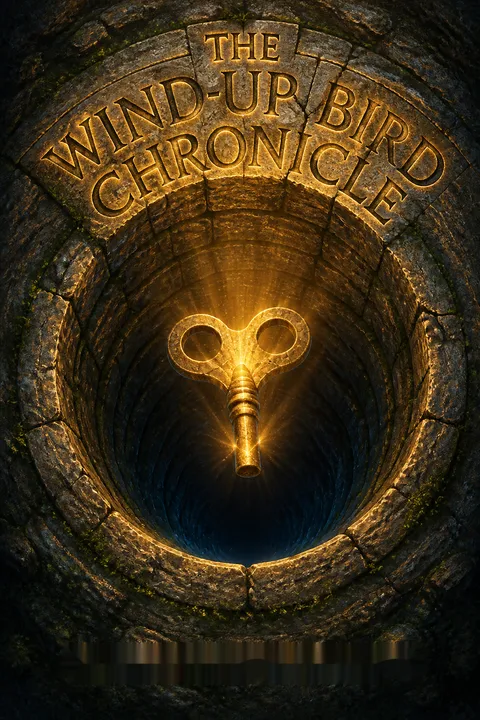


Plot Summary
The Missing Cat Rings
Thirty-year-old Toru Okada has quit his law office without a plan, leaving him at home to cook, clean, and wait for work. His wife Kumiko supports the pause, but their cat has been missing for over a week, and she believes it lingers near an abandoned house. As Toru prepares spaghetti, an unknown woman calls, knows he is unemployed, and insists they have met before.
Her intimate, unsettling call leaves him staring at the silent phone. Kumiko later mentions visiting the alley without explaining why and asks him to search for the cat. Toru agrees, distracted by the wind-up bird whose unseen cry seems to mark each morning, and by a marriage whose ordinary routines are beginning to feel less secure.
The opening makes absence physical before it makes it dramatic. Toru has withdrawn from paid work, the cat has vanished, and a caller claims intimacy without offering a verifiable identity. His routines give him control over domestic details, but not over the meanings those details may carry. Kumiko's unexplained visits to the alley introduce a gap between shared life and private knowledge. The missing cat therefore initiates more than a search: it exposes Toru's habit of treating quietness as evidence that nothing important is happening.
The Alley’s Watcher
Following Kumiko's directions, Toru climbs a wall into a narrow passage sealed at both ends. At the abandoned Miyawaki property, a stone bird spreads its wings above an overgrown garden, but no cat appears. May Kasahara, a sixteen-year-old who watches the alley from her family's yard, recognizes the brown striped cat and says neighborhood cats cross her lawn.
She invites Toru to wait with her, then describes a motorcycle accident that has left a scar by her eye and made school difficult. May questions him about death, bodies, and what makes people different. When she later shows him the vacant house's dry well, Toru remembers a warning from an old fortune teller: sometimes a person must go down into the deepest well.
May turns Toru's solitary search into an encounter with another person who studies absence rather than smoothing it over. Her questions unsettle him because she refuses the adult assumption that frightening subjects should be softened or postponed. The dried well, the bird statue, and the blocked alley all interrupt ordinary movement in different ways. Together they make the neighborhood feel like a system whose routes have been cut off. Toru has not yet chosen to enter that system, but May gives his idle curiosity a concrete destination.
Malta’s Unwelcome Warning
Kumiko arranges for Toru to meet Malta Kano, a consultant known for unusual intuitions. Malta says the missing cat has left the neighborhood and may never return, then reveals that her younger sister was sexually violated by Kumiko's brother, Noboru Wataya. She insists the matter is not about police or blame, but about a deeper disturbance she calls a change in the body's elements.
Malta asks Toru to picture something he saw that day and holds his hand in silence. She predicts that difficult changes are beginning and tells him he will find his missing polka dot tie outside the house. The tie turns up at a cleaner's, forgotten there for months, making Toru take Malta's unsettling claims more seriously.
Malta's authority rests less on explanation than on an uncanny accuracy that changes Toru's threshold for belief. The lost tie is a modest, testable prediction, while her claim about Noboru introduces a much graver violation without offering a familiar route to justice. Her refusal to reduce the problem to evidence or accusation frustrates Toru, who wants practical facts. Yet the recovered tie gives the supernatural language a foothold in daily life. The result is not certainty but a destabilizing willingness to treat coincidence as information.
Mamiya’s Desert Well
After the fortune teller Mr. Honda dies, his former comrade Lieutenant Tokutaro Mamiya brings Toru an unopened keepsake and recounts their wartime mission in Mongolia. Mamiya crossed the Khalkha River with a secret Japanese unit, watched the agent Yamamoto be skinned alive by Mongolian soldiers, and was thrown into a dry well.
For days he endured broken bones, thirst, and a brief shaft of sunlight that seemed to offer revelation before vanishing. Corporal Honda, whose strange foresight had predicted Mamiya would survive, eventually found and rescued him.
Mamiya returned to Japan physically and emotionally emptied, then spent decades teaching. The keepsake from Honda is an empty whiskey box, leaving Toru with a vivid story but no explanation.
Mamiya's account gives the novel's central image of descent a historical cost. His well is not an abstract symbol but a place where military violence, thirst, and enforced waiting strip a person of any stable relation to the future. Honda's prophecy saves Mamiya's body while seeming to burden him with survival. The empty box sharpens the contradiction: the gift is not an object but the encounter and testimony itself. Toru receives no usable instruction, only evidence that an apparently ordinary life can be permanently altered by a hidden event.
Creta’s Pain Ledger
Creta Kano, Malta's younger sister, visits Toru to collect samples of the household water, then begins recounting a life governed by relentless physical pain. On her twentieth birthday she tries to die by crashing her brother's car, but survives with a broken rib and discovers that the pain has disappeared.
To repay the debts from the wreck, she becomes a prostitute, then is forced into a criminal network that films and blackmails her. Her body feels numb until Noboru Wataya, one of her clients, touches her in a way that restores sensation and tears open something she cannot name. Creta leaves before finishing the story. Later she returns, completes it, and asks Toru to help her mark an end to the identity imposed on her.
Creta's history refuses a simple equation between pain and injury. Physical suffering is first her entire identity, then its sudden disappearance leaves her not liberated but detached from her own body. Sexual exploitation deepens that split, while an encounter with Noboru restores sensation through an experience Creta describes as both pleasure and violation. Her account complicates any clean distinction between healing and harm. Toru's role is not to interpret her for her, but to listen as she tries to construct a self from experiences that have made her feel like a vessel for other people's actions.
Kumiko Leaves at Dawn
One morning Kumiko fails to come home or report to work. Toru discovers that she has taken almost none of her clothes, but the cleaner confirms she collected a blouse and skirt before disappearing. May calls Kumiko's office and learns that she missed work on both days, contradicting any hope that the absence is a routine delay.
Malta calls soon after and says the cat is unlikely to return, then urges Toru to wait for a call from someone whose name begins with O. Toru paces, cooks without appetite, and tries to make the sparse facts cohere. The ordinary house becomes a place organized around what is missing: Kumiko's breakfast chair, her clothes, and the explanation she has not given.
The disappearance is rendered through small discrepancies rather than a dramatic confrontation. Kumiko's absence from work, the clothes collected at the cleaner's, and the untouched wardrobe create a pattern Toru can infer but cannot confirm. His search for facts is also a search for permission to believe what he fears. Domestic objects become evidence, but evidence cannot tell him what Kumiko intended or whether she was free to leave. The scene exposes the limits of intimate knowledge: shared routines make absence legible, yet they do not explain the person who has gone.
Wataya Demands a Divorce
At a hotel tearoom, Toru meets Malta and Noboru Wataya, who says Kumiko has had a lover for months and wants to end the marriage. He presses Toru to sign divorce papers and stop looking for her, describing him as an unambitious failure who has damaged Kumiko's life. Toru refuses to treat Noboru's account as a substitute for hearing from his wife.
He senses that Noboru's polished public persona hides something more dangerous and confronts him with a bluff about exposing it. Noboru's face flushes in irregular patches, and he leaves without answering. Malta tells Toru that future encounters with Noboru are unavoidable, while declining to take either man's side.
Noboru tries to convert a private marriage into an administrative problem that he can settle on his own terms. His media-trained composure makes the attack especially effective: Toru is not merely insulted but assigned a public identity as useless and blameworthy. Toru's counterattack is strategically weak because he admits inwardly that he does not know the secret he threatens to expose. Yet it interrupts Noboru's familiar pattern of controlling the exchange. Malta's refusal to adjudicate matters preserves the burden of choice for Toru, who must act without the guarantee of a reliable interpreter.
The Well Takes Toru
Searching the abandoned house, Toru climbs down its deep, dry well with water, crackers, a flashlight, and a rope ladder. He uses the darkness to reconsider his marriage and the childhood distance he had missed in Kumiko. May discovers him below, pulls up the ladder, and closes the cover, claiming she wants to test how close he can come to death.
Hunger and fear erode his concentration until he hears Creta Kano calling from above. She lowers the ladder, and Toru climbs out after several days underground. Soon afterward he discovers a blue black mark on his cheek exactly where he felt heat while passing through a wall in a dreamlike hotel room. The well has given him no answer, but has left a visible consequence.
The descent converts Toru's passive waiting into a bodily confrontation with vulnerability. Without light, food, or a clear sense of time, his carefully managed detachment fails; he must depend on another person's decision to live. May's cruelty is mixed with curiosity, while Creta's rescue is both practical and unexplained. The mark carries the well's experience back into ordinary daylight, refusing to let Toru classify it as a dream. His attempt to think his way through the marriage has instead altered his body, making investigation inseparable from physical risk.
A Mark and a Choice
After Toru returns, Kumiko's letter confirms that she had a three month affair, describes an overpowering sexual desire, and says she cannot return to the marriage. Creta tells Toru that Noboru once used her as a client and that the encounter changed her sense of self; she later chose to sleep with Toru as a deliberate boundary between that past and a new life.
May admits that her motorcycle boyfriend died after she covered his eyes during a reckless ride, and explains why she has pursued danger ever since. She plans to leave for a different school, while Creta proposes that she and Toru go to Crete. Toru declines to flee. He decides he must find Kumiko and face what has happened.
These confessions give Toru competing models of damage. Kumiko describes desire as something that overran her intentions; Creta describes a body transformed by both violation and chosen intimacy; May reveals that her provocations conceal guilt over a death. None offers a simple moral lesson, and Toru cannot repair any of their histories for them. Their disclosures instead force him to stop treating escape as a solution. His decision to pursue Kumiko is not confidence that he can restore the marriage, but a refusal to let other people define its ending in her absence.
The Empty Guitar Case
Trying to follow his uncle's advice to study ordinary faces, Toru spends days watching passersby in Shinjuku. He recognizes a singer he once heard in a Sapporo bar and tails him through a deserted district to an almost empty apartment building. The young man attacks Toru with a baseball bat, striking his shoulder and arm.
Toru fights back with kicks, takes the bat, and beats the attacker until the man falls, laughing. The black guitar case that seemed to explain the singer's presence contains nothing. Toru escapes with blood on his clothes and the bat in his hand, then dreams that the man skins himself and his skin crawls over Toru. The violence makes Toru understand that he cannot simply leave his life behind.
The assault turns Toru's passive observation into involuntary action. He enters the building believing that careful attention might clarify his situation, only to be attacked before he can speak. His response is not heroic composure but a frightening loss of control, followed by the realization that anger has divided him from himself. The empty guitar case denies an easy explanation for the singer, while the dream of transferred skin makes violence feel contagious. Toru's resolve to act grows from this encounter, but so does his fear that resistance may reproduce the very brutality he opposes.
Money for the Jinxed Lot
After months of isolation, Toru learns from a realtor that the abandoned Miyawaki property is again for sale, though its history of suicides has driven buyers away. He decides he must acquire it because the old well may be the only place from which he can reach Kumiko. In Shinjuku, a well dressed woman notices his cheek mark and offers him money if he will visit an office at a set time.
A silent, exceptionally polished young man greets him, covers his eyes with opaque swimming goggles, and leaves him alone with a woman who touches and licks the mark. Toru experiences a sexual response without understanding the encounter. The young man gives him two hundred thousand yen, which Toru uses first to buy new shoes.
Toru's search becomes materially costly: he needs the very land associated with abandonment, but has no job or collateral. The nameless woman's payment offers a way forward while making him feel that his body has become a resource others can use. The opaque goggles remove sight without providing true darkness, contrasting the controlled office ritual with the well's physical danger. His first purchase is shoes, not a grand tool or weapon, a modest attempt to reenter the world. Yet the money's source remains deliberately unclear, and dependence begins to blur with agency.
Nutmeg Opens the Residence
The nameless woman later identifies herself as Nutmeg Akasaka, a former fashion designer, and her silent son as Cinnamon. Nutmeg explains that she dislikes disorder in clothing and begins replacing Toru's worn wardrobe with carefully chosen suits, shirts, shoes, and a watch. Cinnamon drives a leased Mercedes and maintains a secluded residence built on the former Miyawaki lot.
There, Nutmeg receives wealthy women in a fitting room and touches the marks or disturbances they carry; Toru becomes part of this work, though neither mother nor son explains its full purpose. Meanwhile, the missing cat returns filthy but alive. Toru names him Mackerel, separating the animal from the name he shared as a joke with Noboru.
Nutmeg's world gives Toru structure through repeated acts of selection, care, and exact placement. Her clothing choices seem superficial until they reveal her need to control what can be seen, while Cinnamon's silence makes him both present and unreadable. The residence turns the cursed property into a functioning, guarded workplace rather than a ruin. Mackerel's return briefly restores reciprocal domestic warmth, but Toru's new name for the cat is also an act of separation from Noboru. Ordinary care persists, yet it now sits beside a concealed economy of influence.
The Zoo’s Last Animals
Nutmeg recounts her childhood in Manchuria, where her father ran the Hsin ching zoo. As Soviet forces approach in August 1945, soldiers arrive to kill the dangerous animals because the zoo lacks poison and the city is collapsing.
They shoot tigers, leopards, wolves, and bears, but leave the elephants alive. Nutmeg witnesses the event only in a vision from a refugee ship, where an American submarine prepares to attack before abruptly withdrawing after Japan's surrender. Her father later disappears in the Soviet aftermath.
Cinnamon, who has heard these stories repeatedly, turns them into a computer chronicle linking the zoo, a veterinarian, soldiers, and the wind up bird. Its hidden sequence suggests his silence contains a private system of memory.
Nutmeg's account binds family memory to the machinery of war without making the two identical. The zoo's animals are killed as a logistical necessity, while the refugees on the ship become potential targets whose lives are spared by an unseen change in orders. Survival arrives through decisions made elsewhere, not through personal control. Cinnamon's chronicle reworks this inherited material rather than simply recording it. His fiction becomes a method of approaching what his mother cannot know about her father's fate, showing how a family story can preserve both memory and its unresolved gaps.
Ushikawa Names the Price
Ushikawa, an ungainly fixer working for Noboru, enters Toru's home with a key from Kumiko and says she is being looked after, though he will not explain where. On a later visit, he reveals that Noboru knows Toru is using the Miyawaki property and offers eighty million yen if Toru will abandon it. In return, Noboru may help restore Toru's relationship with Kumiko.
Toru refuses both the money and Noboru's mediation, insisting he will reach his wife himself. Ushikawa warns that the residence attracts dangerous attention and that Toru is likely to be hurt. His apparent sympathy does not soften the threat: he is a messenger for a powerful man and expects to return.
Ushikawa is unsettling because he combines genuine self-disgust with practiced coercion. He knows how to make a threat sound like counsel and a bribe like a reasonable exit. The offer exposes Noboru's real concern: not simply Toru's marriage, but Toru's presence on the jinxed property. Toru's refusal protects his autonomy at immediate material cost. It also closes off a conventional route to Kumiko, forcing him to pursue a connection that cannot be purchased, delegated, or settled through the family hierarchy.
Boris and the Chronicle
Lieutenant Mamiya writes again, describing his later years as a Soviet prisoner and his encounter in a Siberian mine with Boris, the Russian officer who had ordered Yamamoto's skinning. Boris now controls the camp through bribery and terror, using Mamiya to manage his illicit accounts. Mamiya eventually tries to shoot him, but the gun is empty; Boris lets him live and curses him to a loveless existence.
Toru reads the letter as a warning about power that survives by recruiting the people it has damaged. Around this time, Cinnamon's computer reveals one installment of his Wind Up Bird chronicle, extending Nutmeg's war story with executions in the zoo. Toru begins to see historical violence threaded into his own crisis.
Mamiya's letter revises his earlier story of passive endurance: after surviving the well, he becomes entangled in the very coercive system that destroyed his sense of agency. His failed attempt to kill Boris makes the curse less supernatural than psychological, a sentence of continued life without emotional participation. Cinnamon's chronicle echoes the episode through invented or reconstructed history, showing how violence is inherited as narrative as well as memory. Toru is not simply receiving parallels; he is learning that survival alone does not determine whether a person remains free.
Room 208 Opens
After using Cinnamon's computer to exchange messages with Kumiko, Toru enters the hotel world through the well and reaches Room 208. A woman inside speaks in a voice he associates with the mysterious caller and urges him to discover her name if he wants to find Kumiko. When someone knocks and enters, she pulls Toru through the wall into darkness.
Later, Toru reaches the room again, finds it deserted, and follows the whistling waiter back to it. A knife wielding intruder attacks him there. Toru uses a bat to fight back, then returns through the wall to the well, where water has surged into the previously dry shaft. Unable to move as the water rises, he faces death before Cinnamon pulls him out.
Room 208 and the well function as connected but unstable spaces, each demanding that Toru surrender ordinary proof of where he is. The intruder's knife makes the imagined violence bodily, while the bat gives Toru a means of resistance whose moral cost is immediate. His return to a flooded well reverses the familiar refuge: the place that once gave him a controlled darkness now threatens to drown him. Rescue depends on Cinnamon, whose actions remain largely opaque. Toru survives, but survival does not grant mastery over the worlds he has entered.
Kumiko Chooses the Sentence
After Toru recovers, he reads Kumiko's final computer message. She admits that her earlier account concealed a wider pattern of sexual coercion tied to Noboru, and says she will stop his life support and surrender to the police. Kumiko is eventually in custody awaiting trial; Toru does not force a reunion, and she refuses visitors while proceedings are pending.
His cheek mark has disappeared, though the wound remains, and the residence is being closed. Toru visits May at the factory pond, where she says she may continue working and thinking before deciding what comes next. He leaves her with the duck people and returns by train, still waiting for the possibility of a life with Kumiko.
The ending resolves the immediate conflict through Kumiko's action, not through Toru's rescue fantasy. She chooses to confront Noboru and accept legal consequences, reclaiming responsibility without pretending that the past can be undone. Toru's refusal to force contact marks a change from pursuit toward waiting, though the novel does not certify that waiting will restore their marriage. May's unfinished future mirrors his own. The disappeared mark offers no simple proof of healing; instead, the conclusion leaves Toru alive in an altered world, responsible for deciding what kind of hope can survive uncertainty.
Analysis
The novel treats the self less as a sealed interior than as a contested passage between bodies, memories, and stories. Toru begins by mistaking domestic familiarity for knowledge: he believes he knows Kumiko because they share routines, then discovers that intimacy can coexist with radical privacy. His search is not solved by collecting clues in a conventional sequence. The cat, the well, the mark, the computer, and other people's testimony make knowledge arrive in fragments, each carrying a cost. The recurring wells and enclosed rooms give this problem physical form. Toru's descent is an attempt to think at a distance from ordinary life, but darkness does not provide pure insight. It intensifies hunger, fear, memory, and dependence. He survives because other people act for him, just as Mamiya survives through Honda and Kumiko's fate is entangled with family forces she cannot initially name. The book therefore resists the fantasy of the self made wholly by will.
Its historical narratives deepen that resistance. Wartime Manchuria, the Nomonhan battlefield, the zoo killings, and Soviet imprisonment show institutions converting people and animals into logistical quantities. The same habits of control reappear in Noboru's public authority and in the hidden systems built around the residence. Yet the stories do not make private pain reducible to historical allegory. Each character must still decide what to do with the body and life that remain.
The ending offers action without full restoration. Kumiko chooses to confront her brother and accept legal judgment; Toru survives but cannot compel her return. May continues searching for a place of her own. The novel's hard lesson is not that every mystery yields an answer, but that uncertainty does not cancel responsibility. Love becomes an act of attention and restraint, not ownership, and hope remains meaningful precisely because it cannot guarantee reunion.
Review Summary
The Wind-Up Bird Chronicle by Murakami is a complex, surreal novel that deeply impacts readers. It follows Toru Okada's search for his missing cat and wife, exploring themes of loneliness, identity, and Japan's dark history. The book's intricate plot, memorable characters, and masterful writing style captivate readers, though some find it confusing or unresolved. Many consider it Murakami's masterpiece, praising its philosophical depth and imaginative storytelling. While divisive, most reviewers agree it's a unique and thought-provoking work of literature.
People Also Read



Characters
Toru Okada
The patient husbandToru is a thirty-year-old former law office assistant whose practical competence exceeds his ambition. He likes cooking, ironing, swimming, and letting other people speak before he decides what he thinks. This reserve can look like passivity, but it also gives him a stubborn capacity to remain present when events become impossible to explain. His marriage to Kumiko is the center of his chosen life, and his estrangement from her forces him to question how much of that life he ever truly understood. Toru tends to seek concrete facts, yet he is increasingly drawn into experiences that resist verification. His defining tension is between emotional self-protection and a willingness to enter danger for someone he loves.
Kumiko Okada
The absent wifeKumiko is a magazine editor who values competence, independence, and the modest home she has built with Toru. Her childhood was marked by separation from her parents and the early death of a sister who had been her closest source of safety. She is careful about appearances and routines, yet there are parts of her experience she struggles to name even to herself. Kumiko does not simply depend on Toru; she has a private interior life shaped by family history, desire, guilt, and fear. Her silences can confuse people who love her, but they are not emptiness. They suggest the strain of protecting a self that has never felt entirely free to choose its own boundaries.
May Kasahara
The alley's sharp observerMay is a sixteen-year-old neighbor who watches the alley from her family's large yard and speaks to Toru with disconcerting frankness. She questions adults about death, work, bodies, and the limits of responsibility, often with a wit that masks her uncertainty. Her apparent idleness is partly a refusal of a school and family life she does not trust, while her fascination with danger reveals a wish to test what people conceal. May is not merely Toru's guide to the well; she sees his evasions and challenges him to recognize the costs of his choices. Her intelligence is tactile and skeptical, formed by observation more than formal authority.
Noboru Wataya
The polished power brokerNoboru is Kumiko's elder brother, an academic turned celebrated media personality and politician. Raised to excel within a fiercely competitive family, he learns to use knowledge, statistics, and controlled speech as instruments of public influence. Toru distrusts the gap between Noboru's television persona and the man he encounters privately, but he cannot easily explain what feels wrong. Noboru's relationship with Kumiko is complicated by their family history and by the unequal attention their parents gave them. He represents an intellect that can persuade without revealing a stable inner position. His presence pressures other characters to distinguish genuine authority from the appearance of certainty.
Nutmeg Akasaka
The exacting healerNutmeg is a former fashion designer whose precise eye for clothing extends to a broader desire to make disorder legible. She moves among wealthy clients who seek her discreet help with private disturbances, and she protects their anonymity through elaborate routines. Her childhood in Manchuria and her father's work at a zoo give her an intimate connection to animal life and wartime displacement. Nutmeg can be practical and stylish while remaining deeply uncertain about the force she works with. She relies on her son Cinnamon as both assistant and confidant, and her care for others is shadowed by the fear that she is being depleted by the work.
Cinnamon Akasaka
The silent system makerCinnamon is Nutmeg's son, a strikingly handsome man who stopped speaking as a child. He communicates through fluent signs and writing, and he prefers precise systems to casual social exchange. He teaches himself music, languages, mechanics, and computing, then builds the guarded infrastructure that protects his mother's work and its clients. His silence is not presented as an absence of thought; he observes carefully and acts with extraordinary discipline. Cinnamon's exacting care for the residence contrasts with the hidden complexity of the computer labyrinth he has designed. He seems to understand that order can protect people, though the systems he builds also conceal lives and histories.
Creta Kano
The survivor seeking a selfCreta is Malta's younger sister, a woman whose life has been shaped by severe physical pain, numbness, exploitation, and a difficult return to sensation. Her retro styling and careful manners make her seem out of time, but she is trying to understand what kind of person she can become after experiences that divided her sense of self. Creta's work as a medium for Malta is both a role and a stage in her search for independent identity. She speaks with unusual candor about bodily experience, though she sometimes disappears or loses memories. Her wish to choose a new beginning is genuine, but she knows that healing cannot simply erase what happened.
Malta Kano
The water seeking clairvoyantMalta is Creta's elder sister and a consultant who studies water and what she calls the body's elements. Years spent abroad, including a period of austere practice on Malta, have shaped her disciplined, formal manner. She believes that some events can be sensed before they become visible, but she does not offer Toru a practical map of what lies ahead. Malta protects Creta and tries to guide her without claiming full control over her recovery. Her speech often remains general, which frustrates Toru's demand for facts while suggesting that she works in a realm where knowledge is partial.
Lieutenant Tokutaro Mamiya
The surviving witnessMamiya is a retired geography teacher and former Japanese officer who carries the memory of a disastrous wartime mission in Mongolia. He is courteous, precise, and reluctant to dramatize his suffering, even when describing violence that has shaped his entire life. His lost hand and long captivity are visible consequences of war, but the deeper wound is his sense that he returned to Japan without recovering the person he had been. He feels a strong attachment to wells because he believes something essential was taken from him in one. Mamiya's testimony gives Toru a model of survival that is not the same as renewal.
Mr. Honda
The old family divinerHonda is an elderly fortune teller whom Toru and Kumiko once visited at the request of Kumiko's father. Nearly deaf from wartime combat, he lives simply and speaks often about the battle of Nomonhan, water, and the need to wait when circumstances cannot be forced. His predictions appear cryptic to Toru, but they linger in memory because they connect practical danger with a larger sense of timing. Honda's place in the story is modest yet consequential: his advice and keepsake bring Toru into contact with Mamiya and with histories he would otherwise never have encountered.
Ushikawa
The shambling fixerUshikawa is a political fixer who performs Noboru's discreet errands. His shabby clothes, bald head, and self-mocking manner conceal a practiced talent for investigation and persuasion. He can describe his own past cruelty with apparent remorse, yet he remains capable of entering Toru's home without permission and applying pressure on his employer's behalf. Ushikawa understands how power works below the polished surface of public life. He is neither a straightforward villain nor a trustworthy ally; his occasional sympathy is real enough to complicate the threats he delivers.
Mackerel
The returning house catMackerel is the striped cat Toru and Kumiko found soon after marrying. The couple once jokingly associated him with Noboru Wataya because of his blank expression and walk. His disappearance leaves a hole in the household that neither spouse can explain, while his habits and warmth remain vivid to Toru. A cat belongs partly to its own routes and desires, making him a fitting presence in a story where domestic attachment cannot guarantee possession.
Nutmeg's husband
The gifted designerNutmeg's husband is a talented fashion designer who shares her ambition and helps build their independent clothing business. Introverted and socially awkward, he becomes its public representative as the company grows. His relationship with Nutmeg is grounded in creative partnership more than easy emotional intimacy. His unexplained absence from ordinary family life contributes to the uncertainties that surround Nutmeg's past.
Plot Devices
The dry well
A descent into hidden memoryThe well behind the abandoned Miyawaki house gives Toru a physical place to withdraw from ordinary life and confront what he cannot understand about Kumiko. Its darkness strips away his usual routines and alters his sense of time, while stories told by Mamiya connect it to wartime captivity and survival. The well later becomes a route into the hotel world and a place of mortal danger when water returns. Its changing condition keeps the image concrete: it is not only a metaphor but a structure that people enter, leave, seal, and reopen.
The wind up bird
A hidden signal in daily lifeToru and Kumiko name an unseen bird whose creaking call seems to wind the spring of their quiet neighborhood. Because no one can identify or see it, the bird becomes a private marker of attention and shared language. Its call recurs in Nutmeg's wartime memories and in Cinnamon's computer chronicle, linking separate lives without explaining their connection. The bird's function is not to provide prophecy in a simple sense, but to signal that the world contains activity beyond what the characters can observe or control.
The blue cheek mark
A visible trace of passageAfter Toru experiences a passage through a wall in the hotel world, a blue black mark appears on his cheek where he felt heat. It is visible to other people and attracts attention, making an inward experience impossible to keep private. Nutmeg and her clients understand it as a site of unusual significance, while Toru treats it as evidence that his experiences have consequences in the waking world. The mark connects him to Nutmeg's father and changes the way others respond to him. Its meaning remains uncertain even when its appearance changes.
The missing cat
A domestic loss becomes a guideMackerel's disappearance begins Toru's search and prompts Kumiko to consult Malta through Noboru. The cat's absence exposes a fracture in the marriage before Toru understands that one exists. Its routes through the neighborhood lead him toward May, the alley, and the abandoned house. When Mackerel returns after a long absence, Toru gives him a new name, reclaiming a small piece of shared domestic life without restoring the marriage itself. The cat's independent movements echo the limits of what Toru can know or keep.
Cinnamon's chronicle
A computer hides family historyCinnamon stores a sequence of linked stories in a protected computer system, accessible only through passwords and careful navigation. One installment retells events in wartime Manchuria, combining Nutmeg's memories with details that reach beyond what she witnessed. Toru's access reveals that the computer is not merely a business tool but a private narrative space where history can be rearranged and extended. The chronicle blurs the line between factual record and imaginative reconstruction, while its technical barriers make knowledge dependent on trust and timing.
FAQ
Synopsis & Basic Details
What is The Wind-Up Bird Chronicle about?
- Unemployed man's strange journey: The story follows Toru Okada, an unemployed man in Tokyo, as he searches for his missing cat and becomes entangled in a series of bizarre and surreal events.
- Intertwined mysteries and relationships: The narrative weaves together elements of mystery, psychological drama, and surrealism, exploring Toru's relationships with his wife, Kumiko, and a cast of eccentric characters.
- Exploration of hidden worlds: The novel delves into the hidden worlds beneath the surface of everyday life, revealing the unseen forces that shape human experience and the complexities of identity and memory.
Why should I read The Wind-Up Bird Chronicle?
- Unique narrative style: Experience Haruki Murakami's signature blend of surrealism, mystery, and philosophical musings, creating a captivating and thought-provoking reading experience.
- Intricate plot and characters: Immerse yourself in a complex narrative with richly developed characters, each with their own secrets and motivations, leading to unexpected connections and revelations.
- Exploration of profound themes: Delve into the novel's exploration of themes such as identity, memory, loss, and the search for meaning in a world where reality and dreams blur, offering a deeply rewarding and thought-provoking experience.
What is the background of The Wind-Up Bird Chronicle?
- Post-war Japan: The novel is set in 1980s Japan, but it frequently references historical events, particularly the Second World War and its impact on Japanese society and individual lives.
- Cultural and political context: The story explores the lingering effects of war, the rise of consumerism, and the changing social landscape of Japan, providing a rich cultural and political backdrop.
- Psychological and philosophical underpinnings: The narrative delves into the psychological complexities of its characters, exploring themes of identity, memory, and the search for meaning in a world where reality and dreams often blur.
What are the most memorable quotes in The Wind-Up Bird Chronicle?
- "Sometimes ten minutes is not ten minutes.": This quote, spoken by the mysterious woman on the phone, highlights the novel's exploration of time and its subjective nature, suggesting that time can be fluid and unpredictable.
- "When youre supposed to go up, find the highest tower and climb to the top. When youre supposed to go down, find the deepest well and go down to the bottom.": This quote from Mr. Honda, a spirit possession practitioner, encapsulates the novel's themes of fate and acceptance, suggesting that life is a journey of ups and downs that must be embraced.
- "Dying is the only way / For you to float free: / Nomonhan.": This quote, also from Mr. Honda, reflects the novel's exploration of death and its connection to freedom, hinting at the idea that death can be a release from the burdens of life.
What writing style, narrative choices, and literary techniques does Haruki Murakami use?
- Surreal and dreamlike atmosphere: Murakami employs surreal imagery, dreamlike sequences, and a blurring of reality and fantasy to create a unique and captivating reading experience.
- First-person perspective: The story is narrated from Toru Okada's point of view, allowing readers to intimately experience his thoughts, feelings, and perceptions, enhancing the sense of mystery and introspection.
- Nonlinear storytelling and time manipulation: Murakami uses nonlinear storytelling, flashbacks, and shifts in time to create a complex and layered narrative, challenging readers to piece together the puzzle of the story.
Hidden Details & Subtle Connections
What are some minor details that add significant meaning?
- The color blue: Kumiko's aversion to blue tissues and flower-patterned toilet paper foreshadows the growing distance between her and Toru, highlighting their lack of understanding of each other's preferences.
- The red vinyl hat: Malta Kano's red vinyl hat, seemingly out of place with her otherwise elegant attire, serves as a visual marker of her unique and unconventional nature, hinting at her connection to the spiritual realm.
- The lemon drops: Toru's addiction to lemon drops after quitting smoking symbolizes his attempt to replace one habit with another, highlighting his struggle with change and his reliance on familiar comforts.
What are some subtle foreshadowing and callbacks?
- The wind-up bird's cry: The recurring mechanical cry of the wind-up bird foreshadows the unraveling of Toru's world and the sense of a predetermined fate, as if a hidden force is winding the spring of his life.
- The mention of Nomonhan: Mr. Honda's stories about the battle of Nomonhan foreshadow the themes of war, loss, and the futility of human conflict, which are echoed in the characters' personal struggles.
- The recurring image of water: The recurring motif of water, from the woman on the phone's description of her body to Mr. Honda's warnings about water, foreshadows the well's significance and the transformative power of water in the narrative.
What are some unexpected character connections?
- Malta Kano and Noboru Wataya: The revelation that Noboru Wataya defiled Malta Kano's sister creates a complex web of relationships, highlighting the hidden connections and conflicts that drive the narrative.
- Mr. Honda and the Nomonhan Incident: Mr. Honda's connection to the Nomonhan Incident, a historical event that also affected Toru's uncle, reveals the interconnectedness of seemingly disparate characters and events.
- May Kasahara and the wig company: May Kasahara's part-time job at a wig company, seemingly unrelated to the main plot, adds a layer of irony and foreshadows the themes of identity and appearance that are explored in the novel.
Who are the most significant supporting characters?
- May Kasahara: A perceptive and introspective teenager, May serves as a foil to Toru, offering a fresh perspective on his situation and challenging his assumptions about the world.
- Malta Kano: A mysterious and powerful clairvoyant, Malta acts as a guide for Toru, leading him deeper into the mysteries surrounding the missing cat and the unseen forces at play.
- Lieutenant Mamiya: A former soldier haunted by his past, Lieutenant Mamiya's stories about the war and his experiences in Siberia provide a historical and emotional context for the novel's themes of loss and trauma.
Psychological, Emotional, & Relational Analysis
What are some unspoken motivations of the characters?
- Kumiko's desire for independence: Kumiko's affair and subsequent disappearance may stem from a desire for independence and self-discovery, as she seeks to break free from the constraints of her marriage and family.
- Noboru Wataya's need for control: Noboru Wataya's actions are driven by a need for control and power, as he seeks to manipulate those around him and maintain his position in society.
- Toru's search for meaning: Toru's journey is fueled by an unspoken desire to find meaning and purpose in his life, as he grapples with unemployment, a failing marriage, and the mysteries that surround him.
What psychological complexities do the characters exhibit?
- Toru's passivity and introspection: Toru's tendency towards passivity and introspection reflects his struggle to find his place in the world and his difficulty in taking decisive action.
- Kumiko's emotional detachment: Kumiko's emotional detachment and her inability to express her feelings highlight her internal struggles and her difficulty in forming genuine connections.
- Malta Kano's spiritual burden: Malta Kano's spiritual gifts and her research on water reveal her deep-seated desire to understand the unseen forces that shape human experience, but also her burden of knowledge and responsibility.
What are the major emotional turning points?
- Kumiko's confession: Kumiko's letter, revealing her affair and her decision to leave, marks a major emotional turning point for Toru, forcing him to confront the reality of his broken marriage.
- Toru's descent into the well: Toru's descent into the well is a symbolic journey into his subconscious, where he confronts his fears and desires, leading to a profound sense of isolation and introspection.
- The encounter with the faceless man: Toru's encounter with the faceless man in the hotel corridor marks a turning point in his journey, as he realizes he has the power to change his fate and protect those he loves.
How do relationship dynamics evolve?
- Toru and Kumiko's marriage: The novel explores the breakdown of Toru and Kumiko's marriage, highlighting the growing distance between them and their inability to communicate their true feelings.
- Toru and May Kasahara's bond: Toru and May's relationship evolves from a chance encounter to a deep connection, as they share their thoughts and feelings, offering each other support and understanding.
- Toru and Malta Kano's connection: Toru and Malta Kano's relationship is marked by a sense of mystery and shared purpose, as they navigate the unseen forces that shape their lives, forming a bond based on mutual respect and understanding.
Interpretation & Debate
Which parts of the story remain ambiguous or open-ended?
- The nature of the phone calls: The identity and motivations of the mysterious woman who calls Toru remain ambiguous, leaving readers to question the nature of reality and the unseen forces at play.
- The meaning of the well: The well's significance as a symbol of both death and rebirth is open to interpretation, as it represents Toru's journey into the depths of his subconscious and his eventual emergence with a renewed sense of purpose.
- The ending: The novel's ending, with Toru's decision to wait for Kumiko and his encounter with May Kasahara, leaves the reader with a sense of hope but also with a lingering sense of uncertainty about the future.
What are some debatable, controversial scenes or moments in The Wind-Up Bird Chronicle?
- The graphic descriptions of violence: The novel's graphic descriptions of violence, particularly the skinning of Yamamoto, can be disturbing and controversial, raising questions about the nature of violence and its impact on the human psyche.
- The sexual encounters: The novel's exploration of sexuality, including Toru's encounters with the woman on the phone and Creta Kano, can be seen as both provocative and unsettling, challenging readers to confront their own views on desire and intimacy.
- The portrayal of Noboru Wataya: Noboru Wataya's character is complex and morally ambiguous, prompting debate about his motivations and the extent of his culpability in the events that unfold.
The Wind-Up Bird Chronicle Ending Explained: How It Ends & What It Means
- Toru's decision to wait: Toru's decision to wait for Kumiko, despite her rejection and the uncertainty of their future, reflects his commitment to love and his belief in the possibility of reconciliation.
- May Kasahara's departure: May Kasahara's decision to return to school and her farewell to Toru symbolize the end of one chapter in his life and the beginning of another, as he moves forward with a renewed sense of purpose.
- The cyclical nature of life: The novel's ending, with its open-ended nature and the return of the cat, suggests the cyclical nature of life, where loss and rebirth are intertwined, and where the search for meaning is an ongoing process.
About the Author
Other books by Haruki Murakami







Download PDF
Download EPUB
.epub digital book format is ideal for reading ebooks on phones, tablets, and e-readers.








