

Key Takeaways
Read body language as a live report of comfort, not a transcript of thoughts.
A practical starting point. Joe Navarro’s central claim is that nonverbal behavior often reveals a person’s momentary comfort or discomfort more reliably than it reveals a specific thought. At eight, after arriving in the United States from Cuba without English, he learned to watch faces and gestures to understand people around him. That early necessity grew into a lifelong practice, later sharpened through 25 years in the FBI and thousands of interviews.
Signals, not mind reading. A tightened face, a turned torso, or a hand moving to the neck can tell an observer that something has changed emotionally. It cannot, by itself, say exactly why. The book is best used as a field guide to noticing possible changes, not as a decoder that translates gestures into certain conclusions.
What's useful here is the distinction between detecting a shift and explaining it. The body can make changes in arousal, attention, and social approach visible before someone puts them into words. That makes observation valuable in conversation, interviewing, and caregiving. But an emotional signal is not a sentence hidden beneath speech. Treating it as one invites projection: the observer supplies a motive that the gesture itself cannot establish. Curiosity is the sounder response to a signal than certainty.
Compare a person's behavior with their own baseline before interpreting change.
Start with ordinary. A baseline is a person’s typical behavior in a particular setting when they are not noticeably under stress. Navarro repeatedly warns that interpretation depends on knowing this norm. Someone who blinks often, fidgets with a ring, or speaks slowly may simply behave that way; the same action becomes more informative if it appears suddenly when a sensitive topic arises.
Check the conditions. Blinking can change with lighting, dry air, screen use, or contact lenses. Sweating can reflect heat or exertion as well as stress. Eye contact varies with culture and personal habit. Notice what changes, when it changes, and what else is happening. A single behavior without that context is weak evidence, even when it looks dramatic.
Baseline comparison resembles measurement in the behavioral sciences: change within the same person is often more informative than a universal threshold applied to everyone. It also guards against a familiar reasoning error, confirmation bias, in which an observer notices only the cues that support an existing suspicion. The practical discipline is simple but demanding: observe before labeling. One limitation is that a person’s usual behavior can itself vary across settings, so a baseline from a relaxed chat may not transfer neatly to a formal interview.
Notice self-soothing movements as evidence of strain, not proof of guilt.
Comfort through touch. Navarro calls many repetitive, self-directed actions pacifiers: behaviors that soothe discomfort through touch, movement, or sensory stimulation. Adults may stroke their hair, rub their neck, massage an earlobe, press their lips together, or wring their hands. The book traces this pattern from childhood thumb-sucking to subtler habits used under pressure.
Look for a shift. A person who routinely plays with a necklace may be passing the time. If the movement starts just after a difficult question, it may signal that the question has caused discomfort. Navarro describes people touching the neck or adjusting a collar when anxious, and massaging the side of the neck as a calming action. These signs point toward tension; they do not identify its cause.
Self-touch gives visible form to self-regulation. In that sense, it is not merely a clue for an observer; it is a small coping action by the person doing it. Recognizing this can make an interaction more humane: a pause, clearer question, or less threatening setting may help more than pressing harder. The interpretive limit matters just as much. Stress can come from fear of being misunderstood, pain, embarrassment, or the stakes of the conversation, as well as from concealed information.
Treat a single gesture as a question, never a verdict.
No universal lie signal. Navarro rejects several popular shortcuts. Looking away, blinking quickly, taking time to answer, or having a dry mouth does not establish deception. Eye movement while answering a question can simply mean the person is thinking. The book notes that more than 20 studies have debunked the claim that looking in a particular direction reliably exposes a lie.
Stress has many causes. Both an honest and a dishonest person may hesitate, become tense, or try to manage how they appear. A person who scans a listener’s face may be seeking acceptance, but that alone does not prove a falsehood. The practical lesson is to notice a cue and gather more information, rather than treating a gesture as a lie detector.
This caution is especially important because confidence in lie detection can exceed the evidence available from a brief encounter. Human observers are prone to mistake nervousness for guilt, particularly when they already suspect someone. The book’s stronger contribution is to redirect attention from supposed deception tells toward observable changes and follow-up questions. Even clusters of stress cues mainly indicate strain, not dishonesty. Fair assessment requires independent evidence and a chance for the person to explain what the observer has noticed.
Read clusters and contradictions before deciding what someone feels.
Signals gain meaning together. Navarro encourages observers to compare several cues rather than isolating one. A tense face alongside compressed lips and a withdrawn chin offers stronger evidence of discomfort than any one of those movements alone. A genuine smile, as described through Paul Ekman’s Duchenne smile, engages muscles around both the mouth and eyes; a social or nervous smile may look different. Still, even a cluster indicates an emotional state more readily than its cause.
Watch for mismatch. Someone might speak politely while turning their body away, or smile while showing facial tension. Such incongruence can suggest competing feelings or social politeness. It deserves attention, not a verdict. A person may be uncomfortable with the subject, the setting, or the observer, rather than with the message being discussed.
Reading a pattern is more defensible than treating a gesture as a fixed symbol because behavior is redundant: emotion can appear through several channels at once. Yet clusters do not automatically solve the problem of interpretation. If each cue is ambiguous, adding them together may strengthen the impression of discomfort without revealing its source. The useful question is therefore not simply what does this mean, but what changed, what might explain it, and what respectful question could clarify the situation.
Follow torso and feet to notice comfort, distance, and intent.
Orientation speaks quietly. Navarro draws attention to the body’s direction, especially the torso and feet. Turning the belly toward someone, or gradually revealing the shoulders, can accompany interest and ease. Turning away can signal a wish for distance. A foot angled toward a door may indicate that someone is preparing to leave, even while the conversation continues.
Space has rules. Proxemics is the study of how people use interpersonal distance. Navarro gives approximate American norms: about 1.5 to 4 feet for personal space, with larger distances preferred for social and public settings. These are not universal measurements. Culture, relationship, location, and personal preference all affect what feels comfortable. Orientation and distance can help an observer notice a change, but they cannot reliably reveal a person’s private intention.
Direction can be more practical than decoding a fleeting facial expression. A foot pointed toward an exit is useful information for a host who wants to end a conversation gracefully; a body turning away may be a cue to give someone space. This is an application, not proof of a hidden motive. Personal space is negotiated through culture and circumstance, and people may orient toward a door simply because it is the most comfortable position. The best response is often to offer options rather than demand an explanation.
Separate inherited signals from cultural rules before reading a gesture.
Some patterns appear early. Navarro recounts watching congenitally blind children show behaviors he had assumed were learned by watching others, including expressive movements of the feet and hands. He took this as evidence that some nonverbal behaviors have deep biological roots. He also describes eyebrow flashes as quick greetings and notes that expressions and body movements can communicate before words do.
Culture still shapes meaning. Eye contact, touch, distance, and gestures vary across societies and communities. Some children are taught to lower their eyes before elders as a sign of respect; in other contexts, direct gaze is more expected. A gesture that feels friendly in one place may be intrusive or insulting elsewhere. Familiarize yourself with local norms before treating a behavior as universal.
The account of blind children makes a persuasive case that not every expressive behavior is copied through vision. It does not mean every gesture has one fixed, universal meaning. Biological capacities and cultural rules can coexist: people may share the ability to express emotion while learning different conventions for when and how to display it. This distinction is useful well beyond body language. It encourages attention to both human commonality and local context, without making either biology or culture explain everything.
Practice observing carefully, then use what you notice to respond with empathy.
Build skill through checking. Navarro’s method began with years of recording small observations and validating them repeatedly. He recommends acting out a behavior while reading about it, then noticing how it looks and feels in everyday life. The aim is not to memorize hundreds of gestures, but to become attentive to changes and test interpretations over time.
Use the information generously. Nonverbal behavior can help someone recognize that a colleague is uneasy, a guest wants to leave, or a listener is engaged. Navarro also emphasizes that gestures support speech: speakers use their hands to draw attention and reinforce ideas, while active listening includes facing the person and allowing them time to speak. Observation is most useful when it improves communication, not when it becomes surveillance.
Repeated observation can sharpen attention, much as practice trains a musician to hear distinctions a novice misses. The crucial safeguard is to test interpretations against what people say and do next, rather than collecting gestures as proof of a theory. In relationships, nonverbal awareness has its greatest value when it changes the observer’s conduct: making room, listening longer, or checking whether a person is comfortable. The same skill can become intrusive if it is used to claim access to another person’s private thoughts.
Analysis
The book’s chief strength is its reversal of the usual body-language promise. Rather than offering a dependable trick for catching liars, Navarro’s most durable lesson is that bodies disclose changing comfort, attention, and stress. That claim fits the book’s origin story: an immigrant child without English learns to monitor faces and movement, then an FBI agent applies sustained observation in interviews. The narrative gives the field guide a human purpose, understanding people across the verbal gap.
Its structure, however, creates a tension. A dictionary of more than 400 behaviors is easy to consult, but individual entries can encourage the very one-gesture certainty the introduction warns against. The strongest way to use the catalog is as a list of hypotheses. First notice a change, compare it with the person’s ordinary behavior, check environmental and cultural explanations, and seek clarification. This method is more reliable than memorizing a gesture-to-meaning key because many visible reactions reflect general arousal rather than a particular motive.
The book also moves between different kinds of claims: physiological reactions such as blushing, culturally shaped conventions such as eye contact, and Navarro’s observations from professional practice. These forms of evidence should not be treated as interchangeable. Repeated field experience can reveal useful patterns, but it does not by itself establish how often a cue is accurate or whether it generalizes across settings. The text’s own warnings about context and baselines provide the right corrective.
Ultimately, this is most valuable as a manual for attention, not a machine for inference. Its practical promise is to help readers notice discomfort, engagement, distance, and incongruence early enough to respond thoughtfully. The ethical test is whether observation leads to better listening and more respectful interaction, rather than confident judgments about what someone secretly thinks.
Review Summary
What Every Body Is Saying receives mixed reviews, with an average rating of 3.91/5. Many readers find it informative and eye-opening, praising Navarro's expertise and real-life examples. The book is lauded for its detailed explanations of body language cues and their meanings. However, some critics find it repetitive, obvious, or overly focused on law enforcement scenarios. Several reviewers note that while interesting, the information may be challenging to apply in everyday situations. Despite some criticisms, many readers recommend it as a solid introduction to nonverbal communication.
People Also Read







Glossary
Pacifiers
Self-soothing behaviorsNavarro’s term for behaviors that help people regulate stress or discomfort through touch or repeated movement. Examples include rubbing the neck, stroking the hair, or wringing the hands. Such actions may accompany anxiety or uncertainty, but they do not identify the cause of that feeling or establish deception.
Baseline
Typical behavior for comparisonA person’s usual behavior in a particular setting when not notably affected by stress or strong emotion. Comparing a current behavior with this reference point can make a sudden change more noticeable. A baseline is contextual, since a person may act differently across settings, relationships, and physical conditions.
Proxemics
Use of interpersonal distanceThe study of how people and other animals use personal space and distance. In the book, proxemics helps explain why closeness can feel comfortable with one person and intrusive with another. Preferred distances vary with culture, relationship, location, time, and individual preference, so numerical ranges are approximate rather than universal.
Ventral denial
Turning the torso awayA term for turning the vulnerable front of the body, especially the belly, away from a person or interaction. Navarro interprets this shift as a possible sign of discomfort, dislike, or a wish for distance. It should be read alongside context and other behavior, not as a definitive judgment about the person being faced.
Emotional chirality
Different emotions across facial sidesNavarro’s term for facial asymmetry in which different feelings appear on opposite sides of the face at the same time. He describes this as possible emotional leakage, such as a socially polite expression occurring alongside a less positive signal. Facial asymmetry may prompt closer observation, but does not independently explain a person’s feelings.
Isopraxis
Matching another person’s postureThe book’s term for postural echoing, in which people adopt similar positions or movements. Navarro describes it as a behavior that can accompany comfort, agreement, or social connection, including in dating and conversation. Similar posture can also arise for practical or habitual reasons, so it is a clue rather than a reliable measure of rapport.
Orientation reflex
Attention drawn to movementAn automatic response that directs attention toward a new movement or stimulus. Navarro uses it to explain why a hand moving toward the hair can attract notice. The response is not necessarily conscious, and noticing a movement does not mean the observer has correctly understood the intention behind it.
Conjugate lateral eye movement (CLEM)
Sideward eye movement during thoughtA term used in the book for coordinated lateral eye movement that can occur as someone processes a question or recalls information. Navarro emphasizes that looking to the side does not, by itself, indicate lying. The movement can accompany thinking, and its direction is not a dependable shortcut to a person’s truthfulness.
FAQ
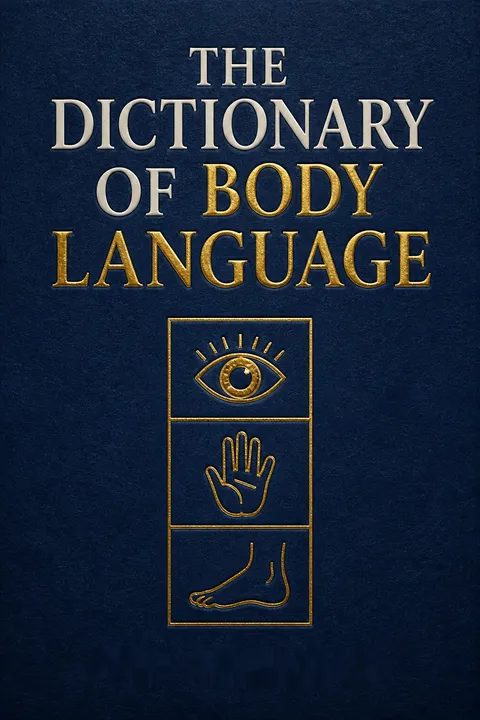
What's "The Dictionary of Body Language" about?
- Comprehensive Guide: "The Dictionary of Body Language" by Joe Navarro is a detailed field guide to understanding human behavior through nonverbal communication.
- Body Language Insights: It covers over 400 body language cues, from head to feet, explaining what each gesture or movement might indicate about a person's thoughts or feelings.
- Practical Applications: The book is designed to help readers decode body language in everyday situations, enhancing their ability to interpret others' intentions and emotions.
- Author's Expertise: Joe Navarro, a former FBI agent, draws on his extensive experience in behavioral analysis to provide insights that are both practical and scientifically grounded.
Why should I read "The Dictionary of Body Language"?
- Improve Communication Skills: Understanding body language can significantly enhance your ability to communicate effectively and empathetically with others.
- Professional Advantage: In professional settings, being able to read nonverbal cues can give you an edge in negotiations, interviews, and team interactions.
- Personal Relationships: The book offers tools to better understand friends, family, and partners, potentially improving personal relationships.
- Expert Knowledge: Joe Navarro's background as an FBI agent provides a unique perspective on the importance and application of body language in high-stakes situations.
What are the key takeaways of "The Dictionary of Body Language"?
- Nonverbal Communication: Body language is a critical component of communication, often revealing more than spoken words.
- Comfort vs. Discomfort: Many body language cues can be categorized as indicators of psychological comfort or discomfort.
- Cultural Variations: While some gestures are universal, others can vary significantly across different cultures, highlighting the importance of context.
- Practical Exercises: The book encourages readers to practice observing and interpreting body language in real-life situations to improve their skills.
How did Joe Navarro's background influence "The Dictionary of Body Language"?
- FBI Experience: Navarro's 25-year career with the FBI, particularly in behavioral analysis, provided him with firsthand experience in reading body language.
- Real-World Application: His work involved interviewing criminals and spies, where understanding nonverbal cues was crucial for gathering information.
- Scientific Approach: Navarro combines his practical experience with scientific research to offer a comprehensive understanding of body language.
- Cultural Adaptation: His personal journey from Cuba to the U.S. required him to adapt to new cultural norms, enhancing his sensitivity to nonverbal communication.
What are some specific body language cues discussed in "The Dictionary of Body Language"?
- Head Movements: Includes nodding, head tilting, and head scratching, each with different implications for agreement, curiosity, or confusion.
- Eye Behavior: Covers pupil dilation, eye contact, and blinking rates, which can indicate interest, stress, or deception.
- Hand Gestures: Discusses steepling, hand wringing, and finger pointing, which can convey confidence, anxiety, or aggression.
- Posture and Positioning: Explores how body orientation and posture can signal openness, defensiveness, or dominance.
How does "The Dictionary of Body Language" address cultural differences in body language?
- Cultural Context: The book emphasizes the importance of understanding cultural norms when interpreting body language, as gestures can have different meanings in different cultures.
- Examples Provided: Navarro provides specific examples of gestures that vary across cultures, such as the meaning of eye contact or handshakes.
- Universal vs. Cultural: While some body language cues are universal, others are deeply rooted in cultural practices, requiring careful consideration.
- Practical Advice: Readers are encouraged to learn about cultural differences to avoid misinterpretations, especially in international or multicultural settings.
What are the best quotes from "The Dictionary of Body Language" and what do they mean?
- "If language was given to men to conceal their thoughts, then gesture’s purpose was to disclose them." This quote highlights the idea that body language often reveals what words may hide.
- "Our bodies reveal very accurately, in real time, our state of unease." It underscores the reliability of nonverbal cues in indicating discomfort or stress.
- "People often lie, but their nonverbals usually reveal how they actually feel." This emphasizes the importance of observing body language to discern true emotions.
- "The nonverbal cues we give, and those we notice in others, matter significantly." It stresses the impact of body language on communication and relationships.
How can "The Dictionary of Body Language" be applied in professional settings?
- Interviewing Skills: Understanding body language can help interviewers assess candidates' confidence and honesty.
- Negotiation Tactics: Recognizing nonverbal cues can provide insights into the other party's level of agreement or resistance.
- Leadership Development: Leaders can use body language to project confidence and build rapport with their teams.
- Conflict Resolution: Identifying signs of discomfort or aggression can aid in de-escalating tense situations.
What are some common misconceptions about body language addressed in "The Dictionary of Body Language"?
- Deception Myths: Navarro clarifies that no single gesture definitively indicates lying; context and clusters of behaviors are crucial.
- Cultural Misunderstandings: The book dispels the notion that all body language is universal, highlighting the need for cultural awareness.
- Overinterpretation: Readers are cautioned against overanalyzing isolated gestures without considering the overall context and baseline behaviors.
- Infallibility: While body language is informative, it is not infallible and should be used in conjunction with other communication cues.
How does "The Dictionary of Body Language" suggest improving one's ability to read body language?
- Observation Practice: The book encourages regular observation of people in various settings to hone body language reading skills.
- Acting Out Cues: Readers are advised to act out behaviors described in the book to better understand and remember them.
- Contextual Awareness: Emphasizes the importance of considering the context and baseline behaviors when interpreting body language.
- Feedback and Reflection: Suggests seeking feedback from others and reflecting on personal experiences to improve accuracy in reading nonverbal cues.
What are some practical exercises from "The Dictionary of Body Language" to enhance understanding?
- People Watching: Spend time observing people in public places, noting their body language and hypothesizing about their emotions or intentions.
- Mirror Practice: Use a mirror to practice and recognize your own body language, improving self-awareness and control.
- Role-Playing: Engage in role-playing exercises with friends or colleagues to practice interpreting and responding to nonverbal cues.
- Journaling Observations: Keep a journal of body language observations and reflections to track progress and insights over time.
How does "The Dictionary of Body Language" address the role of technology in nonverbal communication?
- Digital Limitations: The book acknowledges that digital communication lacks the richness of face-to-face interactions, where body language plays a crucial role.
- Video Conferencing: Suggests paying attention to available nonverbal cues, such as facial expressions and tone of voice, during video calls.
- Social Media: Highlights the challenges of interpreting emotions accurately through text-based communication without nonverbal context.
- Balancing Technology: Encourages maintaining a balance between digital and in-person interactions to preserve the depth of human communication.
About the Author
Other books by Joe Navarro

Download PDF
Download EPUB
.epub digital book format is ideal for reading ebooks on phones, tablets, and e-readers.








