

Key Takeaways
Stop serving abstractions; make your own life the measure of every cause.
The opening provocation is personal. Stirner surveys the causes people are told to serve: God, truth, freedom, humanity, the nation, and justice. Each claims to be selfless, yet each can consume real individuals for its own continuation. A nation gains glory from soldiers' deaths, while humanity advances by discarding the people who served it.
Stirner calls the self a creative nothing, meaning not emptiness, but a living source that creates, adopts, uses, and abandons purposes. The point is not to have no commitments. It is to refuse any commitment the status of a superior being. A cause may be worth pursuing, but it must remain the person's instrument, not become the person's owner.
What's striking is the book's anti-idolatry test: whenever a principle demands sacrifice while presenting itself as unquestionably higher, ask who benefits from its elevation. This resembles later existentialist suspicion toward inherited meanings, but Stirner is more aggressively personal. The limitation is that causes can also coordinate genuine cooperation, protect vulnerable people, and express commitments that individuals freely endorse. Treating every collective good as disguised predation exposes hypocrisy, but can also flatten real moral difference.
Treat identity as something you use, not a destiny you must fulfill.
Stirner maps development in three stages. The child confronts physical forces and learns to outwit them. The youth discovers thought, then becomes absorbed by ideals such as truth, God, patriotism, or reason. The adult discovers the embodied self, with concrete desires, interests, and powers. Maturity means becoming the creator and user of thoughts, rather than remaining subordinate to them.
He applies the same pattern to history. Antiquity struggles against the material world; Christianity and modern philosophy turn the world into a spiritual problem; the hoped-for egoist age would treat both things and ideas as usable. Feuerbach's replacement of God with human essence therefore fails, in Stirner's view. It changes the master without ending mastery.
The developmental story is memorable because it frames ideology as a second childhood: physical authorities disappear, but internalized authorities take their place. Its weakness is historical and psychological overreach. People do not move neatly from material realism to idealism to embodied autonomy, and adults often need ideals to organize long-term action. The model works best as a diagnostic metaphor, not as a universal history of human development.
Interrogate every ideal that starts commanding you from inside your own head.
A fixed idea is a thought that rules its thinker. It may be religious, moral, political, or intellectual. Stirner's examples include God, the state, humanity, virtue, truth, and the demand to be a good person. The idea begins as something created by people, then becomes an apparently independent authority. Conscience becomes an inner police force, enforcing rules even after external authorities disappear.
This is what Stirner means by possessedness: a person is possessed when an idea, appetite, or goal uses the person as its instrument. The cure is not permanent skepticism or intellectual emptiness. It is the ability to take thoughts back, revise them, discard them, and use them without treating them as sacred. Even criticism can become a fixed idea if criticism itself becomes the new master.
The distinction anticipates a useful modern practice: holding beliefs as tools rather than as identity-protecting possessions. It also explains why ideological disputes feel like personal attacks, since challenging a fixed idea threatens the person's organizing self-image. Yet a mind without durable commitments can become merely reactive. The strongest interpretation preserves Stirner's flexibility while adding a practical question he leaves underdeveloped: which commitments remain worth keeping after scrutiny?
Freedom subtracts burdens; ownness means directing what remains.
Stirner separates freedom from ownness. Freedom usually means being released from something: a ruler, a church, a law, a passion, or a limitation. That leaves an empty space. Ownness, or Eigenheit, means possessing oneself as the active source of one's choices. A person is their own when neither external authorities nor internal compulsions command them.
This includes power over appetites. The miser may pursue only personal gain, yet still be enslaved by money. The zealot may serve an ideal, yet remain equally possessed. Ownness therefore means more than indulgence or impulse. It requires enough distance from desires and principles to decide whether they serve the person. A slave may lack outward freedom, Stirner argues, yet retain ownness if the person still acts strategically for personal purposes.
This is a sharp distinction between negative liberty and self-direction. Contemporary theories of autonomy similarly distinguish having options from being able to reflectively govern one's motives. Stirner pushes the second idea toward instability by rejecting even self-imposed obligations as binding. That protects revision and experimentation, but it risks treating continuity as servitude. Many forms of agency depend on chosen commitments that constrain present impulses for the sake of a broader, still-owned project.
Replace the three liberal masters: state, society, and humanity.
Stirner attacks liberalism in three versions. Political liberalism removes personal rulers but enthrones the state and its laws. Social liberalism removes unequal private ownership but gives society control over property and labor. Humane liberalism goes further, declaring abstract humanity the supreme standard, so the unique person must become a proper human being.
Each version appears emancipatory because it abolishes one master. Yet each transfers authority to a more impersonal one. The king becomes the state, private property becomes collective property, and God becomes Man. Stirner's complaint is not that political equality, social provision, or human rights have no practical value. It is that these ideals become sacred when they demand that individuals subordinate their particular lives to a general concept.
The substitution argument remains powerful whenever a movement condemns one hierarchy while making its own vocabulary immune to criticism. It resembles modern warnings about ideological capture, where liberation becomes a license for supervision. The harder question concerns rights. Universal rights can indeed abstract away from individuality, but they also give individuals a shield against states, majorities, and charismatic leaders. Stirner identifies their theological residue while underestimating their defensive usefulness.
Join others as tools of your aims, not as sacred bodies demanding your loyalty.
Stirner distinguishes society from a union. Society is an established body that claims authority over its members. It gives people identities, duties, and permissions, then expects obedience. A union of egoists is different: individuals associate because cooperation increases their power or enjoyment, and they leave when the arrangement no longer serves them.
A party, family, nation, or church becomes oppressive when loyalty to its persistence outranks the person's judgment. Stirner uses political parties as an example. The moment a party makes its principles unquestionable, membership becomes subordination. A union remains fluid, instrumental, and voluntary. It does not require identical beliefs, a common essence, or permanent allegiance. Its unity consists in the participants' continuing decision to use it.
This model resembles voluntary association and some forms of cooperative governance, where participation is conditional rather than devotional. It explains why institutions decay when membership becomes identity and dissent becomes betrayal. Still, durable cooperation usually requires trust, role expectations, and some willingness to absorb short-term costs for others. Stirner's union is strongest as a safeguard against institutional capture, but thinner as an account of how care and reliability survive over time.
Test rights against power, but do not confuse power with moral permission.
For Stirner, rights are external claims. A right is valid in practice because a god, state, society, nature, or humanity recognizes and enforces it. He calls this foreign right. Against it, he sets power, meaning the ability to assert, defend, and retain what one claims. The state names its coercion law, while it names an individual's opposing force crime.
This is not simply a moral command to seize whatever can be seized. Stirner is dissolving the language of sacred entitlement. Socrates, for example, accepts Athens as a legitimate judge and submits to its sentence; Stirner sees that as surrendering personal judgment to a collective authority. The egoist may cooperate, resist, lie, or obey, but does so from personal assessment rather than automatic duty.
The power analysis is politically perceptive because formal rights often depend on institutions capable of enforcing them. It also exposes how states moralize their own violence. Yet reducing entitlement to effective power leaves the weak with no principled vocabulary for demanding protection. A modern synthesis would retain Stirner's suspicion of sanctified law while treating rights as negotiated tools for distributing power, not as metaphysical truths.
Make property effective control, not a title granted by the state.
Stirner redefines property through power. Legal ownership is a protected fiction: an object is called yours because the state recognizes your title. Egoistic property instead means what remains within your effective control. A field, idea, skill, or institution is yours only insofar as you can use and defend it.
This attacks both private and collective ownership when either becomes an authority above the individual. Proudhon and the communists criticize private property, but Stirner argues that society can simply become the new proprietor, distributing access by its own rules. He urges people to realize value from their own competence rather than wait for charity or official permission. The claim is deliberately confrontational: dependence, not poverty alone, is the central problem.
The distinction between legal title and effective control remains useful in analyzing workplaces, intellectual property, and political power. It also anticipates the insight that formal access means little without practical capacity. But control is not self-sustaining. Stable property often depends on shared rules, infrastructure, and protection from stronger actors. Stirner's account diagnoses dependence with unusual clarity, yet offers little guidance for preventing the powerful from converting capacity into domination.
Stop waiting for your perfect future self; enjoy the life already operating.
Stirner rejects the life of permanent preparation. Religious people postpone themselves for salvation; moralists postpone themselves until they become good; humanists postpone themselves until they embody humanity. Against this, he proposes self-enjoyment, the active use and consumption of one's present powers, relationships, thoughts, and opportunities.
He also rejects a prescribed calling. A person is not a failed version of an ideal human, waiting to become complete. Capacities appear in action, just as a singer becomes visible by singing. This supports Stirner's distinction between revolution and insurrection. Revolution seeks a new social arrangement; insurrection begins with individuals refusing to let an arrangement define them. It is not a blueprint for society, but a refusal to remain organized by someone else's blueprint.
The emphasis on present activity counters perfectionism, a pattern in which imagined future worth devalues current experience. It also makes political change less dependent on designing a flawless institution. The danger is that self-enjoyment can become short-term consumption if detached from consequences and relationships. Stirner's strongest point is not live for pleasure alone, but stop treating the present self as merely raw material for an abstract future.
Start from the unique person, not from a human ideal imposed above.
The book ends by replacing what with who. Asking what a person is invites an essence: Christian, citizen, rational being, moral subject, or human in the abstract. Asking who the person is points back to the unrepeatable individual who creates, changes, uses, and dissolves these descriptions.
The unique one is not a superior personality type or a final identity. It is the concrete person who cannot be exhausted by any label. This self is both creator and creature, continually making itself without needing a universal model. The closing gesture returns to the opening challenge: nothing, not even humanity, outranks the living individual. Every doctrine, relationship, and institution must earn its place by becoming useful to that person rather than demanding worship.
The shift from essence to singularity is the book's most durable philosophical contribution. It resists both reductionism and identity absolutism by treating descriptions as partial tools. Modern identity politics and personal branding can each turn labels into new fixed ideas, making Stirner's warning timely. Still, singularity is not isolation. A person becomes intelligible through language, history, and relationships, even when none of those contexts has the right to define the whole person.
Analysis
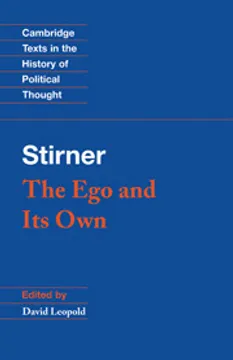
The Ego and Its Own is a polemical work of radical individualist philosophy, structured as a historical and conceptual attack rather than a linear argument. Its first part presents human development and European intellectual history as parallel movements from dependence on things, to dependence on ideas, toward possible self-ownership. Its second part develops the positive vocabulary of the egoist, the owner, the union, and the unique one. The book is difficult to summarize because Stirner repeatedly shifts between wordplay, historical caricature, political criticism, psychological observation, and deliberately provocative examples. The same term can function descriptively, rhetorically, and normatively within a few pages.
The central achievement is diagnostic. Stirner shows how authority can survive secularization by relocating itself. God becomes human essence, monarchy becomes the state, private ownership becomes collective ownership, and religious duty becomes moral or humanitarian duty. His idea of possessedness offers a compact account of ideological capture: people create concepts, forget their authorship, then obey the concepts as if they were external beings. This anticipates later critiques of alienation, ideology, and identity fixation.
The central weakness is political. Stirner's insistence that power precedes right reveals the coercive foundations of law, but his alternative is too thin to regulate unequal power or protect vulnerable people. His union of egoists is suggestive as a model of voluntary association, yet the book does not adequately explain trust, reciprocity, care, or the public goods that make individual agency possible. His treatment of history is also schematic and culturally prejudiced, using civilizations as symbols for stages in his argument rather than investigating them on their own terms. The most productive reading is therefore neither endorsement nor dismissal. Stirner is best used as a solvent. He dissolves inherited claims to authority, forcing each cause, identity, institution, and ideal to answer a personal question: does this enlarge the individual's power and enjoyment, or does it quietly demand ownership of the individual?
Review Summary
Reviews of The Ego and Its Own are mixed, praising Stirner's radical, provocative dismantling of social constructs, religion, and political ideologies while criticizing the work's verbosity and repetitiveness. Many compare him favorably to Nietzsche, noting his profound influence on philosophy. Readers appreciate his critique of "spooks" — abstract ideas that possess individuals — and his defense of egoism. However, some find the arguments underdeveloped, lacking political substance, and occasionally adolescent. The newer Landstreicher translation is widely preferred over the older Byington version.
People Also Read
Glossary
creative nothing
Self that creates meaningsStirner's term for the individual understood as neither an empty void nor a fixed essence. The creative nothing is the source from which a person creates identities, purposes, interpretations, and relationships. Because it is not reducible to any one creation, it can also revise, abandon, or consume what it has made.
ownness
Self-mastery and self-possessionOwnness, or Eigenheit, is Stirner's central positive ideal. A person has ownness when they are not ruled by external authorities, sacred ideals, fixed principles, or compulsive appetites. It is broader than legal ownership and different from mere freedom, because it means retaining practical control over oneself and treating one's powers and commitments as one's own.
fixed idea
Idea that rules its thinkerA fixed idea is a thought that has become independent of the person who created or adopted it. Religious doctrines, moral rules, political ideals, and abstract identities can all become fixed ideas. Stirner argues that the person then serves the idea, experiences it as sacred, and mistakes obedience to it for freedom or virtue.
possessedness
Captivity to an idea or impulsePossessedness describes a condition in which an idea, ideal, passion, appetite, or institution controls a person. The possessed person may believe they are acting freely, but their conduct serves a power they no longer evaluate. Stirner applies the term equally to religious devotion, moral fanaticism, political loyalty, and narrow material greed.
involuntary egoist
Unconscious self-serving subjectAn involuntary egoist pursues personal satisfaction but believes they are serving a higher power such as God, morality, humanity, or the state. Stirner distinguishes this person from the conscious egoist, who recognizes personal interests openly and refuses to let an ideal disguise itself as an unquestionable obligation.
union of egoists
Voluntary, instrumental associationThe union of egoists is Stirner's alternative to society, state, church, family, and party as fixed authorities. Individuals join because cooperation increases their power or enjoyment, retain their independence, and leave when the association no longer serves them. The union has no sacred purpose, permanent loyalty, or authority above its participants.
my power
Effective capacity to actMy power refers to the practical ability to obtain, use, defend, or retain something. Stirner contrasts it with rights, which depend on recognition by an external authority. Property, freedom, and entitlement become real for the individual only insofar as they can be exercised through actual capacity rather than merely claimed in principle.
insurrection
Individual rising against imposed identityInsurrection is Stirner's contrast with revolution. Revolution seeks to replace an existing political or social order with a new arrangement. Insurrection begins with individuals refusing to let an existing arrangement define or govern them. It has no required constitution or institutional blueprint; its emphasis is personal elevation above imposed roles and authorities.
unique one
Individual beyond every general categoryThe unique one, or Einzige, is the concrete individual who cannot be fully expressed by concepts such as human, citizen, Christian, worker, or rational being. Uniqueness is not a universal ideal or personality type. It names the irreducible person who uses descriptions and institutions without allowing any of them to become the person's essence.
Download PDF
Download EPUB
.epub digital book format is ideal for reading ebooks on phones, tablets, and e-readers.








