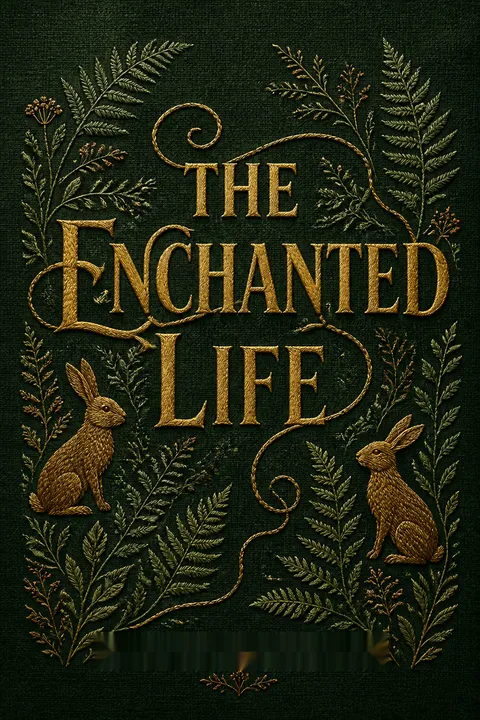


Key Takeaways
Treat enchantment as participation, not escape from ordinary life.
Two ways to walk. The book opens with two versions of a woodland walk. One walker stays on the path, checks the time, replays an argument, and dismisses a crow as merely a bird. The other attends to birdsong, smells, plants, and a stone that seems to hold a story. The difference is not the setting, but the quality of attention and the feeling of belonging it makes possible.
A practical meaning. Enchantment, in Blackie’s use, is a cultivated way of experiencing a vivid, layered world and taking part in it. It is not escapism or a demand to believe in literal magic. The book links disconnection with modern distress: it reports low life-satisfaction scores in wealthy countries and widespread anxiety, depression, and lack of belonging. Re-enchantment means recovering connection with the self, other people, and the living world.
The opening contrast makes an abstract idea immediately testable: the same walk can feel like scenery passing by or a relationship taking shape. That distinction matters because attention is not merely a private mood; it changes what a person notices and what seems worthy of care. The argument is strongest when enchantment means fuller participation, whether or not the walker believes a crow is sending a message. That keeps the invitation open to skeptics while preserving its ethical force. It also avoids making wonder a luxury reserved for dramatic wilderness or unusually mystical people.
Notice how human-superiority stories turn living places into resources.
A learned separation. Blackie traces a Western habit of dividing humans from the rest of nature through language and philosophy. In English, people are often called he or she while wild animals and plants become it. Plato elevated reason above sensory experience; Aristotle arranged living things in a hierarchy, and Descartes described animals as machines. These ideas helped make nature seem like an object outside human life, available for mastery.
The cost of the story. The author connects this separation with shame toward the body, disregard for nonhuman life, and a culture of extraction. She argues that people can be materially comfortable yet feel alienated from themselves and their surroundings. Her account is not a rejection of science: she values its rigor, but objects when one method claims exclusive authority over what counts as real. The problem is a narrowed worldview, not careful inquiry.
This genealogy is useful less as a complete history of Western thought than as a map of assumptions that can hide inside ordinary habits. Calling a forest a resource, for example, makes one set of decisions feel natural and other forms of value harder to see. The critique also deserves a qualification: scientific description can deepen wonder, and rational analysis has helped expose environmental harm. The practical question is not whether reason should be discarded, but whether it can coexist with sensory knowledge, humility, and ethical regard for forms of life that do not resemble us.
Return to one nearby place until observation becomes relationship.
A practice of return. Blackie describes finding belonging through a large rock in Donegal, which she named the Story Stone. Returning to it, watching its lichens and plants change, and speaking stories aloud transformed it from a feature in the landscape into a meaningful presence in her life. The point is not to prove the stone can hear. The repeated attention changes the human relationship to the place.
Try a Sit Spot. A Sit Spot is a place visited regularly for quiet observation, ideally near home. Sit in the same location through different seasons and weather. Notice sound, scent, touch, light, and changes in plant and animal life. If it feels comfortable, speak, sing, or read aloud. Blackie calls the broader sense of reciprocal involvement participation mystique: experiencing people, places, and things as involved in a shared field of relationship rather than as wholly separate objects.
The Sit Spot is compelling because it turns belonging into a repeatable practice rather than a feeling that must arrive on command. Familiarity accumulates: a place becomes legible through small changes that a hurried visitor misses. Naming a stone or talking to a tree can also function as imaginative attention, even for someone who rejects the idea that nonhuman things possess humanlike intentions. A useful boundary is to let these practices increase care and curiosity without treating personal impressions as evidence about what nature thinks or wants.
Protect wonder by making room for uncertainty, imagination, and play.
Wonder keeps possibility open. Blackie distinguishes wonder from awe: awe can make a person feel small before something powerful, while wonder makes new possibilities feel available. As a child, she imagined the industrial landscape around her as full of devils, night-angels, and stories. As an adult, she describes seeing the outline of two horses in the mountains of Donegal after months of looking. The landscape had not changed; her attention and imagination had become more receptive.
Make space for discovery. The book argues that children’s curiosity and creativity are narrowed by passive entertainment, reduced outdoor time, and schooling that rewards conformity and measurable answers. The Wonderment, a project described by Blackie, helped young people develop ideas into community projects, including a mobile library proposed by a teenager in Guatemala. For adults, the invitation is concrete: learn something unfamiliar, take a different route, make things, and play without turning every activity into achievement.
Wonder works here as a disciplined willingness to notice more than the obvious, not as a substitute for knowledge. The horse-shaped mountains remain mountains; the imaginative reading adds a personal layer without erasing geology. That balance is valuable in education too: curiosity can help learners connect facts and invent solutions, while facts keep imagination answerable to the world. The challenge is preserving play without romanticizing childhood or dismissing structure. Children benefit from room to explore, but they also need boundaries, materials, and adults who take their ideas seriously.
Let the body, not only the thinking mind, teach you where you belong.
Knowledge through sensation. Blackie recounts arriving at a Missouri retreat burned out from corporate life and feeling physically held during a warm-water bodywork session. Floating and being gently moved dissolved her usual sense of separation from the world. The experience mattered because it was sensory, not merely an idea she could agree with. She argues that treating the body as an inconvenient container for the mind can cut people off from pleasure, vulnerability, and contact with the world.
Bring attention back down. The book recommends movement, outdoor sensory awareness, and noticing bodily signals. Blackie recalls chronic breathlessness and throat tension that eased after she made major life changes. She also describes leaving a silent meditation retreat when sitting indoors felt more like confinement than connection. Her preferred word, bodyfulness, names a grounded awareness of bodily experience as part of being present, rather than a project of escaping the body.
The account pushes against the assumption that insight must begin as a verbal explanation. Bodily cues can reveal stress, comfort, or resistance before a person has a polished story about them. Still, physical symptoms require care: interpreting them as emotional messages cannot replace medical assessment, and the book’s own examples involve ruling out an evident physical cause. The larger point survives that caution. Embodied practices, from walking to making food, can reconnect thought with the conditions under which a life is actually lived.
Use old stories to imagine endings your current life cannot yet see.
Stories offer a working metaphor. Blackie describes using the fairy tale The Girl Without Hands with a client who could not speak directly about childhood abuse. In the story, a young woman loses her hands, survives exile, and eventually grows them back. The client used that image to approach painful experience indirectly and imagine herself as someone recovering agency. The story did not supply a diagnosis or a guaranteed cure; it offered language and a structure for reflection.
Question the dominant plot. Blackie argues that societies also live by stories, including the belief that progress means endless growth, consumption, and competition. She contrasts the conquering hero with a post-heroic journey focused on endurance, care, and learning what matters. Myths and folktales can preserve alternative values, but folklore can also be used to exclude outsiders. Their value depends on how people interpret and retell them, not on treating every inherited story as wise.
Metaphor can create enough distance for difficult material to become approachable, while still keeping it emotionally vivid. This is one reason stories can help people rehearse possible identities rather than merely report on the past. But a story should be an invitation, not a script imposed on someone else: the same image may liberate one person and constrain another. The book’s social argument is equally important. Consumer culture also tells a story, though it presents its values as common sense. Making that narrative visible is a first step toward choosing alternatives.
Learn the ecology and lore of where your feet actually land.
Place shapes a life. Blackie describes herself as changed by the islands, bogs, and coasts where she has lived. She proposes that landscape influences identity through its weather, geology, plants, animals, and human histories. The term geopsyche, used by Tewa writer Gregory Cajete, refers to the imprint a landscape makes on the people who inhabit it. Belonging is not only a feeling or an ancestry; it can be developed through close attention to the place one occupies now.
Build local knowledge. Learn the names of nearby plants, birds, waterways, and landmarks. Find out where local food, water, and power come from, and what stories people attach to the landscape. Blackie points to Irish dinnseanchas, a body of place-lore that links landmarks and names with stories, often carrying lessons about how to live. In cities as well as rural areas, mapping a neighbourhood and recording its changes can make it more than a backdrop.
Local knowledge turns environmental concern from an abstract allegiance into familiarity with particular lives and places. It can make consequences easier to notice: a change in a stream or the disappearance of a familiar bird is harder to dismiss when the place has become known. The book’s rootedness should not be mistaken for a demand that everyone stay put. Migration, displacement, and temporary residence are real conditions. Its more inclusive claim is that people can practice responsibility wherever they are, while learning the history and limits of their connection.
Extend kinship to inconvenient wild neighbors, not just beloved pets.
Otherness is not a reason to destroy. Blackie recalls an encounter with nineteen stags in mist, when for a moment she felt herself not as a spectator but as one animal facing another. She pairs this with Aldo Leopold’s account of killing a wolf and seeing the animal’s life fade, an experience that changed how he understood predators and the mountain ecosystem. These encounters challenge the assumption that wildlife matters only when it is useful or charming.
Respect includes friction. The book asks readers to reconsider hostility toward foxes, badgers, coyotes, and other animals that share human spaces. It also notes that plants exchange information through chemical signals, roots, and fungal networks. Animism is the specialized view that the world includes many kinds of persons, not only humans, living in relationships with one another. Whether or not one adopts that belief literally, the author argues that treating other life as kin can change the choices people make.
Kinship broadens moral attention beyond the animals people have domesticated or learned to love. It is a useful corrective to the tendency to value wildlife only when it is convenient. Yet coexistence is not frictionless: predators, disease, and land use can create real conflicts for people and livelihoods. A mature ecological ethic needs more than affection; it requires evidence, negotiation, and ways to share costs fairly. The book’s relational frame can help keep those conflicts from collapsing into the easy conclusion that removal is always the answer.
Make and mend slowly to restore meaning to daily material life.
Handwork creates connection. On a croft in Lewis, Blackie learned to spin sheep’s wool and dye it with plants gathered from the land. The work linked animals, plants, materials, and her own hands in a cycle that felt more meaningful than buying finished goods. She also describes quilting a star-patterned blanket during a painful period, experiencing the repeated stitching as a way to gather a fragmented life into a pattern.
Let the ordinary matter. The book connects handmade work with the Slow Movement, which means doing things at a fitting pace and valuing quality over speed and quantity. Cooking, repairing, or tending a home can become attentive practices rather than tasks to rush through. Blackie’s scarred kitchen table holds memories of meals, arguments, and guests. This does not require a rural retreat or expensive craft materials. It asks people to buy less carelessly, use what they have, and give everyday objects a history through use.
Handwork makes the hidden costs and origins of objects harder to ignore. A repaired garment or reused building material carries visible decisions about labor, waste, and care. This can resist the disposability of mass consumption without pretending that every handmade object is automatically ethical or affordable. The deeper point is the relationship formed through making and tending. A table, a quilt, or a meal gains meaning not through purity or perfection, but through repeated use and the shared life it supports.
Treat calling as a lifetime apprenticeship, then mark change with ritual.
Purpose unfolds through practice. Blackie uses psychologist James Hillman’s idea of calling: a potential or purpose that is developed through choices, not a fixed destiny or necessarily a career. Clues may come from childhood fascinations, enduring loves, recurring images, and the work a person feels moved to offer. Blackie’s own departure from corporate life was a major choice, but her friend Jeanette finds purpose in helping bees while earning her living in a tea room. Calling can shape a life beyond a job title.
Give transitions a shape. The book presents rites of passage as three broad phases: separation from an old role, a liminal period of uncertainty and learning, then incorporation into a new role. A pilgrimage or a daily walk can take on ritual meaning when it has an intention, a place, a deliberate action, and a closing reflection. Ritual makes change visible and can connect private transitions to community and place.
Calling is more useful as a direction of inquiry than as a hidden answer waiting to be discovered. The apprenticeship emphasis protects people from confusing early enthusiasm with mastery, and from believing every meaningful activity must become paid work. Ritual, meanwhile, gives transitions a social and sensory form that ordinary schedules often omit. These ideas also need material realism: time, health, caregiving, and money constrain choices. A meaningful life is not always achieved by quitting a job; small commitments and shared practices can also express purpose.
Analysis
The book’s central move is to treat enchantment as a change in relationship rather than a return to supernatural certainty. Its recurring question is not whether a crow literally carries a message, but what changes when a person meets the crow with sustained attention, humility, and curiosity. That distinction lets Blackie build a bridge between spiritual language and ordinary practices such as walking, gardening, making things, and learning local history.
The narrative structure gives this argument emotional credibility. Blackie’s shifts in perspective emerge through lived scenes: a walk in the woods, a bodywork session, a difficult island home, and the work of making a quilt. These stories carry the reader from an account of alienation toward practices of reconnection. The strongest practical insight is that belonging is cultivated by repeated contact. A place becomes meaningful through return, care, memory, and responsibility, not simply through scenic beauty.
The book’s ecological ethic also depends on a change in perception. If nonhuman life is encountered as a community rather than a stockpile, exploitation becomes harder to treat as morally neutral. But the metaphysical claims in animism and panpsychism remain interpretations, not established conclusions. Enchantment does not need to settle whether rocks or ecosystems possess consciousness. It can still support restraint by reminding people that their knowledge is partial and their lives are entangled with other forms of life.
A further tension lies between personal transformation and structural change. Blackie argues that individuals can influence wider culture through shared values, while also criticizing the economic and educational systems that reward extraction, speed, and conformity. The first claim should not become a burden placed on individuals with little power. The book is most persuasive when personal practices are understood as seeds of collective change, not substitutes for political action. Its lasting proposal is both intimate and public: learn to attend to the world, then live as though that attention creates obligations.
Review Summary
The Enchanted Life receives mixed reviews. Many praise its exploration of reconnecting with nature and finding meaning in everyday life. Readers appreciate Blackie's eloquent writing and thought-provoking questions. However, some criticize the book for being pretentious, privileged, and impractical for those without means to make drastic lifestyle changes. While some find it life-changing and inspiring, others feel it lacks concrete advice for urban dwellers. The book's focus on folklore, mythology, and challenging modern disenchantment resonates with many readers seeking a more fulfilling existence.
People Also Read



Glossary
Enchantment
Belonging through participationBlackie uses enchantment to mean a vivid, embodied sense of belonging to a layered, living world. It includes wonder, curiosity, imagination, and openness to mystery. It is not simply pleasure, fantasy, or escape. In this account, enchantment grows through participation in everyday life and can support greater care for people, places, and nonhuman life.
Disenchantment
Separation from living meaningDisenchantment is a condition in which people experience themselves as separate from their bodies, other people, and the nonhuman world. Blackie connects it with a cultural preference for rational control, human superiority, and material progress. The result is a narrowed sense of what matters, with the world treated as an object rather than a community of relationships.
participation mystique
Reciprocal involvement with the worldA term used by Lucien Lévy-Bruhl and discussed by Blackie for a worldview in which humans participate in relationships with animals, places, objects, and forces around them. Things may be understood as themselves and also as carrying wider meaning. Blackie uses it to describe a less separate way of experiencing the world, while acknowledging that scholars interpret the idea differently.
animism
A world of relational personsIn the account Blackie draws from scholar Graham Harvey, animism recognizes that the world includes persons who are not human and that life is lived in relationships with others. It is not merely the claim that natural things resemble humans. The term names a way of understanding human life as one part of a wider community of living beings.
panpsychism
Mindlike qualities throughout naturePanpsychism is the philosophical view that everything in the universe has some interior or mental dimension, including things usually called inanimate. Blackie discusses it through environmental philosophers such as Val Plumwood and Freya Mathews. In the book, this perspective challenges the idea that nature is only inert matter, but it is presented as a philosophical position rather than settled scientific fact.
Sit Spot
A place for regular observationA Sit Spot is a place, ideally near home, visited repeatedly for quiet observation. The practice is to sit in the same location, use multiple senses, and notice changes in weather, plants, animals, and light over time. Speaking or singing there can turn a person from a detached observer into an active participant in the place.
end-of-history illusion
Underestimating future changeThe end-of-history illusion is a finding discussed by Blackie from research involving 19,000 people aged eighteen to sixty-eight. People recognized how much they had changed over the previous decade but expected to change far less in the next one. The idea helps explain why the present can feel like a final version of the self.
bodyfulness
Awareness through the bodyBlackie’s preferred alternative to a purely inward or head-centered account of mindfulness. Bodyfulness means attending to bodily sensation, movement, and physical rhythms as part of being present in the world. It treats the body as a source of experience and information, while the book’s examples do not imply that bodily interpretation replaces medical care.
geopsyche
Landscape’s imprint on identityA term used by Tewa writer Gregory Cajete for the influence a landscape has on the psyche of the people who live there. Blackie uses it to explain how geology, weather, plants, animals, and local history can shape ways of feeling and imagining. It emphasizes that identity develops in relation to a particular place.
dinnseanchas
Irish lore of significant placesDinnseanchas is the Irish body of place-lore, including stories and poems that explain landmarks, place-names, and features of the landscape. These accounts connect geography with cultural memory and often carry moral or practical lessons. Blackie presents knowledge of such stories as one way people can deepen their relationship with the land they inhabit.
mythic imagination
Reading life through story and symbolThe mythic imagination is an active awareness of myth, symbol, and archetypal patterns in stories and everyday experience. Blackie argues that it helps people explore personal meaning and imagine possibilities for change. It can be developed by reflecting on fairy tales, recurring images, and dreams, then working with them through writing, art, or conversation.
calling
A purpose developed over a lifetimeCalling is a sense of purpose or potential that shapes how a person lives and what they offer the world. Drawing on James Hillman, Blackie treats it as neither a fixed destiny nor simply a career. It develops through choices, experience, learning, and attention to enduring interests, values, and forms of contribution.
About the Author
Other books by Sharon Blackie
Download PDF
Download EPUB
.epub digital book format is ideal for reading ebooks on phones, tablets, and e-readers.








