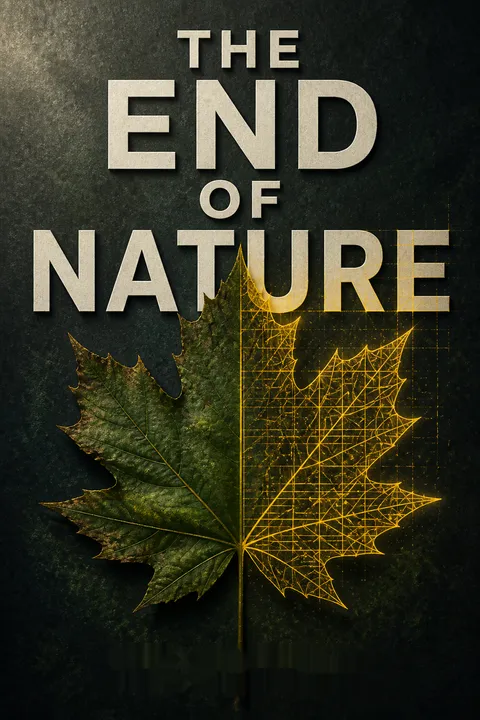


Key Takeaways
See climate change as nature losing independence, not nature disappearing
A changed relationship. McKibben’s phrase “the end of nature” does not mean that rain, forests, or wildlife vanish. It means nature no longer functions as a realm independent of human activity. Greenhouse gases from ordinary life alter the atmosphere, influencing weather even in places where no road, factory, or house can be seen.
His Adirondack walks make the idea tangible. A motorboat crossing a quiet lake changes the swimmer’s experience by making human presence impossible to ignore. Climate change does something similar everywhere, but invisibly and at planetary scale. McKibben accepts that people have shaped landscapes for centuries and are themselves part of nature. His point is that global atmospheric change crosses a threshold: human influence is no longer confined to particular places.
The distinction is useful because it separates a physical claim from a philosophical one. The physical claim is that human activity alters climate; the philosophical claim is that this weakens the sense of nature as an independent world. That second claim is not inevitable. People can still experience awe, attachment, and humility in landscapes shaped by human influence. But the argument identifies a real shift in responsibility: a storm can remain a natural event while also carrying consequences of collective choices.
Read remote weather as a record of human choices
A planetary footprint. The book traces the greenhouse effect from early scientific reasoning to atmospheric measurement. In the nineteenth century, Svante Arrhenius calculated that additional carbon dioxide could warm the planet. In 1957, Roger Revelle and Hans Suess challenged the assumption that the oceans would absorb most of humanity’s excess carbon. Their work helped prompt Charles Keeling’s measurements at Mauna Loa and the South Pole.
At the time McKibben wrote, Mauna Loa readings had climbed from about 315 parts per million in 1958 to nearly 360. Those figures are historical, not current measurements. The larger point is that fossil-fuel combustion changes the shared atmosphere, not just the air near a smokestack. McKibben also discusses ozone loss and acid rain as evidence that pollution can travel far beyond its source.
A distant measurement can make an invisible collective process legible. That is one of the book’s strongest moves: atmospheric chemistry turns everyday acts into cumulative public consequences without pretending any single driver or household controls the outcome. The contrast with local pollution also clarifies why familiar remedies can fail. A nearby factory may be regulated at its source, but carbon emissions disperse through a system that connects regions and generations. The challenge is translating global evidence into institutions that people experience as accountable and fair.
Plan for climate disruption, not a return to yesterday’s weather
Old patterns lose authority. Human settlements and livelihoods have been built around recurring seasons, rainfall, and river flows. McKibben argues that rapid climate change weakens the reliability of those patterns. He cites estimates that climate could shift 10 to 60 times faster than its natural pace. Forests illustrate the mismatch: a tree line may move only about half a mile in a year, while a one-degree temperature rise can shift climate zones 35 to 50 miles.
The 1988 North American drought shows why local impacts are difficult to forecast. The author does not claim that greenhouse warming caused that particular drought. Instead, he presents it as a glimpse of vulnerability: drought reduced harvests, dried prairie wetlands, and exposed weaknesses in systems that assumed familiar conditions would persist.
This is an argument for planning around uncertainty rather than waiting for perfect local predictions. Infrastructure designed from past rainfall or river records can become fragile when the underlying conditions change. The book is especially persuasive when it distinguishes a broad climate signal from the cause of any single storm or drought. Its specific forecasts belong to their historical moment, but the decision principle remains sound: uncertainty about precise outcomes is not evidence that the old baseline is safe.
Treat feedback loops as accelerants, not distant scientific curiosities
Change can amplify change. A feedback loop occurs when an initial change triggers effects that intensify or reduce that change. McKibben emphasizes the amplifying kind. As Arctic ice melts, darker ocean water absorbs more sunlight than reflective ice, adding heat. Warming soils and thawing permafrost can release stored carbon and methane. Forests stressed by heat or drought may die and release carbon that had been held in trees and soil.
These processes make climate more than a simple emissions-to-temperature calculation. The book describes scientists struggling to represent interacting effects such as clouds, oceans, forests, and soil. Some processes could moderate warming, but the author argues that the major feedbacks could accelerate it. The concern is not that every proposed loop is certain, but that a damaged system may respond in ways that are difficult to reverse or predict.
The systems perspective matters because risks can emerge from interactions, not just from a single pollutant or event. It also explains why gradual-looking averages may conceal abrupt local changes. A useful caution is that identifying a possible feedback is not the same as proving its size or timing. McKibben’s strongest case is therefore about risk management: when consequences could compound and recovery is slow, waiting for certainty can be a costly strategy.
Beware fixes that preserve consumption by turning Earth into a managed machine
The defiant reflex. McKibben uses this phrase for the impulse to answer environmental damage by extending human control while keeping familiar consumption intact. In the book, proposed responses range from more nuclear power and vast tree plantations to schemes for manipulating sunlight. Genetic engineering appears especially powerful: it could produce crops able to tolerate heat or drought, but also intensify the idea that living things are redesignable tools.
The issue is not that technology has no value. The book describes the phaseout of ozone-damaging chemicals as a possible response because those chemicals had substitutes. Greenhouse gases are harder: they arise from energy, transport, food, and industry across society. A technical fix can reduce harm, yet still preserve the assumption that growth and human convenience should remain the goals.
This critique helps distinguish useful innovation from technological optimism. A technology can solve a real problem while leaving the incentives that produced it untouched. Energy efficiency, for instance, may lower resource use per task, but expanding demand can absorb part of the savings. The harder question is not whether tools should be used, but what ends they serve and who bears their costs. The book can sound suspicious of technology as such; its more durable warning concerns technology treated as permission to avoid restraint.
Protect nature’s independence, because its meaning cannot be manufactured
A source of meaning. For McKibben, nature is not only scenery or a storehouse of useful resources. Its independence has also offered people a sense of something larger than human plans. He connects this experience to naturalists such as John Muir and to religious thought. In the Book of Job, the divine response describes rain falling in uninhabited places and creatures that do not exist for human convenience.
Climate change unsettles that relationship. A season or storm may still be beautiful, but it becomes harder to regard it as wholly separate from human action. McKibben fears that this weakens a source of humility and spiritual reassurance. The loss he describes is not beauty itself; it is the belief that beauty belongs to a world beyond human design.
The argument gives environmental concern a cultural dimension that economic calculations can miss. A forest may matter not only because it stores carbon or supports recreation, but because its existence beyond human purpose challenges human self-importance. That is a powerful account of intrinsic value. It should not be mistaken for a universal religious claim, however. People find spiritual meaning in many ways, and ecological responsibility can be defended without sharing McKibben’s theology.
Give other species room to exist beyond their usefulness to us
A biocentric ethic. McKibben presents deep ecology as a challenge to the human-centered assumption that other life matters chiefly for its benefits to people. The idea is that species and ecosystems can have value in their own right. Jim Stolz’s encounters with grizzly bears sharpen the point: in bear country, people are not automatically the rightful masters of the landscape.
The book also recounts environmentalists defending a small desert canyon with little obvious recreational or commercial value. Its worth lies in its life and existence, not in what people can extract from it. This ethic asks societies to limit population pressures and resource use, though McKibben acknowledges that the right limits are unsettled. The practical demand is to make room for nonhuman life, not merely manage it for human benefit.
Intrinsic value can widen the moral circle beyond familiar, attractive, or economically useful species. It also counters the habit of defending a forest only because it may contain a future medicine. Yet a biocentric ethic must face human needs directly, especially where poverty and dependence on local ecosystems are involved. Respect for nonhuman life need not mean indifference to people. The strongest version asks how human communities can flourish within ecological limits rather than treating flourishing and restraint as opposites.
Aim to limit damage, not restore the climate you remember
Prevention still matters. McKibben argues that some warming is already committed because greenhouse gases have accumulated and the oceans store heat. That does not make action pointless. The aim shifts from preventing all change to reducing how severe it becomes and preserving a world in which societies and ecosystems can adapt.
The contrast with ozone protection clarifies the difficulty. The book describes international efforts to phase out CFCs, chemicals with uses that could be replaced more readily. Fossil fuels are woven into transport, electricity, heating, and industry, so cutting their emissions demands wider changes. McKibben rejects the comforting idea of a clean return to the old baseline. Delay adds to the burden, while every reduction can still lessen future harm.
This is a valuable distinction between preventing every consequence and preventing the worst consequences. Fatalism treats incomplete success as failure; risk reduction treats each avoided increment of harm as meaningful. The framing also guards against the reverse error, assuming adaptation can substitute for emissions cuts. Adaptation helps communities face changes already underway, while mitigation limits the scale of future disruption. Both matter, but only one addresses the source of the accumulating risk.
Cut fossil use collectively, then redesign everyday life around shared needs
Choices need infrastructure. McKibben argues that individual conservation is valuable but cannot solve a global emissions problem alone. The larger task is to change the systems that shape daily life: transportation, housing, energy, food, and patterns of consumption. In the 2005 introduction, he notes that western Europeans used about half the energy of Americans, attributing much of the difference to denser cities and greater reliance on public transit. He also points to Curitiba’s bus system as a way to reduce fuel use.
The book’s personal examples, such as driving less and growing food, are gestures toward a wider change, not substitutes for it. Stronger communities can make lower-impact choices practical and dignified. The central political challenge is persuading people to revise shared expectations of convenience, growth, and private consumption before worsening conditions force harsher changes.
The emphasis on community shifts the focus from personal virtue to the conditions that make choices possible. Compact neighborhoods and reliable transit can reduce dependence on private vehicles without asking each person to solve a structural problem alone. Climate action also creates a collective-action problem: costs may be immediate and local, while benefits are spread widely and over time. Policies are more likely to endure when they pair emissions cuts with fairness, access, and credible improvements in everyday life.
Analysis
The book’s deepest contribution is a change in scale. Environmental damage is often understood as a wound in a particular place, something that can be cleaned up or fenced off. McKibben argues that greenhouse gases alter the background conditions shared by every place. This makes the crisis physical, political, and philosophical at once. The weather is not merely more dangerous; the old division between human society and an independent natural world becomes harder to sustain.
That argument is most convincing when it joins evidence to lived experience. Atmospheric measurements, changing seasons, stressed forests, and the swimmer interrupted by a motorboat all show different dimensions of the same problem. The title is deliberately provocative, but it is not a literal claim that natural processes have stopped. It names the loss of nature’s independence from human influence. Keeping that distinction clear avoids turning a powerful metaphor into an imprecise scientific statement.
The book also sees that technology cannot be evaluated apart from the values directing it. A crop engineered for drought tolerance may protect food supplies, yet a society that treats every ecological limit as a design flaw can use such advances to postpone difficult choices. The analysis is less complete on how to govern these technologies fairly or distribute the sacrifices of lower consumption. A call for restraint can sound very different to an affluent household than to a family still seeking reliable food, electricity, or transport.
Its answer is therefore ethical as well as practical: reduce emissions, but also reconsider the idea that human expansion is the unquestioned purpose of economic life. That is a demanding proposition, not a ready-made policy blueprint. The book’s lasting value lies in asking what counts as progress when preserving human convenience may erase the independent world that gives that convenience a home.
Review Summary
The End of Nature, published in 1989, is a groundbreaking work on climate change for a general audience. Reviewers praise McKibben's foresight and eloquence in addressing environmental issues, though some find his tone overly pessimistic. The book argues that human activity has fundamentally altered nature, ending its independence from us. While dated in some aspects, many readers find its message still relevant and urgent today. Some criticize McKibben's perspective on wilderness and human-nature separation, but overall, the book is considered an important contribution to environmental literature.
People Also Read

Glossary
The end of nature
Loss of nature’s independenceMcKibben’s term for the loss of nature as a realm independent of human society. It does not mean that natural processes cease. It means that human influence, especially through greenhouse gases, reaches the atmosphere and climate everywhere, making even remote weather partly shaped by human activity.
Defiant reflex
Control instead of restraintMcKibben’s name for the impulse to preserve familiar human habits by finding new ways to control the planet. Rather than changing consumption or accepting limits, societies may turn to technological fixes, engineered organisms, or large-scale management. The term describes a cultural response, not a specific technology.
Deep ecology
Value beyond human useA perspective presented in the book that challenges the human-centered view of nature. Deep ecology holds that species and ecosystems have value independent of their usefulness to people. It questions assumptions about human dominance, population growth, and resource use, and asks what place people occupy within the wider community of life.
Gaia hypothesis
Life regulates planetary conditionsJames Lovelock’s hypothesis that living organisms and the physical environment interact in ways that help regulate conditions on Earth. McKibben explains the idea through Daisyworld, a model in which different-colored daisies alter planetary reflectivity as the sun grows warmer. The hypothesis does not imply that the planet necessarily protects human beings.
Atopia
A world beyond human desireMcKibben’s tentative term for a society not organized primarily around maximizing human happiness, consumption, or expansion. An atopia would place limits on population and resource use while allowing different ways of life within those boundaries. It is not a detailed blueprint or a conventional utopia promising universal human satisfaction.
FAQ
What's The End of Nature about?
- Human Impact on Nature: The book explores how human activities, particularly industrialization and climate change, have fundamentally altered the natural world.
- Philosophical Implications: McKibben argues that nature is no longer an independent force but is now intertwined with human existence and actions.
- Call to Awareness: It emphasizes the need for a reassessment of our relationship with nature, urging readers to recognize the consequences of their actions on the environment.
Why should I read The End of Nature by Bill McKibben?
- Pioneering Environmental Literature: As one of the first books addressing global warming for a general audience, it provides foundational knowledge on climate issues.
- Timely and Relevant: Given the ongoing climate crisis, McKibben's insights are more relevant than ever, encouraging urgent discussions about sustainability.
- Thought-Provoking Perspective: It challenges readers to think deeply about their relationship with nature and the consequences of their lifestyle choices.
What are the key takeaways of The End of Nature?
- Humanity's Role in Nature: The book illustrates that human beings have become a dominant force in altering the planet's climate and ecosystems.
- Urgency for Action: McKibben stresses the importance of immediate action to mitigate climate change and restore a healthier relationship with the environment.
- Philosophical Shift Needed: A fundamental change in how we view our relationship with nature is necessary, advocating for a more humble approach.
What are the best quotes from The End of Nature and what do they mean?
- “We have ended nature.”: This quote encapsulates McKibben's argument that human actions have fundamentally altered the natural world, making it impossible to view nature as a separate entity.
- “The world is a different place—more chaotic, storm tossed, disease ridden.”: This reflects the consequences of climate change, highlighting the instability and unpredictability that now characterize our environment.
- “The greatest beauty is organic wholeness of life and things.”: McKibben emphasizes the importance of preserving the integrity of natural ecosystems, advocating for respect beyond utilitarian views.
What is the significance of the title The End of Nature?
- Symbolic Meaning: The title signifies the end of nature as an independent, untouched entity, suggesting that human influence has permeated every aspect of the environment.
- Cultural Shift: It reflects a cultural shift in how we perceive nature, moving from a view of it as a separate, sacred space to one that is integrated with human existence.
- Call to Action: The title serves as a wake-up call, urging readers to confront the reality of environmental degradation and the need for change.
How does Bill McKibben define "nature" in The End of Nature?
- Nature as Independent Force: McKibben initially describes nature as a realm separate from human influence, characterized by its own rhythms and processes.
- Nature's Transformation: He argues that this definition has changed, as human actions have altered the atmosphere and climate, leading to a new understanding of nature as intertwined with humanity.
- Philosophical Implications: The redefinition of nature raises questions about our responsibility and the ethical implications of our actions on the environment.
What are the main environmental issues discussed in The End of Nature?
- Global Warming: McKibben highlights the impact of greenhouse gases on climate change, emphasizing the urgency of addressing this issue.
- Deforestation and Biodiversity Loss: The book discusses the consequences of habitat destruction and the loss of species, which threaten ecological balance.
- Pollution and Its Effects: McKibben addresses various forms of pollution, including acid rain and chemical runoff, and their detrimental effects on ecosystems and human health.
How does Bill McKibben suggest we can address environmental issues in The End of Nature?
- Individual Responsibility: He emphasizes the importance of personal choices, such as reducing consumption and advocating for sustainable practices.
- Community Action: McKibben encourages collective efforts to promote environmental awareness and policy changes at local and national levels.
- Technological Solutions: While acknowledging the potential of technology to mitigate some effects, he stresses that it cannot replace the need for fundamental changes in behavior and values.
How does The End of Nature address the concept of deep ecology?
- Definition of Deep Ecology: McKibben discusses deep ecology as a philosophical perspective that values the intrinsic worth of all living beings, advocating for a shift away from anthropocentrism.
- Contrast with Shallow Ecology: The book contrasts deep ecology with shallow ecology, which focuses on human-centered environmentalism.
- Implications for Action: McKibben suggests that adopting a deep ecological perspective could lead to more meaningful environmental action.
What role does genetic engineering play in The End of Nature?
- Potential Benefits and Risks: McKibben explores the implications of genetic engineering as a tool for addressing environmental challenges, such as creating climate-resilient crops.
- Ethical Considerations: The book raises ethical questions about the manipulation of life forms and the consequences of playing God.
- Call for Caution: McKibben advocates for a cautious approach to genetic engineering, emphasizing the need to consider the long-term effects on ecosystems.
How does The End of Nature envision a future without nature?
- Artificial World: McKibben describes a future where nature is replaced by artificial environments created through genetic engineering and technological advancements.
- Cultural Shift: The book suggests that a cultural shift towards valuing artificiality over naturalness could have profound implications for society.
- Hope for Restoration: Despite the bleak outlook, McKibben holds out hope that if we change our ways, nature could eventually recover.
What emotional responses does Bill McKibben evoke in The End of Nature?
- Sadness and Loss: The book conveys a deep sense of grief over the loss of untouched nature and the irreversible changes wrought by human activity.
- Urgency and Responsibility: McKibben instills a sense of urgency, encouraging readers to take responsibility for their actions and advocate for change.
- Hope and Resilience: Despite the grim realities, he also highlights examples of resilience in nature and the potential for positive change through collective action.
About the Author

Download PDF
Download EPUB
.epub digital book format is ideal for reading ebooks on phones, tablets, and e-readers.








