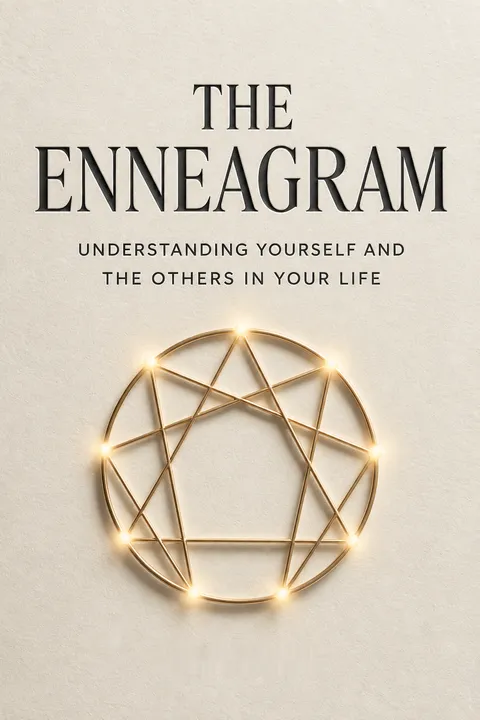


Key Takeaways
Treat your Enneagram type as a lens, not a life sentence
A map, not a box. Palmer describes nine personality types as recurring ways attention and emotion become organized. Each type has a characteristic worldview, but people are not reducible to a list of traits. The diagram also connects the types: its lines suggest how behavior can shift under pressure or in safer circumstances, while neighboring points influence a type’s style. A couple, for example, may mistake very different ways of seeking connection for lack of love.
Patterns can become guides. Palmer’s spiritual model treats persistent personality habits as clues to capacities that feel missing, such as courage or trust. Seeing a pattern may help someone loosen it and respond more freely. This is a proposed spiritual interpretation, not a scientific finding, and the system is most useful when held as a working map rather than an unquestionable truth.
The distinction between a map and an identity is crucial. In psychology, labels can help people notice repeated patterns, but they can also create confirmation bias: once a label is applied, ordinary behavior may be interpreted as proof. Treating a type as a revisable hypothesis preserves the practical benefit of pattern recognition while protecting individual complexity. The map is most humane when it helps people ask better questions, not when it claims to know them in advance.
Catch where attention narrows before habit chooses for you
Notice the filter. Palmer calls a type’s central recurring preoccupation its Chief Feature. Gurdjieff’s term buffers describes psychological defenses that keep conflicting motives out of awareness. The practice of self-observation, or the inner observer, means watching thoughts, feelings, and impulses without immediately treating them as the whole self. A One might notice constant judgment; a Six might catch attention scanning for danger.
Separate signal from story. Palmer argues that these habitual ways of noticing can become both burdens and skills. A fearful person may spot subtle cues, but may also mistake imagined danger for present fact. She also proposes that attention tends to be centered through thinking, feeling, or bodily sensation. Intuition, in her account, is not the same as essence, and impressions still need to be checked against reality.
This model has a useful connection to metacognition, the ability to notice and evaluate one’s own thinking. A person who can say that a thought is occurring gains room to test it rather than obey it. That does not make every impression accurate, however. Strong imagery, empathy, or bodily certainty can reflect expectation as well as information. The book’s emphasis on observation is strongest when paired with reality checks and appropriate psychological support.
Question the inner judge before it turns desire into duty
Correctness can conceal want. Palmer’s One, the Perfectionist, learns to avoid criticism by following strict rules and monitoring every mistake. The internal critic may judge work, behavior, anger, and pleasure. Because personal wishes seem suspect, a One can fill every hour with worthwhile tasks while remaining unsure what would actually feel satisfying. In one account, a would-be art student spent years reconsidering whether painting fit her moral and spiritual standards before applying.
Treat irritation as information. Ones may displace anger onto visible errors or righteous causes, while overlooking the unmet need underneath. Palmer recommends noticing resentment, questioning rigid standards, checking whether others are truly judging, and making room for pleasure without requiring it to be earned. The strength behind the pattern is real: Ones can bring discipline, precision, and sustained effort to work they believe matters.
The One’s dilemma resembles perfectionism studied in cognitive and clinical psychology: inflexible standards can motivate careful work while also making mistakes feel threatening. A useful question is not whether standards should disappear, but whether they serve the task or the fear of disapproval. The book’s portrait also invites a practical distinction between moral commitment and moralized self-denial. Anger may signal a violated value, but it may also reveal a need the person has not allowed themselves to name.
Give help without hiding the needs you expect returned
Care can become currency. Palmer’s Two, the Giver, learns to secure affection by adapting to other people’s moods and needs. This can look generous, but the helper may become indispensable while losing track of personal preferences. One account describes a person who felt like a different self with each group of friends, and struggled when those friends met together.
Make the exchange visible. Twos may hope that support will bring protection, attention, or inclusion without asking directly. When the return does not arrive, hurt can surface as complaint, control, or a sudden demand for freedom. Palmer’s practical direction is to notice the urge to flatter or manage, and to identify what one wants before accommodating someone else. The strength of this pattern is genuine warmth: Twos can draw people out and help them develop their abilities.
This pattern connects to the familiar social norm of reciprocity: people often expect kindness to be returned, even when nobody has stated the terms. The problem is not giving, but relying on an unspoken contract that the other person never agreed to. Direct requests and clear boundaries make care more sustainable. At the same time, the type description should not turn ordinary generosity into evidence of manipulation. Motives can be mixed, and context matters.
Stop using performance as proof that you deserve love
Achievement can replace feeling. Palmer’s Three, the Performer, learns that recognition follows success. Work, status, and an effective public image can then become evidence of personal worth. Threes may move quickly from idea to action, take on several tasks at once, and adapt their presentation to what a group values. A young gymnast in the book kept training despite disliking it, then filled her schedule with new achievements as soon as she quit.
Leave room for an unproductive self. Because feelings interrupt efficiency, Threes may not know whether a role reflects a real desire or a successful image. Palmer suggests slowing down, naming bodily sensations, and asking what one feels about a task before switching to the next one. Their drive is also a strength: Threes can mobilize teams, work hard, and turn ambitious plans into finished projects.
The Performer’s pattern is close to contingent self-worth, where confidence depends heavily on achievement or approval. Roles can be useful sources of identity and skill, but become costly when they are the only acceptable sources. Pausing to identify feeling is not a rejection of ambition; it can help distinguish chosen effort from compulsive effort. The book’s account is especially resonant in performance-driven settings, though not every ambitious person is using work to avoid emotion.
Bring attention back from the missing ideal to the available real
Distance can improve what is absent. Palmer’s Four, the Tragic Romantic, is preoccupied with loss and with what seems unavailable. Attention may magnify the best qualities of a distant person while finding flaws in someone present. This can create a cycle of longing, closeness, disappointment, and renewed longing. One teacher described missing a partner most when apart, then fixating on small irritations during visits.
Let ordinary life count. Fours value emotional depth and may turn sadness into artistic sensitivity or an ability to stay with others in grief. But intensifying pain can also make everyday satisfaction seem shallow. Palmer recommends noticing when attention leaves the present, completing projects, and separating a real feeling from an imagined or amplified one. Her distinction between melancholy and severe depression matters: disabling or persistent depression calls for appropriate professional care, not just self-observation.
The Four’s attention pattern resembles a broader human tendency to idealize what is distant and discount what is familiar. The book offers a memorable way to notice that shift, especially in relationships. Its account of melancholy as meaningful can honor artistic and emotional life, but it should not romanticize serious depression. A useful balance is to respect the information in sadness while judging its severity by its effects on functioning and safety.
Let people close without retreating into the safety of analysis
Privacy protects and isolates. Palmer’s Five, the Observer, responds to intrusion by reducing needs, withdrawing, and keeping life in separate compartments. Fives often feel more emotion alone than during a conversation, then review an encounter afterward. One person described enjoying a meeting most in memory, when there was no longer pressure to respond in real time.
Practice contact in tolerable doses. Analysis and preparation can help Fives think clearly, but they can also substitute for participating. Palmer suggests noticing when ideas replace direct experience, allowing feelings to arise before they are fully explained, and making commitments with clear boundaries. The same detachment can be an asset: Fives may stay calm in a crisis, study difficult subjects deeply, and offer sound advice without needing public recognition.
The Observer’s retreat can be understood through the useful distinction between restorative solitude and unwanted isolation. Time alone can support concentration and emotional recovery; persistent withdrawal can make relationships harder to initiate and maintain. Clear limits may help a private person engage without feeling engulfed. Yet the book’s type cannot determine whether solitude reflects temperament, circumstance, or distress. The meaning of withdrawal is best assessed by its effects and by the person’s own experience.
Test fearful predictions instead of letting doubt veto action
Preparation can become paralysis. Palmer’s Six, the Devil’s Advocate, scans for hidden motives and possible dangers. Doubt can delay action, especially when success brings visibility and the possibility of criticism. Sixes may either avoid a feared situation or move toward it aggressively. The book describes both a driver who swerved to avoid an imagined fall and a person who confronted fear by taking up dangerous sports.
Check the forecast. A Six’s attention to risk can make a strong troubleshooter, but the same vigilance may turn guesses about other people into apparent facts. Palmer recommends checking fears with trusted people, asking for clear expectations, remembering evidence of past success, and taking realistic steps toward a goal. Loyalty and courage are central strengths: Sixes can persist for a cause even when personal reward is unlikely.
Threat detection is valuable when danger is real, so the answer is not to dismiss fear. Anxiety can also magnify uncertain risks and encourage avoidance that prevents new evidence from being gathered. A small, reversible action can test a prediction more usefully than endless internal argument. The Six’s skepticism is most constructive when it scrutinizes both reassuring claims and alarming interpretations, including its own.
Choose one experience deeply instead of collecting possible lives
Options can be an escape hatch. Palmer’s Seven, the Epicure, maintains excitement through plans, new interests, and backup choices. A difficult or boring task can be replaced with a more appealing possibility before it is finished. The result may be many lively beginnings but little sustained contact with disappointment, limits, or depth. Palmer contrasts this with the Seven’s real gift for connecting ideas that appear unrelated.
Stay with the whole experience. Sevens may remember positive moments vividly while minimizing painful ones. Palmer’s term sobriety means being able to continue with one course of action and attend to what is actually happening, pleasant or not. Sevens can bring optimism, imagination, and energy to a group, especially when a project is beginning. Those strengths become more useful when enthusiasm is joined to follow-through.
Decision science distinguishes exploration, trying possibilities, from exploitation, developing what has already shown promise. A life needs both. The Seven’s broad curiosity can generate novel combinations, but continual switching can prevent expertise and durable relationships from forming. Commitment is not automatically virtuous, and some projects deserve to be abandoned. The key question is whether a change of direction reflects new information or a quick exit from discomfort.
Use strength to protect, not to make every disagreement a fight
Control can feel like safety. Palmer’s Eight, the Boss, expects unfair treatment and protects against it through force, directness, and control. Eights often test people to discover whether they are honest or strong enough to stand their ground. Anger can bring energy and clarify a position, but it can also narrow attention until opposing evidence seems irrelevant. The book describes an athlete who initially denied the seriousness of an injury he caused, then stopped playing after a second incident made the harm real.
Make room for other truths. Eights may call retaliation justice and mistake vulnerability for weakness. Palmer encourages delaying angry responses, looking for middle ground, and noticing when boredom or excess hides a more difficult feeling. Their protective instinct can be powerful: Eights may take responsibility during a crisis, defend people with less power, and bring stubborn obstacles to a direct confrontation.
The Eight’s commitment to candor can be valuable in organizations where people avoid difficult news. But confrontation is not the only route to honesty. In relationships and teams, excessive force can silence precisely the information a leader needs. Strength is more effective when people can disagree without being punished for it. The distinction between defending someone and taking control on their behalf is particularly important.
Name your own priority before comfort and errands erase it
Busyness can hide indecision. Palmer’s Nine, the Mediator, learns to preserve connection by setting aside personal wishes and sensing what others want. Nines may spread attention across many tasks, delaying the one that matters most. One student, facing a term-paper deadline, spent a morning searching for matching lids for kitchen jars. The distraction looked small; its function was to avoid the priority.
Give your position a next step. Nines may agree outwardly while remaining undecided or stubbornly resisting pressure. Palmer recommends identifying what is essential, asking for choices, setting deadlines, voicing opinions, and beginning with one immediate action. This is not simply laziness: many Nines are busy and capable. Their strengths include patient listening, mediation, and an ability to understand several sides of a conflict without rushing to judge.
The Nine’s difficulty resembles the everyday problem of task initiation: secondary tasks can feel easier because they offer immediate closure, while meaningful work carries uncertainty. A concrete next action and an external schedule can reduce that friction. Still, not every delay is avoidance; exhaustion, unclear priorities, and excessive demands can also obstruct action. The useful test is whether activity is moving a chosen priority forward or simply filling the space around it.
Analysis
Palmer’s book is both a personality guide and a proposal for inner development. Its most useful move is to treat type not as a bundle of fixed traits, but as a habitual organization of attention. The One notices error, the Six scans for threat, the Four attends to absence, and the Nine loses track of personal priorities. Each pattern narrows experience, yet each also carries a practical capacity: precision, vigilance, emotional depth, or perspective-taking. Growth, in this account, begins when the pattern becomes observable rather than automatic.
The book’s oral-panel method gives the system narrative force. People recognize themselves not only in descriptions, but in stories about how they interpret a room, manage intimacy, delay a decision, or respond to authority. Such stories are illuminating accounts of lived experience, but they are not proof that nine discrete personality types exist or that childhood causes can be inferred from present behavior. The spiritual ideas of essence and higher awareness should likewise be understood as Palmer’s framework, not established psychological facts.
The appendix reports encouraging but preliminary evidence. In one study of 390 Enneagram-informed adults, 85 percent reported the same type across a span of three months to nine years. A separate sample of 172 volunteers showed some associations with established personality measures. The Cohen-Palmer inventory classified 97 percent of that sample after statistical weighting, but the text itself calls for testing those weights on new samples. That distinction matters: high classification within the development sample does not by itself establish reliable prediction elsewhere.
The practical value, then, does not depend on accepting the typology as a validated diagnostic instrument. A reader can use its portraits as prompts: What do I repeatedly notice? What do I avoid? What strength does this defense protect, and what does it cost? The system is at its best when it increases curiosity and compassion, and at its worst when a type label replaces observation of the individual.
Review Summary
The Enneagram receives mixed reviews, with an average rating of 3.90/5. Many readers find it insightful for understanding themselves and others, praising its depth and psychological approach. Some appreciate its potential for personal growth and increased empathy. However, critics find it overly negative, difficult to relate to, or comparable to astrology. Some readers struggle to identify their type, while others find the descriptions uncannily accurate. The book's clinical language and focus on negative traits are points of contention. Overall, it's viewed as a valuable tool for self-awareness by many, but not universally embraced.
People Also Read







Glossary
Enneagram
Nine-pattern personality mapA nine-point diagram used in Palmer’s book to describe recurring personality patterns and their relationships. Each point represents a characteristic worldview and pattern of attention. Lines between points suggest behavioral shifts, while the full system also connects personality to Palmer’s spiritual account of human development. The map is presented as a tool for reflection, not a complete description of a person.
Chief Feature
Central personality preoccupationA term associated with Gurdjieff for the dominant weakness or recurring fixation around which a person’s habitual patterns gather. In Palmer’s account, recognizing this feature can expose how attention repeatedly narrows and how automatic behavior contributes to suffering. It is meant to be discovered through observation, rather than accepted only because another person assigns it.
buffers
Defenses hiding inner conflictGurdjieff’s term for psychological defenses that soften awareness of contradictions within a person. Buffers reduce the discomfort of conflicting feelings, beliefs, and actions, but can also conceal the patterns that might otherwise be observed. Palmer connects each Enneagram point with a characteristic defense and presents self-observation as a way to notice what those defenses obscure.
inner observer
Awareness watching experienceThe capacity to notice thoughts, feelings, sensations, and impulses without immediately identifying with them. Palmer describes this detached vantage point as central to recognizing personality type and interrupting automatic reactions. The inner observer is not a separate personality; it is an attentional stance that can make habitual patterns more visible and provide room for choice.
essence
Underlying human potentialA spiritual concept in Palmer’s framework referring to qualities regarded as innate or fundamental, in contrast with acquired personality and its defenses. The book describes qualities such as trust, courage, and love as capacities obscured by habitual preoccupations. Palmer treats their existence as an assumption of sacred psychology, not something that can be established by personality testing.
wings
Neighboring type influencesThe two points adjacent to a person’s primary Enneagram point. Palmer uses the term to describe variations in how a type may appear, while maintaining its central preoccupation. A person’s dominant wing can give the personality a distinct flavor, but both neighboring points remain possible influences rather than separate fixed subtypes.
law of Three and law of Seven
Forces and stages of processTwo principles Palmer uses to explain the Enneagram diagram beyond personality. The law of Three represents three forces involved when a process begins. The law of Seven represents stages through which a process unfolds. Their interaction is presented as a model for understanding events and consciousness, drawing on the book’s account of mystical traditions.
action/stress point
Type shift under pressureThe point on the Enneagram toward which Palmer says a person’s behavior may shift under pressure or when moving into action. It describes a possible change in a type’s usual patterns, not a different underlying identity. The book’s accounts are based on its model and interviews, and should not be treated as a clinical prediction for every individual.
Cohen-Palmer Enneagram Inventory
Experimental type questionnaireA 108-item questionnaire developed for Palmer’s research program, with twelve statements associated with each Enneagram point. Participants indicated whether statements described them. In the reported sample, initial classification was better than chance; statistical weighting classified 97 percent of that same sample. The appendix notes that further testing on new samples was needed.
FAQ
1. What is The Enneagram: Understanding Yourself and the Others in Your Life by Helen Palmer about?
- Ancient personality system: The book introduces the Enneagram, an ancient typology describing nine distinct personality types and their interrelationships.
- Psychological and spiritual integration: Palmer combines psychological insights with spiritual growth, showing how personality patterns relate to deeper human capacities.
- Practical guide: It offers detailed descriptions of each type, their challenges, and growth paths, making it a tool for self-understanding and improving relationships.
- Focus on transformation: The Enneagram is presented as a bridge between ordinary personality and higher consciousness, aiming to help readers access their true essence.
2. Why should I read The Enneagram by Helen Palmer?
- Insight into suffering: The book explains how much of our suffering is self-created through personality habits and how understanding type can reduce unnecessary pain.
- Comprehensive personality model: It offers a dynamic system that goes beyond conventional personality theories by including spiritual and existential dimensions.
- Practical application: Palmer provides attention and intuition practices tailored to each type, helping readers transcend neurotic patterns and grow personally and spiritually.
- Improved relationships: Understanding the Enneagram enhances empathy and communication with others by appreciating different worldviews and motivations.
3. What are the key takeaways from The Enneagram by Helen Palmer?
- Self-awareness and acceptance: Recognizing your Enneagram type helps identify habitual patterns, emotional challenges, and defense mechanisms.
- Growth beyond personality: The book emphasizes moving from ego-based personality to essence, unlocking higher human capacities like empathy and love.
- Type-specific advice: Each type receives practical guidance for overcoming neurotic patterns and fostering personal development.
- Empathy for others: Understanding others’ types improves relationships by fostering compassion and reducing misunderstandings.
4. What are the nine Enneagram personality types described by Helen Palmer?
- Distinct types: The types are The Perfectionist (One), The Giver (Two), The Performer (Three), The Tragic Romantic (Four), The Observer (Five), The Devil’s Advocate (Six), The Epicure (Seven), The Boss (Eight), and The Mediator (Nine).
- Core emotional passions: Each type is organized around a chief emotional passion or habit, such as anger, pride, fear, or envy, developed as childhood coping mechanisms.
- Potential for growth: Every type has a corresponding higher mental quality and virtue, representing the potential to move beyond neurotic patterns.
- Type interrelationships: The Enneagram diagram maps how types influence and relate to each other, especially under stress or security.
5. How does Helen Palmer’s Enneagram model explain personality dynamics and change?
- Three aspects per type: Each type has a dominant aspect, a stress (action) aspect, and a security (nonstressful) aspect, showing how behavior shifts under different conditions.
- Interconnecting lines: The nine-pointed star diagram illustrates how individuals may move toward other types under stress or security.
- Wings influence: Each type is influenced by its adjacent “wings,” adding complexity and nuance to individual personalities.
- Dynamic system: The model emphasizes that personality is not static but shifts in response to life circumstances.
6. What is the role of attention and intuition in Helen Palmer’s Enneagram system?
- Attention shapes perception: Once personality forms, attention narrows to type-specific preoccupations, filtering reality through habitual biases.
- Intuition as a byproduct: Intuition emerges when attention withdraws from habitual thoughts and feelings, allowing access to deeper insights.
- Type-specific intuition: Each Enneagram cluster (head, heart, belly) develops a characteristic intuitive style, such as mental witnessing (Five), empathic merging (Two), or body-based sensing (One).
- Path to growth: Shifting attention away from neurotic preoccupations opens access to intuition and essence.
7. What is the “Chief Feature” in Helen Palmer’s Enneagram, and why is it important?
- Central axis of personality: The Chief Feature is the core neurotic habit or weakness around which a person’s personality revolves, often unconscious but observable by others.
- Source of suffering and growth: Recognizing one’s Chief Feature allows for self-observation and the possibility of transcending limiting patterns.
- Gurdjieff’s influence: Palmer draws on Gurdjieff’s teachings, emphasizing the importance of identifying and working with the Chief Feature for personal transformation.
- Key to self-understanding: Awareness of this feature is crucial for meaningful change and spiritual development.
8. How does Helen Palmer define the difference between personality and essence in The Enneagram?
- Personality as acquired: Personality is the false self or ego, formed through childhood defenses to protect the essential nature from harm.
- Essence as true self: Essence is the innate, undefended core of being, characterized by spontaneous, natural connection to the environment and others.
- Goal of Enneagram work: The system aims to help individuals set aside personality defenses to reconnect with their essence and higher human potentials.
- Transformation process: Moving from personality to essence is central to the book’s approach to growth.
9. What are “buffers” in Helen Palmer’s Enneagram system, and how do they affect self-awareness?
- Psychological defense mechanisms: Buffers are unconscious defenses that protect us from internal contradictions and painful feelings, causing distorted perceptions.
- Obstacle to self-recognition: They blind us to our true personality and prevent effective self-observation, keeping us “asleep” to our motivations.
- Gurdjieff’s insight: Buffers “lessen the shock” of internal conflicts but also reduce the friction necessary for growth, making it harder to see reality clearly.
- Challenge for growth: Overcoming buffers is essential for honest self-awareness and transformation.
10. How does The Enneagram by Helen Palmer describe the intuitive styles and attention habits of each type?
- Type-specific attention: Each type develops a unique way of paying attention shaped by childhood concerns—Fives detach to observe, Sixes scan for threats, Sevens juggle options, Eights focus on power, and Nines merge with others.
- Attention as defense: These attentional styles serve as psychological defenses but can limit awareness and growth if rigidly held.
- Meditative implications: Understanding these patterns helps in meditation and therapy by revealing how each type can shift from habitual defense to higher awareness.
- Path to presence: Shifting attention patterns is key to accessing intuition and essence.
11. What are the main characteristics and growth challenges of Enneagram types Four (Tragic Romantic), Five (Observer), Six (Devil’s Advocate), Seven (Epicure), Eight (Boss), and Nine (Mediator) according to Helen Palmer?
- Type Four (Tragic Romantic): Fours feel a deep sense of loss and uniqueness, often clinging to dark feelings; growth involves mourning losses, breaking self-absorption, and accepting sadness.
- Type Five (Observer): Fives value privacy and knowledge, withdrawing emotionally; growth means tolerating feelings, finishing projects, and balancing privacy with connection.
- Type Six (Devil’s Advocate): Sixes are driven by fear and mistrust, often doubting and procrastinating; growth involves building courage, trusting others, and acting despite anxiety.
- Type Seven (Epicure): Sevens are optimistic and avoid pain through mental agility and planning; growth requires facing discomfort, practicing sobriety, and appreciating the present.
- Type Eight (Boss): Eights assert control and deny vulnerability, using anger as power; growth means recognizing softer emotions, delaying anger, and cultivating innocence.
- Type Nine (Mediator): Nines merge with others and avoid conflict, struggling with indecision; growth involves voicing opinions, setting limits, and expressing anger constructively.
12. What empirical research findings on the Enneagram does Helen Palmer discuss, and how do they support the system’s validity?
- Stability of types: Studies show that individuals’ Enneagram types are relatively stable over time, with about 85% agreement in self-identified types across years.
- Correlations with other tests: Enneagram types correlate significantly with established psychological assessments like the MBTI and MMPI, supporting the typology’s validity.
- Assessment tools: The Cohen-Palmer Enneagram Inventory (CPEI) was developed to predict Enneagram type with significant accuracy, and discriminant analysis improved classification to 97%.
- Scientific support: These findings indicate that the Enneagram is a promising tool for objective personality assessment and personal growth.
Download PDF
Download EPUB
.epub digital book format is ideal for reading ebooks on phones, tablets, and e-readers.








