

Plot Summary
Prologue
In an Umbrian church, the dying scientist5 Ignazio Baresi5 confesses a deed so momentous that the priest,4 Giulio Azetti,4 hurries to Rome for help. Cardinal Orsini and other Vatican leaders debate the confession, then decide to wait rather than act.
Their inaction reaches Donato Maggio,9 a Vatican archivist who belongs to the hard-line Catholic order Umbra Domini. Maggio9 tells the order’s charismatic leader,7 Silvio della Torre,7 what Baresi5 has done. The priest’s4 confession becomes a secret passed from churchmen to extremists, while the people who might be endangered remain unaware.
The opening makes confession a plot mechanism, but also tests the limits of institutional responsibility. Azetti treats what he hears as an emergency; Orsini’s circle treats it as a problem too dangerous to decide. Their silence is not neutral, because Maggio carries the secret to people willing to act. The scene also establishes the novel’s central tension between religious certainty and scientific possibility. Before readers know what Baresi has accomplished, the Church’s officials and Umbra Domini are already responding to the same knowledge in radically different ways.
Fire on Keswick Lane
A November night in suburban Virginia turns catastrophic when an intruder6 bursts through Kathy Lassiter’s window, ablaze, and her house ignites behind him. Neighbors and firefighters find Kathy and her three-year-old son, Brandon, dead upstairs.
A call wakes Joe Lassiter,1 Kathy’s brother,1 and he drives to the wreckage hoping the report is mistaken. The fire department’s evidence says otherwise: multiple ignition points and tampered gas lines make the blaze deliberate.
Joe1 identifies the bodies, then learns that the burned man6 is the only person to have escaped. His instinct to grieve collides with the investigator’s habit of looking for causes. The arson is not an accident, and someone has made certain that Kathy and Brandon cannot testify.
The murder attacks Joe twice: first by removing the people he loves, then by turning their deaths into an unexplained crime scene. His professional reflex to inspect evidence is not simple emotional avoidance; it is the only form of agency available to him while grief remains too large to absorb. The fire also makes destruction part of the crime’s design. Whoever killed Kathy and Brandon is not merely hiding a motive. The killer is trying to erase the conditions under which a motive might be discovered.
The Fire Came Second
Medical examiner Tom Truong12 tells Joe1 that neither victim breathed smoke: both died before the fire. Kathy was stabbed in the chest after trying to defend herself, while Brandon’s throat was cut. At the hospital, detective Jim Riordan8 shows Joe1 the combat knife recovered from the burned intruder,6 along with a small antique-looking bottle bearing a cross and crown.
Kathy’s skin and blood are under her attacker’s6 nails, and the child’s hair clings to the blade. The evidence makes the case look almost solved, except the suspect6 has no identity and cannot yet be questioned. Riordan8 warns Joe1 not to interfere. Joe1 hears the warning, but the knife and bottle leave him with a question the police have not answered: why this family?
The autopsy converts a terrible fire into a sequence of human choices. The flames were not the cause of death but an attempt to conceal murders already committed, and the defensive wounds show Kathy resisting with the limited time she had. The bottle disrupts the otherwise practical evidence trail. It belongs neither to an ordinary burglary nor to an impulsive assault, suggesting that the killer’s private world matters as much as his method. Joe’s investigative attention becomes a way of keeping the dead specific, not reducing them to case numbers.
A Stranger at the Funeral
At Kathy and Brandon’s funeral, Joe1 feels detached from the ceremony until a blond woman introduces herself as Marie Sanders.2 Marie2 says she met Kathy in Europe and came after seeing the deaths reported on television. Her young son,3 Jesse,3 stands beside her, dark-eyed and solemn. Joe1 recognizes neither name, yet something about Marie2 seems familiar.
The sight of Jesse3 sharpens his sense of what the family has lost: a child who should have been playing with Brandon, and a mother who understood Kathy’s longing for a child. After the service, Joe1 returns to a house that feels less like a refuge than an empty shell. A message from Riordan8 asks him to come back to the investigation the next day.
Marie and Jesse enter the story as mourners, not clues, which lets their later importance grow from an ordinary human encounter. Joe’s recognition is only a flicker, but it becomes a counterweight to the emotional numbness he has carried since the phone call. At the funeral, he remembers the childhood pact he and Kathy called the Alliance, a private promise shaped by parents who treated family life as an appointment. Her loss therefore breaks more than a sibling bond. It removes the person who shared his earliest account of what family was supposed to mean.
Ashes in Brandon’s Grave
Someone exhumes Brandon’s body, removes it from the coffin, and burns the remains with thermite. Joe1 sees the disturbed grave and the scraps of ash left behind, then returns to bury his nephew in a new casket without a ceremony. Police find no useful prints, only clues suggesting one careful visitor.
The desecration makes the original arson feel like part of a larger plan, not a single killer’s attempt to destroy evidence. On Thanksgiving morning, Joe1 runs a five-mile race and realizes he has already decided to take leave from his investigative firm. He will use his own people and resources to find out why Kathy and Brandon were targeted, even if that means crossing Riordan’s8 case.
The grave robbery strips away the last protection Joe could give Brandon: the assumption that death ends the violence. Thermite turns the child’s body into a target again, making the crime feel ritualized and methodical. Joe’s decision to investigate follows not from confidence that he can win, but from the intolerability of being powerless while someone keeps acting on his family. Running gives him the interval in which the decision can surface without being forced. His professional life, once a source of identity, becomes expendable beside the unanswered fate of his sister and nephew.
A Name in the Suitcase
Joe1 follows the burned man’s6 trail to a Comfort Inn and learns that he used a carefully built identity, Juan Gutierrez. A short telephone call from the room points to an Embassy Suites in Chicago. Joe1 impersonates Gutierrez, pays the hotel’s outstanding bill, and retrieves a hidden travel bag.
Its false compartment holds cash and an Italian passport for Franco Grimaldi. Joe1 sends a copy to his old friend Nick Woodburn,10 a State Department intelligence analyst, who explains that Grimaldi6 served in Italy’s SISMI intelligence service and later became a mercenary.
His record includes political killings in Europe and Africa. The killer6 is no longer an anonymous suspect. Joe1 now knows he has pursued a trained operative, and the family murders were likely commissioned.
The passport gives Joe a name but not yet an explanation. Its importance lies in the gap between identity and accountability: Grimaldi has constructed a life that can survive ordinary scrutiny while concealing a career built on violence. Joe’s success depends on information systems, borrowed identities, and friends inside institutions, tools that mirror the killer’s own tradecraft. The discovery also shifts the question from who committed the murders to who had the power and motive to hire him. Knowledge advances the case, but it also places Joe closer to the machinery that produced the crime.
The Hospital Escape
Before police can move Grimaldi6 from the burn ward, he pulls out his breathing tube and attempts suicide, leaving Joe1 convinced the killer6 must stay alive to answer questions. Weeks later, as officers prepare to transfer him, Grimaldi6 uses a pen to kill guard Dwayne Tompkins, takes his pistol, and forces nurse Juliette19 to wheel him out.
He escapes in her car and abandons her near Olney. Riordan8 returns to the case, while the FBI takes a larger role because an officer has been murdered and a prisoner has escaped. Joe1 suspects the nurse’s19 convenient access and later learns she had joined the ward shortly before Grimaldi6 arrived. The apparent witness may have helped the fugitive6 from the beginning.
The escape changes the investigation from a search for evidence into a race against a mobile, organized threat. Grimaldi’s violence is controlled rather than theatrical: he exploits hospital routine, turns an everyday pen into a weapon, and leaves his nurse hostage to the consequences. Joe’s concern that the killer survive is morally complicated. He wants information, but he also needs a living focus for his anger. Juliette’s unexplained access plants a clue whose meaning is obscured by the authorities’ confidence in procedure.
The Bottle’s Old Faith
Joe1 gives photographs of the bottle to young investigator Freddy Dexter,18 who traces its design to old Murano glass and the kind of holy-water vessels associated with the Knights Templar. The clue sends Joe1 to Rome, where local investigator Bepi11 helps him visit Grimaldi’s6 former addresses. A bare room in a poor neighborhood contains a Bible, a Latin primer, and an Umbra Domini pamphlet.
Grimaldi’s6 sister, Angela, says he underwent a religious conversion years earlier, gave away his property, and urged her to live as a monk. Her account clashes with the cash, false identity, and killing knife found in America. Joe1 sees that Grimaldi’s6 piety may be a cover, or that religion is entangled with his work.
The bottle becomes valuable because it connects material evidence to a religious institution, but the connection is not yet proof of guilt. Joe’s methods rely on reading objects as social records: glass points toward a historical tradition, pamphlets toward an organization, and a stripped room toward a chosen identity. Angela’s testimony further complicates the notion that Grimaldi simply changed from killer to saint. The contrast between his austere living space and his lethal competence suggests that devotion can discipline violence rather than displace it.
Money for the Crusade
Joe1 follows a bank transfer to Zurich and persuades union leader Max Lang to obtain the history of Grimaldi’s6 Swiss account. The records show that Grimaldi6 gave most of his fortune to Umbra Domini, then received money from the order before returning to active travel.
Earlier deposits came through Salve Caelo, a charity that operated in Bosnia. In Rome, journalist Gianni Massina explains that Umbra rejects Vatican reforms, promotes a new crusade against Islam, and used Salve Caelo as a cover for anti-Muslim operations.
Joe1 confronts the order’s leader,7 Silvio della Torre,7 in Naples. Della Torre7 recognizes Joe’s1 false identity and knows about his inquiries. When a matching holy-water bottle falls from the priest’s7 pocket, Joe1 understands that Grimaldi’s6 private token belongs to the order’s world.
The money trail supplies what religious rhetoric alone cannot: a sequence of transactions that ties Grimaldi’s career to Umbra Domini’s operations. Charity becomes difficult to distinguish from political violence when Salve Caelo’s humanitarian name conceals work in a war zone. Della Torre’s polished public manner and private knowledge of Joe make him a more dangerous adversary than a remote financier. The matching bottle is not a confession, but it links symbols to people. Joe learns that the assassin’s religious life is not an isolated eccentricity; it belongs to a system with money, doctrine, and reach.
Bepi Pays the Price
In Naples, Joe1 asks della Torre7 about Grimaldi6 and the money. The priest7 evades the accusation, draws Joe1 into a staged prayer, then loses his composure when a drunk interrupts. The same antique bottle tumbles from his pocket. Joe1 leaves, but a huge accomplice attacks him in his hotel room while others search his belongings. He escapes with bruised ribs and a broken tooth.
Back in Rome, he learns that Bepi11 has been tortured and killed outside a church. With no safe channel to report his suspicions, Joe1 keeps moving. Detective Riordan8 summons him to Prague, where a Czech officer has identified a similar arson murder of a mother and boy. Grimaldi’s6 passport shows he was in the country when that family died.
The attack on Joe and Bepi’s murder make the cost of investigating Umbra brutally concrete. Della Torre uses prayer as a means of controlling the room, but the interruption exposes the anger beneath his practiced spiritual authority. Joe’s injuries are more than a warning: they reveal that his adversaries can reach him across national borders and can punish the people who help him. The Prague case breaks the assumption that Kathy’s murder was a private vendetta. Repetition across countries gives the violence a pattern, though the motive remains hidden.
The Clinic Connection
In Prague, Joe1 and Riordan8 meet Jiri Reiner,13 whose wife and young son were killed in an arson attack like Kathy and Brandon. Jiri13 confirms that his wife sought treatment at the Clinica Baresi in Italy. Joe’s1 search turns up similar murders in London, Brazil, and Canada, including children conceived at fertility clinics.
In London, the dead novelist Matilda Henderson’s friend Kara Baker16 finds a postcard from the Umbrian hill town where Matilda became pregnant. Kara16 remembers that Matilda and Kathy both visited Italy for treatment. Joe1 later learns Jiri’s wife13 did too. The coincidence becomes a chain: mothers who sought help conceiving children at one clinic are being killed, and someone has begun hunting the children as well.
The clinic connection changes the victims from a collection of apparently unrelated families into a deliberately selected population. The investigative breakthrough depends on intimate traces, a postcard, an old guest address, and a grieving husband’s memory, rather than on the spectacular evidence of fire. Joe’s attention shifts from the killer’s biography to the women’s reproductive histories. That shift is ethically charged: the mothers’ private medical decisions have become the basis for a public murder pattern. The crime’s design treats children as evidence to be eliminated, not people whose lives possess independent value.
The Clinic Is Ash
Joe1 reaches Montecastello di Peglia and finds the Clinica Baresi burned to its stone walls. At the Pensione Aquila, hosts Nigel Burlingame15 and Hugh Cockayne14 show him the guest register, where patients stayed while receiving treatment.
Joe1 identifies eighteen women who remained for the long oocyte-donation procedure. Several are already dead, and each known case involved a boy killed in a fire. The clinic’s founder5 has also died, leaving little chance of recovering records from the building.
Joe1 turns to Azetti,4 who says Baresi5 combined scientific work, religious scholarship, and medicine, but cannot reveal what he learned in confession. He gives Joe1 a letter from Baresi,5 promising it may explain the case, then returns to his parish duties.
The guestbook is an ordinary business record that becomes a life-or-death map. Its mundane notation of arrival dates and discounted stays allows Joe to identify a hidden cohort, while the burned clinic suggests that someone has already tried to erase the source. Azetti’s refusal is not mere obstruction; he is bound by an institution whose secrecy collides with the imminent danger to children. Baresi’s three identities, scientist, theologian, physician, are now visible as parts of one unresolved question. The letter offers a route through the silence, but it arrives in a town where danger is already closing in.
A Leap into Darkness
After Joe1 leaves the church, a local killer shoots Azetti4 inside the confessional. Joe1 finds the body, then discovers the same enormous accomplice and a gunman waiting outside. Trapped against the town wall, he leaps over the parapet and tumbles down the hillside, badly injuring his ankle. He steals a bicycle, escapes the pursuers’ car, and later kills the knife-wielding accomplice in a forest fight.
With police likely to treat him as a suspect in Azetti’s4 murder, Joe1 avoids authorities and crosses into Slovenia hidden in a truck. He reaches safety with help from his London colleague Roy Dunwold22 and obtains temporary travel papers. Yet he carries Baresi’s5 letter, the only surviving explanation of what the clinic may have done.
The escape sequence forces Joe to abandon the assumption that investigation can remain separate from survival. He is injured, hunted, and now exposed to criminal suspicion, while the people pursuing him are willing to kill a priest to close the trail. His choices become physically immediate: jump, fight, flee, cross a border. The route through Slovenia depends on practical help rather than institutional protection, underlining how little faith Joe can place in official channels. Baresi’s letter survives as a fragile counterweight to the violence, but Joe has not yet understood what it means.
Marie Is Still Alive
Back in Washington, Joe1 learns that investigators have located nearly every woman from the Aquila register and found them dead. One name remains unconfirmed: Marie Williams.2 A credit check links her to the woman who introduced herself as Marie Sanders2 at Kathy’s funeral. Joe1 recognizes her as missing movie star Callista Bates2 after watching one of her films and remembering the veiled mourner beside Jesse.3
Her old identity is dangerous because publicity once exposed her to a stalker, so she has been living under a new name. A photograph from the National Enquirer places her near a Maine ski mountain. Joe1 follows the clue to the Department of Motor Vehicles and finds a woman named Marie Sanders2 who owns a vintage Volkswagen van.
The discovery of Marie turns a dry list of possible victims into a person Joe has already met and failed to recognize. Celebrity is both camouflage and threat: Callista’s fame makes her identity searchable, while her long disappearance lets her move outside the systems that ordinarily locate people. The funeral scene acquires a second meaning without being rewritten. Joe had noticed the woman’s grief but not her danger. His effort now depends on seeing the person behind multiple names, a task that echoes the novel’s larger concern with identities that can be fabricated, inherited, or imposed.
Baresi’s Impossible Science
Joe1 takes Baresi’s scientific papers to MIT professor David Torgoff,21 who explains that Baresi5 studied how embryonic cells become specialized. If a mature cell could be returned to its earliest, all-purpose state, it might provide genetic material for a clone.
Baresi5 had worked on that problem decades before cloning became a public scientific possibility, then left research for theology and eventually ran the fertility clinic. Joe1 now sees why the clinic’s long oocyte procedures mattered: Baresi5 needed women to carry embryos.
Meanwhile, a newspaper places della Torre7 in Massachusetts, and Joe1 eludes federal officers who want to question him about the Italian killings. He heads north with Baresi’s5 letter and a photograph that may lead him to the surviving mother and child.
Torgoff translates abstract science into a moral possibility, making the story’s supernatural appearance depend on plausible laboratory steps. The crucial distinction is between a theory and a demonstrated fact: Baresi may have discovered how to restore cellular potential, but the victims’ deaths do not themselves prove what he created. Joe’s mind nevertheless begins to connect science, theology, and the clinic. The tension lies in the gap between what can be engineered and what people will believe it means. Della Torre’s presence in Massachusetts also shows that interpretation has become as dangerous as the discovery itself.
The Island’s Little Family
Joe1 reaches Maine, finds Marie’s2 van, and pays an urchin diver named Roger to take him to Rag Island. A storm drives the boat into rocks, killing Roger and leaving Joe1 unconscious in the freezing water. Marie2 and Jesse3 pull him ashore and revive him. Once he can speak, Joe1 explains the murders and recognizes Marie2 as Callista,2 the woman from the funeral.
She says she chose Baresi5 because he did not let patients select donors. She sought an egg donor because she carried Duchenne muscular dystrophy, the disease that killed her brother and could be passed to a son. Joe1 also finds that Jesse3 is the only child from the clinic whom the killers have not reached. Marie2 wants to remain hidden; Joe1 knows the island cannot protect them forever.
The island offers refuge, but its isolation is a fragile bargain rather than a solution. Marie’s choice to use a donor egg was an act of care shaped by the memory of her brother’s illness, not a pursuit of perfection or convenience. That history makes the murders especially cruel: the child she tried to protect from inherited suffering is now endangered by a different kind of inherited claim. Joe’s rescue also softens his pursuit of answers. He is no longer investigating a pattern from a distance; he is sitting beside the one surviving mother and child.
Baresi’s Letter Unsealed
As the storm passes, Joe1 reads Baresi’s5 letter with Marie.2 The scientist5 says he restored genetic material from a dozen relics and used it to create embryos for eighteen patients, hoping one might be a new incarnation of Christ. Torgoff’s21 explanation supplies the possible method; the relics supply the disputed DNA. The idea does not prove that any relic was authentic, or that Jesse3 is Jesus.
It does explain Umbra Domini’s campaign: della Torre7 regards the children as an abomination and fears the theological consequences of Baresi’s experiment. Joe1 understands why the killers burned the bodies and destroyed the clinic. Marie2 finally accepts that Jesse3 is not safe on Rag Island, and she agrees to leave with Joe.1
The letter resolves the mystery without resolving the metaphysical question. Baresi’s experiment is real within the story; the authenticity of the relics and the identity of any resulting child remain matters of faith. Umbra Domini responds to that uncertainty with extermination, treating the possibility of a rival sacred truth as more intolerable than the deaths of children. Joe’s role is not to establish whether Jesse is divine, but to protect him from people who believe the answer must be settled by violence. The novel makes certainty itself dangerous when it authorizes action against the vulnerable.
The Island Burns
Grimaldi,6 della Torre,7 and the giant accomplice arrive by boat. Joe1 has only one rifle cartridge, and he refuses a chance to shoot the men offshore. When the pursuers find the boathouse, he kills the giant with his single shot. Back at the cabin, della Torre7 ties Marie2 and Joe1 to chairs, calls Jesse3 an Antichrist, and prepares to burn them with gasoline.
Marie2 tips the table, wrenching the knives from Joe’s1 hands and knocking over a kerosene lamp. In the fire and smoke, Joe1 fights Grimaldi,6 shoots his knee, then kills him. Della Torre7 burns badly. Marie2 urges Joe1 to take the priest7 to a hospital, but Joe1 shoots him instead, fearing Umbra will use him to find Jesse.3
The climax brings the competing claims of the novel into one room: a child, a religious verdict, a weapon, and a fire intended to erase evidence. Joe’s earlier hesitation to shoot from a distance gives way to close combat, where protecting Jesse requires immediate action. Marie is not a passive captive; tipping the table creates the opening that saves them. Joe’s decision to kill the wounded priest is morally harsher than the rescue itself. He chooses secrecy and survival over compassion, leaving the reader to feel the cost of a world where institutions cannot be trusted to contain violence.
A Life Beyond the Search
Joe1 helps Marie2 and Jesse3 leave the island and builds them new identities, backed by records strong enough to withstand scrutiny. He sells his investigative firm to American Express and uses the proceeds to finance their escape.
What begins as a practical arrangement becomes a shared life in the North Carolina countryside. Marie2 studies speech therapy, Joe1 sells rare books and coaches children’s soccer, and Jesse3 grows up among friends, pets, and ordinary routines.
Years later, a television reenactment wrongly reports that everyone from the island vanished or died. The family watches, knowing the story has mistaken secrecy for tragedy. In the final scene, Jesse3 notices a sick aquarium fish and lifts it gently from the water, trying to save it.
The resolution answers the opening loss not with restored innocence but with a chosen family built from the survivors’ attention to one another. Joe gives up the public identity and company that once defined his success, while Marie accepts connection after years of concealment. Jesse’s kindness to the fish quietly echoes the adults’ work of keeping him alive, but it does not turn him into proof of divinity. The television special’s false account shows how public narratives can erase private survival. The real ending belongs to small acts of care, not to the spectacle of the conspiracy.
Analysis
The novel builds its thriller from a collision between systems that claim authority over human life. Joe1 trusts records, forensic evidence, and investigative method; Umbra Domini trusts a rigid theological interpretation; Baresi5 trusts that scientific possibility may carry spiritual meaning. None of those frameworks is neutral. The police can misclassify a patterned murder as solved, the Church can let a dangerous secret pass through its bureaucracy, and science can create consequences its practitioner cannot control.
The clinic’s patients are targeted because they sought help becoming mothers, a choice that exposes them to both medical institutions and private judgments about reproduction. Marie’s2 history of inherited Duchenne muscular dystrophy gives that choice specific moral weight: she seeks a donor egg to spare a future son from the disease that killed her brother. The killers reduce that intimate decision to a theological threat, then treat children as contaminated evidence. Their violence shows how certainty can convert abstract doctrine into permission to harm.
Joe’s1 development is not a rejection of reason but a change in what he considers reason responsible for. He begins by treating grief as a case to solve and ends by using his expertise to protect a family, even when the explanation cannot settle whether Jesse3 is sacred. He also faces a moral cost that the novel does not neatly erase: he kills the wounded della Torre7 rather than risk exposing Marie2 and Jesse3 to the order again. The ending offers no public vindication, only a quiet life built through care, labor, and concealment. In this story, survival is not proof of divine intervention. It is the result of people choosing, repeatedly, to protect one another.
Review Summary
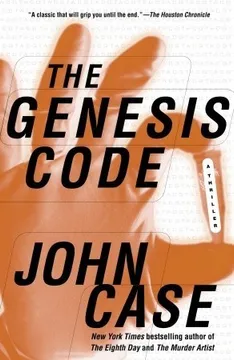
The Genesis Code receives an overall rating of 3.87/5, with readers praising its gripping blend of religion, science, and thriller elements. Many highlight the sharp dialogue, compelling plot twists, and a memorable ending. Positive reviews compare it favorably to Dan Brown's work, noting it predates the Da Vinci Code. Critics cite weaknesses including an underwhelming protagonist, excessive descriptive passages, and predictability. The Italian setting receives particular praise, while some found the pacing uneven. Most agree the core concept is fascinating, making it an engaging read despite its flaws.
People Also Read



Characters
Joe Lassiter
Grieving investigatorJoe runs a high-end investigative firm and approaches uncertainty as something that can be reduced through records, interviews, and persistence. His professional competence also protects him from feelings he cannot yet manage; after Kathy and Brandon die, he first handles grief as if it were a case file. The childhood Alliance he shared with Kathy gives his loyalty a private history, and the murders make that old bond newly urgent. Joe is independent, skeptical of institutions, and accustomed to making decisions for others. His central psychological conflict is whether control can substitute for trust. The search forces him to reconsider what his career, wealth, and investigative skill are for when someone’s life matters more than the answer.
Marie Sanders
Hidden motherMarie is a former film star who has spent years retreating from public attention and protecting her son3, Jesse3. She is resourceful and self-reliant, able to live with little infrastructure, but her isolation also reflects a deep mistrust of being seen and interpreted by strangers. Her decision to pursue motherhood is bound to family history and a hereditary illness, not to celebrity or social approval. Marie’s experience as an actress gives her unusual control over how others perceive her, while her private life asks her to be fully present rather than perform. She is affectionate, practical, and wary of rescue that might become another form of control.
Jesse
Curious island childJesse is Marie’s2 young son3, observant, affectionate, and delighted by the practical world around him. He studies reading, helps with chores, invents games, and treats the island as a place full of things to explore. His questions and enthusiasms reveal a child who feels secure in his mother’s2 attention, even though his life is far from ordinary. Jesse’s warmth draws Joe1 toward an intimate role that he has never quite claimed for himself. He is not a symbol to the people who love him; he is a boy with a school lesson to finish, a game to play, and a fish he wants to keep safe.
Giulio Azetti
Conscience in the confessionalA Jesuit priest serving a small Umbrian parish, Azetti is an intellectual and former Vatican official whose career was curtailed after he spoke against political repression. He is proud, politically alert, and more committed to the poor than to advancement within the Church. Years in parish life have made his faith less dependent on prestige, even as he retains an instinct for institutional procedure. His friendship with Baresi5 gives him access to knowledge that tests the boundaries of his vocation. Azetti is caught between pastoral responsibility and the absolute obligation of secrecy, making him a figure through whom the novel asks what obedience means when lives may depend on speaking.
Ignazio Baresi
Scientist of sacred matterBaresi is a wealthy, unmarried Italian scholar whose career moves through genetics, religious history, and medicine. His intelligence is matched by an inward, contemplative temperament; he is fascinated by the material traces people treat as sacred, from relics to the biological processes of conception. He is willing to follow questions beyond the boundaries set by academic or religious authorities, but he is not simply a cold experimenter. His work brings scientific method into direct contact with belief, and his private convictions shape what he considers worth pursuing. Baresi’s life is driven by a desire to understand whether matter can carry evidence of the divine.
Franco Grimaldi
Mercenary with a creedGrimaldi is a former Italian intelligence operative turned contract killer. He is disciplined, physically formidable, and adept at building false identities that withstand routine scrutiny. His history includes paramilitary service and political violence, but he is also associated with a severe religious life and an austere personal style. That combination makes him difficult to categorize as either a simple mercenary or a sincere convert. Grimaldi’s most unsettling quality is the calm with which he treats violence as work. He embodies the danger of a person who can make brutality serve a larger cause without needing to see himself as merely cruel.
Silvio della Torre
Charismatic religious leaderDella Torre leads Umbra Domini, a hard-line Catholic lay order, and possesses the education, beauty, and rhetorical skill to make its strict doctrines attractive. He understands how lighting, voice, and ritual shape an audience’s experience, and he uses public warmth to soften the extremity of his beliefs. Beneath that polish is a man who treats theological disagreement as a threat requiring decisive response. He is ambitious for his organization and skilled at navigating the gap between its public image and private commitments. Della Torre’s appeal rests on his ability to make certainty feel like intimacy, a quality that both attracts followers and conceals coercion.
Jim Riordan
Dogged homicide detectiveRiordan is a seasoned Fairfax homicide detective, blunt, funny, and stubbornly loyal to the demands of police work. He recognizes that Joe’s1 personal connection makes the case dangerous for him, but he also understands why Joe1 will not stand aside. Riordan balances procedural caution with a practical willingness to share what he can. His humor and irritation mask fatigue rather than indifference. He cares about victims, colleagues, and the integrity of an investigation, even when the institution’s priorities pull him elsewhere.
Donato Maggio
Vatican informantMaggio is a Dominican priest and Vatican archivist who also belongs to Umbra Domini. He is a traditionalist drawn to the order’s rejection of modern Church reforms, and he enjoys being close to powerful people. His position gives him access to confidential discussions, but his loyalties are divided between the institution employing him and the movement whose beliefs he shares. Maggio is observant enough to recognize an opening when the Curia hesitates, yet his ambition and ideological certainty make him careless about the consequences of passing on dangerous knowledge.
Nick Woodburn
Intelligence analyst friendNick, whom Joe1 calls Woody, is Joe’s1 longtime friend and a senior State Department intelligence analyst. He is discreet, analytical, and willing to help Joe1 interpret foreign intelligence, but he knows that some information carries consequences beyond a private favor. Their shared childhood gives their friendship ease and candor, while Nick’s work requires him to draw firm boundaries. He helps Joe1 see the scale of Grimaldi’s6 background without pretending that intelligence can explain every motive.
Antonio Bepistraversi
Roman investigatorBepi is a young Roman private investigator who works with Joe1 as a guide, translator, and local source. He is sociable and quick-minded, with a talent for reading the risks hidden in apparently empty records. His humor and enthusiasm make him easy company, but his willingness to help Joe1 is not merely professional. He believes that practical loyalty matters, even when the person being helped is a foreigner asking dangerous questions.
Dr. Tom Truong
Forensic medical examinerTruong is the medical examiner who performs the autopsies on Kathy and Brandon. He is meticulous, direct, and skilled at translating physical evidence into conclusions investigators can use. His personal connection with Joe1 comes from years of playing soccer and consulting on cases, which makes the news he delivers both professional and painful. Truong’s care for the dead is expressed through precision: he refuses to let the fire obscure what happened to them.
Jiri Reiner
Bereaved Czech fatherJiri is a Czech father whose wife and young son are murdered in a crime resembling the Lassiter killings. Grief has left him withdrawn and physically fragile, but he remains able to answer questions when Joe1 approaches him with honesty. Jiri’s loss gives Joe1 a human connection across the borders that otherwise make the investigation abstract. His memories and medical history help establish that the pattern reaches beyond one family.
Hugh Cockayne
Pensione host and witnessHugh runs the Pensione Aquila with his partner, Nigel15. Sociable, expressive, and more knowledgeable about fertility procedures than his manner suggests, he remembers the women who stayed at the pensione for treatment. His recollections and the guest register give Joe1 access to the clinic’s former patients. Hugh’s warmth makes him a source of human detail rather than simply a keeper of records.
Nigel Burlingame
Keeper of the guestbookNigel is Hugh’s14 partner and co-owner of the Pensione Aquila. Polite, observant, and quietly hospitable, he maintains the guest register that records the clinic’s patients. His affection for the town and its visitors gives the book a personal dimension: he remembers names, habits, and small requests, not just dates. Nigel provides Joe1 with the practical record that connects individual families to the same place.
Kara Baker
Matilda’s closest friendKara is the close friend of novelist Matilda Henderson and one of the few people willing to speak openly about Matilda’s private life. Warm, emotionally expressive, and perceptive about relationships, she challenges the cold account given by Matilda’s sister17. A postcard she has kept helps Joe1 connect Matilda’s pregnancy to the Italian clinic.
Honor Henderson
Matilda’s guarded sisterHonor is Matilda’s sister, an artist whose meticulous work and controlled home reflect a need to keep disorder at bay. She speaks sharply about Matilda’s decision to have a child, presenting their estrangement as simple and final. Her account proves difficult to reconcile with Kara’s16 memories. Honor’s guardedness illustrates how grief and resentment can make even a family history unreliable.
Freddy Dexter
Resourceful young investigatorFreddy works for Joe’s1 investigative firm and is skilled at both interviews and archival research. He traces the bottle’s design and later helps check the names on the clinic list. Earnest and capable, he is still learning how much a routine search can matter when a case is built from incomplete records.
Juliette
Nurse in the burn wardJuliette is a nurse assigned to the hospital ward where Grimaldi6 is treated. She is young, religious, and initially appears to Joe1 and the police to be a frightened witness. Her position gives her access to a patient whose movements are closely controlled, making her an important figure in the investigation’s questions about trust and institutional vulnerability.
Thomas Drabowsky
Senior FBI agentDrabowsky is a senior FBI agent who oversees the federal response after Grimaldi6 escapes. He is conscious of appearances and the political risks of a conspicuous operation, particularly at a religious retreat. His command decisions expose the limits of procedure when an adversary understands how authorities think.
David Torgoff
Plain-speaking geneticistTorgoff is an MIT microbiologist and a consultant Joe1 turns to when Baresi’s5 scientific papers become impenetrable. He is genial, intellectually rigorous, and unusually good at explaining complex genetics without pretending to know more than science can establish. His account of cell differentiation gives Joe1 a framework for understanding the clinic’s possible work.
Roy Dunwold
London-based investigatorRoy runs Joe’s1 London office and has a gift for remaining unobtrusive. A resourceful former intelligence professional, he finds reports of similar killings in Britain and Brazil and helps Joe1 move across borders when ordinary travel becomes unsafe. His dry humor keeps their working relationship steady under pressure.
Plot Devices
The Clinica Baresi guestbook
Maps the hidden victimsNigel’s15 register records the names, addresses, and dates of women who stayed at the Pensione Aquila while receiving treatment at the nearby clinic. Joe1 sorts the entries by length of stay and identifies eighteen patients associated with a long oocyte-donation procedure. Comparing those names with reports of fires reveals that the murders are not random, and the list gives him a way to search for survivors. Its importance comes from its ordinariness: a hotel’s record-keeping preserves what the clinic’s destruction was meant to erase.
Baresi’s relic research
Joins genetics to faithBaresi5 studies relics both as historical objects and as possible carriers of biological material. His research into cell differentiation suggests a method for returning mature cells to a state capable of developing into an organism. The fertility clinic provides the means to implant embryos, while his religious conviction gives the experiments a purpose. The method and the relics remain scientifically and historically uncertain, but the belief that they might be authentic drives Umbra Domini to destroy the clinic’s patients and records.
Grimaldi’s holy-water bottle
Links killer to UmbraThe unusual glass bottle found with Grimaldi6 first appears to be an obscure personal possession. Freddy18 identifies its form as an old holy-water vessel, and Joe1 later sees a matching bottle in della Torre’s7 possession. That resemblance does not prove the men’s exact relationship, but it places them within the same religious world. The bottle carries the novel’s central ambiguity in miniature: it is simultaneously a historical artifact, an emblem of devotion, and a clue in a modern murder investigation.
False identities and records
Conceal and expose peopleGrimaldi6 builds a convincing identity as Juan Gutierrez, while Marie2 revives her birth name and disappears from public life. Joe1 uses credit reports, hotel records, passport stamps, and motor vehicle data to follow both of them. The same information systems that make people traceable can be manipulated by anyone who understands their gaps. Joe’s1 eventual creation of new identities for Marie2 and Jesse3 extends that logic from investigative tool to protection, giving the family a past that can withstand routine checks.
Fire and thermite
Erases bodies and evidenceFire is used first to cover Kathy and Brandon’s murders, then to destroy other families and the clinic itself. When the original blaze leaves Brandon’s remains recognizable, someone burns the exhumed body again with thermite. The repeated fires are not simply arson; they are attempts to prevent identification and remove biological evidence. This method makes the investigation difficult while giving the murders a ritual appearance. It also connects the killers’ practical need for concealment to their belief that the children’s existence must be erased.
Download PDF
Download EPUB
.epub digital book format is ideal for reading ebooks on phones, tablets, and e-readers.








