

Key Takeaways
Treat your subconscious as a powerful partner, not a wish-granting machine
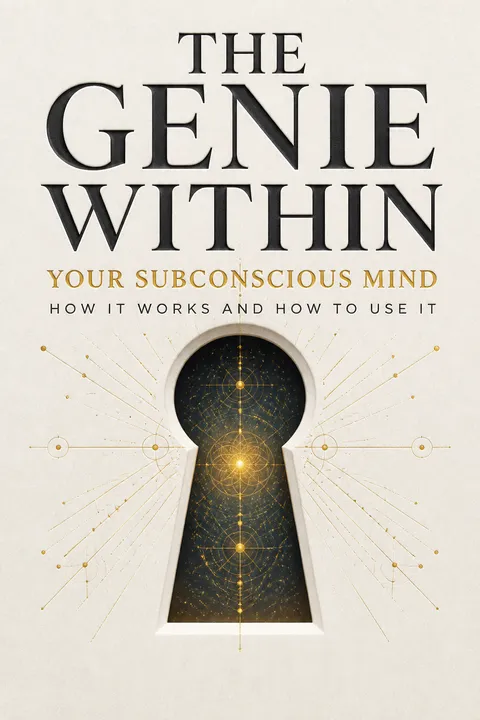
The book’s central metaphor. Carpenter calls the subconscious mind a “genie”: a name for mental activity outside awareness that shapes habits, emotions, memory, and bodily responses. His opening parable makes the point: a man spends his life seeking a magical bottle, then learns that his unexamined expectations have been steering him all along. The practical lesson is to notice the goals and assumptions embedded in everyday self-talk, not to expect wishes to materialize by magic.
A personal origin story. Carpenter says that, at nine, he recovered from a grave heart condition after a practitioner encouraged him to expect healing. He takes this experience as evidence of the mind’s power, though it cannot establish what caused the recovery. The book itself warns readers to seek professional care and not treat its exercises as medical treatment.
What's striking is how effectively the genie metaphor turns an abstract subject into a question of stewardship: what mental patterns are being rehearsed, and who benefits from them? That framing can encourage useful self-observation. Its limit is equally important. A compelling recovery story is not a controlled test, and illness is not proof of faulty thinking. The metaphor works best as a guide to attention and behavior, not as a literal account of a hidden agent or a promise of control over disease.
Use vivid rehearsal to make desired behavior feel familiar before pressure hits
Imagine the performance. Carpenter argues that the subconscious responds to vividly imagined events much like it responds to real ones. He uses this premise to recommend mental rehearsal: picture a specific action going well, with sights, sounds, sensations, and emotion. His examples range from athletes imagining a successful play to a nervous speaker rehearsing a calm presentation. He also recounts a dart-throwing exercise in which people who practiced in imagination reportedly performed as well as, or better than, other novice groups.
Pair imagination with practice. Rehearsal can make a sequence more familiar and help a person focus on the task rather than panic about it. The book does not make physical practice unnecessary, and its own sports examples combine the two. Visualization is most useful when it rehearses controllable actions, not merely a hoped-for trophy or outcome.
Mental rehearsal has a plausible bridge to skill learning: it lets people preview actions, notice obstacles, and organize attention without the costs of a full performance. The distinction between process and outcome matters. Imagining a clean golf swing or a composed speech rehearses behaviors; imagining applause alone may rehearse little. This practice can support preparation, but it cannot provide the feedback, strength, or technical correction that real attempts supply. Treating visualization as rehearsal, rather than a substitute for training, preserves its value.
Give your mind one clear target, then stop micromanaging the route
Specify what matters. Carpenter models the subconscious as a goal-seeking biocomputer: give it a target, and it may organize attention and behavior around that target. In his account, vague or conflicting aims produce muddled effort. He recommends writing down short-, medium-, and long-term goals, reviewing them, and checking that they are genuinely one’s own and compatible with other people’s well-being.
Trust the process, not a fantasy. The book draws on plastic surgeon Maxwell Maltz’s observation that some patients changed their confidence and behavior after surgery while others did not. Maltz’s proposed explanation was self-image: people often act in ways consistent with the person they believe themselves to be. Carpenter suggests imagining oneself carrying out the desired role, then letting go of constant scrutiny. A clear target can guide action, but it does not guarantee success or replace a workable plan.
The useful tension here is between direction and control. Goals can help people select relevant information and persist, while excessive monitoring can heighten anxiety and make performance feel effortful. Yet the instruction to avoid thinking about how to reach a goal can be too sweeping: complex goals often require feedback, planning, and revision. A stronger reading is to define the destination, choose practical next steps, and avoid letting self-doubt dominate attention during execution. That keeps the metaphor helpful without making intention do the work of strategy.
Practice relaxation as a doorway to focused imagery, not magical brain control
A calmer working state. The book calls relaxed, inwardly focused wakefulness the alpha state, and describes the deeper, dreamier theta state as especially associated with insight. It recommends simple routines such as slow breathing, relaxing muscles progressively, counting down, and picturing a peaceful scene. Carpenter suggests that repeated practice can make a short cue, such as a chosen word, recall the relaxed state without a full routine.
Use the model carefully. Alpha and theta refer to patterns of electrical brain activity, and the book gives frequency ranges for them. It treats these states as doorways to the subconscious and says suggestions are more readily accepted there. That is the author’s practical model, not proof that a particular brain-wave state reliably bypasses critical thought. The relaxation exercises can be used for calm and concentration without accepting every claim about what they unlock.
The practical insight does not depend on a special gateway: relaxing, reducing distraction, and focusing on an image can make mental practice easier. The brain-wave labels offer a memorable map, but they risk making a complex relationship sound mechanical. A measured EEG pattern does not, by itself, establish that a person is receptive to a suggestion or that an affirmation will take hold. The most defensible use is modest: relaxation is a trainable context for attention, reflection, and rehearsal.
Repeat emotionally vivid, present-tense cues until they compete with old habits
Rehearse the replacement. Carpenter’s proposed rules for suggestions emphasize repetition, emotional force, and present-tense wording. Instead of rehearsing a desired change as something that may happen someday, he recommends imagining it as happening now. He also argues that old beliefs are not simply erased; a stronger, repeatedly rehearsed alternative must become more influential. His balance-scale analogy pictures positive and negative self-beliefs competing for dominance.
Make the image personal. A useful affirmation, in this approach, is more than a slogan. Someone preparing for a difficult conversation might visualize speaking clearly, hear a calm response, and feel composed. The book also recommends attaching a small word or image to the experience as a reminder. Repetition can strengthen a mental association, but repeating a statement does not make it true, and affirmations that feel implausible may increase resistance rather than confidence.
This section connects self-talk to memory: repetition and emotion can make certain thoughts easier to retrieve, which may influence what a person notices and does. The present-tense format can make a goal feel concrete, but it should not require denying current reality. A useful affirmation bridges aspiration and action, such as rehearsing a specific skill, rather than insisting on a state that contradicts experience. The book’s replacement metaphor is memorable, though beliefs are rarely a single contest with one winner; context and evidence also shape them.
Turn worry into a concrete next action before it becomes mental rehearsal
Give stress an outlet. Carpenter’s Natural Energy Cycle describes energy building around a thought, finding expression in action, and then giving way to rest. He argues that worry traps attention on an imagined threat and can leave stress without a constructive outlet. His example is a worker afraid of losing a job: rather than repeatedly picturing disaster, update a résumé, quietly explore alternatives, and take other useful steps.
Separate action from rumination. The book also suggests reframing a difficult encounter, using relaxation, or imagining a calmer response. These methods do not make an external problem disappear, but they can reduce the time spent rehearsing helplessness. Carpenter’s advice to avoid resistance to negative ideas is less convincing as a universal rule; sometimes a direct boundary or disagreement is necessary. The practical test is whether a response improves the situation or merely keeps the alarm going.
This is one of the book’s most grounded applications because it converts a vague internal struggle into problem-solving. Psychology distinguishes productive worry, which identifies a solvable concern and prompts a plan, from repetitive rumination, which circles without changing the situation. That distinction sharpens Carpenter’s advice: act where action is possible, and use calming techniques where it is not. The claim that unexpressed stress causes particular diseases is much less secure than the simpler observation that chronic distress can burden well-being.
Let a problem incubate after you have supplied it with useful material
Prepare, then disengage. Carpenter recommends giving a problem to the mind before sleep or during a period of relaxation, then turning attention elsewhere rather than forcing an answer. He calls this the subconscious crock-pot: a metaphor for ideas continuing to combine outside deliberate focus. The book recounts chemist Friedrich Kekulé’s dream of circling snakes, which he associated with the ring structure of benzene, and describes other creators finding solutions after setting a problem aside.
Keep a record nearby. The suggested practice is straightforward: define the question, gather relevant information, make an initial attempt, and leave room for rest or sleep. If an idea appears in a dream or upon waking, write it down before it fades. Incubation can help loosen a mental rut, but it does not guarantee a useful insight, and the stories do not show that dreams provide answers without prior knowledge or effort.
The crock-pot image gives a practical name to a familiar creative rhythm: focused preparation followed by a break. Rest can alter attention and allow people to see a problem from a new angle, while sleep supports memory processes. The important ingredient is not passivity alone; the mind needs material to work with, and a proposed answer still needs testing. Anecdotes about famous discoveries make the idea vivid, but they are selective stories, not a reliable recipe for producing breakthroughs on demand.
Attach small cues to practiced states, but do not mistake signals for evidence
Build a useful reminder. Carpenter calls a learned reminder a trigger: a word, image, color, sound, or small movement associated through repetition with a particular response. For example, he describes linking a finger touch with relaxation or using a meaningful image to recall a longer health affirmation. He also presents one-word prompts and pictures as compact reminders that can bring a practiced response to mind.
Distinguish reflection from diagnosis. The book proposes pendulums, finger movements, automatic writing, and Muscle Response Testing as ways to question the subconscious. These methods may reveal a person’s expectation or feeling, but an involuntary movement is not dependable proof of a hidden fact, allergy, medication need, or illness. Such questions belong with qualified professionals. Used as memory prompts, cues can be low-risk; used as diagnostic instruments, they can create false confidence.
The cue idea fits learning theory: a repeated signal can become associated with a practiced response, making recall easier in the moment. That is different from the book’s stronger claim that a pendulum or muscle test can retrieve objective information unavailable to awareness. Small movements are vulnerable to expectation and unconscious muscular influence, so apparent certainty can exceed actual accuracy. The distinction is valuable beyond this book: a tool may help someone notice an internal reaction without validating the explanation attached to it.
Use prayer as aligned intention, while keeping spiritual claims distinct from proof
Extend the method spiritually. In its final lesson, the book proposes a Universal Mind, a shared intelligence beyond an individual’s conscious and subconscious activity. Carpenter points to remote viewing, animal navigation, quantum entanglement, and reports of intercessory prayer as suggestive evidence. He describes a cardiac-patient study involving 393 people and reports better outcomes on several measures among those prayed for, while acknowledging that prayer can be approached in different ways.
A practice of focus and care. His suggested prayer combines a relaxed state, a positive image of the hoped-for outcome, compassion, gratitude, and release of control. He also advises aligning conscious belief with deeper expectation. These steps may give prayer structure and emotional meaning. The book explicitly says its methods do not replace professional care; prayer should not be treated as a proven way to cure illness or as a reason to delay treatment.
Prayer can matter to people as ritual, relationship, and a way to organize hope or compassion. Those functions can be meaningful even when a proposed supernatural mechanism is unverified. The reported cardiac study cannot, by itself, settle whether prayer changes medical outcomes; study design, replication, and chance all matter. Likewise, quantum entanglement does not establish a universal channel for thoughts. Respecting spiritual practice does not require presenting contested claims as scientific conclusions.
Analysis
The book is a practical self-help course built around one durable intuition: mental habits can influence what people notice, rehearse, feel, and do. Its instruction is unusually concrete. Readers are asked to relax, form vivid images, write goals, rehearse desired behavior, redirect worry, and allow creative problems to rest. The parable of the searching old man and Carpenter’s own illness story give the material a personal narrative, while the repeated computer and genie metaphors make invisible processes easier to discuss.
The book’s strength is also its main intellectual hazard. It often moves from a useful psychological observation to a much larger biological or metaphysical claim without a matching increase in evidence. Mental imagery may support preparation, but it does not show that thought alone controls disease. Placebo responses can change experience and some symptoms, but the presence of an expectation effect does not mean an inert treatment cures every underlying condition. A reported recovery, hypnosis demonstration, or vivid anecdote can motivate inquiry, but none substitutes for controlled evidence.
The model of a single subconscious agent that accepts instructions literally is best treated as metaphor. Modern accounts of cognition describe many interacting processes, most outside awareness, rather than a unified inner servant. Likewise, alpha and theta are measurable patterns, not proof of a special passage to hidden knowledge. The book’s proposed pendulum and muscle tests deserve particular caution because subjective movement can reflect expectation rather than objective information.
A careful reader can keep the useful practices and decline the overreach. Use relaxation to settle attention, imagery to rehearse specific actions, goals to guide choices, and problem-solving to convert worry into plans. Treat affirmations as prompts, not guarantees. Treat prayer as meaningful practice if it fits one’s beliefs, not as medical evidence. The book is most valuable when its genie is understood as a memorable name for mental processes worth training, not as a supernatural mechanism with unlimited power.
Review Summary
The Genie Within receives mostly positive reviews, with readers praising its practical approach to harnessing the subconscious mind. Many find it life-changing and easy to understand, appreciating the exercises and techniques provided. Some readers report successful results from applying the book's methods. Critics note repetition and similarity to other self-help books. Overall, readers value the book's insights into the subconscious mind's power and its potential to improve various aspects of life, though some find certain concepts difficult to accept.
People Also Read









Glossary
Subconscious mind
Unconscious mental processesCarpenter uses this term for mental activity outside present awareness, including habits, emotions, involuntary bodily functions, and stored experience. He presents it as powerful, goal-seeking, and more responsive to images and feelings than to logical argument. This is a simplified model rather than a single, clearly bounded system in modern neuroscience.
Alpha state
Relaxed, focused wakefulnessIn the book’s model, the alpha state is a relaxed but conscious condition associated with daydreaming, meditation, and inward focus. Carpenter recommends entering it through breathing, progressive muscle relaxation, counting, and visualization, then using it to rehearse suggestions. Alpha waves are measurable brain activity, but the book’s claim that this state reliably opens a special channel to the subconscious is not established by the label alone.
Theta state
Deeper relaxed attentionCarpenter describes theta as a deeper state than alpha, linked in his model with dreams, intuition, and sudden creative insight. He teaches a relaxation exercise intended to reach it and suggests it can make imagery and suggestions more effective. Theta refers to a range of brain-wave activity, but its presence does not by itself demonstrate access to hidden knowledge or guarantee insight.
Law of Reverse Effort
Straining can worsen performanceThis is Carpenter’s name for the idea that forceful conscious effort can intensify the fear or competing expectation that interferes with a goal. His examples include struggling to remember a name or trying too hard to fall asleep. The practical advice is to prepare, reduce pressure, and allow a practiced response to emerge rather than continually monitoring it.
Natural Energy Cycle
Thought, action, then restCarpenter’s model of stress describes energy building around a thought, finding expression through directed action, and being followed by rest. He argues that unresolved stress can remain as tension or restless behavior when it has no constructive outlet. The cycle supports a practical recommendation to respond to worries with useful action where possible, then make room for recovery.
Subconscious crock-pot
Unconscious problem incubationThis metaphor describes the mind continuing to work on a problem after a person has supplied relevant information and stopped concentrating on it. Carpenter recommends defining the question, making an initial effort, then taking a break or sleeping. The metaphor does not imply that solutions arrive automatically; insights still need preparation, recall, and evaluation.
trigger
A learned response cueA trigger is a word, image, color, sound, smell, or movement that Carpenter recommends associating with a practiced mental or emotional response. Repeated pairing is intended to make the cue recall that response quickly, such as using a finger touch as a reminder to relax. A cue can prompt a learned behavior without proving that it reveals hidden facts.
instant playback
Rapid mental pattern recallCarpenter uses this phrase for the claimed ability to review a familiar, well-established experience or sequence very quickly in the mind. He describes it as a way to save time when recalling programmed affirmations or repeated material. The book presents anecdotes for the idea, but the term should not be taken as a measured or universal mental capability.
Universal Mind
Shared transcendent intelligenceIn the prayer lesson, Carpenter proposes a Universal Mind as an intelligence that exists beyond an individual’s conscious and subconscious activity and is shared by all. He uses it to explain prayer, remote perception, and other claimed forms of information transfer. This is a spiritual hypothesis offered by the author, not an established scientific account of how minds communicate.
Muscle Response Testing
Muscle-based answer testingCarpenter describes Muscle Response Testing as using resistance in a person’s arm or fingers to indicate whether a statement or substance is supposedly positive or negative for them. He presents it as a way to ask about health, emotions, and choices. The method is not a reliable substitute for clinical testing, and a muscle response cannot establish an allergy, diagnosis, or appropriate treatment.
organ language
Emotional meaning assigned to symptomsCarpenter uses organ language for the idea that a phrase expressing emotion, such as feeling unable to stomach a situation, can be linked to a bodily symptom. He presents this as one possible way emotional conflict may be expressed physically. The concept can invite reflection on stress, but a symptom should not be assumed to have a symbolic cause without medical assessment.
FAQ
What is "The Genie Within: Your Subconscious Mind—How It Works and How to Use It" by Harry W. Carpenter about?
- Unlocking the Subconscious Mind: The book explains how the subconscious mind functions and how individuals can harness its power to improve their lives.
- Practical Self-Help Guide: It offers concrete, easy-to-follow techniques for changing habits, achieving goals, and enhancing well-being.
- Accessible and Non-Metaphysical: The content is presented in layman’s terms, focusing on practical application rather than esoteric or metaphysical concepts.
- Comprehensive Resource: Carpenter compiles information from numerous sources, aiming to provide a single, thorough manual for understanding and using the subconscious mind.
Why should I read "The Genie Within" by Harry W. Carpenter?
- Empowerment Through Knowledge: The book teaches readers how to become the master of their subconscious mind, rather than being controlled by it.
- Wide Range of Benefits: Techniques in the book can help with habit change, self-esteem, learning, creativity, health, and more.
- Simple, Actionable Methods: The author emphasizes that the methods are easy, effortless, and accessible to anyone, regardless of prior experience.
- Real-Life Examples: The book is filled with case studies and stories that illustrate the power of the subconscious mind in everyday life.
What are the key takeaways from "The Genie Within" by Harry W. Carpenter?
- Subconscious Mind’s Power: Most people use only a small fraction of their subconscious mind’s potential, but it can be trained to achieve remarkable results.
- Alpha State Access: Entering the alpha (and theta) brainwave states is crucial for effectively programming the subconscious mind.
- Repetition and Emotion: Lasting change requires repeated, emotionally charged affirmations or visualizations in the present tense.
- Harmony Between Minds: Success comes when the conscious and subconscious minds work together; conflict between them leads to self-sabotage.
How does Harry W. Carpenter define the subconscious mind in "The Genie Within"?
- Unconscious Mental Processes: The subconscious mind is the part of the mind we are unaware of, responsible for involuntary functions, emotions, and habits.
- Biocomputer Analogy: Carpenter likens it to a super biocomputer, capable of storing vast amounts of information and running countless programs simultaneously.
- Literal and Present-Focused: The subconscious takes things literally, operates only in the present, and cannot distinguish between real and vividly imagined experiences.
- Emotion and Imagery Driven: It communicates primarily through images and feelings, rather than words or logic.
What are the main differences between the conscious and subconscious mind according to "The Genie Within"?
- Conscious Mind: Logical, analytical, voluntary, and limited in capacity; it can only do one thing at a time and is aware of itself.
- Subconscious Mind: Emotional, inductive, involuntary, and virtually unlimited; it can handle trillions of tasks simultaneously and is always active.
- Memory and Processing: The conscious mind has short-term, limited memory, while the subconscious has virtually infinite memory and processes information globally.
- Will vs. Power: The conscious mind has will (direction), but the subconscious has the power (energy) to carry out actions.
What are the "laws of the subconscious mind" in "The Genie Within" by Harry W. Carpenter?
- Repetition: New programs must be repeated often to be accepted and maintained by the subconscious.
- Emotion: Attaching strong emotion to suggestions makes them more effective.
- Present Tense: Affirmations must be stated in the present, as the subconscious only operates in the now.
- Dominant Concept: Only one concept can dominate at a time; to change a negative belief, it must be overpowered by a stronger positive one.
- Expectation and Reverse Effort: Expectation is self-fulfilling, and trying too hard (reverse effort) can actually hinder results.
How does "The Genie Within" by Harry W. Carpenter recommend accessing and programming the subconscious mind?
- Alpha/Theta State Induction: Use relaxation routines to enter the alpha or theta brainwave states, which open the door to the subconscious.
- Affirmations and Visualization: Employ present-tense, emotionally charged affirmations and vivid visualizations to implant new beliefs or habits.
- Repetition and Triggers: Repeat affirmations regularly and use triggers (like a word, color, or gesture) to reinforce programming.
- Letting Go: After programming, trust the subconscious to do its work without conscious interference or micromanagement.
What practical methods and exercises does "The Genie Within" offer for using the subconscious mind?
- Mental Alarm Clock: Program yourself to wake up at a specific time using suggestion before sleep.
- Progressive Relaxation: Use guided routines to deeply relax and enter the alpha state.
- Visualization Boards and Dream Books: Create visual reminders of your goals to keep them active in your subconscious.
- Pendulum and Muscle Testing: Communicate with your subconscious for yes/no answers or to uncover hidden beliefs.
- Joy Center Activation: Mentally stimulate the brain’s “joy center” to instantly improve mood.
How does "The Genie Within" by Harry W. Carpenter explain the role of childhood programming and habit formation?
- Early Programming: Most subconscious programs are formed in childhood, often before the conscious mind is fully developed.
- Influence of Authority Figures: Parents, teachers, and peers unintentionally install both positive and negative beliefs through repetition and emotion.
- Conditioned Reflexes: Emotional experiences can create lasting, automatic responses (habits or fears) that persist into adulthood.
- Reprogramming Possible: By understanding these origins, adults can use the book’s methods to override negative childhood programming with positive beliefs.
What is the significance of the alpha and theta states in "The Genie Within" by Harry W. Carpenter?
- Gateway to the Subconscious: Alpha (8–13 Hz) and theta (4–7 Hz) brainwave states are natural, relaxed states where the subconscious is most receptive.
- Enhanced Suggestibility: Suggestions and affirmations are accepted much more readily in these states than in the normal waking (beta) state.
- Natural Occurrence: We pass through these states daily when falling asleep or waking up, making these times ideal for subconscious programming.
- Techniques Provided: The book offers step-by-step routines for entering and using these states for personal change.
How does "The Genie Within" by Harry W. Carpenter address the influence of advertising and external suggestions?
- Targeting the Subconscious: Advertisers use repetition, emotion, and imagery to plant suggestions directly into the subconscious mind, often bypassing logic.
- Alpha State Susceptibility: People are especially vulnerable to suggestion while watching TV or in relaxed, daydreamy states.
- Defensive Techniques: The book teaches readers to recognize and mentally “delete” or “cancel” negative suggestions from ads or others.
- Self-Programming Emphasis: By being aware of these influences, readers can consciously choose what to accept and what to reject, taking control of their own programming.
What does "The Genie Within" by Harry W. Carpenter say about prayer and its relationship to the subconscious mind?
- Prayer as Affirmative Programming: Effective prayer uses the same principles as subconscious programming—affirmation, emotion, and present-tense visualization.
- Alpha/Theta State Prayer: Praying in a relaxed, meditative state (alpha/theta) greatly increases the power and effectiveness of prayer.
- Single-Mindedness and Faith: For prayer to work, both the conscious and subconscious minds must be in agreement, and faith must be deeply rooted in both.
- Universal Mind Concept: The book introduces the idea of a Universal Mind, suggesting that prayer taps into a higher intelligence accessible through the subconscious.
What are the best quotes from "The Genie Within" by Harry W. Carpenter and what do they mean?
- “You have a genie that will grant your wishes. But your genie will not grant wishes simply by rubbing a lamp or uncorking a magical bottle. The genie is your subconscious mind and you must know how it works and how to use it before it will be your powerful servant.”
Meaning: True power lies within, but it requires understanding and conscious direction to be effective. - “When will and imagination are in conflict, imagination always wins.” (Emile Coué, quoted in the book)
Meaning: The subconscious (imagination) will override conscious effort (willpower) if they are not aligned. - “The less you strain, the more you relax and let it happen, the more successful you will be.”
Meaning: Effortless, relaxed programming of the subconscious is more effective than forceful, conscious striving. - “Every thought or idea causes a physical reaction in the body.”
Meaning: The mind and body are deeply interconnected; mental states directly influence physical health and behavior.
Download PDF
Download EPUB
.epub digital book format is ideal for reading ebooks on phones, tablets, and e-readers.








