

Plot Summary
Prologue
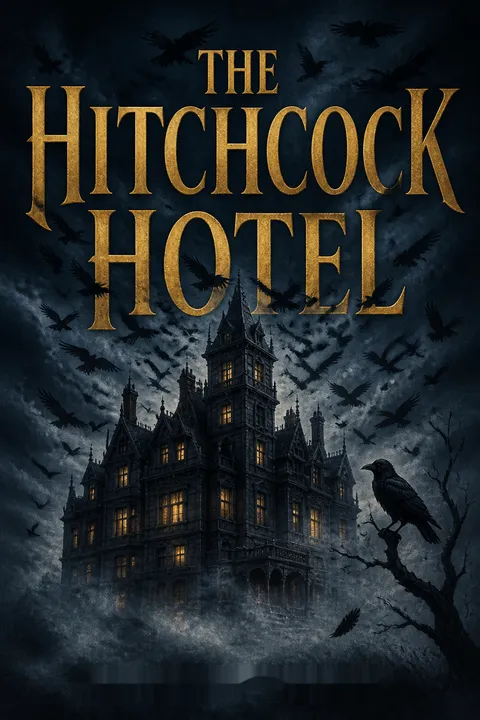
A crow wanders through the Hitchcock Hotel, unable to find its way back to the aviary. It has glimpsed a human body twisted at an unnatural angle, and its instincts tell it to flee before the hotel stirs again.
But the bird, like everyone inside, is trapped. The glimpse offers no name, no cause, and no way out, only the certainty that something terrible has happened beneath the hotel’s theatrical decor.
The crow’s limited perspective turns the hotel into a maze before the reader knows who built it or why. Its instinctive fear is more reliable than the human explanations that will follow: the guests will debate accidents, pranks, and guilt while the bird registers danger without rationalizing it away. The trapped animal also previews the guests’ predicament. The hotel is designed as a place of observation and performance, but the crow sees no distinction between a staged scare and a genuine threat. Its opening glimpse promises a body while withholding the identity and cause, establishing suspense through partial knowledge.
The Reunion on the Hill
On the anniversary of his Hitchcock-themed hotel, Alfred Smettle welcomes five former college friends: chef Zoe, entrepreneur Samira, security guard TJ, heir Julius, and financier Grace. The hotel is lavish but struggling to attract guests, and Alfred hopes a notorious weekend will bring the publicity he needs.
He has also spent weeks studying his guests and preparing for their arrival. Grace’s separate, urgent appeal helped persuade the others to come; Alfred has leverage over her that she does not explain.
He greets the group with polished hospitality, a tight collar concealing the birthmark that Julius once mocked. The old friends reunite beneath a carousel horse, unsure whether Alfred wants to celebrate their past or settle something left unfinished there.
Alfred’s hospitality is both a business strategy and a form of authorship. He has designed the building, researched his guests, arranged their rooms, and rehearsed his welcome, treating the reunion as a production in which he controls the setting and the cast. Yet his power is compensatory: the hotel’s financial weakness and his unresolved humiliation make him dependent on the very people he wants to command. Grace’s private effort to assemble the group hints that the invitation is coercive rather than simply nostalgic. The opening tension therefore rests on a mismatch between Alfred’s courteous surface and the resentments shaping his choices.
Grass at the Dinner Table
During dinner, Alfred invents a history for the house’s former owners: he claims a neglected husband died after his wife fed him grass. The guests laugh uneasily, then drift into a game about how they would commit a perfect murder. TJ favors a disappearance, Zoe proposes a weapon that melts, and Julius describes disguising a killing as a fall.
When Zoe hints that Alfred once caused a death, the table goes still, but she retreats before explaining. She is drinking again after two months of sobriety, and Samira worries without managing to stop her. The evening ends with Julius and TJ trading insults, while Grace leaves to soothe TJ. The reunion’s playful cruelty begins to expose old injuries rather than conceal them.
The fictional grass story supplies the group with a shared object of dread, but its immediate function is social: it lets Alfred control the room by making everyone listen to him. The murder game similarly converts danger into entertainment, allowing the friends to display wit while approaching a history none of them will name. Zoe’s allusion punctures that safety, then her retreat shows how thoroughly shame and fear have trained her to stop short of disclosure. Her drinking is not merely a relapse in isolation; it is a way to survive a reunion in which humor keeps reopening the wound she hoped to close.
The Pillow Goes Missing
On Friday morning, Zoe vomits and blames the wine, though she had initially felt only a manageable hangover. Alfred brings her bland food and offers concern, but Zoe reads menace in his attention. She remembers how her drinking escalated after a senior-year crisis and how the resulting shame helped drive her from friends and into restaurant work.
A clump of grass appears on her pillow, echoing Alfred’s story, but vanishes when Zoe brings Samira back to see it. Samira suspects a prank or a hangover-fueled misperception and refuses Zoe’s claim that Alfred poisoned her. Separately, Samira sees a shadowy intruder in her bedroom while showering. No one can identify the visitor, and Alfred’s assurances do not ease her fear.
The two bedroom incidents create a credibility trap. Zoe has a real history of drinking and concealment, so Samira can plausibly dismiss her report, while Samira’s own glimpse is too brief to establish what she saw. Their uncertainty benefits whoever is exploiting it: each woman must choose between trusting a friend and protecting herself from seeming irrational. The grass is especially effective because it transforms Alfred’s invented story into a physical threat without proving who placed it there. Shame becomes an instrument of isolation. Zoe fears she will not be believed, while Samira begins to fear that the hotel’s apparent safety is only another performance.
Eyes Above the Bedrooms
Alfred retreats to a hidden attic above the third floor, where vents let him watch the guest rooms. He has installed the observation point without the visitors’ knowledge, turning his hotel into a private theater.
Through it, he sees Grace and TJ in bed together and records their encounter. The discovery sharpens his leverage over Grace, who is married to Rob, and exposes TJ’s hope that she will eventually leave her husband. Their relationship is more than a casual reunion fling to him; she resists discussing any future.
Alfred already knows how to pressure Grace, and now he has intimate evidence to use against her. Meanwhile, TJ has come to the hotel partly to hide from a fixer connected to his own secret misconduct, making him reluctant to leave.
The vents literalize the power imbalance that has been developing throughout the weekend. Alfred can observe without being seen, and his claim to be a devoted host becomes indistinguishable from entitlement to his guests’ private lives. The recorded affair gives him leverage, but it also reveals how surveillance changes the observer: he treats what he sees as material to arrange, not as evidence of another person’s boundaries. TJ’s separate concealment complicates the moral field. He is both a victim of Alfred’s spying and someone using his friends as cover from a threat he has not yet confessed.
Rope Without Phones
Alfred summons the friends to watch Rope, then collects their phones under the pretext of reviving their old film-club rituals. The movie shows murderers hiding a body while guests remain unaware, an unnerving choice for a group already suspicious of their host.
When the screening ends, Alfred cannot produce the phones from the locked reception drawer. The concierge and most of the staff have gone home, leaving the guests without their usual connection to the outside world.
Dinner is delayed, tempers flare, and Samira insists on keeping a courtyard door open as an escape route. A crow escapes its aviary, circles the dining room, and scratches Julius before flying through the hotel. The guests laugh afterward, but the room no longer feels like a place they can safely leave.
The screening turns Hitchcock’s suspense principle into the guests’ lived condition: the audience of Rope knows a body is concealed, while the characters in the film do not. Here the friends suspect hidden danger but lack enough information to identify it. Taking the phones narrows their options and transfers practical control to Alfred, even before anyone can prove he has kept the devices. The crow’s escape briefly makes the hotel’s most theatrical feature uncontrollable. Its attack disrupts the group’s banter, yet the laughter that follows is a fragile reset, not reassurance. The friends remain dependent on one another while increasingly doubting one another.
The Closet Opens
By Saturday morning, Alfred is still missing and the phones remain unaccounted for. Zoe finds antifreeze in a kitchen cabinet and takes it as proof that Alfred poisoned her, though she cannot prove the bottle was used.
TJ, Zoe, and Julius search Alfred’s room; while they wait for TJ to fetch tools, Zoe learns Julius has testicular cancer and surgery scheduled for the following week. They force their way into the storage closet instead. Alfred lies dead beside the attic ladder, his leg caught on a rung, his head bloodied and neck twisted.
Zoe climbs into the attic and discovers the hidden vents overlooking the bedrooms. The revelation confirms that someone watched the guests, but it does not explain who killed Alfred or whether his fall was an accident.
The discovery collapses several kinds of uncertainty into one room. Zoe’s fear of poisoning gains a suspicious object but no causal proof; TJ’s suspicions about surveillance are confirmed; and Julius’s cancer disclosure reveals how much vulnerability has been hidden beneath his comic persona. Alfred’s body initially invites the simplest explanation, a fall from the ladder, even as the scene resembles the murder method discussed at dinner. The attic vents change the meaning of earlier bedroom incidents, but they do not solve them. Knowledge arrives in fragments, and each fragment implicates the people who have already been least willing to trust one another.
Seven Slashed Tires
Danny, Alfred’s fiercely protective housekeeper, finds the group around his body and immediately challenges their claims of innocence. She points to Julius’s earlier suggestion that a murder could be staged as a fall, and reminds them that TJ argued with Alfred.
Before anyone can leave, the friends discover every vehicle in the parking lot has been disabled by slashed tires. Police arrive and confine the guests while detectives investigate the body and question them separately. Zoe tells the detectives about the antifreeze and her suspicions, but the bottle has disappeared by the time they search the kitchen.
TJ is questioned about his inquiries into the staff. The clues seem to multiply, yet several could have been planted, and the stranded friends cannot tell whether Danny is helping the investigation or steering it.
The slashed tires change the hotel from a suspicious destination into a coercive enclosure. The guests cannot test their suspicions by leaving, so every explanation must be negotiated within the same small group. Danny’s accusations exploit facts that are true but incomplete: Julius did discuss staging a fall, and TJ did confront Alfred. The missing antifreeze weakens Zoe’s credibility just as the surveillance vents make her fears seem more plausible. This is a classic evidentiary problem shaped by intimate relationships: knowledge is distributed unevenly, and each person can be both a witness and a source of distortion. Confinement magnifies the cost of every secret.
Easy A Breaks Apart
As the detectives question the guests, their college history surfaces. Alfred and Grace had jointly run Easy A, selling essays for Professor Jerome Scott’s film courses; Grace wrote much of the work while Alfred handled customers.
Julius, angry at Alfred for exposing his cocaine sharing to his father, reported the cheating scheme to Scott. When the professor investigated, Alfred took the expulsion while Grace concealed her role. Julius stayed away from Alfred’s disciplinary hearing, as did the others, and Alfred left Reville alone.
Zoe later saw Alfred leaving the campus building after Scott fell to his death. Alfred threatened to expose her own cheating if she told anyone what she had seen. A dead bird on Zoe’s bed made the threat feel immediate, and she stayed silent for years.
The old scandal shows how a group can convert loyalty into selective concealment. Julius’s report was motivated by retaliation, not a principled commitment to academic honesty; Grace benefited from Alfred’s willingness to absorb the punishment; and Zoe’s silence was secured through fear. The result was not one guilty person and several innocent witnesses, but a network in which each person had a different reason to let the truth remain buried. Alfred’s grievance therefore contains real injury, though it cannot justify what he later plans. The reunion brings these asymmetries into view, forcing the friends to confront how their past choices distributed consequences unevenly.
Samira’s Midnight Confession
Danny tells the detectives that Samira entered the attic closet during the night, so Samira explains what happened. Unable to sleep after seeing an intruder, she searched the attic for the stolen phones and found them beside the vents.
While she was looking into Grace’s room, Alfred arrived with a knife. Samira shoved him in terror; he struck his head and fell through the hatch, leaving her to believe she had killed him. She took the phones, fled to her room, and hid the incident rather than call for help.
The detectives hear her out but reveal a mark around Alfred’s throat beneath his turtleneck. His fall injured him, but it did not kill him. Samira’s confession explains the body’s position while leaving the actual strangler unidentified.
Samira’s account is a moral turning point because she chooses truth after spending the night calculating its costs. Her fear is concrete: she is pregnant, raising two children, and facing the possibility of imprisonment. Yet the confession does not simplify her into either a murderer or a hero. She acted in self-defense, then withheld help because she feared the consequences. The distinction between causing a fall and causing death matters legally, but psychologically the burden is already real. The detectives’ evidence restores uncertainty at the exact moment she expects punishment, showing how confession can be ethically necessary without immediately delivering emotional relief.
The Roof at Reville
Grace remembers how the cheating scheme brought Alfred before Scott and the university, and how she refused to accompany him to the disciplinary hearing. Later, Scott’s investigation threatened to expose her too.
Grace and Alfred planned to confront the professor on Carroll Hall’s roof, intending to prevent him from reporting them. Alfred brought Scott to the edge but could not push him. Grace did it instead, then helped Alfred escape and accepted his promise that Scott had never known she was involved.
Alfred kept Scott’s glasses as a souvenir. Zoe had seen Alfred leaving the building that day and recognized the disguise, but his threat about her own essays silenced her. Years later, Alfred used the shared secret to compel Grace to bring their friends to the hotel.
Grace’s confession overturns the group’s preferred moral arrangement. Alfred was not the sole author of the old crime, nor was Grace merely a frightened bystander who benefited from his silence. She chose the act when Alfred faltered, then let him carry the visible punishment for their academic scheme as well. Her competence, usually presented as control and foresight, becomes an instrument for suppressing consequences. Alfred’s later blackmail grows from this shared history, but the power between them is not simple: each holds evidence against the other. Their relationship is sustained by a secret that makes intimacy, coercion, and fear difficult to disentangle.
Grace Leaves in Cuffs
Zoe finally tells the detectives what she saw after Scott’s death and describes Alfred’s threats, including the dead bird left in her room. The police connect Grace’s affair with TJ to Alfred’s recording and see a possible motive for silencing him.
They find a rope hidden in Grace’s suitcase, and Officer Shaw arrests her for Alfred’s murder. TJ is stunned; he did not know the extent of Grace’s past or expect her to be accused.
The others are released once the police finish their immediate questioning, but they remain uncertain whether the evidence tells the whole story. Grace insists she did not kill Alfred. The arrest gives the investigation a culprit, yet the guests have already learned that appearances in this hotel can be carefully arranged.
The arrest provides procedural closure before the narrative has earned moral certainty. Grace has motive, a compromised relationship with Alfred, and a rope in her luggage, but each item is also vulnerable to manipulation. The police interpret the evidence within the same staged logic that has governed the hotel: an object appears to explain a death, and a person’s secret becomes a ready-made motive. Zoe’s belated testimony brings an essential truth into the open, but it does not certify every conclusion drawn from it. The scene asks readers to distinguish disclosure from proof, a distinction the characters have repeatedly failed to maintain.
Danny’s Long Revenge
Danny reveals that she is Jerome Scott’s widow, who took the housekeeping job to investigate Alfred. She found Jerome’s bent glasses in the attic and learned that Alfred’s vents let him spy on guests. On Friday night, Alfred told her he intended to kill Zoe and make Grace appear responsible.
Danny had already planted grass on Zoe’s pillow and staged other scares to inflame suspicion. After Samira pushed Alfred from the attic, Danny found him unconscious but alive.
She took a prop rope from his room and strangled him, then hid the rope in Grace’s suitcase and transferred Alfred’s recording to the police. Her revenge also answers the old mystery: she believes Alfred and Grace jointly caused Jerome’s death, and leaves Grace to face the punishment she escaped before.
Danny’s reveal turns the apparently marginal employee into the story’s most deliberate director. Her actions are not a sudden eruption but the endpoint of years spent pursuing evidence after authorities failed her. That history makes her grief intelligible without making her justice reliable. She protects Zoe from Alfred’s intended scheme, but she also manipulates the guests, fabricates clues, and engineers Grace’s arrest. The hotel’s theatrical logic reaches its limit here: Danny does not merely observe the production, she rewrites its ending. Her revenge offers emotional certainty where the law once offered none, but it depends on deception and leaves the question of justice unsettled.
Friends Leave the Hill
After Danny drives away, Samira tells the others that her shove caused Alfred’s fall, though Danny’s strangling caused his death. TJ admits he accepted a sixty-thousand-dollar payment from a political client’s allies and slashed the cars’ tires to keep his friends at the hotel while he sought Julius’s help.
Julius agrees to support him with lawyers and a place to stay. Samira plans to tell the group about her pregnancy and work out co-parenting with Henry.
Zoe, still angry at Alfred and facing her own struggle with alcohol, accepts the others’ invitation to meet again in New York. They leave the garage with their cars repaired, unsure what to do about Alfred’s memorial, but newly willing to resume the friendships that the reunion exposed and nearly destroyed.
The survivors’ movement toward one another is tentative rather than redemptive. Their renewed closeness begins not with nostalgia but with disclosures that change how they understand one another: Samira’s fear, TJ’s corruption, Julius’s illness, and Zoe’s long silence. The invitation to meet again does not erase the group’s history or promise that trust will return intact. Instead, it creates a small practical obligation to keep showing up. That matters because the novel has shown how friendships decay through accumulated avoidance as much as through spectacular betrayal. Their departure is not absolution; it is a chance to build a less fictional account of who they are.
Epilogue
Months later, Danny returns to the hotel with a lawyer to discuss Alfred’s estate. She asks whether she must keep the aviary’s crows, then watches them cry out at her as if they recognize what she has done. Alfred’s will makes no provision for the birds.
After the lawyer leaves her alone in the courtyard, Danny considers the hotel’s future and smiles toward the aviary. She wants no keepsakes, no monument to Alfred, and no audience for her next decision. To the crows, she offers a final, quiet instruction: let the place burn.
The crows return as witnesses, but their knowledge remains animal and incomplete. They remember Alfred as the person who spoke to them, while Danny knows she has removed him from their world and may now destroy the hotel that housed them. Her final wish for fire refuses the consoling idea that a crime scene can become a memorial simply because its owner is gone. The hotel began as Alfred’s attempt to turn life into a controlled Hitchcock set; Danny’s ending threatens to erase the set itself. Yet the crows’ continued confinement complicates her gesture. Destroying the stage may not free everyone trapped inside it.
Analysis
The Hitchcock Hotel examines how people turn uncertainty into stories, then mistake those stories for truth. Alfred’s hotel is a machine for producing suspense: its props invite interpretation, its hidden vents make privacy impossible, and its remote setting removes the ordinary exits by which guests might test their fears. Yet the novel’s most consequential deceptions are not cinematic tricks. They are the everyday revisions people make to preserve a career, a friendship, a marriage, or an image of themselves as decent.
The college group’s history shows that guilt is distributed rather than neatly assigned. Julius reports Alfred partly from spite. Grace helps run the cheating scheme, then lets Alfred bear its public cost. Zoe witnesses a crime and stays quiet under threat. Alfred’s real injury does not erase his later coercion, and Samira’s self-defense does not prevent her from hiding what happened. Each person has both a reason and a responsibility. The narrative’s shifts among their perspectives make readers experience how partial knowledge can feel like certainty, especially when a friend’s past makes an accusation seem plausible.
Danny’s revenge complicates the distinction between justice and retaliation. Her husband’s death was dismissed, and she devotes years to finding proof, yet she ultimately kills Alfred and plants evidence against Grace. Her actions protect Zoe from Alfred’s plan and punish someone she believes helped kill Jerome, but they also repeat the novel’s central corruption: using a compelling story to force an outcome. Danny’s grief makes her motives understandable, not her methods reliable.
Hitchcock’s motifs of looking, framing, and suspense thus become ethical questions. Observation can be curiosity, care, surveillance, or preparation for control. A staged clue can reveal a truth while also concealing the person who placed it. The surviving friends begin repairing their bond only after speaking more honestly, but the novel offers no clean restoration. They leave with the difficult knowledge that friendship requires more than shared memories. It requires accepting what those memories reveal about the harm they chose not to see.
Review Summary
The Hitchcock Hotel receives mixed reviews averaging 3.6/5 stars. Readers praise the compelling premise of a Hitchcock-themed hotel and the locked-room mystery setup. Hitchcock fans particularly enjoy the film references and atmospheric setting. However, many find the pacing slow, especially in the first half, with excessive backstory and unlikable characters. The ending divides readers—some appreciate the twists while others find them predictable or anticlimactic. Common criticisms include overly melodramatic writing, a villain monologue finale, and characters staying despite danger for implausible reasons. Several reviewers note the book feels longer than necessary.
People Also Read








Characters
Alfred Smettle
The wounded hotelierAlfred owns the Hitchcock Hotel, a meticulously themed inn near the college where he once studied film. He is disciplined, observant, and hungry for recognition, with a deep attachment to Hitchcock’s films and to the order they impose on chaos. His polished hospitality masks a history of loneliness, humiliation, and unresolved anger toward his former friends. A birthmark on his neck has made him self-conscious since college, while his mother’s love of Hitchcock helped shape his adult identity. Alfred’s need to control his surroundings can look like fastidiousness until it reaches into other people’s privacy. He wants friendship and admiration, but struggles to distinguish either from obedience.
Zoe Allen
The guarded chefZoe is a gifted chef who built a restaurant career through long shifts, high standards, and a taste for controlled chaos. She grew up in a family marked by alcoholism and once tried to avoid drinking, but college social life helped turn alcohol into both escape and a source of shame. Her blunt humor can make her seem fearless, though she often uses it to keep painful subjects at arm’s length. Zoe is proud of her working-class parents and the restaurant she created in their honor. She carries a private burden from senior year and fears that her friends see her as permanently unreliable. Her longing for closure competes with a powerful instinct to avoid exposure.
Samira Reddy
The capable caretakerSamira founded Babe, a company making sexual wellness products for women, after working as a sex therapist. She is politically engaged, entrepreneurial, and accustomed to caring for the people around her, including her young children and her college friends. That caretaking is both a strength and a burden: she often manages other people’s crises before admitting her own. Recently separated from Henry, she is privately facing an unexpected pregnancy and an uncertain next chapter. Samira values honesty and wants people to feel included, but her desire to keep the peace can delay hard conversations. Beneath her sunny competence is a woman trying to decide which responsibilities she freely chooses and which she has simply learned to carry.
Grace Liu
The calculating achieverGrace is a successful hedge-fund professional, a wife and mother, and the group’s natural organizer. Since college she has relied on planning, competence, and decisiveness to protect herself from uncertainty. She values achievement and control, and can be generous when doing so aligns with her own judgment, but has little patience for vulnerability that cannot be managed. Her carefully built adult life leaves her restless, drawn to risks that puncture routine. Grace’s relationships often reveal a tension between wanting autonomy and wanting to remain indispensable. She is capable of intimacy and affection, yet tends to treat emotional obligations as problems to solve or contain rather than experiences to share openly.
TJ Stewart
The watchful protectorTJ works in private security and has transformed himself from a bookish, physically slight college student into a disciplined, muscular professional. He notices exits, risks, and small changes in a room, a habit that makes him useful but also prone to vigilance and anxiety. Before security work, he hoped to become a book editor, and he still values stories and thoughtful conversation. TJ prizes loyalty and moral conduct, yet his fear of losing his career and financial stability can make him compromise the standards he professes. His relationship with Grace exposes his desire to be chosen, while his old friendship with Julius gives him a connection built on affection and contrast.
Julius Thénardier
The flamboyant heirJulius is a wealthy heir whose flamboyant clothes and quick jokes have long made him the group’s comic relief. He enjoys attention but worries that people value his money more than his company. His teasing can be careless and cruel, particularly when he uses humor to avoid the demands of sincerity. Beneath the performance, Julius is perceptive about other people’s motives and increasingly conscious of his own privilege. His bond with TJ rests on differences: TJ brings steadiness and seriousness, while Julius brings levity and social ease. A recent health crisis has unsettled his usual defenses and forced him to consider what he wants from the people around him.
Danny Danielson
The devoted housekeeperDanny is Alfred’s elderly housekeeper, a precise and unusually capable presence who handles the hotel’s routines with quiet authority. She has become protective of Alfred and sees herself as the person who understands his wounds when his guests do not. Danny’s formality hides a strong will, practical intelligence, and a capacity for physical independence that others underestimate. She observes people carefully and often interprets their behavior through loyalty, guilt, and the need to protect someone vulnerable. Her devotion makes her both a stabilizing presence in the hotel and a figure whose judgments deserve scrutiny. Danny is not content merely to keep rooms clean; she wants the people in them to face what they have done.
Jerome Scott
The film-club professorJerome Scott teaches film studies at Reville and advises the student film club. Warm, enthusiastic, and generous in class, he encourages students to interpret films rather than simply consume them. He treats discussion as a way to sharpen thought and welcomes students with differing levels of knowledge. His influence gives the college group a shared intellectual home, especially for students who had not grown up discussing art. Jerome’s everyday kindness and love of cinema become central to the students’ memories of Reville, though none of them understands how much his teaching has come to shape their choices.
Henry
Samira’s former partnerHenry is Samira’s former husband and the father of her two children. Their marriage began with attraction and a strong sense of closeness, then gradually became more companionate than romantic. The two ultimately chose separation rather than preserving a household that no longer felt like a partnership. Henry remains involved in the children’s lives, and Samira is still working out how their family should function after the change. He represents a practical, caring connection that persists even as the form of the marriage changes.
Rob
Grace’s husbandRob is Grace’s husband and the father of their children. Grace describes him as a loving parent who shares domestic responsibilities and has built a stable family life with her. Their conflicts are mostly ordinary frictions accumulated over years, not a single dramatic rupture. Rob’s presence makes Grace’s choices consequential beyond herself, because her private restlessness touches a household and children she cares about. He is part of the ordered life Grace has worked hard to create, though order does not guarantee that she feels content within it.
Aditi and Shivam
Samira’s young childrenAditi and Shivam are Samira’s young children with Henry. Aditi is learning to read, while Shivam is still too young for full sentences. Their presence gives Samira’s decisions an intimate, practical scale: she thinks about safety, stability, and the kind of family life they will grow up observing.
Detective Agopian
The seasoned investigatorAgopian is the senior detective called to investigate the death at the Hitchcock Hotel. He questions the guests about their histories and movements, balancing procedural patience with an ability to notice when a witness’s chosen words reveal more than intended. His investigation depends on separating what the guests know from what they assume, a difficult task in a case shaped by old secrets and deliberately arranged clues.
Detective Gromowski
The persistent partnerGromowski works with Agopian on the hotel investigation. He conducts interviews, follows up on the guests’ accounts, and helps connect evidence to possible motives. His direct questions unsettle witnesses who are accustomed to controlling what others know about them. Like his partner, he must work through a web of competing accounts rather than trust the hotel’s apparent explanations.
Officer Shaw
The local officerShaw is a local police officer who helps manage the scene and keep the guests at the hotel while detectives investigate. His connection to the town gives him a personal familiarity with its history, and he has little patience for outsiders turning local lives into spooky entertainment. His presence brings a grounded counterweight to the guests’ film references and suspicions.
Jenna
The hotel bartenderJenna serves drinks during the reunion and helps maintain the hotel’s polished hospitality. Her easy manner lets Julius turn an ordinary bar interaction into one of his familiar flirtatious performances.
The chef
The hotel’s cookThe hotel chef prepares the meals that help Alfred present his inn as a luxury experience. He previously worked at a restaurant in Portland and moved to the area with his wife, who has a position at Reville.
The concierge
The absent desk clerkThe concierge manages the front desk and is supposed to safeguard the guests’ phones during Alfred’s screening. His absence and the missing devices become one of the weekend’s first practical signs that the group cannot rely on normal hotel routines.
The groundskeeper
The hotel’s caretakerThe groundskeeper maintains the hotel property, including the aviary and outdoor spaces. His watchful demeanor makes the guests wonder whether he knows more about the strange events than he lets on.
Plot Devices
The Hitchcock Hotel
A stage for old grudgesAlfred’s hotel is built as an immersive tribute to Hitchcock, complete with film props, portraits, a theater, an aviary, and a carousel horse suspended above the stairs. Its design gives Alfred control over what guests see and how they move through the building. The themed rooms and familiar movie objects repeatedly turn ordinary incidents into possible clues, while the remote location and the guests’ missing phones make the hotel feel increasingly closed. The building is not only a backdrop for the mystery; it embodies Alfred’s wish to arrange real people as characters in a story whose suspense he can direct.
The attic vents
Hidden eyes over guestsA concealed attic above the third floor contains vents through which Alfred can observe the guest rooms. The vents explain why he knows intimate details and how he overhears private conversations. They also recast the hotel’s atmosphere of attentive service as something more invasive. Because guests do not know they are being watched, their ordinary actions become evidence in Alfred’s private drama. The attic’s layout makes observation a physical advantage, but it also creates a route by which a visitor can encounter Alfred unseen. The device is introduced as Alfred’s secret and later becomes central to both the crime scene and the characters’ struggle to establish what really happened.
Rope and the milk
Film props become evidenceThe novel uses Hitchcock references as more than decoration. Rope supplies a murder method and a charged screening choice; the film’s replica rope becomes part of the actual killing. A glass of milk on a silver platter invokes another Hitchcock film and functions as a warning from someone who understands the hotel’s cinematic language. The guests interpret these objects through Alfred’s interests, which makes the clues meaningful but also easy to manipulate. The milk can signify innocence, suspicion, or a threat depending on what a character knows. Together, the objects blur the boundary between homage and crime, allowing characters to stage evidence in forms Alfred and his friends will recognize.
The missing phones
Isolation and suspicionAlfred takes the guests’ phones during the screening and fails to return them, cutting them off from family, colleagues, and outside help. The disappearance heightens the group’s dependence on the hotel’s landline and on one another, while making every explanation suspect. A phone later turns up in Samira’s room, and Alfred’s own device contains a recording that can be used as evidence. The phones therefore serve both as a practical obstacle and as containers of private knowledge. Their changing locations make it difficult for the guests, and then the detectives, to distinguish deliberate concealment from confused behavior after a frightening night.
The grass legend
A false story turns threateningAlfred tells his guests that a former resident died after his wife fed him grass, presenting an invented murder as local history. The story makes the grass that appears on Zoe’s pillow feel like a threat and gives the house a fabricated atmosphere of violence. Later, Danny admits that she placed the grass there to intensify suspicion and unsettle Zoe. The legend demonstrates how easily a story can become evidence when people are frightened and already primed to believe the worst. It also contrasts with Officer Shaw’s account of his parents, whose lives were not the grisly tale Alfred invented for his hotel.
Download PDF
Download EPUB
.epub digital book format is ideal for reading ebooks on phones, tablets, and e-readers.








