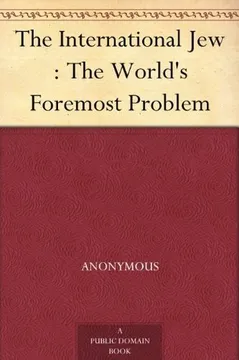


Key Takeaways
Treat this book as evidence of conspiracy thinking, not evidence of Jewish conspiracy.
A polemic dressed as inquiry. Published as a series in the Dearborn Independent in 1920, this book presents itself as an investigation into Jewish influence. It alleges that Jews secretly control finance, politics, industry, and the press, and that they coordinate these powers against non-Jewish society. Those are the book's claims, not established facts. Its arguments repeatedly generalize from selected names, anecdotes, and statistics to an entire people, without supplying a reliable way to test the conclusion.
A story with consequences. The articles move from economic anxiety to accusations of racial conspiracy, then warn that anti-Jewish hostility will grow unless the supposed conspiracy is exposed. This summary treats the text as a historical artifact of antisemitic propaganda, not as a guide to Jewish life or political reality.
What's revealing is the book's claim to oppose prejudice while assigning collective guilt to Jews. That contradiction is not incidental: the language of investigation makes a racial accusation sound like neutral fact-finding. Readers can study the text to see how conspiracy narratives turn economic and political uncertainty into a story of secret enemies. The danger is that a warning about hatred can itself help legitimize it when it treats a diverse population as a single concealed actor.
Notice how it converts economic change into an ethnic conspiracy.
From inequality to identity. The opening articles describe Jewish people as unusually adept in commerce and finance, then claim that a small minority controls major industries, land, banking, and news distribution. The book distinguishes wealthy Jewish financiers from poor Jewish families, but insists that both belong to a unified racial group whose interests ultimately align. It points to historical trade patterns, business practices, and selected census figures as evidence, while interpreting ordinary success and institutional influence as signs of coordinated power.
The leap matters. The text acknowledges that many Jewish people are poor and that individual merchants can be respected. Yet it uses those qualifications to protect its main thesis from counterexamples: the alleged plot belongs to hidden leaders, while ordinary Jews are described as their unwitting or loyal support. Class differences become details within a racial story, rather than reasons to question it.
The text's focus on concentrated wealth touches a legitimate subject: economic power can be opaque, unequal, and politically consequential. Its analytical failure is to substitute ancestry for mechanisms. A sound inquiry would identify ownership, contracts, regulation, and decision-making, then test whether the same standards apply across groups. Social science calls the book's move an ecological fallacy: inferring the nature or intentions of individuals from a supposed group pattern. That error turns a potentially useful critique of concentrated power into collective suspicion.
The Protocols supply the plot that makes every contradiction look confirming.
A hidden script. The articles center on a text called The Protocols of the Learned Elders of Zion, presented as notes from secret Jewish meetings. Its alleged program includes manipulating public opinion, dividing society, controlling finance and the press, weakening religious and family life, and eventually establishing a world ruler. The book claims that the Protocols anticipated the World War, the postwar peace settlement, and political revolutions. It treats similarities between the text's predictions and later events as proof of the plan's reality.
Denial becomes evidence. The author argues that the Protocols' anonymity makes them more credible, and that Jewish objections to the document are attempts to distract from its contents. The result is a closed loop: agreement confirms the conspiracy, while disagreement is recast as concealment. The text gives readers a single master explanation for events that otherwise have different causes.
This is a classic self-sealing argument. In the philosophy of science, a claim becomes difficult to evaluate when every possible observation is interpreted as support and no observation could count against it. The Protocols' sweeping predictions make that maneuver especially easy: almost any conflict can be fitted to a broad story about division and control. A useful test is to ask what evidence would disprove the claim, and whether independent sources support the alleged coordination. If no answer is allowed, the claim is functioning as belief, not investigation.
Treat press silence and publicity as rival evidence, not proof of control.
The press as a plot device. The book alleges that Jewish financiers control newspapers, suppress criticism, and manufacture public opinion. It interprets cautious coverage, favorable articles, and the withdrawal of advertising as signs of organized influence. Two episodes help build the case: a professor reportedly could not place an article about Russia, and the writer criticizes journalist Arthur Brisbane for publishing a favorable piece about Jews. The author presents both editorial choices and commercial pressure as evidence of a coordinated system.
But the test is missing. The articles rarely distinguish censorship from ordinary editorial judgment, business incentives, or disagreement with the writer's claims. A newspaper's refusal to print an article may have many explanations. The book treats the absence of coverage as confirmation, while treating positive coverage as proof of influence. Either result supports the same conclusion, leaving no clear standard of verification.
Media ownership and influence deserve scrutiny, especially when a few firms control distribution or rely heavily on particular advertisers. But a credible account needs records, comparison, and competing explanations. It should distinguish direct censorship from commercial pressure and from editors rejecting weak or unreliable material. Media studies often examine these forces separately because they operate differently. The book's method collapses them into a single ethnic intention, which makes its theory vivid but prevents readers from learning which institutions, if any, actually shaped a particular story.
The book makes disorder itself evidence of a single hidden director.
One cause for many conflicts. The articles portray strikes, revolutions, political movements, changing social norms, luxury markets, and economic instability as parts of one campaign to divide non-Jewish society. The Protocols, as the book presents them, recommend promoting competing ideas, weakening trust, and turning workers against owners. The author applies this account to Russia and Germany, then warns that the same strategy is operating in the United States. Opposing political movements do not disprove coordination, the book argues; they may simply be different tools in the same plan.
Complexity disappears. Instead of examining each movement on its own terms, the text treats conflict as a signature of hidden direction. Its framework gives a bewildering period a clear villain and a clear motive. It also makes ordinary disagreement, unintended consequences, and independent political choices nearly impossible to recognize.
A single hidden cause can feel more satisfying than a system with many interacting forces. Historians and social scientists often find that revolutions arise from combinations of state weakness, economic pressure, popular organization, and contingent events, not one actor's master plan. Coordination can certainly occur, but it must be demonstrated rather than inferred from the existence of disorder. The book's framework is therefore most useful as a lesson in how conspiracy thinking simplifies complexity: it replaces the difficult work of tracing causes with the easier task of naming an enemy.
It casts Jewish communal autonomy as a rival state inside every nation.
Community becomes conspiracy. The book describes the Kahal, a term it uses for Jewish communal governance, as the ancestor of the Soviet system. It also speculates about a modern Sanhedrin, an exilarch, and an invisible Jewish government coordinating communities around the world. These institutions and offices are presented as evidence that Jews form a separate political state within other countries. The articles connect this alleged structure to Jewish self-governance, religious practice, and the persistence of community ties across national borders.
The argument distorts its subject. The book moves from the existence of communal institutions to the claim of a unified plan for world rule. It offers little evidence for the leap. Practices that can preserve a minority's identity or provide community services become, in this narrative, signs of political disloyalty and hidden command.
Minority communities often build institutions that preserve language, faith, mutual aid, and internal authority. Such institutions can coexist with citizenship and national belonging; their existence alone does not demonstrate a secret state. The book's interpretation reflects a broader political anxiety about pluralism, in which visible difference is treated as evidence of divided loyalty. A more careful analysis would ask what a community body actually does, who participates, and how it relates to public law. That approach can examine autonomy without turning identity into suspicion.
Its promised solution is publicity, but its method is accusation by ancestry.
A claim to fairness. The author says open discussion will prevent prejudice by replacing silence with facts. The articles distinguish anti-Jewish hatred from criticism of powerful individuals, and argue that the public should investigate finance, politics, and media. They also predict that American anti-Semitism will rise, partly in response to immigration and commercial resentment. Their proposed remedy is more scrutiny, which the writer presents as a path toward understanding and social peace.
The contradiction. The book's call for careful inquiry sits beside sweeping claims that Jews share a racial will, coordinate across nations, and seek to dominate others. It repeatedly treats Jewish objections as proof of manipulation and Jewish communal ties as evidence of conspiracy. That method does not separate accountable individuals from a whole people. It turns a stated effort to prevent hatred into a framework that can intensify it.
Public scrutiny can protect both fairness and democratic accountability, but the quality of the scrutiny matters. Specific allegations require specific evidence, and responsibility should attach to people and institutions rather than ancestry. The book's rhetoric blurs that boundary, then presents its own sweeping accusations as the antidote to prejudice. This is a useful reminder that transparency is not automatically virtuous: it can expose wrongdoing, or it can create a stage for stigma. The distinction rests on evidence, proportionality, and whether claims remain open to correction.
Separate real abuses of concentrated power from fantasies of racial coordination.
Keep the useful question. Beneath the book's conspiracy claims are concerns that can be examined on their own: landlords raising rents, financiers influencing public decisions, business concentration, wartime profiteering, and newspapers responding to advertisers. The articles give examples involving property, cotton, banking, and political access. These subjects matter because concentrated power can affect everyday life, whether exercised by a bank, company, landlord, or government.
Change the method. Rather than accepting the book's racial explanations, investigate named actors, documented transactions, laws, and decision-making chains. Compare claims against independent records and consider alternative causes. The book repeatedly argues that the public must look behind official explanations. That instinct can be valuable only when the inquiry is open to evidence that complicates or disproves its starting theory. Scrutiny without that discipline becomes accusation, not knowledge.
The strongest way to preserve legitimate criticism is to make it more precise. Political economy offers tools for tracing ownership, lobbying, market concentration, and regulatory capture without assuming that people of one ancestry act as a unified bloc. Such methods can reveal hidden influence while avoiding collective blame. They also make conclusions revisable: a claim can be narrowed or rejected when the records do not support it. The book's enduring value is therefore diagnostic rather than evidentiary. It shows how the language of reform can be used to redirect anger toward a vulnerable group.
Analysis
The International Jew is best read not as a coherent investigation but as a case study in conspiracy rhetoric. Its 1920 articles begin with recognizable anxieties about wealth, media influence, labor conflict, and political change. They then make a repeated interpretive leap: selected Jewish individuals become evidence of a unified Jewish actor, and unrelated events become stages in a single plan. The narrative gains force from its scale. Finance, war, revolution, fashion, farming, education, and journalism all appear connected, so the reader is invited to experience the theory as comprehensive.
Its central evidentiary device, The Protocols of the Learned Elders of Zion, is now known to be a forgery. Substantial passages were copied from Maurice Joly's 1864 political satire, Dialogue in Hell Between Machiavelli and Montesquieu, which criticized Napoleon III and did not describe a Jewish conspiracy. The book nevertheless treats the Protocols as an authentic blueprint, then reads later events as its fulfillment. That interpretation is circular: the alleged plan validates the document, and the document validates the alleged plan.
The text's historical importance lies in showing how conspiracy propaganda borrows the vocabulary of investigation. It lists names, numbers, institutions, and anecdotes, but does not apply consistent standards of proof or distinguish individual conduct from collective identity. Its disclaimers against hatred cannot repair that structure. By turning Jewishness itself into the connecting explanation, it transforms ordinary political inquiry into racial suspicion. A responsible reader can still examine the questions the book exploits, including who holds economic power and how media incentives work. Those questions require records and institutional analysis, not a story of inherited collective intent.
Review Summary
The International Jew receives mixed reviews, with an average rating of 3.82 out of 5. Some readers praise it as an essential introduction to 20th-century anti-Semitism, while others criticize its biased content. Positive reviews commend its examination of the Russian Revolution and the Protocols of the Elders of Zion. Critics argue it promotes hate and inspired Nazi ideology. One reader notes its connection to Henry Ford and its potential for inspiring modern anti-Semitic rhetoric. Another reviewer finds it difficult to take seriously, likening it to the "white tears" meme.
Glossary
The Protocols of the Learned Elders of Zion
Forged conspiracy textA fabricated document presented as notes from secret meetings of Jewish leaders planning world domination. The book treats it as an authentic political program and claims its predictions came true. It is widely recognized as a forgery, with substantial passages copied from Maurice Joly's 1864 satire against Napoleon III.
International Jew
Book's imagined hidden actorThe book's label for an alleged network of Jewish financiers and political actors coordinating influence across national borders. It shifts between meaning Jews generally and a supposed elite said to control institutions. This ambiguity allows claims about particular wealthy individuals to be extended to Jews as a whole.
Kahal
Jewish communal governing bodyA term for a Jewish community or its governing council in historical settings. The book recasts the Kahal as an ancient political system that supposedly underlies Soviet government and demonstrates secret Jewish rule. That connection is an assertion of the text, not evidence that Jewish communal institutions formed a world conspiracy.
Jewish World Program
Alleged plan for dominationThe book's name for the supposed long-term Jewish strategy described in the Protocols. It claims the strategy works through finance, political influence, press control, social division, and revolution, culminating in Jewish rule over other peoples. The term belongs to the book's antisemitic conspiracy framework, not to an established historical program.
Gentile
Non-Jewish personA conventional term for someone who is not Jewish. In this book, it is used as a sweeping political category for the non-Jewish world, portrayed as a single society opposed to Jews. That framing erases differences among nations, classes, religions, and political movements, helping the author cast diverse conflicts as one struggle.
About the Author
Other books by Anonymous





Download PDF
Download EPUB
.epub digital book format is ideal for reading ebooks on phones, tablets, and e-readers.








