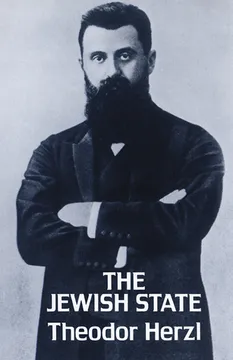


Key Takeaways
Treat persistent antisemitism as a political problem, not a plea for sympathy
A structural diagnosis. Herzl describes Jewish insecurity as more than religious hostility or individual prejudice. In his account, emancipation granted equality in law without reliably removing social exclusion, economic competition, and inherited suspicion. Jews could remain outsiders even after generations of loyalty and contribution to the countries where they lived.
Why sympathy is insufficient. Rather than appeal for better treatment, Herzl argues that a problem recurring wherever Jews live in significant numbers requires a political solution. He recognizes that Jewish people, like others, are not flawless, but insists that a group should not depend on being admired to enjoy security. His diagnosis leads from moral argument toward collective political action.
What's striking is the shift from asking whether Jews deserve fair treatment to asking which institutions can protect them when popular attitudes turn hostile. That move resembles structural analysis in sociology: unequal outcomes can persist even when formal rules promise equality. Yet Herzl's sweeping account risks making antisemitism seem inevitable and uniform across countries. A structural explanation is most useful when it identifies mechanisms without treating prejudice as an unchangeable law. The text's urgency is powerful, but its claims about a single, shared Jewish experience should be read as a political argument, not a neutral description of every Jew's circumstances.
Seek collective sovereignty where assimilation and legal equality cannot protect Jews
A national remedy. Herzl argues that the Jewish question is political because legal equality and individual assimilation cannot guarantee lasting safety. He sees Jews as a people shaped by shared history and by the recurring experience of being treated as outsiders, even when they have adopted local languages and customs.
A choice, not a command. His proposed answer is a sovereign Jewish state, not a religious government or a demand that every Jew leave home. Small-scale emigration schemes, he says, cannot provide a lasting answer, and assimilation depends on acceptance by a majority that may not come. Jews who do not wish to join the project could remain where they are. The central claim is that a people needs political agency of its own, rather than relying solely on other states to protect it.
The case for sovereignty rests on a recognizable political insight: rights written into law may be fragile when a group lacks power to defend them. Collective institutions can provide representation, public capacity, and a place to shape common rules. But sovereignty is not the same as guaranteed safety. A state can protect one population while creating new risks for others, and national identity is rarely as unified as a manifesto needs it to be. Herzl's proposal is strongest as an argument for political agency, not as proof that statehood alone can end prejudice or resolve every question of belonging.
Separate political representation from the business machinery of migration
Two institutions, distinct jobs. Herzl proposes the Society of Jews as a political and scientific body. It would gather statistics, examine possible territories, negotiate with governments, and prepare public institutions. The Jewish Company would be a commercial enterprise responsible for land, property transfers, settlement, and trade. The division is meant to pair public legitimacy with practical financial capacity.
A legal rationale. To explain provisional leadership for a dispersed people, Herzl adapts negotiorum gestio, a Roman legal doctrine for managing another party's affairs without prior authorization. He argues that a corporate body, rather than a lone leader, could act for a people unable to coordinate its political affairs. The body would carry responsibilities for how it managed the undertaking.
This division anticipates a durable institutional-design problem: political legitimacy and operational competence are related, but they are not interchangeable. A representative organization can set a mandate, while a company can execute transactions and absorb financial risk. The arrangement also shows why a grand movement needs more than a charismatic founder. Its weak point is accountability. Herzl gives the Society broad authority but says less about how ordinary members could challenge its decisions or replace its leaders. Expertise can make coordination possible, but it cannot substitute for meaningful consent.
Make migration gradual, voluntary, and financially orderly rather than a mass flight
A managed transition. Herzl imagines migration unfolding over decades, not as a sudden exodus. People would leave when ready, beginning with those in greatest distress and followed by more prosperous groups. Local branches of the Jewish Company would arrange sales or management of homes, land, and businesses, aiming to protect property rather than force people to abandon it.
A two-way economic plan. In Herzl's scheme, Christian residents could take over businesses and positions left behind, while governments would receive taxes, transport revenue, and new trade. He predicts that this orderly transfer would avoid economic crises and benefit the countries Jews departed. These are forecasts, not demonstrated outcomes. The plan's emphasis on voluntary movement and protecting assets distinguishes it from expulsion, but its confidence in smooth adjustment is striking.
The gradual approach takes seriously a fact that political blueprints often ignore: people are attached to homes, work, and local relationships, and large movements have costs. It also treats migration as a chain of decisions supported by institutions, rather than a single act of departure. The promised economic benefits, however, are largely assumed. Replacing workers and business owners is not frictionless, and transition costs would not fall evenly. The plan is persuasive as logistics, less so as a guarantee that host societies would welcome the movement or that every migrant would find a better life.
Create jobs and markets together instead of paying people to relocate
Build demand through work. Herzl rejects the idea that settlers can simply be paid to move and then left to find a livelihood. He proposes starting with practical work such as roads, railways, telegraph lines, tree planting, and housing. These projects would create jobs and bring workers, materials, and customers together, allowing local commerce to develop around real needs.
Relief becomes productive. He points to Assistance par le Travail, a relief system that gives people in need simple work, such as chopping wood, rather than handing out money without a task. In an established economy, such work might produce goods no one needs. In a new settlement, he argues, the demand for infrastructure would give the labor immediate value. The model turns assistance into a bridge to employment, though it depends on careful planning and actual demand.
The market-making idea is more subtle than a promise to create jobs by decree. Infrastructure can lower the cost of trade, while initial demand gives private businesses a reason to enter. Modern development economics similarly distinguishes between moving people and building the institutions, transport, and markets that make a place economically viable. Still, Herzl treats coordinated demand as more predictable than it is. Poorly chosen infrastructure can waste resources, and a planned labor force can become captive to its organizers. The central lesson is to connect employment programs to work that communities genuinely need.
Treat shorter workdays and social provision as state-building infrastructure
Work as a public design. Herzl proposes a regular seven-hour workday, arranged in three-and-a-half-hour shifts so that some operations could continue across a fourteen-hour span. He presents shorter working hours as compatible with high productivity and as a way to leave time for rest, family, and education. Overtime would be limited and, in his plan, require medical approval.
Provision with strings attached. The Company would supply housing, training, and support for people unable to work. Early unskilled laborers would help build their own shelter and could earn permanent ownership after three years of good conduct. Herzl also proposes a temporary truck system, in which workers receive provisions rather than cash. His social program is ambitious, but its benefits sit beside close supervision and restricted worker autonomy.
Herzl treats labor conditions as part of the constitution of everyday life, not merely a matter between employer and worker. That connects to modern debates about how housing, education, health, and working hours shape productivity and social stability. The seven-hour day is presented as an experiment that could benefit other societies, rather than as a proven universal formula. More troubling is the gap between humane aims and paternalistic control: delayed ownership, goods in place of wages, and discipline imposed by the Company. Worker voice and bargaining power are as important to decent work as shorter hours.
Keep clergy out of government and protect freedom of belief
A secular public order. Herzl rejects a theocracy. Religious leaders would be honored for their spiritual work but kept out of state administration; citizens would be free to practice a faith or reject religion. He also says people of other religions and nationalities should receive legal equality and protection.
Plural languages, shared institutions. Herzl does not expect Hebrew to serve immediately as a common spoken language. He proposes letting people retain the languages in which they think, with a shared public language emerging through practical use rather than compulsion. The plan therefore combines a national project with room for religious and linguistic variety. Its unifying basis is cultural and historical, but its public institutions are meant to remain secular.
The distinction between shared national institutions and private religious practice is a notable safeguard against clerical rule. The language proposal is similarly pragmatic: people need common means of communication, but forcing linguistic uniformity can make a new state feel like an instrument of cultural erasure. There is a productive tension here. Herzl grounds Jewish unity partly in ancestral faith while insisting that faith should not govern the state. The model's pluralist promise depends on whether equality is enforced in daily life, not simply announced in a founding plan.
Build a modern refuge with expert planning, but constrain centralized power
Plan before settlement. Herzl calls for scientific surveys of land and resources, coordinated infrastructure, prepared town plans, and laws designed for a modern state. Local groups would help choose settlement sites, while a central administration would coordinate the larger undertaking. The intention is to avoid improvised colonization and to protect acquired rights.
A contested form of rule. Herzl favors an elite-led republic or a monarchy balanced by representative institutions. He distrusts pure democracy, referendums, and professional politicians, and gives the Society strong authority during state formation, including power to suppress opposition it considers obstructive. This makes the blueprint internally tense: it promises freedom and opportunity while placing considerable trust in centralized leadership. The proposed flag, with seven stars for the working day, shows how practical policies would also become symbols of shared civic identity.
The plan recognizes that expertise matters when a society must coordinate land use, transport, public health, and law at once. Yet state capacity and democratic legitimacy are different achievements. Central authority can build infrastructure quickly, but unchecked authority can define disagreement as sabotage. Contemporary institutional design would ask how expertise is reviewed, how local knowledge changes central plans, and what protections dissenters retain. Herzl's blueprint contains the ingredients of a capable administration, but its faith in enlightened leadership leaves a serious accountability problem unresolved.
Win recognized sovereignty before settlement, or migration remains vulnerable
Territory by negotiation. Herzl considers Palestine and Argentina as possible locations. Palestine carries historic and emotional significance; Argentina is presented as fertile, vast, and sparsely populated. He leaves the choice to the Society and Jewish public opinion rather than treating one destination as settled in advance.
Recognition before immigration. The core requirement is internationally recognized sovereignty. Herzl argues that gradual settlement without political authority can provoke resistance and be stopped by the government that controls the territory. He therefore proposes negotiating with the existing sovereign power and seeking guarantees from European states. In his conception, a neutral Jewish state would be a diplomatic partner, not an unauthorized stream of migrants. The distinction is central to his argument: organized migration needs a lawful political framework to endure.
The insistence on legal recognition makes the plan more than an emigration scheme. It identifies sovereignty as a condition for durable institutions and for migration that cannot be halted at another government's discretion. That is a serious insight about the power of legal status. But an agreement between political authorities does not by itself settle the rights of people living on the territory. Treating land as available through diplomacy can obscure who already depends on it and whose consent is necessary for a legitimate settlement.
Give neighboring communities political voice, not merely promised legal protection
An incomplete account of consent. Herzl proposes negotiating with the current rulers of a territory, compensating landowners, and protecting people of other religions and nationalities under the new state's laws. He also recognizes that unplanned immigration can make an existing population feel threatened. These points show awareness that settlement affects people beyond the migrants themselves.
Protection needs participation. The text gives much less attention to how those already living in a chosen territory would shape the decision, exercise political power, or refuse the arrangement. Its detailed plans for Jewish institutions and migration contrast with the thinner account of neighboring communities' agency. A state founded to remedy one group's insecurity must also answer how it avoids creating insecurity for another. Legal equality matters, but it cannot replace a meaningful role in decisions about land and sovereignty.
This is the plan's sharpest unresolved ethical test. Modern accounts of self-determination ask not only who gains a state, but who has authority over the territory and who participates in the decision. Herzl's assurances of protection and compensation are meaningful, yet protection can still leave a population politically subordinate. A stronger design would treat neighboring communities as political participants, not simply as future residents or property holders. That standard does not erase the urgency of Jewish safety. It asks whether refuge can be built through institutions that recognize more than one community's claim to security.
Analysis
The Jewish State is both a diagnosis of persecution and a piece of institutional engineering. Herzl does not stop at arguing that antisemitism is unjust. He asks what could be built to make Jewish security less dependent on changing public opinion. The answer is unusually concrete for a political manifesto: a representative Society of Jews, a commercial Jewish Company, staged migration, property transfer, labor organization, urban planning, legal preparation, and international negotiation. The text's energy comes from this conversion of a moral crisis into an administrative program.
Its central analytical strength is the distinction between formal equality and effective political power. Herzl sees that legal rights can coexist with social exclusion, and that scattered populations may lack the leverage to protect themselves. His emphasis on institutions, infrastructure, and coordinated demand also makes the proposal more than a romantic return to an imagined past. He wants a modern society that uses technical knowledge and experiments with labor and welfare.
The proposal is less convincing when it treats prediction as proof. Herzl expects migration to benefit host economies, antisemitism to subside, and a planned labor market to flourish. These are strategic forecasts, not established results. His social model also mixes humane provisions with paternalistic controls, while his distrust of mass democracy sits uneasily beside his claim to act for a people. The tension matters: a project that seeks collective agency must explain how its own leaders remain answerable to those they represent.
Most consequentially, the account of territorial legitimacy is thinner than its account of Jewish institutions. Herzl proposes negotiations with sovereign rulers and legal protections for other communities, but gives less space to the political consent of people already living in a selected territory. That gap does not cancel the book's argument about Jewish insecurity. It shows that the standard of political legitimacy must be applied to every affected population. The enduring value of the manifesto lies in its insistence that safety requires institutions, paired with the recognition that institutions must protect the agency of all under their authority.
Review Summary
The Jewish State elicits sharply divided reactions. Supporters praise Herzl's visionary, detail-oriented blueprint for Jewish statehood, marveling at how his seemingly impossible plan became reality. Critics, particularly Arab and pro-Palestinian readers, condemn it as the foundation of settler colonialism and displacement of Palestinians. Many note Herzl's glaring omission of Palestine's existing inhabitants. Recurring observations include his secular vision for governance, his uncertainty between Argentina and Palestine as locations, and his incorrect prediction that Hebrew could not become a national language.
People Also Read









Glossary
The Jewish Question
Jewish political insecurityHerzl uses this historical label for the recurring political, social, and economic insecurity of Jewish communities in countries where they live in significant numbers. He argues that it cannot be resolved by religious debate, individual assimilation, or appeals for sympathy alone, and therefore requires a political solution. The label is his framing of the problem, not a question about whether Jews belong.
Society of Jews
Political and planning bodyHerzl's proposed corporate organization to represent the Jewish national movement. It would collect statistics, investigate potential territories, negotiate with governments, prepare legislation and administration, and create institutions that could form the nucleus of a state. It would supply political authority and oversight, while remaining distinct from the commercial organization responsible for migration and settlement.
Jewish Company
Commercial settlement organizationHerzl's proposed joint-stock company for the economic work of migration and settlement. It would manage the sale or transfer of departing Jews' property, acquire land, build infrastructure and housing, organize labor and commerce, and help establish businesses in the new territory. Its commercial function is deliberately separate from the Society of Jews' political and scientific role.
negotiorum gestio
Unauthorized affairs managementA Roman legal doctrine Herzl adapts to explain how a representative body might act for a people unable to manage its political affairs directly. The gestor undertakes necessary management without prior authorization, on the grounds that the common cause is in danger. In Herzl's account, the acting body also assumes responsibility for how it manages those affairs.
Assistance par le Travail
Relief through useful workA relief approach Herzl discusses in which people in need receive simple work, such as chopping wood, instead of support that asks nothing of them. He argues that work can preserve dignity and provide income while people search for more suitable employment. In a new settlement, he believes labor could meet immediate infrastructure needs rather than produce unwanted goods.
Truck system
Payment in goodsA system in which workers receive provisions or goods instead of money wages. Herzl proposes using it temporarily for early unskilled settlers, arguing that the Company would already provide for many of their needs and could shield them from exploitation by traders and landlords. The arrangement also gives the Company substantial control over workers' access to necessities.
seven-hour day
Proposed regular workdayHerzl's proposed standard working day for the new state and its Company. He imagines seven hours of work organized in shifts of three and a half hours, allowing some operations to span a longer daily period. The proposal is linked to rest, family life, education, and worker welfare, although the plan also imposes strict labor organization and limits on overtime.
Download PDF
Download EPUB
.epub digital book format is ideal for reading ebooks on phones, tablets, and e-readers.








