Key Takeaways
1. October 7th: A Price for Arrogance and Siege
A few hundred people proved that it’s impossible to imprison 2 million people forever without paying a cruel price.
Consequences of policy. The October 7th attack, while horrific, is presented not as an unprovoked act but as a direct consequence of Israel's long-standing policies of occupation, siege, and denial of Palestinian rights. The author highlights the "Israeli arrogance" that believed it could act with impunity without facing repercussions.
Breached defenses. Billions of shekels were spent on a sophisticated border barrier around Gaza, yet it was breached by "a smoky old bulldozer" and "bicycle and moped," exposing the illusion of security through technological superiority. This event shattered the complacency that Israel was "covered" by diplomatic accords and could ignore the Palestinian question.
Cycle of punishment. Instead of learning from the "cruel price" paid, Israel immediately threatened to punish Gaza "as it has never been punished before," demonstrating a failure to internalize lessons from 75 years of continuous abuse and repeated military operations that yield no lasting solutions.
2. Gaza: An Unlivable Open-Air Prison
On January 1, 2020, the year of the end for Gaza began. As of January 1, 2 million human beings are living in a place that is not livable.
Humanitarian catastrophe. Gaza is consistently described as a "stricken enclave," a "permanent disaster zone," and the "biggest prison in the world," where 2 million people live under an "unbelievable siege." The UN predicted Gaza would be "unfit for human habitation" by 2020, a projection the author states has been surpassed.
Daily suffering. Residents face dire conditions:
- Unemployment: 53% overall, 67% among youth (2020)
- Poverty: 80% rely on welfare, 40% below poverty line (2015)
- Water: 97% unfit for consumption (2020)
- Electricity: Only a few hours a day (2015)
- Homelessness: 100,000 after 2014 war, no rebuilding (2015)
Deliberate isolation. The blockade, imposed by Israel with Egypt's collaboration since 2007, has cut off Gaza from the world, preventing movement for study, work, family visits, or medical treatment. This deliberate isolation is deemed a "greatest war crime" in the region.
3. Israeli Media's Role in Dehumanization
Israel’s media have for the most part volunteered to serve the cause of national propaganda.
Propaganda machine. The author criticizes Israeli media for voluntarily abandoning objectivity, becoming a "ministry of propaganda" that "conceals the occupation and whitewashes its crimes." This self-censorship ensures the public receives a "nonstop news" diet of Israeli heroism and suffering, while Gaza's reality remains hidden.
Concealing Gaza's reality. The suffering in Gaza—dying children, displaced families, destruction, indiscriminate killings, hunger, and disease—is "not covered in the newspapers, and it’s not on TV." This deliberate omission prevents Israelis from confronting the humanitarian disaster unfolding an hour's drive away.
Dehumanization agent. By selectively reporting and suppressing information, the media acts as "the most important agent for dehumanization of the Palestinians." This allows Israelis to tolerate the "brutal and cruel" occupation, as if Palestinians are "not truly human," making the "crime being committed against them goes down easier."
4. The Moral Collapse of Israeli Society
The legitimization of evil will remain with us long after the war is over.
Widespread consensus. The war has revealed an almost complete consensus within Israel, with "almost a complete lack of opposition to carrying on with the war." Even the "Jewish left" has "crumble[d] in the face of the first challenge," with many adopting the right-wing's stance that "after what they did to us, there’s nothing forbidden to us."
Acceptance of extremism. Extreme rhetoric, once confined to the fringes, has become "politically acceptable." Examples include:
- A retired general proposing "spreading diseases" in Gaza.
- Another general suggesting "starving the population of Gaza to death."
- A TV commentator advocating for killing "100,000 residents of Gaza in a single, initial blow."
Suppression of dissent. Any expression of solidarity with Palestinians leads to "police investigations, to arrests and, at times, to the people expressing them being put on trial," while "fascistic statements from the right incurred no such sanctions." This "McCarthyism" has silenced Israeli Arabs and eroded democratic norms.
5. Futility of Endless Military Operations
Was there a single war in Gaza that did anyone any good, except the lords of war? Was there one bombing, one targeted killing that solved anything?
Repetitive cycle. The author repeatedly highlights the "senseless and bloody Gaza operations through the ages," noting that "nobody seems to learn anything, and nothing changes except the weapons." Each war, like "Operation Protective Edge" or "Operation Breaking Dawn," is described as a "war of choice" that fails to achieve lasting security or deterrence.
Counterproductive outcomes. Despite immense destruction and Palestinian casualties, these operations are deemed counterproductive. Hamas, for instance, "doubled its military might, as well as its boldness" after the 2014 war, and is seen as "the hero of the hour, not Israel" after recent conflicts.
Lack of endgame. Israel consistently goes to war "without an endgame, without any strategy for 'the day after'." The author questions the purpose of such conflicts, arguing that even if declared military goals are achieved, "nothing will be solved," leading only to "another inevitable round of fighting that will lead nowhere."
6. The Dehumanization of Palestinian Lives
And when we look at the eyes of the dead children of Gaza, we don’t see our own children. It is doubtful whether we see children at all.
Indifference to suffering. The core of Israel's moral failing is its "pathological indifference" to Palestinian suffering, particularly in Gaza. The author contrasts the Israeli public's deep grief for its own victims with its "sealed heart" to the "mass slaughter of children in Gaza," where thousands of children have been killed.
"Un-children" and "un-human." This dehumanization is so profound that Gazan children are considered "un-children, just like their parents are un-human," making their deaths permissible and their suffering irrelevant to the Israeli public. This allows for the acceptance of atrocities like the bombing of hospitals or the killing of unarmed civilians.
Justification through victimhood. The "October 7 horror" is used as a blanket justification for all actions, leading to the belief that "Israel is permitted to do anything." This narrative prevents any empathy or critical examination of the immense human cost inflicted on Gaza.
7. The West Bank: Escalating Violence and Dispossession
A population transfer under the auspices of war.
Increased settler violence. Under the cover of the Gaza war, settler violence in the West Bank has "grown wilder than ever," with new outposts appearing and roads blocked by boulders. Settlers, often in IDF uniforms, threaten and terrorize Palestinian shepherding communities, demanding they leave their homes within 24 hours.
Forced displacement. This systematic harassment has led to the forced displacement of at least 16 shepherding communities, with 149 families fleeing their villages. This constitutes a "population transfer" aimed at "cleansing the entire South Hebron Hills and other areas of their Palestinian residents."
IDF complicity. The Israeli army's "twitchier fingers on the trigger" and increased incursions, like those in Nur Shams refugee camp, contribute to the violence. Soldiers are accused of indiscriminate killings, destroying infrastructure, and abusing wounded Palestinians, effectively bringing Gaza-like conditions to parts of the West Bank.
8. Palestinian Prisoners: Abused Hostages of Israel
Israel has no right to set standards for evil when its hands are also stained with wickedness.
Systematic abuse. Palestinian prisoners in Israeli jails, including those arrested from Gaza on October 7th, face "brutal beatings," "torture," "humiliation," and "inhumane conditions." Reports describe guards regularly beating prisoners with batons, leading to deaths in custody.
Deaths in detention. At least four prisoners died since October 7th, "almost certainly from beatings," with 19 guards investigated for one death. Hundreds of Gazan detainees, many with no Hamas connection, are held "bound and blindfolded 24 hours a day," with some dying at Sde Teiman base.
Hypocrisy and indifference. The author highlights the hypocrisy of Israel's outrage over its own hostages' treatment while being "cold-hearted and indifferent" to the fate of Palestinian "hostages" in its own jails. The Prison Service's refusal to report on non-citizen deaths underscores the dehumanization.
9. The Death of the Two-State Solution
The two-state solution is dead. Seven hundred thousand Jewish settlers in the West Bank and East Jerusalem killed it.
Settlements as a killer. Levy asserts that the expansion of Israeli settlements, housing 700,000 Jewish settlers, has rendered the two-state solution unfeasible, leaving "no place for a Palestinian state to come into existence, unless it’s going to be a Bantustan." This outcome was the deliberate intention of successive Israeli governments.
One-state reality. Since 1967, a de facto "single state" has existed between the Jordan River and the Mediterranean Sea, characterized by an "apartheid" regime where "Jews have all the rights and the Palestinians none." The author argues that continuing to advocate for a non-viable two-state solution is "tantamount to making the occupation eternal."
Choice for the future. The only remaining options are "democracy between the Jordan and the Mediterranean, or apartheid between the Jordan and the Mediterranean." Levy calls for a vision of a single democratic state, acknowledging the immense challenges and the current deep division and hatred between the two peoples.
10. Israel's Self-Inflicted International Pariah Status
Israel has become a pariah state more than ever before.
Global condemnation. The war in Gaza has brought Israel's international standing to an "unprecedented nadir," with "world public opinion" expressing "loathing" for its actions. The author notes that polls show Hamas becoming "more popular among them than Israel is" among young people, including young Jews, in the US.
Legal challenges. Israel faces charges of "genocide" at the International Court of Justice (ICJ) and potential "war crimes" indictments from the International Criminal Court (ICC). The ICJ's provisional measures, citing Israeli leaders for "incitement to genocide," highlight the severity of the accusations.
Blaming others. Instead of self-reflection, Israel "blames the damned judge, antisemitism, the world’s hypocrisy and wickedness." It ignores international proceedings, believing that if it "closes its eyes, they won’t see us," and that its "good name" is expendable as long as US support and lack of sanctions persist.
11. The Author's Profound Shame and Connection to Gaza
I cannot not help but feel a profound shame over what my country is doing to Gaza.
Personal anguish. Gideon Levy expresses deep personal shame and anguish over Israel's actions, stemming from his identity as an Israeli whose parents escaped the Holocaust and his career dedicated to covering the state's "betrayal of universal values." This shame is a central emotional thread throughout his writings.
Lost connection. Levy laments his inability to visit Gaza since 2006, missing the "warm, compassionate community" he once knew and loved. He reflects on the fate of individuals he met—children, taxi drivers, the wounded—wondering if they survived the siege and wars, and how their lives were irrevocably altered.
Unforgettable memories. His reporter's notes from Gaza evoke vivid, painful memories:
- Children shot in the head, reduced to a vegetative state.
- Infants killed by artillery shells.
- Disabled individuals struggling to survive.
- A young girl seeing a green lawn for the first time before dying of cancer.
These personal stories underscore the human cost often obscured by statistics.
12. Call for International Justice and Accountability
Without international involvement, there will never be a solution.
Israel's refusal to change. Levy argues that Israel will not "wake up one morning and say to itself... The occupation, the siege, and the apartheid are not good—let’s bring them to an end." Decades of inaction prove that internal will for change is absent, making international intervention essential.
Punishing war criminals. The author calls for the International Criminal Court to "do its job" and hold Israeli leaders and military officers accountable for "war crimes" in Gaza, including "mass killing and starvation." He believes this is the "only way that Israel’s moral standard... will change."
Forcing peace. The world, particularly the United States, must "force peace on Israel" through actions, not just words. This could involve sanctions, conditioning aid, or imposing a "Dayton Accords–like solution" that presents Israel with a clear choice: "sanctions, or an end to the occupation; territories, or weapons; settlements, or international support; a democratic state, or a Jewish one; apartheid, or an end to Zionism."
Last updated:
Review Summary
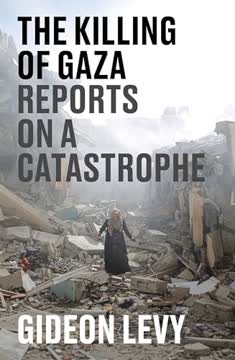
The Killing of Gaza collects Israeli journalist Gideon Levy's columns documenting Palestinian suffering from 2014-2024. Reviewers praise his courage in condemning Israeli actions and humanizing Gazans, though some criticize his attempts at neutrality and equivalence between Hamas and Israeli forces. Many find his detailed accounts of civilian casualties and humanitarian catastrophe essential reading, particularly his criticism of Israeli media propaganda. Several readers note his contradictory positions—condemning Hamas while acknowledging resistance is Palestinians' only option. The book is described as painful, necessary documentation that challenges Israeli society's indifference and forces confrontation with war crimes, though some desired deeper analysis of occupation's root causes.
Similar Books