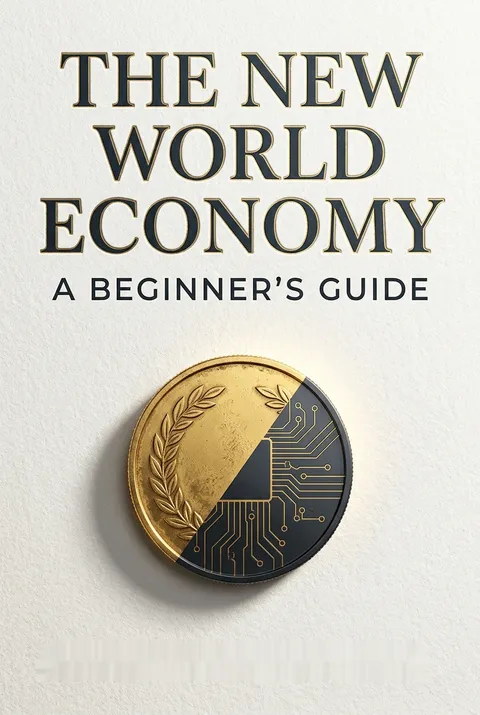


Key Takeaways
Treat the world economy as a network, not a predictable machine
Small shocks travel far. The book’s “fusion economy” is a world where finance, technology, politics, and trade interact so tightly that a local event can trigger consequences elsewhere. Chaos theory helps explain why: when many forces feed back into one another, outcomes can be hard to predict even when the original cause seems minor. The butterfly effect describes how a small change in a complex system can have large, distant effects. The book points to sudden market drops, where computer-driven trades can amplify a shift in prices within seconds.
Plan for uncertainty. A government change or debt crisis in one country can prompt investors to sell assets in another simply to cover losses at home. The result is not a neat chain of cause and effect, but a web of reactions that can surprise even sophisticated market participants.
What's useful here is the shift from asking for a perfect forecast to asking where a system is vulnerable to feedback. That perspective appears in ecology, epidemiology, and engineering: resilience often matters more than prediction. A diversified economy, for example, may absorb a shock better than one dependent on a single industry. Still, complexity should not become an excuse for treating every outcome as unknowable. Some risks, such as heavy short-term borrowing or dependence on one export, can be identified and reduced even when the precise timing of a crisis cannot.
Trace how credit, trade, and fear turn local downturns global
Crises spread through connections. The Great Depression illustrates the danger of combining financial distress with protectionism. After the 1929 crash, U.S. banks called in foreign loans, while the Smoot-Hawley Tariff Act raised barriers to imports. Trading partners retaliated, reducing commerce and worsening the downturn. Unemployment exceeded 25 percent in several major economies, and economic collapse helped create conditions in which authoritarian movements gained power.
The plumbing matters. In 2008, risky U.S. mortgages had been repackaged into securities and sold to financial institutions around the world. When housing prices fell broadly, investors lost confidence, banks stopped lending, and the shortage of credit crossed borders. The lesson is that interconnectedness can spread prosperity, but it also transmits failures when many institutions share the same hidden risk.
This account highlights a central idea in network science: a system's danger depends not only on the size of a shock, but on how tightly its parts are connected and how much redundancy exists. The same links that let capital flow quickly can carry panic quickly. That does not mean integration itself is the problem. It means regulators and investors need to examine shared exposures, incentives, and fallback options, rather than assume that risk is safely distributed just because it has been divided into many financial products.
Treat tariffs as costs shifted across the economy, not victories won
Protection has a price. A tariff is a tax on imported goods. Quotas limit how much can enter, while subsidies use public money to help domestic producers compete. Each can shelter a local industry, but they can also raise prices, weaken competitive pressure, and invite retaliation. In the 2018 U.S.-China trade conflict, foreign tariffs targeted American soybeans, wheat, and motorcycles, hitting some of the workers and farmers the policy claimed to protect.
Trade is not a scoreboard. A country’s purchases from abroad are connected to payments and investment moving in the other direction. A bilateral goods deficit alone does not reveal the whole economic relationship. The Brexit campaign also showed the cost of overlooking geography: the EU took more than 40 percent of British exports, while distant markets were much smaller trading partners. Replacing nearby trade is not simply a matter of choosing a new destination.
Trade policy creates concentrated losses and dispersed benefits, which helps explain why protection can be politically attractive even when its total cost is high. A factory facing foreign competition is visible; consumers paying slightly more across thousands of purchases are less visible. The book is right to challenge the idea that a deficit automatically signals defeat. But aggregate gains from trade do not guarantee that displaced workers share in them. Open markets need credible adjustment support, or the economic case for integration will remain weaker than its political opponents.
Compare countries by what people can buy and how they live
GDP answers one question. Gross domestic product totals the value of goods and services produced within a country. It does not show how widely income is shared or whether people are healthy, educated, and secure. Nor does it capture unpaid care, environmental damage, or the value of leisure. GDP per person improves comparisons between countries of different sizes, but it is still an average, not a portrait of a typical household.
Adjust for local prices. Purchasing power parity, or PPP, compares what money buys in different countries using a basket of goods and services. The book uses the Big Mac Index as an intuitive illustration: if the same burger costs much less in one country, official exchange rates may understate what local incomes can buy there. The UN Human Development Index adds health, education, and income to the picture.
Measurement is never just bookkeeping. Once a statistic becomes a target for governments, it influences which needs receive attention. This is why a dashboard of indicators is often more informative than a single national ranking. GDP can track production reasonably well while missing distribution, unpaid work, or ecological depletion. Broader measures have their own judgment calls, however: deciding which outcomes matter and how to weigh them is political as well as technical. The practical lesson is not to discard GDP, but to ask what it leaves outside the frame.
Understand money, risk, and fees before chasing impressive returns
Money depends on trust. Money works as a medium of exchange, a store of value, and a unit of account. Modern fiat currencies are not redeemable for a fixed quantity of gold; their value depends substantially on confidence in the institutions issuing them. Cryptocurrencies use digital records to track ownership without a central bank, but that does not make them automatically stable, safe, or convenient. The book notes bitcoin's capped supply, high price volatility, energy demands, and the risk of theft from trading platforms.
Returns need context. Stocks represent ownership in a company, while bonds are loans that promise repayment and interest. Diversification spreads exposure across investments, and low-cost funds can make that easier. Yet past performance cannot promise future gains. The 2008 crisis also showed how ratings agencies can misjudge complex securities, especially when their income depends on the firms whose products they assess.
The strongest financial lesson is procedural: understand what an asset represents, what could make it lose value, and what you pay to hold it. That discipline counters the common tendency to mistake a rising price for a sound investment. Diversification reduces the damage from any one failure, but it cannot eliminate market-wide risk or guarantee gains. The book's comparisons of historical returns are useful illustrations, not forecasts. A practical investor should distinguish a long horizon from a high tolerance for risk, since time alone does not make every asset safe.
Make development aid accountable to people and measurable human gains
Institutions serve different roles. The IMF generally provides short-term financial support and helps countries restructure during crises. The World Bank focuses more on long-term development, including infrastructure, schools, and health programs. Both emerged from postwar efforts to build economic cooperation, but critics argue that wealthy members wield disproportionate influence and that loan conditions can demand spending cuts that deepen hardship.
Follow the money locally. Loans and projects do not automatically reduce poverty. Corruption can divert funds to elites, while debt repayments can crowd out education and health spending. The book points to Brazil's family benefits linked to children's school attendance and medical checkups as an example of tying support to human outcomes. It also describes microcredit, which offers small loans to people excluded from conventional banking, and partnerships that can bring services directly to communities.
Development succeeds when a project changes people's capabilities, not merely when money has been disbursed or a structure has been built. That is a useful connection to the capabilities approach, which judges progress by what people are able to do and become. Conditional cash transfers can align immediate help with education and health, but conditions may unfairly penalize families when schools or clinics are unavailable. Likewise, microcredit can expand opportunity without replacing public services, infrastructure, or fair access to larger sources of capital.
Treat personal data as an economic asset that needs real protection
Free services have a price. Many digital platforms earn money by collecting information about users and selling access to audiences or insights. Metadata, information that describes patterns in other data, can help companies infer interests and predict behavior. The book uses the Cambridge Analytica scandal, involving data from tens of millions of Facebook users, to show how information gathered for ordinary online activity can be repurposed for political targeting.
Connection creates both value and exposure. The Internet of Things links devices such as cars, appliances, and health monitors so they can exchange information and respond automatically. That can improve convenience and efficiency, but it also expands the number of places where sensitive data might be accessed or misused. The book notes proposals to let users control or earn from their data, alongside privacy rules that require companies to obtain consent.
The key issue is not simply whether users consent, but whether consent is meaningful when access to everyday services depends on accepting long, difficult terms. Data systems also create collective effects: one person's information can reveal patterns about people who never shared theirs. That makes privacy less like a private preference and more like a public rule, similar to standards for clean water or financial disclosure. User compensation is one possible model, but payment alone cannot address manipulation, discrimination, or unequal bargaining power.
Train people for changing tasks, not for one permanent occupation
Automation changes jobs unevenly. A robot performs programmed tasks; artificial intelligence uses data to learn patterns and make decisions beyond a fixed instruction. Together, they can raise productivity and remove dangerous or repetitive work. At BMW's South Carolina plant, production and employment both grew during the 2010s, illustrating that automation does not always shrink a workforce. But the book also estimates that about 80 percent of U.S. manufacturing job losses over the previous thirty years came from automation, with many displaced workers moving into lower-paid service work.
Make adaptation practical. The book favors ongoing retraining, technical skills paired with creativity and judgment, and vocational routes that combine classroom learning with workplace experience. Germany, Austria, and Switzerland use apprenticeship systems and report low youth unemployment. Flexible or gig work can suit some people, but often provides fewer benefits and less security.
The debate is clearer when it focuses on tasks rather than whole job titles. A machine may take over part of an occupation while increasing the value of human judgment, care, or problem-solving in the rest. That makes education throughout a career more useful than a one-time credential. Still, retraining is not a magic remedy: workers differ in time, health, location, and access to good programs. Employers and governments share responsibility for transition costs, especially when the gains from automation accrue mainly to owners.
Reduce inequality by widening access to assets, education, and health care
Starting points compound. The Gini coefficient measures income inequality on a scale from perfect equality to extreme concentration. Intergenerational income elasticity estimates how strongly children's incomes track their parents'. The book reports that U.S. elasticity rose from 0.3 to above 0.5 over about fifty years, suggesting reduced mobility. Families with savings can buy homes, invest, and pay for education; families without reserves often cannot, so inherited advantage grows over time.
Public systems shape opportunity. Education, progressive taxation, worker training, and access to health care can help distribute the gains from a changing economy. In the book's comparison, U.S. health spending per person was more than twice the average in other advanced economies, yet life expectancy was lower than in several countries with universal coverage. Unions can also counterbalance employers, though their influence has weakened as work has become more automated and fragmented.
Inequality is not only about the distance between incomes; it is also about who can absorb a setback and invest in the next opportunity. This connects economic mobility to balance sheets: a modest emergency reserve can change whether a family can move, retrain, or withstand illness. The book's policy menu is broad, but effectiveness depends on design and institutional trust. Redistribution can support opportunity, while poorly targeted programs can miss those most in need. The relevant test is whether policy expands people's real choices without preserving unproductive arrangements.
Count environmental damage as a cost of production, not someone else's problem
Growth can hide its bill. GDP records economic output but does not subtract the damage caused by pollution or depleted resources. The book describes the tragedy of the commons: when many users benefit from shared resources such as clean air and oceans, each may have an incentive to overuse them while the costs are spread across everyone. Climate change makes this problem especially unequal, since poorer regions often rely more heavily on agriculture and have fewer resources to rebuild after floods, droughts, or storms.
Change the incentives. A carbon tax charges for emissions. Cap-and-trade sets a pollution limit and allows companies to buy or sell permits. In the book's example, a more efficient factory can produce more within the overall emissions cap by purchasing unused permits from a less efficient one. Such systems can make pollution costly, but they require enforceable limits and careful oversight.
Environmental policy is an economic design problem because prices often omit costs imposed on people who are not part of a transaction. Putting a price on emissions can correct that signal and reward cleaner production. Yet a price alone cannot settle every question: some ecological losses are difficult to reverse or measure, and the burden of higher energy costs may fall hardest on low-income households. Climate policy therefore works best when emissions reduction is paired with transition support and when the cap reflects environmental constraints rather than political convenience.
Judge economic systems by outcomes, not by ideological labels
Real economies mix models. Capitalism gives private owners and markets a central role; socialism gives government a larger role in production or distribution; communism aims at collective ownership and centralized control. In practice, countries blend these approaches. The Nordic model combines competitive markets with extensive social services, while China pairs state direction with entrepreneurial activity. Neither label alone explains how opportunity, power, or wealth is actually allocated.
Build for the people living there. The book highlights German worker participation in company decisions and apprenticeship programs, as well as Danish efforts to balance work with life outside it. It also warns that centralized control can suppress freedom and weaken incentives, as Venezuela's collapse illustrates. The useful question is not whether a system is purely market-based or state-run, but which institutions deliver prosperity, security, and voice without locking in privilege.
This pluralist view avoids the false choice between an unregulated market and total state control. Institutional design matters: competition can encourage innovation, while public provision can broaden access to health, education, and security. The same policy can succeed in one setting and fail in another because administrative capacity, political accountability, and social trust differ. The challenge is to evaluate results without treating growth as the only result that counts. Work-life balance, democratic rights, and resilience also matter, even when they are harder to summarize in a single statistic.
Analysis
The book's central achievement is translation. It treats tariffs, exchange rates, blockchain, health care, climate policy, and automation as parts of one shared system rather than isolated technical subjects. Its recurring civic argument is that economic literacy is a form of democratic self-defense: voters who understand how costs move through an economy are harder to persuade with simple claims about winners, losers, and national decline.
The strongest sections connect a mechanism to a lived consequence. The Smoot-Hawley example links trade barriers to retaliation and unemployment; the mortgage crisis shows how financial engineering can carry local losses across borders; the discussion of data makes clear that a free app may be paid for with behavioral information. These examples help readers see economics as a map of incentives and dependencies, not merely a collection of numbers.
The book's broad scope also creates a limitation. A beginner's guide can make mechanisms legible, but sometimes compresses contested questions into confident generalizations. Trade can increase total prosperity while imposing severe losses on particular workers. Immigration can expand demand and entrepreneurship while straining services where public capacity is limited. Growth can help fund environmental improvements, but it does not guarantee them. In each case, distribution, institutional quality, and political choices determine who benefits.
Its numerical snapshots belong to the period around publication and should be read as evidence of the argument, not as current statistics. More fundamentally, no index can settle the question of what a society should value. GDP, human development, equality, and environmental performance illuminate different dimensions of well-being. The book is most useful when it encourages readers to compare those measures, trace causes across borders, and ask who bears a policy's costs. Economic literacy does not remove political disagreement. It makes the disagreement more honest and the consequences harder to hide.
Review Summary
The New World Economy receives mixed reviews, with an average rating of 3.60 out of 5. Readers appreciate its concise explanations of complex economic topics, making it accessible for beginners. The book covers a wide range of subjects, including globalization, cryptocurrency, and current global issues. Some find it a good starting point or refresher, while others desire more depth. Critics note that it may be overly simplistic for those with prior economic knowledge. Overall, it's viewed as an informative introduction to modern economic concepts, with a helpful glossary.
People Also Read






Glossary
Fusion economy
Interconnected global economic systemThe book's term for an economy in which trade, finance, technology, politics, and social behavior increasingly interact across borders. Because these forces feed back into one another, an event in one place can produce unexpected effects elsewhere. The term emphasizes complexity and interdependence rather than a single, predictable chain of economic causes.
Purchasing Power Parity (PPP)
Compares what money buysA method of comparing economic output or income across countries by adjusting for differences in local prices. It compares the cost of a similar basket of goods and services in each country, creating a more realistic exchange-rate comparison than market currency rates alone. The book uses the Big Mac Index as a simple illustration of how prices differ across countries.
Current Account
Tracks cross-border trade and incomeA country's record of transactions in goods and services, along with certain income flows and transfers, such as interest on foreign debt or money sent home by workers abroad. It is broader than a tally of physical imports and exports. The book stresses that trade figures should be considered alongside financial flows and investment when judging a country's international economic position.
Hot money
Short-term cross-border investmentFunds moved internationally for short-term returns, often toward countries with higher interest rates or stronger growth prospects. These inflows can make credit more available, but they can reverse quickly when conditions change. A rapid outflow may weaken a currency, raise borrowing costs, and deepen a local downturn, even when the original trigger occurred elsewhere.
Blockchain
Shared tamper-resistant transaction recordA digital record-keeping system in which transactions are grouped into linked records and checked across a network of users. Altering an established record is designed to be difficult because the network can detect changes that do not match its shared history. The technology first became widely known through its use in recording bitcoin ownership, but the book also describes possible uses in tracking goods and information.
Metadata
Data describing other dataInformation that describes or summarizes other information, helping analysts find patterns in large collections of data. In the book's examples, digital activity such as searches, clicks, and likes can reveal patterns of interest or behavior even when a person's name is not the main focus. Companies and political campaigns may use those patterns to tailor products, messages, or advertisements.
Internet of Things (IoT)
Networked everyday devicesA system of physical objects connected to the Internet so they can collect, exchange, or act on data. Examples include appliances, vehicles, farm equipment, and health monitors. The connections can make production and services more efficient, such as alerting a company that a machine needs repair, while also increasing the amount of personal and operational information that must be secured.
Cap and trade
Limits and trades pollution permitsAn environmental policy that sets an overall limit on emissions and allows regulated parties to buy or sell permits for portions of that limit. A company that cuts pollution below its allowance can sell unused permits; another company can buy them. The intended result is to reduce total emissions while giving firms an incentive to find lower-cost ways to pollute less.
Gini coefficient
Measures income inequalityA statistical measure of how unevenly income or wealth is distributed within a population. In the scale described by the book, zero represents perfect equality and a score of 100 represents complete inequality, where one household holds all wealth. The measure helps compare inequality between countries, but it does not explain its causes or show differences in quality of life by itself.
Download PDF
Download EPUB
.epub digital book format is ideal for reading ebooks on phones, tablets, and e-readers.








