

Key Takeaways
Judge digital revolutions by who gains power, not by what tools permit.
Possibility is not equality. Taylor opens with a homemade magazine she produced as a teenager. Printing and distributing it took real effort, and she could reach only a small local audience. Today, a person can publish instantly to the world. That change matters, but access to a publishing button does not mean equal reach, resources, or influence.
The book rejects both the claim that technology automatically liberates us and the claim that it inevitably harms us. Its central question is who owns and shapes the systems through which people create, discover, and share culture. The Internet has enabled new voices, yet consolidation, commercial pressure, and inequality have travelled into the digital world, often in less visible forms.
What's useful here is the shift from technological potential to institutional outcomes. A tool can lower the cost of speaking while leaving the distribution of attention untouched. This distinction appears in many domains: access to a school is not the same as equal educational opportunity, and access to a market is not equal bargaining power. Taylor's argument does not require denying genuine digital gains. It asks whether those gains are broadly shared, and who sets the conditions under which participation becomes visible or valuable.
Treat your clicks as labor when platforms turn them into advertising value.
Participation creates value. Web 2.0 companies built businesses around social connection and user contributions. People post photographs, write reviews, share links, and maintain communities; platforms gather the resulting attention and behavioral data, then sell access to advertisers. Taylor calls this arrangement digital sharecropping: users help make a platform valuable without sharing proportionately in the wealth its owners capture.
The imbalance reaches beyond social media. Taylor cites a decline in publishers' share of online advertising: article and video publishers received about twenty cents of each advertising dollar in 2010, compared with nearly a dollar in 2003. The platform may host the work and gather the audience data, while creators receive little. Users can enjoy these services and still contribute economically to them.
The labor question is not settled simply by asking whether users enjoy posting. Pleasure and economic value can coexist, as they do in many forms of work. The more useful test is whether contributors can understand the bargain, refuse it without losing essential access, and influence how value is distributed. Digital participation also produces social benefits that cannot be priced easily. That makes the arrangement more complicated than a simple wage dispute, but not less deserving of scrutiny.
Protect paid creative time; cheap copies do not make creation cheap.
Making remains labor-intensive. A digital film can be copied and delivered at almost no additional cost, but its first version may require years of work, travel, equipment, and editing. Filmmaker Laura Poitras spent nearly three years making The Oath, including a year in the editing room. Her work depended on patience, trust, and time with difficult subjects, not just a camera and an upload button.
Economists William Baumol and William Bowen described the cost disease: in arts and other labor-intensive fields, productivity cannot rise as quickly as it does in industries where machines replace human effort. A string quartet still needs musicians and performance time. Digital tools can widen creative possibilities, but they do not erase the labor needed to make a film, book, or investigation.
This distinction helps explain why abundance of copies can coexist with scarcity of new work. In economic terms, copying costs fall while the initial investment remains substantial. A society that treats distribution as the whole problem risks confusing cheap access with sustainable production. At the same time, not every cultural product needs the resources of a feature film, and low-cost tools have enabled valuable experiments. The key is to avoid using the cheapest cases to define the economics of every creative practice.
Keep investigative journalism staffed, because public need rarely pays its full cost.
Reporting needs an infrastructure. Photographer Andrew Burton went to Egypt on his own dime, hoping news organizations would buy his images. He wanted a staff position not because he lacked initiative, but because institutional support meant income, insurance, and backup in dangerous situations. Reporter Stephen Janis found a similar limit at the Investigative Voice, an online outlet that produced consequential local investigations but could not pay him enough to keep reporting.
The problem is not merely the format of the news. In one study of Baltimore's news ecosystem, 95 percent of stories containing new information originated with traditional media. Meanwhile, US newsrooms had shrunk by about 30 percent since 2000. Reporting serves the public beyond the people who buy it, so commercial revenue alone tends to underfund the work.
Journalism resembles other public infrastructure: its value includes benefits that do not accrue only to the person reading a particular story. Oversight can deter misconduct, and verified information supports decisions across a community. That is why a purely consumer-driven model may systematically undersupply reporting. Institutional support, however, should not be romanticized. Legacy organizations have failed and can be captured by owners or political interests. The question is how to preserve time, expertise, and accountability while making institutions more independent and answerable to the public.
Measure participation by who can contribute, not who can log on.
Access has several layers. Taylor reports that one-third of US households lacked broadband at the time of writing, and that mobile access was a weaker substitute for a computer and fast wired connection. Even among people who were online, skills, time, and confidence shaped who created material and who benefited from it. Sociologist Eszter Hargittai calls this unequal uptake: people with similar access do not participate equally or gain the same returns.
Gender illustrates the pattern. Women wrote fewer than 15 percent of Wikipedia articles in one cited survey, while online harassment and informal group cultures discouraged participation. Jo Freeman's critique of structureless groups offers a useful warning: removing formal rules does not remove power. It can make influence harder to see, leaving the already confident or well-connected in control.
A useful extension is to distinguish formal openness from practical capability. A door can be unlocked while the path to it remains costly, unsafe, or unfamiliar. This insight applies to civic participation as well as digital design. It also explains why representation cannot be inferred from user counts alone. Still, interventions should avoid treating demographic categories as proxies for individual ability. The aim is to remove predictable barriers and examine outcomes, not to presume what any particular person wants or can do.
Do not mistake viral popularity for a democratic cultural marketplace.
Attention compounds advantage. Online networks often follow power laws, distributions in which a small number of sites or creators attract a very large share of attention. By 2010, ten websites accounted for 75 percent of US page views, up from 31 percent in 2001. A huge catalogue can coexist with a narrow audience concentrated around a few winners.
In an experiment involving 14,000 listeners and 48 songs, people who could see what others were downloading produced more extreme outcomes: popular songs became more popular, and less popular songs fell further behind. Social influence made success harder to predict, not more meritocratic. Taylor argues that cultural democracy means more than giving everyone a chance to compete for clicks. It includes diverse voices, minority protection, and support for work that may not become a hit.
Popularity is a feedback signal, not a reliable measure of quality or public importance. Once people can see what others chose, a decision becomes both a preference and a cue, which can amplify early advantages. This helps explain why recommendation systems can narrow discovery even while expanding the catalogue. The counterpoint is that shared popularity can also help people find work they genuinely value. The design question is whether discovery systems only reward accumulated attention or also create routes to unfamiliar, lower-profile material.
Build a commons that rewards creators as well as sharing audiences.
Sharing needs reciprocity. Taylor's documentary Examined Life cost more than $500,000 to produce, yet copies appeared online before its planned release. The episode exposes a tension: ideas and culture belong to a shared inheritance, but creators still need ways to support the work that adds to it. Taylor calls the mutual support between makers and audiences the double anchor.
Copyright was intended as a limited incentive for creation, not permanent ownership of culture. Excessive control can block quotation, remix, and access; unrestricted copying can weaken creators' ability to continue working. The commons is not simply an open-access pile of material. Drawing on Elinor Ostrom's work, Taylor describes durable commons as governed by negotiated rules. Fair use, shorter copyright terms, public funding, and fair compensation can help balance access with production.
The strongest version of this position avoids equating payment with enclosure or sharing with exploitation. Creative work is relational: it draws on inherited culture, then returns something new to the public. The practical challenge is to design rules that preserve access while preventing powerful intermediaries from taking most of the value. Ostrom's commons research is relevant because it treats shared resources as systems of governance, not as resources that manage themselves. Different kinds of work may need different arrangements, so one universal licensing solution is unlikely to suffice.
Ask who finances free media, then examine what that sponsor shapes.
Free has a business model. Advertising has become a major source of online revenue, even as many creators and publishers struggle. In 2012, advertising accounted for 95 percent of Google's revenue. Platforms can offer free services because they sell advertisers access to attention and information gathered through users' activity.
That arrangement can shape both privacy and culture. Taylor describes tracking systems that collect browsing behavior, location, and social connections for targeted advertising. Publishers also face pressure to produce rapid, clickable material, while sponsored posts blur the line between reporting and promotion. The result is not simply that ads appear beside content. Commercial incentives can influence which stories are made, which audiences are pursued, and how people present themselves online.
Advertising is not just a payment mechanism; it is a system for allocating attention. When revenue depends on measurable engagement, creators and editors have reason to favor what can be counted quickly. That does not mean every popular story is shallow or every sponsored project is compromised. It does mean independence requires more than disclosure after the fact. Readers benefit from knowing who funds a work, what data are collected, and whether the funder can shape editorial decisions.
Count the mines, energy, and waste behind every weightless digital service.
Digital culture has a physical footprint. Devices depend on mined materials, factory labor, electricity, and disposal systems. Taylor notes that extracting the gold for a single mobile phone can produce more than 220 pounds of waste. Data centers consume substantial energy, while short replacement cycles send usable devices into the waste stream.
The environmental case for digital reading is not automatic either. A cited comparison estimated that manufacturing an e-reader used resources comparable to producing roughly 40 to 50 printed books, with larger estimates for some impacts. Its environmental advantage depends on how long it lasts and how many books it replaces. Repairability, durable design, responsible sourcing, and longer use matter as much as whether a product is digital or paper.
This material accounting corrects a common blind spot: information can feel immaterial because its infrastructure is out of sight. Life-cycle analysis offers a better comparison than assuming that paper is wasteful and screens are clean. Such analyses also depend on assumptions about device lifespan, energy sources, and user behavior, so their numbers should be treated as conditional rather than universal. The larger principle remains solid: convenience has costs, and those costs often fall on workers and communities far from the person using the device.
Fund durable, diverse cultural institutions instead of outsourcing democracy to platforms.
Sustainability needs collective support. Taylor's proposal is sustainable culture: a cultural ecosystem that can preserve work, support creators, and make room for diverse voices over time. That includes independent institutions, local media, libraries, bookstores, public broadcasting, and platforms designed around more than shareholder returns. Institutions can pool risk, allowing difficult projects to survive even when they are not immediate commercial successes.
The book calls for action across the system: protect open access to network infrastructure, limit excessive concentration, strengthen privacy and copyright safeguards, and invest public money in journalism and culture. Crowdfunding can help individual projects, but it cannot reliably replace stable support for work serving a broad public. The aim is not to restore the old media order unchanged. It is to build institutions that are more democratic, accountable, and fair.
The proposal moves the debate beyond personal virtue, such as asking each user to pay more or each creator to promote harder. Durable cultural provision is a coordination problem: its benefits are shared, while its costs often land on particular producers. Public funding and cooperative models can address that mismatch, but neither is automatically democratic. Transparent selection, diverse decision-makers, and protections for dissent are essential. Taylor's case is strongest when sustainability means not only keeping institutions alive, but making them worthy of public trust.
Analysis
Taylor's most important move is to treat the Internet not as a single liberating or corrupting force, but as an ecosystem whose outcomes depend on ownership, labor, policy, and material infrastructure. That reframing unites issues often kept apart: unpaid participation, the collapse of reporting, concentrated attention, copyright disputes, surveillance, and electronic waste. Each is a different expression of the same question: who receives the benefits of shared cultural activity, and who bears its costs?
The argument is especially persuasive when it distinguishes access from power. Posting is easier than ever, but visibility, financial security, and institutional backing remain scarce. Taylor's examples of Laura Poitras, Andrew Burton, and Stephen Janis make that gap concrete. The book also avoids a simple defense of legacy media. It recognizes that old institutions could be exclusionary and commercially compromised, while insisting that dismantling them does not automatically create fairer alternatives.
Its proposed standard, sustainable culture, is deliberately broader than a single business model. It asks whether creative work can be made, fairly supported, preserved, and encountered across differences. This framework is valuable because it joins cultural policy to labor rights and environmental accountability. A digital service cannot be assessed only by convenience or price when its costs include data extraction, precarious work, and physical production.
The main limitation is that the evidence and examples reflect a particular moment in the platform economy, and some measurements are tied to the period Taylor describes. The institutional remedies also need careful design: public investment can broaden access, but it must include safeguards against political control and bureaucratic exclusion. These qualifications do not weaken the central thesis. They sharpen its demand: evaluate technology by its social arrangements, and judge those arrangements by whether they distribute voice, income, risk, and cultural opportunity more fairly.
Review Summary
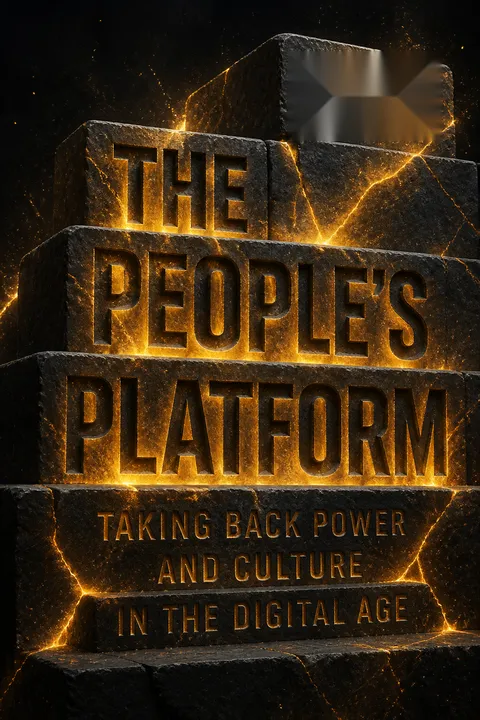
The People's Platform receives mostly positive reviews for its insightful critique of internet culture and the tech industry. Readers appreciate Taylor's well-researched analysis of how digital platforms impact creativity, economics, and society. Many find the book thought-provoking and ahead of its time in identifying issues with social media and online monopolies. Some reviewers note that while the book excels at diagnosing problems, it offers fewer concrete solutions. Overall, it's praised for challenging utopian views of the internet and encouraging critical thinking about digital media's effects.
People Also Read








Glossary
digital sharecropping
Unpaid user work creates platform valueA business arrangement in which users contribute posts, reviews, photographs, code, or other material to a platform without direct payment. The platform gains audience, data, and advertising value from their activity, while ownership and most financial returns remain concentrated in the company controlling the service.
playbor
Leisure that generates profitA term for the blurred boundary between play and labor online. Activities such as sharing, rating, commenting, and socializing may feel enjoyable, yet they also generate attention and data that platforms can monetize. The concept highlights how economic value can be produced during leisure without participants experiencing the activity as a conventional job.
cost disease
Rising costs in labor-intensive artsAn economic pattern identified by William Baumol and William Bowen: labor-intensive activities do not gain productivity as quickly as industries where technology replaces human work. A string quartet still needs musicians and performance time, even as other sectors produce more output per worker. As wages and costs rise elsewhere, the relative cost of the arts increases.
unequal uptake
Unequal participation despite accessA term used by sociologist Eszter Hargittai for the uneven ways people use online opportunities. Access alone does not guarantee that users will create, publish, or benefit from digital tools equally. Differences in skills, time, confidence, socioeconomic position, gender, and other conditions affect participation and its rewards.
second level digital divide
Differences in online skillsThe gap between people who can connect to the Internet and those who can use it effectively for different purposes. Even among connected users, practical skills, confidence, available time, and social position vary. The divide can therefore persist after basic access expands, shaping who gains educational, creative, or economic benefits.
power laws
Uneven winner-take-most distributionsA pattern in which a small number of network participants, websites, or cultural works attract a disproportionately large share of attention, while most receive very little. Online popularity can grow through network effects and preferential attachment: visibility attracts more visibility. This helps explain why a large catalogue does not necessarily produce a broad distribution of audiences.
filter bubble
Personalized information narrowing exposureA personalized information environment created when platforms use past behavior to predict what a person may want to see. Because recommendations are shaped by collected data and commercial goals, users may encounter less unfamiliar material without deliberately choosing an isolated media diet. The result can narrow exposure to differing perspectives and unexpected discoveries.
churnalism
Fast news recycled from sourcesA term journalist Nick Davies uses for news production dominated by repackaged wire copy, press releases, and material from other outlets rather than original reporting and verification. It describes a response to commercial pressure for high output and speed. The result can appear abundant while offering little independent investigation.
the double anchor
Mutual support between makers and audiencesFilmmaker Jem Cohen's term for a reciprocal relationship between people who create cultural work and people who receive it. Audiences gain access to meaningful work, while creators receive enough support to continue making it. The idea rejects both the assumption that all culture should be free of charge and the notion that fair exchange requires corporate control.
sustainable culture
Durable and equitable cultural productionTaylor's vision of a cultural ecosystem that can support creation, fair exchange, preservation, and diverse participation over time. It includes digital and physical institutions, public investment, responsible technology, and working conditions that let creators continue. The goal is not merely abundant access, but a culture whose production and distribution do not depend on exploitation or short-term popularity.
About the Author
Other books by Astra Taylor
Download PDF
Download EPUB
.epub digital book format is ideal for reading ebooks on phones, tablets, and e-readers.








