

Key Takeaways
Count the slow cost of standing still, not only the sting of failure.
Inaction charges quietly. Eschenroeder distinguishes right action from mere activity. Right action is deliberate behavior that tests ideas against reality and reflects the kind of person one wants to be. It can be small, such as brushing one’s teeth attentively, or substantial, such as beginning a difficult project. Action can hurt sharply when it fails, but it also produces experience and new options. Inaction feels safer because its losses accumulate slowly: neglected opportunities, untested assumptions, and a growing sense of being stuck.
Meaning needs contact. The book grew from the author’s own paralysis between projects and relationships. His relief came not from solving life in theory, but from attending to what was happening and acting within it. The central claim is that doing is not merely a route to purpose. It is one way purpose becomes tangible.
What's striking is the book's treatment of avoidance as a choice with consequences, rather than a neutral pause. This resembles behavioral activation, an approach in psychology that addresses low mood by rebuilding meaningful activity before waiting for motivation to return. The distinction is useful because avoidance often offers immediate relief while quietly shrinking a person's sense of possibility. Still, not every pause is evasion. Exhaustion, illness, and real constraints can make restraint the wise choice. The practical question is not whether someone is busy, but whether their current pattern is restoring capacity or protecting them from information they need.
Begin before motivation arrives; movement is often what creates it.
Start without the mood. The book argues against waiting to feel ready. A workout may feel unappealing until the body is moving; a social event may become enjoyable only after arriving. In this account, action can generate motivation rather than depend on it. The same principle applies to identity: someone need not first feel like a writer, healthy eater, or filmmaker before taking a step in that direction.
Use a smaller map. Preparation helps, but people often demand more information than the first step requires. The book invokes the Spartans, who are said to have asked where the enemy was, not how numerous it was. The point is not to ignore danger. Gather enough information to begin safely, then learn from the situation itself. A plan can orient a person, but it cannot show every detail encountered on the ground.
This insight turns motivation from a prerequisite into a possible consequence of behavior. It also fits feedback control: a person cannot correct a course until there is movement and some signal about what happens next. The emphasis on starting is especially useful when imagined difficulty grows in the absence of experience. Yet the Spartan image should not be mistaken for a universal rule against research. In medicine, finance, or safety-critical work, a premature test can cause irreversible harm. The stronger principle is proportionality: investigate enough to limit unacceptable risk, then let real-world feedback replace speculation.
Test a small version of your dream before building your life around it.
Trade prediction for evidence. The book recommends trying a low-cost version of an ambition instead of relying on an idealized picture of it. Someone curious about a career can sample the actual work; someone with a business idea can test whether customers want a basic offering. Eric Ries's minimum viable product, or MVP, is a simple version built to test a central assumption while limiting time and cost. The same logic can be applied to a personal dream: find out whether the daily process suits you, not just whether the imagined outcome does.
Learn through iteration. The Wright brothers reportedly made about 1,900 test flights in a month, while better-funded competitors managed a similar number in a year. Their advantage was rapid adjustment after each attempt. Failure supplied information instead of sending them back to an abstract starting point. A useful test is focused on a question, affordable to repeat, and capable of changing the next attempt.
The book's most concrete method is experimental: replace a large bet with a series of informative, reversible ones. This is close to the logic of design science, where a prototype is valuable less as a miniature finished product than as a device for exposing assumptions. It also protects motivation from fantasy, since the test reveals the texture of the work itself. A caution matters: fast experiments can overvalue what is easy to measure and neglect slower effects, such as trust or craft. The best test is not merely quick. It produces evidence relevant to the decision at hand.
Make room for stillness that serves action, not avoidance.
Not all action looks busy. The book includes meditation, observation, imagination, reading, waiting, and relaxation among possible forms of action. They count when they connect a person more closely to reality or prepare useful work. Its meditation exercise is straightforward: sit for twenty minutes, attend to the breath, and return attention when it wanders. The aim is not to eliminate thought, but to notice it without being dragged along by it.
Separate recovery from retreat. Rest can help the mind process difficult work, just as muscles need recovery after exertion. The author describes Einstein playing violin after concentrating intensely on a problem, allowing attention to shift while the problem remained in the background. By contrast, rumination circles without progress, and retreat is the reflex of withdrawing from a meaningful but uncomfortable step. Stillness is useful when it renews attention or changes understanding, not when it endlessly postpones contact.
This is a valuable correction to the crude equation of productivity with visible motion. Attention, deliberate rest, and observation can alter what a person notices and how effectively they respond. In cognitive science, incubation describes the possibility that stepping away from a problem can help new associations form, though it is not a substitute for knowledge or sustained work. The book's distinction between recovery and avoidance is harder to measure than it sounds. A practical test is whether the pause returns someone to the task with greater clarity, or merely makes postponement feel more respectable.
Shape habits, rituals, and surroundings to make tomorrow's action easier.
Build useful defaults. Repeated actions can become easier and more influential than isolated bursts of effort. The book points to habits, environmental changes, and experiments as high-leverage actions because their effects can recur. A cleaned workspace, for instance, may support attention beyond the moment it is tidied. A ritual can also prepare the mind: Stephen King has described a consistent writing time, place, and set of small preparations before beginning work.
Protect your first attention. Starting the day with email and social feeds invites other people's priorities to take over. Starting with a chosen piece of creative work makes the day less reactive. The book also gives the Greek orator Demosthenes as an example of shaping his surroundings to compel future practice: he secluded himself and made leaving difficult. Such measures need not be dramatic. The useful move is to arrange the environment so the desired next action is easier to begin than the distraction.
The shift from relying on willpower to arranging defaults connects the book to environmental psychology: behavior depends partly on which options are visible, convenient, and socially reinforced. Rituals can work as transition cues, marking the move from ordinary attention into a demanding activity. Their value is practical, not magical. A routine that once helped may become empty repetition if the work or the person's needs change. Good design therefore combines consistency with review: preserve cues that lower friction, but revise the system when its effects no longer serve the purpose.
Treat progress as a process, not a straight line or perfect plan.
Expect uneven returns. Practice often includes plateaus, periods when effort does not produce visible improvement. The author uses learning piano to illustrate how a skill can seem unchanged until something clicks. A plateau calls for patience, but not blind persistence: another perspective may reveal a problem, and quitting can sometimes be the right decision.
Choose and continue. Herbert Simon's terms, maximizers and satisficers, describe people who seek the best possible option and those who accept a sufficiently good one. The book argues that endless comparison can keep a person from enjoying a choice already made. Warren Buffett, by contrast, did not begin with a complete life plan; sustained interest in his chosen game gave direction while the route remained uncertain. For overwhelming projects, Anne Lamott's bird-by-bird idea offers a useful scale: focus on the next manageable piece, then the next.
This section combines two important ideas: uncertainty is normal, and decision quality includes the cost of continuing to decide. Research on choice and decision-making often distinguishes the search for an optimal option from a satisfactory one, but the right balance depends on stakes. A restaurant choice and a medical treatment do not deserve the same threshold of confidence. Likewise, persistence is not automatically virtuous. The useful discipline is to define what evidence would justify continuing, changing approach, or stopping, so patience does not become a polished name for sunk-cost thinking.
Practice first; identity, courage, and inspiration grow from doing.
Work invites the spark. The book rejects the idea that inspiration must arrive before creative effort. Writers often find ideas by sitting down to write, and the author uses Stephen King's image of inspiration as something encountered through labor. Repeated practice also builds competence and can make a task easier to begin. In this sense, a person may become a writer or artist through the work itself, rather than waiting for a settled identity to grant permission.
Courage has a history. Acting while afraid gives experience that can make the next difficult step less mysterious. The book connects sustained practice to intuition and flow, the absorbed state in which skilled action feels coordinated and attention is fully engaged. Such fluency is not a shortcut around effort; it depends on learning the details of a craft. Early attempts may be awkward. Their value is that they begin building the capability that imagined confidence cannot supply.
The section treats identity as partly enacted, which offers a useful alternative to waiting for a perfectly coherent self-concept. Skill-learning research likewise suggests that repeated, focused practice changes what a person can perceive and do, making later decisions less dependent on conscious calculation. The qualification is that effort alone does not guarantee expertise or a flow state. Feedback, suitable challenge, and recovery matter, and some environments offer better opportunities to practice than others. The durable insight is narrower and stronger: confidence is more trustworthy when it reflects accumulated encounters with the task.
Move with an open mind, and let action expose unforeseen chances.
Movement creates new options. The book calls this emergence: action changes the possibilities available by creating experience, relationships, and further opportunities. A person who starts writing may discover subjects worth pursuing; someone who enters a field may learn which roles fit. The route is not fully visible in advance because each step changes the information and choices at hand.
Stay alert on the way. Serendipity, as used in the book, means finding something valuable through a combination of chance and attentive judgment. A person who moves toward a goal but notices what appears along the route can encounter opportunities that were not part of the original plan. Action also filters consumption: when a project is underway, it becomes clearer which books, advice, and media are useful. The aim is neither rigid focus nor aimless wandering, but directed effort with enough attention to notice what reality adds.
This is a strong account of exploration: a commitment can make relevant opportunities easier to see, while experience reveals options that could not be specified beforehand. In decision theory, exploration has value because acting can teach more than choosing from existing knowledge alone. But openness has a cost. Too many pivots can prevent compounding skill, and not every coincidence deserves pursuit. A productive stance pairs a stable direction with flexible tactics. That keeps chance visible without giving every new possibility equal authority over a person's time.
Let results revise your method, not your character or values.
Separate conduct from outcome. The book's idea of heroic action is to do what seems right without assuming that success is fully under one's control. Results depend on chance and conditions beyond any individual's command. A failed attempt can still leave useful experience, while a successful outcome does not prove that every choice was wise. The author uses Warren Buffett's emphasis on preserving room for error to reinforce the value of staying capable of another attempt.
Use errors as information. A poor result can expose a faulty assumption, a missing skill, or an unsuitable strategy. The book's harp analogy makes the point: learning a song involves finding which notes work, not treating every wrong note as a verdict on the musician. Ethical standards should not be discarded simply to improve the odds of a win. Adjust the approach in response to evidence, while keeping the distinction between what worked and what was worth doing.
This distinction resembles the Stoic separation between chosen conduct and external outcomes, but the book also treats outcomes as feedback. That combination avoids two extremes: believing that effort guarantees success, and pretending that results contain no information. It is especially useful in volatile settings where luck can disguise skill or punish sound judgment. Still, values can require revision when new evidence shows that a supposedly principled action causes avoidable harm. The point is not to freeze one's moral beliefs, but to avoid using a single success or failure as a complete measure of one's worth.
Your daily conduct can give other people permission to act.
Influence travels through example. The book questions the idea that a life matters chiefly through fame, monuments, or a single celebrated achievement. Ordinary interactions may affect more people: calm behavior in a tense moment can steady others, and taking a socially uncomfortable step can show that it is possible. The author's point is not that every small act produces a predictable chain of consequences. It is that people observe one another, and conduct helps shape what feels permissible.
Create the culture nearby. Rather than spending all one's attention trying to decode a vast public culture, the book argues for building a local one through choices, friendships, and shared habits. A person who creates instead of only consuming helps make creation more normal for those around them. This brings the book's argument back to everyday practice: the life people encounter is often a more persuasive lesson than a speech about how life ought to be lived.
The closing emphasis on example gives action a social dimension. Social learning means people can acquire expectations by observing what others attempt, tolerate, and reward. A visible act of courage may lower the perceived cost of similar behavior for someone nearby, even without a formal lesson. The reach of any individual gesture is impossible to calculate, so the book's large claims about ripple effects are best treated as possibility, not guarantee. Their practical force remains: conduct contributes to the immediate norms of a group, and those norms influence what its members think they can do.
Analysis
The book's central achievement is to recast action as a way of knowing, not merely a productivity technique. Its strongest argument is epistemic: plans and beliefs remain provisional until they meet the resistance of events. A test, conversation, practice session, or deliberate pause can reveal information that introspection cannot reliably supply. This makes the book less anti-thinking than its punchiest slogans suggest. It repeatedly allows reflection, imagination, meditation, and rest, provided they change perception or enable a more grounded response.
Its meditative, aphoristic structure suits the subject. The repetitions are not a linear proof so much as repeated pressure against familiar forms of delay: waiting for certainty, motivation, purpose, confidence, or a flawless plan. The variety of examples, from the Wright brothers to a friend selling tile, helps translate that pressure across work, craft, and daily life. The weakness of the form is that its recurring celebration of action can blur essential distinctions. Action can be impulsive, coercive, or wasteful. The author tries to preserve a distinction between activity and right action, but a reader still needs criteria: deliberate purpose, contact with reality, ethical limits, and feedback.
A useful modern reading is to treat the book as an invitation to run small, responsible experiments. Each attempt should clarify something, preserve the ability to adjust, and avoid making an outcome the sole measure of worth. This reading also guards against a simplistic account of paralysis. People may be constrained by illness, caregiving, poverty, discrimination, or a genuinely dangerous situation; not every delay is a failure of nerve. Sometimes the right action is preparation, asking for help, or waiting until conditions change.
The book is most persuasive when it couples movement with attention. Action without attention becomes busyness; attention without action can become a closed loop of explanation. Its memorable middle ground is a cycle: notice, try, learn, and revise. That cycle cannot promise a perfect future, but it makes the next decision less imaginary and more answerable to the world.
Review Summary
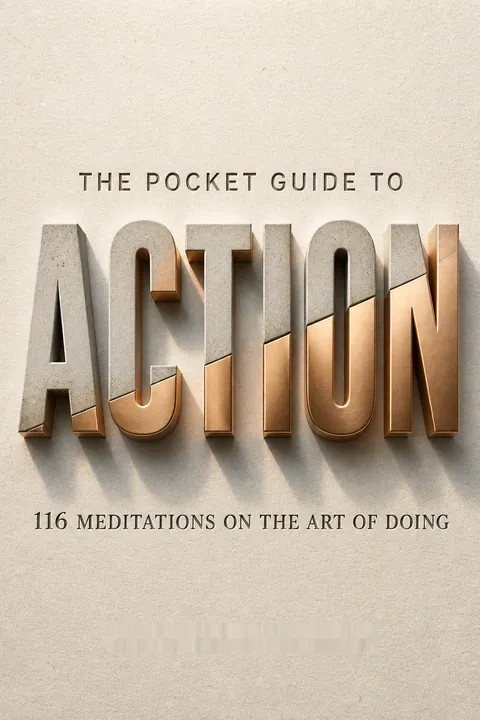
The Pocket Guide to Action receives mostly positive reviews, with an average rating of 4.30/5. Readers appreciate its concise wisdom on taking action and overcoming procrastination. Many find it motivational and a useful daily reference. Some critics argue it's oversimplified or repetitive. The book's format of 116 short meditations is generally well-received, though opinions vary on its depth and applicability. Several reviewers mention its philosophical influences and quotes from various thinkers. Overall, it's seen as a quick, inspiring read for those seeking motivation to act.
People Also Read






Glossary
Right action
Deliberate, reality-facing behaviorThe book's term for intentional behavior that is virtuous, responsive to reality, and capable of turning ideas into lived experience. Right action is not simply motion or busyness. It may be a small everyday practice, a bold decision, or a disciplined pause, provided it moves a person toward clearer understanding and constructive conduct.
Abstraction
Ideas detached from eventsThe book uses abstraction to mean thinking that treats ideas as more important than concrete events, especially when that thinking becomes excessive. Planning, theory, and reflection can be useful, but they become evasive when they replace contact with reality. Action tests whether an abstract belief can guide behavior and reveals details that a mental model cannot contain.
Minimum viable product
A low-cost hypothesis testA minimum viable product, or MVP, is a quick, inexpensive version of a product designed to test an important assumption. The book applies the idea beyond business: a person can try a small version of a career, project, or dream to learn whether the work itself is worthwhile. Its purpose is learning, not immediate polish.
Satisficers
People accepting sufficient choicesA term associated with Herbert Simon, used for people who select an option that meets their needs rather than searching endlessly for the best possible choice. The book contrasts them with maximizers, who keep comparing alternatives and may continue doubting after deciding. Satisficing can conserve attention and make it easier to engage fully with a choice.
Emergence
New options created through actionThe book uses emergence for the way action creates possibilities that were not available or visible beforehand. Each step can generate experience, relationships, and information that shape the next set of choices. The process can open constructive paths or reinforce harmful patterns, making repeated action consequential even when its eventual outcome cannot be predicted.
Download PDF
Download EPUB
.epub digital book format is ideal for reading ebooks on phones, tablets, and e-readers.








