

Key Takeaways
Treat creativity as a practice, not a visitation from the muse.
Make showing up the work. Godin uses “practice” to mean a repeated, intentional commitment to creating and sharing work, whether inspiration appears or not. It is not a recipe that guarantees success. It is a way to keep learning and contributing when results remain uncertain. Creativity, in this view, is less a rare gift than a decision to make something that could improve another person’s world.
Build trust through repetition. The book compares creative work to learning to juggle: students first practice throwing and let the balls fall, rather than lunging after every catch. Consistent action builds the skill and identity that waiting for confidence cannot provide. The result is not assured, but continuing the practice is within reach.
The distinction between controllable effort and uncertain results resembles a central idea in behavioral science: people persist more reliably when they can connect action to a meaningful process, rather than tying self-worth to outcomes they cannot fully control. That does not make outcomes irrelevant. Rent, health, and access to time shape who can afford to keep practicing. The useful reading is not “ignore consequences,” but “do not mistake a disappointing result for proof that the work, or its maker, has no value.”
Train the throw instead of demanding a catch before you begin.
Separate process from payoff. The juggling lesson makes the distinction physical. Learners practice a reliable throw, first with one ball, then two. Catching becomes possible because the throws improve, not because students will themselves into a perfect outcome. Creative work follows a similar pattern: the maker can control preparation, effort, and revision, but cannot dictate audience response.
Judge decisions by what was knowable. The book draws on poker champion Annie Duke’s distinction between a decision and its result. A sensible choice can end badly because chance intervenes. A strong creative process can likewise produce work that does not sell or resonate. Treating every result as a verdict encourages safe imitation; assessing the process makes it possible to learn without pretending failure never matters.
This is a practical antidote to outcome bias, the tendency to judge a decision by what happened afterward rather than by the information available at the time. Research on decision-making under uncertainty supports evaluating choices probabilistically, not through hindsight alone. Still, process praise can become a shield against useful evidence. If work repeatedly misses the intended audience, the answer is not endless repetition without change. Process matters because it creates a disciplined way to notice results and adjust.
Make the work for someone specific, not an imaginary everyone.
Choose a real recipient. Godin urges creators to ask who the work is for, then learn what that person values, fears, and trusts. “Everyone” is too broad to guide meaningful choices. A specific audience gives the maker something concrete to understand and a reason to reject feedback from people the work was never designed to serve.
Let change spread through people. The book contrasts mass television, which often settled for broadly appealing entertainment, with cable shows such as Mad Men, which could serve a smaller audience with a sharper point of view. It also describes General Magic, whose early handheld device sold only 3,000 units despite anticipating features of later smartphones. A small initial audience did not mean the ideas lacked influence; timing and audience fit mattered.
Specific audiences are not merely a marketing convenience. They make empathy testable: creators can observe whether a particular group understands, uses, or values the work. This aligns with human-centered design, where prototypes are tested with actual users rather than imagined average people. But “serve a niche” should not become an excuse to ignore who is excluded. Audience choice carries power. A creator should ask not only who can be reached, but whose needs the chosen focus leaves outside the frame.
Ship work early enough for reality to teach you something.
Creation needs contact. The book treats sharing as part of creative work, not a ceremonial step after the “real” work is finished. Drew Dernavich, a prolific New Yorker cartoonist, is presented with a desk crowded by discarded sketches. The point is not that every attempt succeeds, but that a large body of attempts makes improvement possible. A private perfect idea gives its maker little evidence about how it works for anyone else.
Separate the work from the self. Feedback becomes more useful when it addresses choices in the work rather than the creator’s worth. Godin favors criticism from people who understand the work’s purpose and audience. Their response can reveal what to revise. Anonymous hostility or feedback from people who dislike the genre may reveal little beyond a mismatch of expectations.
Shipping creates a feedback loop: an attempt produces evidence, and evidence can guide the next attempt. This resembles iterative design and scientific experimentation, where a claim becomes more useful when exposed to observation. The quality of the evidence matters, though. A handful of reactions can be unrepresentative, and public feedback can reward novelty or outrage rather than durable value. The stronger practice is selective exposure: share with people who can understand the intention, while remaining open to what their actual response shows.
Define the change you want before choosing the work’s ingredients.
Give each choice a purpose. Godin’s “intentional action” begins with three questions: whom is the work meant to affect, what change should it make, and how might its success be recognized? These questions turn vague effort into design. The book’s receptionist example shows the difference: a receptionist can merely guard a doorway, or help visitors arrive informed and welcomed. The role’s purpose changes what good performance looks like.
Treat selling as service, not extraction. A creator who understands a genuine audience need can invite people to take part without resorting to pressure. Godin calls this enrollment: people knowingly choosing to join a shared journey. His test for manipulation is whether people would still be glad they acted if they knew what the seller knew. If not, the offer needs rethinking.
Purpose is most powerful when it constrains design. In engineering, a specification helps teams choose among competing solutions; in public services, a clear account of whom a service benefits can expose whether its procedures serve people or merely preserve routine. The same questions can prevent creative work from becoming self-expression without regard for its effects. Yet not every worthwhile work has a measurable impact. Some changes are gradual or private, so evaluation should guide judgment without reducing art to a dashboard.
Treat creative discomfort as part of learning, not proof you lack ability.
Expect awkward beginnings. Godin presents the feeling of being an impostor as common when a person attempts something new. The uncertainty may signal that there is no established procedure to copy, not that the person has no right to contribute. Waiting for confidence can keep that uncertainty in charge. The more useful response is to take the next deliberate step, then learn from it.
Practice at the edge of competence. The book calls “desirable difficulty” a challenge that feels frustrating while helping a person improve. It contrasts predictable batting practice, which can feel smooth, with randomly mixed pitches, which feel harder but develop adaptable skill. This does not mean seeking distress for its own sake. It means accepting manageable struggle instead of equating ease with progress.
Learning research supports the distinction between feeling fluent and retaining a skill. Interleaved practice, in which different problem types are mixed rather than drilled in blocks, can feel less comfortable while improving later recall and transfer. The insight is useful for creative disciplines where novelty demands adaptation. Its limit is equally important: difficulty helps only when the challenge is attainable and feedback is available. Unstructured struggle can exhaust people or reinforce mistakes. Discomfort is a clue to examine, not a universal instruction to push harder.
Earn a distinctive voice through skill, knowledge, and repeated choices.
Distinguish talent from earned skill. The book argues that natural ability is less decisive than the skills and attitudes built through practice. In Daniel Chambliss’s study, “The Mundanity of Excellence,” competitive swimmers differed in how they performed specific skills and how they approached training, not simply in hours spent or innate gifts. Godin also stresses domain knowledge: learning the history and conventions of a field helps creators make informed departures rather than accidental imitations.
Be specific enough to be recognized. Genre gives audiences a familiar frame, while an individual creator’s choices can bend that frame in a distinctive direction. Godin’s ideal is work that “rhymes” with its maker’s earlier work without merely repeating it. A consistent voice is a recognizable promise, not a demand to produce the same thing forever.
The combination of domain knowledge and deviation captures a productive tension in expertise. Beginners can notice possibilities insiders overlook, while experienced practitioners can recognize which departures matter and which are errors. Strong work often needs both forms of attention. Chambliss’s findings also caution against reducing excellence to raw hours, but they do not show that practice alone erases unequal access to training, mentorship, or opportunity. Skill is earnable, yet the conditions for earning it are not evenly distributed.
Use constraints as creative materials instead of waiting for better conditions.
Let limits focus invention. Constraints can include time, money, format, tools, or audience expectations. Susan Kare’s early Mac icons were drawn on a 32-by-32 grid, just 1,024 squares. That severe limit helped give the icons a clear, memorable form. The book’s point is not that every constraint is welcome, but that boundaries can concentrate attention and make choices more coherent.
Change the rules you can reach. R.E.M. broke a musical rut while making Out of Time by limiting touring and changing instruments, including having Peter Buck foreground the mandolin rather than his familiar electric guitar. The constraint altered the band’s writing process. Instead of waiting for limitless freedom, creators can work at the edge of the box they have, where a small departure may create a meaningful difference.
Constraints can reduce choice overload and force a project to develop a recognizable logic. In design, a fixed canvas or limited palette can make experimentation more directed, much as a research method narrows a question enough to investigate it. But constraints are not automatically liberating. An imposed lack of funding, time, or authority can simply reduce quality and increase strain. The useful distinction is between constraints that clarify the problem and barriers that deny people the resources needed to solve it.
Make a provisional claim, then invite others to help test it.
Begin before certainty arrives. Godin calls an “assertion” a tentative claim about what might improve a situation, not a guarantee that the idea is correct. French musician Joël Roessel’s discovery that chickpea cooking liquid could become foam is offered as an example of someone acting on a possibility and testing it. The assertion gives a project direction without pretending the answer is already known.
Build a circle around the attempt. An assertion is also an invitation for others to take part. Godin describes a weekly brainstorming group formed by students who met in the same room and generated more than a thousand business ideas over nine months. The repeated setting helped make experimentation normal. A small, dependable cohort can provide encouragement, questions, and momentum without requiring permission from a gatekeeper.
A provisional claim makes uncertainty discussable. It resembles a scientific hypothesis or a design proposal: specific enough to test, modest enough to revise. The social setting matters because public commitment can support follow-through, while trusted peers can correct blind spots. Still, a group can become an echo chamber if belonging depends on agreement. Productive collaborators need both psychological safety and permission to disagree, so that encouragement strengthens inquiry rather than replacing it.
Analysis
The book’s central move is to replace the romantic story of creativity with a behavioral account: creative work is chosen, practiced, and shared. Its most useful distinction is between agency over process and lack of control over reception. That distinction helps explain why shipping matters, why rejection need not define a person, and why useful feedback must be connected to the work’s intended audience.
The argument also joins two commitments that are often treated as opposites. Creators should resist chasing universal approval, yet they should not treat private preference as sufficient. They need a point of view and practical empathy, a chosen audience and attention to its response. This is a more demanding account of originality than simply “be yourself.” Distinctiveness requires both craft and a relationship with people who can receive the work.
The book’s repeated encouragement to choose action is energizing, but it can blur personal agency with structural opportunity. A person may lack time, money, safety, training, or access to a platform. These are not merely stories that can be revised by will. The strongest interpretation is therefore not that anyone can produce the same outcomes, but that uncertainty and imperfect credentials need not be automatic reasons for silence.
The work’s practical value lies in its small tests: identify a recipient, define the intended change, make a modest attempt, share it with relevant people, and learn from their response. Such a cycle cannot promise commercial success or cultural influence. It can replace passive waiting with evidence, skill, and a growing body of work. The book asks readers to measure success less by applause than by whether they keep making thoughtful contributions that have a real chance to matter to someone.
Review Summary
The Practice receives mixed reviews. Many praise its insights on creativity and motivation, calling it essential for artists and entrepreneurs. Readers appreciate Godin's emphasis on consistent work and focusing on the process rather than outcomes. However, some criticize the book's structure, describing it as disjointed and repetitive. Critics argue it reads like a collection of blog posts rather than a cohesive narrative. Despite this, many find valuable wisdom in Godin's approach to creativity and professional development, even if the delivery is not universally appealing.
People Also Read







Glossary
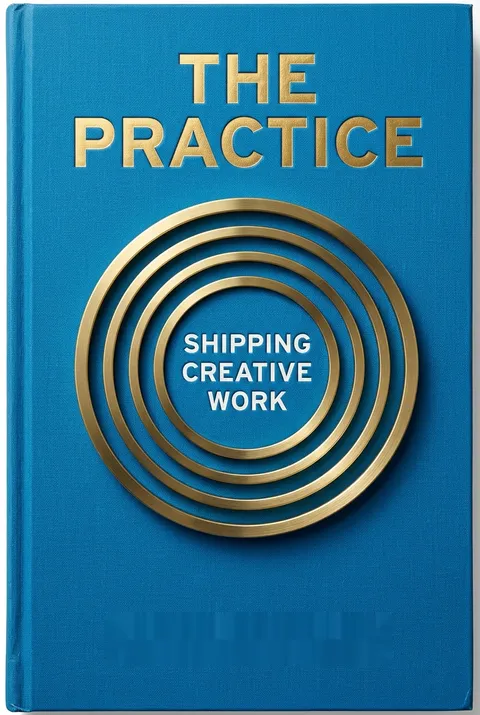
The Practice
Repeated creative commitmentGodin’s term for a sustained way of making and sharing work without a guarantee of success. It includes showing up, developing skill, acting with intention, and learning from each attempt. The practice is not a fixed recipe for a particular result; it is a repeatable process that a creator can choose even when confidence or inspiration is absent.
Art
Work that creates changeThe book uses “art” broadly, not just for painting, music, or museum objects. Art is creative work that takes a risk, brings a distinct point of view, and has the possibility of changing its recipient. A contribution can count as art when it aims to make something better, even if it is made through leadership, service, design, or another field.
Practical empathy
Understanding a specific audienceA creator’s effort to understand the people the work is meant to serve, including what they value, believe, fear, and need. Practical empathy requires seeing beyond the creator’s own perspective and shaping the work for a particular audience. It does not require pleasing everyone; it helps determine whether a contribution can make the intended change.
Enrollment
Voluntary shared commitmentThe point at which people choose to join a creator’s proposed journey. They understand the work’s direction and agree to participate, rather than being compelled or merely targeted by a sales pitch. Enrollment shifts the relationship from a one-sided attempt to persuade toward a shared project with a purpose, expectations, and an audience willing to engage.
Intentional action
Purpose-led designA way of making choices by clarifying whom the work is for, what change it is meant to create, and how its effects might be assessed. The questions are applied to the whole project and to its individual elements. Intentional action makes the creator responsible for a purpose while leaving room for uncertainty about whether the work will succeed.
Desirable difficulty
Challenge that builds skillA learning challenge that feels effortful but helps a person develop stronger, more transferable skill. The book contrasts this with practice that feels smooth and reassuring but may not prepare someone to respond flexibly. Difficulty is desirable when it is relevant to the goal and supports learning, not simply because it is uncomfortable.
Genre
A frame for creative workA recognizable category that helps an audience understand what kind of work it is encountering and what expectations to bring. Genre is different from generic sameness: it provides conventions that a creator can learn and then bend. In the book’s account, this shared frame makes originality easier to recognize and gives the maker boundaries to work against.
The Mundanity of Excellence
Study of competitive swimmingDaniel Chambliss’s study of competitive swimmers, cited to examine how athletes progress across levels of performance. The book highlights Chambliss’s emphasis on learned differences in skill and attitude, rather than explanations based only on training hours or innate talent. It supports the idea that excellence is built through specific practices, not explained by mysterious gifts alone.
Assertion
A testable creative proposalA provisional claim that a particular idea or action may create a useful change. An assertion is not a promise of success or a declaration of certainty. It gives creative work a direction, makes the creator accountable for trying, and invites others to examine the proposal, ask questions, and help discover whether it works.
FAQ
What's "The Practice: Shipping Creative Work" about?
- Author's Focus: Seth Godin's book emphasizes the importance of consistently creating and sharing work, regardless of the outcome. It challenges the notion that creativity is a rare gift and instead presents it as a practice that can be cultivated.
- Core Message: The book argues that creativity is a choice and a process, not a magical event. It encourages readers to trust themselves and engage in the practice of creation.
- Structure: The book is divided into sections that explore different aspects of creative work, including trust, generosity, professionalism, and intent.
- Target Audience: It's aimed at anyone who wants to lead, innovate, or solve interesting problems, whether they are writers, artists, or leaders.
Why should I read "The Practice: Shipping Creative Work"?
- Practical Advice: The book offers actionable insights for anyone looking to improve their creative output and overcome common barriers like fear and self-doubt.
- Empowerment: It empowers readers to take control of their creative process and trust in their ability to make a difference.
- Universal Application: The principles discussed are applicable across various fields, making it a valuable read for a wide audience.
- Inspiration: Seth Godin's writing is motivational, encouraging readers to embrace their potential and contribute meaningfully to the world.
What are the key takeaways of "The Practice: Shipping Creative Work"?
- Creativity as a Practice: Creativity is not a one-time event but a continuous practice that requires commitment and consistency.
- Trust Yourself: Trusting oneself is crucial in the creative process, as it allows for the exploration of new ideas and the courage to share them.
- Generosity in Creation: Creating work is an act of generosity, meant to serve others and make a positive impact.
- Focus on Process: The emphasis should be on the process of creation rather than the outcome, as good processes lead to good results over time.
What are the best quotes from "The Practice: Shipping Creative Work" and what do they mean?
- "The magic of the creative process is that there is no magic." This quote underscores the idea that creativity is not mystical but a result of consistent effort and practice.
- "Creativity is an action, not a feeling." It highlights that waiting for inspiration is less effective than actively engaging in the creative process.
- "Trust your self." This phrase is a recurring theme, encouraging readers to have confidence in their abilities and instincts.
- "Art is the generous act of making things better by doing something that might not work." It defines art as a selfless endeavor aimed at improvement and change.
How does Seth Godin define creativity in "The Practice: Shipping Creative Work"?
- Action-Oriented: Creativity is defined as an action rather than a feeling, emphasizing the importance of doing rather than waiting for inspiration.
- Choice and Process: Godin presents creativity as a choice and a process that can be practiced and improved over time.
- Generous Act: Creativity is seen as a generous act that involves making things better and serving others.
- Not Outcome-Dependent: The focus is on the process of creation rather than the outcome, encouraging creators to detach from the need for immediate success.
What is the significance of "Trust Your Self" in "The Practice: Shipping Creative Work"?
- Core Principle: Trusting oneself is a foundational principle in the book, essential for engaging in the creative process.
- Overcoming Doubt: It helps overcome self-doubt and the fear of failure, which are common barriers to creativity.
- Empowerment: Trusting oneself empowers creators to take risks and explore new ideas without the need for external validation.
- Consistency: It encourages consistency in practice, as trusting oneself leads to a more sustainable creative process.
How does "The Practice: Shipping Creative Work" address the concept of "Imposter Syndrome"?
- Acknowledgment: The book acknowledges imposter syndrome as a common experience among creatives, especially when doing important work.
- Healthy Sign: Godin suggests that feeling like an imposter is a sign of doing meaningful work and pushing boundaries.
- Embrace It: Instead of trying to eliminate imposter syndrome, the book encourages embracing it as part of the creative journey.
- Focus on Generosity: By focusing on the generous act of creation, creators can shift their attention away from self-doubt.
What role does "Generosity" play in "The Practice: Shipping Creative Work"?
- Central Theme: Generosity is a central theme, with the book advocating for creating work that serves others and makes a positive impact.
- Art as Service: Art is described as a service to others, where the creator's intent is to improve and contribute to the community.
- Abundance Mindset: The book encourages an abundance mindset, where sharing ideas and work leads to more creativity and connection.
- Cultural Contribution: Generosity in creation helps build culture and community, fostering a sense of belonging and shared purpose.
How does "The Practice: Shipping Creative Work" redefine "Success"?
- Process Over Outcome: Success is redefined as engaging in the creative process rather than achieving a specific outcome.
- Long-Term Commitment: It emphasizes the importance of long-term commitment to practice and improvement over short-term gains.
- Personal Fulfillment: Success is also about personal fulfillment and the satisfaction of contributing meaningfully to the world.
- Impact on Others: The book suggests measuring success by the positive impact one's work has on others, rather than external validation.
What is the "Pattern and the Practice" in "The Practice: Shipping Creative Work"?
- Life Patterns: The book discusses how our lives often follow patterns set by societal expectations and the industrial economy.
- Breaking Free: It encourages breaking free from these patterns to embrace a practice focused on creativity and personal growth.
- Persistent Approach: The practice is described as a persistent, stepwise approach pursued for its own sake, not for guaranteed results.
- Leadership and Art: Engaging in this practice involves leadership and creativity, contributing something unique and valuable to the world.
How does "The Practice: Shipping Creative Work" suggest dealing with "Writer's Block"?
- Myth of Writer's Block: The book argues that writer's block is a myth and a choice, not an insurmountable barrier.
- Change the Narrative: It suggests changing the narrative around writer's block, viewing it as a story that can be rewritten.
- Focus on Process: By focusing on the process of creation rather than the outcome, creators can overcome the fear of being blocked.
- Consistent Practice: Regular practice and commitment to the craft help dispel the notion of writer's block, making creativity a habit.
What is the "Generous Critic" concept in "The Practice: Shipping Creative Work"?
- Valuable Feedback: A generous critic provides valuable feedback that helps creators improve their work without personal attacks.
- Understanding Intent: They take the time to understand the creator's intent and offer constructive criticism that aligns with it.
- Enrolled in the Journey: Generous critics are enrolled in the creator's journey, eager to see the work succeed and willing to offer support.
- Learning Opportunity: Engaging with generous critics is seen as a learning opportunity, helping creators refine their process and output.
About the Author
Other books by Seth Godin










Download PDF
Download EPUB
.epub digital book format is ideal for reading ebooks on phones, tablets, and e-readers.








