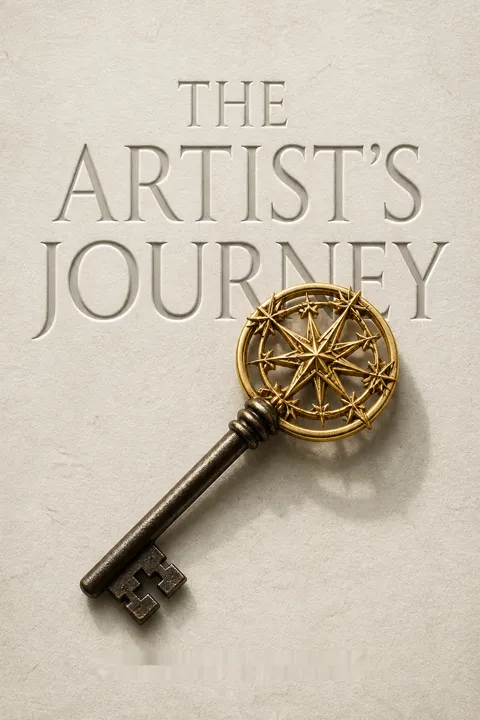


Key Takeaways
Let the moment you finally begin matter more than the work's first quality
A small beginning changed everything. Pressfield left advertising to write a novel, nearly finished it, then panicked, destroyed the book, and damaged his marriage. He spent years on the road, working odd jobs and avoiding writing. Later, driving a New York cab, he forced himself to sit at a typewriter for two hours. The pages were poor and immediately discarded. Then he washed a stack of dishes and realized he felt unexpectedly lighter. The breakthrough was not a good draft. It was showing up.
One passage led to another. Pressfield calls the first passage the Hero's Journey: a mythic pattern of leaving the familiar, facing trials, and returning changed. The Artist's Journey begins after that return, when a person commits to making work and discovering what it expresses. His story warns against confusing creative progress with early brilliance.
What's striking is the scale of the turning point: no masterpiece, no public recognition, just an evening spent doing the work. That distinction resembles the difference between outcome goals and process goals. A writer cannot command a good book into existence, but can choose to sit down and write. The story also resists an easy triumph narrative. Pressfield's escape from writing hurt people around him; suffering is not proof that a calling is noble. The useful lesson is narrower and sturdier: begin with the next honest action, without requiring it to justify the past or guarantee the future.
Treat every finished work as one chapter in a lifelong artistic journey
There is no final arrival. The Artist's Journey is Pressfield's name for the lifelong process of making work and discovering the self through it. It follows the Hero's Journey, but does not end with a return to ordinary life. The artist keeps producing, learning, and changing for as long as the work continues.
Each project repeats the pattern. A new idea arrives, fear argues against it, a source of encouragement helps the artist begin, and the work brings its own trials. Completion and release return something to other people. Pressfield extends the pattern even to individual trips between an idea and a finished sentence. A body of work is therefore not a single grand revelation, but a sequence of creative attempts, each building on and revising what came before.
This nested model makes creative careers easier to understand: a life can have an arc while each project has its own smaller arc of uncertainty, effort, and completion. It also counters the fantasy that an artist must discover a single, perfectly clear vocation before starting. In practice, a project can reveal what the next question should be. The mythic pattern is most useful as a map, not a rule. Some work unfolds out of order, stalls for reasons beyond the artist's control, or never reaches an audience. The model offers orientation without needing every experience to fit a heroic plot.
Follow the theme that keeps returning, even before you can explain it
Subject is deeper than topic. Pressfield uses subject to mean the recurring concern beneath an artist's apparent topics: the question or tension a body of work keeps exploring. Martin Scorsese's films, for instance, return to outlaw life and the love of cinema. Bruce Springsteen's songs repeatedly consider passion and the dignity of ordinary people. Neither subject is simply a list of settings or characters.
Notice what persists. Pressfield says artists often recognize their subject only after making several works. He describes his own books as repeatedly returning to war, courage, discipline, and the inner life of the fighter, though he did not begin with a master plan. A private interest can seem too strange or too personal to matter. The task is to observe it before dismissing it.
Recurring themes can be treated as evidence about attention: what an artist keeps noticing may matter more than what they claim to care about. That makes the idea practical. Reviewing old projects, sketches, or questions can expose a pattern that conscious planning missed. Still, a recurring concern is not necessarily an unchangeable essence. People work under different pressures, and interests can develop or fade. Pressfield's point is strongest as an invitation to investigate repetition, not as a demand to obey every old fixation. A subject can be a compass without becoming a cage.
Make work to discover your voice, not to perform an identity
The work can know first. Pressfield calls the deeper creative source the second you: the part of the artist that may produce insights before the conscious, self-conscious mind understands them. In his account, a character's important speech appeared in a novel without being planned. He sees this as the work revealing something about its maker, rather than the maker carefully expressing a known identity.
Voice takes shape through practice. An artist's subject, point of view, medium, and style develop together. A recognizable style is not merely a trick or a fixed signature; it grows as the artist makes choices about what to show and how. Pressfield points to artists whose work changes over decades while retaining an underlying continuity. The artist's identity becomes clearer through the body of work, not through a résumé or a declaration.
The idea usefully shifts attention from self-branding to sustained making. A voice is easier to recognize after it has produced enough work to reveal recurring choices. It also resembles a broader feature of learning: people often understand what they think by articulating, testing, and revising it. The caution is that an unexpected idea is not automatically profound merely because it feels unconscious or inspired. Editing, criticism, and judgment remain essential. The deeper self is best treated as a source of possibilities, not an infallible authority. Craft gives those possibilities form and helps distinguish a discovery from a first impulse.
Let imagination lead, then use craft to make its vision real
Two kinds of work meet. Pressfield describes the artist's process as moving between the material world and a higher, invisible realm of possibility. He calls the intuitive source of new images and ideas the Superconscious. This is his spiritual model of creativity, not a measurable account of how the brain works. In practical terms, an artist receives or imagines something, then finds a way to make it perceptible to others.
Vision needs technique. The painter Claude Monet spent years working out how to use paint to suggest sunlight on water. Pressfield presents that labor as both mundane experiment and imaginative pursuit. The same combination applies to writing, music, dance, and design: intuition may suggest what should exist, but technique helps it exist in a medium. Inspiration alone cannot finish the work.
The pairing of imagination and technique avoids two familiar traps: treating art as mysterious inspiration alone, or reducing it to competent execution. Creative cognition can involve both less-directed thought, where associations emerge, and focused revision, where choices are tested. The artist's spiritual language gives those experiences meaning, but the practical insight does not depend on accepting a higher realm. A useful test is whether an intuition can survive translation into the chosen medium. If the imagined effect cannot yet be made, the gap is not evidence of failure; it identifies the next craft problem.
When resistance rises, cross the threshold through a repeatable ritual
Fear often wears ordinary clothes. Pressfield calls the force that blocks creative work Resistance. It includes fear, distraction, procrastination, perfectionism, and the desire for outside approval. In his framework, Resistance is a refusal of the call to make something. It is a mental obstacle, not a monster waiting outside the studio.
Make beginning concrete. Choreographer Twyla Tharp describes a daily ritual that began when she got into a cab and told the driver to take her to the gym. The ride itself helped make the next action automatic. Pressfield similarly prepares to work by entering his office and invoking the Muse. The details differ, but the principle is to use a repeatable physical cue to move from intention into practice, rather than waiting to feel fearless or inspired.
Rituals reduce the number of decisions between wanting to work and beginning it. That connects Pressfield's mythic threshold to practical behavior design: a stable cue can make action less dependent on mood. The ritual does not need spiritual significance to be useful, though it may acquire that significance for the person performing it. A caveat matters here. Calling every obstacle self-generated can obscure exhaustion, illness, financial constraints, or unsafe conditions. A ritual can ease avoidant friction, but it cannot solve every external barrier. The distinction helps preserve both agency and realism.
Treat finishing as a craft skill, not a mood
Professionalism is practiced. Pressfield's practical inventory begins with learning to start, continue, and finish. It also includes tolerating solitude, collaborating, handling praise and rejection, staying calm during panic, and knowing when to abandon a failing work. These capacities matter because Resistance often grows strongest in the middle of a project, when the initial excitement has worn off but the ending is not yet visible.
Persistence needs judgment. Pressfield describes a film project that took seventeen years to reach production. Its co-originator stayed attached through multiple changes of writers, returned to write on it several times, and ultimately received credit. Another example comes from a painter who called unsuccessful canvases clinkers and learned not to keep reviving every one. Commitment means staying with the practice, not insisting that every individual project must be saved.
This is one of the book's most transferable sections because it treats artistic maturity as a set of trainable behaviors rather than a temperament. The distinction between persistence and sunk-cost thinking is especially important. Continuing can be wise when a project remains meaningful and workable; letting go can be wise when effort no longer serves the work. Neither decision is automatically virtuous. A useful standard is whether the artist is protecting the possibility of making good work, rather than protecting pride in a particular attempt. That standard applies to collaboration as well as solo practice.
Test the calling by doing the work, not worshipping the dream
A daimon is a persistent inner summons. Drawing on psychologist James Hillman, Pressfield describes the daimon as an inborn guiding spirit associated with a person's calling. He tells the story of gymnast Hermes Melissanidis, who at eight wanted to train for Greece's Olympic team. His doctor parents initially objected. After the boy refused food for four days, they agreed to support his gymnastics on the condition that he also pursue medical training. He later won Olympic gold and graduated from medical school.
Longing becomes real through effort. Pressfield also recalls repeatedly leaving jobs to write, despite years without a published novel. The book treats such persistence as evidence of a calling. But it is the sustained action, not the dramatic story of desire, that gives the claim practical weight.
The daimon offers a vivid way to understand desire that persists despite social pressure. The story of a child fighting for gymnastics makes that persistence memorable, while Pressfield's own long wait illustrates that creative work may require years of effort without reward. Yet suffering is not a reliable test of destiny. Many people endure pain in pursuits that harm them, and economic or family duties can rightly limit risk. The most grounded reading is to treat persistent longing as a hypothesis worth testing through practice, feedback, and honest attention to its costs.
Use art to make unfamiliar lives feel human and near
Art can bridge separation. Pressfield sees the artist's work as more than private expression. A story or film can bring an audience into lives it has never encountered, making unfamiliar people feel specific and emotionally legible. He imagines this as a movement toward the Divine Ground, his term for a deeper unity beneath the separateness of ordinary consciousness. He also calls Necessity the future that is not yet present but is coming into being.
The idea becomes concrete through empathy. A documentary about hunters in Siberia or a film about an Iranian family caring for someone with Alzheimer's can make distant circumstances immediate. In Pressfield's account, the artist's gift to the public is the work itself: an imaginative encounter that can reduce the distance between strangers.
This social account of art complements the book's focus on private effort. Stories let audiences rehearse attention to people beyond their immediate circle, and that can widen the range of lives they consider worthy of understanding. Pressfield's cosmic language describes this aspiration powerfully, but it remains a belief rather than a demonstrated mechanism. Empathy is also not the same as justice: feeling close to another person's experience does not by itself change the conditions shaping it. The artistic contribution is still substantial. It can make indifference harder by turning an abstraction into a human life.
Analysis
The book is part memoir, part creative manual, and part metaphysical argument. Its organizing move is to separate two journeys: the formative passage through hardship that prepares a person to answer a calling, and the ongoing work of making art once that calling is accepted. Pressfield's own story gives the distinction emotional force. The damaged marriage, years of drift, and eventual return to a typewriter are not presented as steps in a career plan. They become intelligible retrospectively as preparation for a life organized around work.
The strongest parts are also the most testable. Artists often discover their recurring concerns through repeated practice; projects demand different forms of persistence; rituals can help turn intention into action; and technique is needed to translate an imagined effect into a real medium. These claims do not require belief in a Muse or a higher realm. The book's language of the second self gives creative uncertainty a generous interpretation: not knowing what a work means yet can be part of discovering it, rather than evidence of incompetence.
The metaphysical account is more speculative. Pressfield describes a Superconscious, a daimon, and a universal source of creativity as active realities, while acknowledging that his model cannot be proved. Readers can treat this as spiritual conviction, poetic psychology, or a metaphor for processes outside deliberate awareness. The most caution-worthy claim is that artistic enemies are mental and self-generated. That frame can strengthen agency, but it can also understate material barriers such as money, care responsibilities, disability, or exclusion from institutions.
The book's most useful synthesis is therefore neither mystical certainty nor grim discipline alone. It is a practical wager: make work consistently, study what keeps returning, develop the craft to realize it, and let the results revise the artist's sense of self. Pressfield's final social claim, that art can cultivate empathy, gives this private labor a public purpose without guaranteeing that every work will achieve it.
Review Summary
The Artist's Journey receives mixed reviews, with an overall rating of 4.14 out of 5. Many readers find it inspiring and thought-provoking, praising Pressfield's concise writing and philosophical approach. Some appreciate its motivational aspects and insights into the creative process. However, critics argue it lacks depth, contains too much spiritual content, and offers little practical advice. Several reviewers note its similarity to Pressfield's previous works and suggest it's best suited for those early in their artistic journey or seeking reaffirmation.
People Also Read






Glossary
The Hero's Journey
Mythic departure and returnA recurring narrative pattern in which a person leaves a familiar world, faces trials and transformation, and returns changed, often bringing something valuable to others. Pressfield uses it to describe both life experiences that prepare someone for a calling and the smaller arc of an individual creative project.
The Artist's Journey
Lifelong creative self-discoveryPressfield's term for the ongoing process of making art after a person has recognized and committed to a calling. It involves discovering a subject, voice, and way of working through successive projects. Unlike a single adventure, it continues through the artist's life and produces a body of work.
Resistance
Force blocking creative workPressfield's name for the psychological force that keeps people from undertaking work they feel called to do. It appears as fear, procrastination, distraction, perfectionism, self-doubt, or dependence on approval. He describes it as an obstacle that intensifies when a person approaches meaningful creative work.
second you
Deeper source of creative insightPressfield's informal term for the aspect of an artist that produces work and insights beyond the conscious ego's plans. He regards it as wiser and more authentic than the self a person uses in ordinary social life. The idea explains why artists may discover what they think or who they are through making.
Superconscious
Intuitive source of creative workPressfield's preferred name for the deeper psyche that dreams, intuits, and supplies ideas not reached through deliberate conscious reasoning. He associates it with an artist's true voice and subject, and sometimes with a spiritual dimension beyond the individual mind. The book presents this as a personal model, not a scientific finding.
daimon
Inborn guide to a callingDrawing on James Hillman, Pressfield uses the Greek term daimon for an inhering spirit that knows and presses a person toward a particular destiny or calling. He portrays it as a persistent, powerful source of direction. The term describes a spiritual idea in the book, not a verified psychological mechanism.
Divine Ground
Underlying spiritual unityA term Pressfield draws from mystical and Jungian thought for a deeper, universal level of consciousness beneath ordinary individual awareness. He proposes that artists approach it through imagination and creative work, and that art can help audiences sense connection across apparent divisions. He presents this as a belief he cannot prove.
Necessity
The future coming into beingPressfield's name for an ancient cosmic force associated with what does not yet exist but is destined to come into existence. In his model, the artist serves Necessity by creating work that belongs to a larger future, even without understanding the full purpose of that work.
Muse
Source of artistic inspirationPressfield's personal name for the source of creative help he invokes before working. The Muse can mean inspiration, intuition, the Superconscious, or a spiritual presence beyond ordinary awareness. He treats this relationship as a practical form of humility: the artist prepares, works, and remains open to material that cannot be planned in advance.
FAQ
What's "The Artist's Journey" by Steven Pressfield about?
- Exploration of Creativity: "The Artist's Journey" explores the transition from the hero's journey to the artist's journey, focusing on the lifelong pursuit of meaning through creative expression.
- Hero's Journey Framework: The book uses the hero's journey framework, popularized by Joseph Campbell, to explain how artists find their calling and voice.
- Self-Discovery and Expression: It emphasizes the process of self-discovery and the importance of expressing one's true self through art.
- Practical and Mystical: The book combines practical advice with mystical insights to guide artists on their creative paths.
Why should I read "The Artist's Journey"?
- Inspiration for Creatives: The book is a source of inspiration for anyone engaged in creative work, offering insights into overcoming obstacles and finding one's voice.
- Guidance on Resistance: It provides strategies to combat Resistance, a concept Pressfield describes as the force that hinders creative work.
- Understanding the Artist's Path: Readers gain a deeper understanding of the artist's journey as a lifelong process of growth and self-discovery.
- Practical Advice: The book offers practical advice on developing skills, maintaining discipline, and staying committed to one's art.
What are the key takeaways of "The Artist's Journey"?
- Hero's Journey as Preparation: The hero's journey is a preparatory phase for the artist's journey, where one finds their calling and voice.
- Resistance is the Enemy: Resistance is a powerful force that artists must overcome to succeed in their creative endeavors.
- Self-Discovery is Central: The artist's journey is about discovering one's true self and expressing it through art.
- Lifelong Commitment: The journey is ongoing, requiring dedication, discipline, and a willingness to evolve.
How does Steven Pressfield define the "Artist's Journey"?
- Post-Hero's Journey: The artist's journey begins after the hero's journey, focusing on the expression of one's true self.
- Internal and Personal: It is an internal journey of self-discovery, unique to each individual.
- Lifelong Process: The journey lasts a lifetime, with the artist continually evolving and refining their craft.
- Creative Expression: It involves finding and expressing one's true voice, subject, and style.
What is "Resistance" according to Steven Pressfield?
- Force Against Creativity: Resistance is a negative force that prevents individuals from pursuing their creative work.
- Manifests as Fear: It often manifests as fear, self-doubt, procrastination, and distraction.
- Universal Experience: All artists experience Resistance, and overcoming it is crucial for creative success.
- Enemy of the Artist: Resistance is the primary enemy that artists must battle to fulfill their creative potential.
How does "The Artist's Journey" relate to the "Hero's Journey"?
- Sequential Journeys: The artist's journey follows the hero's journey, building on the experiences and lessons learned.
- Hero's Journey as Foundation: The hero's journey provides the foundation and preparation for the artist's journey.
- Different Focus: While the hero's journey is about finding one's calling, the artist's journey is about expressing it.
- Shared Structure: Both journeys share a similar structure, with stages of challenge, growth, and transformation.
What advice does Steven Pressfield give for overcoming Resistance?
- Daily Practice: Establish a daily routine to build discipline and reduce the power of Resistance.
- Commitment to Craft: Stay committed to your art, even when faced with self-doubt and fear.
- Seek Inspiration: Draw inspiration from mentors, muses, and the creative works of others.
- Embrace Failure: Accept failure as part of the process and use it as a learning opportunity.
What role does the "Muse" play in "The Artist's Journey"?
- Source of Inspiration: The Muse is seen as a source of inspiration and guidance for artists.
- Connection to the Divine: It represents a connection to a higher realm of creativity and potential.
- Invocation for Creativity: Artists are encouraged to invoke the Muse to aid in their creative endeavors.
- Symbol of the Unconscious: The Muse symbolizes the unconscious mind, where true creativity resides.
What are the stages of the "Artist's Journey"?
- Self-Discovery: The journey begins with discovering one's true self and artistic voice.
- Skill Development: Artists must develop their skills and craft to express their creativity effectively.
- Overcoming Resistance: Battling Resistance is a continuous part of the journey.
- Lifelong Evolution: The journey is ongoing, with the artist continually evolving and refining their work.
What is the significance of the "Epiphanal Moment" in the book?
- Turning Point: The epiphanal moment is a turning point where the artist realizes their true calling.
- Breakthrough Experience: It often follows a period of struggle and leads to a breakthrough in creativity.
- Internal Change: The moment signifies an internal change in perspective and attitude.
- Beginning of the Artist's Journey: It marks the end of the hero's journey and the beginning of the artist's journey.
What are the best quotes from "The Artist's Journey" and what do they mean?
- "The artist's journey is the process of self-discovery that follows." This quote emphasizes that the journey is about finding and expressing one's true self.
- "Resistance is the enemy of the artist." It highlights the importance of overcoming Resistance to succeed in creative endeavors.
- "The artist's journey lasts the rest of your life." This underscores the lifelong nature of the artist's journey and the ongoing process of growth and evolution.
- "The Muse is the only female to whom I have always been faithful." This reflects the deep connection and reliance on the Muse for creative inspiration.
How does Steven Pressfield suggest artists find their "Subject"?
- Innate Subject: Pressfield suggests that artists are born with their subject, which they discover over time.
- Self-Discovery Process: The artist's journey involves a process of self-discovery to uncover one's true subject.
- Subject as Theme: The subject is not just a topic but a deeper theme that resonates with the artist's true self.
- Follow the Muse: By following the Muse and engaging in creative work, artists can uncover their subject naturally.
About the Author
Other books by Steven Pressfield





Download PDF
Download EPUB
.epub digital book format is ideal for reading ebooks on phones, tablets, and e-readers.








