

Key Takeaways
Treat Resistance to meaningful work as a signal to begin.

Name the hidden opponent. Pressfield calls Resistance the internal force that blocks actions tied to long-term growth, integrity, or creative ambition. It is not an outside person or circumstance, though it may use them as excuses. It appears wherever a valuable undertaking asks for sustained effort: writing, education, health, service, or a principled choice. The book’s central image is a life divided between what a person does and the potential left unused.
Turn recognition into action. Instead of waiting to feel ready, notice the familiar dodge: another task suddenly seems urgent, the project feels impossible, or tomorrow looks more convenient. Naming the pattern does not solve the work, but it can stop the delay from masquerading as a considered decision.
What's striking is how the metaphor converts a vague failure of motivation into something observable: a person can study the moment they divert attention. That resembles behavioral approaches that use small, scheduled actions to interrupt avoidance rather than waiting for mood to improve first. The metaphor is powerful precisely because it is simple, but it should not become a universal diagnosis. Lack of time, money, safety, or health can be a real barrier, not an inner saboteur. The useful question is whether a specific obstacle needs solving or is serving as a recurring excuse.
Let fear point toward meaningful work, but never make it your only compass.

Read fear as information. Pressfield argues that self-doubt and fear often gather around projects that matter deeply. They can indicate aspiration, not incapacity. He recalls that actor Henry Fonda still felt physically sick before performances late in life, yet went onstage. The point is not that confidence must come first, but that fear can accompany committed action.
Check the signal carefully. The book’s rule is to pay attention to the work that most frightens you, because it may be the work you most want to attempt. But fear alone cannot distinguish creative risk from genuine danger. Ask what the fear concerns, what evidence supports it, and what small, responsible step would test the project without pretending every risk is imaginary.
Fear is useful as a clue to value, but not as a reliable GPS. In decision science, strong emotion can mark high stakes while also distorting estimates of likelihood and cost. Pressfield's framing helps counter the common belief that anxiety proves a person is unsuited to a task. The refinement is to separate fear of evaluation from fear of concrete harm. The first may call for practice and exposure; the second may call for safeguards or a different plan. Courage is not a blanket endorsement of every frightening choice.
Put work on the calendar before asking inspiration to arrive.

Make a daily appointment. Pressfield describes a workday built around ordinary preparation, a set start, several focused hours, and a clear stopping point. He does not judge the session by whether the pages are brilliant or plentiful. The essential measure is that he sat down and worked. He also cites Somerset Maugham’s joke that inspiration reliably arrives at his desk at the appointed hour.
Let action invite momentum. A schedule protects the work from chores, correspondence, and distractions that can expand to fill the day. It also removes the daily negotiation about whether to begin. Set a realistic time, prepare the materials, and stay with the task long enough to get past the first resistance. Inspiration may follow; the schedule does not depend on it.
This is a practical account of initiation, not a claim that routine makes every session productive. Creative work often includes unglamorous setup, uncertainty, and revision, so judging each day by visible output can encourage premature quitting. A fixed appointment reduces reliance on fluctuating motivation and makes the task easier to re-enter. Still, rigid schedules can fail when caregiving, shift work, illness, or other constraints dominate. The durable principle is not a particular hour or ritual. It is protecting a recurring block of attention that fits the life actually available.
Turn pro by showing up when the day feels ordinary.
Choose the professional stance. Pressfield uses professional to mean a person who treats a calling as serious work, not necessarily someone who earns a living from it. A professional returns consistently, accepts that progress takes time, studies technique, and tolerates the imperfect conditions of real life. The author notes that many people already behave professionally in paid jobs: they arrive, stay through the day, and meet obligations even when enthusiasm is low.
Borrow that reliability. Apply the same expectations to a creative practice. Prepare a workable space, learn the craft, seek knowledgeable feedback, and make room for slow stretches. Pressfield contrasts patient effort with the amateur’s fantasy of a sudden burst that completes everything. The shift is less about grand confidence than about keeping a modest, repeatable promise.
The distinction makes professionalism a form of identity-based commitment rather than a status granted by the market. That can free a beginner from waiting for credentials before taking practice seriously. It also connects to deliberate practice, where improvement depends on sustained effort, feedback, and attention to technique, not simply hours spent near a craft. A caution: paid employment does not always provide a clean template, since some jobs are precarious or exploitative. The transferable lesson is dependable practice, not glorifying overwork or treating every calling as an obligation without limits.
Let rejection judge the draft, not the person who made it.
Separate work from worth. Pressfield recounts co-writing King Kong Lives and expecting a triumphant premiere. Few people attended, the reviews were harsh, and the film performed poorly. He felt that the failure made his whole life a failure. A friend redirected him to a more useful question: would he quit? He chose not to, and came to see the experience as proof that he had entered the arena and endured a real defeat.
Use judgment as data. A professional can listen for what a review, editor, audience, or customer reveals about the work without treating it as a verdict on personal value. Praise is not proof of mastery, and rejection is not proof of fraud. Revise what can be improved, learn from the response, and return to the work.
The story captures a distinction central to resilient performance: evaluation of an output need not become evaluation of an entire self. That separation makes feedback usable, because a person can change a draft or method without defending their identity. It also avoids the opposite trap of dismissing all criticism as jealousy or sabotage. Some feedback is perceptive, some poorly informed, and some irrelevant to the intended audience. The professional stance is neither submission nor contempt. It is selective attention, followed by another attempt.
Build a territory where effort matters more than rank.
Choose a home base. Pressfield contrasts a hierarchical orientation, where identity depends on status and other people’s approval, with a territorial orientation, where satisfaction comes from practicing an activity itself. He calls the activity a territory: a domain claimed through work that supplies its own sense of engagement. A runner may feel restored by running; an artist may find steadiness at the desk, even without an audience.
Test the motive. Ask whether the activity would still matter if nobody were watching or praising it. If the answer is yes, the work may be rooted in its own rewards rather than rank. This does not mean ignoring readers, customers, or collaborators. It means not letting comparisons and market predictions dictate every creative choice before the work has been made.
The contrast clarifies two different reward systems: external position and the felt value of the activity. Research on intrinsic motivation similarly distinguishes doing something for its inherent interest from doing it chiefly for separable rewards, while recognizing that external feedback can support or undermine engagement depending on how it is delivered. The last-person-on-earth test is vivid, not definitive. Artists need audiences, institutions, and income; those are not automatically corrupting. The practical aim is to keep external evaluation from becoming the only reason to create.
Do not wait to be fully healed before beginning.
Start while imperfect. Pressfield warns that preparation, workshops, and self-examination can become elaborate ways to postpone the work. He tells of a period when he finally sat at an old typewriter and worked for two hours, producing pages he immediately discarded. Afterward, he washed dishes and found himself whistling. The change came not from a brilliant result, but from having stopped avoiding the task.
Keep care in its place. The book’s challenge is to stop making readiness a prerequisite for action. That is different from denying pain or refusing help. A person may need treatment, rest, support, or a safer situation. The question is whether care is helping life resume or has become an endless condition that must be satisfied before any meaningful action is allowed.
This insight aligns with behavioral activation, an approach in which planned, meaningful activity can be part of addressing low mood rather than something postponed until motivation returns. The typewriter episode makes the point without pretending that the pages were good: action can restore agency before it produces success. Pressfield sometimes draws the boundary too sharply between healing and work. Mental illness, trauma, and disability are not merely disguises for avoidance. A humane application supports both treatment and appropriately scaled activity, instead of making either one a moral test.
Treat inspiration as a collaborator, not an entry requirement.
Leave room for the unknown. Pressfield describes the Muse as a source of creative assistance that becomes available through steady work. Readers need not take this literally: he allows the idea to mean a spiritual presence, an impersonal force, or the talent and unconscious processes that generate insight. His example is the familiar experience of noticing a flaw or solution while walking, after attention has moved away from the desk.
Prepare, then receive. Technique and routine give an idea somewhere to land. The writer learns craft, begins the work, and remains alert to unexpected connections or corrections. Pressfield’s account of ideas arriving during a walk does not make inspiration a substitute for labor. It makes labor a way to gather and organize material that conscious effort alone may not immediately solve.
The Muse is one of the book’s most flexible devices because it lets a spiritual reader and a secular reader describe a similar experience in different terms. Cognitive accounts of incubation likewise suggest that stepping away from a problem can allow new associations to surface, although they do not establish a supernatural source. The key is to respect both deliberate practice and unplanned insight. Waiting passively for a breakthrough is not the same as creating conditions in which attention, memory, and imagination can keep working.
Guard the finish line, where old excuses make one final bid.
Expect a late detour. Pressfield retells the Odyssey episode in which Odysseus’s crew, nearly home, opens a sealed bag of winds and drives the ships off course. He uses the episode as a picture of how disruption can arrive when completion is close. The point is not that every setback is self-sabotage, but that a nearly finished project can provoke fresh rationalizations, distractions, or unnecessary changes.
Finish before judging success. Pressfield spent twenty-six months completing a novel that found no buyer, and waited years for his writing to earn its first payment. Completing it still mattered because finishing broke a pattern of abandoning work near the end. Protect the final stretch, deliver the work in a usable form, and separate completion from the uncertain response that follows.
The closing-stage warning is memorable because completion changes the stakes: an unfinished project can preserve a flattering fantasy, while a finished one can be evaluated. That makes avoidance especially tempting near delivery. The distinction between finishing and succeeding is also psychologically useful; it returns control to the creator without pretending that effort guarantees a market. Yet not every project deserves completion. Deadlines, resources, and changing evidence can justify stopping. The test is whether ending the work is a considered choice or a familiar escape from exposure.
Analysis
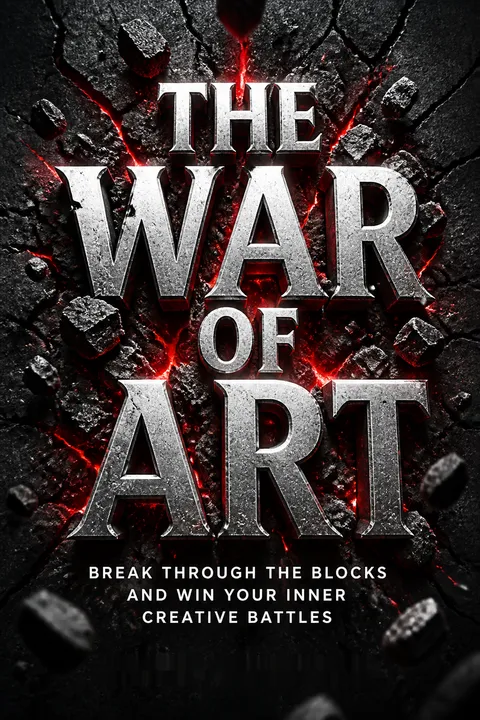
The War of Art is a compact self-help book arranged as a three-stage campaign: identify Resistance, adopt the conduct of a professional, then understand creativity as aided by forces beyond the everyday ego. Its memorable achievement is not a technical system for making art, but a language for the moment before action. Procrastination, rationalization, compulsive distraction, and fear become recognizable maneuvers rather than mysterious evidence of personal inadequacy. The recurring injunction is behavioral: begin, return, and finish.
The professional ideal supplies the book’s strongest practical correction to romantic ideas of creativity. Pressfield replaces the image of the artist waiting for a lightning strike with routines, patience, craft, humility, and exposure to actual judgment. His story of a failed film is especially useful because it shows that professional identity can precede success. The work can fail without the worker having to disappear with it.
The book’s mythology is both strength and limitation. Resistance and the Muse make inner conflict vivid, and the Muse can be read as theology, unconscious cognition, or a name for the insight that emerges from sustained attention. But Pressfield sometimes treats the metaphor as an explanation, and his claims can become too sweeping. Fear may signal importance, but also real danger. Seeking support may delay work, but support can also make difficult work possible. Illness and distress should not be reduced to avoidance. The distinction between internal resistance and external constraint needs careful judgment.
A modern reading therefore keeps the behavioral core and loosens the universal claims. Treat avoidance as a hypothesis to investigate, not a diagnosis. Set a recurring appointment, practice the craft, seek useful feedback, and detach personal worth from each result. At the same time, account for material conditions and care needs. The book is most persuasive when its war imagery helps a reader take one honest step, and least persuasive when it implies that every obstacle is an enemy within. Its enduring lesson is not that willpower conquers every circumstance, but that meaningful work becomes possible when intention is converted into repeated action.
Review Summary
The War of Art receives mixed reviews. Some praise it as a motivational kick to overcome creative blocks, with practical advice on discipline and professionalism. Others criticize it for repetitive content, unsubstantiated claims, and potentially harmful advice. Many find the first two sections insightful but dislike the spiritual third part. Readers appreciate Pressfield's candor and concise writing style, though some find his tone judgmental. The book's central message of overcoming "Resistance" resonates with many creatives, despite its controversial aspects.
People Also Read



Glossary
Resistance
Inner force blocking meaningful workPressfield’s name for the internal opposition that arises when someone attempts a demanding action associated with growth, integrity, or creative purpose. It can appear as procrastination, rationalization, distraction, fear, or self-sabotage. The term is a motivational model for noticing avoidance, not a clinical diagnosis and not a claim that external barriers are unreal.
Professional
Committed approach to the workPressfield uses Professional as an ideal stance, rather than a job title or proof of income. A Professional shows up consistently, treats the craft seriously, accepts slow progress and imperfect conditions, learns technique, and keeps personal worth separate from success or rejection. Turning pro means deciding to treat the calling as real work.
Territory
Work rewarded by its practiceA Territory is an activity or domain claimed through sustained effort and valued for the engagement it provides, rather than mainly for status or approval. Pressfield presents it as a psychological home base: practice gives energy and a sense of steadiness without requiring an audience. It can include creative work, sport, or another personally sustaining activity.
Hierarchical orientation
Identity built around rankPressfield’s term for defining success and identity through one’s position in a social pecking order. It directs attention toward comparison, status, and other people’s reactions. He contrasts this with a territorial orientation, where the activity matters for its own sake. The distinction is a lens for examining motives, not a complete account of social or artistic life.
Muse
Source of creative inspirationPressfield’s name for the source of insight and inspiration that seems to assist creative work. He presents it in mythic language but allows readers to understand it as a literal spiritual presence, an impersonal creative force, or the talent and unconscious processes involved in making things. The Muse is not a replacement for practice; work prepares the conditions for inspiration.
Ego
Everyday self-protective mindIn Pressfield’s personal framework, the Ego is the part of the psyche oriented toward physical life, self-preservation, and familiar conditions. He associates it with Resistance because it resists change and creative risk. This is Pressfield’s reworking of a psychological term, not a standard clinical definition, and it should be read as a philosophical model.
Self
Deeper source of growthPressfield uses the Self, drawing on Jungian language, for a deeper psychic dimension that includes unconscious material, dreams, intuition, and the impulse toward creative development. In his spiritual interpretation, it reaches beyond the personal ego and is aligned with a larger source of life. This account is metaphysical and should not be confused with a settled psychological finding.
FAQ
What's "The War of Art" about?
- Author's Focus: "The War of Art" by Steven Pressfield is about overcoming the internal barriers that prevent creative individuals from achieving their goals.
- Central Theme: The book identifies "Resistance" as the primary enemy of creativity, which manifests as procrastination, self-doubt, and fear.
- Structure: It is divided into three parts: "Defining the Enemy," "Combating Resistance," and "Beyond Resistance," each offering insights and strategies to conquer creative blocks.
- Purpose: The book aims to inspire and guide artists, writers, and entrepreneurs to push through their internal struggles and realize their creative potential.
Why should I read "The War of Art"?
- Practical Advice: It provides actionable strategies for overcoming procrastination and self-doubt, common issues faced by creatives.
- Inspiration: The book is motivational, encouraging readers to pursue their true calling and not succumb to fear or societal pressures.
- Insightful Concepts: It introduces the concept of "Resistance" as a universal force that hinders creativity, offering a new perspective on personal struggles.
- Empowerment: Reading it can empower you to take control of your creative process and commit to your work with a professional mindset.
What are the key takeaways of "The War of Art"?
- Resistance as the Enemy: Recognize that Resistance is a natural force that opposes creative endeavors and must be confronted daily.
- Turning Pro: Adopt a professional attitude towards your creative work, showing up consistently and treating it with seriousness and dedication.
- Inspiration and the Muse: Understand that inspiration often comes after you start working, not before, and that invoking the Muse can help in the creative process.
- Territorial vs. Hierarchical Thinking: Focus on your work for its own sake (territorial) rather than for external validation (hierarchical).
How does Steven Pressfield define "Resistance"?
- Universal Force: Resistance is described as a destructive force within human nature that opposes any act that might lead to personal growth or creativity.
- Manifestations: It can appear as procrastination, self-doubt, fear, rationalization, and other forms of self-sabotage.
- Internal Origin: Resistance is self-generated and arises from within, often disguised as legitimate reasons not to pursue creative work.
- Impersonal Nature: It is not out to get you personally; it is a natural force that acts objectively, like gravity.
What is the "Turning Pro" concept in "The War of Art"?
- Professional Mindset: Turning Pro means adopting a professional attitude towards your creative work, treating it as a vocation rather than a hobby.
- Commitment: It involves showing up every day, regardless of circumstances, and dedicating yourself fully to your craft.
- Discipline and Routine: Professionals work through fear and Resistance by establishing routines and maintaining discipline.
- Focus on Mastery: The professional focuses on mastering the craft, understanding that success is a by-product of consistent effort.
What role does "Inspiration" play in "The War of Art"?
- Result of Work: Inspiration is seen as a result of consistent work rather than a prerequisite for starting.
- Invocation of the Muse: Pressfield suggests invoking the Muse, a metaphor for divine inspiration, to aid in the creative process.
- Concentration of Power: When you sit down to work, power concentrates around you, attracting ideas and insights.
- Higher Realm: Inspiration is linked to a higher realm, suggesting that creativity is a divine or spiritual process.
How does "The War of Art" address procrastination?
- Common Manifestation: Procrastination is identified as the most common form of Resistance, often rationalized as harmless.
- Habitual Nature: It can become a habit, leading to a lifetime of unfulfilled potential and regret.
- Immediate Action: The book emphasizes the power of starting immediately, as every moment holds the potential to change your life.
- Overcoming Procrastination: The key is to recognize it as Resistance and to act in spite of it, committing to your work daily.
What are the best quotes from "The War of Art" and what do they mean?
- "Resistance is the most toxic force on the planet." This highlights the destructive power of Resistance in preventing individuals from achieving their potential.
- "The more important a call or action is to our soul’s evolution, the more Resistance we will feel toward pursuing it." This suggests that the level of Resistance is directly proportional to the importance of the task.
- "The professional loves it so much he dedicates his life to it." This emphasizes the commitment and dedication required to overcome Resistance and succeed in creative endeavors.
- "When we sit down each day and do our work, power concentrates around us." This illustrates the idea that consistent effort attracts inspiration and creative energy.
How does "The War of Art" differentiate between "Territory" and "Hierarchy"?
- Territorial Orientation: Working territorially means focusing on your work for its own sake, deriving satisfaction from the act itself.
- Hierarchical Orientation: Working hierarchically involves seeking external validation and defining success by others' opinions.
- Sustenance from Territory: A territory provides sustenance and fulfillment without external input, while hierarchy can lead to insecurity and dependence on others.
- Creative Focus: The book advocates for a territorial approach, encouraging artists to concentrate on their craft rather than external recognition.
What is the significance of "The Higher Realm" in "The War of Art"?
- Source of Inspiration: The Higher Realm is where inspiration and creativity originate, a place beyond the material world.
- Divine Assistance: Pressfield suggests that unseen forces, like muses or angels, support and sustain creative efforts.
- Connection to the Self: The Higher Realm is linked to the Self, the part of us that is connected to the divine and seeks to create.
- Spiritual Dimension: Creativity is portrayed as a spiritual journey, with the Higher Realm providing guidance and insight.
How does "The War of Art" suggest dealing with fear?
- Fear as an Indicator: Fear is seen as a sign of what we must do, indicating the importance of the task to our soul's growth.
- Direct Proportion: The more fear we feel, the more significant the task is to our personal evolution.
- Acting Despite Fear: The book encourages acting in the face of fear, understanding that it is a natural part of the creative process.
- Fear of Success: It also addresses the fear of success, which can be as paralyzing as the fear of failure, urging readers to embrace their potential.
What is the role of "Self" and "Ego" in "The War of Art"?
- Ego's Beliefs: The Ego is concerned with material existence, self-preservation, and external validation, often hindering creative efforts.
- Self's Connection: The Self is connected to the divine, seeking growth, creativity, and unity with others.
- Conflict: The Ego and the Self are in constant conflict, with the Ego producing Resistance to maintain the status quo.
- Creative Alignment: Aligning with the Self allows for true creative expression, as it is the source of inspiration and authenticity.
About the Author
Other books by Steven Pressfield






Download PDF
Download EPUB
.epub digital book format is ideal for reading ebooks on phones, tablets, and e-readers.








