

Key Takeaways
Treat safety as a practiced responsibility, not a feeling someone supplies.
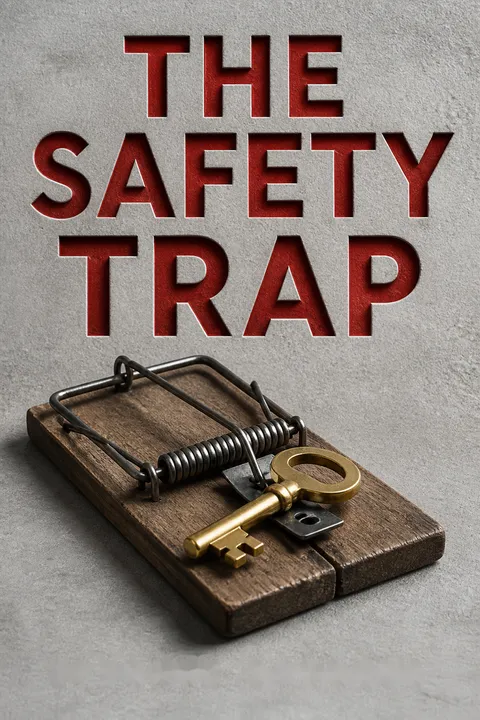
Relief is not protection. The Safety Trap is the false confidence that appears when fear fades but the underlying risk remains. After a frightening event, people may demand changes, then return to familiar routines once the headlines move on. Their anxiety declines, but the vulnerabilities may be untouched. The author argues that safety is not a guarantee delivered by an institution. It requires ongoing participation, much like physical fitness requires more than paying for a gym membership.
Make attention habitual. Seat belts illustrate the gap between knowing a safeguard works and choosing to use it. The book’s point is not to stay frightened, but to practice ordinary protective habits before a crisis makes them urgent.
The distinction between feeling safe and being safer is a useful correction to a common error in risk perception. Institutions can reduce danger, but no system eliminates it, and reassurance can be mistaken for evidence that a problem is solved. The fitness analogy makes participation concrete. Its limit is that safety cannot be reduced to individual effort: building design, workplace policy, and public services shape exposure too. The strongest reading is shared responsibility, not blame placed on people who lack power or resources.
Train attention to notice warning signs your expectations filter out.
Expectation hides surprises. Pattern recognition is the learned ability to anticipate what is likely to happen next. Inattentional blindness describes missing an unexpected object because attention is occupied elsewhere. The book explains this through a visual experiment: people concentrating on comparing a cross on a screen often failed to notice a new shape that appeared in view. A driver who expects ordinary traffic may likewise overlook a hazard.
Notice the precursors. The author calls the mind’s learned attention to early cues a filtered forecast. It works like a motion camera that detects a change before an event fully enters the frame. Yet attention can also be overwhelmed by repeated media alerts and false alarms. The goal is not constant suspicion. It is recognizing meaningful changes in context.
This account connects protective awareness to cognitive science: attention is selective, and expectation helps determine what enters conscious awareness. The camera analogy captures why advance preparation matters. Alarm fatigue adds an important systems dimension, since too many low-value alerts can make important warnings easier to dismiss. The practical challenge is discrimination. Training people to notice everything is impossible and can intensify anxiety. Effective awareness needs clear priorities, relevant cues, and permission to update judgments when new information arrives.
Document escalating behavior early, before repeated contact becomes a staged encounter.
Avoidance can compound risk. A television performer received increasingly disturbing emails from a man who had become fixated on her. She stopped opening them and asked an assistant to delete them. Weeks later, the man approached her on a film set with an envelope and confronted her about ignoring his messages. Reviewing the preserved emails revealed that he had disclosed travel plans and preparations for the encounter.
Keep a record. The book argues that concerns are easier to assess while they are still manageable. Save messages, note dates and incidents, and seek help when behavior escalates. Avoidance may be useful as a short pause after shock, but using it to deny a persistent problem can leave the other person’s behavior unchecked and make a later response harder.
The case shows how an apparently private nuisance can become a physical encounter when no one tracks its progression. Documentation preserves context that memory can blur, and it can help professionals distinguish a repeated pattern from a single unpleasant interaction. The advice to disengage from an irrational or coercive person can be protective, but silence is not a complete safety plan. The appropriate next steps depend on the threat, the relationship, and available support. A trusted advocate or qualified professional can help turn a record into a proportionate response.
Judge safety advice by relevant expertise, not uniforms, titles, or confidence.
Authority has boundaries. During the September 11 attacks, some occupants of the second World Trade Center tower began evacuating after seeing the first tower hit. Port Authority announcements told people to return to their desks, and some followed those instructions. The author uses the episode to distinguish authority over a building’s operations from expertise in emergency protection.
Check the fit. A false authority is someone whose credentials are absent, questionable, or unrelated to the decision at hand. A venue guard trained to check tickets may not be an emergency-planning expert, just as a respected professional is not automatically qualified in every specialty. Before relying on advice, consider who is giving it, what they know, and whether the instructions match the immediate conditions.
The key insight is not that authority should always be ignored, but that authority is domain-specific. In high-stakes situations, a title can create an unjustified halo of competence. At the same time, individual judgment is vulnerable to panic, incomplete information, and mistaken interpretation. The sounder principle is calibrated trust: follow credible, relevant guidance when it fits the situation, while staying alert to contradictions and immediate hazards. Institutions can support that judgment by making emergency roles and decision authority clear before a crisis.
Invest in prevention, not security theater that merely reassures.
Response is not prevention. The book distinguishes measures that reduce the chance of harm from those that help after harm begins. A fire department’s equipment can improve its ability to put out a fire, but it does not prevent the fire’s cause. Similarly, a camera that is reviewed only after an incident may document a breach without stopping it.
Test what exists. Security theater is a visible show of protection that may reassure people while leaving the underlying risk unchanged. The author points to guards, cameras, and drills that are present but poorly matched to the actual threat or not consistently used. A useful assessment asks what a safeguard is meant to prevent, who monitors it, and whether everyday practice matches policy.
This prevention-versus-response distinction is valuable across safety engineering, cybersecurity, and public health. A warning system matters only if someone can interpret and act on it; equipment without procedures can become expensive decoration. Still, visible measures are not automatically useless, and emergency drills can build coordination when designed for realistic scenarios. The relevant test is not whether a measure looks reassuring, but whether it measurably reduces exposure, improves response, or both. That standard is more useful than dismissing a whole category of safeguards.
Treat violence risk as a shared pattern, not an isolated outburst.
Patterns reveal escalation. The book presents a pathway to intended violence: a grievance may lead to harmful ideas, then research and planning, a breach of safeguards, and finally an attack. No single behavior proves that someone will become violent. The concern is the pattern across time, especially when changes in behavior combine with preparations or attempts to overcome security.
Share the pieces. In the Parkland and Capital Gazette cases, warning signs had been noticed by different people or organizations, but concerns were not effectively connected or acted on. The bystander effect helps explain why people hesitate when others are present. Assigning a specific person a task, such as calling for help, makes responsibility clearer. Workplaces and schools can support this with reporting channels and trained threat-management teams.
A pattern-based approach is more defensible than trying to identify a dangerous person from appearance or personality. It focuses attention on behavior and context, while also making room for intervention before an attack. The model depends on careful assessment: grievance, distress, or unusual conduct alone should not become grounds for labeling or punishment. Good systems need trained reviewers, consistent documentation, and routes to support as well as security action. Otherwise, reporting can become surveillance without care, or warnings can be lost in bureaucracy.
Rehearse what your body must do before stress narrows your choices.
Plans need capability. A jewelry-store owner had identified a nearby exit after hearing what she thought was a gunshot. When a real shooting occurred years later, she froze because she doubted she could run the short distance. Her plan had lowered her worry without proving she could carry it out. The story makes physical readiness part of practical preparedness, not an abstract fitness goal.
Practice manageable effort. Stress inoculation is gradual exposure to demanding conditions so that a person can function more effectively under pressure. The author recommends building basic strength, mobility, and cardiovascular capacity through regular activity, then practicing realistic skills. A route, tool, or emergency plan is useful only if a person can execute it under the conditions likely to arise.
Preparedness is partly embodied knowledge. Rehearsal can reduce the gap between knowing a plan and being able to perform it when attention and fine motor control are impaired by stress. The idea also supports gradual practice rather than dramatic, one-off training. Fitness should not be treated as a moral test or a guarantee of survival, however. Disability, age, and health constraints matter. The useful aim is to build capacity appropriate to the person, and to design plans that do not assume everyone can run, lift, or fight.
Audit your real routines, not the security features you merely own.
Look from the outside. The FOIL method is the author’s framework for assessing a place: consider first impressions, examine the outer grounds, inspect the interior, then record lasting concerns. It asks what a visitor can see, how someone might enter or leave, and whether locks, cameras, and access rules actually work. The author’s parents, for example, knew bears visited their property but had not changed a door latch that a bear could operate.
Count the information you expose. A couple’s social posts about a date night helped an old acquaintance time a burglary. No single post told the whole story; details accumulated across platforms. A practical audit therefore includes both physical routines and digital traces, while comparing perceived risk with the actual circumstances rather than with a wealthier neighbor’s situation.
The audit mindset is powerful because people are often poor judges of the vulnerabilities made familiar by routine. Looking at a home or workplace as an outsider can reveal obvious gaps that residents no longer notice. The same logic applies to data aggregation: scattered details can expose schedules, relationships, or access. A do-it-yourself review is useful for ordinary checks, but it should not replace specialist assessment for complex risks. It should also be conducted responsibly, without creating a public inventory of vulnerabilities.
Give children usable options, not blanket warnings that leave them helpless.
Warnings need an exit. A lost child in Central Park did not ask for help because she had been taught never to speak to strangers. The author argues that children need to understand that it can be appropriate to ask a safe adult for assistance. His Three Fs of Family, Food, and Flags offer memorable cues: approach an adult with children, someone working where food is served, or a trusted public institution identified by a flag.
Practice without frightening. Parents can discuss what a child knows, assumes, and wants to know, then rehearse simple actions through games. Choose a recognizable family meeting place, identify nearby safe havens, and practice how to call for help. The aim is neither to conceal every risk nor to make danger the center of childhood, but to give children options they can remember.
The shift from prohibition to usable judgment is developmentally important. A rule such as never speak to strangers is memorable but too broad to guide a child who is actually lost. Concrete, rehearsed options are more likely to translate into action. The approach also treats children as learners rather than passive objects of protection. Its examples need adaptation to local settings and a child’s age or abilities. Parents should verify that any suggested safe adult or location is genuinely accessible and appropriate where they live.
Leave a troubling interaction without waiting for permission or perfect certainty.
Courtesy is not consent. A client traveling in a rideshare became uncomfortable when her driver discussed a previous passenger in sexualized terms and described a podcast about disposing of bodies. She hesitated to change her destination because she feared hurting his feelings. Her adviser helped her create a face-saving reason to exit at a nearby hotel, where she could arrange safer onward transport.
Use discomfort to create options. The author distinguishes a present-focused gut signal from generalized anxiety, which can persist even without new evidence. A person need not prove that someone intends harm before choosing distance, contacting a trusted person, or moving to a public place. At the same time, one uncomfortable cue is a reason to reassess, not proof of guilt.
The permission to disengage is especially useful in situations where social politeness pressures someone to remain alone with a stranger. A boundary can be justified by uncertainty itself; it does not require a courtroom standard of proof. The nuance is equally important: intuition can be informative, but it can also reflect prior experience, stereotypes, or stress. The safest use of a gut feeling is often to change the conditions, increase distance, and gather support, rather than to make a confident claim about another person’s intent.
Analysis
The book’s most useful contribution is a shift in the meaning of safety. It is not a permanent condition conferred by a locked door, a uniform, a drill, or the temporary decline of fear. It is a process of noticing vulnerabilities, testing assumptions, and coordinating people who may each possess only part of the picture. That thesis connects human attention with institutional design: an ignored email, an unmonitored camera, or an unenforced visitor policy can matter because systems fail at the seams between what is known and what is acted upon.
Its case studies make this logic memorable, especially when a small earlier sign is later revealed as meaningful. But retrospective clarity can make prevention look easier than it is. Before an attack, warning behaviors are ambiguous, and many people who are distressed or angry never become violent. A responsible threat-management system must therefore combine attention with proportionality, privacy, due process, and access to help. The book is strongest when it urges people to record patterns and connect information, and weaker when it treats a confident interpretation as self-evident.
The most consequential tension is between empowerment and burden. People should not assume that public safety agencies, schools, or employers can guarantee personal safety. Yet shifting responsibility entirely onto individuals ignores unequal resources and the collective nature of risk. Organizations have obligations to maintain workable access controls, listen to staff, and provide competent assessments. Individuals can learn routes and ask questions, but they cannot personally repair every institutional failure.
Some of the book’s tactical recommendations are stated too categorically for situations that vary by location, threat, and available exits. A general lesson to understand options is more robust than a universal instruction to run, shelter, or disregard an evacuation plan. The strongest practical reading is therefore neither complacency nor permanent alarm. It is informed participation: prepare in advance, use credible expertise, adapt to immediate conditions, and preserve room for human judgment.
Review Summary
The Safety Trap receives mostly positive reviews, with readers praising its practical advice on personal safety and threat assessment. Many find the book informative, eye-opening, and applicable to everyday life. Readers appreciate Coursen's expertise and clear writing style. Some reviewers note the book's potential to change perspectives on safety and security. A few criticisms mention repetitiveness and occasional fear-mongering. Overall, reviewers recommend the book for its valuable insights into personal and family safety, situational awareness, and preparedness strategies.
People Also Read








Glossary
Safety Trap
Fear fades, risk remainsA false sense of security that arises when fear or anxiety has subsided even though the underlying risk has not been reduced. Coursen uses the term for situations in which people return to ordinary routines after a frightening event without addressing the vulnerabilities that made the event possible.
filtered forecast
Learned attention to precursorsCoursen’s term for the mind’s learned recognition of early cues that may signal what is about to happen. Like a motion camera responding to a change before a person fully enters view, it describes background observation that can bring a relevant risk into conscious attention.
Protective intelligence
Information used to reduce threatsThe collection and assessment of information about people who may have the interest, motivation, intention, and practical ability to cause harm. In the book, it includes noticing and connecting behaviors such as expressed grievances, surveillance, attempts to bypass safeguards, and planning, so concerns can be assessed before violence occurs.
path to intended violence
Stages toward a planned attackA behavioral sequence used in threat assessment to organize signs that may precede targeted violence. The stages described are grievance, ideation, research and planning, breach, and attack. The sequence is a guide to assessing patterns over time, not a checklist that proves any individual will become violent.
FOIL method
A structured vulnerability reviewCoursen’s practical method for examining a location from an outsider’s perspective. The letters refer to Firsts, Outers, Inners, and Lasts: initial impressions, the exterior, the interior, and final conclusions. The review considers visibility, access, routines, safeguards, and possible ways to enter or exit.
security theater
Visible reassurance without risk reductionA security measure or public display that makes people feel protected without meaningfully addressing the threat it is supposed to manage. Coursen applies the term to safeguards that are poorly matched to actual risks, inconsistently used, or intended mainly to restore public confidence after an incident.
stress inoculation
Practice under increasing stressA training approach in which people gradually encounter demanding conditions so they can perform more effectively when stress rises. Coursen applies it to safety preparation: skills and actions should be practiced, rather than merely understood, because fear can impair attention, movement, and decision-making.
alarm fatigue
Reduced response after repeated alertsDesensitization that can occur when people receive frequent alarms, many of which are false or irrelevant. Over time, alerts may be ignored or receive slower responses. The book applies the concept to emergency notifications, news exposure, medical alarms, and cybersecurity warnings.
bystander effect
Help decreases in a crowdA social psychological phenomenon in which an individual may be less likely to help someone when other people are present. The book explains that responsibility can feel diffused across a group. Directly assigning a task to a specific person, such as calling emergency services, can make action more likely.
Download PDF
Download EPUB
.epub digital book format is ideal for reading ebooks on phones, tablets, and e-readers.








