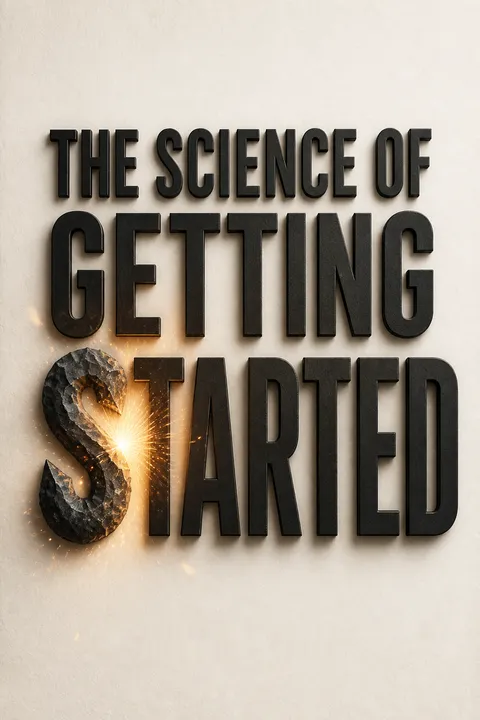


Key Takeaways
Make the first step so small that avoidance loses its advantage.
A shelf took years. The book begins with the author’s father, who imagined building a keepsake shelf before his child was born. It was finished only after the child had lost a first tooth, nearly eight years later. The father said the project felt too large, while smaller chores were easier to start. He finally made progress by spreading the work into tiny actions, such as gathering materials and taking measurements over time.
Lower the starting cost. Procrastination is not merely choosing fun over boredom. A daunting task can trigger discomfort, excuses, and substitute activities that feel productive without advancing the real goal. Breaking the task into steps that take minutes makes the beginning less intimidating. The aim is not to finish the shelf today, but to make the next useful action easy to do now.
The shelf story makes a powerful distinction between the size of a goal and the size of its first action. This resembles behavioral activation, an approach in which taking a manageable action can shift mood and engagement rather than waiting for the right mood to appear. It also treats procrastination as a design problem, not proof of laziness. Small steps are not sufficient when a task is genuinely impossible, under-resourced, or unsafe, but they are an effective test: if a tiny next move is possible, the obstacle may be emotional friction rather than the task itself.
Diagnose your procrastination pattern before choosing the remedy.
Delay has a loop. The book describes a procrastination cycle: unhelpful assumptions create discomfort, excuses reduce that discomfort, avoidance activities offer temporary relief, and the resulting consequences reinforce the original assumptions. Cleaning a desk instead of beginning a report can feel industrious while leaving the report untouched.
Different people dodge differently. The five profiles are thrill-seekers who want deadline pressure, avoiders who fear failure or success, indecisive people who fear blame, perfectionists who fear imperfect work, and busy procrastinators who keep switching among tasks. Triggers may come from the environment, such as a tempting screen, or from fear, fatigue, and unrealistic standards. Delay can occasionally help when a task becomes unnecessary or when a decision needs more information, but routine avoidance usually has a cost.
The typologies are useful as hypotheses about what a person is trying to escape. A perfectionist may need permission to draft imperfectly, while a busy procrastinator may need a narrower priority list. That is more precise than treating every delay as the same failure of discipline. The profiles should remain diagnostic tools, not identities: people often move among them depending on the task and context. The book’s acknowledgment that delay sometimes prevents wasted effort adds needed nuance, though useful postponement should produce information or a better decision, not merely repeated relief.
Treat procrastination as an impulse-control struggle, not a character defect.
Immediate rewards pull hard. The book contrasts the fast, emotion-driven limbic system with the prefrontal cortex, which supports planning and deliberate control. Its lizard-brain metaphor describes why a quick pleasure can overpower a distant benefit. Impulsivity can involve urgency, acting without considering consequences, giving up when effort lasts, and seeking stimulating experiences.
Find the weak link. A study of 212 students associated procrastination with nine executive functions, including inhibition, planning, task initiation, emotional control, working memory, and organization. The book also offers HALT, a check for hunger, anger, loneliness, or tiredness, conditions that can make an impulsive choice more likely. The point is to identify what interferes with starting or staying on task, then address that particular obstacle instead of condemning the whole self.
This framing replaces moral judgment with a more useful question: which capacity or condition is failing in this moment? That question is compatible with research on self-regulation, where attention, emotion, and planning interact rather than operating as a single store of willpower. The brain-versus-brain account is a metaphor, not a literal contest between two independent agents, and the nine functions are not a diagnosis. Persistent, severe difficulty initiating tasks can also warrant professional support, especially when it affects multiple areas of life. Practical strategies should not become a reason to dismiss clinical or environmental causes.
Start before motivation arrives; progress is often what creates it.
Mood need not lead. Waiting to feel ready creates another condition that must be met before work can begin. The book recommends lowering the entry threshold: open the document, sketch a rough outline, or work on one small part rather than demanding a polished result. It also distinguishes the process from the product. A large handbook becomes manageable when attention shifts to drafting one section during a defined work period.
Recover without self-punishment. After a lapse, guilt can encourage more avoidance. A 2010 study discussed in the book found that university freshmen who forgave themselves for delaying study before one exam procrastinated less before the next. The practical move is to stop replaying the mistake and identify the next solvable action. Imperfect work can be revised; work that never begins cannot.
The sequence matters: action can generate evidence of competence, and that evidence can make continued effort feel less threatening. This connects with mastery experiences, in which confidence grows from successfully doing something rather than from reassurance alone. Self-forgiveness is most useful when it supports a return to action, not when it erases responsibility. Likewise, lowering standards at the beginning is different from abandoning standards altogether. A rough draft is a starting material; its value lies in making revision possible, not in pretending quality never matters.
Make tomorrow's consequences vivid, then decide your response in advance.
Inaction has consequences too. Omission bias is the tendency to notice the effects of an action more readily than the effects of not acting. Someone may see the danger of using an outdated chemical process but overlook the risks of delaying an update. Imagining the future makes those hidden costs more concrete. The book calls temporal myopia a weak connection to one’s future self, which can make immediate comfort outweigh later well-being.
Pre-decide the next move. An if-then plan links a recognizable cue to a specific action, such as responding to a set time with a short work session. A review of 94 studies by psychologist Peter Gollwitzer found higher success rates for goals using this kind of planning. One exercise study cited in the book reported that 91% of participants who scheduled when, where, and how long to exercise followed through, compared with 35% of a motivation-only group.
Vividly imagining a future consequence addresses temporal discounting, the tendency to value an immediate reward more than a later one. The book’s virtual-reality example, in which people interacted with a representation of their future self, illustrates how making that future feel personal can influence present choices. If-then plans add a complementary benefit: they reduce the number of decisions required in the moment. However, planning is not a guarantee. A cue must be reliable, and the action must be realistic; otherwise, a detailed plan can become another abandoned promise.
Raise task value, lower temptation, and reward progress sooner.
Motivation has adjustable parts. The book’s procrastination equation organizes motivation around four factors: expecting to succeed and valuing the task help, while impulsiveness and a distant reward hinder. A person who doubts their ability can build confidence through a smaller first attempt. Someone repeatedly pulled toward online distractions can remove those options while working.
Make focus concrete. The STING method describes a bounded work period centered on one task, a set time, fewer distractions and interruptions, and a reward afterward. Temptation bundling pairs an enjoyable activity with an unpleasant but useful one, making the present experience more rewarding. For example, a person might reserve a favorite podcast for a routine task. The reward should support, not undo, the goal. Together, these tactics make work less vague and its payoff less remote.
This is a practical form of choice architecture: adjust the conditions around a behavior so the desired action is easier and more rewarding. The equation is best used as a diagnostic map, not as a precise calculator. Its value lies in asking which lever is weak: confidence, meaning, impulse management, or immediacy of payoff. The structured work period can also be too rigid if interpreted as forbidding all breaks. The book’s broader point is to protect a stretch of attention, not to ignore fatigue or the need for recovery.
Put one task on the calendar and protect it from noise.
Give intention a place. A useful schedule names the task, the time, the location, and the resources needed, with a backup plan if the slot fails. In a study of exercise intentions described in the book, 91% of people who made a specific schedule exercised at least weekly, compared with 35% of those given motivational information alone.
Keep progress nonzero. A zero day is a day with no action toward a goal. The target is not major progress every day; reading one paragraph or writing one sentence can keep a project moving. When stuck, ask what single action would start the task, what matters most today, or how the work could be made easier. Those questions turn vague resistance into a concrete next step.
A calendar converts an intention into a time-and-place commitment, reducing the need to reconsider the task repeatedly. The zero-day idea adds a useful measure of continuity without demanding heroic effort. Together, they shift success from an all-or-nothing outcome to observable behavior. Still, schedules should include slack: unexpected demands, caregiving, illness, and ordinary delays are part of real life. A missed block is a cue to reschedule, not evidence that the entire plan has failed. A system that can recover is more durable than one that assumes perfect compliance.
Spend your best effort on important work, not loud work.
Urgent is not always important. The Eisenhower matrix sorts tasks by whether they matter and whether they demand immediate attention. Important and urgent tasks need action now. Important but not urgent tasks should be scheduled before they become crises. Urgent but less important tasks may be delegated, while tasks that are neither important nor urgent can be removed or saved for leisure.
Guard your attention. The book also recommends reviewing information consumption. Social feeds, articles, and entertainment can become automatic ways to avoid meaningful work, even when they feel educational. Track what is being consumed, cut low-value sources, and decide deliberately before giving a medium time. The goal is not to ban recreation, but to stop letting every alert or interesting link outrank work tied to a real priority.
The matrix makes a neglected distinction visible: urgency often belongs to the person demanding attention, while importance depends on the goals and responsibilities at stake. This is useful for resisting interruptions that feel consequential simply because they are immediate. Delegation, however, depends on authority and resources; not everyone can hand work to another person. The information-diet idea also treats attention as a limited budget rather than an endless stream. Its strongest application is not eliminating pleasure, but choosing it deliberately instead of consuming by default.
Stop researching when you know enough to begin.
Preparation has a boundary. The book presents Colin Powell’s 40-70 rule as a decision heuristic: act when you have enough information to make a sound move, but before searching for total certainty drains momentum. The percentage is a guide, not a measurement. Opening a business, for instance, may require a workable initial inventory rather than every possible item.
Time expands to fill its allowance. Parkinson’s Law describes work stretching to occupy the time available. A small chart-making task can balloon into reorganizing an entire spreadsheet if the deadline is distant. Set a shorter, clear deadline to keep attention on what the task actually requires. Excuses such as waiting for perfect timing, a complete plan, or instant competence often conceal fear; doing the next available step produces information that further preparation cannot.
The value of these rules is that they force a stopping decision. Endless research can feel responsible while functioning as risk avoidance, and a deadline can expose which parts of a task truly matter. Yet the 40-70 range should not be treated as universal: high-stakes choices may demand more verification, while rushed work can create costly errors. The useful question is not whether a person has reached a particular percentage, but whether additional information is likely to change the next action. If not, beginning may be the better experiment.
Manage energy in layers, then build recovery into the routine.
Energy has foundations. The book’s energy pyramid places physical energy at the base, followed by emotional, mental, and spiritual energy. Sleep, food, and exercise support the capacity to regulate emotions and concentrate. Mental energy depends on how thoughts are managed, while the top tier concerns whether work aligns with personal values and purpose.
Effort needs renewal. The model emphasizes cycles: use energy, recover it, stretch capacity, and establish repeatable rituals that sustain healthy behavior. A person who is exhausted may struggle to focus even with a perfect schedule. A person doing work that conflicts with deeply held values may also find it difficult to stay engaged. The proposed response is not simply to push harder, but to improve the conditions beneath the work and build routines that can be maintained.
This model usefully broadens productivity beyond time management. Focus depends on the body, emotional state, thought patterns, and perceived meaning of the task. It also resists the fantasy of endless output by treating recovery as part of performance rather than a prize earned after exhaustion. The layers are a practical map, not a strict scientific hierarchy: people can sometimes act effectively while tired or unhappy, and meaningful work can still be draining. The model works best as a prompt to locate a bottleneck, not as a demand to perfect every area before starting.
Analysis
The book’s strongest idea is that procrastination is not solved by a better slogan about discipline. It is interrupted by changing the conditions that make avoidance attractive: the task feels too large, the reward too distant, the next step unclear, or the competing distraction too close. The recurring remedy is to shorten the distance between intention and action. Tiny steps lower the entry cost; schedules and if-then plans reduce repeated decisions; immediate rewards compete with immediate temptations; and deadlines limit unproductive expansion.
That practical consistency is also the book’s main organizing strength. Its many techniques can seem like a long menu, but they address a smaller set of bottlenecks: starting, focusing, deciding, tolerating discomfort, and sustaining energy. A reader need not adopt every tool. A useful diagnosis comes first. If fear of evaluation is the obstacle, a timer alone may not help. If the phone keeps interrupting, self-forgiveness is not the primary fix. The best method is the one matched to the mechanism.
The account is most persuasive when it replaces shame with observation, but it sometimes places too much weight on personal control. Persistent difficulty can reflect ADHD, depression, chronic stress, inaccessible work conditions, excessive workload, or unclear authority. These are not necessarily cured by a smaller checklist. In addition, productivity is not identical to a worthwhile life: a person can become efficient at work that should be refused or redesigned. The book’s own emphasis on values offers a way to ask that larger question.
Its frameworks should therefore be treated as useful heuristics, not laws of human behavior. Newton’s physics is an analogy, the 40-70 threshold is a rule of thumb, and a scheduled routine does not guarantee follow-through. Their practical value lies in prompting experiments: reduce one source of friction, make one commitment specific, and observe what changes. Procrastination becomes easier to address when it is treated as evidence about the task and its context, rather than a verdict on character.
Review Summary
"The Science of Getting Started" receives mostly positive reviews, with readers praising its practical advice and actionable strategies for overcoming procrastination. Many found the book's insights relatable and helpful, particularly the breakdown of procrastination types and methods like the STING technique. Some readers noted that the abundance of information could be overwhelming, suggesting a slower reading pace. While a few felt the content wasn't entirely novel, most appreciated the book's comprehensive approach to productivity and motivation.
People Also Read







Glossary
Procrastination cycle
Avoidance that reinforces itselfA pattern in which unhelpful assumptions create discomfort, excuses soften that discomfort, and avoidance activities provide temporary relief. Consequences then add stress or reinforce the original assumptions, making future avoidance more likely. The cycle helps identify points where a person can question beliefs, inspect excuses, or redirect an avoidance activity.
HALT
Check four vulnerability statesAn acronym for hunger, anger, loneliness, and tiredness. The book uses it as a brief check before acting on an impulse or abandoning a task. These conditions can weaken judgment or persistence, so recognizing them may suggest that a basic need or emotional state should be addressed before deciding what to do.
Procrastination typologies
Five common delay patternsA set of five procrastination profiles discussed in the book: thrill-seeker, avoider, indecisive, perfectionist, and busy procrastinator. Each describes a different reason for delay, such as seeking deadline pressure, fearing judgment, avoiding blame, fearing imperfect work, or scattering effort across too many tasks. They are practical categories, not formal diagnoses.
Three Laws of Productivity
A physics-based productivity analogyA framework that adapts Newton’s laws of motion as metaphors for work. Starting helps overcome inactivity, focused effort is more useful than scattered effort, and productive conditions can be strengthened by reducing counteracting forces such as distraction and stress. The laws are analogies intended to guide behavior, not literal equations describing human productivity.
Paradox of choice
Too many options stall decisionsThe difficulty and dissatisfaction that can arise when a person faces many possible choices. In the book, abundant options can delay action, increase worry about the alternatives not chosen, and make selecting a merely adequate option feel risky. Suggested responses include narrowing criteria, setting decision limits, choosing a default, and accepting a good-enough result.
Omission bias
Overlooked costs of inactionA cognitive tendency to notice consequences of an action more readily than consequences of failing to act. The book applies the idea to procrastination: because inaction can feel like doing nothing, its effects may remain mentally invisible. Imagining what could happen if a task stays undone can make those costs easier to recognize.
Temporal myopia
Weak connection to future outcomesA short-sighted orientation toward immediate experience at the expense of future consequences. The book uses the term for the difficulty some chronic procrastinators have in imagining or emotionally relating to their future selves. Making future outcomes more vivid can help present decisions account for the person who will live with them.
If-then technique
Link a cue to an actionA planning method, also called an implementation intention, that connects a recognizable situation to a specific behavior. Its basic structure is: if a particular time or event occurs, then take a defined action. The plan makes the response easier to carry out without reopening the decision each time the cue appears.
Procrastination equation
Four levers affecting motivationA model associated in the book with researcher Piers Steel. Motivation rises with a person’s expectation of succeeding and the value attached to the task, and falls as impulsiveness increases or the reward becomes more delayed. The equation is presented as a way to identify which conditions to adjust, rather than as a precise calculator of an individual’s behavior.
STING method
A bounded focused work sessionA structured approach for creating a protected period of work. It centers one selected task, sets a time boundary, limits unrelated distractions and unplanned interruptions, and provides a reward after completing the work period. The method aims to make the task finite and focused, rather than requiring a promise to work indefinitely.
Temptation bundling
Pair pleasure with useful workA strategy associated in the book with behavioral scientist Katy Milkman. It pairs an enjoyable activity with a task that may otherwise be delayed, giving the present self a more immediate reward while still supporting a longer-term goal. The pairing should make the task more appealing without canceling out its intended benefit.
Eisenhower matrix
Sort tasks by importance and urgencyA two-by-two task-sorting framework based on whether work is important and whether it is urgent. Important, urgent tasks call for action; important, nonurgent tasks should be scheduled; less important but urgent tasks may be delegated; and tasks that are neither can be eliminated or reserved for leisure. The distinction helps prevent urgency from dominating priorities.
Zero day
A day without goal progressA day in which a person takes no action toward a chosen goal. The book recommends replacing an all-or-nothing standard with a small but real action, such as reading a paragraph or writing a sentence. The idea can also be applied to shorter or longer periods and is meant to preserve continuity without requiring major daily accomplishments.
40-70 rule
Begin before certainty is completeA decision heuristic attributed in the book to Colin Powell. It suggests acting when roughly 40% to 70% of the needed information or preparation is available, rather than moving with too little knowledge or waiting for impossible certainty. The range is a rule of thumb for avoiding excessive preparation, not a universal standard for high-stakes decisions.
Parkinson’s Law
Work expands to fill available timeThe principle that a task tends to expand to occupy the time allotted for its completion. The book applies it to procrastination by arguing that overly generous deadlines can encourage unnecessary complexity and delay. Setting a clear, shorter time limit can help a person focus on essential work, provided the limit remains realistic.
Energy pyramid
Four connected sources of energyA model, associated in the book with Jim Loehr and Tony Schwartz, that organizes energy into physical, emotional, mental, and spiritual levels. Physical health supports the other levels; emotional state and thought patterns affect concentration; and values influence a sense of purpose. The model also emphasizes recovery, challenge, and repeatable habits as parts of sustaining energy.
FAQ
What's "The Science of Getting Started" about?
- Overview: "The Science of Getting Started" by Patrick King is a guide to overcoming procrastination and enhancing productivity. It delves into the psychological and strategic aspects of why we delay tasks and how to combat this tendency.
- Focus Areas: The book covers various topics, including the psychology behind procrastination, action mindsets, strategic planning, and structuring your day to minimize procrastination.
- Goal: The ultimate aim is to equip readers with practical tools and techniques to stop self-sabotage and become more productive in both personal and professional settings.
Why should I read "The Science of Getting Started"?
- Practical Solutions: The book offers actionable strategies to tackle procrastination, making it ideal for anyone struggling with productivity.
- Psychological Insights: It provides a deep understanding of the psychological factors that contribute to procrastination, helping readers identify and address their own habits.
- Comprehensive Approach: With a mix of psychological tactics, strategic planning, and mindset shifts, the book covers all angles to help readers get started and stay productive.
What are the key takeaways of "The Science of Getting Started"?
- Understanding Procrastination: The book explains the cycle of procrastination and the role of the "lizard brain" in driving impulsive behavior.
- Action Mindsets: It emphasizes the importance of taking the first step and how motivation often follows action, rather than precedes it.
- Strategic Planning: Techniques like the STING method and the Eisenhower Matrix are introduced to help prioritize tasks and manage time effectively.
What are the best quotes from "The Science of Getting Started" and what do they mean?
- "Procrastination is opportunity’s assassin." This quote highlights how delaying tasks can lead to missed opportunities and potential success.
- "If and When were planted, and Nothing grew." This proverb underscores the futility of waiting for the perfect moment to act, emphasizing the need for immediate action.
- "The only difference between success and failure is the ability to take action." This quote by Alexander Graham Bell, featured in the book, stresses that taking action is crucial to achieving success.
How does Patrick King explain the "Procrastination Cycle"?
- Five Stages: The cycle includes unhelpful assumptions, increasing discomfort, excuse-making, avoidance activities, and consequences.
- Understanding Triggers: By identifying these stages, readers can recognize their own procrastination patterns and work to disrupt them.
- Breaking the Cycle: The book offers strategies to address each stage, helping readers move from inaction to productivity.
What is the "Lizard Brain" concept in "The Science of Getting Started"?
- Primitive Instincts: The "lizard brain" refers to the limbic system, which controls basic survival instincts and emotions.
- Impulsive Behavior: This part of the brain drives impulsive actions, often leading to procrastination as it seeks immediate pleasure.
- Balancing Act: The book discusses how to manage the lizard brain's impulses with the rational prefrontal cortex to make better decisions.
What are the "9 Procrastination Scales" mentioned in the book?
- Executive Functions: These scales include inhibition, self-monitoring, planning and organization, activity shifting, task initiation, task monitoring, emotional control, working memory, and general orderliness.
- Impact on Procrastination: Deficiencies in these areas can make individuals more prone to procrastination.
- Improvement Strategies: The book suggests ways to strengthen these executive functions to reduce procrastination tendencies.
How does "The Science of Getting Started" address the "Paradox of Choice"?
- Too Many Options: The paradox of choice refers to the overwhelming nature of having too many options, leading to indecision and procrastination.
- Simplifying Decisions: The book advises setting rules and limits to make decision-making easier and more efficient.
- Focus on Satisfaction: It encourages readers to aim for "satisficing" rather than maximizing, reducing the stress of making the perfect choice.
What is the "STING Method" in "The Science of Getting Started"?
- Acronym Breakdown: STING stands for Select one task, Time yourself, Ignore everything else, No breaks, and Give yourself a reward.
- Focus and Discipline: This method helps maintain focus and discipline by breaking tasks into manageable parts and rewarding completion.
- Practical Application: By following these steps, readers can create productive work sessions and reduce procrastination.
How does "The Science of Getting Started" suggest using "If-Then" statements?
- Implementation Intention: If-then statements help pre-plan responses to specific situations, making it easier to take action.
- Behavioral Chaining: By linking actions to specific cues, these statements reduce the need for willpower and increase the likelihood of following through.
- Practical Examples: The book provides examples of how to use if-then statements to tackle procrastination in daily life.
What is "Temptation Bundling" as described in the book?
- Combining Tasks: Temptation bundling involves pairing a pleasurable activity with a less enjoyable task to make the latter more appealing.
- Dual Satisfaction: This method satisfies both immediate desires and long-term goals, reducing procrastination.
- Examples and Application: The book offers practical examples of how to implement temptation bundling in various aspects of life.
How does "The Science of Getting Started" recommend structuring your day to avoid procrastination?
- No Zero Days: The book suggests aiming for no "zero days," where you do nothing toward your goals, to maintain momentum.
- Self-Interrogation: It encourages asking specific questions to break through procrastination and take immediate action.
- Detailed Scheduling: Writing down a detailed schedule with specific tasks, times, and locations helps keep procrastination at bay.
About the Author
Other books by Patrick King



Download PDF
Download EPUB
.epub digital book format is ideal for reading ebooks on phones, tablets, and e-readers.








