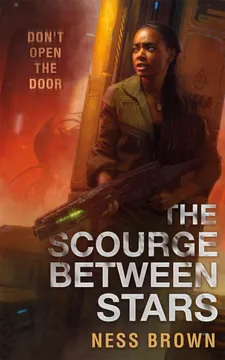


Plot Summary
A Signal in Watson
First mate Jacklyn Albright is rationing water and food aboard the Calypso, a failing ship carrying six thousand people toward Earth. The fleet has lost contact with other vessels, and mysterious impacts keep damaging the ship.
Head technician Otto Watson summons Jacklyn to demonstrate the new processing system he has installed in Watson, his android. The droid turns a mass of space noise into an eerie sequence of tones, suggesting something in the void might finally be detectable.
Later, a garbled transmission reaches the bridge from another ship, the Atalanta. Its captain warns listeners not to open a door before the signal cuts off. Jacklyn has no explanation, but the message makes Otto’s discovery feel less like salvation than a hazard approaching from inside the fleet.
The signal gives the crew a possible way to survive, but its arrival is inseparable from dread. Jacklyn’s response captures the novella’s central tension: knowledge can offer agency while also exposing how little control people possess. Her distrust of Otto is personal, rooted in his treatment of Watson, yet the danger is operational too. The message from the Atalanta converts an abstract mystery into a warning with a practical command, introducing the story’s recurring conflict between cautious interpretation and urgent action.
Knocks Inside the Hull
After the transmission, Jacklyn tries to keep the Calypso functioning while its captain, her father Noah, stops answering calls from his quarters. During a repair shift, repeated bangs sound from inside a corridor wall, and a hypodroid overheats while reporting an anomaly.
The noise stops before Jacklyn can investigate. Elsewhere, growing anger over rationing erupts into a riot, and the quartermaster reports that the ship’s agricultural soil is failing. Jacklyn also hears the same banging on the observation deck, where Watson warns that something is opening a door just before another impact rocks the ship.
The sounds recall her mother Tegan’s old fears about hidden creatures, fears Jacklyn learned to dismiss. Now the ship’s unexplained failures begin to resemble evidence rather than superstition.
The threat first appears as a problem of interpretation. Jacklyn has rational reasons to distrust her mother’s warnings, whose past distress shaped family life, but the ship’s failing systems make dismissal increasingly costly. Meanwhile, her father’s absence leaves her responsible for decisions without the reassurance of command. The banging works as both a literal clue and an assault on her confidence in measurable reality. Every malfunction has an ordinary explanation available, yet those explanations no longer fit together cleanly.
The Bridge Goes Blind
A fresh engagement tears through the Calypso, shearing part of Perseus Ward away and damaging the ship’s systems. With Noah still absent, Jacklyn takes command on the bridge. She chooses a navigation route with better than even odds, then orders a breach sealed despite knowing crew members may be trapped beyond it.
During the crisis, Watson reacts to a signal and crushes the communications console, causing an explosion that badly burns third mate Jolie Singh and disables navigation functions.
The engagement eventually ends, but 157 people are dead, the ship is partly blind, and survivors blame Jacklyn for the sealed corridors. She suspends Otto’s project and strikes him after he invokes her dead sister. The damage has turned a technical experiment into a crisis of trust and command.
Jacklyn’s first major command decision is morally costly because the ship offers no option without casualties. The sealed breach saves the larger population, but responsibility does not feel abstract to those who lose someone behind it. Watson’s interference compounds the crisis, although its motives remain unclear, forcing Jacklyn to distinguish intention from consequence. Her confrontation with Otto shows grief breaking through discipline. She is not yet certain she can lead, but she has begun making decisions rather than waiting for her father to return.
Mutiny and Murder
As repairs begin, several ward factions seal off their commons and demand more resources, representation on the bridge, and a course back to Proxima b. Their case rests on ship records showing a safe route to the colony, while failing supply figures make the journey toward Earth look increasingly hopeless.
Before command can negotiate, Jacklyn discovers the murdered engineer Vidal in a maintenance hatch. The coroner rules out an onboard weapon and identifies biological traces unlike anything in the ship’s records.
Jacklyn’s suspicion first falls on the mutineers, but Watson reports no faction communications about Vidal. A scan of the ship reveals an unregistered heat signature inside a supposedly full silo. The political rebellion remains dangerous, but it is no longer the Calypso’s only hidden threat.
The factions’ demands are not simply irrational resistance: they have assembled evidence that command’s chosen destination may be fatal. Jacklyn cannot treat their challenge as noise, even while the mutiny threatens repairs. Vidal’s murder changes the scale of the problem. The crew’s political divisions now coexist with a danger that does not belong to any faction. The unexplained heat signature links the killings to the ship’s resource crisis, suggesting that the Calypso’s shortages may have a living cause.
The Silo's Hidden Tenant
Jacklyn orders a ship-wide quarantine and learns from Watson that other flotilla ships sent warnings about something living inside their hulls. She cannot reach quartermaster Panio Nizzola in the hold. By the time Jacklyn and security chief Michiko Tomimori reach the silo, Panio and the purser lie dead outside it, torn apart.
The unregistered presence has vanished into places the ship’s sensors cannot see. A sample from the scene is sent to the surviving biology team, which finds no evidence that it came from an Earth organism.
Jacklyn orders a lockdown and a systematic search, while the ship’s crew seal themselves into protected spaces. The alien discovery arrives alongside the terrible possibility that other ships have already fallen, and that the Calypso’s walls may be its predator’s hiding place.
The silo turns scarcity into something more disturbing than bad planning: provisions have been consumed by an organism hidden among the people they were meant to sustain. Jacklyn’s quarantine is a shift from managing a community to containing an unknown biological threat, and it risks further isolating already frightened crew. Watson’s recovered transmissions widen the horror beyond the Calypso, but they do not provide reassurance. The flotilla’s silence may mean there is no one left to warn.
An Egg Behind Plating
In a spacesuit, Jacklyn joins the security sweep of the ship. Watson detects an anomaly in the wall of Jacklyn’s own office, where the team finds a large alien egg lodged in the cavity. The creature has been using the ship’s structure to move unseen. In Data, the searchers find Otto dead at his desk, killed by the same predator.
Beside him, Jacklyn discovers an input chip he had been working on, but she pockets it without deciding whether to trust his final project. In a damaged laboratory, the team finds an older body, then hears a scream that turns out to be a creature’s cry. One alien attacks and is hit by plasma fire; another drags it away. Bright blue blood confirms the predators can be wounded, and that there is more than one.
The egg and Otto’s body make the threat tangible, but they also complicate the hunt. The crew now has a specimen that might yield knowledge, while any delay could give the predator time to kill again. Jacklyn’s decision to preserve the egg reflects a practical curiosity she has to balance against fear. Otto’s death does not settle her anger at him; his chip remains an unresolved inheritance. The alien’s blue blood offers the team its first evidence that the creatures are vulnerable.
The Hunt Reaches Engineering
As the security teams continue their sweep, the creatures jam sensors and attack in darkness. Jacklyn learns that Michiko’s team has suffered devastating losses; engineer Onyekachi James is wounded, and only a few security officers have reached his group.
Viktorija Novak warns that ordinary attacks glance off the predators, while high-energy plasma can hurt them. In the vast engine interface, Watson detects several creatures, but their movements are too erratic for reliable tracking. One drops from above and kills an officer, scattering the team.
Jacklyn and the survivors retreat through the machinery as the creatures pursue them. The security chief Yanis Kokkinos stays behind to buy time, and Watson shoves Jacklyn through an airlock before a predator can reach her. The hunt has become a desperate effort to escape the ship’s own machinery alive.
The search reverses the hunters’ position: the crew’s organized sweep becomes prey movement through a space designed for machines, not humans. Sensor interference strips away the certainty on which command depends, leaving Jacklyn to act with partial information. The deaths also make leadership painfully embodied. She cannot protect everyone through calculation alone, and each retreat costs people who chose to follow her. Watson’s intervention marks a change in their relationship, from Jacklyn’s suspicion of Otto’s creation toward trust earned through action.
The Core Becomes a Weapon
Trapped near the engine core, Jacklyn finds herself alone after Watson is struck and the remaining officers are killed or separated. With no weapon in reach, she briefly opens the core door, releasing a burst of energy that burns one creature to death.
Watson survives, badly damaged, and reports that the others have retreated into the walls. Jacklyn helps the engineers escape, then realizes security never cleared the command quarters. She goes to her father’s sealed room and finally finds Noah alive, disheveled and surrounded by signs of long isolation.
He tells her that Tegan had heard the creatures years earlier, but he dismissed her warnings. Before Jacklyn can make sense of the confession, Noah reveals that he has known about the infestation and believes it can be used to save the ship.
The core is a weapon only because Jacklyn is willing to use a system designed to sustain the ship as an instrument of destruction. The success is partial: one predator dies, others remain, and Watson pays for helping her. The missed command deck leads directly to the family revelation. Tegan’s dismissed warnings reappear as evidence, while Noah’s reclusion shifts from an unexplained failure of duty to a deliberate withholding of knowledge. Jacklyn’s private grief now has public consequences.
Noah Opens the Door
Noah admits that he falsified supply data and disrupted communications to prevent panic. He intended to let the creatures kill roughly half the crew, believing their deaths would reduce the population enough for the rest to survive the journey.
His plan is not finished: he uses his captain’s access to open the creatures’ route through the ship. Jacklyn shoots him before he can continue. She and Watson then lure the predators onto the observation deck, tethering Jacklyn before she fires through a cracked window and breaks the hull.
The creatures are sucked into space, but they vent gas from their bodies and steer themselves back toward the opening. Jacklyn orders Jolie to make a space jump. The Calypso surges forward, crushing Jacklyn under the acceleration and leaving her unconscious.
Noah’s calculation turns survival into an excuse for deciding who deserves to live. His betrayal is especially devastating because he uses the same cold arithmetic Jacklyn relies on, but strips it of accountability to the people affected. Jacklyn’s killing of her father is both an emergency act and an irreversible rupture in her family identity. The vacuum trap initially appears decisive, then fails when the creatures reveal another adaptation. Her order to jump is not a victory speech but a last, uncertain attempt to keep the remaining crew alive.
A Path Back to Earth
Jacklyn wakes in Sickbay after twenty-seven days. The dangerous jump has shortened the journey but consumed the Calypso’s remaining power, leaving the ship adrift. Doctors used tissue from the alien egg to rebuild her damaged spine, and the crew have ended the mutiny and resumed repairs.
Once Jacklyn returns to duty, another engagement strikes. Watson inserts Otto’s chip and uses its completed processing system to interpret the signal. A new course appears, and the ship follows it through a smooth jump beyond human capability.
Watson’s body overloads, but the jump succeeds. On the viewfinder, Jacklyn sees the Sun and recognizes the blue planet she has spent her life imagining. The Calypso has reached Earth’s system, and the home that began as a distant point of light is finally visible.
The resolution does not erase the cost of survival: Jacklyn has lost family, friends, and the certainty that human technology alone can carry the ship home. Yet the chip Otto left behind becomes useful only when Watson chooses how to use it, making the droid an agent rather than an instrument. Jacklyn’s arrival at Earth fulfills the longing that shaped her opening perspective, but it does not promise a simple refuge. The ending gives her a destination and a future, not a guarantee that home will repair what the voyage has broken.
Analysis
The novella makes survival a problem of scale. Jacklyn can calculate rations, hull damage, and the odds of a navigation route, but the decisions that matter cannot be reduced to arithmetic without remainder. Sealing a breach saves the ship while abandoning people; Noah’s population math turns that same logic into deliberate murder. The difference between them is not that Jacklyn avoids sacrifice, but that she accepts responsibility for consequences instead of treating other people as disposable inputs.
The ship’s architecture gives this moral conflict a physical form. Its walls promise protection, yet become corridors for a predator. Its core sustains life, then becomes a weapon. Its observation windows offer the stars as a source of wonder and become the means of expelling the creatures. Safety is never a stable condition; each system can change function under pressure.
Watson complicates the boundary between instrument and person. Otto’s technological ambition produces the capacity to hear the universe, but he fails to respect the android’s limits or agency. Jacklyn begins by seeing Watson through her grief, as a face borrowed from her family, then gradually responds to its choices and loyalties. Their relationship offers an alternative to Noah’s paternal control: care that includes listening and allowing another being to act.
Finally, the return to Earth fulfills Jacklyn’s childhood longing without pretending the homecoming is uncomplicated. The Calypso reaches the destination that organized generations of sacrifice, but the journey has left the crew diminished and dependent on an encounter beyond human control. The ending offers arrival, not restoration. Home is no longer an idea that can be protected by distance; it is a real place the survivors must face.
Review Summary
Reviews for The Scourge Between Stars are mixed, averaging 3.59/5. Many praise its fast-paced, claustrophobic atmosphere, compelling protagonist Jacklyn Albright, and diverse representation. The novella's accessible writing and tension-filled plot resonate with space horror fans. However, common criticisms include heavy similarities to the Alien franchise, predictable plot points, underdeveloped side characters, and insufficient world-building. Many readers feel the novella format limits the story's potential, leaving numerous intriguing threads unexplored. Despite its shortcomings, most agree Brown shows promise as a debut author.
People Also Read




Characters
Jacklyn Albright
First mate under pressureJacklyn is the Calypso’s first mate, a disciplined officer who trusts calculations because they make impossible choices seem manageable. Her work is inseparable from the ship’s failing supplies and the absent captain, her father. She carries unresolved grief for her mother and sister, and she is wary of feelings that might compromise judgment. That reserve does not make her indifferent: she patrols the wards, knows the costs behind each statistic, and keeps trying to protect the people those numbers represent. Her developing bond with Watson and her relationship with third mate Jolie reveal a more intimate, vulnerable side than her command role allows.
Watson
An android built to listenWatson is an advanced android created by Otto Watson to process information beyond the Calypso’s ordinary systems. Its familiar faceplate, modeled on someone Jacklyn loved, makes its presence emotionally charged from the start. Watson is observant, eager to help, and increasingly capable of behavior that feels personal rather than merely programmed. Its power can protect the ship, but it can also overload the systems it touches. Jacklyn’s suspicion of the android gradually gives way to a working relationship built on its loyalty, initiative, and growing capacity to choose.
Noah Albright
The missing captainNoah is the Calypso’s captain and Jacklyn’s father, a respected commander whose confidence has helped define her idea of leadership. His relationship with Jacklyn is shaped by affection, authority, and the expectations of a family serving the same fragile mission. He once offered a model of calm decision-making, which makes his withdrawal from command especially difficult for her to interpret. Noah’s concern for survival is genuine, but his faith in his own judgment can make him secretive and controlling. His presence hangs over the ship even when he is absent from its bridge.
Jolie Singh
A steady third mateJolie is the third mate and a capable bridge officer whose composure helps stabilize Jacklyn during crises. She is direct, observant, and willing to challenge Jacklyn when duty threatens to become self-punishment. Their attraction is expressed through brief private moments amid the demands of command. Jolie’s injuries and responsibilities never erase her independence; she expects Jacklyn to trust her with the ship as well as with their relationship.
Asher Kind
The practical second mateAsher is the second mate, a dryly humorous officer who understands how much of command consists of keeping people moving through bad news. He works closely with Jacklyn and Jolie, and his willingness to take the conn gives Jacklyn room to address crises elsewhere. Beneath his teasing manner, Asher is attentive to morale and to the practical consequences of every decision. He is one of the colleagues who can disagree with Jacklyn without abandoning her.
Tegan Albright
A mother with warningsTegan is Jacklyn’s mother, remembered as warm and imaginative, but also as a woman whose fears became difficult for her family to interpret. Her stories about hidden creatures and her sensitivity to sounds in the ship left a lasting mark on Jacklyn. Tegan’s history complicates her daughter’s faith in rational explanations: Jacklyn wants to honor evidence without repeating what she saw as her mother’s spiraling fear. She remains an important presence in Jacklyn’s understanding of family, uncertainty, and what it means to be believed.
Kimberly Albright
Jacklyn's beloved sisterKimberly is Jacklyn’s sister, associated with the warmth and ease that Jacklyn struggles to summon for herself. The resemblance between Kimberly and Watson’s face makes the android an unsettling reminder of family loss. Jacklyn’s memories of her sister shape how she responds to Watson, even when she tries to keep that grief separate from her duties. Kimberly’s place in the family helps explain the fierce protectiveness behind Jacklyn’s controlled exterior.
Otto Watson
The android's possessive makerOtto is the Calypso’s head data technician and Watson’s creator. Brilliant and impatient, he sees technological progress as a route out of the fleet’s long decline. His attachment to Watson is intense, but he treats the android as a project he can modify rather than as a being with limits. That tension puts him at odds with Jacklyn, who worries that his ambition could endanger the ship. Otto’s vision offers hope, yet his confidence often leaves little room for restraint.
Michiko Tomimori
Security's quiet authorityMichiko is the Calypso’s experienced security chief and a longtime source of guidance for Jacklyn. She is measured rather than showy, using close attention and steady authority to prevent conflict from becoming violence. Michiko knows Jacklyn from her childhood and understands the strain beneath her command habits. When the ship’s ordinary procedures fail, Michiko brings practical judgment to the response and expects officers to protect the whole crew, not merely obey orders.
Viktorija Novak
The first engineerViktorija is the first engineer, a physically imposing and compassionate officer responsible for the Calypso’s repairs. She has little patience for waste, but her kindness makes her attentive to the people working under dangerous conditions. Jacklyn relies on her for grounded assessments of damaged systems and the ship’s physical limits. Viktorija’s practical knowledge helps translate an unfamiliar threat into problems the crew can act on.
Onyekachi James
A propulsion engineerOnyekachi is the second engineer, focused on the propulsion system and the mechanical consequences of the Calypso’s long, damaged journey. He understands why the ship cannot simply accelerate at will: its shock absorbers and engines are compromised. His blunt assessments counter the crew’s wishful thinking, while his commitment to repair keeps him working through repeated crises.
Wang Hsu
The exhausted chief doctorWang is the chief medical officer, stretched between injury, surgery, and the impossible demands of a ship in crisis. His bedside manner can be blunt, especially when Jacklyn ignores her own limits, but he is attentive to the people under his care. Wang’s expertise is rooted in human medicine, which makes the alien biological evidence both professionally challenging and urgently consequential.
Panio Nizzola
Keeper of the storesPanio is the quartermaster, responsible for tracking the food, water, and supplies that keep the Calypso alive. He is frank about scarcity and unwilling to disguise hard numbers for the sake of morale. His work connects the ship’s political unrest to its material limits.
Yanis Kokkinos
A senior security officerYanis leads one of the security teams searching the Calypso. He is tactical and disciplined, conscious that careless movement can put every officer at risk. His experience provides structure during the hunt, even as the creatures force the team beyond the limits of ordinary procedure.
Plot Devices
The engagements
Unseen forces shape the routeThe Calypso suffers unpredictable impacts called engagements, damage caused by forces its systems cannot detect. They explain the fleet’s losses and the ship’s long deceleration, while making every navigation choice a calculation under uncertainty. Past impact locations become evidence for both the mutineers’ proposed return to Proxima b and Jacklyn’s attempts to steer through danger. The engagements establish that the humans are not alone in the space they cross, even before they understand what else is there.
Watson's processing system
Turns noise into usable signalsOtto equips Watson with a powerful data-processing library and feeds it an enormous set of sensor recordings. The system enables the android to detect and interpret signals that ordinary ship equipment misses, but the processing strains its body and can disrupt connected systems. Watson’s abilities allow Jacklyn to hear messages from other ships and track what happens in areas where sensors fail. Later, an input chip Otto leaves behind lets Watson interpret a signal that offers a route the Calypso cannot calculate for itself.
The wall spaces
Conceal movement inside the shipThe banging in the bulkheads first resembles a mechanical fault. In fact, the ship’s walls, vents, and maintenance passages give the hidden organisms places to travel beyond cameras and heat sensors. This device makes familiar parts of the Calypso unreliable: a corridor can be empty while something moves beside it. The wall spaces also connect the noises that haunted Tegan to the later attacks and help explain why the crew’s security sweep repeatedly misses its targets.
The alien egg
Makes the threat examinableThe egg found inside Jacklyn’s office gives the biology team a living specimen of the organisms aboard the Calypso. Its presence confirms that the creatures have reproduced or nested inside the ship, while its biological material helps the crew study their unfamiliar life cycle. The sample later proves medically useful when Jacklyn’s injuries exceed what ordinary treatment can repair. The egg therefore serves as evidence, a potential source of knowledge, and a troubling link between the humans and the species they are trying to remove.
The ship's core
A dangerous source of energyThe energy core is protected by a heavy door because opening it exposes nearby areas to intense radiation and heat. Jacklyn turns that danger against one of the creatures when conventional weapons and escape routes fail. The core’s destructive power provides a local solution, but it cannot eliminate all the predators or make the ship safe by itself. The scene also establishes a crucial contrast between the energy environment that shaped the creatures and the more intense output of the human vessel.
Download PDF
Download EPUB
.epub digital book format is ideal for reading ebooks on phones, tablets, and e-readers.








