

Key Takeaways
Read world history from its waters, not only its borders
Move the map's center. Lincoln Paine asks readers to treat water as historical infrastructure, not blank space between nations. Before railways, rivers and seas often moved people, goods, ideas, religions, and disease faster than land routes. The point is not that every society was equally maritime, but that access to navigable water shaped what communities could reach and influence.
Trace consequences ashore. Greek settlements depended on ships to stay connected to their homelands. During the California gold rush, tens of thousands reached San Francisco by sea, a route more than four times longer than crossing the continent but faster, cheaper, and safer. A map centered on water reveals how the American West was reached from both coasts, not simply by an overland march westward.
What's striking is the book's reversal of the usual map-reading habit. Water becomes connective tissue: a route that can link distant societies more tightly than neighboring territories are linked. This resembles network analysis, where access to a few key connections can matter more than sheer geographic distance. The perspective is powerful, though geography alone never explains who benefits. Ships, ports, political authority, and labor determine whether a waterway becomes a bridge, a border, or a battlefield.
Treat ocean crossings as learned skills, not lucky drift
Navigation without writing. Pacific voyagers settled islands across an immense ocean through deliberate journeys, not merely accidental drift. They read stars, swells, birds, clouds, and changes in water color, passing this knowledge orally. One method, etak, uses a reference island and the stars to track stages of a voyage, even when the destination is beyond sight.
Test the old routes. In 1976, Mau Piailug navigated the double-hulled Hokule'a from Hawaii to Tahiti, roughly 2,400 miles, without modern instruments. Later voyages covered thousands more miles. These journeys demonstrated that traditional knowledge could support purposeful, repeatable passages. The settlement of remote islands, from Samoa to Hawaii and New Zealand, is therefore evidence of sophisticated wayfinding and boatbuilding, not proof that nonliterate societies lacked science.
The example challenges a familiar bias: written records are often mistaken for the only reliable form of technical knowledge. Oral systems can store precise observations when communities have strong reasons to transmit them accurately. Modern replica voyages establish that routes were navigable, although they cannot prove the exact itinerary of every ancient migration. The larger lesson is methodological: archaeological evidence, linguistic patterns, and living expertise can correct stories built from sparse written sources.
Make rivers navigable, and distant regions become governable
Egypt moved with the Nile. Its current carried boats north toward the Mediterranean, while prevailing northerly winds helped them sail upstream to the south. The oldest known image of a sail dates to about 3300 to 3100 BCE. This two-way transport helped rulers move officials, armies, building materials, and grain through the length of the kingdom.
Canals extend state power. In third-century BCE China, the Lingqu Canal connected river systems flowing toward the Yangzi and the South China Sea. The Qin used it to move supplies during the conquest of the southern Yue. Mesopotamia offered a contrast: its faster rivers and contrary winds made upstream travel harder. Water geography mattered, but engineering and political organization determined whether rulers could turn it into reliable communication.
Rivers are not just natural highways. They are infrastructure that requires maintenance, labor, and political coordination. The Nile and the Lingqu show how transport can help a state collect resources and project authority across distance. This also puts a useful limit on environmental explanations: favorable geography creates possibilities, not outcomes. A river may unite a territory, but only institutions and technology can keep the route open and make its benefits dependable.
Follow the monsoons to see Asia's ancient network come alive
Sail by the seasons. The Monsoon Seas are the connected waters from East Africa and the Red Sea through India and Southeast Asia to China, where seasonal winds shaped sailing schedules. The wind reversal made long voyages predictable: ships could travel with one monsoon and return with another. Local sailors used this system long before Mediterranean traders arrived in force.
Trade moved more than goods. Mesopotamian and Indus-region sailors exchanged goods thousands of years ago. By the Roman era, Strabo reported as many as 120 ships sailing from Egypt toward India, compared with fewer than 20 under the Ptolemies. A ship wrecked near Indonesia around 826 carried tens of thousands of Chinese ceramics, some decorated for Muslim and Buddhist buyers. These routes also carried religious ideas, crops, and navigational knowledge.
The monsoon system shows how recurring environmental patterns can support a durable commercial network without a single empire controlling it. This is a different model from the Mediterranean, where competition among naval powers was more conspicuous. The network's resilience came partly from many participants and regional stopping points. Still, predictability did not make the sea benign: storms, piracy, and political disruption could interrupt trade, and the benefits were distributed unevenly.
Judge sea power by who controls routes, not who trades most
Trade does not require empire. Indian Ocean commerce linked distant ports without producing the same pattern of repeated fleet battles found in the Mediterranean. Merchants often crossed political and religious boundaries, while rulers gained revenue by taxing or protecting trade. In contrast, Athens turned naval strength into an empire: after Salamis, it used the Delian League's ships and payments to support its own power.
The European pattern was unusual. Paine calls the tight alliance between state policy, commercial expansion, and naval force a naval-commercial complex. Rome used control of Mediterranean sea lanes to move armies and secure grain, while later European states joined naval strategy directly to overseas commerce. These cases show that a busy trading sea and a dominant navy are related, but they are not the same thing.
This distinction prevents a common analytical shortcut: treating commercial activity as automatic evidence of naval supremacy. Trade can thrive through negotiation, shared interests, or the protection of several competing powers. Naval dominance is a separate political achievement, often costly and coercive. The comparison also raises a useful question about security: when does protecting trade create public goods, and when does it become a justification for extracting tribute or subordinating trading partners?
Notice when cheaper ships let smaller states challenge established powers
Construction changed the market. In shell-first construction, shipwrights build the outer hull before adding internal frames. In frame-first construction, they build a skeleton first and attach planks to it. Medieval Mediterranean shipwrights increasingly used the latter method, which required less wood and labor, and allowed ships to be built or repaired more quickly.
New designs opened opportunities. Northern European cogs carried bulky cargo under sail; Mediterranean galleys combined rowing, speed, and fighting power. Later, caravels and larger mixed-rig ships supported Atlantic exploration. These were not simply bigger versions of old vessels. Their costs, crews, and handling characteristics changed who could enter a trade and what routes could be served. Smaller maritime states could compete by specializing rather than matching the largest fleet ship for ship.
The history of ship design is also a history of production systems. A cheaper hull can matter more than a spectacular new weapon if it lets more communities build, repair, and operate ships. This connects maritime innovation to the economics of entry: lower fixed costs invite new competitors. Yet technical efficiency does not guarantee fairer trade. The same designs that broaden access can also make conquest and extraction cheaper.
Build shared trade rules across religious and political boundaries
Trust needed rules. Medieval merchants faced shipwreck, piracy, disputed cargoes, and religious restrictions on lending at interest. Muslim, Jewish, and Christian traders developed contracts that spread risk and made investment possible across long voyages. A qirad gave capital to a traveling trader, with profits shared and capital losses borne by the investor. The related commenda became a key contract for Mediterranean commerce.
Losses could be shared. General average is the principle that when cargo is sacrificed to save a ship, those whose goods survive contribute toward the loss. Safe-conduct passes also allowed Christian merchants to trade in Muslim ports during periods of conflict. Such arrangements did not erase religious or political divisions, but they gave traders common procedures for doing business despite them.
Commercial law is often less visible than ships and battles, but it can be just as consequential. Contracts translate trust into procedures: who bears risk, how losses are divided, and what happens when a voyage fails. The cross-cultural similarities suggest that practical cooperation can develop without shared beliefs. The limits matter too. These rules generally protected property and commercial interests more clearly than passengers, sailors, or enslaved people.
Treat Europe's oceanic rise as contingent, and count its human cost
Europe arrived late. Before the fifteenth century, Asian and African mariners had built long-distance networks across the Indian Ocean. Portuguese sailors entered an existing commercial world; Spanish voyages across the Atlantic connected it to the Americas. Columbus believed he had reached Asia, but his crossing created a lasting link between continents that had developed largely apart.
Connection came with coercion. Papal decrees and treaties divided claims to overseas lands between Spain and Portugal. European ships and state-backed companies then carried out conquest, extraction, and the transatlantic slave trade. Eurasian and African diseases devastated Indigenous American populations, killing more than 80 percent in some estimates and perhaps as much as 95 percent. Maritime expansion was not inevitable progress. Its consequences depended on power, policy, disease, and violence.
The book refuses a triumphalist story in which superior European ships alone explain global dominance. Finance, diplomacy, military force, and the weakness or division of local states mattered as much as navigation. The emphasis on disease also shows how unintended consequences can overwhelm the intentions of explorers and rulers. A useful nuance is that connection itself is not benevolent: networks can transmit knowledge and prosperity, but also pathogens, forced labor, and political subordination.
Make shipping visible in a world built to hide it
Efficiency concealed the work. Before containerization, the freighter Warrior carried about 5,000 tons in nearly 195,000 separate packages. Loading took six days and unloading four. Container shipping transformed the process: sealed boxes moved between ship, truck, and train with far fewer workers and much shorter port stays. Today ships carry about 90 percent of world trade, although most consumers rarely see the ships or the ports that serve them.
Distance has a human cost. Container terminals moved cargo handling away from historic waterfronts, while flags of convenience let owners register ships in countries with lower taxes and fewer regulations. Industrial fishing likewise hides ecological costs behind cheap, plentiful seafood. The modern maritime system is highly efficient, but its labor conditions, environmental effects, and dependence on international rules remain easy to overlook.
What's striking is that the more efficient shipping becomes, the easier it is for societies to forget their dependence on it. This is a familiar feature of infrastructure: reliability makes the system nearly invisible until it fails. The comparison with industrial fishing sharpens the point, because lower prices can conceal depleted stocks and precarious work. Efficiency is a genuine achievement, but it is not a complete measure of social or ecological value.
Analysis
The book's central intervention is a change of scale and perspective. Instead of treating oceans as empty margins around political history, it treats navigable water as a network that links communities, carries power, and changes the practical meaning of distance. This makes familiar events look different: Egypt's political cohesion depended on river transport, Athens converted naval capacity into empire, and European expansion relied on maritime systems that already connected much of Asia.
Its strongest analytical move is comparative. The Mediterranean, Indian Ocean, Pacific, and northern European waters did not produce one universal maritime pattern. Seasonal monsoons supported trade across immense distances; enclosed seas encouraged concentrated naval competition; and the rivers of continental Europe and China joined inland economies to the coasts. These contrasts resist both environmental determinism and the claim that some peoples were inherently maritime. Geography supplies constraints and opportunities, while institutions, technology, and labor decide how they are used.
The book also broadens maritime history beyond fleets. Ship construction, port administration, credit, insurance, navigation, religion, migration, and forced labor all belong in the same account because they made voyages possible and shaped their consequences. This is a significant correction to histories that celebrate discovery while omitting the commercial arrangements and human costs behind it. The evidence is uneven, however. Archaeology illuminates some regions where written sources are sparse, while imperial chronicles dominate others. A global synthesis must therefore distinguish what is demonstrated from what is plausible.
The modern chapters bring the argument close to home. Containerization and flags of convenience make maritime commerce both more efficient and less visible, while fishing and shipping place growing pressure on shared marine resources. The book's history consequently offers more than a forgotten cast of ships and admirals. It provides a way to ask who controls access to water, who benefits from connection, and whose risks remain hidden when trade appears frictionless.
Review Summary
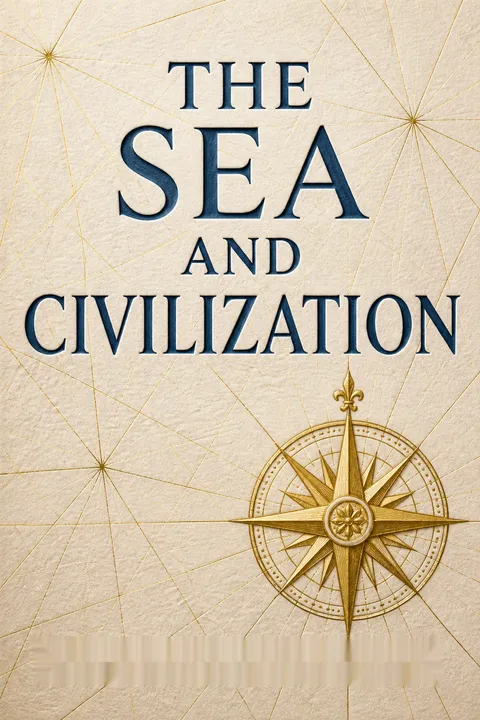
The Sea and Civilization receives mixed reviews, with praise for its comprehensive scope and unique perspective on world history through maritime lens. Readers appreciate the wealth of information but find the dense content challenging. Some criticize the lack of analysis and uneven coverage of different periods. The book is commended for its global approach, particularly in pre-Columbian eras. While some find it dry and tedious, others consider it a remarkable achievement in maritime history, offering fresh insights into human development and global interconnectedness.
People Also Read




Glossary
Monsoon Seas
Seasonally connected Asian watersPaine's term for the linked waters extending from East Africa and the Red Sea through the Arabian Sea and Bay of Bengal to Southeast and East Asia. Seasonal monsoon winds made long voyages predictable by reversing direction through the year. The term emphasizes connected routes rather than treating each named sea as a separate historical world.
etak
Island-based wayfinding methodA traditional navigation system used in parts of Micronesia. A navigator tracks a voyage through stages using a reference island, or etak, and knowledge of the stars under which islands appear. The method belongs to a larger body of orally transmitted knowledge about swells, birds, clouds, fish, and other signs of land.
naval-commercial complex
Trade joined to state sea powerPaine's label for the close relationship between commercial expansion and naval policy characteristic of Europe's maritime rise. States used naval force to protect and extend trade, while commercial activity supplied revenues and strategic motives for naval power. The term describes a historically specific partnership, not a universal feature of maritime societies.
shell-first construction
Hull built before its frameA shipbuilding sequence in which builders form the outer hull by joining planks edge to edge, then strengthen it with internal ribs or frames. It was common across much of Eurasia and North and East Africa for centuries. The resulting hull could be strong and flexible, but construction demanded considerable skill.
frame-first construction
Frame built before hull planksA shipbuilding sequence in which builders erect a keel and supporting frames first, then attach the hull planks. Compared with shell-first construction, it could use less wood and labor and made ships quicker to build or repair. Its spread helped smaller maritime communities compete without matching the resources of established powers.
qirad
Profit-sharing trade investmentA Muslim commercial arrangement in which an investor transferred capital to a traveling merchant. The two parties agreed in advance how to divide any profits. The investor bore losses to the capital, while the merchant lost the time and labor invested in the voyage. The arrangement enabled trade without a conventional interest-bearing loan.
commenda
Voyage-based investment contractA medieval commercial contract in which a sedentary investor supplied capital to a merchant who traveled and traded with it. Profits were divided according to an agreed share, while responsibility for losses depended on the contract's form. Similarities with the Muslim qirad helped make the commenda useful across the Mediterranean's religiously diverse trading world.
general average
Shared sacrifice for ship safetyA maritime principle that spreads the cost when cargo or equipment is deliberately sacrificed to save a ship and the interests aboard it. If cargo is thrown overboard in an emergency, those whose goods remain contribute toward compensating the owners of the jettisoned cargo. The principle appears in medieval maritime law and remains recognizable in modern shipping.
flags of convenience
Foreign registration for shipownersThe practice of registering a ship in a country other than the owner's home country, often to reduce taxes or avoid stricter regulation. The ship then operates under that country's flag and legal system. Paine presents this practice as one reason modern shipping has become less visibly tied to national identity.
FAQ
What is The Sea and Civilization: A Maritime History of the World by Lincoln Paine about?
- Comprehensive maritime history: The book presents a sweeping narrative of world history through the lens of maritime enterprise, tracing how seas, rivers, and oceans have shaped civilizations, trade, culture, and power from prehistory to the present.
- Global and interdisciplinary scope: Paine covers diverse regions including the Mediterranean, Indian Ocean, East and Southeast Asia, the Atlantic, and the Pacific, integrating archaeology, economics, naval warfare, and social history.
- Focus on human interaction with the sea: The narrative explores shipbuilding, navigation, trade networks, piracy, naval power, and the human experience at sea, emphasizing the sea’s role as a conduit for exchange and conflict.
Why should I read The Sea and Civilization by Lincoln Paine?
- Unique maritime perspective: The book challenges land-centric and Eurocentric historical narratives, offering a fresh worldview that places maritime activity at the center of human development.
- Rich detail and scholarship: Paine’s work is grounded in extensive research, drawing on primary sources, archaeological evidence, and technological analysis, making it valuable for both general readers and scholars.
- Relevance to modern issues: The book connects historical maritime developments to contemporary challenges such as globalization, shipping, environmental concerns, and international law.
What are the key themes and takeaways from The Sea and Civilization by Lincoln Paine?
- Maritime trade as a driver: The sea has been a major catalyst for economic growth, cultural exchange, and the spread of religions and ideas, shaping societies and empires.
- Technological innovation: Advances in shipbuilding, navigation, and naval warfare transformed maritime capabilities, enabling longer voyages and military dominance.
- State and sea interplay: States invested in navies and maritime infrastructure to secure trade and project power, with maritime law and diplomacy evolving alongside these developments.
- Human experience at sea: The book highlights the lives of sailors, merchants, and migrants, including the hardships, social hierarchies, and cultural attitudes toward seafaring.
How does Lincoln Paine define maritime history and its importance in The Sea and Civilization?
- Maritime history as perspective: Paine frames maritime history as both a subject—covering shipbuilding, trade, exploration, and naval warfare—and a lens that reveals unique insights into human affairs.
- Contrast with terrestrial history: The book demonstrates that many pivotal historical developments, such as colonization, migration, and empire-building, depended on maritime capabilities.
- Interdisciplinary approach: Maritime history draws on arts, religion, language, law, and political economy, reflecting the multifaceted impact of the sea on societies.
How does The Sea and Civilization by Lincoln Paine challenge traditional and Eurocentric historical narratives?
- Critique of Eurocentrism: Paine argues that focusing solely on Europe’s maritime dominance since 1500 distorts the broader, more complex history of global maritime achievement.
- Highlighting global contributions: The book exposes the limitations of traditional narratives by showcasing the maritime achievements of non-European cultures, such as those in Oceania, Asia, and the Americas.
- Reframing human history: By centering maritime enterprise, Paine reveals how access to navigable waters has been a critical determinant of cultural diffusion, economic development, and political power.
What are the most significant maritime technologies and innovations discussed in The Sea and Civilization by Lincoln Paine?
- Shipbuilding evolution: The book traces the development from ancient reed boats and sewn-plank vessels to Greek triremes, medieval cogs, caravels, steamships, and modern container ships.
- Navigation instruments: Paine details the adoption of the compass, astrolabe, sextant, and marine chronometer, which enabled precise navigation and long-distance voyages.
- Naval warfare advancements: The introduction of gunpowder, broadside cannons, ironclads, submarines, and aircraft carriers transformed naval tactics and global power dynamics.
How does The Sea and Civilization explain the role of maritime trade in shaping world history?
- Trade networks and cultural exchange: Maritime trade connected distant regions, facilitating the spread of goods, ideas, religions, and technologies, and fostering cosmopolitan port cities.
- Economic and political impact: Control over sea routes brought wealth and influence to states and trading companies, stimulating shipbuilding and financial innovations.
- Conflict and cooperation: Maritime trade was often contested, leading to piracy, naval battles, and treaties, but also encouraged cooperation through shared legal frameworks and navigational knowledge.
What are the major maritime regions and cultures highlighted in The Sea and Civilization by Lincoln Paine?
- Oceania and the Pacific: The book details the sophisticated navigation and settlement of the Pacific islands by Austronesian peoples using double canoes and oral wayfinding.
- Indian Ocean and Asia: Paine explores the monsoon-driven trade networks connecting East Africa, Arabia, India, and Southeast Asia, and the maritime innovations of Chinese and Indian shipbuilders.
- Mediterranean and Europe: The narrative covers the Phoenicians, Greeks, Romans, Byzantines, and later the Italian city-states, as well as the Vikings and Hanseatic League in northern Europe.
How does The Sea and Civilization by Lincoln Paine address the relationship between states, empires, and maritime power?
- State investment in navies: States built navies to protect trade, colonies, and national interests, with examples like the British Royal Navy and Dutch naval dominance.
- Maritime law and diplomacy: The book discusses legal frameworks such as the Rhodian Sea Law and Mare Liberum, and treaties regulating navigation and blockades.
- Economic monopolies and companies: State-chartered companies like the Dutch and English East India Companies combined commercial and military functions, enforcing monopolies and acting as agents of state power.
What insights does The Sea and Civilization provide about the human experience of seafaring and maritime labor?
- Life aboard ships: The book describes the harsh conditions faced by sailors, including cramped quarters, disease, and limited provisions, as well as efforts to improve health and safety.
- Migration and diaspora: Maritime routes enabled large-scale migrations, including voluntary settlers, forced movements like the transatlantic slave trade, and indentured labor.
- Piracy and privateering: Paine explores the prevalence and impact of piracy, distinguishing between pirates and state-sanctioned privateers, and analyzing their social and economic dimensions.
How does The Sea and Civilization by Lincoln Paine explore the development and significance of maritime law?
- Origins and evolution: The book traces early maritime legal codes like the Rhodian Sea Law and medieval consulates of the sea, which regulated trade, navigation, and conflict.
- Legal debates on sea ownership: Paine examines the contrasting views of Hugo Grotius’s Mare Liberum (The Free Sea) and John Selden’s Mare Clausum, which shaped international law on navigation and territorial claims.
- Modern conventions: The narrative covers 20th-century agreements like SOLAS and the Law of the Sea, reflecting technological change and new geopolitical realities.
What are the best quotes from The Sea and Civilization by Lincoln Paine and what do they mean?
- On the nobility of sailing: George Pachymeres wrote, “Sailing is a noble thing, useful beyond all others to mankind. It exports what is superfluous, it provides what is lacking, it makes the impossible possible, it joins together men from different lands…”—summarizing the book’s theme of the sea as a unifying force.
- On maritime tragedy: Walt Whitman’s lines on the Arctic disaster evoke the human cost and emotional impact of maritime disasters, highlighting the risks and sacrifices of seafaring.
- On the future of sea power: Admiral Michael Mullen’s vision of a “1,000-ship Navy” as “an international city at sea” underscores the need for global cooperation in maritime security and the evolving nature of sea power.
Download PDF
Download EPUB
.epub digital book format is ideal for reading ebooks on phones, tablets, and e-readers.








