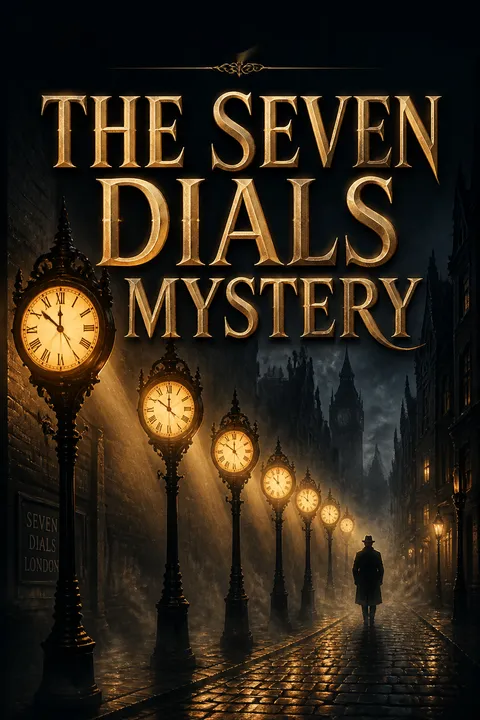


Plot Summary
Eight Clocks, One Missing
At Chimneys, a country-house party decides to cure Gerry Wade of sleeping through breakfast by hiding eight alarm clocks in his room. They ring in succession the next morning, but Gerry does not appear. When the household sends someone to check, he is found dead beside a bottle of chloral.
The doctor judges the death an overdose, and Ronny Devereux, Gerry's closest friend, firmly rejects both suicide and foul play when questioned. Jimmy Thesiger visits the body and notices that the clocks have been arranged on the mantelpiece, but only seven remain. Nobody admits moving them. What had been a childish joke now leaves the survivors with a death, a missing clock, and an unexplained arrangement.
The prank makes the novel's first mystery out of an ordinary social ritual. The guests try to control Gerry's habits through noisy machinery, then discover that machinery cannot explain his silence. The missing clock matters because it turns a comic object into evidence, while the survivors' differing reactions hint that they have not all understood the same event. Ronny's certainty that Gerry did not kill himself quietly resists the official ease of the doctor's conclusion. The scene also establishes Christie’s comic misdirection: the party's foolishness is real, but it sits beside a danger the characters are not yet equipped to see.
The Letter in Chimneys
After the Cootes leave Chimneys, Bundle Brent, Lord Caterham's energetic daughter, puzzles over the clocks. In a writing desk she finds a crumpled unfinished letter Gerry had written to Loraine Wade, the young woman he treated as his sister. He had told Loraine to forget a matter called Seven Dials, warning that it was no longer a joke and that she should not be involved.
The letter says he feels well, yet also that he is suddenly sleepy. Its date is the night before his death. Bundle notices the contradiction: Gerry had no reason to take a sleeping draught, and his own letter makes the overdose seem less like an accident. She sends the letter to Loraine and sets out to learn what Gerry meant.
Bundle's investigation begins with a habit of mind rather than a formal role. She refuses to let an official explanation erase details that do not fit, and she treats a private letter as evidence because its contradictions carry more weight than its unfinished sentences. The letter also gives the mystery an intimate center: Gerry's warning was meant to protect Loraine, but it has made her a possible target and a necessary witness. The desk hides a clue in plain domestic space, suggesting that danger has already entered the home before anyone recognizes it.
Ronny's Last Message
The next morning, Bundle drives toward London and swerves when a man stumbles into the road. She believes her car has struck him, but a doctor finds a rifle bullet in his body. Before dying, the stranger manages to identify himself as Ronny Devereux and urges her to pass on two clues: Seven Dials and Jimmy Thesiger.
Bundle realizes that Gerry's closest friend has been murdered, not merely lost to a second apparent accident. She reports the shooting to the local police, who suspect careless rifle practice, while Scotland Yard keeps the case out of the papers. The last message joins Gerry's letter to Ronny's death, giving Bundle a clear reason to seek out Jimmy and Loraine.
The road accident briefly makes Bundle feel responsible for a death, then the bullet reverses her understanding of what happened. That reversal is characteristic of the novel's method: a first interpretation is not necessarily false, but it is dangerously incomplete. Ronny's final words turn an isolated roadside killing into a connected case, and his choice to name Jimmy gives the message emotional force as well as investigative direction. Bundle's nerve is not fearlessness; she is shaken, but she keeps acting. The shift from private curiosity to active inquiry happens because the dead themselves have made a request.
Three Friends, One Secret
Bundle finds Loraine, then goes with her to Jimmy's rooms, where the three compare what they know. Loraine explains that Gerry had once shown her a cheap letter bearing a Seven Dials address and containing names and dates. He had treated it as evidence of a strange English secret society, then later warned her away from it.
Jimmy recalls that Ronny had begun to confide in him after Gerry died, but stopped because he was bound by a promise. The three conclude that Gerry was probably murdered and that Ronny was investigating the same danger. At the inquest, however, officials return a verdict of death by misadventure. Jimmy and Bundle suspect the case is being hushed up, and Jimmy arms himself before continuing.
The alliance forms around incomplete knowledge, not trust without reservation. Loraine brings the personal history that gives Gerry's clue meaning; Jimmy contributes access to Ronny's suspicions; Bundle keeps asking what their assumptions leave unexplained. Their shared grief makes action feel morally necessary, yet Jimmy's insistence that the women stay out of danger exposes a familiar tension between protection and agency. The inquest's bland verdict heightens that tension: procedure can close a case without resolving it. The group must decide whether to accept institutional certainty or follow evidence that official channels have declined to pursue.
A Door Behind the Club
At Scotland Yard, Bundle asks Superintendent Battle about secret societies in Seven Dials. He offers a list of harmless-sounding groups, then hints that Bill Eversleigh may help her understand the name. Bill reluctantly explains that the Seven Dials Club is a fashionable novelty disguised as a shabby late-night venue.
There Bundle recognizes Alfred, formerly a footman at Chimneys, now employed by the club's Russian manager, Mosgorovsky. The next day she corners Alfred and learns that Mosgorovsky paid him handsomely to leave Chimneys at once, arranging for a replacement. In the club's gambling rooms, Bundle finds a locked passage into a soundproof meeting chamber with seven chairs and a concealed exit. She decides to wait there unseen.
Battle's hint is both permission and a test: he knows Bundle may go farther than he intends, yet he gives her a path instead of simply forbidding her. Alfred's transfer makes domestic staffing part of the mystery, linking the respectable house at Chimneys to the club's hidden operations. Bundle's discovery depends on noticing how ordinary explanations can conceal extraordinary functions: a gaming room provides cover for a secret door, and a spare cupboard masks a meeting place. Her willingness to hide in the chamber shows the cost of her curiosity. She is no longer just interpreting clues; she is placing herself inside their danger.
The Masks at Midnight
From inside a cupboard, Bundle watches masked visitors arrive at the club's concealed chamber. Each wears a clock-face mask with a different hour marked on it, and the chair for number seven remains empty. They discuss a missing member, John Bauer, who has been placed at Chimneys, and a coming operation at Wyvern Abbey.
Their target is a valuable invention by Herr Eberhard, a process that could make aircraft lighter and transform aviation. The group believes the plans will be available during a political gathering hosted by George Lomax, and it expects the Air Minister to carry them away. They also know Bundle found Gerry's letter. When the meeting ends, Bundle understands that Seven Dials is organized, dangerous, and preparing to act.
The clock masks transform the missing alarm clock into a larger system of signs, though Bundle does not yet know who controls that system. Numbering offers anonymity and hierarchy at once: members can coordinate without revealing names, while the absent seventh figure exerts authority through not appearing. The meeting's language of invention, national interest, and human cost gives the threat a scale beyond local crime. Yet Bundle is still an observer, not a participant in the group's true purpose. Her partial view makes the scene suspenseful and epistemically unstable: she hears accurate details but cannot know what the masked people are actually serving.
Wyvern Abbey's Watch
Bundle uses her aunt, Lady Caterham, to secure an invitation to Wyvern Abbey, while Jimmy persuades Bill to present him to Lomax as a politically interested young man. The guests include Eberhard, Air Minister Sir Stanley Digby, his secretary Terence O'Rourke, Sir Oswald and Lady Coote, and the Hungarian Countess Radzky.
Superintendent Battle arrives in an obvious footman's disguise, ostensibly to deter trouble. Jimmy and Bill agree to watch the rooms where the formula will be kept, though Jimmy tells Bundle to stay in bed.
She pretends to accept, then changes into dark clothes and prepares to climb out. Loraine, too, refuses to remain safely at home. The house party settles into a watchful quiet, with more than one guest hiding a private plan.
The Abbey gathering brings politics, money, and performance into the same room. Jimmy's invented political seriousness and Bundle's borrowed interest in public affairs show how easily social credentials can be put on like costumes. Battle's conspicuous disguise is an inversion of secrecy: by making himself visible, he may discourage an intruder from acting. Meanwhile, the women are not merely protected dependents. Bundle and Loraine each make their own decisions about risk, though neither fully understands the other's purpose. The chapter turns the country house into a controlled stage where every guest has a role, and where the central question becomes who is directing the performance.
The Papers Change Hands
After midnight, Bundle climbs down the ivy but Battle intercepts her on the terrace and sends her back. She sneaks toward the west wing again and hears a struggle in the library, followed by two shots. Loraine, who has secretly entered the grounds, sees a parcel fall from an upper window and takes it before running for help.
Battle finds her and rushes to the library, where Jimmy lies wounded in the arm. O'Rourke is unconscious, and Sir Stanley discovers the plans missing. Battle takes the parcel from Loraine, and Eberhard confirms the formula is safe. The intruder has escaped, leaving a pistol outside. When the Countess is found behind a screen, Bundle recognizes a mole on her back and suspects her.
The apparent rescue gives the scene a satisfying surface resolution: the formula is recovered, the injured guest survives, and the woman who found the parcel appears to have saved the day. But the evidence is deliberately difficult to read. Bundle's recognition of the Countess's mole is vivid yet circumstantial, and Battle's restraint suggests he is considering more than the obvious suspect. The episode also reveals how readily gendered expectations shape judgment: Loraine is treated as a vulnerable outsider, while the Countess's beauty makes her seem a plausible seductress and criminal. The reader, like Bundle, must distinguish a compelling image from a reliable conclusion.
Battle's Quiet Reconstruction
In the morning, Battle examines the bullets, the abandoned pistol, and a partly burned glove. Sir Oswald says he found the weapon on the lawn, while Battle notes that the footprints and the pistol's landing place do not fit a simple escape across the grounds.
He suspects the intruder climbed back up the ivy and re-entered the house. Bundle privately tells him she recognized the Countess as the woman from the club meeting, but Battle asks her not to act on the suspicion.
He knows the Countess is a public figure and warns that accusation requires more than resemblance. Then Bundle learns that Bauer has disappeared from Chimneys. Sir Oswald identifies him as a German posing as Swiss and suggests he was the thief, giving the investigation a convenient new suspect.
Battle's method contrasts with Bundle's instinctive pattern-making. He does not dismiss her observation, but he refuses to let a single resemblance become a verdict. His physical reconstruction of the grounds treats small material details as constraints on a story, while Sir Oswald's account supplies a neat explanation that is not yet proven. The missing Bauer seems to close the case, but his absence can equally be evidence of a planned disappearance. By leaving Bundle with competing interpretations, the novel asks readers to notice who benefits when a complicated event is reduced to one obvious culprit.
The Left-Handed Clue
Jimmy accepts Lady Coote's invitation to Letherbury, where Sir Oswald has moved. One night he searches the industrialist's study for a clue to the hidden leader, but finds nothing and narrowly avoids Rupert Bateman, Sir Oswald's vigilant secretary. The next day Bundle and Loraine arrive after arranging a convenient car breakdown.
They keep Bateman and O'Rourke occupied while Jimmy looks around the grounds and finds a bottle of white powder. Bundle recalls Battle's burned glove and notices that he tested it on Jimmy, whose right arm was in a sling. The glove was for a left hand. She also remembers Sir Oswald's unusual ability to use either hand, and that he dealt cards left-handed at Chimneys. Bundle begins to suspect him.
The evidence now shifts from theatrical clues to bodily habits. A glove, a sling, and the remembered motion of dealing cards connect the crime to the practical asymmetries of the body. Bundle's deduction is intelligent, but it is not proof; her belief that Sir Oswald may be responsible could still be another attractive false pattern. Jimmy's private search and unexplained powder bottle add further uncertainty, since he withholds where he found it. The group is learning that observation alone cannot secure truth. Evidence must be interpreted in relation to motive, access, and the possibility that someone is deliberately staging what others see.
The Trap at Hunstanton Street
Bill receives a sealed message delayed by Ronny's executors and hurries to Jimmy with news he claims could expose the Seven Dials operation. Jimmy summons Bundle and Loraine to the club, telling them to remove Alfred and wait for him. When they arrive, Bill is slumped in the car, apparently poisoned. Jimmy leaves to fetch a doctor, and Bundle stays beside him while Loraine retrieves her bag from the meeting room.
A hidden attacker knocks Bundle unconscious with a sandbag. She wakes inside the secret chamber, where Bill is alive and holding her close, and Mosgorovsky escorts her to an emergency meeting. Someone has brought Bundle into the heart of Seven Dials, but she cannot tell whether she is a prisoner or a witness.
The apparent poisoning reverses the earlier pattern of helpless victims: this time, the scene's most vulnerable figure may be acting, while the person who appears to be rescuing her is the threat. Bill's staged collapse and Bundle's sudden unconsciousness make trust an immediate physical question, not just an intellectual one. Their reunion in the chamber briefly turns terror into tenderness, but the comfort is unstable because Bill knows more than he has said. The narrative's suspense comes from unequal knowledge among allies, forcing Bundle and the reader to reconsider who has been directing events all along.
No. Seven Unmasked
At the meeting, the masked leader removes his disguise: No. 7 is Superintendent Battle. The Seven Dials group is not a criminal society but a covert network of amateur agents working with Scotland Yard.
Gerry and Ronny were members; Bill is another, and the Countess is actually Babe St. Maur, an actress and Ronny's former fiancée. Battle explains that Jimmy was the thief they had pursued. He poisoned Gerry's drink before bed, arranged the evidence to suggest an overdose, then killed Ronny when Ronny uncovered the truth.
At Wyvern, Jimmy staged the fight, wounded himself, and used the confusion to retrieve the formula. Loraine helped him, passing on information and joining the later trap. Bill's supposed poisoning was a ruse to expose Jimmy, who is arrested.
The unmasking overturns the story's central visual metaphor. Clock faces had seemed to signify a hidden criminal hierarchy, but they belonged to an improvised intelligence network whose members used theatricality to make dangerous work bearable. The true deception is not the masks themselves; it is Jimmy's cultivated image of harmless incompetence. His betrayal hurts because friendship served as his best disguise, and because Gerry and Ronny trusted the person closest to them. Battle's explanation restores causal order, but it does not erase the moral cost: an amateur network has stopped the thief only after losing two of its own.
Chimneys Opens to Love
With Jimmy arrested and Loraine in custody, Bundle returns to Chimneys and tells her father that she intends to marry. Lord Caterham assumes she means George Lomax, whose earlier proposal she rejected, then learns that her choice is Bill. The news pleases him largely because he and Bill can play golf together.
Bundle's relationship with Bill has emerged through danger and affection rather than grand declarations: she once saw him as a blundering friend, but his loyalty and courage have become impossible to dismiss. The case that began with Gerry's death ends not by restoring the lost friends, but by giving Bundle a future that joins her restless independence to a dependable companion.
The domestic ending refuses to make romance a reward that cancels grief. Gerry and Ronny remain dead, and Loraine's betrayal has permanently altered the group's trust. Yet Bundle's choice of Bill suggests that intimacy can grow from sustained care rather than glamour or status. Lord Caterham's practical approval, based on golf and companionship, brings the novel back to its comic social world without undoing the violence that disrupted it. Bundle remains active and self-directed; marriage is presented as her decision, not a retreat from action. The final note is affectionate because it is ordinary, earned after a plot built on extraordinary disguises.
Analysis
The Seven Dials Mystery makes uncertainty a social problem. Its characters do not merely lack facts; they trust people according to familiar roles. Jimmy's affable idleness, Loraine's apparent meekness, Battle's unremarkable manner, and the Countess's glamour all encourage judgments that feel plausible before they are tested. The novel's clues therefore work on two levels: they help reconstruct events, and they expose the observers' habits of interpretation.
The clock motif is especially effective because it moves from a prank to an apparent emblem of criminal power and finally to a theatrical sign used by a patriotic network. Meaning is not inherent in the object. It depends on who arranged it, who noticed it, and what story the observer already expects. Bundle is often right to resist the official version, but she is not immune to attractive theories. Her suspicion of the Countess and Sir Oswald shows that curiosity can challenge authority while still producing its own errors.
The book also examines the moral ambiguity of amateur service. Gerry, Ronny, Bill, and their associates accept danger in the name of public protection, but their secret methods expose them to betrayal and death. Jimmy's crimes are especially corrosive because he exploits friendship, not just access. Loraine's attachment to him illustrates how emotional dependence can distort judgment without making the resulting harm less real. Bundle's growing trust in Bill offers a quieter counterexample: affection becomes credible through consistent loyalty rather than performance.
Ultimately, the mystery asks readers to distinguish appearance from evidence without assuming that appearances are useless. Social behavior, physical traces, and private loyalties all matter, but none can stand alone. Battle solves the case by revising his theory as details accumulate; Bundle contributes by refusing to stop asking questions. The resolution honors both forms of intelligence: disciplined patience and energetic dissent.
Review Summary
The Seven Dials Mystery receives an average rating of 3.78/5. Readers praise the spirited heroine Bundle (Lady Eileen Brent), her witty exchanges with her father, and the surprising twist ending. Many enjoy the Wodehouse-esque humor and the blend of murder mystery with espionage thriller elements. Superintendent Battle is appreciated, though some feel his role is limited. Common criticisms include tonal inconsistency, a slow middle, and an unsatisfying conclusion where the resolution is told rather than shown. Overall, it's considered a lighter, fun Christie offering.
Characters
Eileen Brent (Bundle)
Restless amateur investigatorBundle, daughter of Lord Caterham, is quick, athletic, curious, and impatient with any rule that keeps her from investigating a puzzle. Her social rank opens doors, but she relies less on authority than on noticing inconsistencies and acting before a clue goes cold. She can be reckless, especially when others try to protect her by withholding information, and her confidence sometimes outruns the evidence. Her humor keeps fear at a manageable distance without making her indifferent to loss. Bundle's relationships with her father, Jimmy, Loraine, and Bill reveal a person who values independence but is not emotionally self-sufficient. She wants danger to make sense, and she expects herself to do something when it does not.
Jimmy Thesiger
Charming idle socialiteJimmy moves through fashionable company with an easy, apparently unserious manner. He is Gerry Wade's friend and one of Bill Eversleigh's companions, and he is accustomed to being treated as more charming than capable. His humor and social fluency help him avoid the solemn expectations attached to work and politics. Jimmy is observant enough to discuss clues and confident enough to take risks, though he often masks seriousness with jokes. His connection to Loraine brings an emotional thread into his friendship with Gerry's circle. He is a useful reminder that a person's public manner may be an incomplete guide to their intelligence, loyalties, or ambitions.
William Eversleigh (Bill)
Loyal Foreign Office friendBill is a junior Foreign Office man whose large presence, generous impulses, and lack of polish make him easy to underestimate. He belongs to the same circle as Gerry, Ronny, and Jimmy, and his affection for Bundle often appears through worry, practical help, and blunt concern. He is socially open and emotionally transparent, particularly around women he admires, but those traits do not make him shallow. Bill's loyalty is active: when friends are endangered, he accepts responsibility rather than waiting for someone cleverer to take charge. His comic awkwardness gives the story warmth, while his steadiness supplies a counterweight to Jimmy's charm and Bundle's restless improvisation.
Loraine Wade
Gerry's devoted confidanteLoraine is a young woman with a quiet manner, strong feelings, and a stubborn reserve beneath her apparent meekness. Gerry is the closest person in her life, and his death leaves her searching for an explanation as well as a reason to keep acting. She remembers details others overlook and is willing to enter unfamiliar spaces when someone she loves may be in danger. Her gentleness should not be confused with passivity: she makes decisions privately and does not always reveal what she intends. Loraine's attachment to Jimmy complicates her judgment and her relationships with Bundle and Bill. She embodies the difficulty of separating love from trust when grief makes certainty feel necessary.
Superintendent Battle
Patient Scotland Yard detectiveBattle is a seasoned investigator of politically sensitive cases, known for a calm, plain manner that gives little away. He watches people and objects without rushing to display what he has noticed, preferring patient reconstruction to dramatic accusation. Bundle's energy both impresses and complicates his work; he recognizes her usefulness while understanding that she may ignore warnings. Battle is pragmatic about secrecy and understands that appearances can be tools, not merely obstacles. His authority comes less from intimidation than from disciplined attention and a willingness to wait for evidence to become meaningful. He represents professional restraint in a story where nearly everyone is tempted to act on a vivid first impression.
Gerald Wade (Gerry)
Cheerful Foreign Office manGerry is remembered by his friends as affable, sleepy, and apparently careless about routine. He is deeply attached to Loraine, whom he treats as his sister, and his concern for her shapes the warning he leaves behind. His easygoing public manner makes it difficult for those around him to imagine that he might be involved in serious work. Gerry's role in the story is felt through memories, a letter, and the clues he leaves to people he trusts. He shows how a person can be underestimated by friends who know his habits but do not know the responsibilities he has chosen to carry.
Ronny Devereux
Gerry's closest friendRonny is a Foreign Office man, Gerry's closest friend, and a confidant of Jimmy. He is observant enough to recognize when an official explanation does not fit the person he knew, yet cautious about sharing what he suspects. His promise to keep silent reflects both loyalty and the danger surrounding the information he has found. Ronny's bond with Gerry gives the first death a lasting emotional consequence, while his connection to Jimmy places friendship at the center of the investigation. He is defined less by status than by the choices he makes when suspicion threatens people he cares about.
Lord Caterham
Comfort-loving aristocratBundle's father prefers quiet, comfort, and the services of his capable household staff to politics or adventure. His comic evasions and reluctance to become involved conceal genuine affection for his daughter. He often responds to danger by hoping it will happen elsewhere, but he does not try to control Bundle's choices. His laid-back temperament contrasts with her restless energy and helps ground the story's social comedy.
Lady Coote
Earnest industrialist's wifeLady Coote is kind, lonely in grand houses, and accustomed to being overshadowed by her husband's ambition. Her concern for young guests is sincere, and she finds comfort in domestic interests that Sir Oswald barely notices. She can be socially awkward, but her quiet determination gives her more agency than her mournful manner suggests. Her hospitality becomes important as the investigation moves between country houses.
Sir Oswald Coote
Powerful steel magnateSir Oswald is a self-made industrialist whose discipline, forceful personality, and practical confidence have carried him to enormous wealth. He measures people by competence and is impatient with what he regards as idleness or inefficiency. His marriage to Lady Coote is affectionate but unequal in temperament, with her domestic concerns often lost beneath his projects. He is accustomed to commanding rooms and expects others to accept his judgments.
Rupert Bateman (Pongo)
Meticulous private secretaryBateman, Jimmy's old schoolmate, is Sir Oswald's private secretary and a man of rigorous habits. He approaches work and leisure alike with earnest attention, making him a reliable presence in a household full of casual young guests. Jimmy regards him as humorless and overly serious, while Sir Oswald values his judgment. Bateman's quiet vigilance makes him difficult to surprise, and his competence shapes the atmosphere around the Cootes.
George Lomax
Self-important political hostLomax is a senior government official who takes politics, public duty, and his own speeches with great seriousness. He hosts the gathering at Wyvern Abbey and is sensitive to any threat against his position or guests. His verbose manner makes him a target for Bundle's impatience, though he is not simply a fool: he knows how to seek professional help when alarmed. He represents the weight of official respectability that the younger characters move around and sometimes exploit.
Countess Radzky
Glamorous Hungarian guestThe Countess arrives at Wyvern Abbey as a striking, socially confident Hungarian visitor associated with public causes. Her beauty and fluency dominate a room, while her interest in the house's history and its people draws attention. Bundle finds her difficult to read, and Bill is especially susceptible to her charm. The Countess's presence demonstrates how charisma can shape other people's judgments before they have any firm evidence.
Terence O'Rourke
Air Minister's lively secretaryO'Rourke is Sir Stanley Digby's secretary, an Irishman with an irreverent manner and a taste for elaborate stories. He is energetic, socially adept, and comfortable treating serious events as material for a joke. His official position gives him proximity to the political gathering's most sensitive business, making his presence relevant even when he seems to be entertaining everyone.
Herr Eberhard
Nervous German inventorEberhard is a German inventor whose work has attracted interest from British officials and industrialists. He appears shy and uncomfortable in company, with habits others mistake for arrogance or bad manners. His invention gives the gathering at Wyvern Abbey its political and commercial stakes. Eberhard's nervousness makes him a reminder that the people whose ideas drive international events may be far less commanding than the officials discussing them.
Mr. Mosgorovsky
Russian club proprietorMosgorovsky runs the Seven Dials Club, a venue that mixes dancing, gambling, and discreet private rooms. He is controlled, observant, and difficult for Bundle to understand during her first encounter with him. His management of the club places him at the center of the mystery's hidden social world. He knows how to use ordinary business as cover for private purposes.
Alfred
Former Chimneys footmanAlfred leaves service at Chimneys for better pay at the Seven Dials Club, where his polish helps the establishment appear respectable. He is nervous under Bundle's questioning and more concerned with keeping his position than with understanding the larger operation. His move connects two otherwise separate settings.
Vera Daventry (Socks)
Sharp-tongued young guestKnown as Socks, Vera is one of the young women staying at Chimneys. She is fond of calling ideas subtle and is quick to challenge the men around her. Her lively skepticism contributes to the comic atmosphere of the house party and gives Jimmy a social connection beyond the central investigation.
Tredwell
Imperturbable Chimneys butlerTredwell is the dignified butler at Chimneys, attentive to household routine and careful in a crisis. His composure helps the house respond to Gerry's death without confusion. He treats young visitors with formal patience and represents the stable machinery of the estate.
Dr. Cassell
Country doctor and witnessDr. Cassell examines the man Bundle believes she has struck and identifies the gunshot wound that changes the meaning of the roadside incident. His practical judgment corrects Bundle's mistaken assumption and begins the police inquiry into Ronny's death.
Plot Devices
The Alarm Clocks
A joke becomes a signalThe house party hides eight alarm clocks to wake Gerry Wade, creating the comic setup for his death. Afterward, seven clocks appear in a row while the eighth is missing. The objects first seem to be a meaningless aftermath of the prank, then connect to the name Seven Dials and to a system of numbered identities. Their changing meaning captures the book's method: familiar objects acquire significance only when someone notices their arrangement.
Gerry's Unfinished Letter
A warning becomes a trailThe letter Bundle finds in the desk at Chimneys places Seven Dials beside Gerry's concern for Loraine. It also says he feels well while describing an abrupt sleepiness, a contradiction that makes the official account of his death harder to accept. Loraine's recollection of a separate letter with names and dates expands the clue into a possible organization. The unfinished page connects the personal danger around Gerry and Loraine to the investigation Bundle begins.
Clock-Face Masks
Anonymity with hierarchyThe masked visitors at the Seven Dials Club wear clock faces marked with different hours, allowing them to meet without immediately identifying one another. Their numbers suggest a formal structure, while the absent number seven creates the impression of an unseen leader. The arrangement misdirects Bundle toward a secret criminal society. Its eventual meaning depends on recognizing that theatrical secrecy can conceal a purpose different from the one its costumes imply.
Eberhard's Formula
A technical prize raises stakesEberhard's process promises stronger, lighter aircraft materials and attracts the attention of the Air Minister, Sir Oswald Coote, and the Seven Dials meeting. The formula gives the Wyvern Abbey operation a concrete objective and a reason for political officials to gather under one roof. Because it is valuable both commercially and nationally, its disappearance could be mistaken for industrial theft or espionage. It also provides the apparent target around which Jimmy's staged events can unfold.
The Burned Glove
A small clue redirects suspicionBattle finds a partly burned glove after the apparent attack at Wyvern Abbey. Its size and left-handed shape connect it to the shooter's weapon, while its torn condition raises questions about how it was removed. At first, the clue points toward a left-handed suspect and seems to support Bundle's suspicion of Sir Oswald. Battle's careful handling of the glove reveals how evidence can mislead when only one feature is considered and how a minor physical detail can eventually reshape the entire reconstruction.
Superintendent Battle Series Series

About the Author
Other books by Agatha Christie






Download PDF
Download EPUB
.epub digital book format is ideal for reading ebooks on phones, tablets, and e-readers.








